
Life, 1921-11-24 · page 7 of 34
Life — November 24, 1921 — page 7: what you’re looking at
What you’re looking at
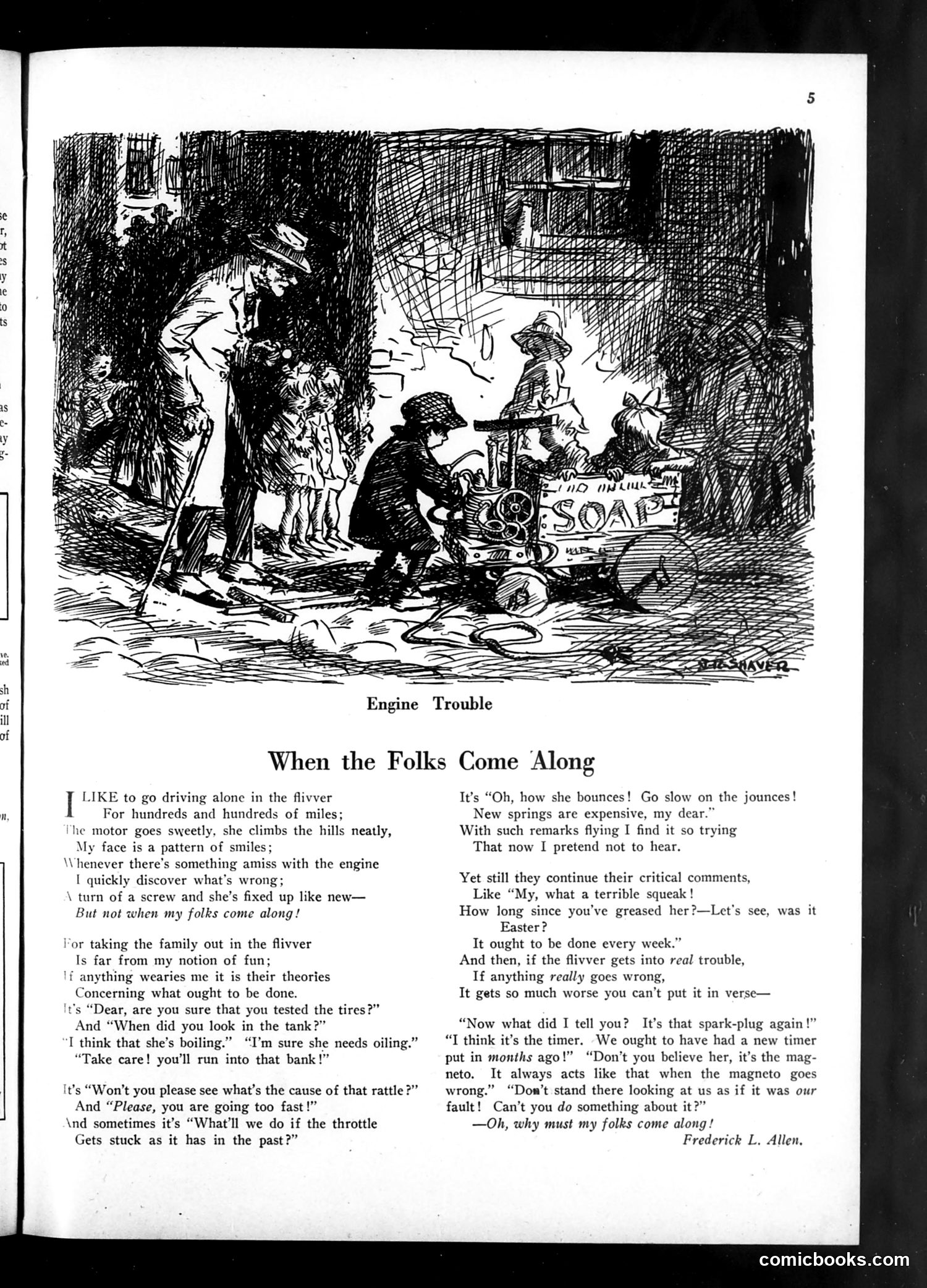
This page satirizes the experience of early automobile ownership. The cartoon depicts a driver broken down on the roadside with their car, surrounded by pedestrians offering unsolicited advice and criticism. The poem by Frederick L. Allen mocks the presumed-helpful comments from passersby—suggestions about loose bolts, oiling, tire pressure, spark plugs, and timing. The satire targets not the car itself but the social phenomenon of strangers stopping to offer amateur mechanical diagnoses, often contradicting each other ("Don't you believe her, it's the magneto"). The humor lies in the driver's frustration that these critical "folks" offer no actual assistance, only theories and complaints about the car's performance, while making the experience worse rather than better.
📄 Transcribed text from this page (OCR, searchable)
Machine-transcribed from the original scan — historical spelling and the odd misread are preserved.
Engine Trouble When the Folks Come Along LIKE to go driving alone in the flivver For hundreds and hundreds of miles; he motor goes sweetly, she climbs the hills neatly, My face is a pattern of smiles; \Vhenever there’s something amiss with the engine I quickly discover what's wrong; \ turn of a screw and she’s fixed up like new— But not when my folks come along! Vor taking the family out in the flivver Is far from my notion of fun; \f anything wearies me it is their theories Concerning what ought to be done. t's “Dear, are you sure that you tested the tires?” And “When did you look in the tank?” I think that she’s boiling.” “I’m sure she needs oiling.” “Take care! you'll run into that bank!” it's “Won't you please see what’s the cause of that rattle?” And “Please, you are going too fast!” \nd sometimes it’s “What’ll we do if the throttle Gets stuck as it has in the past?” It’s “Oh, how she bounces! Go slow on the jounces! New springs are expensive, my dear.” With such remarks flying I find it so trying That now I pretend not to hear. Yet still they continue their critical comments, Like “My, what a terrible squeak ! How long since you've greased her?—Let’s see, was it Easter? It ought to be done every week.” And then, if the flivver gets into real trouble, If anything really goes wrong, It gets so much worse you can’t put it in verse— “Now what did I tell you? It’s that spark-plug again!” “I think it’s the timer. We ought to have had a new timer put in months ago!” “Don’t you believe her, it’s the mag- neto. It always acts like that when the magneto goes wrong.” “Don’t stand there looking at us as if it was our fault! Can’t you do something about it?” —Oh, why must my folks come along! Frederick L, Allen, comicbooks.com