
Life, 1921-11-24 · page 13 of 34
Life — November 24, 1921 — page 13: what you’re looking at
What you’re looking at
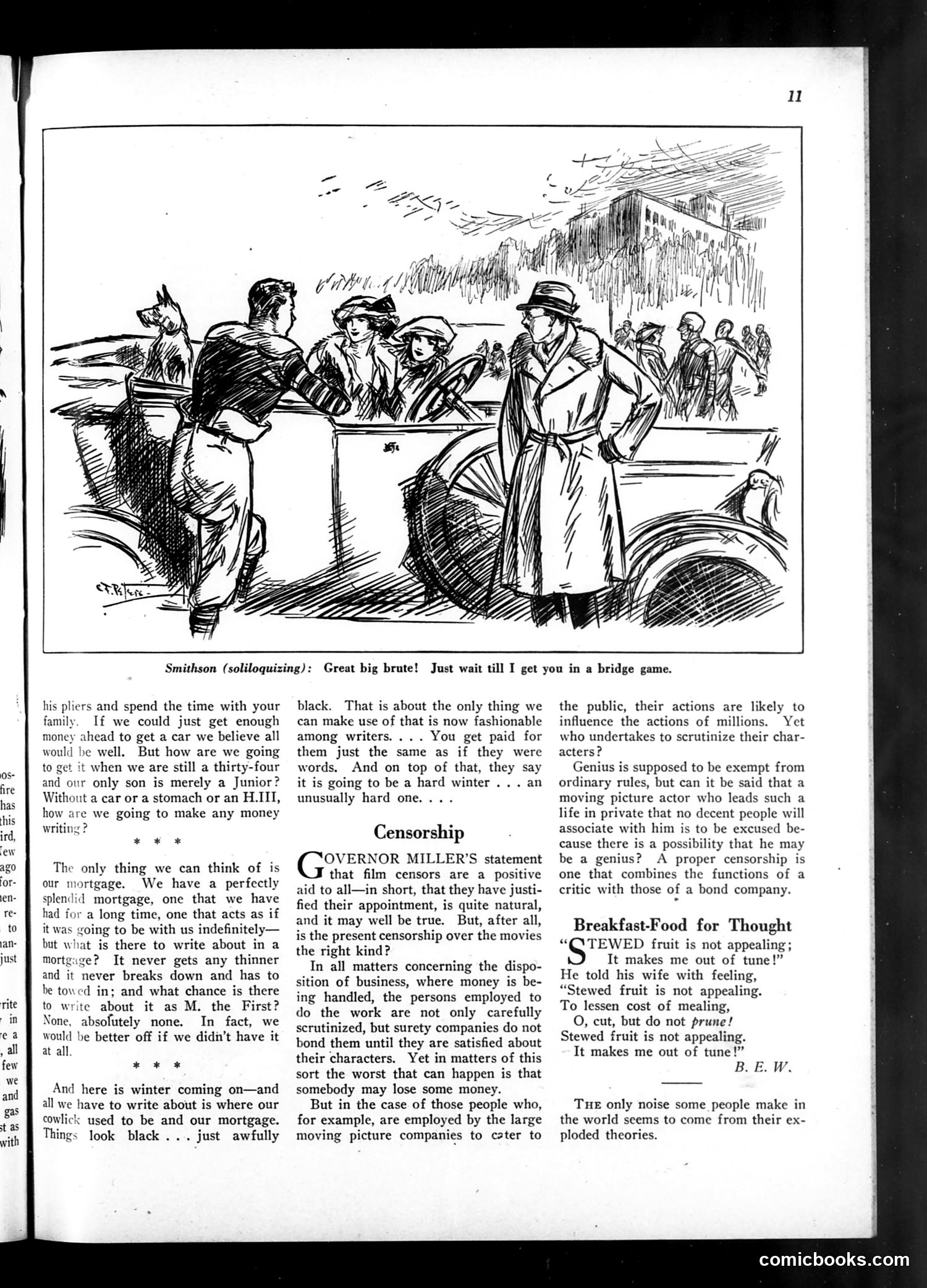
The cartoon depicts a social scene at what appears to be a golf or country club. A man (labeled "Smithson") is accosting another man, threatening to "get you in a bridge game"—implying he'll beat him at cards as revenge for some prior slight. The satire targets upper-class leisure culture and competitive social hierarchies among wealthy men. Bridge was a fashionable card game among the affluent, and the cartoon mocks how seriously these men took recreational competition, treating card games as venues for social dominance and settling scores. The accompanying text discusses financial hardships and writing careers, suggesting broader commentary on economic anxiety during this period, contrasting the frivolous concerns of the wealthy with ordinary people's serious money troubles.
📄 Transcribed text from this page (OCR, searchable)
Machine-transcribed from the original scan — historical spelling and the odd misread are preserved.
Smithson (soliloquizing) : his pliers and spend the time with your family. If we could just get enough ahead to get a car we believe all would be well. But how are we going to get it when we are still a thirty-four and our only son is merely a Junior? Without a car or a stomach or an H.III, how are we going to make any money writing ? * * The only thing we can think of is our mortgage. We have a perfectly splendid mortgage, one that we have had for a long time, one that acts as if it w ng to be with us indefinitely— but what is there to write about in a Mortgage? It never gets any thinner and it never breaks down and has to be toved in; and what chance is there to write about it as M. the First? None, absofutely none. In fact, we would be better off if we didn’t have it at all * * * And here is winter coming on—and all we have to write about is where our used to be and our mortgage. Things look black... just awfully Great big brute! black. That is about the only thing we can make use of that is now fashionable among writers. ... You get paid for them just the same as if they were words. And on top of that, they say it is going to be a hard winter... an unusually hard one... . Censorship OVERNOR MILLER’S statement that film censors are a positive aid to all—in short, that they have justi- fied their appointment, is quite natural, and it may well be true. But, after all, is the present censorship over the movies the right kind? In all matters concerning the dispo- sition of business, where money is be- ing handled, the persons employed to do the work are not only carefully scrutinized, but surety companies do not bond them until they are satisfied about their characters. Yet in matters of this sort the worst that can happen is that somebody may lose some money. But in the case of those people who, for example, are employed by the large moving picture companies to cater to Just wait till I get you in a bridge game. the public, their actions are likely to influence the actions of millions. Yet who undertakes to scrutinize their char- acters? Genius is supposed to be exempt from ordinary rules, but can it be said that a moving picture actor who leads such a life in private that no decent people will associate with him is to be excused be- cause there is a possibility that he may be a genius? A proper censorship is one that combines the functions of a critic with those of a bond company. Breakfast-Food for Thought So fruit is not appealing; It makes me out of tune!” He told his wife with feeling, “Stewed fruit is not appealing. To lessen cost of mealing, O, cut, but do not prune! Stewed fruit is not appealing. It makes me out of tune!” B. E. W. THE only noise some people make in the world seems to come from their ex- ploded theories. comicbooks.com