
Life, 1921-11-24 · page 26 of 34
Life — November 24, 1921 — page 26: what you’re looking at
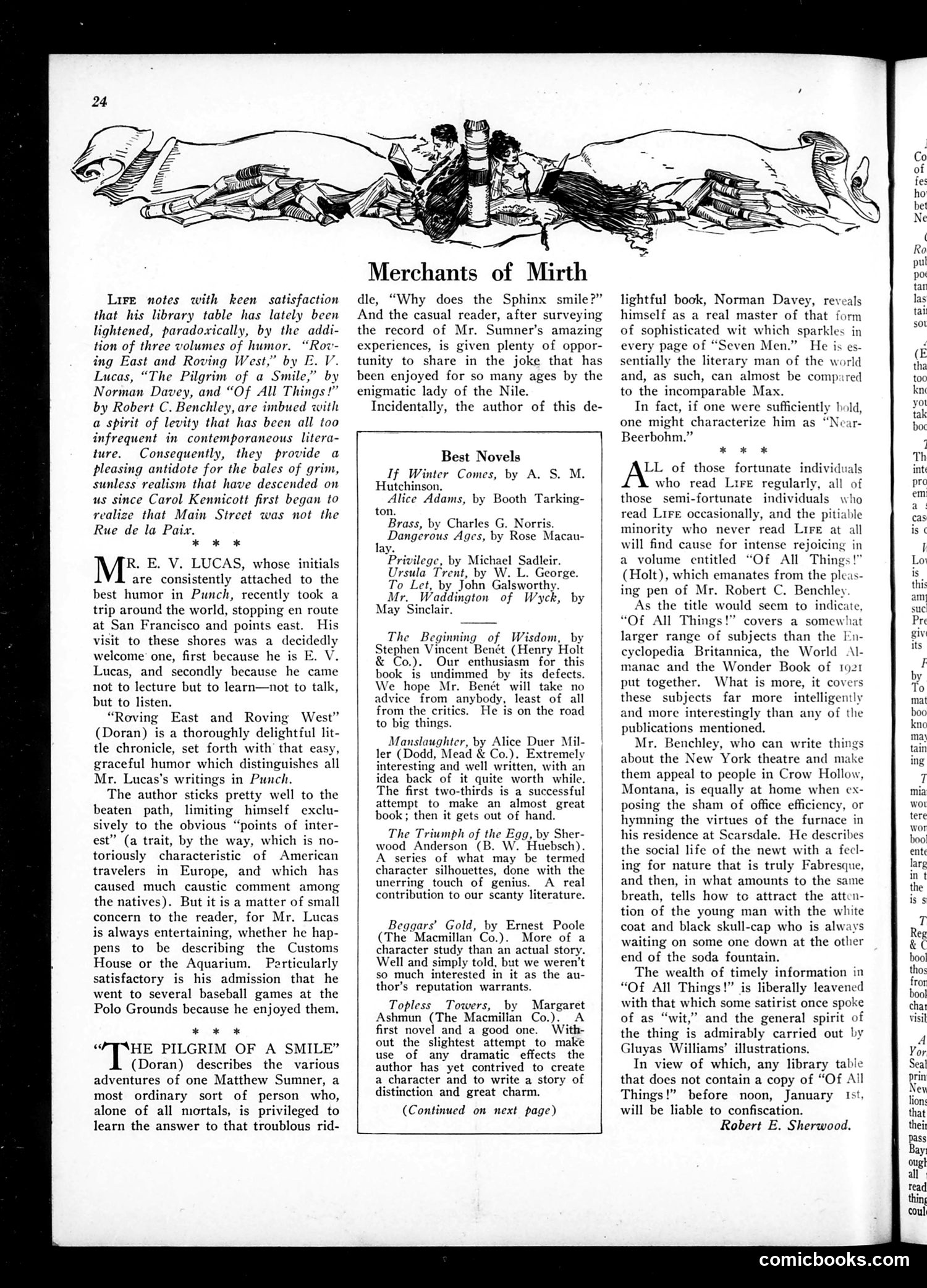
A restored page from Life, 1921-11-24. Page through the whole issue in the reader above.
📄 Transcribed text from this page (OCR, searchable)
Machine-transcribed from the original scan — historical spelling and the odd misread are preserved.
Lire notes with keen satisfaction that his library table has lately been lightened, paradoxically, by the addi- tion of three volumes of humor. “Rov- ing East and Roving West,” by V. Lucas, “The Pilgrim of a Smile,” by Norman Davey, and “Of All Things!” by Robert C. Benchley, are imbued with a spirit of levity that has been all too infrequent in contemporaneous litera- ture. Consequently, they provide a pleasing antidote for the bales of grim, sunless realism that have descended on us since Carol Kennicott first began to realize that Main Street was not the Rue de la Paix. * ok x R. E. V. LUCAS, whose initials are consistently attached to the best humor in Punch, recently took a trip around the world, stopping en route at San Francisco and points east. His visit to these shores was a decidedly welcome one, first because he is E. V. Lucas, and secondly because he came not to lecture but to learn—not to talk, but to listen. “Roving East and Roving West” (Doran) is a thoroughly delightful lit- tle chronicle, set forth with that easy, graceful humor which distinguishes all Mr. Lucas's writings in Punch. The author sticks pretty well to the beaten path, limiting himself exclu- sively to the obvious “points of inter- est” (a trait, by the way, which is no- toriously characteristic of American travelers in Europe, and which has caused much caustic comment among the natives). But it is a matter of small concern to the reader, for Mr. Lucas is always entertaining, whether he hap- pens to be describing the Customs House or the Aquarium. Perticularly satisfactory is his admission that he went to several baseball games at the Polo Grounds because he enjoyed them. xk ok ss HE PILGRIM OF A SMILE” (Doran) describes the various adventures of one Matthew Sumner, a most ordinary sort of person who, alone of all mortals, is privileged to learn the answer to that troublous rid- Merchants of Mirth dle, “Why does the Sphinx smile?” And the casual reader, after surveying the record of Mr. Sumner’s amazing experiences, is given plenty of oppor- tunity to share in the joke that has been enjoyed for so many ages by the enigmatic lady of the Nile. Incidentally, the author of this de- Best Novels If Winter Comes, by A. S. M. Hutchinson. Alice Adams, by Booth Tarking- ton. Brass, by Charles G. Norris. ! Dangerous Ages, by Rose Macau- jay. Privilege, by Michael Sadleir. Ursula Trent, by W. L. George. To Let, by John Galsworthy. Mr. Waddington of Wyck, by May Sinclair. The Beginning of Wisdom, by Stephen Vincent Benét, (Henry Holt & Co.). Our enthusiasm for this book is undimmed by its defects. We hope Mr. Benét will take no advice from anybody, least of all from the critics. He is on the road to big things. Manslaughter, by Alice Duer Mil- ler (Dodd, Mead & Co.). Extremely interesting and well written, with an idea back of it quite worth while. The first two-thirds is a successful attempt to make an almost great book; then it gets out of hand. The Triumph of the Egg, by Sher- wood Anderson (B. W. Huebsch). A series of what may be termed character silhouettes, done with the unerring touch of genius. A real contribution to our scanty literature. Beggars’ Gold, by Ernest Poole (The Macmillan Co.). More of a character study than an actual story. Well and simply told, but we weren't so much interested in it as the au- thor’s reputation warrants. Topless Towers, by Margaret Ashmun (The Macmillan Co.). A first novel and a good one. With- out the slightest attempt to make use of any dramatic effects the author has yet contrived to create a character and to write a story of distinction and great charm. (Continued on next page) lightful book, Norman Davey, reveals himself as a real master of that form of sophisticated wit which sparkles in every page of “Seven Men.” He is es- sentially the literary man of the world and, as such, can almost be compared to the incomparable Max. In fact, if one were sufficiently hold, one might characterize him as “Near- Beerbohm.” * * * LL of those fortunate individu who read Lire regularly, all of those semi-fortunate individuals who read Lire occasionally, and the pitiable minority who never read Lire at all will find cause for intense rejoicing in a volume entitled “Of All Things!” (Holt), which emanates from the pleas- ing pen of Mr. Robert C. Benchley As the title would seem to indicate, “Of All Things!” covers a somewhat larger range of subjects than the En- cyclopedia Britannica, the World Al- manac and the Wonder Book of 1921 put together. What is more, it covers these subjects far more intelligently and more interestingly than any of the publications mentioned. Mr. Benchley, who can write things about the New York theatre and make them appeal to people in Crow Hollow, Montana, is equally at home when ex- posing the sham of office efficiency, or hymning the virtues of the furnace in his residence at Scarsdale. He describes the social life of the newt with a fecl- ing for nature that is truly Fabresque, and then, in what amounts to the same breath, tells how to attract the atten- tion of the young man with the white coat and black skull-cap who is always waiting on some one down at the other end of the soda fountain. The wealth of timely information in “Of All Things!” is liberally leavened with that which some satirist once spoke of as “wit,” and the general spirit of the thing is admirably carried out by Gluyas Williams’ illustrations. In view of which, any library table that does not contain a copy of “Of Ail Things!” before noon, January 1st, will be liable to confiscation. Robert E. Sherwood. comicbooks.com