
Life, 1921-11-24 · page 4 of 34
Life — November 24, 1921 — page 4: what you’re looking at
What you’re looking at
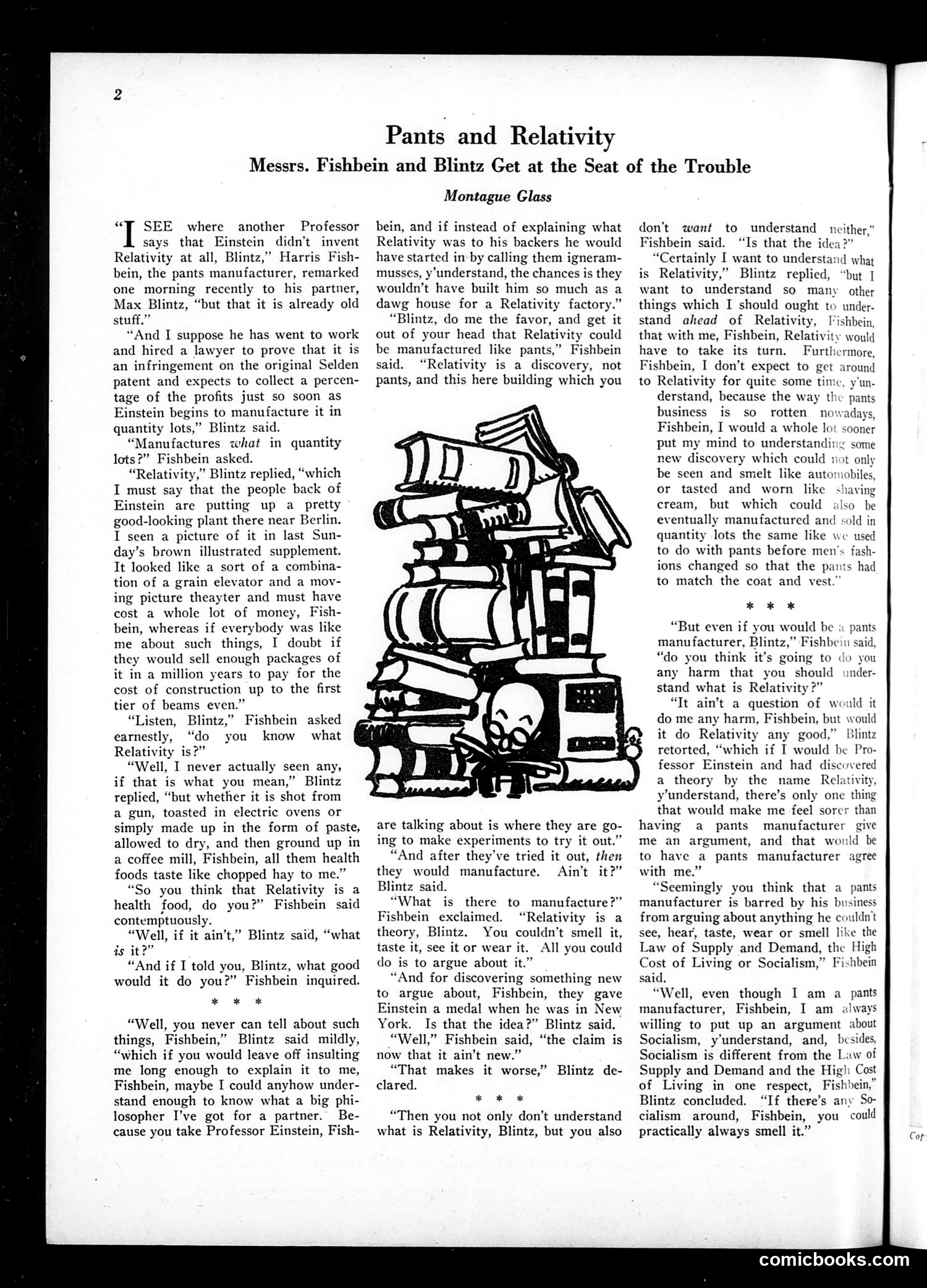
This satirical piece mocks the debate around Einstein's Theory of Relativity circa 1920s. Two characters—Fishbein (a pants manufacturer) and Blintz—argue about whether Relativity has practical value. The cartoon's humor derives from Fishbein's literal-minded incomprehension: he conflates Einstein's abstract physical theory with literal pants manufacturing. When Blintz suggests Relativity could be "manufactured like pants," Fishbein takes him seriously, unable to grasp the conceptual distinction between theoretical physics and commercial production. The satire targets public confusion about Einstein's increasingly famous but poorly understood theory. By showing an intelligent businessman completely missing the point, Life mocks both popular scientific illiteracy and the gap between abstract intellectual achievement and everyday American commerce. The pants metaphor emphasizes how remote theoretical physics seemed to ordinary business interests.
📄 Transcribed text from this page (OCR, searchable)
Machine-transcribed from the original scan — historical spelling and the odd misread are preserved.
Pants and Relativity Messrs. Fishbein and Blintz Get at the Seat of the Trouble “J SEE where another Professor says that Einstein didn’t invent Relativity at all, Blintz,’ Harris Fish- bein, the pants manufacturer, remarked one morning recently to his partner, Max Blintz, “but that it is already old stuff.” “And I suppose he has went to work and hired a lawyer to prove that it is an infringement on the original Selden patent and expects to collect a percen- tage of the profits just so soon as Einstein begins to manufacture it in quantity lots,” Blintz said. “Manufactures what in quantity lots?” Fishbein asked. “Relativity,” Blintz replied, “which I must say that the people back of Einstein are putting up a pretty good-looking plant there near Berlin. I seen a picture of it in last Sun- day’s brown illustrated supplement. It looked like a sort of a combina- tion of a grain elevator and a mov- ing picture theayter and must have cost a whole lot of money, Fish- bein, whereas if everybody was like me about such things, I doubt if they would sell enough packages of it in a million years to pay for the cost of construction up to the first tier of beams even.” “Listen, Blintz,” Fishbein asked earnestly, “do you know’ what Relativity is?” “Well, I never actually seen any, if that is what you mean,” Blintz replied, “but whether it is shot from a gun, toasted in electric ovens or simply made up in the form of paste, allowed to dry, and then ground up in a coffee mill, Fishbein, all them health foods taste like chopped hay to me.” “So you think that Relativity is a health food, do you?” Fishbein said contemptuously. “Well, if it ain’t,” Blintz said, “what és it?” “And if I told you, Blintz, what good would it do you?” Fishbein inquired. * Ok Ok “Well, you never can tell about such things, Fishbein,” Blintz said mildly, “which if you would leave off insulting me long enough to explain it to me, Fishbein, maybe I could anyhow under- stand enough to know what a big phi- losopher I’ve got for a partner. Be- cause you take Professor Einstein, Fish- Montague Glass bein, and if instead of explaining what Relativity was to his backers he would have started in by calling them igneram- musses, y’understand, the chances is they wouldn’t have built him so much as a dawg house for a Relativity factory.” “Blintz, do me the favor, and get it out of your head that Relativity could be manufactured like pants,” hbein said. “Relativity is a discovery, not pants, and this here building which you are talking about is where they are go- ing to make experiments to try it out.” “And after they've tried it out, then they would manufacture. Ain't it?” Blintz said. “What is there to manufacture?” Fishbein exclaimed. ‘Relativity is a theory, Blintz. You couldn’t smell it, taste it, see it or wear it. All you could do is to argue about it.” “And for discovering something new to argue about, Fishbein, they gave Einstein a medal when he was in New York. Is that the idea?” Blintz said. “Well,” Fishbein said, “the claim is now that it ain’t new.” “That makes it worse,” Blintz de- clared. * * * “Then you not only don’t understand what is Relativity, Blintz, but you also don’t want to understand Fishbein said. “Is that the idea? “Certainly I want to understand what is Relativity,” Blintz replied, “but | want to understand so many other things which I should ought to under- stand ahead of Relativity, Fishbein, that with me, Fishbein, Relativity would have to take its turn. Furthermore, Fishbein, I don’t expect to get around to Relativity for quite some time, y'un- derstand, because the way the pants business is so rotten nowadays, Fishbein, I would a whole lot sooner put my mind to understanding some new discovery which could not only be seen and smelt like automobiles, or tasted and worn like shaving cream, but which could also be eventually manufactured and sold in quantity lots the same like we used to do with pants before men’s fash- ions changed so that the pants had to match the coat and vest neither,” * * * “But even if you would be « pants manufacturer, Blintz,” Fishbein said, “do you think it’s going to do you any harm that you should under- stand what is Relativity?” “Tt ain’t a question of would it do me any harm, Fishbein, but would it do Relativity any good,” Blintz retorted, “which if I would be Pro- fessor Einstein and had discuvered a theory by the name Relativity, y’understand, there’s only one thing that would make me feel sorer than having a pants manufacturer give me an argument, and that would be to have a pants manufacturer agree with me.” “Seemingly you think that a pants manufacturer is barred by his business from arguing about anything he couldn't see, hear, taste, wear or smell like the Law of Supply and Demand, the High Cost of Living or Socialism,” Fishbein said. “Well, even though I am a pant manufacturer, Fishbein, I am «alway willing to put up an argument about Socialism, y’understand, and, besides, Socialism is different from the Law of Supply and Demand and the High Cost of Living in one respect, Fishbein,” Blintz concluded. “If there’s any So- cialism around, Fishbein, you could practically always smell it.” comicbooks.com Cop