
Life, 1921-11-24 · page 24 of 34
Life — November 24, 1921 — page 24: what you’re looking at
What you’re looking at
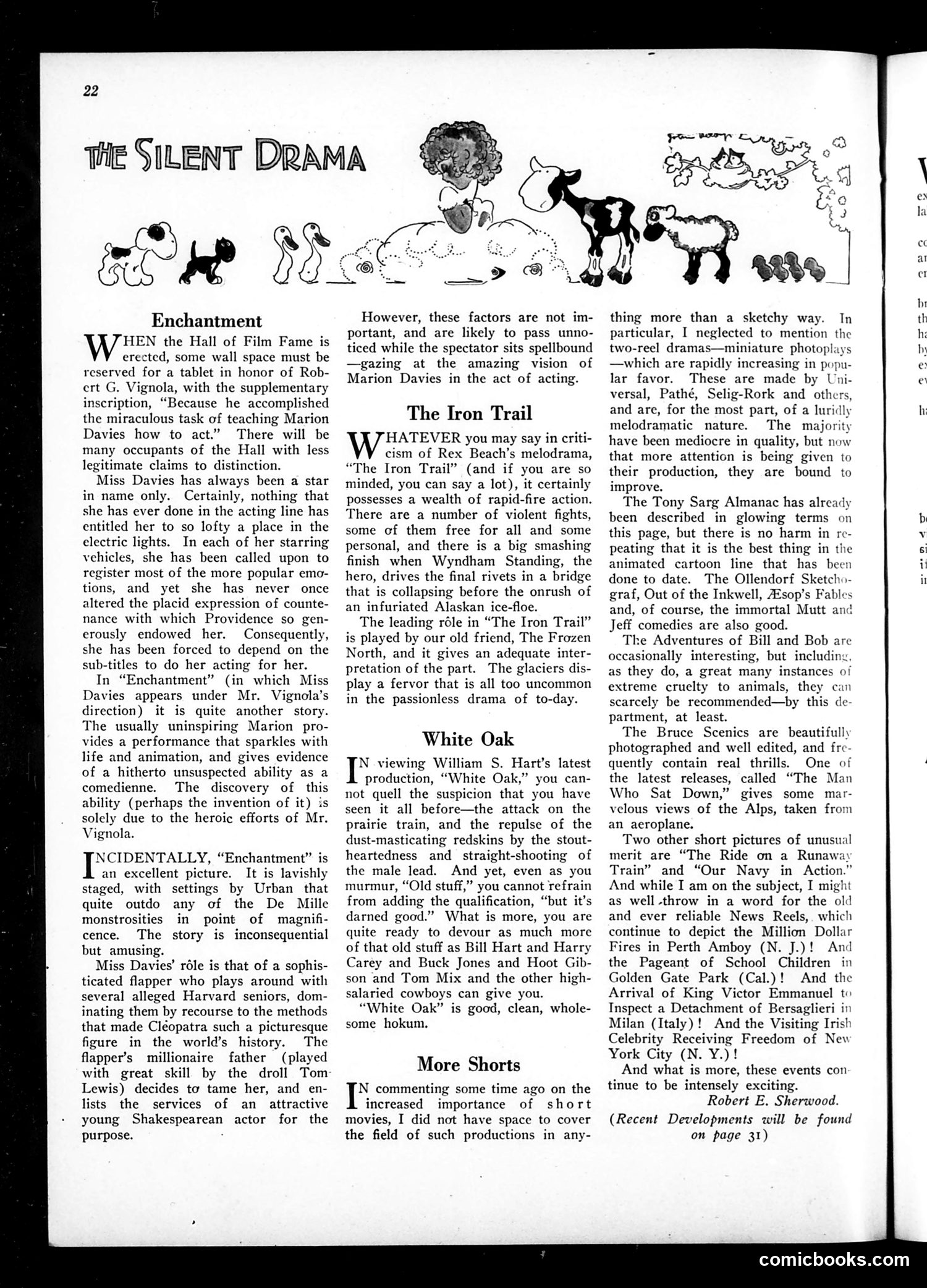
This page reviews several silent films from the 1920s. The opening section mocks actress Marion Davies, calling her a "star in name only" whose acting ability was so wooden that subtitles had to carry her performances. The reviewer credits director Robert G. Vignola with miraculous work in making her appear competent in "Enchantment"—backhanded praise suggesting her previous films relied entirely on intertitles rather than her performance. The cartoon strip at the top ("Enchantment") humorously illustrates this through animal characters, likely a visual pun on the film. Other reviews discuss Rex Beach's action-heavy melodrama "The Iron Trail," praising its spectacle, and William S. Hart's Western "White Oak," which the critic acknowledges as familiar but enjoyable "hokum"—predictable cowboy-versus-Indians material that audiences apparently relished despite its formulaic nature. The tone throughout is witty mockery of both performers and audiences.
📄 Transcribed text from this page (OCR, searchable)
Machine-transcribed from the original scan — historical spelling and the odd misread are preserved.
22 Enchantment HEN the Hall of Film Fame is erected, some wall space must be reserved for a tablet in honor of Rob- ert G. Vignola, with the supplementary inscription, “Because he accomplished the miraculous task of teaching Marion Davies how to act.” There will be many occupants of the Hall with less legitimate claims to distinction. Miss Davies has always been a star in name only. Certainly, nothing that she has ever done in the acting line has entitled her to so lofty a place in the electric lights. In each of her starring vehicles, she has been called upon to register most of the more popular emo- tions, and yet she has never once altered the placid expression of counte- nance with which Providence so gen- erously endowed her. Consequently, she has been forced to depend on the sub-titles to do her acting for her. In “Enchantment” (in which Miss Davies appears under Mr. Vignola’s direction) it is quite another story. The usually uninspiring Marion pro- vides a performance that sparkles with life and animation, and gives evidence of a hitherto unsuspected ability as a comedienne. The discovery of this ability (perhaps the invention of it) is solely due to the heroic efforts of Mr. Vignola. \CIDENTALLY, “Enchantment” is an excellent picture. It is lavishly staged, with settings by Urban that quite outdo any of the De Mille monstrosities in point of magnifi- cence. The story is inconsequential but amusing. Miss Davies’ réle is that of a sophis- ticated flapper who plays around with several alleged Harvard seniors, dom- inating them by recourse to the methods that made Cléopatra such a picturesque figure in the world’s history. The flapper’s millionaire father (played with great skill by the droll Tom Lewis) decides to tame her, and en- lists the services of an attractive young Shakespearean actor for the purpose. However, these factors are not im- portant, and are likely to pass unno- ticed while the spectator sits spellbound —gazing at the amazing vision of Marion Davies in the act of acting. The Iron Trail HATEVER you may say in criti- cism of Rex Beach’s melodrama, “The Iron Trail” (and if you are so minded, you can say a lot), it certainly possesses a wealth of rapid-fire action. There are a number of violent fights, some of them free for all and some personal, and there is a big smashing finish when Wyndham Standing, the hero, drives the final rivets in a bridge that is collapsing before the onrush of an infuriated Alaskan ice-floe. The leading réle in “The Iron Trail” is played by our old friend, The Frozen North, and it gives an adequate inter- pretation of the part. The glaciers dis- play a fervor that is all too uncommon in the passionless drama of to-day. White Oak N viewing William S. Hart’s latest production, “White Oak,” you can- not quell the suspicion that you have seen it all before—the attack on the prairie train, and the repulse of the dust-masticating redskins by the stout- heartedness and straight-shooting of the male lead. And yet, even as you murmur, “Old stuff,” you cannot refrain from adding the qualification, “but it’s darned good.” What is more, you are quite ready to devour as much more of that old stuff as Bill Hart and Harry Carey and Buck Jones and Hoot Gib- son and Tom Mix and the other high- salaried cowboys can give you. “White Oak” is good, clean, whole- some hokum, More Shorts N commenting some time ago on the increased importance of short movies, I did not have space to cover the field of such productions in any- thing more than a sketchy way. In particular, I neglected to mention the two-reel dramas—miniature photoplays —which are rapidly increasing in popu- lar favor. These are made by Uni- versal, Pathé, Selig-Rork and others, and are, for the most part, of a luridly melodramatic nature. The majority have been mediocre in quality, but now that more attention is being given to their production, they are bound to improve. The Tony Sarg Almanac has already been described in glowing terms on this page, but there is no harm in re- peating that it is the best thing in the animated cartoon line that has been done to date. The Ollendorf Sketcho- graf, Out of the Inkwell, ZEsop’s Fables and, of course, the immortal Mutt and Jeff comedies are also good. The Adventures of Bill and Bob are occasionally interesting, but including, as they do, a great many instances of extreme cruelty to animals, they can scarcely be recommended—by this de- partment, at least. The Bruce Scenics are beautifully photographed and well edited, and fre- quently contain real thrills. One of the latest releases, called “The Man Who Sat Down,” gives some mar- velous views of the Alps, taken from an aeroplane. Two other short pictures of unusual merit are “The Ride on a Runay Train” and “Our Navy in Action. And while I am on the subject, I might as well throw in a word for the old and ever reliable News Reels,. which continue to depict the Million Dollar Fires in Perth Amboy (N. J.)! And the Pageant of School Children in Golden Gate Park (Cal.)! And the Arrival of King Victor Emmanuel to Inspect a Detachment of Bersaglieri in Milan (Italy)! And the Visiting Irish Celebrity Receiving Freedom of New York City (N. Y.)! And what is more, these events con tinue to be intensely exciting. Robert E. Sherwood. (Recent Developments will be found on page 31) comicbooks.com