
Life, 1921-11-24 · page 12 of 34
Life — November 24, 1921 — page 12: what you’re looking at
What you’re looking at
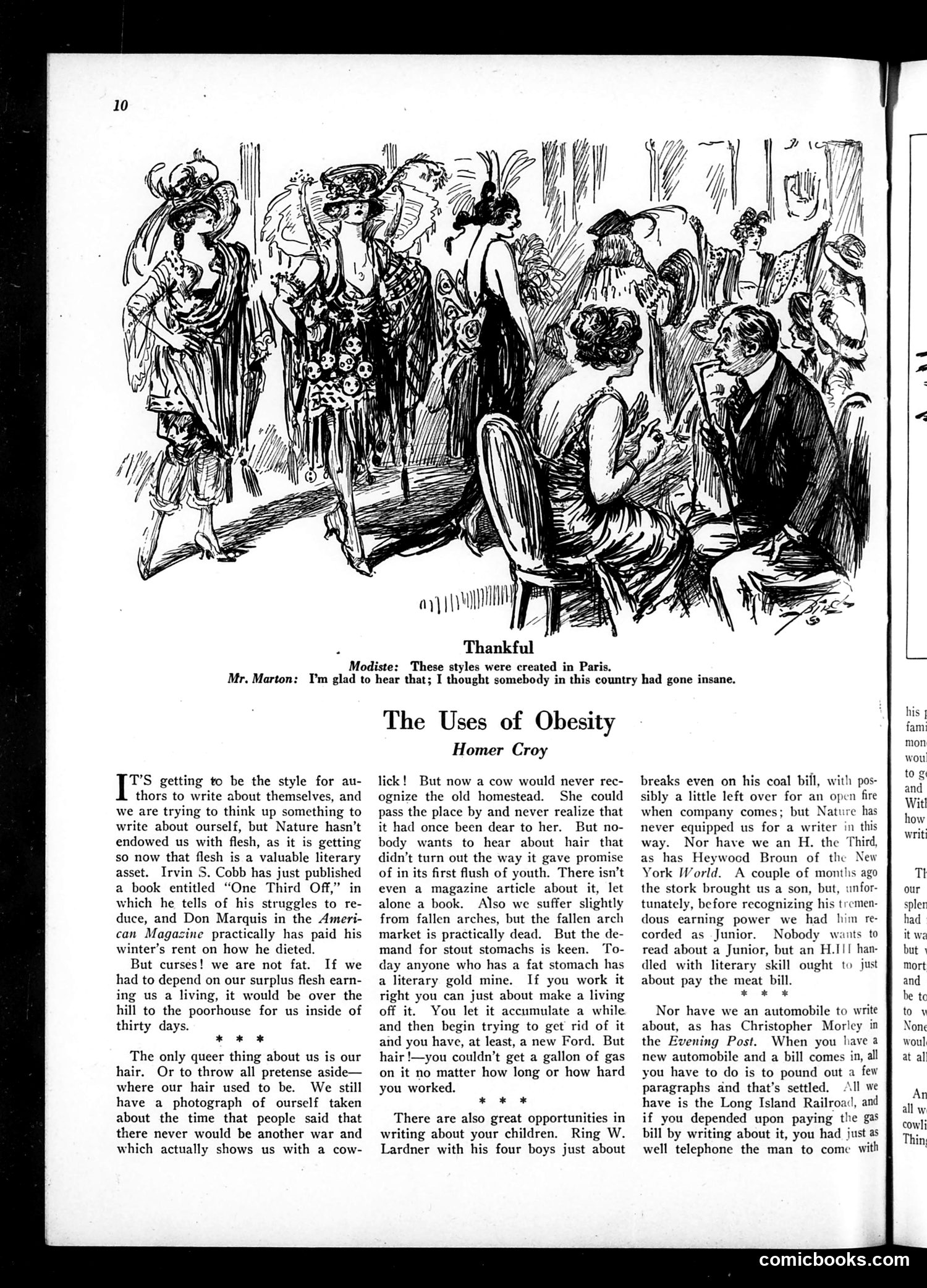
This satirical essay mocks the commercialization of weight and appearance in early 20th-century America. Croy criticizes how obesity has become a "valuable literary asset"—writers exploit their own struggles with weight for magazine articles and book deals. He notes the irony that while magazines profit from weight-loss advice, obesity remains fashionable in high society. The cartoon above depicts a fashionable Parisian salon scene, illustrating the essay's opening: that excessive flesh was becoming a desirable status symbol among the wealthy elite. The dialogue references Paris fashion trends, suggesting Americans are imitating European excess. Croy argues that obesity has become simultaneously profitable to write about and socially acceptable to possess—a contradiction he finds absurd.
📄 Transcribed text from this page (OCR, searchable)
Machine-transcribed from the original scan — historical spelling and the odd misread are preserved.
Thankful Modiste: These styles were created in Paris. Mr. Marton: Ym glad to hear that; I thought somebody in this country had gone insane. T’S getting to be the style for au- thors to write about themselves, and we are trying to think up something to write about ourself, but Nature hasn’t endowed us with flesh, as it is getting so now that flesh is a valuable literary asset. Irvin S. Cobb has just published a book entitled “One Third Off,” in which he tells of his struggles to re- duce, and Don Marquis in the Ameri- can Magazine practically has paid his winter’s rent on how he dieted. But curses! we are not fat. If we had to depend on our surplus flesh earn- ing us a living, it would be over the hill to the poorhouse for us inside of thirty days. ee * The only queer thing about us is our hair. Or to throw all pretense aside— where our hair used to be. We still have a photograph of ourself taken about the time that people said that there never would be another war and which actually shows us with a cow- The Uses of Obesity Homer Croy lick! But now a cow would never rec- ognize the old homestead. She could pass the place by and never realize that it had once been dear to her. But no- body wants to hear about hair that didn’t turn out the way it gave promise of in its first flush of youth. There isn’t even a magazine article about it, let alone a book. Also we suffer slightly from fallen arches, but the fallen arch market is practically dead. But the de- mand for stout stomachs is keen. To- day anyone who has a fat stomach has a literary gold mine. If you work it right you can just about make a living off it. You let it accumulate a while and then begin trying to get rid of it and you have, at least, a new Ford. But hair !—you couldn’t get a gallon of gas on it no matter how long or how hard you worked. + + There are also great opportunities in writing about your children. Ring W. Lardner with his four boys just about breaks even on his coal bill, with pos- sibly a little left over for an open fire when company comes; but Nature has never equipped us for a writer in this way. Nor have we an H. the Third, as has Heywood Broun of the New York World. A couple of montis ago the stork brought us a son, but, unfor- tunately, before recognizing his tremen- dous earning power we had him re- corded as Junior. Nobody wants to read about a Junior, but an H.I! han- dled with literary skill ought to just about pay the meat bill. * * * Nor have we an automobile to write about, as has Christopher Morley in the Evening Post. When you lave @ new automobile and a bill comes in, all you have to do is to pound out a few paragraphs and that’s settled. All we have is the Long Island Railroad, and if you depended upon paying the gas bill by writing about it, you had just as well telephone the man to come with Pe ey his | fam: mon wou! to g and Witl how writi TI our spler had it wa but mort and be te to y None woul at al An all w cowli Thin comicbooks.com