
A complete issue · 34 pages · 1921
Life — November 17, 1921
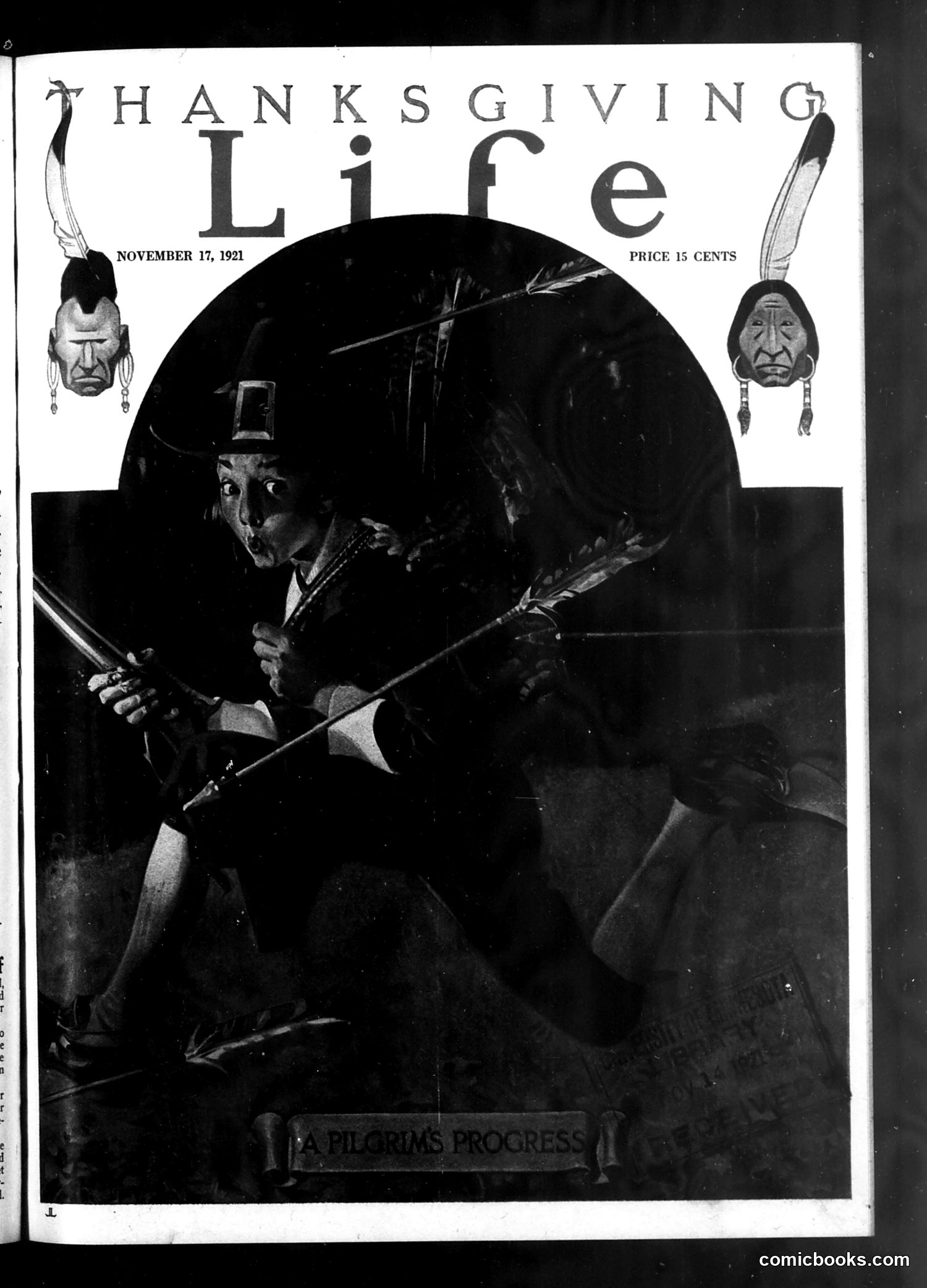
This *Life* magazine cover satirizes Native American representation through a darkly ironic lens typical of early 20th-century humor. The central figure appears to be a Native American in traditional dress (feathered headdress, holding a rifle) depicted in a caricatured style, positioned against a large dark circular background. The caption "A Pilgrim's Progress" references John Bunyan's religious allegory while invoking Thanksgiving's origin narrative. The two smaller Native American head portraits flanking the main image appear to emphasize racial caricature as comedic content. The satire likely comments on how European settlers ("pilgrims") displaced Native Americans, using "progress" ironically. This reflects 1921's casually dehumanizing attitudes toward Indigenous peoples common in mainstream American publications of that era.
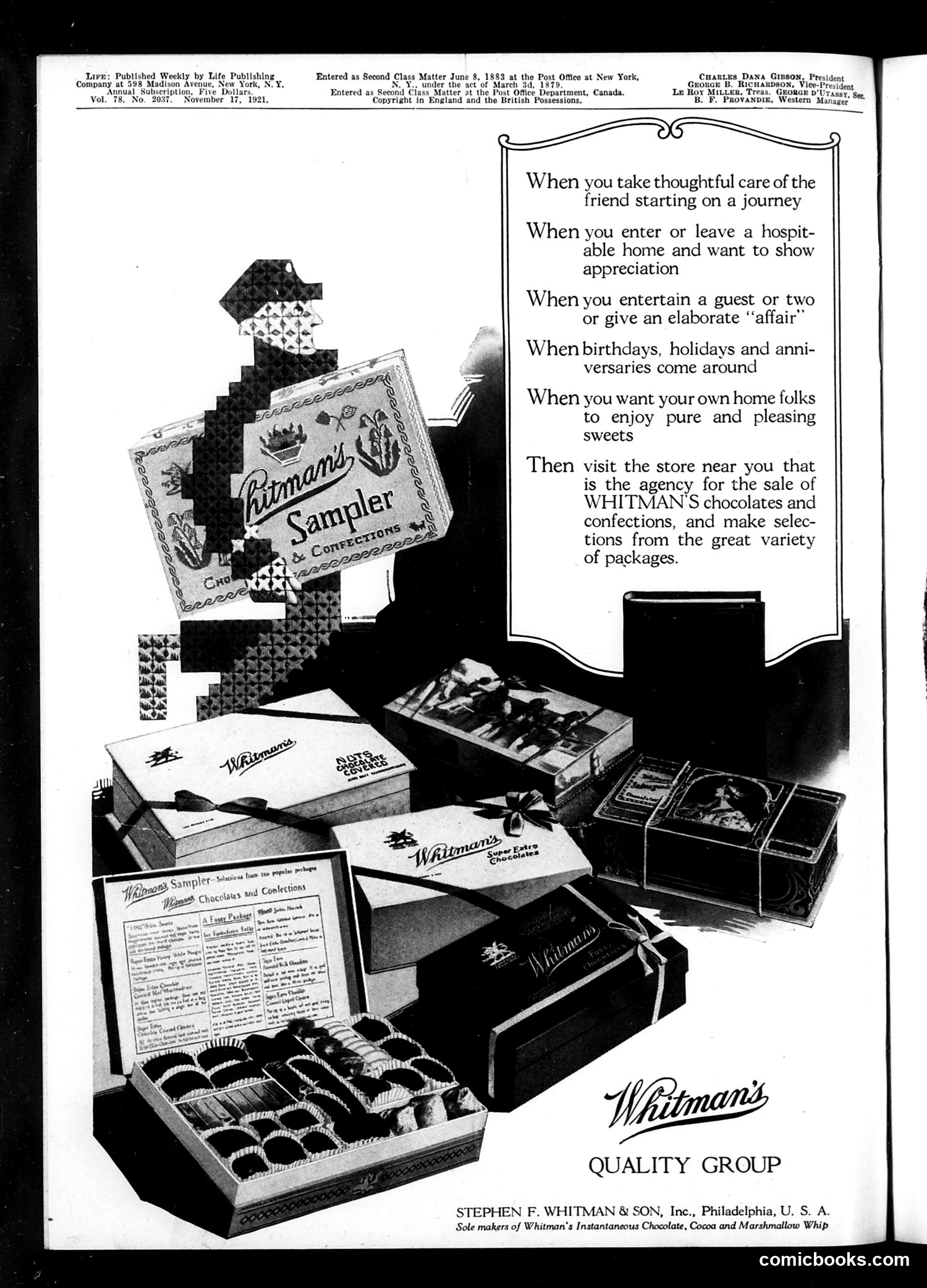
This is **not a political cartoon or satire**—it's a straightforward **advertisement for Whitman's chocolates and confections** from Life magazine (November 12, 1921). The page uses a stylized illustrated figure holding a Whitman's Sampler box to promote gift-giving occasions: journeys, hospital visits, entertaining guests, holidays, and birthdays. The accompanying text lists these scenarios as perfect moments to purchase Whitman's products. Various chocolate boxes and samplers are displayed at the bottom, showcasing the "Quality Group" product line. The ad emphasizes variety in packaging to suit different occasions and recipients. This represents straightforward early 20th-century consumer advertising strategy—associating a branded product with social courtesies and gift-giving traditions.
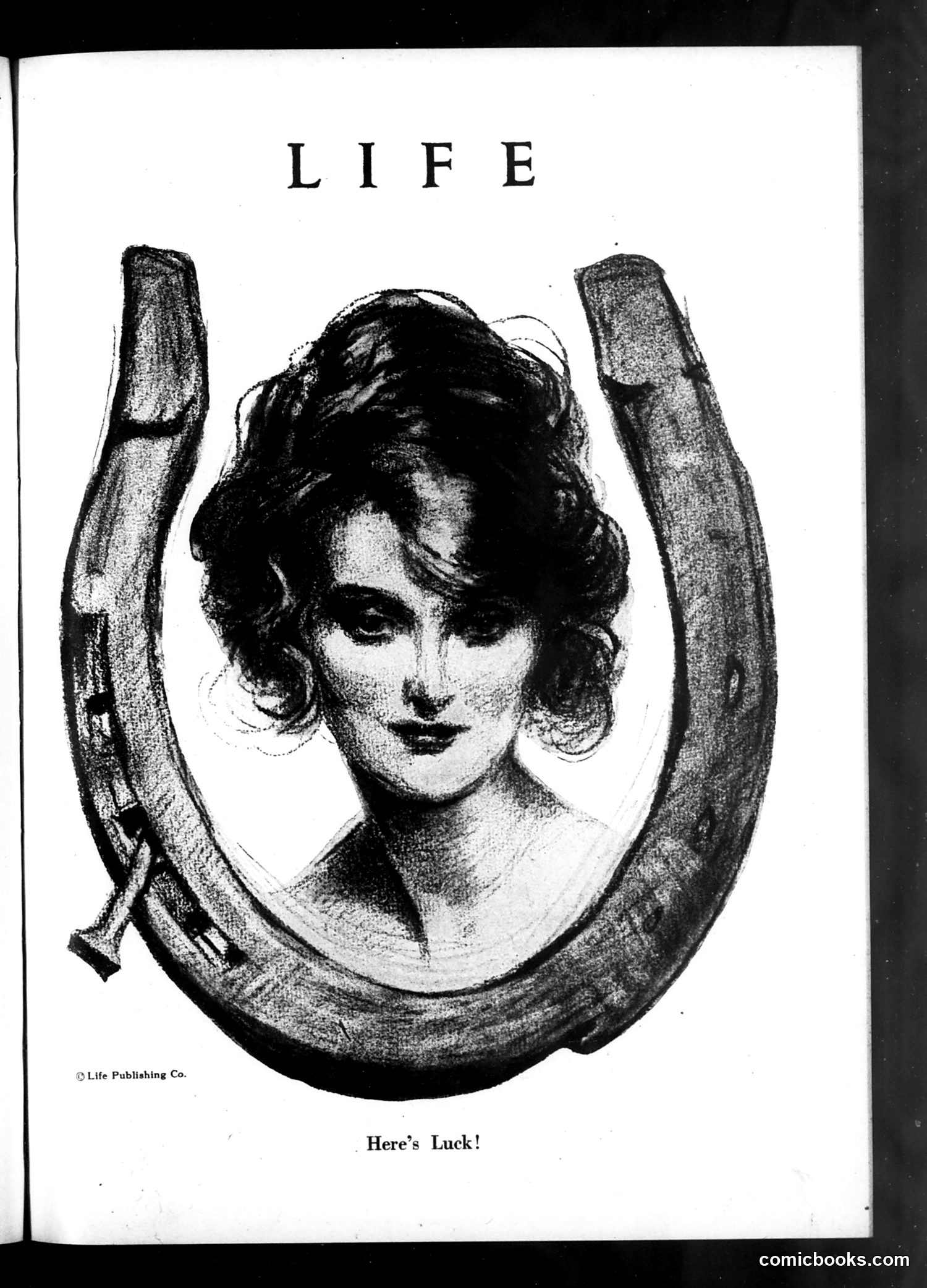
This appears to be a cover or advertisement page from Life magazine featuring a woman's portrait framed within a horseshoe, with the text "Here's Luck!" The horseshoe is a traditional symbol of good fortune, suggesting the page's message is a general wish for luck or good fortune. The woman's portrait is rendered in a classical style typical of early-to-mid 20th century illustration. Without additional context identifying the specific woman or accompanying article, the exact satirical point remains unclear. The page appears primarily decorative or promotional rather than explicitly political satire. The copyright notice indicates "© Life Publishing Co." The composition suggests this may be a cover design or advertisement rather than a political cartoon with specific contemporary references.
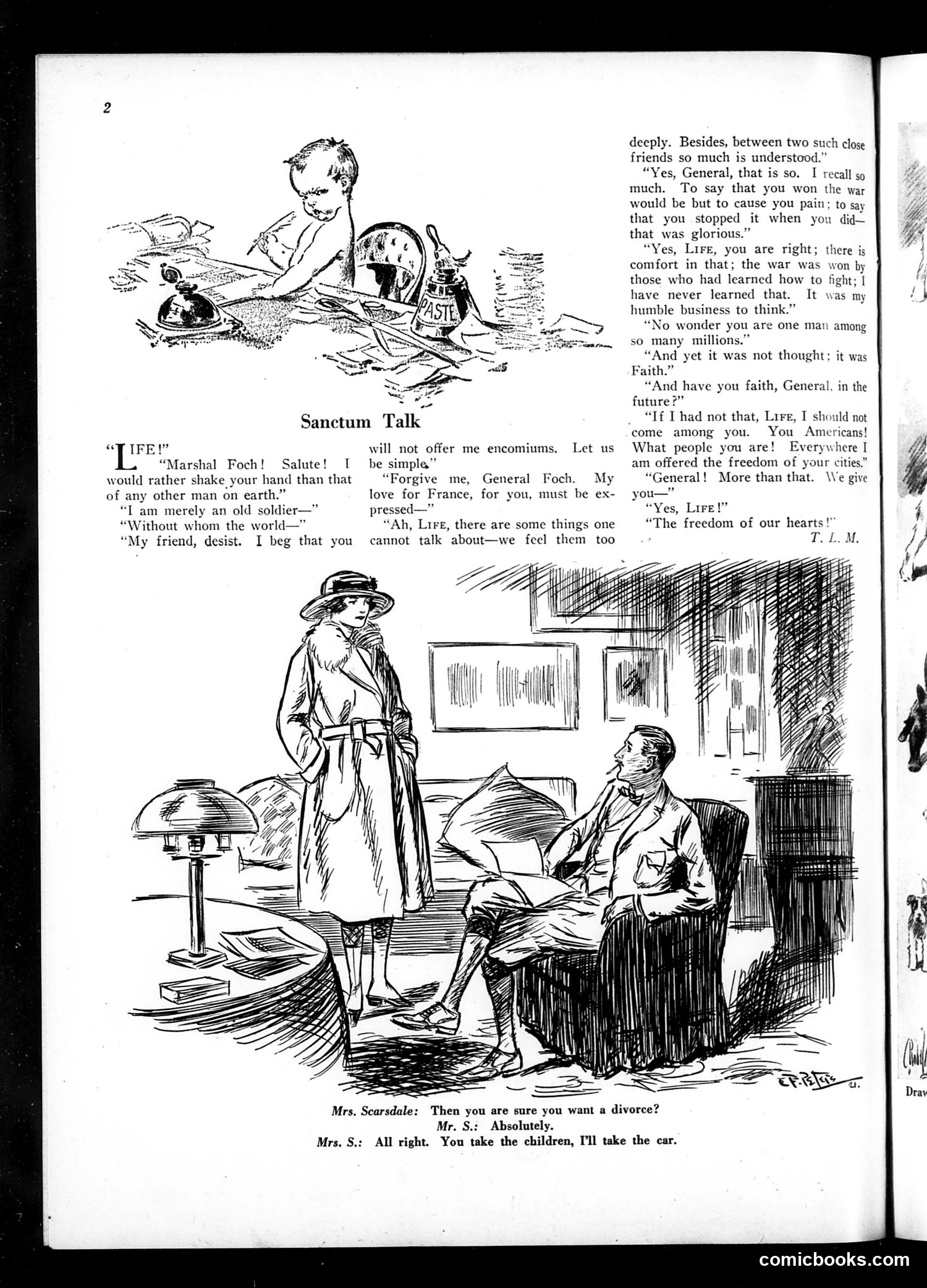
**Top Cartoon: "Sanctum Talk"** A conversation between "Life" (personified) and "Marshal Foch" (French WWI commander). Life refuses formal military salute, preferring friendship. The dialogue addresses post-WWI themes: Foch credits American soldiers' willingness to fight rather than strategic brilliance for Allied victory. Life responds that Americans fought because of "faith" in freedom, not military thinking. The satire celebrates American idealism versus European militarism. **Bottom Cartoon: Divorce Proceeding** A woman stands while a man sits in what appears to be a lawyer's office. Mrs. Scarsdale asks if he's sure about divorce; Mr. S. responds "Absolutely," then says "You take the children, I'll take the car." The satire mocks shallow materialism in 1920s divorce proceedings, suggesting men prioritize possessions over family responsibility.
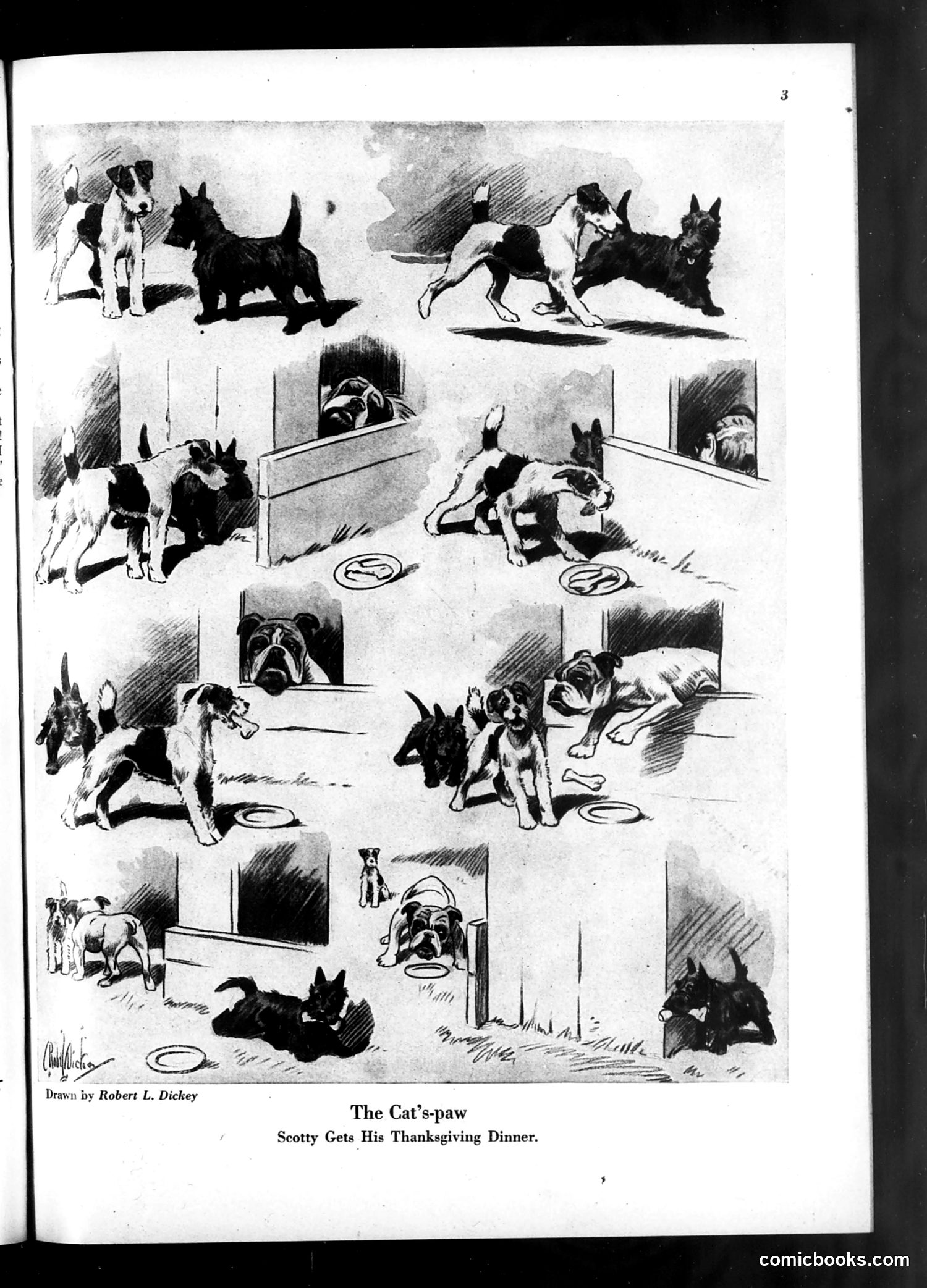
This is a humorous comic strip by Robert L. Dickey depicting a dog named Scotty obtaining his Thanksgiving dinner through trickery. The narrative shows Scotty using a cat as a "cat's-paw"—an idiom meaning using someone else to accomplish one's goals while avoiding responsibility. The strip progresses from Scotty and the cat observing dinner preparations, through the cat being sent to fetch or steal food, to Scotty ultimately receiving the meal while the cat bears the consequences (appearing caught or punished by humans looking out windows). The joke exploits the traditional rivalry between cats and dogs, using it to illustrate the metaphorical meaning of the phrase "cat's-paw" through literal animal action. It's a lighthearted visual pun without political content.
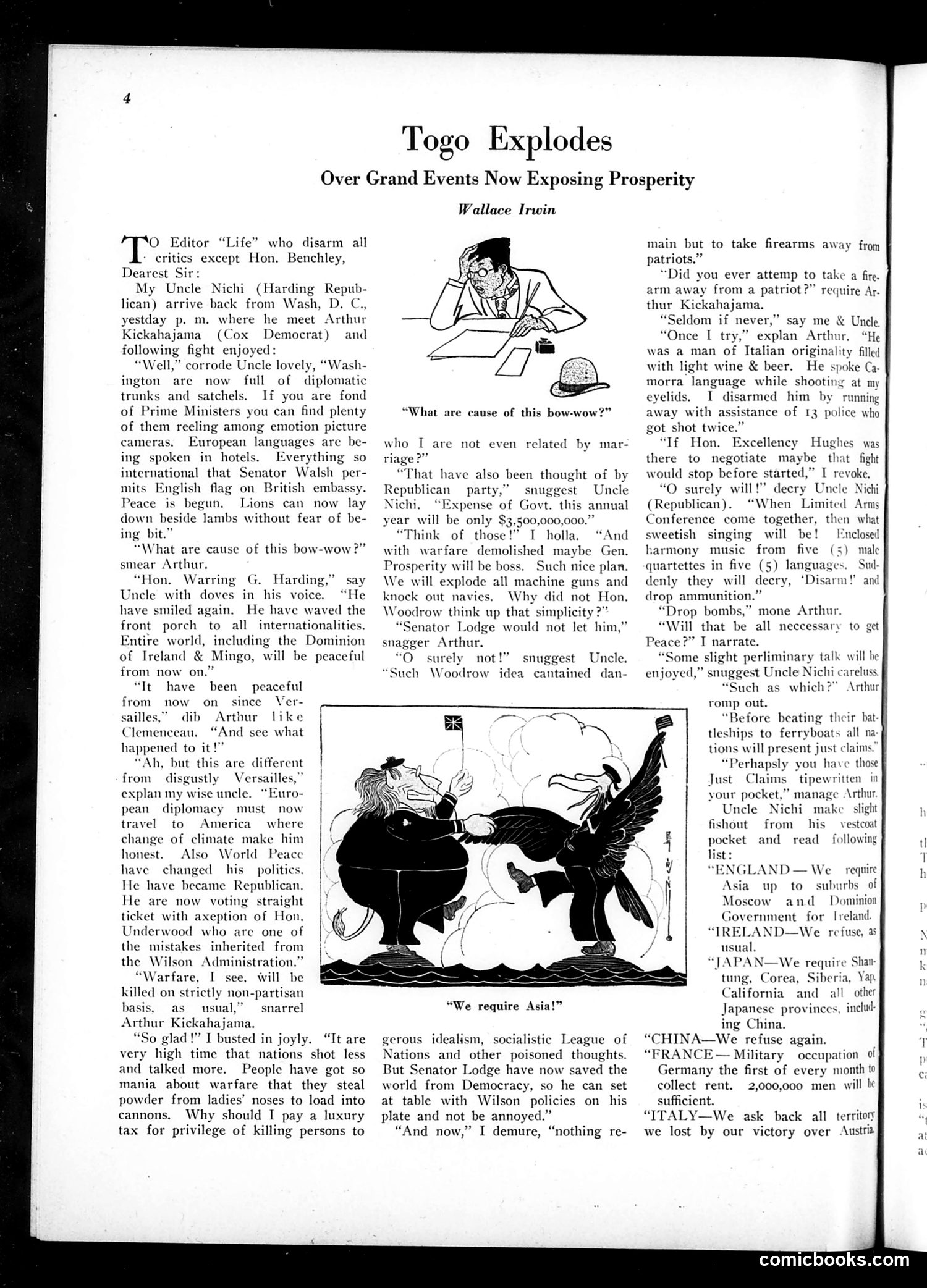
This article by Wallace Irwin satirizes post-WWI diplomatic tensions. The main cartoon depicts two figures (likely representing nations) in violent conflict, labeled "We require Asia!" The text mocks Republican and Democratic politicians debating war expenses and peace terms. Irwin's Uncle Nichi character represents Republican isolationism, while other figures discuss disarmament conferences and territorial claims. The satire targets: - Politicians using pacifist rhetoric while pursuing imperial ambitions - Competing European and Asian powers making contradictory territorial demands (England, Ireland, Japan, China, France, Italy, Germany all listed as making claims) - The hypocrisy of "peace" conferences that actually reflect continued great-power competition The title "Togo Explodes" (referencing Japan's Admiral Togo) suggests ongoing Japanese militarism threatening regional stability despite peace negotiations.
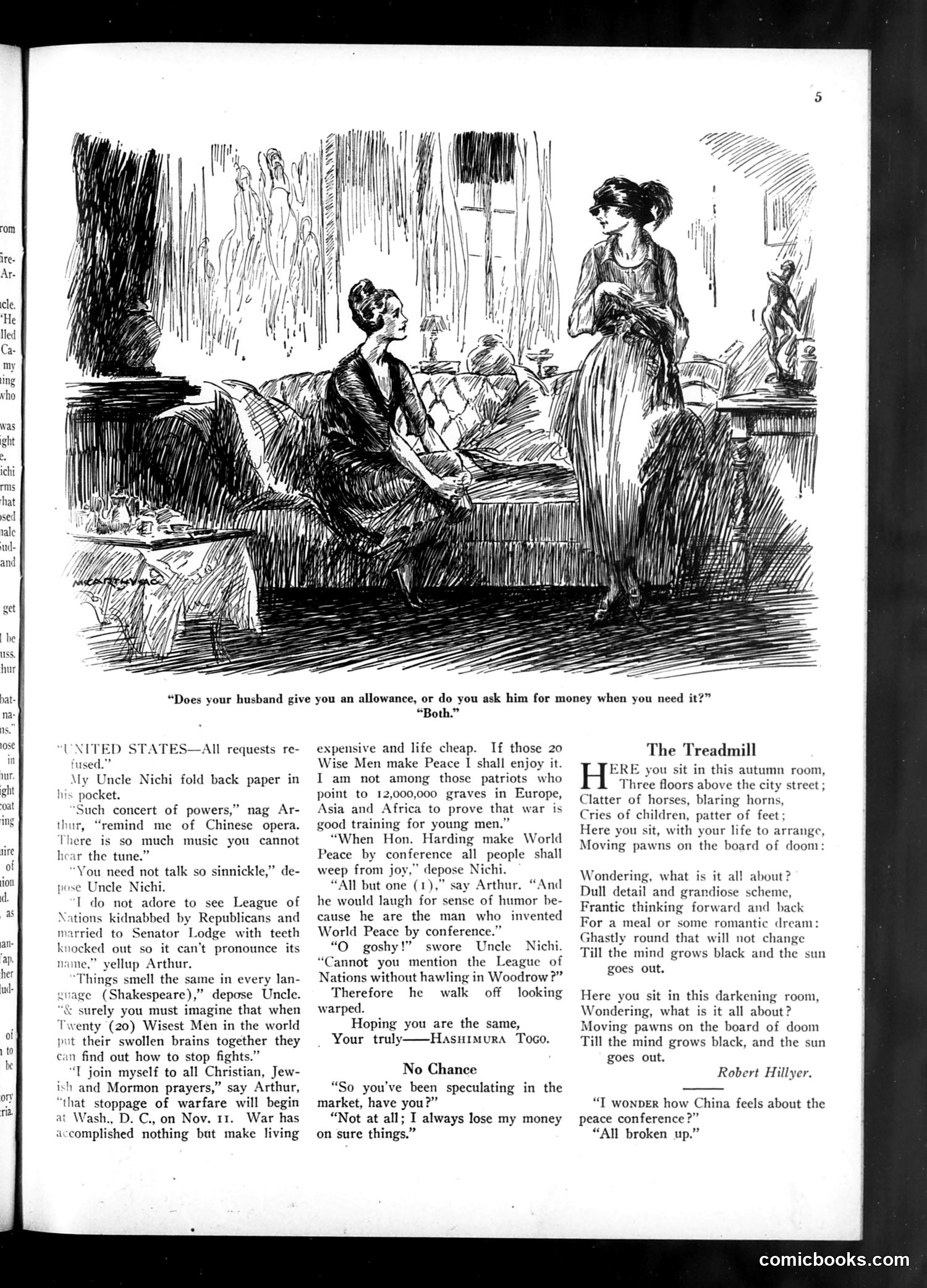
The main cartoon depicts a domestic scene with the caption: "Does your husband give you an allowance, or do you ask him for money when you need it?" Answer: "Both." This is **satire about women's financial dependence and marital power dynamics**. The joke targets the contradiction in early 20th-century marriages where wives had no independent income—they either received a fixed allowance (theoretically controlled spending) or had to ask their husbands for money (requiring permission). The punchline "Both" suggests wives experience both systems simultaneously, highlighting the lack of actual financial autonomy or dignity in the arrangement. The surrounding text discusses post-WWI politics and peace conferences. The satire reflects broader concerns about women's economic vulnerability and rights during this period.
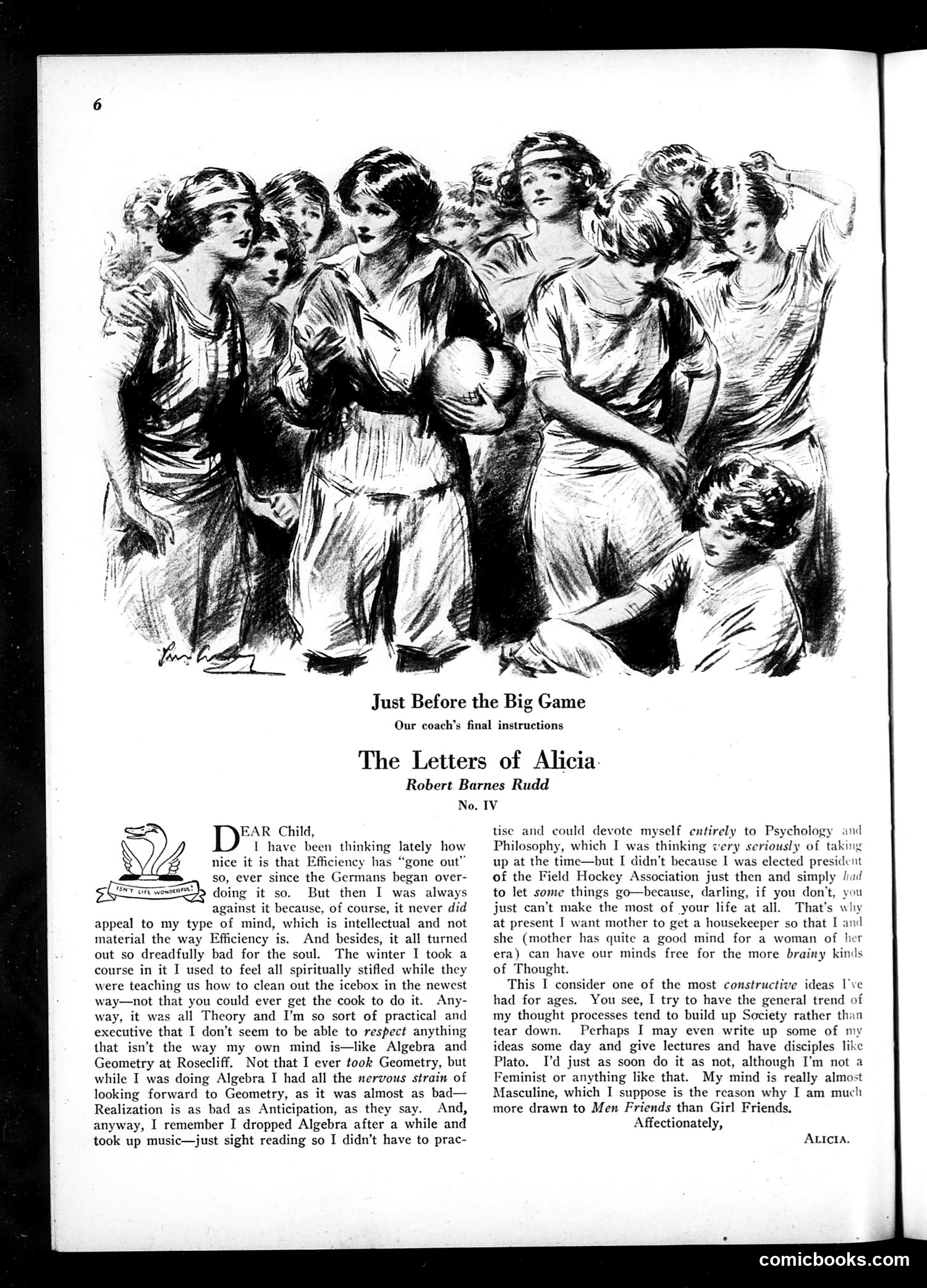
This page features "The Letters of Alicia" by Robert Barnes Rudd, a satirical column. The illustration shows a group of young women gathered together, titled "Just Before the Big Game" with the subtitle "Our coach's final instructions." The satire targets the intellectual pretensions of women's athletics and education in the early 20th century. Alicia's letter mocks the trend of women receiving "final instructions" before sporting events while also critiquing contemporary women's intellectual pursuits. She dismissively references having abandoned subjects like Algebra and Geometry at Rosecliff, claiming she couldn't devote herself "entirely" to serious study. The humor plays on period anxieties about women's education and physical activities, suggesting women couldn't manage both athleticism and serious intellectual work—a common prejudice of the era.
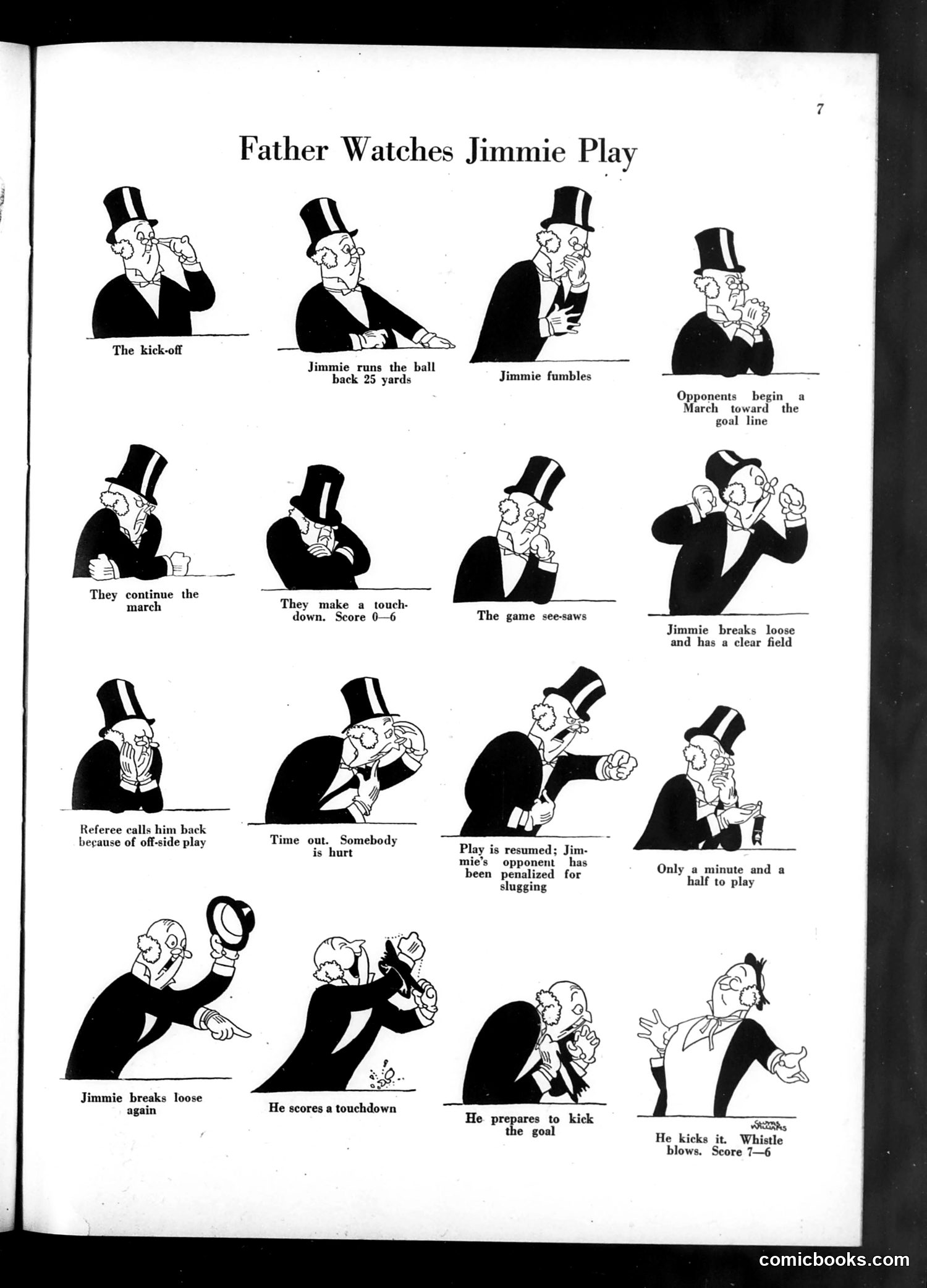
This is a comic strip sequence showing a father watching his son play football. The humor derives from the father's exaggerated emotional reactions to each game event—from anxiety during kickoff through mounting tension as play progresses. The satire targets overly invested parents who experience extreme stress watching their children's sports. Each panel shows the father's face becoming increasingly distressed: worried, contemplative, shocked, panicked, and finally triumphant when his son scores the winning touchdown (7-6). The joke is relatable to any era: the contrast between the casual children's game and the father's intense, almost absurd emotional investment. His top hat and formal attire emphasize how he treats this youth football game with the seriousness of a professional match, mocking parental overinvestment in children's activities.
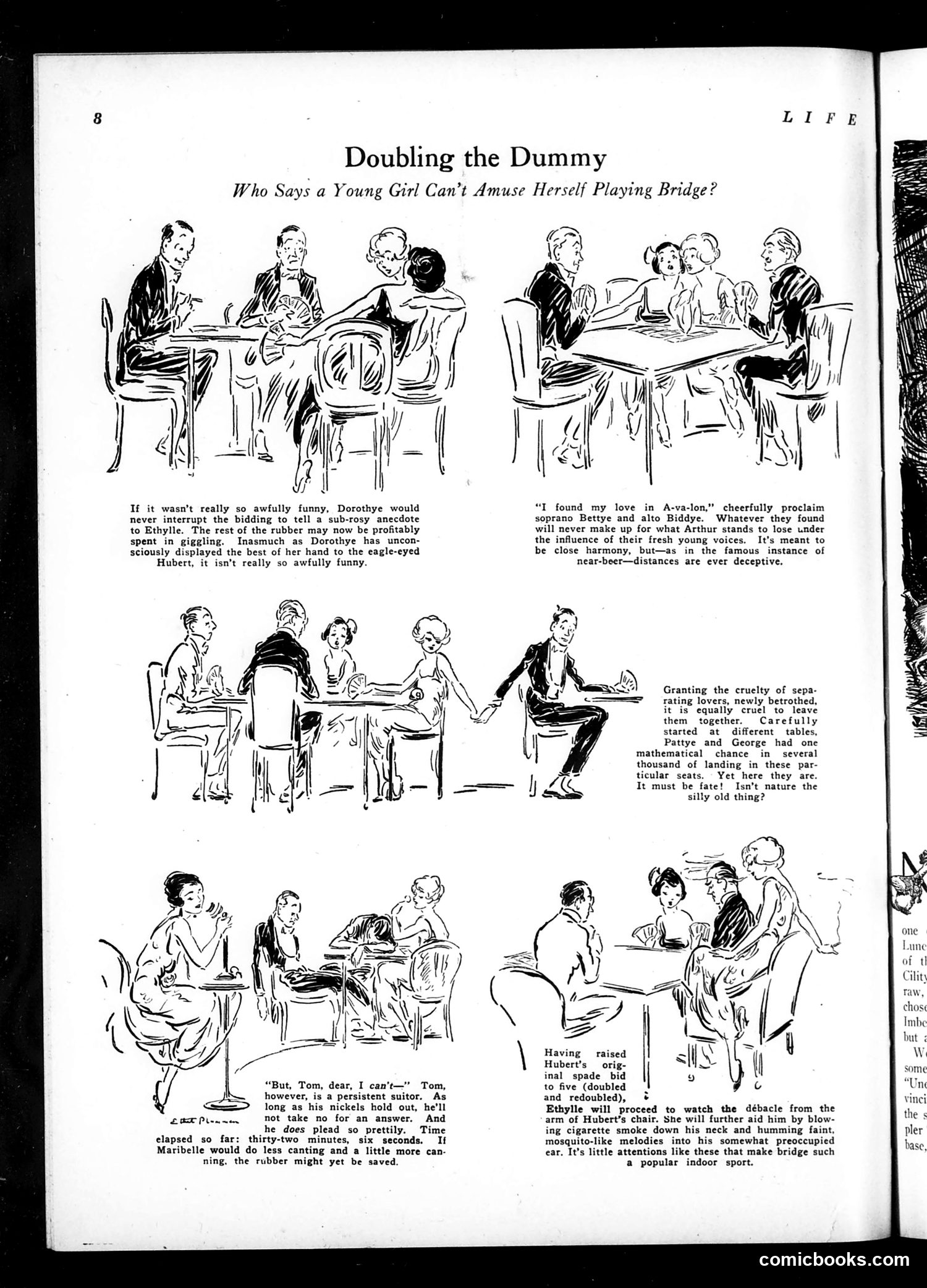
This satirical comic sequence mocks the social pretension of bridge players in the 1920s-30s era. The humor centers on a young woman named Dorothye who, bored during a bridge game, entertains herself by providing commentary about the other players—essentially treating them as her "dummy" hand (in bridge, the dummy is the exposed hand played by the declarer's partner). The satire targets both the tedium of bridge as a social ritual and the absurdity of adults taking the card game so seriously that they fail to notice they're being mocked by a clever young woman. The joke suggests bridge players are pompous and oblivious—perfect targets for her amusement.
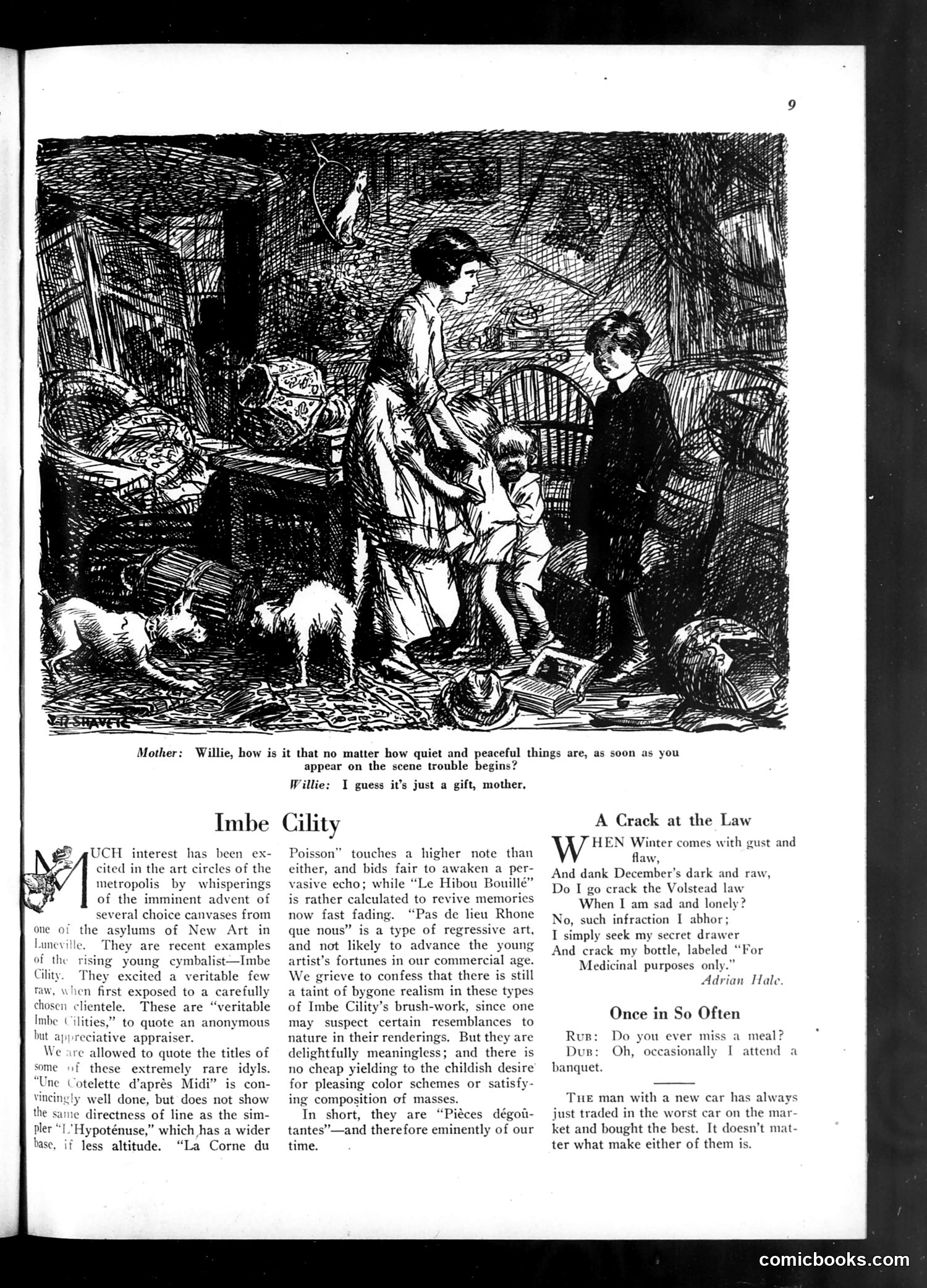
This page contains a domestic cartoon titled "Imbecility" by artist W.H. Shavell, depicting a mother confronting a boy named Willie about causing trouble whenever he appears. Willie claims it's "just a gift." The cartoon satirizes childhood misbehavior and parental exasperation—the joke being that Willie possesses an almost supernatural talent for creating chaos. The visual shows a chaotic domestic scene with the mother, Willie, and other children amid scattered household items. The page also includes brief literary pieces: "A Crack at the Law" (a poem about winter and loneliness by Adrian Hale) and "Once in So Often" (a humorous exchange about missing meals and attending banquets). This appears to be early 20th-century American humor focused on relatable domestic situations rather than explicit political satire.
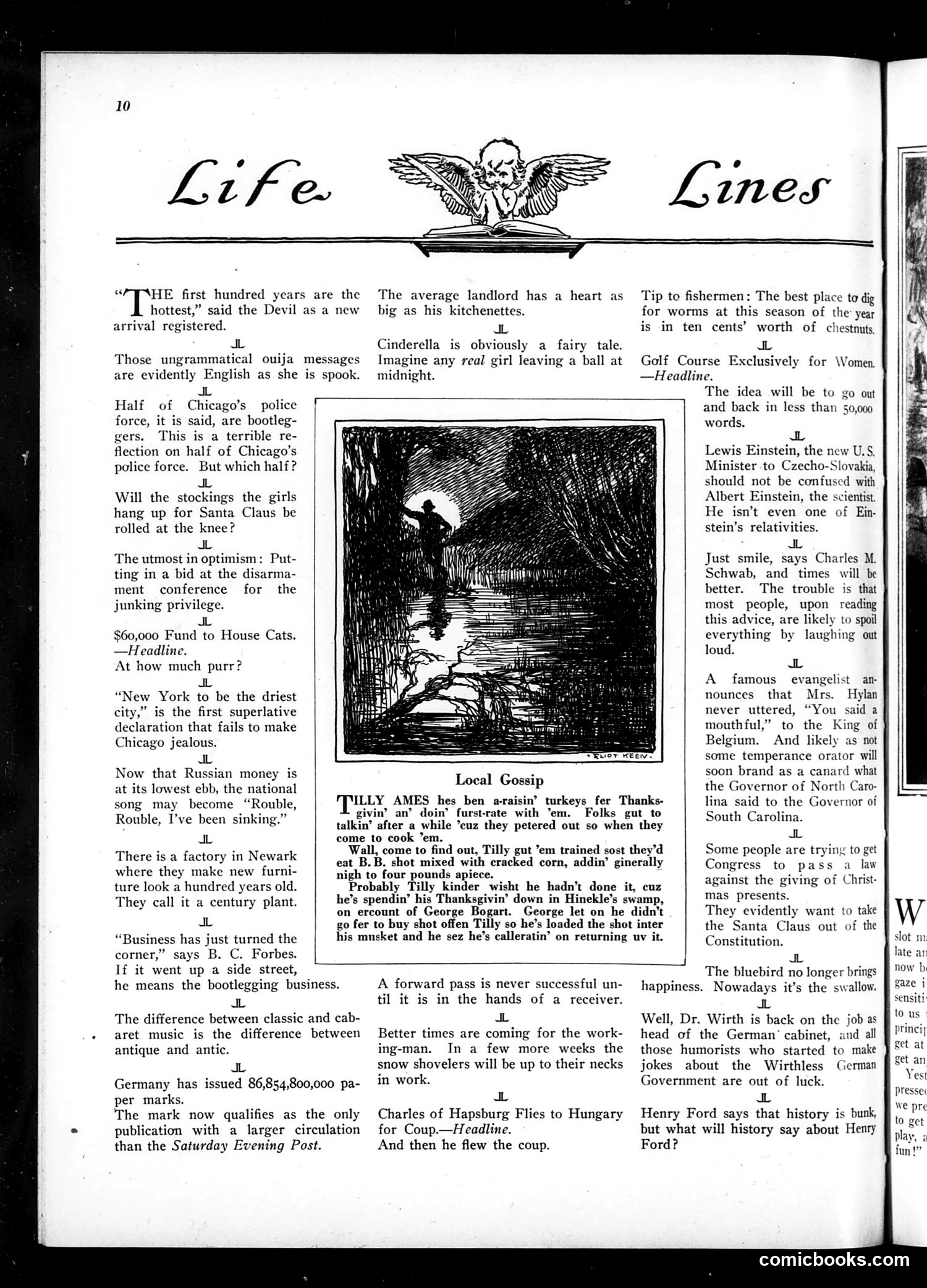
This single-panel cartoon depicts a figure fishing at night in a swampy setting, likely illustrating a humorous anecdote about "Tilly Ames" training turkeys. The accompanying text describes Tilly's mishap: after training turkeys for Thanksgiving dinner ("doin' furst-rate"), he lost them in a swamp. The narrative humorously tracks how other people subsequently found and misused the turkeys—fed them cracked corn, trained them as hunting dogs, until finally Tilly recovered them for his own use. The cartoon functions as visual humor accompanying small-town gossip. The murky swamp setting suggests the chaotic misadventures described in the text, where confusion and poor judgment by various townspeople complicates a simple farming situation. It's gentle rural satire about miscommunication and incompetence.
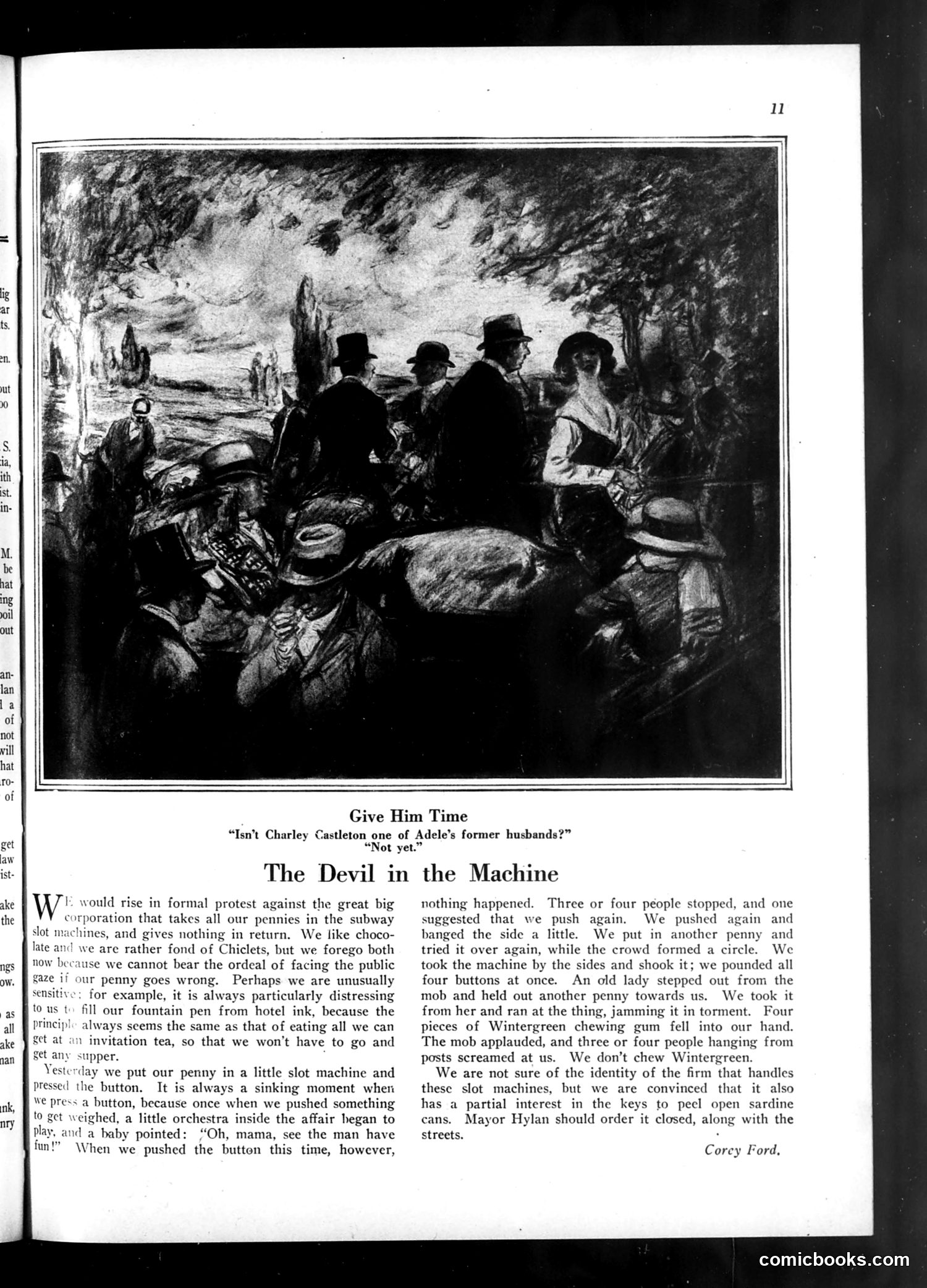
This satirical piece by Corey Ford criticizes slot machines—specifically penny-operated devices in public spaces. The illustration shows well-dressed people gathered around a malfunctioning machine, with one woman having extracted her clothing tangled in it. Ford's complaint centers on how these machines are unreliable: players insert money but receive nothing in return. He recounts an incident where a stuck button activated music and attracted crowds. A woman's garment became jammed in the mechanism, requiring four people and chewing gum to extract it. The satire mocks both the machines' poor design and their presence in public spaces. Ford concludes by calling on Mayor Hylan to have such devices closed, viewing them as urban nuisances exploiting the public rather than providing legitimate entertainment.
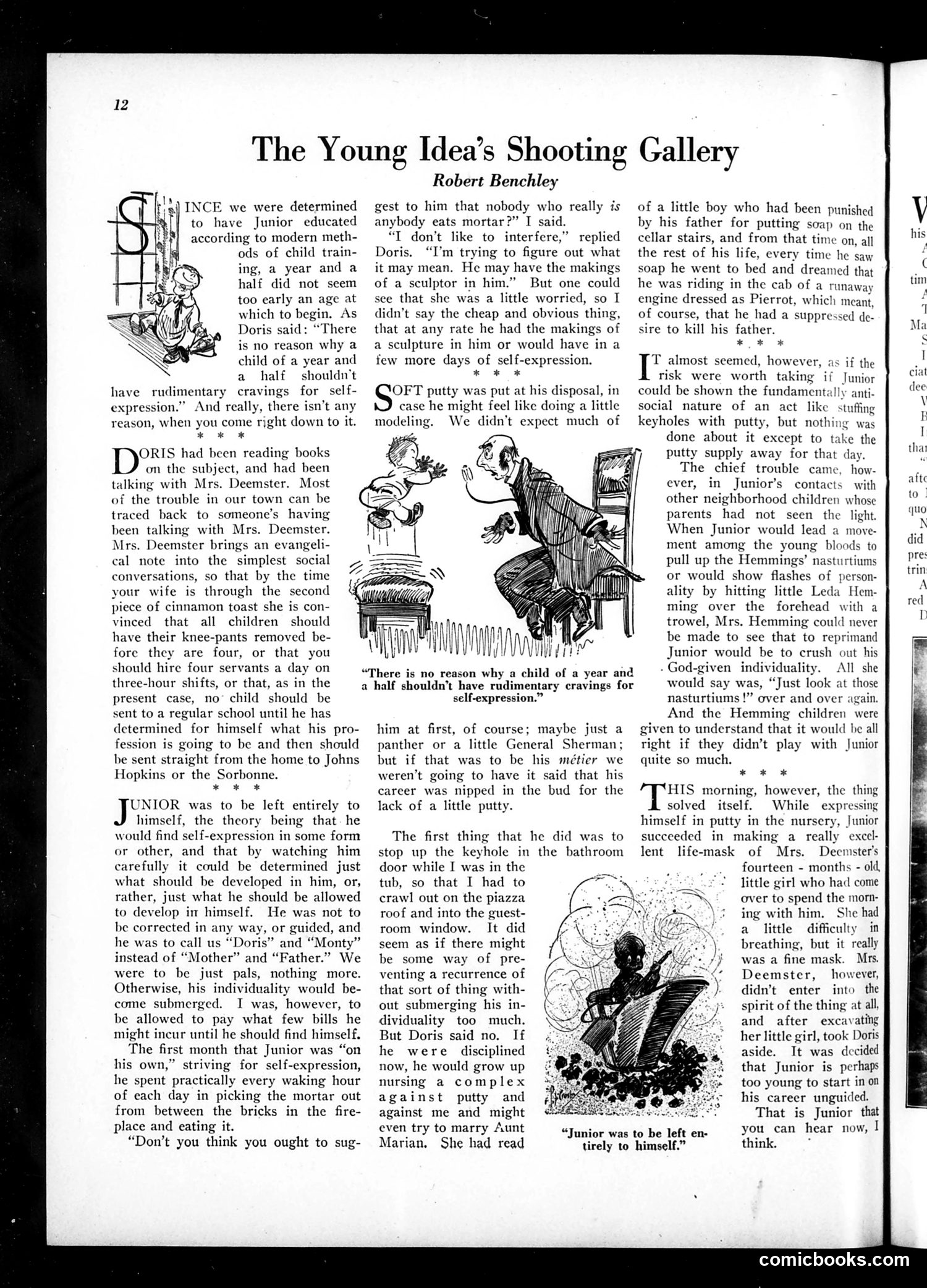
This satirical piece critiques progressive child-rearing theories popular in the 1920s-30s. The article mocks the philosophy that children should be given complete freedom for "self-expression" rather than traditional discipline. The illustrations show a young boy named Junior engaged in destructive behavior—making putty from mortar, creating chaos in a bathroom, and generally running amok—while his parents rationalize his actions as healthy self-expression rather than disciplining him. Benchley's satire targets permissive parenting advocates (influenced by figures like Freud) who believed suppressing children's impulses caused psychological damage. The piece humorously depicts the chaos that results when this philosophy is taken to extremes, suggesting such permissiveness creates insufferable, undisciplined children rather than psychologically healthy ones.
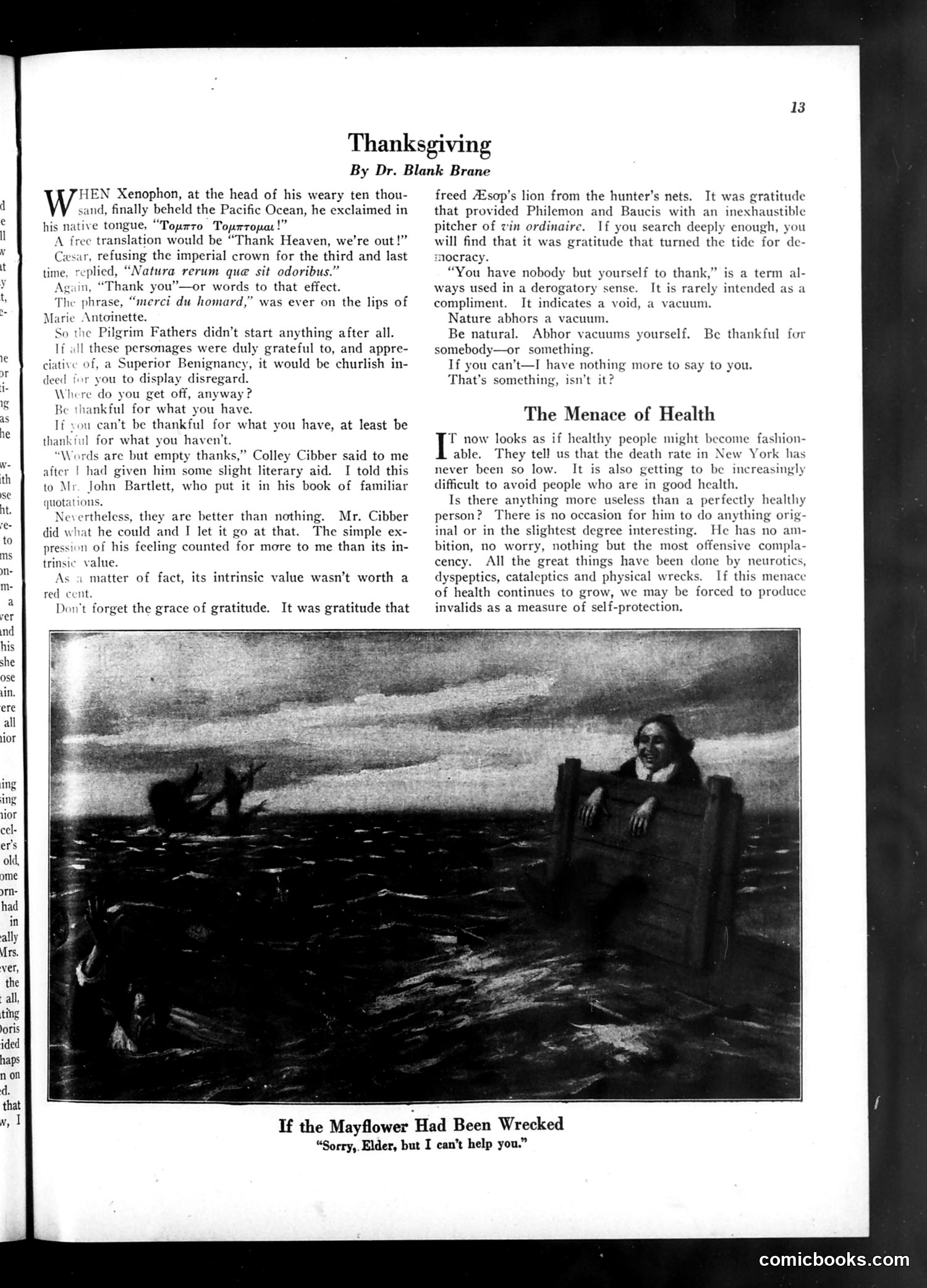
This illustration is a satirical counterfactual showing what would have happened if the Pilgrim ship Mayflower had sunk rather than successfully reaching America in 1620. The image depicts a figure on a desolate shore with a wrecked ship in the background, captioned "Sorry, Elder, but I can't help you." The satire appears to target Pilgrim or Puritan leaders (the "Elder" referenced), suggesting ironic commentary on their religious certainty or self-reliance ideology. By imagining the Mayflower's failure, the cartoonist implies that the Pilgrims' successful voyage and founding of Plymouth Colony was less assured or divinely guided than their mythology suggests—a skeptical jab at American founding narratives and religious triumphalism.
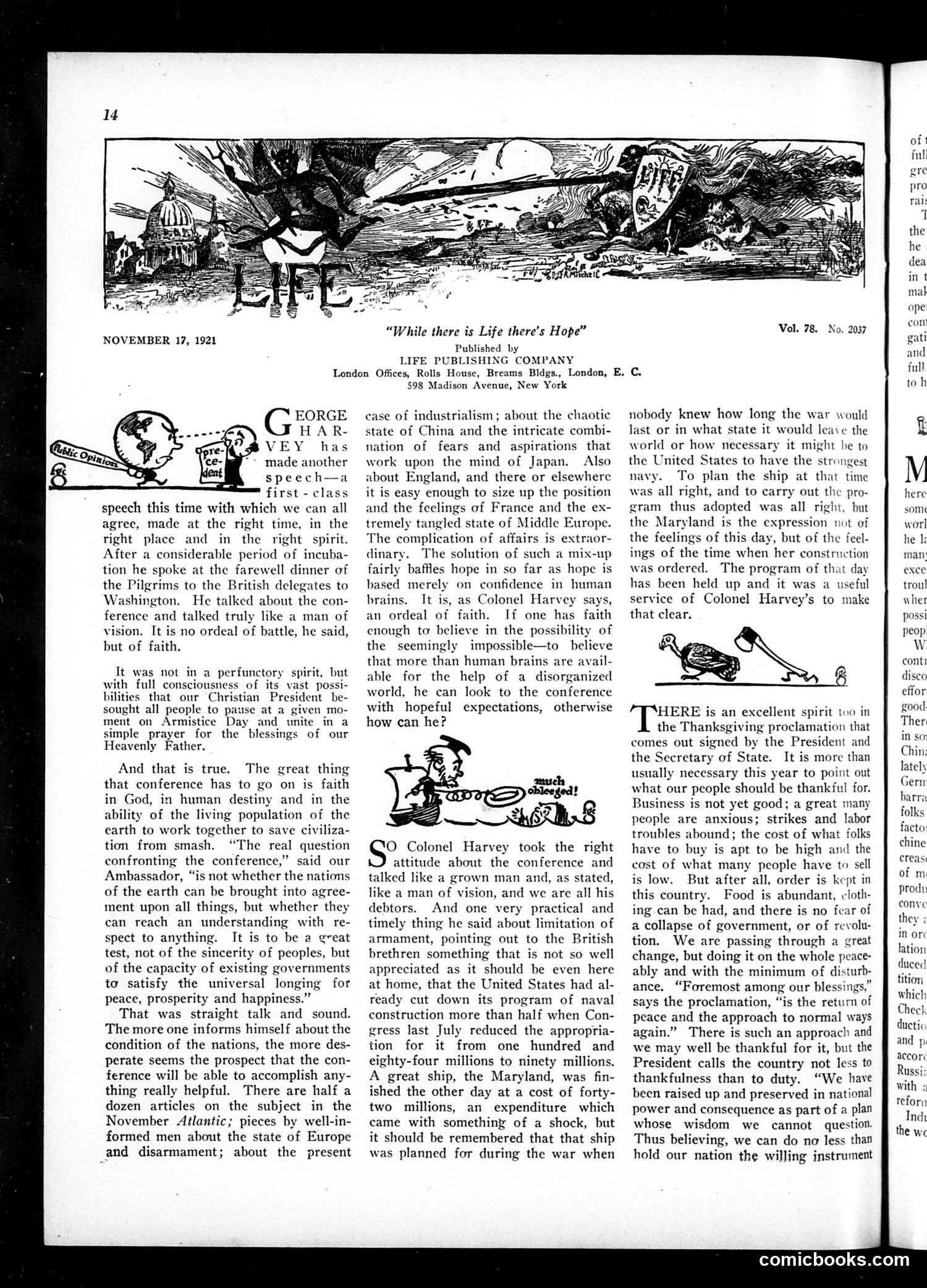
This page features an editorial by George Harvey titled "While there is Life there's Hope." The main text discusses a recent conference (likely the Washington Naval Conference of 1921) and Colonel Harvey's optimistic perspective on international diplomacy. The small cartoon illustrations appear to be decorative elements supporting the editorial rather than standalone satire. One shows a figure with what seems to be military or diplomatic insignia. Harvey's piece emphasizes faith in human ability to resolve global complications through reasonable discussion, and praises the Thanksgiving proclamation from the Secretary of State for reminding Americans to be thankful despite ongoing economic anxieties and labor troubles. The content reflects post-WWI optimism about peace-building through diplomatic conferences.
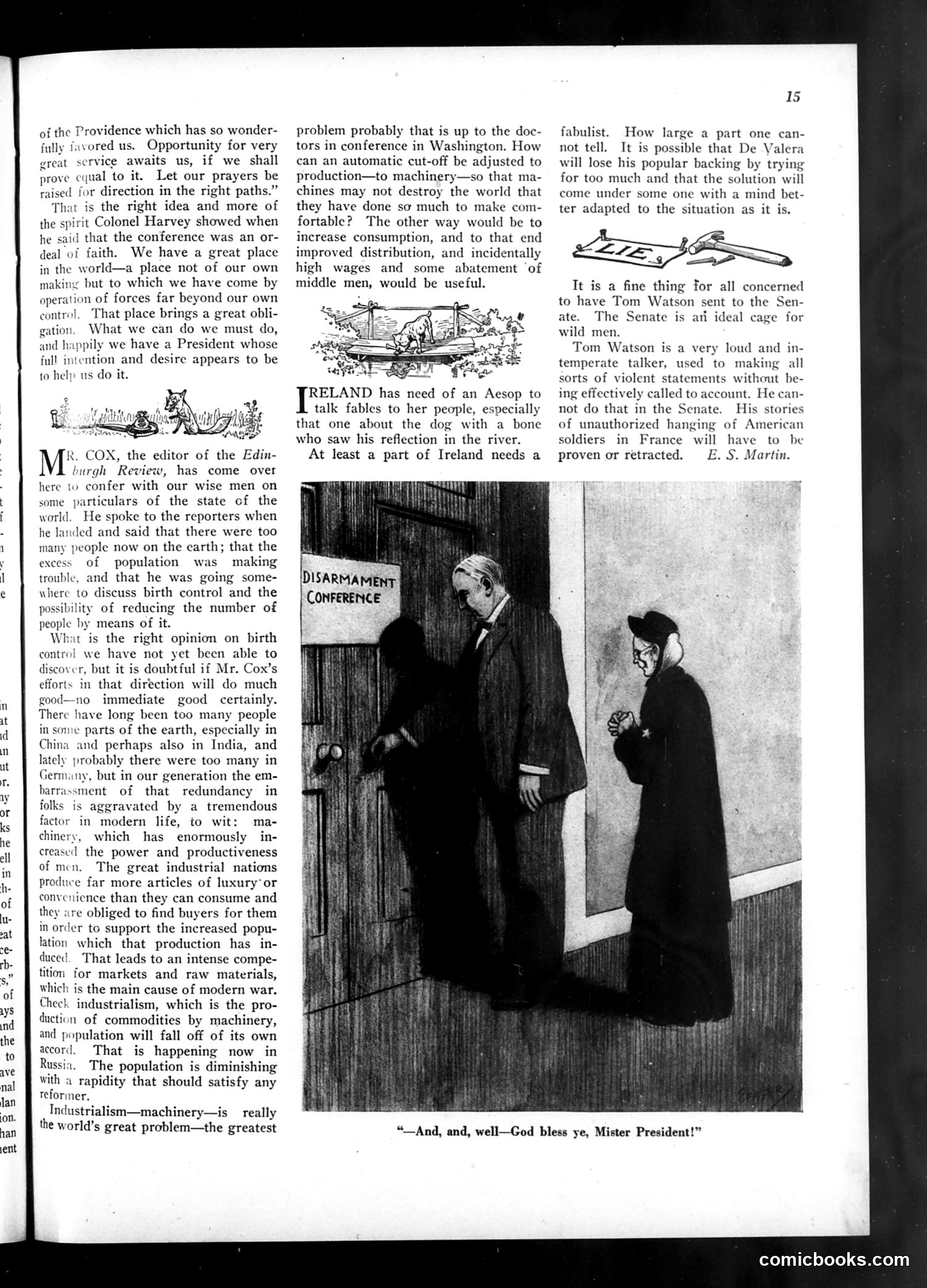
The photograph shows a **Disarmament Conference** scene with two figures—one appears to be a dignitary or politician at a door marked "DISARMAMENT CONFERENCE," greeting what looks like an Irish or working-class visitor. The caption "—And, and, well—God bless ye, Mister President!" suggests ironic humor about the contrast between grand diplomatic ambitions and humble, common people's perspectives. The surrounding text discusses serious post-WWI issues: overpopulation (citing editor Mr. Cox), industrial production as a cause of modern war, and Irish politics (mentioning De Valera). It also criticizes Tom Watson's appointment to the Senate, noting his unsubstantiated claims about American soldiers in France require proof. The satire appears to mock the earnestness of peace conferences while highlighting real-world problems—industrialism, resource competition, and political figures making inflammatory claims—that such conferences cannot solve. The cartoon suggests naive faith in diplomatic solutions.
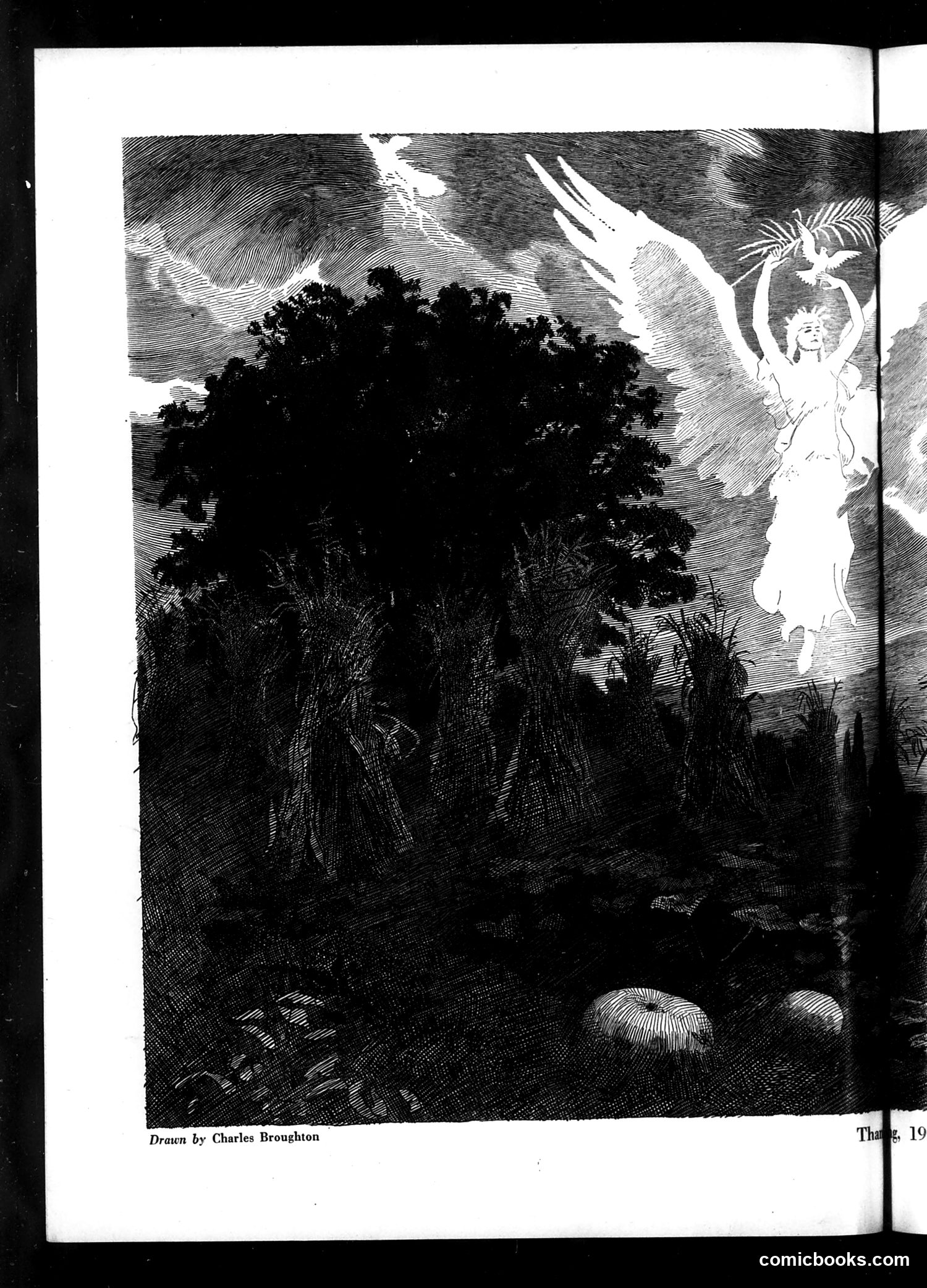
This is a Charles Broughton illustration (credited at bottom) depicting a nighttime scene with strong religious or allegorical imagery. A luminous angelic or divine female figure appears in the upper right, seemingly descending or manifesting above a darkened landscape. Below, silhouetted figures—possibly soldiers or common people—gather beneath large trees, gazing upward toward this apparition. The composition suggests a vision or miracle narrative. Without additional OCR text (the OCR here appears corrupted), the specific satirical target is unclear. This could reference religious fervor, spiritualism, divine intervention in worldly affairs, or a political leader being treated as messiah-like. The contrast between the bright spiritual figure and the dark earthly realm below emphasizes the satire's point about idealism versus reality. The page number indicates this appeared in *Life* magazine, a publication known for political and social satire in early-to-mid 20th century America.
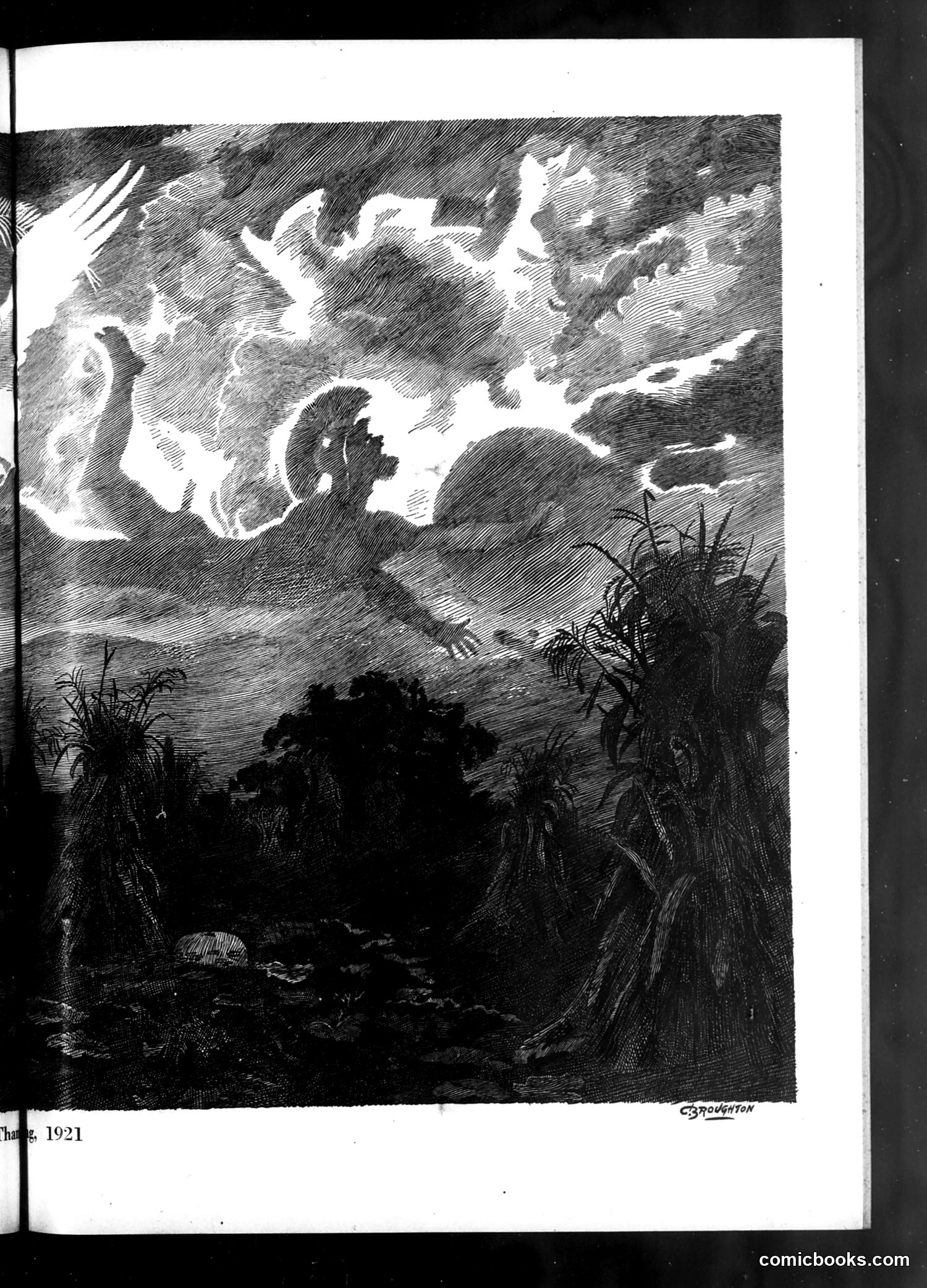
This appears to be an engraving or illustration by C. Roughton (signed lower right), dated 1921. The image depicts a nighttime tropical or swampy landscape with silhouetted palm trees in the foreground and elaborate, ghostly or demonic figures swirling in the sky above—possibly representing supernatural or allegorical forces. Without accompanying text or caption visible on this page, the specific satirical or political meaning is unclear. The 1921 date and dramatic imagery suggest it may reference post-WWI anxieties, social unrest, or moral concerns of the era, but I cannot definitively identify what particular event, figure, or social commentary it targets based solely on the visual content shown. The artistic style is characteristic of early 20th-century magazine illustration.
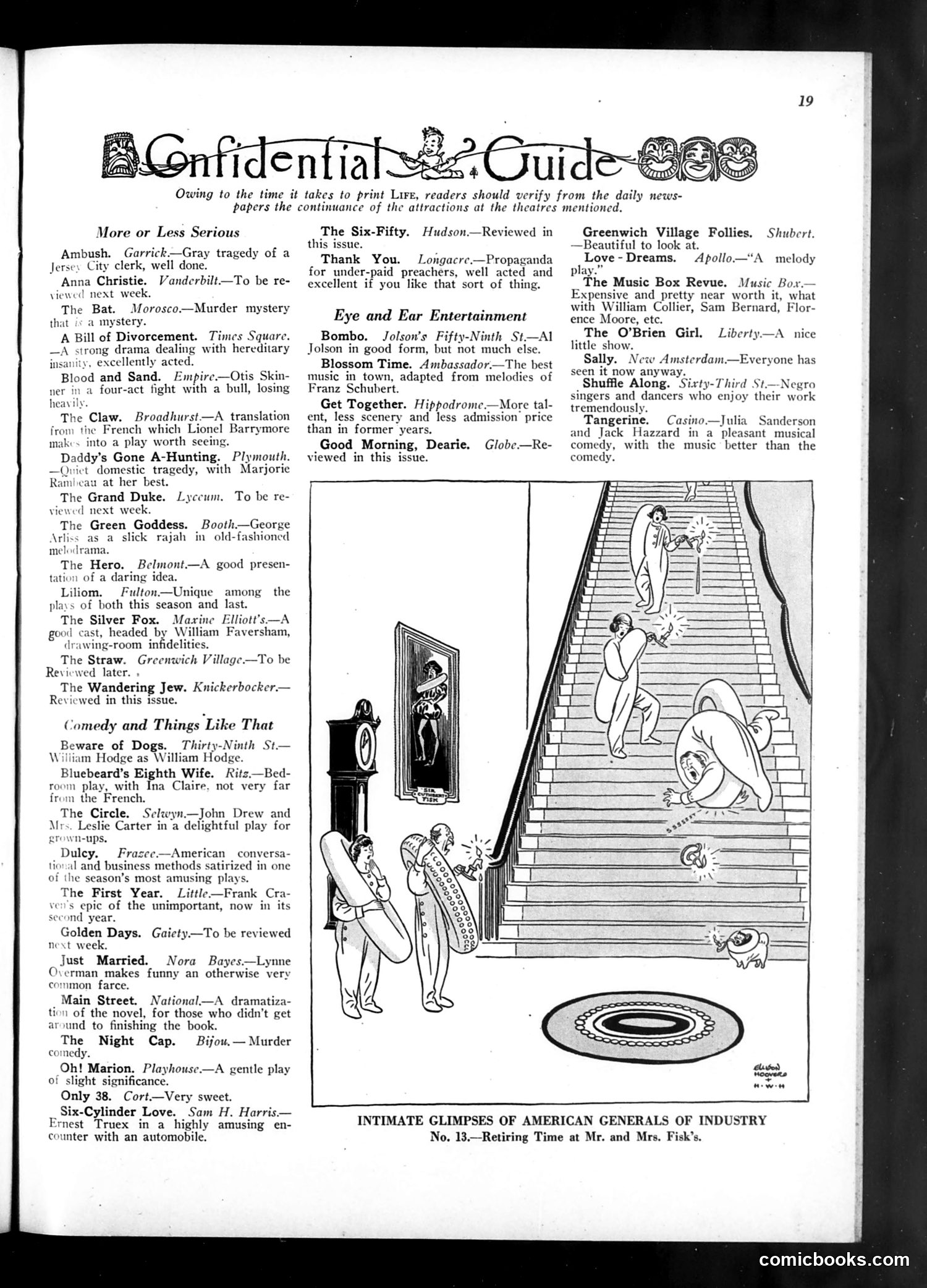
This page is primarily a **theater guide** listing Broadway shows and reviews from what appears to be the early 1920s. The main cartoon illustrates the caption "Intimate Glimpses of American Generals of Industry: No. 13—Retiring Time at Mr. and Mrs. Fisk's." The satire depicts wealthy industrialists (the Fisks) at bedtime in an absurdly grand mansion—figures laboriously climbing an enormous staircase, preparing for sleep with exaggerated formality. The joke mocks the excessive wealth and ostentatious lifestyles of America's industrial elite, treating mundane domestic activities as if they were epic undertakings requiring tremendous effort and elaborate pageantry. This reflects *Life* magazine's satirical stance critiquing the conspicuous consumption and pretensions of the rich during the Jazz Age. The cartoon series appears ongoing ("No. 13"), suggesting regular mockery of wealthy industrialists' daily lives as comedic fodder for the magazine's audience.
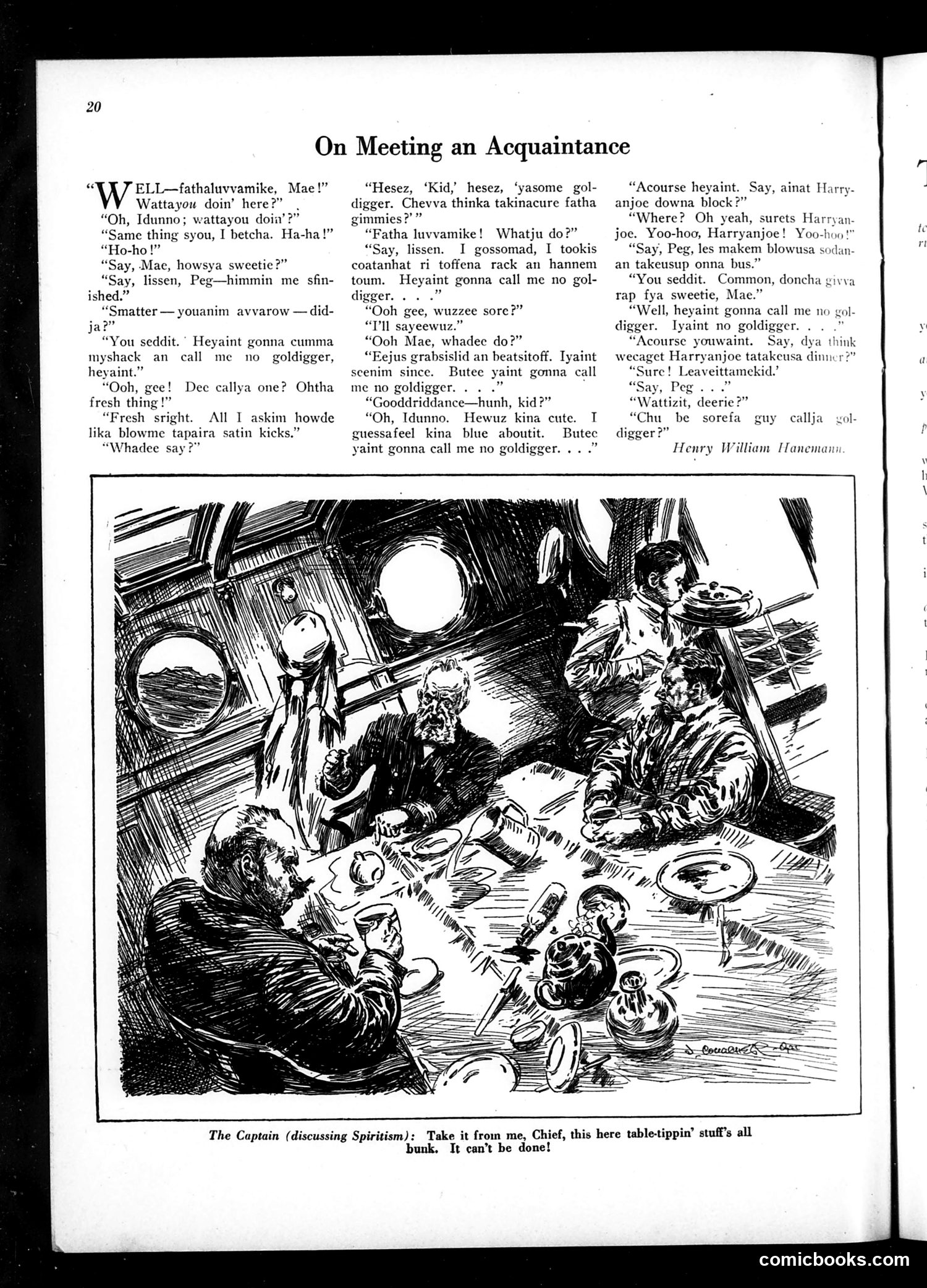
This page presents a satirical dialogue in exaggerated working-class dialect, capturing early 20th-century urban slang and social attitudes. The text depicts two young women gossiping about relationships and dating, using period-specific language ("goldigger," "sweetie," "dough"). The humor centers on the repeated refrain that a boyfriend won't call the narrator a "goldigger" (a woman pursuing men for money)—despite her apparent willingness to manipulate or abandon relationships casually. The satire mocks both the women's materialistic attitudes and their defensive posturing about moral propriety. The accompanying illustration shows people dining together in what appears to be a ship's cabin. The caption below features "The Captain" dismissing spiritualism as impossible—likely social commentary on period fads. The overall piece satirizes modern urban social behavior, particularly young women's dating practices and the tension between expressed values and actual conduct.
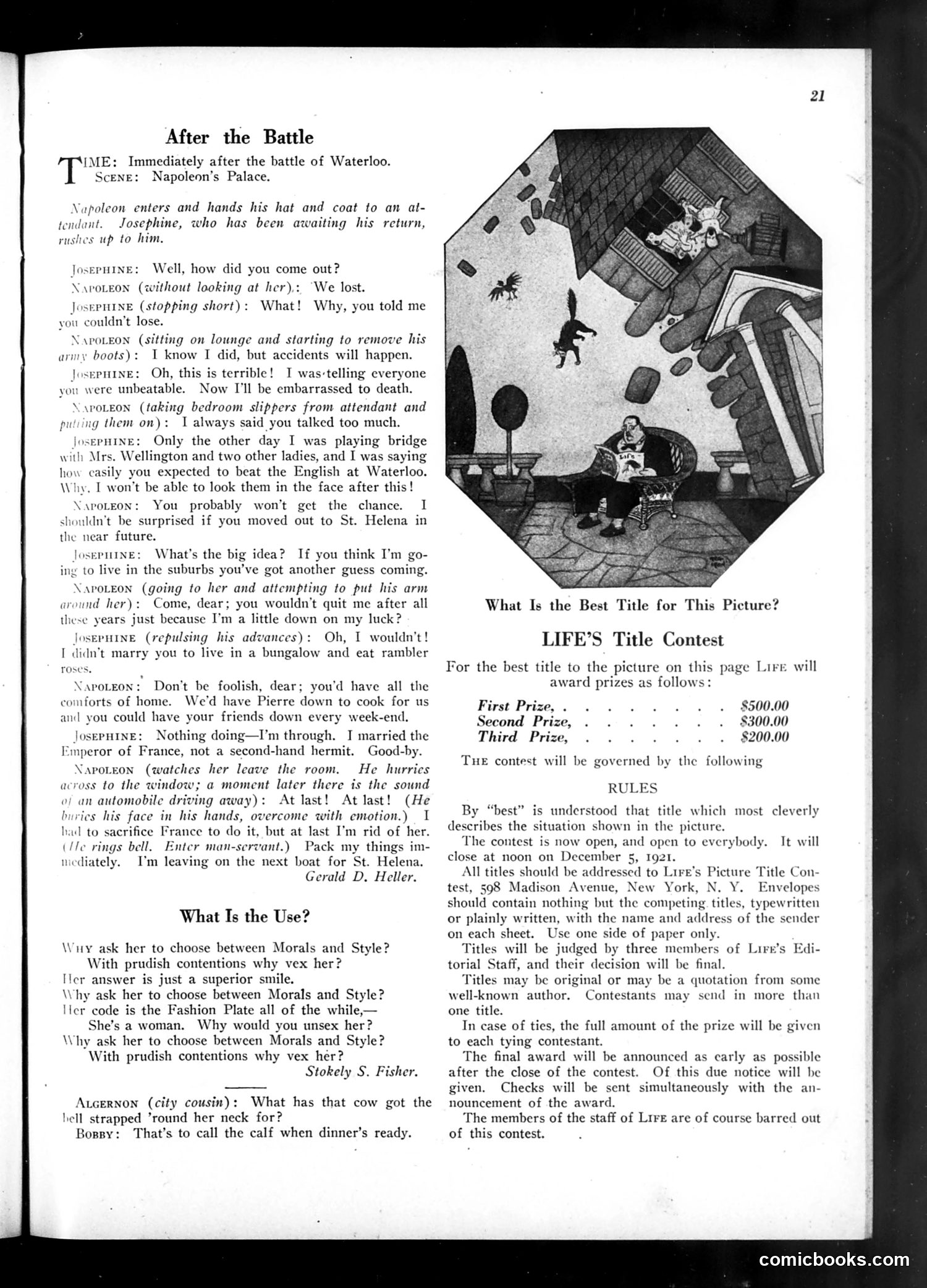
This page from *Life* magazine (circa 1921) contains a satirical sketch mocking Napoleon Bonaparte after his defeat at Waterloo. The humor depends on subverting expectations: rather than depicting Napoleon devastated by military defeat, the sketch shows him relieved to be rid of his ex-wife Josephine, who abandoned him upon learning of his loss. The satire's point is twofold—it trivializes Napoleon's historic downfall by making his personal embarrassment the real concern, and it portrays Josephine as a shallow social climber who only valued him for his power and status. The reference to St. Helena (where Napoleon was actually exiled) adds historical accuracy for contemporary readers familiar with this fact. The page also includes unrelated poetry and a joke about cow bells, plus a *Life* magazine contest inviting readers to title an accompanying illustration.
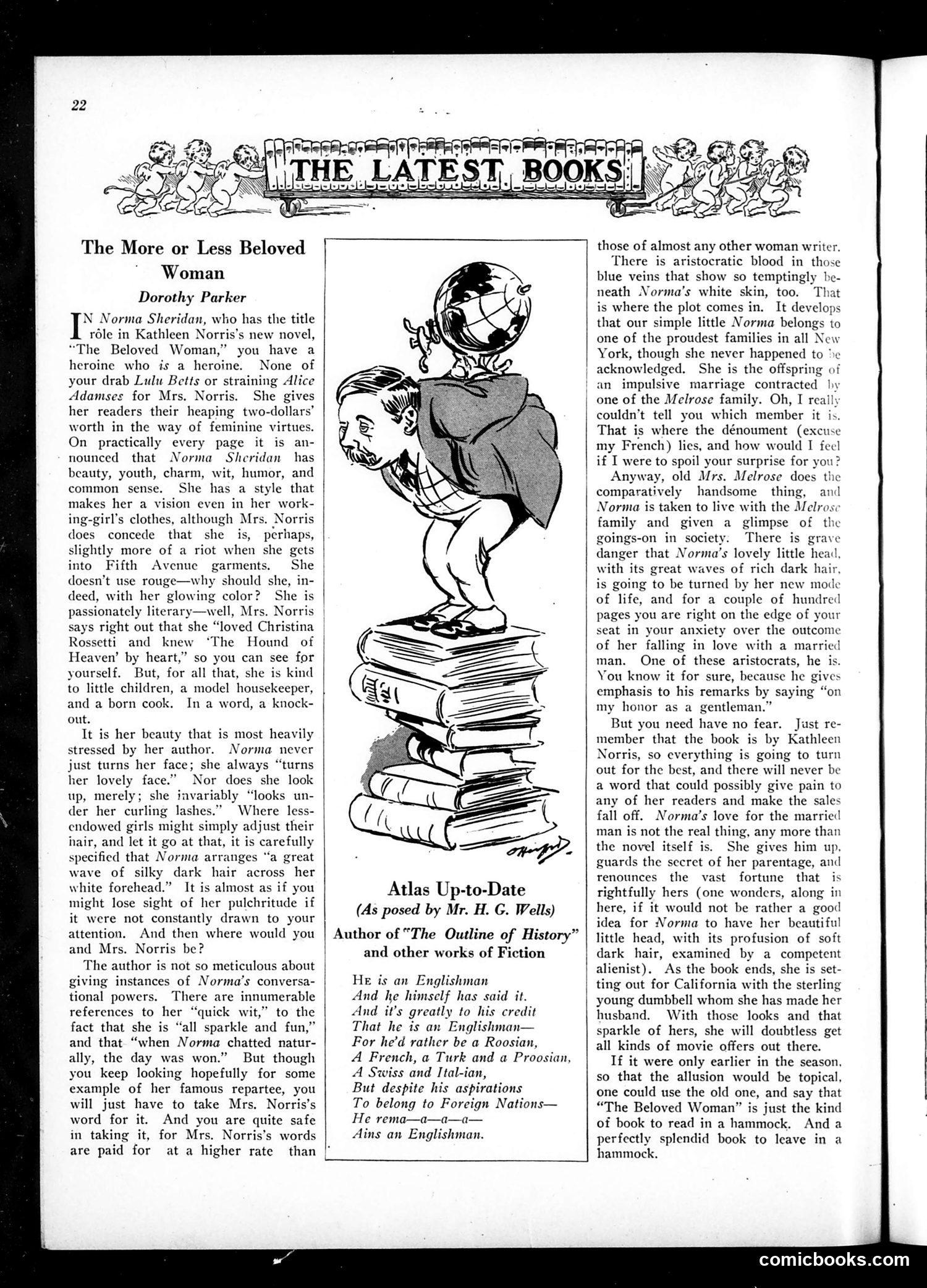
This page contains a literary review by Dorothy Parker satirizing Kathleen Norris's novel "The Beloved Woman." Parker mocks the heroine Norma Sheridan as an unrealistically perfect character—repeatedly described as beautiful, witty, and virtuous, yet never shown actually *demonstrating* these qualities through dialogue or action. The satire highlights the gap between authorial *telling* and *showing*: we're constantly assured of Norma's charm and repartee but given no examples. The accompanying illustration depicts a caricatured H.G. Wells standing atop stacked books, presenting his "Atlas Up-to-Date" in mock-heroic pose. The verse humorously notes Wells is English yet aspires to other nationalities—a gentle jab at his cosmopolitan intellectual pretensions. Both pieces exemplify Life magazine's literary criticism through witty mockery of contemporary popular fiction and its authors.
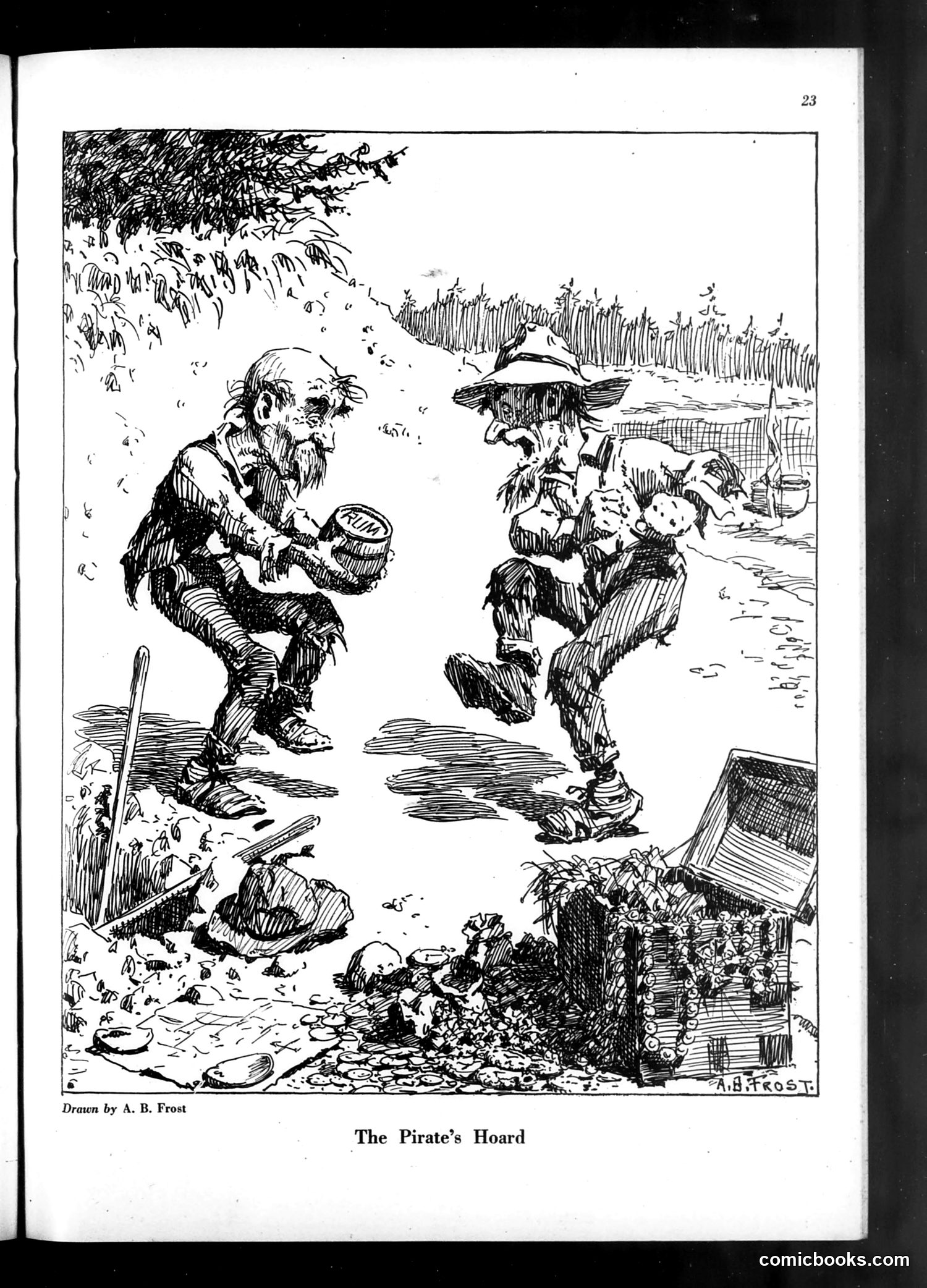
This cartoon by A. B. Frost depicts two grotesque figures examining a treasure chest filled with coins and valuables. The exaggerated facial features and caricatured design suggest these represent specific contemporary figures or types, though their exact identities aren't labeled on the page. The "pirate's hoard" title suggests satirical commentary on wealth accumulation or theft—likely targeting wealthy industrialists, politicians, or corrupt officials of the era who were metaphorically "pirating" resources or money. The crude, villainous depiction of the figures examining the treasure implies criticism of greed or ill-gotten gains. Without additional context about *Life* magazine's date and contemporary events, the specific targets remain unclear, though the visual message condemns opportunistic wealth-seeking.
This page reviews three silent films from approximately the 1920s. "Conflict" stars Priscilla Dean in a melodrama about rival lumbermen competing over a woman, featuring a climactic log-jam scene. The critic praises it as her best work. "Two Minutes to Go" stars Charles Ray as a football hero, but the reviewer criticizes it as a low point in Ray's career, noting Ray succeeds only because extras deliberately avoid tackling him properly. "The Ace of Hearts" features the "Mystic Council"—a secret society that uses card-drawing to assign murders to members. The critic finds the plot clever but faults the film's intertitles (text cards) as banal, citing an instance where a dramatic moment is undercut by bland dialogue.
This is a straightforward advertisement for Phoenix Hosiery, not satire or political commentary. The ad uses a clever pun on "seven-league boots" (from fairy tales, enabling magical long-distance travel) to market hosiery's durability and "long mileage." The pitch emphasizes practical virtues—quality material and workmanship—rather than novelty or gimmicks. It's pitched to "men, women and children," claiming Phoenix is the world's best-selling hosiery line. The ornate decorative border typical of early 20th-century magazine design frames the message. This appears to be a full-page advertisement in *Life* magazine, designed to appeal to consumers seeking reliable, economical everyday wear that lasts through extensive use.
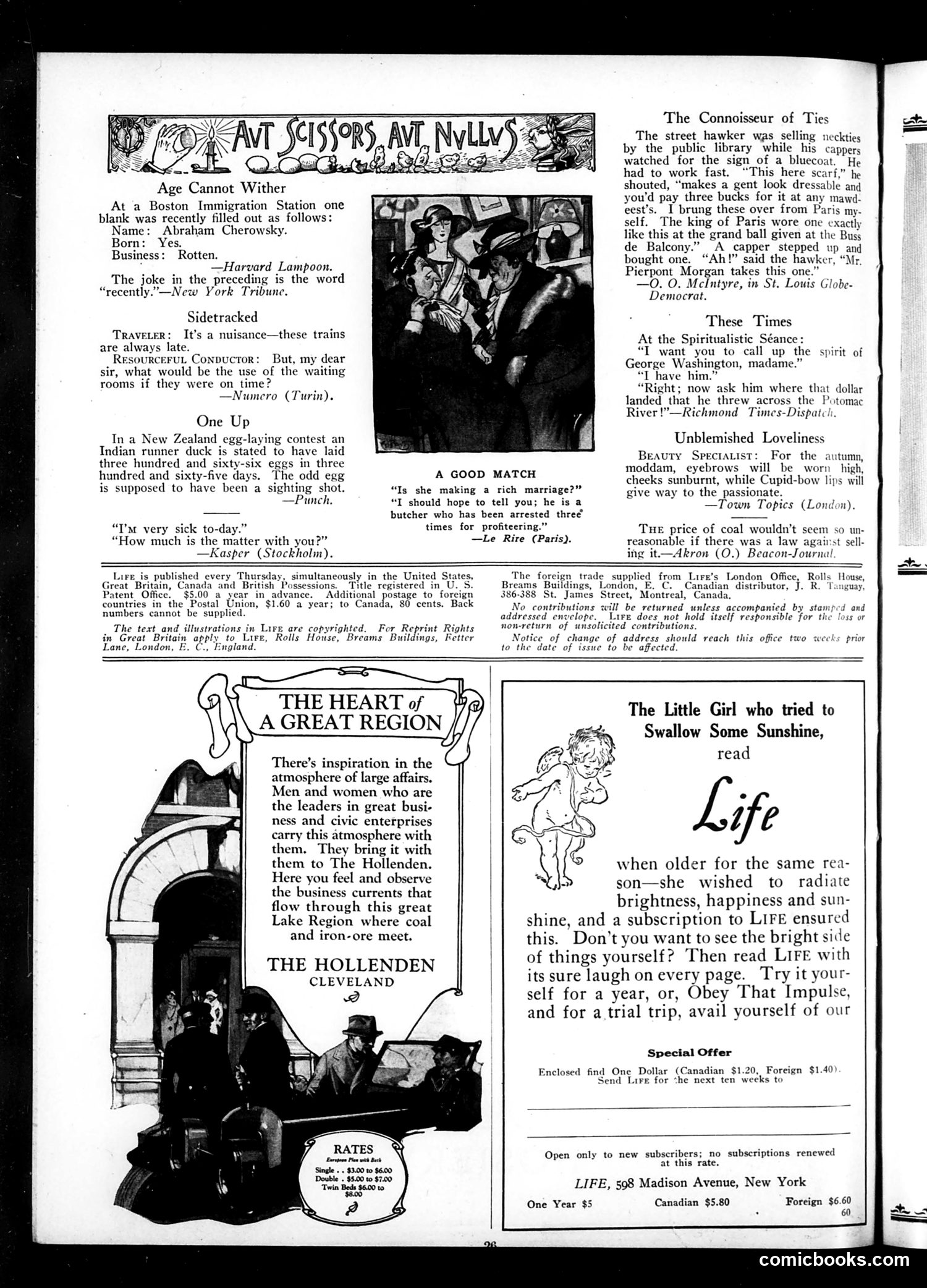
This page from *Life* contains several satirical short items and advertisements typical of early-20th-century American humor magazines. The upper section features brief comic anecdotes reprinted from various international publications. "A Good Match" (from Paris's *Le Rire*) jokes about a woman marrying a butcher arrested repeatedly for "profiteering"—wartime price-gouging—suggesting his criminal profit-making qualifies as a "match" to her mercenary interests. "These Times" references George Washington's famous legend of throwing money across the Potomac, reframed as a current concern about inflation and cost of living. "The Connoisseur of Ties" describes a street vendor employing con-artists ("cappers") to pose as customers, selling dubious merchandise by falsely claiming royal patronage—standard period street-scam satire. The page also advertises *Life* magazine subscriptions and *The Hollenden* hotel in Cleveland, typical period advertising. The humor is gentle, topical mockery of inflation, street commerce, and social pretension rather than sharp political satire.
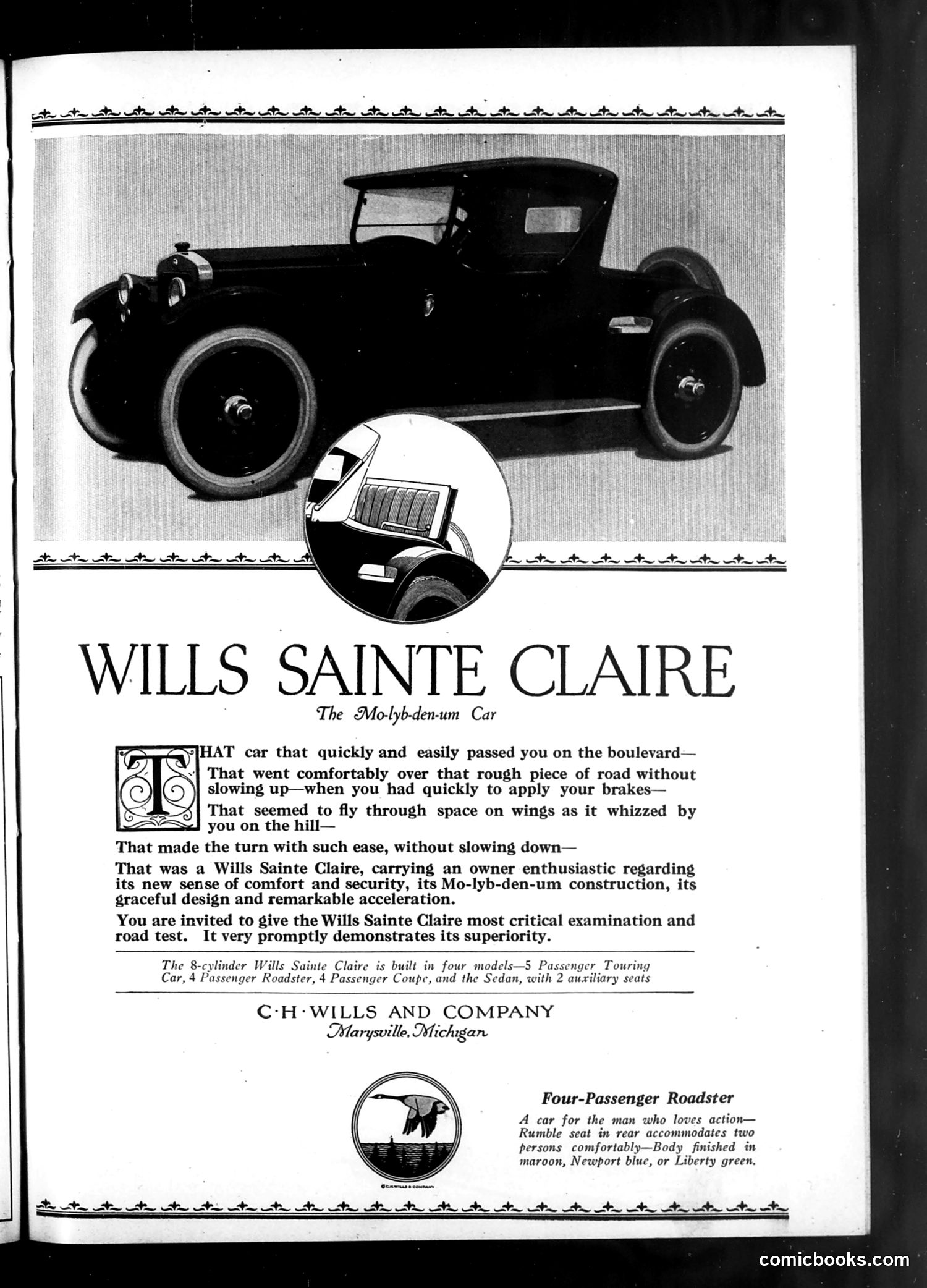
This is a **automobile advertisement**, not political satire. It promotes the Wills Sainte Claire, a luxury car manufactured by C.H. Wills and Company in Marysville, Michigan. The ad uses narrative descriptions of driving experiences—passing other cars, handling rough roads, making turns easily—to highlight the vehicle's superior performance and "Mo-lyb-den-um" (molybdenum steel) construction. The small inset illustration shows a close-up detail of the car's interior. For modern readers: This represents early automotive advertising's emphasis on mechanical innovation and performance capabilities. The molybdenum steel reference was a genuine technological selling point of the era. The "Four-Passenger Roadster" with a rumble seat was a popular open-air style. The color options (maroon, Newport blue, Liberty green) reflect 1920s luxury market preferences. This is primarily commercial content rather than editorial commentary or satire.
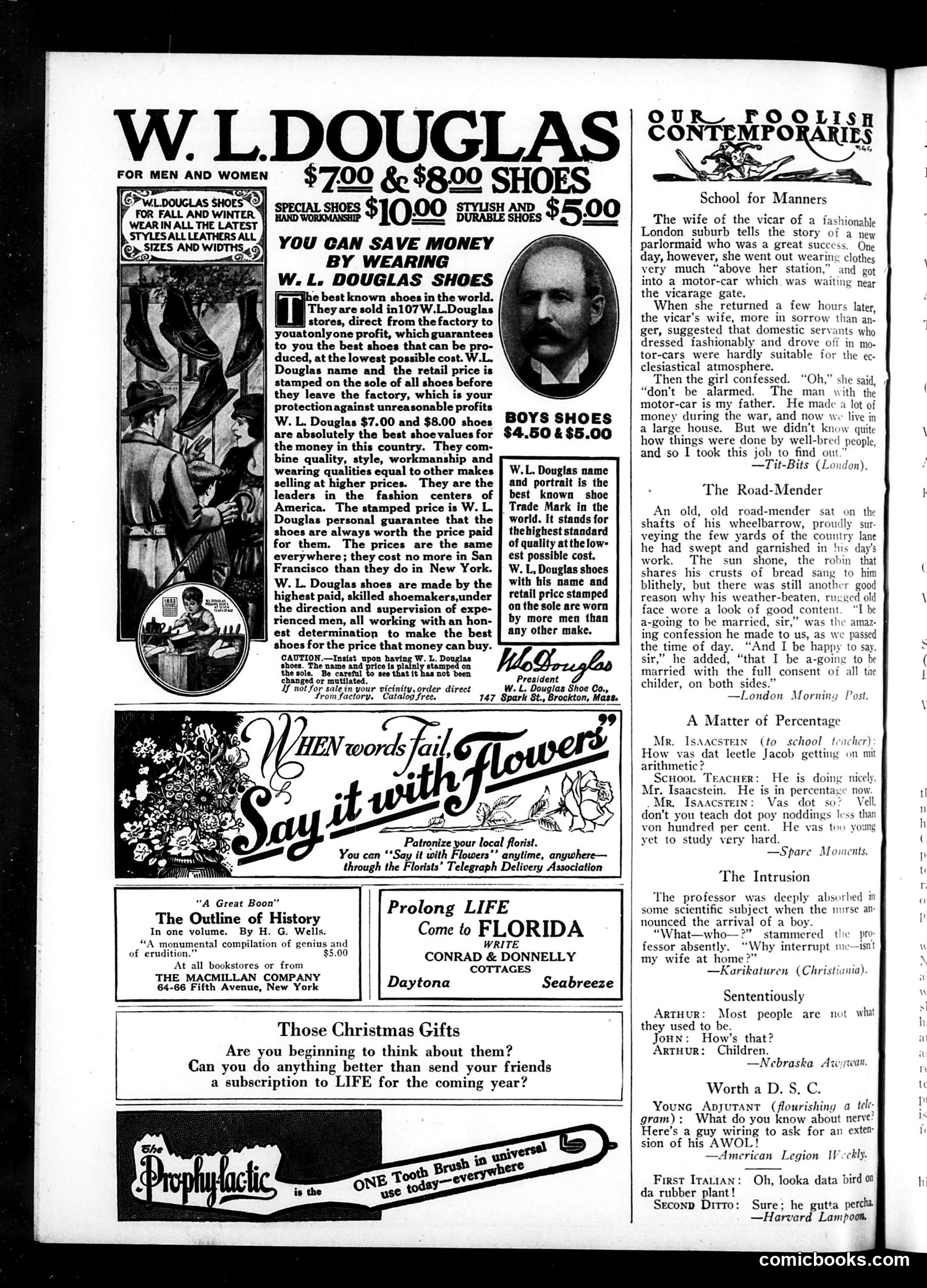
This page is primarily **advertising**, not political satire. The dominant content is a large W.L. Douglas shoe advertisement promoting shoes at $7-8 (men/women) and $4.50-5 (boys), emphasizing factory-direct pricing and quality. The small humorous items are light **social comedy**, not political: - **"School for Manners"**: A servant girl takes domestic work to learn "proper" etiquette from the middle class, revealing post-WWI social mobility—war profiteers' daughters now equal the gentry in wealth. - **"Road-Mender"** and other vignettes: Gentle, sentimental anecdotes about working-class dignity and simple contentment. - **"Say it with Flowers"**: A florist advertisement using the popular phrase (1920s marketing slogan). The page reflects Life magazine's mix of commercial ads, product endorsements, and brief amusing human-interest stories rather than political commentary. Context: this appears early 20th century based on motor-cars, wartime references, and typography.
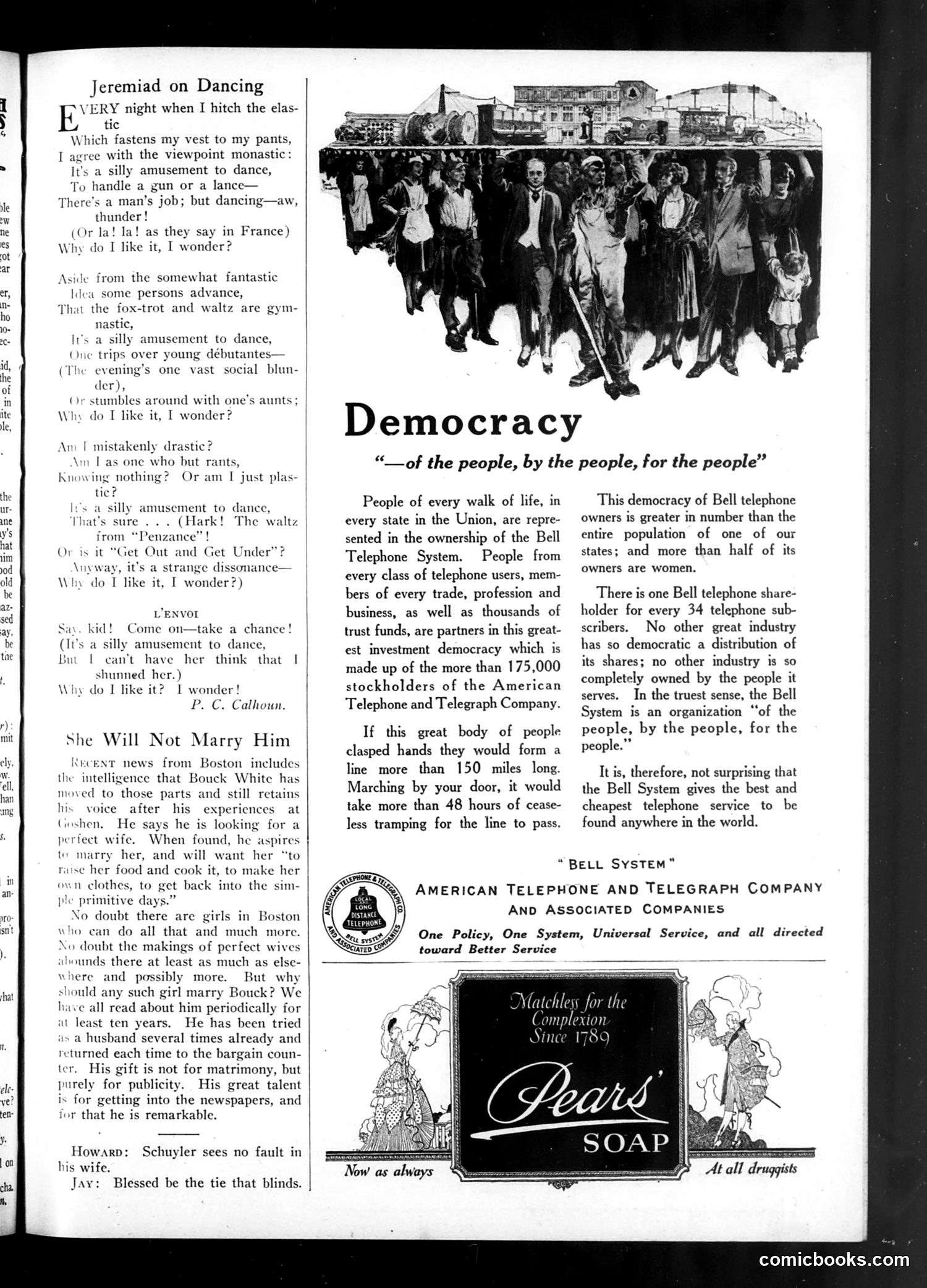
This page contains three distinct items: **"Jeremiad on Dancing"** (left): A humorous poem by P. C. Calhoun mocking the author's own contradictory feelings about dancing. He claims dancing is "silly" and unmanly compared to "real" work, yet admits he enjoys it anyway—a self-aware satire of pretentious masculinity and social hypocrisy common in the era. **"Democracy"** (center): A Bell Telephone advertisement presenting the company as democratically owned. It claims 175,000+ stockholders represent "the people," including women and working-class members. This is propaganda framing corporate capitalism as populist—a claim that would strike modern readers as absurd. **"She Will Not Marry Him"** (left): A brief item about activist Bouck White, mocking his repeated failed marriages. The joke: he's a publicity-seeker whose talent is getting newspaper attention, not domestic stability—a cautionary tale about vanity. The advertisements (Pear's Soap) are incidental.
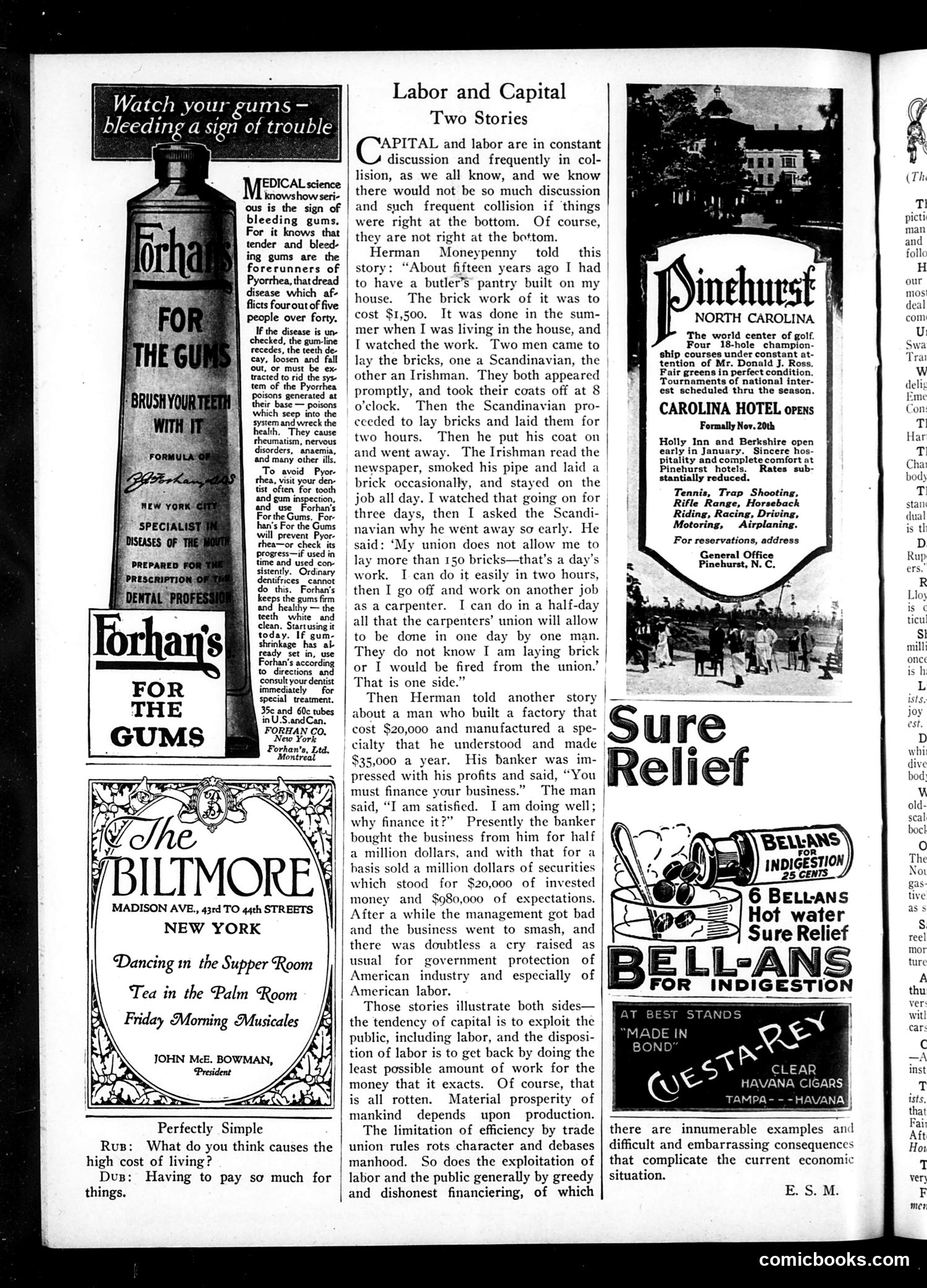
This page presents two cautionary tales about labor-capital relations. Herman Moneypenny recounts observing brickworkers: a Scandinavian who efficiently completed a day's work in two hours then left (bound by union rules limiting output to 150 bricks daily), versus an Irishman who worked the full day at slower pace. The story illustrates union restrictions on productivity. The second anecdote describes a factory owner who built a profitable $20,000 business earning $35,000 yearly. A banker convinced him to "finance" it; the banker bought controlling interest, sold securities, then mismanagement caused collapse—prompting calls for government protection. The author (E.S.M.) uses these narratives to critique both labor unions (for artificially limiting work) and capital (for speculative financing and inefficiency), arguing both exploit the public through "greedy and dishonest financing." The piece frames labor-capital conflict as rooted in mutual dysfunction benefiting neither workers nor honest industry.
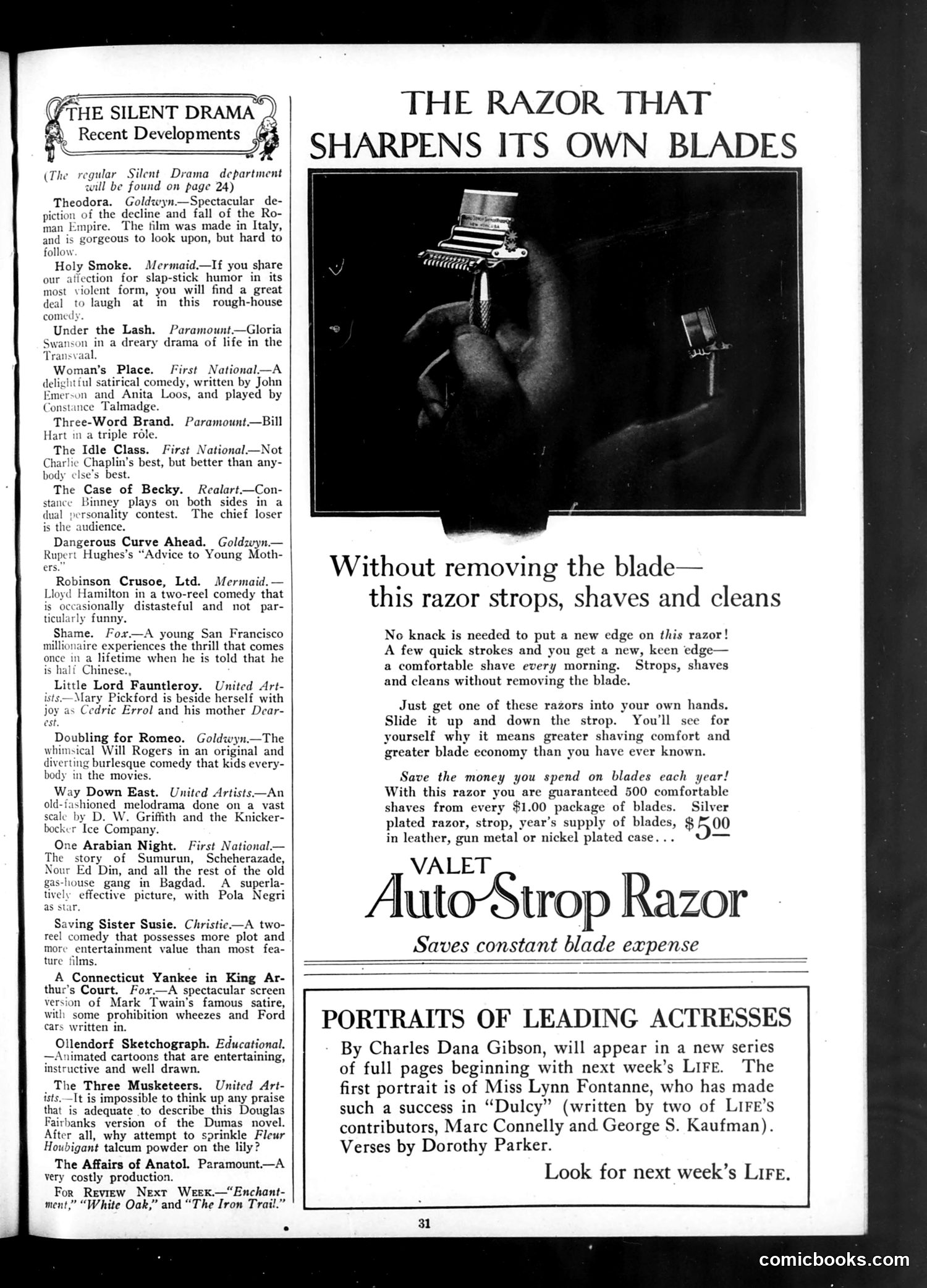
This is primarily a **product advertisement** for the Valet Auto-Strop Razor, with a film review section above it. The left column contains brief reviews of silent films—"The Three Musketeers," "Way Down East," "Little Lord Fauntleroy," and others—typical of Life magazine's entertainment coverage from the early 1920s. The main content is a **razor advertisement** featuring a photograph of the self-stropping mechanism. The ad's pitch is straightforward: this razor automatically sharpens itself without blade removal, saving money on replacements. The promise of "500 comfortable shaves from every $1.00 package" and elimination of blade expense represents the marketing angle. There is **no satire or political commentary** on this page. It's a standard commercial advertisement using the magazine's editorial space, alongside announcements about upcoming portrait features of actresses by artist Charles Dana Gibson.
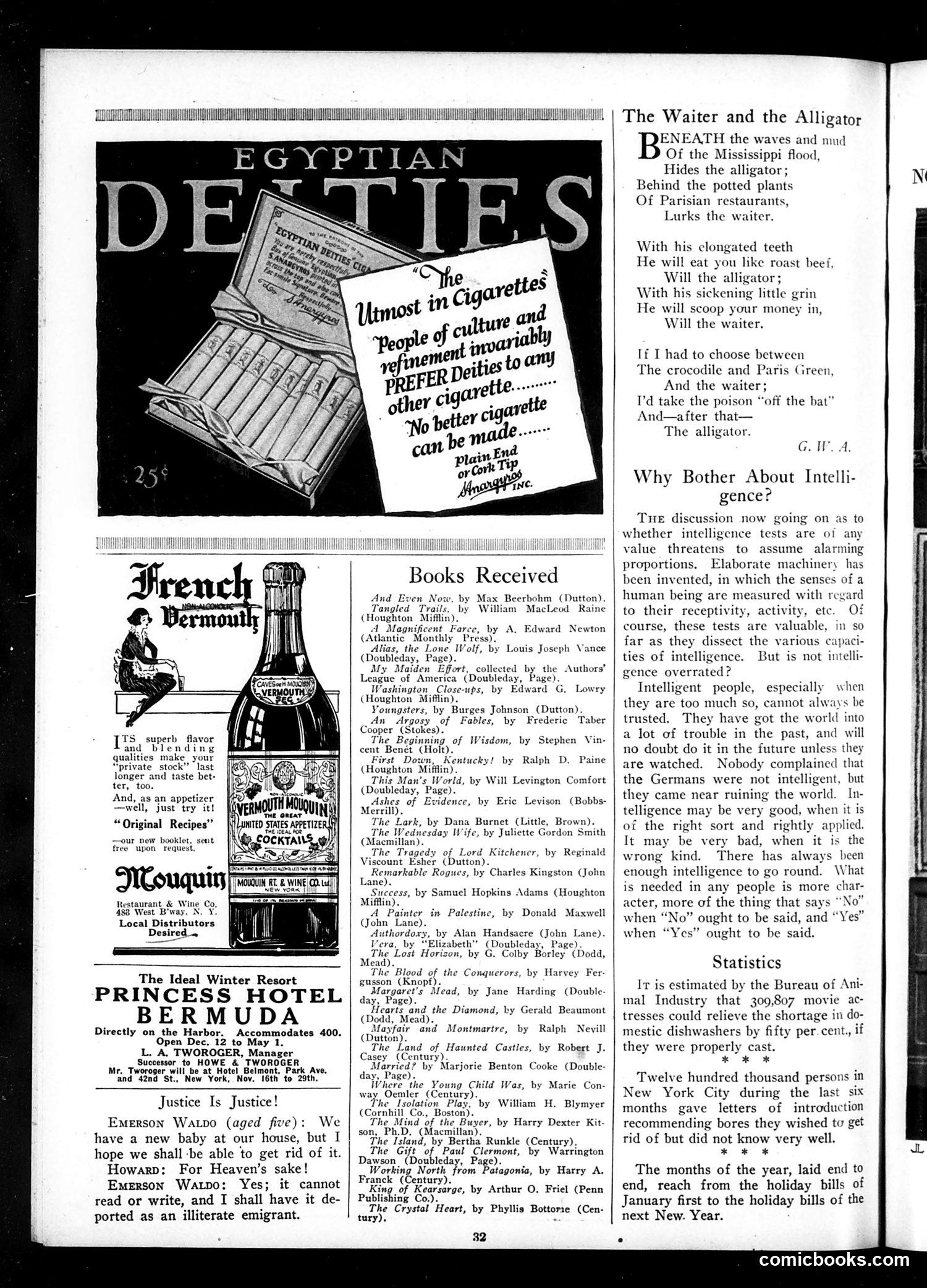
This page contains three satirical pieces typical of *Life* magazine's humor: **"The Waiter and the Alligator"** is a humorous poem contrasting the Mississippi River alligator with a Parisian restaurant waiter. The joke equates the waiter's predatory behavior (overcharging diners, "scooping your money in") with a dangerous animal. It's a common satirical jab at fine dining establishments, suggesting waiters exploit wealthy patrons as ruthlessly as predators. The poet humorously claims the alligator would be preferable. **"Justice Is Justice!"** is a brief comic dialogue where a five-year-old named Emerson Waldo suggests deporting his newborn baby brother as an "illiterate emigrant" because the infant cannot read or write. This satirizes contemporary immigration restrictions and literacy tests used to limit immigration—absurdly applying these adult political criteria to a helpless baby. Both pieces use exaggeration and unexpected comparisons to mock social targets: restaurant pricing practices and restrictive immigration policies.