
Life, 1921-11-17 · page 16 of 34
Life — November 17, 1921 — page 16: what you’re looking at
What you’re looking at
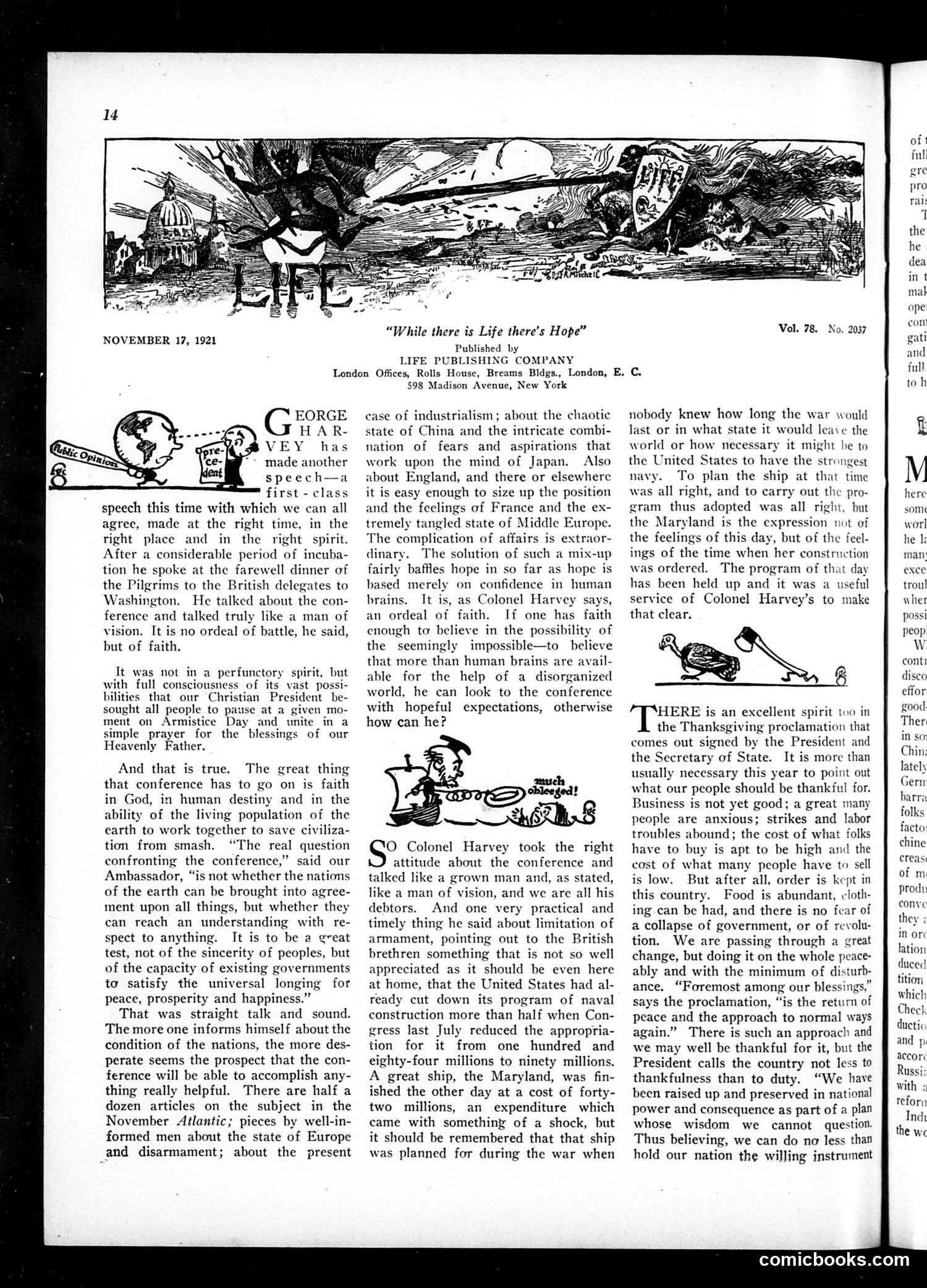
This page features an editorial by George Harvey titled "While there is Life there's Hope." The main text discusses a recent conference (likely the Washington Naval Conference of 1921) and Colonel Harvey's optimistic perspective on international diplomacy. The small cartoon illustrations appear to be decorative elements supporting the editorial rather than standalone satire. One shows a figure with what seems to be military or diplomatic insignia. Harvey's piece emphasizes faith in human ability to resolve global complications through reasonable discussion, and praises the Thanksgiving proclamation from the Secretary of State for reminding Americans to be thankful despite ongoing economic anxieties and labor troubles. The content reflects post-WWI optimism about peace-building through diplomatic conferences.
📄 Transcribed text from this page (OCR, searchable)
Machine-transcribed from the original scan — historical spelling and the odd misread are preserved.
NOVEMBER 17, 1921 London Offices, Rolls House EORGE H AR- VEY has made anomier speech this time with which we can all agree, made at the right time, in the right place and in the right spirit. After a considerable period of incuba- tion he spoke at the farewell dinner of the Pilgrims to the British delegates to Washington. He talked about the con- ference and talked truly like a man of vision. It is no ordeal of battle, he said, but of faith. Tt was not in a perfunctory spirit, but with full consciousness of its vast possi- bilities that our Christian President be- sought all people to pause at a given mo- ment on Armistice Day and unite in a simple prayer for the blessings of our Heavenly Father. And that is true. The great thing that conference has to go on is faith in God, in human destiny and in the ability of the living population of the earth to work together to save civiliza- tion from smash. “The real question confronting the conference,” said our Ambassador, “is not whether the nations of the earth can be brought into agree- ment upon all things, but whether they can reach an understanding with re- spect to anything. It is to be a great test, not of the sincerity of peoples, but of the capacity of existing governments to satisfy the universal longing for peace, prosperity and happiness.” That was straight talk and sound. The more one informs himself about the condition of the nations, the more des- perate seems the prospect that the con- ference will be able to accomplish any- thing really helpful. There are half a dozen articles on the subject in the November Atlantic; pieces by well-in- formed men about the state of Europe and disarmament; about the present “While there is Life there’s Hope” Published by LIFE PUBLISHING COMPANY 598 Madison Avenue, New York case of industrialism; about the chaotic state of China and the intricate combi- nation of fears and aspirations that work upon the mind of Japan. Also about England, and there or elsewhere it is easy enough to size up the position and the feelings of France and the ex- tremely tangled state of Middle Europe. The complication of affair: <traor- dinary. The solution of such a mix-up fairly baffles hope in so far as hope is based merely on confidence in human brains. It is, as Colonel Harvey S, an ordeal of faith. If one has faith enough to believe in the possibility of the seemingly impossible—to believe that more than human brains are avail- able for the help of a disorganized world, he can look to the conference with hopeful expectations, otherwise how can he? O Colonel Harvey took the right attitude about the conference and talked like a grown man and, as stated, like a man of vision, and we are all his debtors. And one very practical and timely thing he said about limitation of armament, pointing out to the British brethren something that is not so well appreciated as it should be even here at home, that the United States had al- ready cut down its program of naval construction more than half when Con- gress last July reduced the appropria- tion for it from one hundred and eighty-four millions to ninety millions. A great ship, the Maryland, was fin- ished the other day at a cost of forty- two millions, an expenditure which came with something of a shock, but it should be remembered that that ship was planned for during the war when Vol. 78. No. 2037 Breams Bldgs., London, E. C. nobody knew how long the war would last or in what state it would leave the world or how necessary it might be to the United States to have the str ngest navy. To plan the ship at that time was all right, and to carry out the pro- gram thus adopted was all right, but the Maryland is the expression not of the feelings of this day, but of the feel- ings of the time when her construction ordered. The program of that day has been held up and it was a useful service of Colonel Harvey’s to make that clear. oO eS 6 HERE is an excellent spirit too in the Thanksgiving proclamation that comes out signed by the President and the Secretary of State. It is more than usually necessary this year to point out what our people should be thankful for. Business is not yet good; a great many people are anxious; strikes and labor troubles abound; the cost of what folks have to buy is apt to be high and the cost of what many pcople have to sell s low. But after all, order is kept in this country. Food is abundant, cloth- ing.can be had, and there is no fear of a collapse of government, or of revolu- tion. We are passing through a great change, but doing it on the whole peace- ably and with the minimum of disturb- ance. “Foremost among our blessings,” says the proclamation, “is the return of peace and the approach to normal ways again.” There is such an approach and we may well be thankful for it, but the President calls the country not less to thankfulness than to duty. “We have been raised up and preserved in national power and consequence as part of a plan whose wisdom we cannot question. Thus believing, we can do no less than hold our nation the willing instrument the he dea in t mal ope con gati and full toh i M here some worl he li man, exce troul wher possi peop effor good: Ther in so Chin: lately Gern barra folks facto chine creas of m produ conv they in orc lation duced tition whic! Cheek ductic and p accors Russi with Teforn Indi the w« comicbooks.com