
Life, 1921-11-17 · page 24 of 34
Life — November 17, 1921 — page 24: what you’re looking at
What you’re looking at
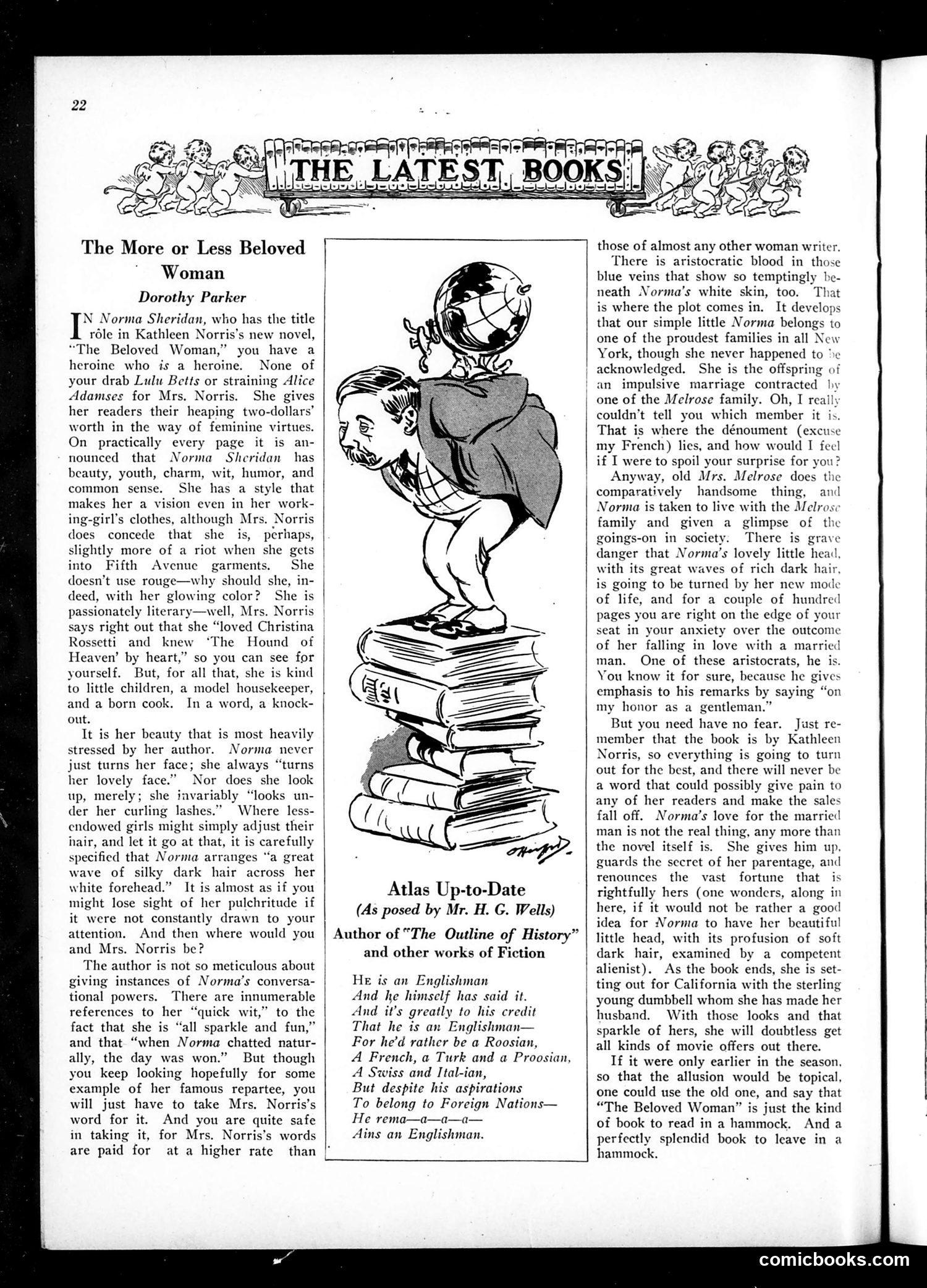
This page contains a literary review by Dorothy Parker satirizing Kathleen Norris's novel "The Beloved Woman." Parker mocks the heroine Norma Sheridan as an unrealistically perfect character—repeatedly described as beautiful, witty, and virtuous, yet never shown actually *demonstrating* these qualities through dialogue or action. The satire highlights the gap between authorial *telling* and *showing*: we're constantly assured of Norma's charm and repartee but given no examples. The accompanying illustration depicts a caricatured H.G. Wells standing atop stacked books, presenting his "Atlas Up-to-Date" in mock-heroic pose. The verse humorously notes Wells is English yet aspires to other nationalities—a gentle jab at his cosmopolitan intellectual pretensions. Both pieces exemplify Life magazine's literary criticism through witty mockery of contemporary popular fiction and its authors.
📄 Transcribed text from this page (OCR, searchable)
Machine-transcribed from the original scan — historical spelling and the odd misread are preserved.
The More or Less Beloved ’ Woman Dorothy Parker N Norma Sheridan, who has the title role in Kathleen Norris’s new novel, “The Beloved Woman,” you have a heroine who is a heroine. None of your drab Lulu Betts or straining Alice Adamses for Mrs. Norris. She gives her readers their heaping two-dollars’ worth in the way of feminine virtues. On practically every page it is an- nounced that Norma Sheridan has beauty, youth, charm, wit, humor, and common sense. She has a style that makes her a vision even in her work- ing-girl’s clothes, although Mrs. Norris does concede that she is, perhaps, slightly more of a riot when she gets | into Fifth Avenue garments. She doesn’t use rouge—why should she, in- deed, with her glowing color? She is passionately literary—well, Mrs. Norris says right out that she “loved Christina Rossetti and knew ‘The Hound of Heaven’ by heart,” so you can see for yourself. But, for all that, she is kind to little children, a model housekeeper, and a born cook. In a word, a knock- out. It is her beauty that is most heavily stressed by her author. Norma never just turns her face; she always “turns her lovely face.” Nor does she look up, merely; she invariably “looks un- der her curling lash Where less- endowed girls might simply adjust their hair, and let it go at that, it is carefully specified that Norma arranges “a great wave of silky dark hair across her white forehead.” It is almost as if you might lose sight of her pulchritude if it were not constantly drawn to your attention. And then where would you and Mrs. Norris be? The author is not so meticulous about | giving instances of Norma’s conversa- tional powers. There are innumerable references to her “quick wit,” to the fact that she is “all sparkle and fun,” and that “when Norma chatted natur- ally, the day was won.” But though you keep looking hopefully for some example of her famous repartee, you will just have to take Mrs. Norris’s word for it. And you are quite safe in taking it, for Mrs. Norris’s words are paid for at a higher rate than Atlas Up-to-Date (As posed by Mr. H. G. Wells) Author of “The Outline of History” and other works of Fiction He is an Englishman And he himself has said it. And it’s greatly to his credit That he is an Englishman— For he’d rather be a Roosian, A French, a Turk and a Proosian, A Swiss and Ital-ian, But despite his aspirations To belong to Foreign Nations— He rema—a—a—a— Ains an Englishman. those of almost any other woman writer. There is aristocratic blood in those blue veins that show so temptingly be- neath Norma’s white skin, too. That is where the plot comes in. It develops that our simple little Norma belongs to one of the proudest families in all New York, though she never happened to »e | acknowledged. She is the offspring of an impulsive marriage contracted hy one of the Melrose family. Oh, I reail; couldn’t tell you which member it is. That is where the dénoument (excuse my French) lies, and how would I if I were to spoil your surprise for you? Anyway, old Mrs. Melrose does comparatively handsome thing, and Norma is taken to live with the Melrose family and given a glimpse of the goings-on in society. There is grave danger that Norma’s lovely little head, with its great waves of rich dark hair, is going to be turned by her new mode of life, and for a couple of hundred pages you are right on the edge of your seat in your anxiety over the outcome of her falling in love with a married man. One of these aristocrats, he is. You know it for sure, because he gives emphasis to his remarks by saying “on my honor as a gentleman.” But you need have no fear. Just re- member that the book is by Kathleen Norris, so everything is going to turn out for the best, and there will never be a word that could possibly give pain to any of her readers and make the sales fall off. Norma’s love for the married man is not the real thing, any more than the novel itself is. She gives him up, guards the secret of her parentage, and renounces the vast fortune that is rightfully hers (one wonders, along in here, if it would not be rather a good idea for Norma to have her beautiful little head, with its profusion of soft dark hair, examined by a competent alienist). As the book ends, she is set- | ting out for California with the sterling young dumbbell whom she has made her husband. With those looks and that sparkle of hers, she will doubtless get all kinds of movie offers out there. If it were only earlier in the season, so that the allusion would be topical, one could use the old one, and say that “The Beloved Woman” is just the kind of book to read in a hammock. And a perfectly splendid book to leave in a hammock. comicbooks.com