
Life, 1921-11-17 · page 15 of 34
Life — November 17, 1921 — page 15: what you’re looking at
What you’re looking at
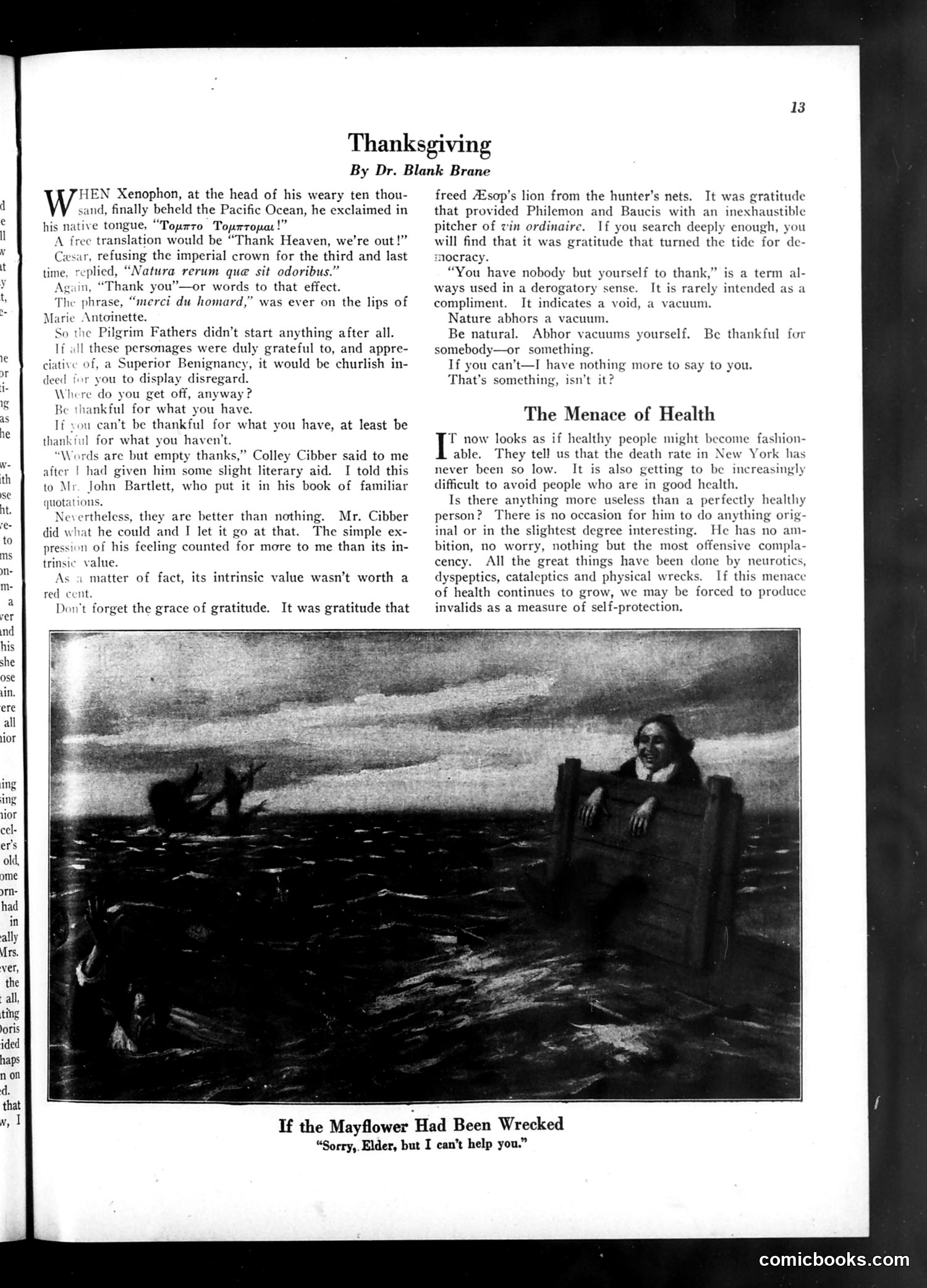
This illustration is a satirical counterfactual showing what would have happened if the Pilgrim ship Mayflower had sunk rather than successfully reaching America in 1620. The image depicts a figure on a desolate shore with a wrecked ship in the background, captioned "Sorry, Elder, but I can't help you." The satire appears to target Pilgrim or Puritan leaders (the "Elder" referenced), suggesting ironic commentary on their religious certainty or self-reliance ideology. By imagining the Mayflower's failure, the cartoonist implies that the Pilgrims' successful voyage and founding of Plymouth Colony was less assured or divinely guided than their mythology suggests—a skeptical jab at American founding narratives and religious triumphalism.
📄 Transcribed text from this page (OCR, searchable)
Machine-transcribed from the original scan — historical spelling and the odd misread are preserved.
ccl- er’s old, ome Thanksgiving By Dr. Blank Brane HEN Xenophon, at the head of his weary ten thou- sand, finally beheld the Pacific Ocean, he exclaimed in his native tongue, “Toprro Topurropa!” A translation would be “Thank Heaven, we're out!” Cxsar, refusing the imperial crown for the third and last time, replied, “Natura rerum que sit odoribus.” Again, “Thank you”—or words to that effect. The phrase, “merci du homard,” was ever on the lips of Marie Antoinette. So the Pilgrim Fathers didn’t start anything after all. If all these personages were duly grateful to, and appre- ciative of, a Superior Benignancy, it would be churlish in- deed for you to display disregard. Where do you get off, anyway? Be thankful for what you have. If you can’t be thankful for what you have, at least be thankful for what you haven't. “Words are but empty thanks,” Colley Cibber said to me after | had given him some slight literary aid. I told this to Mr. John Bartlett, who put it in his book of familiar quotations. Nevertheless, they are better than nothing. Mr. Cibber did what he could and I let it go at that. The simple ex- pression of his feeling counted for more to me than its in- trinsic value. As a matter of fact, its intrinsic value wasn’t worth a red cent. Don't forget the grace of gratitude. It was gratitude that freed HEsop’s lion from the hunter's nets. that provided Philemon and Baucis with an inexhaustible pitcher of vin ordinaire. If you search deeply enough, you will find that it was gratitude that turned the tide for de- mocracy. “You have nobody but yourself to thank,” is a term al- ways used in a derogatory sense. It is rarely intended as a compliment. It indicates a void, a vacuum. Nature abhors a vacuum. Be natural. Abhor vacuums yourself, somebody—or something. If you can’t—I have nothing more to say to you. That's something, isn’t it? The Menace of Health T now looks as if healthy people might become fashion- able. They tell us that the death rate in New York has never been so low. It is also getting to be increasingly difficult to avoid people who are in good health. Is there anything more useless than a perfectly healthy person? There is no occasion for him to do anything orig- inal or in the slightest degree interesting. He has no am- bition, no worry, nothing but the most offensive compla- cency. All the great things have been done by neurotics, dyspeptics, cataleptics and physical wrecks. If this menace of health continues to grow, we may be forced to produce invalids as a measure of self-protection. It was gratitude Be thankful for If the Mayflower Had Been Wrecked “Sorry, Elder, but I can’t help you.” comicbooks.com