
Life, 1921-11-17 · page 26 of 34
Life — November 17, 1921 — page 26: what you’re looking at
What you’re looking at
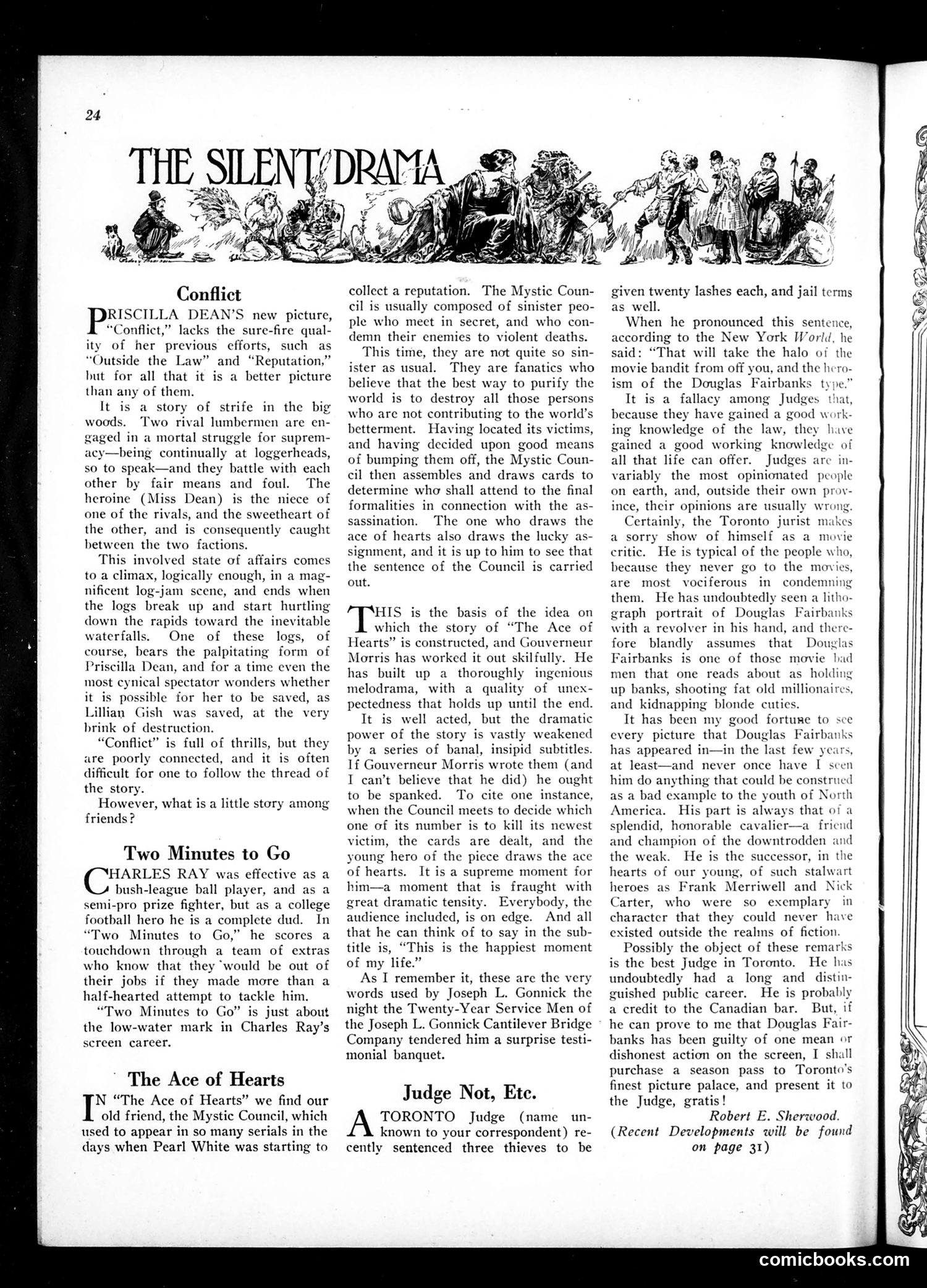
This page reviews three silent films from approximately the 1920s. "Conflict" stars Priscilla Dean in a melodrama about rival lumbermen competing over a woman, featuring a climactic log-jam scene. The critic praises it as her best work. "Two Minutes to Go" stars Charles Ray as a football hero, but the reviewer criticizes it as a low point in Ray's career, noting Ray succeeds only because extras deliberately avoid tackling him properly. "The Ace of Hearts" features the "Mystic Council"—a secret society that uses card-drawing to assign murders to members. The critic finds the plot clever but faults the film's intertitles (text cards) as banal, citing an instance where a dramatic moment is undercut by bland dialogue.
📄 Transcribed text from this page (OCR, searchable)
Machine-transcribed from the original scan — historical spelling and the odd misread are preserved.
Conflict RISCILLA DEAN’S new picture, Conflict,” lacks the sure-fire qual- ity of her previous efforts, such as and “Reputation,” it is a better picture “Outside the Law” but for all tha than any of them. It is a story of strife in the big woods. Two rival lumbermen are en- gaged in a mortal struggle for suprem- acy—being continually at loggerheads, so to speak—and they battle with each other by fair means and foul. The heroine (Miss Dean) is the niece of one of the rivals, and the sweetheart of the other, and is consequently caught between the two factions. This involved state of affairs comes to a climax, logically enough, in a mag- nificent log-jam scene, and ends when the logs break up and start hurtling down the rapids toward the inevitable waterfalls. One of these logs, of course, bears the palpitating form of Priscilla Dean, and for a time even the most cynical spectator wonders whether it is possible for her to be saved, as Lillian Gish was saved, at the very brink of destruction. “Conflict” is full of thrills, but they are poorly connected, and it is often difficult for one to follow the thread of the story. However, what is a little story among friends? Two Minutes to Go 'HARLES RAY s effective as a bush-league ball player, and as a semi-pro prize fighter, but as a college football hero he is a complete dud. In “Two Minutes to Go,” he scores a touchdown through a team of extras who know that they ‘would be out of their jobs if they made more than a half-hearted attempt to tackle him. “Two Minutes to Go” is just about the low-water mark in Charles Ray’s screen career. The Ace of Hearts N “The Ace of Hearts” we find our old friend, the Mystic Council, which used to appear in so many serials in the days when Pearl White was starting to collect a reputation. The Mystic Coun- cil is usually composed of sinister peo- ple who meet in secret, and who con- demn their enemies to violent deaths. This time, they are not quite so sin- ister as usual. They are fanatics who believe that the best way to purify the world is to destroy all those persons who are not contributing to the world’s betterment. Having located its victims, and having decided upon good means of bumping them off, the Mystic Coun- cil then assembles and draws cards to determine who shall attend to the final formalities in connection with the as- sassination. The one who draws the ace of hearts also draws the lucky as- signment, and it is up to him to see that the sentence of the Council is carried out. ‘HIS is the basis of the idea on which the story of “The Ace of Hearts” is constructed, and Gouverneur Morris has worked it out skilfully. He has built up a thoroughly ingenious melodrama, with a quality of unex- pectedness that holds up until the end. It is well acted, but the dramatic power of the story is vastly weakened by a series of banal, insipid subtitles. 1f Gouverneur Morris wrote them (and I can’t believe that he did) he ought to be spanked. To cite one instance, when the Council meets to decide which one of its number is to kill its newest victim, the cards are dealt, and the young hero of the piece draws the ace of hearts. It is a supreme moment for him—a moment that is fraught with great dramatic tensity. Everybody, the audience included, is on edge. And all that he can think of to say in the sub- title is, “This is the happiest moment of my life.” As I remember it, these are the very words used by Joseph L. Gonnick the night the Twenty-Year Service Men of the Joseph L. Gonnick Cantilever Bridge Company tendered him a surprise testi- monial banquet. Judge Not, Ete. TORONTO Judge (name un- known to your correspondent) re- cently sentenced three thieves to be given twenty lashes each, and jail terms as well. When he pronounced this sentence, according to the New York World, he said: “That will take the halo of the movie bandit from off you, and the hero- ism of the Douglas Fairbanks type.” It is a falla among Judges that, because they have gained a good work- ing knowledge of the law, they have gained a good working knowledge of all that life can offer. Judges are in- variably the most opinionated people on earth, and, outside their own proy- ince, their opinions are usually wrong. Certainly, the Toronto jurist makes a sorry show of himself as a movie crit He is typical of the people who, because they never go to the movies, are most vociferous in condemning them. He has undoubtedly seen a litho- graph portrait of Douglas Fairbanks with a revolver in his hand, and there- fore blandly assumes that Douglas Fairbanks is one of those movie had men that one reads about as holding up banks, shooting fat old millionaires, and kidnapping blonde cuties. It has been my good fortune to sce every picture that Douglas Fairbanks has appeared in—in the last few years, at least—and never once have I him do anything that could be construed a bad example to the youth of North America. His part is always that of a splendid, honorable cavalier—a_ friend and champion of the downtrodden and the weak. He is the successor, in the hearts of our young, of such stalwart heroes as Frank Merriwell and Nick Carter, who were so exemplary in character that they could never have existed outside the realms of fiction Possibly the object of these remarks is the best Judge in Toronto. He has undoubtedly had a long and distin- guished public career. He is probably a credit to the Canadian bar. But, if he can prove to me that Douglas F: banks has been guilty of one mean or dishonest action on the screen, I shall purchase a season pass to Toronto's finest picture palace, and present it to the Judge, gratis! Robert E. Sherwood. (Recent Developments will be found on page 31) seen comicbooks.com