
Life, 1921-11-17 · page 14 of 34
Life — November 17, 1921 — page 14: what you’re looking at
What you’re looking at
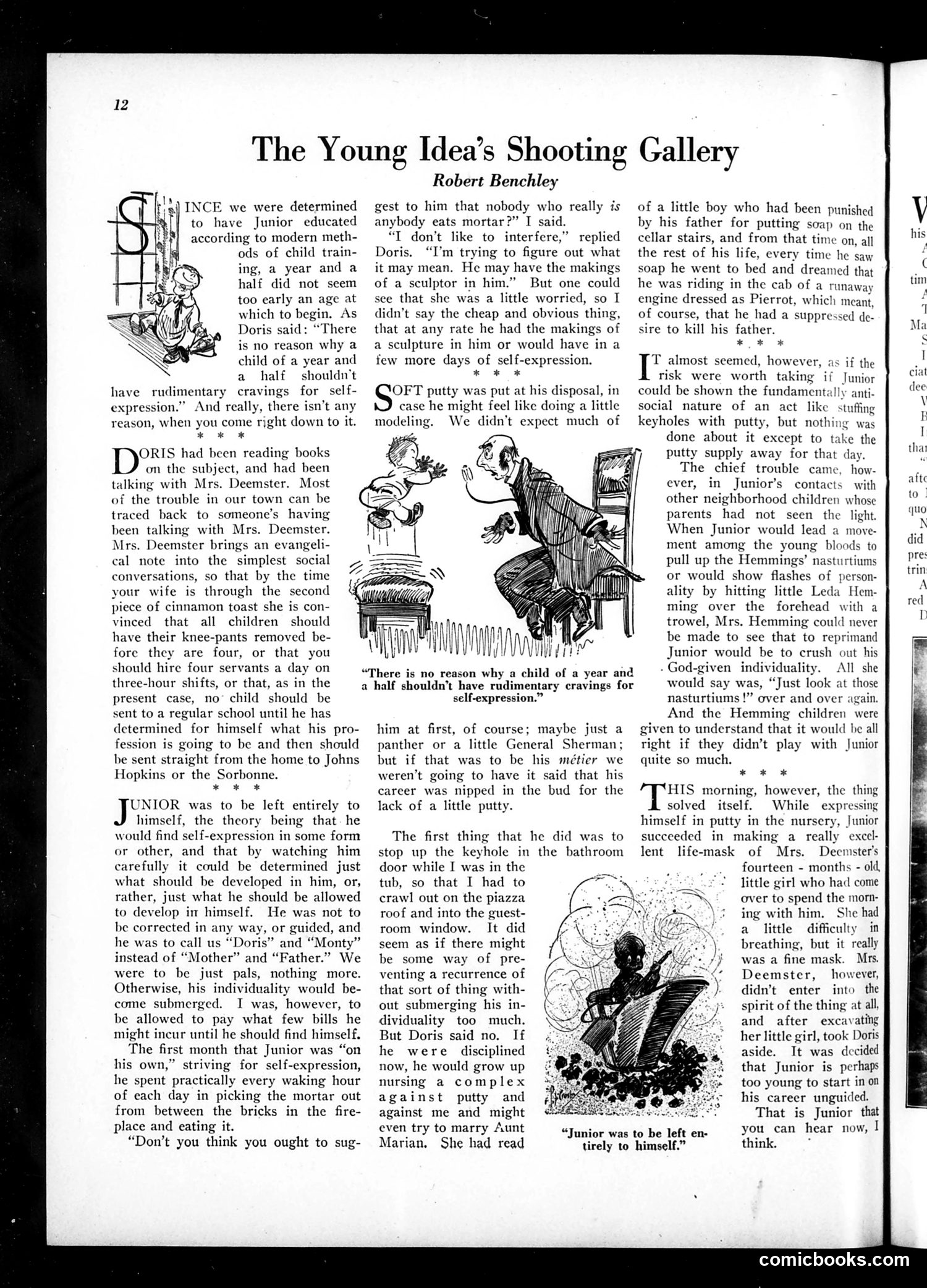
This satirical piece critiques progressive child-rearing theories popular in the 1920s-30s. The article mocks the philosophy that children should be given complete freedom for "self-expression" rather than traditional discipline. The illustrations show a young boy named Junior engaged in destructive behavior—making putty from mortar, creating chaos in a bathroom, and generally running amok—while his parents rationalize his actions as healthy self-expression rather than disciplining him. Benchley's satire targets permissive parenting advocates (influenced by figures like Freud) who believed suppressing children's impulses caused psychological damage. The piece humorously depicts the chaos that results when this philosophy is taken to extremes, suggesting such permissiveness creates insufferable, undisciplined children rather than psychologically healthy ones.
📄 Transcribed text from this page (OCR, searchable)
Machine-transcribed from the original scan — historical spelling and the odd misread are preserved.
The Young Idea’s Shooting Gallery .) INCE we were determined to have Junior educated according to modern meth- ods of child train- ing, a year and a half did not seem too early an age at which to begin. As Doris said: “There is no reason why a child of a year and a half shouldn't have rudimentary cravings for self- expression.” And really, there isn’t any reason, when you come right down to it. * * * ORIS had been reading books D on the subject, and had been talking with Mrs. Deemster. Most of the trouble in our town can be traced back to someone’s having been talking with Mrs. Deemster. Mrs. Deemster brings an evangeli- cal note into the simplest social conversations, so that by the time your wife is through the second piece of cinnamon toast she is con- vinced that all children should have their knee-pants removed be- fore they are four, or that you should hire four servants a day on three-hour shifts, or that, as in the present case, no° child should be sent to a regular school until he has determined for himself what his pro- fession is going to be and then should be sent straight from the home to Johns Hopkins or the Sorbonne. xk UNIOR was to be left entirely to himself, the theory being that. he would find self-expression in some form or other, and that by watching him carefully it could be determined just what should be developed in him, or, rather, just what he should be allowed to develop in himself. He was not to be corrected in any way, or guided, and he was to call us “Doris” and “Monty” instead of “Mother” and “Father.” We were to be just pals, nothing more. Otherwise, his individuality would be- come submerged. I was, however, to be allowed to pay what few bills he might incur until he should find himself. The first month that Junior was “on his own,” striving for self-expression, he spent practically every waking hour of each day in picking the mortar out from between the bricks in the fire- place and eating it. “Don’t you think you ought to sug- Robert Benchley gest to him that nobody who really is anybody eats mortar?” I said. “I don’t like to interfere,” replied Doris. “I’m trying to figure out what it may mean. He may have the makings of a sculptor in him.” But one could see that she was a little worried, so I didn’t say the cheap and obvious thing, that at any rate he had the makings of a sculpture in him or would have in a few more days of self-expression. * * * OFT putty was put at his disposal, in case he might feel like doing a little modeling. We didn't expect much of “There is no reason why a child of a year and a half shouldn’t have rudimentary cravings for self-expression.” him at first, of course; maybe just a panther or a little General Sherman; but if that was to be his métier we weren't going to have it said that his career was nipped in the bud for the lack of a little putty. The first thing that he did was to stop up the keyhole in the bathroom door while I was in the tub, so that I had to crawl out on the piazza roof and into the guest- room window. It did seem as if there might be some way of pre- venting a recurrence of that sort of thing with- out submerging his in- dividuality too much. But Doris said no. If he were disciplined now, he would grow up nursing a complex against putty and against me and might even try to marry Aunt Marian. She had read “Junior was to be left en- tirely to himself.” of a little boy who had been punished by his father for putting soap on the cellar stairs, and from that time on, all the rest of his life, every time he saw soap he went to bed and dreamed that he was riding in the cab of a runaway engine dressed as Pierrot, which meant, of course, that he had a suppressed de- sire to kill his father. * ok ok ie almost seemed, however, : risk were worth taking if could be shown the fundamentally anti- social nature of an act like stuffing keyholes with putty, but nothing was done about it except to take the putty supply away for that day. The chief trouble came, how- ever, in Junior’s contacts with other neighborhood children whose parents had not seen the light. When Junior would lead a move- ment among the young bloods to pull up the Hemmings’ nasturtiums or would show flashes of person- ality by hitting little Leda Hem- ming over the forehead with a trowel, Mrs. Hemming could never be made to see that to reprimand Junior would be to crush out his - God-given individuality. All she would say was, “Just look at those nasturtiums !” over and over again. And the Hemming children were given to understand that it would be all right if they didn’t play with Junior quite so much. * * * if the Junior HIS morning, however, the thing solved itself. While expressing himself in putty in the nursery, Junior succeeded in making a really excel- lent life-mask of Mrs. Deemster’s fourteen - months - old, little girl who had come over to spend the morn- ing with him. She had a little difficulty in breathing, but it really was a fine mask. Mrs. Deemster, however, didn’t enter into the spirit of the thing at all, and after excavating her little girl, took Doris aside. It was decided that Junior is perhaps too young to start in on his career unguided. That is Junior that you can hear now, | think. comicbooks.com