
Life, 1921-11-17 · page 11 of 34
Life — November 17, 1921 — page 11: what you’re looking at
What you’re looking at
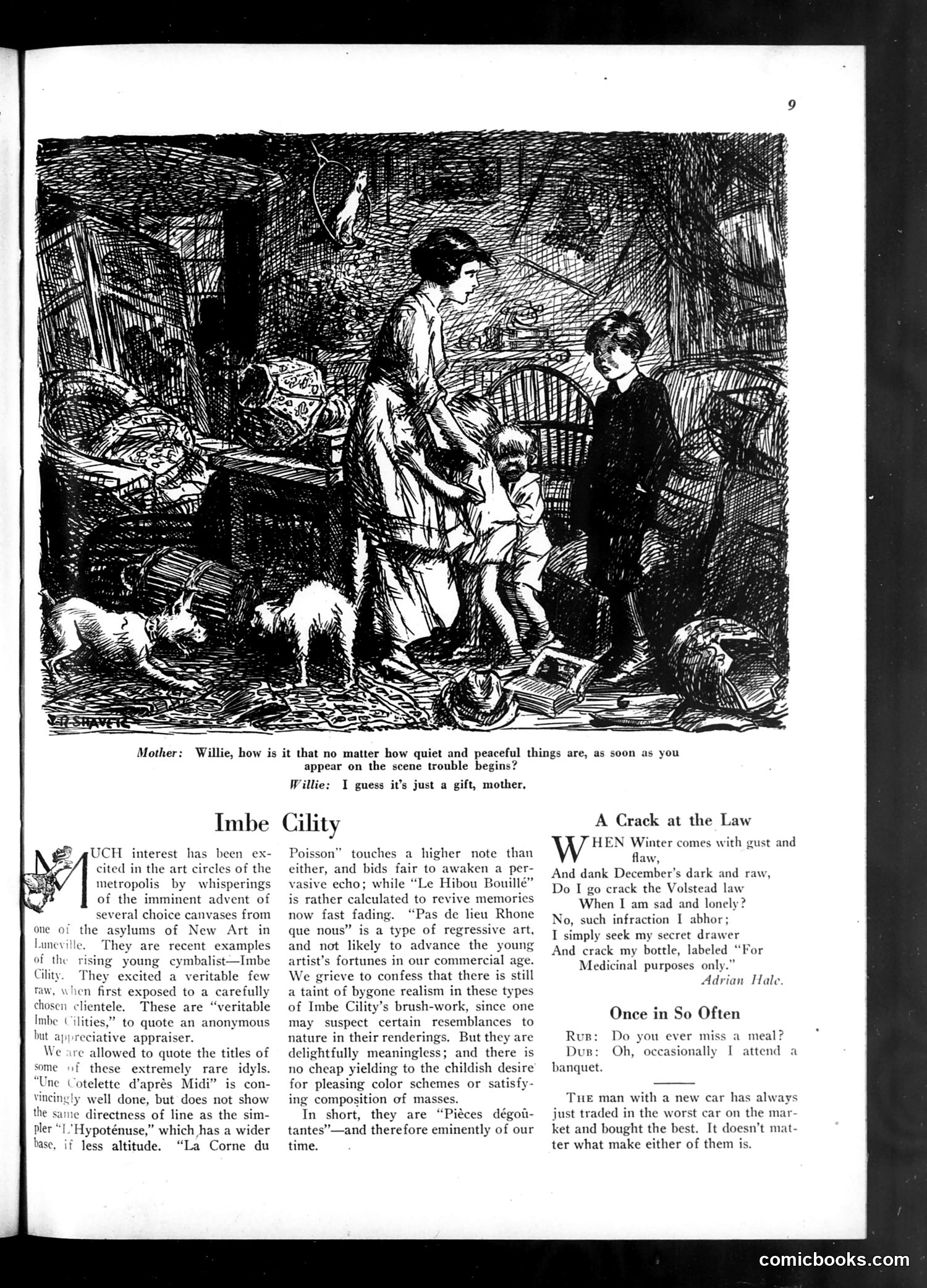
This page contains a domestic cartoon titled "Imbecility" by artist W.H. Shavell, depicting a mother confronting a boy named Willie about causing trouble whenever he appears. Willie claims it's "just a gift." The cartoon satirizes childhood misbehavior and parental exasperation—the joke being that Willie possesses an almost supernatural talent for creating chaos. The visual shows a chaotic domestic scene with the mother, Willie, and other children amid scattered household items. The page also includes brief literary pieces: "A Crack at the Law" (a poem about winter and loneliness by Adrian Hale) and "Once in So Often" (a humorous exchange about missing meals and attending banquets). This appears to be early 20th-century American humor focused on relatable domestic situations rather than explicit political satire.
📄 Transcribed text from this page (OCR, searchable)
Machine-transcribed from the original scan — historical spelling and the odd misread are preserved.
Mother: Imbe UCH cited in the art circ metropolis by wh of the imminent advent of several choice canvases from the asylums of New Art in Luneville. They are recent examples of the rising young cymbalist—Imbe Cility. They excited a veritable few Taw, when first exposed to a carefully chosen clientele. These are “veritable Imbe Cilities,’ to quote an anonymous but appreciative appraiser. We are allowed to quote the titles of some of these extremely rare idyls. “Une Cotelette d’aprés Midi” is con- ly well done, but does not show > directness of line as the sim- ‘Hypoténuse,” which has a wider base, if less altitude. “La Corne du interest has been ex- of the ings one o appear on the scene trouble begins? Willie: Cility Poisson” touches a higher note than either, and bids fair to awaken a per- vasive echo; while “Le Hibou Bouillé” is rather calculated to revive memories now fast fading. “Pas de lieu Rhone que nous” is a type of regressive art, and not likely to advance the young artist’s fortunes in our commercial age. We grieve to confess that there is still a taint of bygone realism in these types of Imbe Cility’s brush-work, since one may suspect certain resemblances to nature in their renderings. But they are delightfully meaningless; and there is no cheap yielding to the childish desire for pleasing color schemes or satisfy- ing composition of masses. In short, they are “Piéces dégoii- tantes”—and therefore eminently of our time. I guess it’s just a gift, mother, NAL Law Willie, how is it that no matter how quiet and peaceful things are, as soon as you A Crack at the Law HEN Winter comes with gust and flaw, And dank December’s dark and raw, Do I go crack the Volstead law When I am sad and lonely? No, such infraction I abhor; I simply seek my secret drawer And crack my bottle, labeled “For Medicinal purposes only.” Adrian Hale. Once in So Often Do you ever miss a meal? Oh, occasionally I attend a Rup: Dus: banquet. Tue man with a new car has always just traded in the worst car on the mar- ket and bought the best. It doesn’t mat- ter what make either of them is. comicbooks.com