
A complete issue · 34 pages · 1921
Life — July 28, 1921
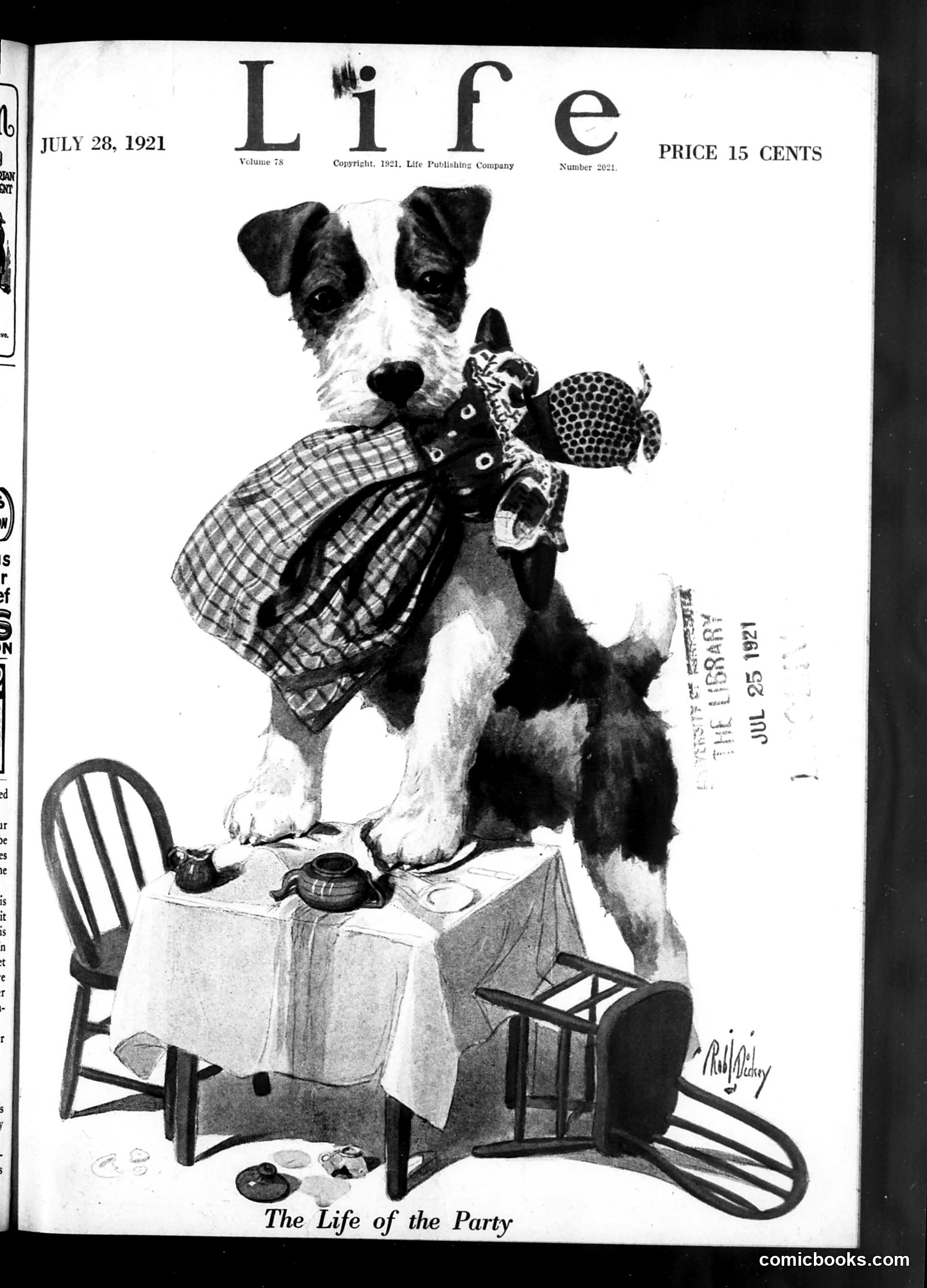
This cover illustrates a dog standing on a table at a dinner party, dressed in a checkered jacket and holding what appears to be a toy fish or similar object. The dog is anthropomorphized as a party guest, surrounded by chairs, place settings, and scattered items on the floor. The satire targets the behavior of social climbers or attention-seekers who disrupt gatherings to be noticed. By depicting an actual dog as "the life of the party," the cartoonist mocks people who act like animals—crude, self-centered, or inappropriately boisterous—while demanding attention at social events. The title plays on the common phrase describing someone who entertains a group, suggesting such behavior is actually bestial rather than charming.

This page is primarily a **Michelin Tire Company advertisement**, not satirical content. There is no political cartoon or satire present. The ad promotes Michelin full-size inner tubes for cord tires, featuring the famous Michelin Man mascot (the white striped figure beside the large tube). The advertisement's argument is straightforward: Michelin tubes are larger in cross-section than competitors, so they require less stretching to fit standard casings and therefore last longer. The only visual element beyond product photography is the iconic Michelin Man character, used as the company's recognizable brand mascot rather than for satirical purposes. This appears to be a standard commercial advertisement from the early 1920s promoting tire superiority through technical specifications.
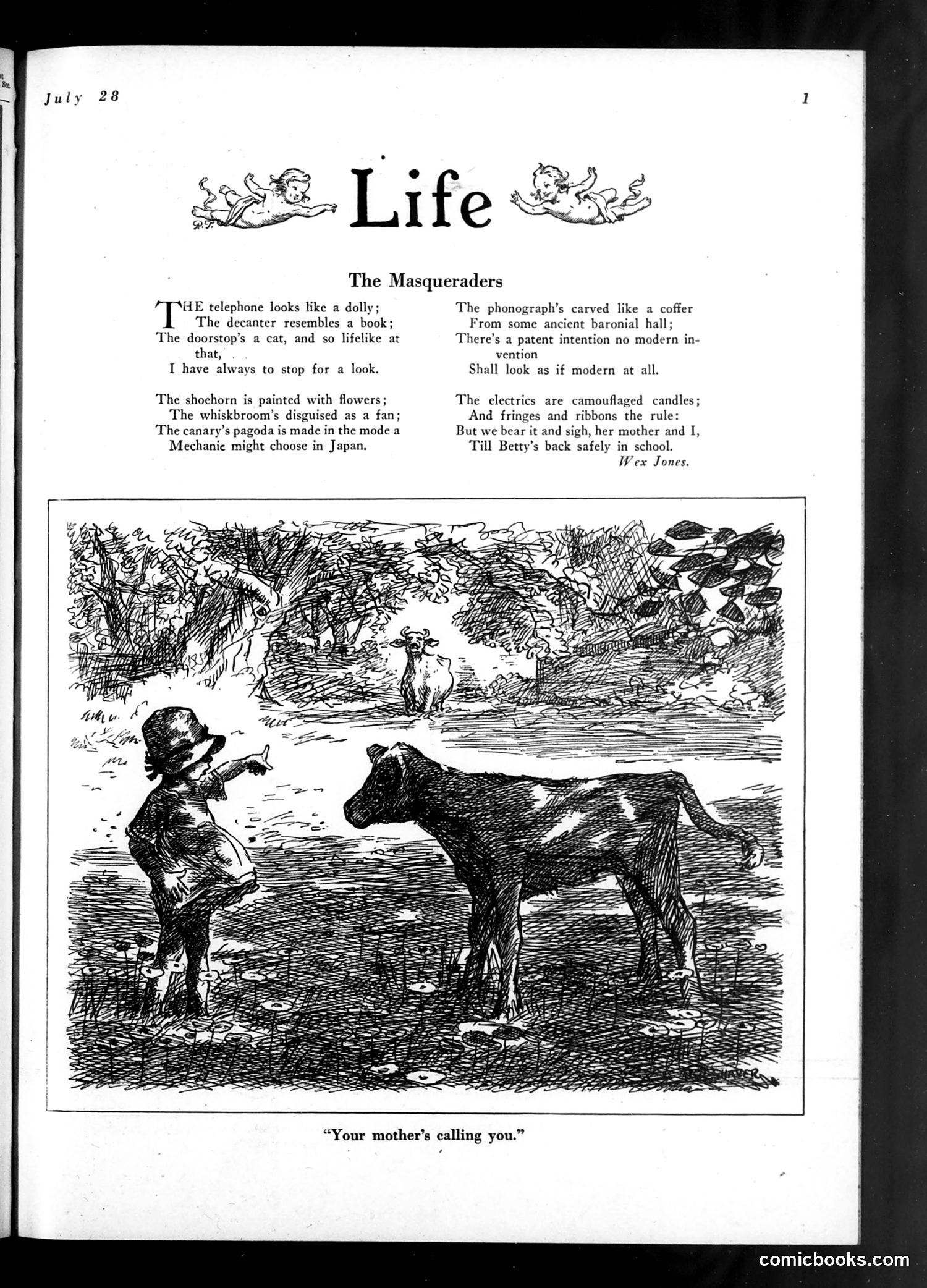
This page satirizes objects disguised to appear more fashionable or modern than they actually are. The poem mocks how everyday items are decorated deceptively: a telephone styled like a doll, a doorstop disguised as a cat, a shoehorn painted with flowers, and electrical fixtures camouflaged as candles and ribbons. The accompanying illustration shows a child encountering a cow, with the caption "Your mother's calling you." The joke appears to be visual wordplay—the child mistakes the cow for something else, or the "masquerade" theme extends to the unexpected rural encounter. The satire critiques early 20th-century consumer culture's tendency to disguise mundane household items with ornamental styling, suggesting superficial modernization over genuine innovation or utility.
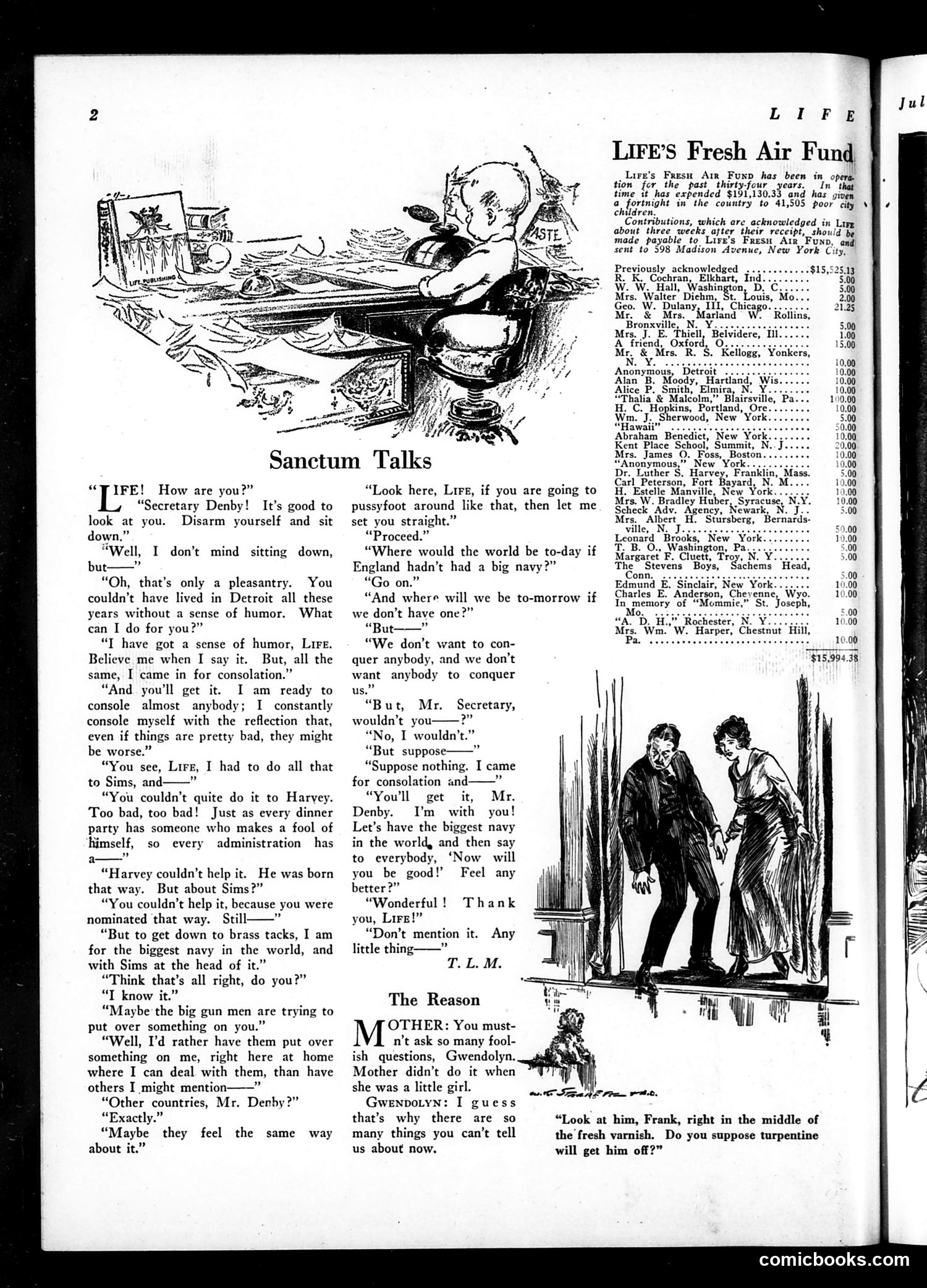
This page contains two distinct pieces: **"Sanctum Talks"** features a conversation between "LIFE" (the magazine personified) and "Secretary Denby" about government administration and naval power. The satire mocks Secretary Denby's defensive justifications for military spending and administrative failures—he repeatedly explains away problems (Harvey, Sims) by claiming they were inevitable or unavoidable. LIFE's character sarcastically suggests every administration has similar issues, implying incompetence is systemic. **"The Reason"** is a brief comic sketch about a mother discouraging her son from asking foolish questions, suggesting some things are inexplicable. The cartoons use wordplay and dialogue-based humor typical of 1920s satirical journalism, critiquing government accountability and bureaucratic deflection rather than depicting specific visual caricatures.
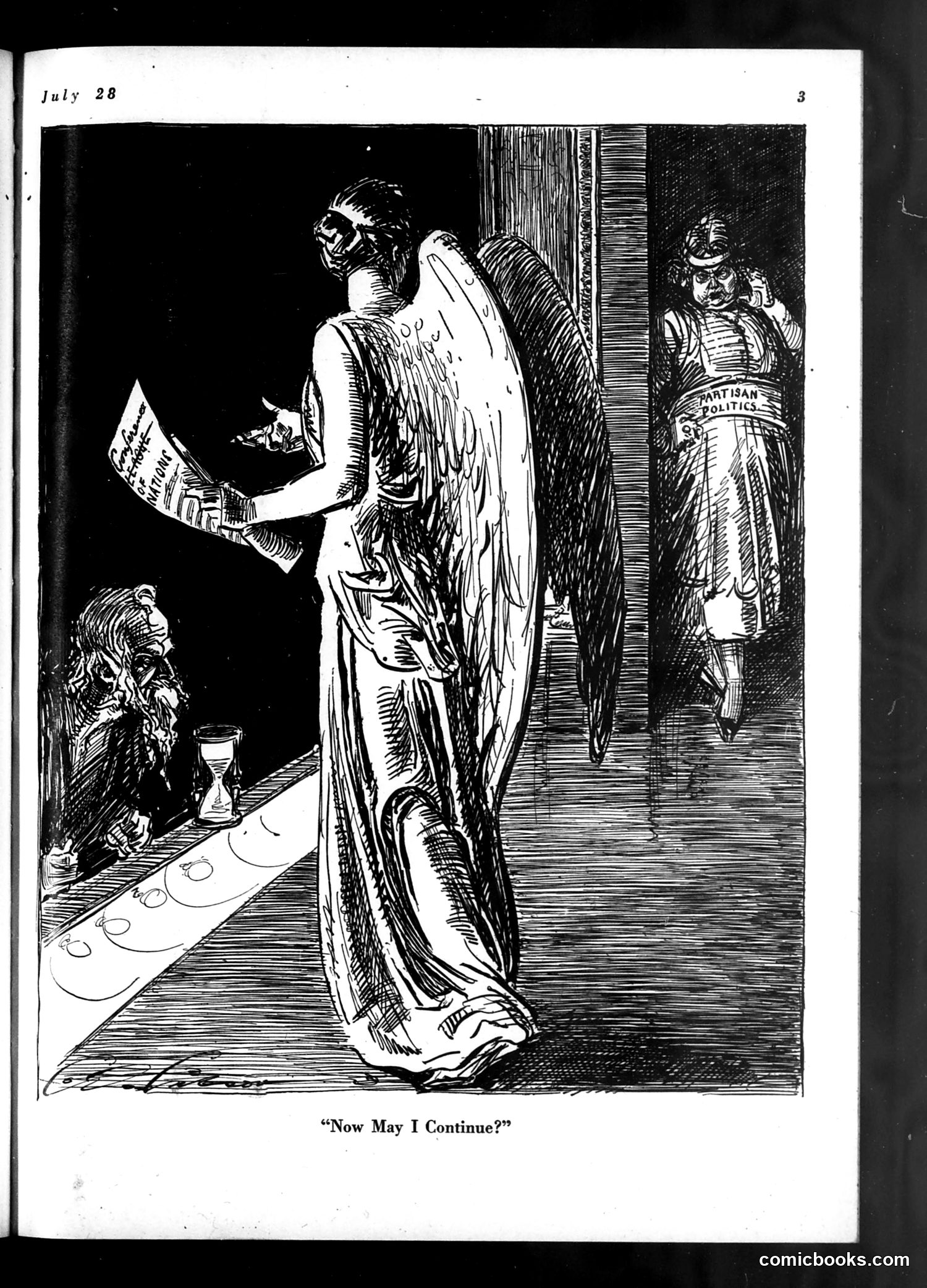
This appears to be an early 20th-century political satire from *Life* magazine. The central winged figure—likely representing an angel or allegorical symbol of justice or progress—holds a document while addressing two figures: one appears to be a bearded man (possibly representing an older political order or establishment) on the left, and another figure on the right labeled "PARTISAN POLITICS." The cartoon suggests that some progressive initiative or reform effort is being interrupted or questioned by partisan political interference. The angel's plea "Now May I Continue?" implies that partisan concerns have disrupted or blocked an important endeavor, satirizing how political factionalism obstructs broader societal progress or justice. The specific reform referenced remains unclear without additional context.
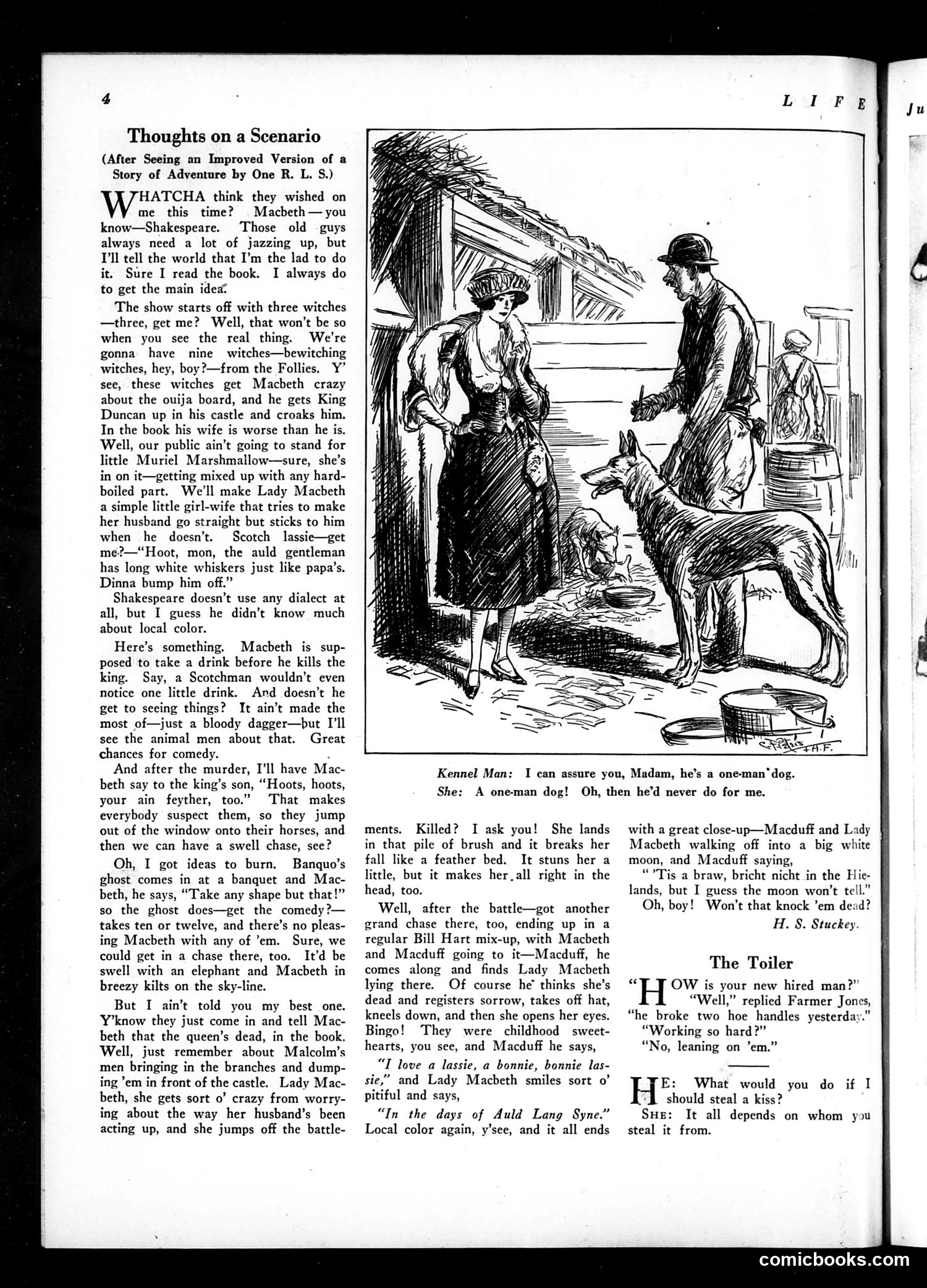
This page contains two sections: an article titled "Thoughts on a Scenario" discussing a proposed adaptation of Shakespeare's *Macbeth*, and a separate joke section called "The Toiler." The main illustration shows a well-dressed woman with a man in what appears to be a domestic scene. The accompanying dialogue reveals the joke's premise: the kennel man assures the woman her dog is "a one-man dog," but she responds that such a dog would "never do for me"—implying she prefers a dog with looser loyalties, likely a humorous commentary on female infidelity or independence. The *Macbeth* article discusses making the classic play more palatable for contemporary audiences by softening its darker elements and adding comedy. The tone is satirical about adapting Shakespeare for popular consumption.
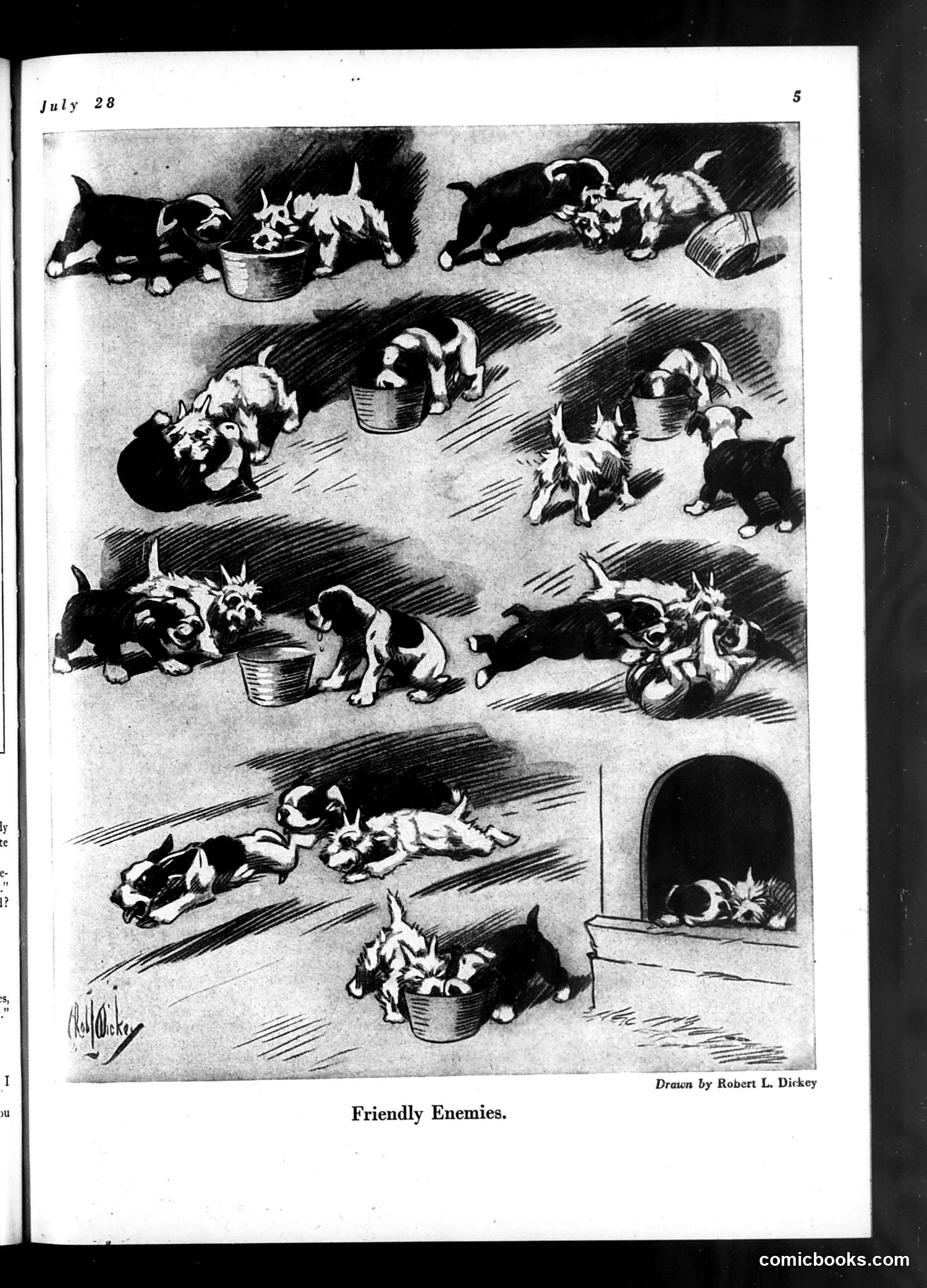
This cartoon depicts cats and dogs playing together peacefully around food bowls and toys. The title "Friendly Enemies" is a playful oxymoron referring to the traditional animosity between cats and dogs—the common expression that they are natural enemies. The joke is straightforward: the cartoon shows these supposedly antagonistic animals coexisting harmoniously, sharing meals and play space without conflict. This appears to be gentle, lighthearted humor about animal behavior rather than political satire. The multiple vignettes demonstrate various peaceful interactions that would be surprising or amusing to contemporary readers, given the widespread cultural assumption that cats and dogs cannot get along. The cartoon likely ran as family-friendly entertainment rather than commentary on social or political matters.
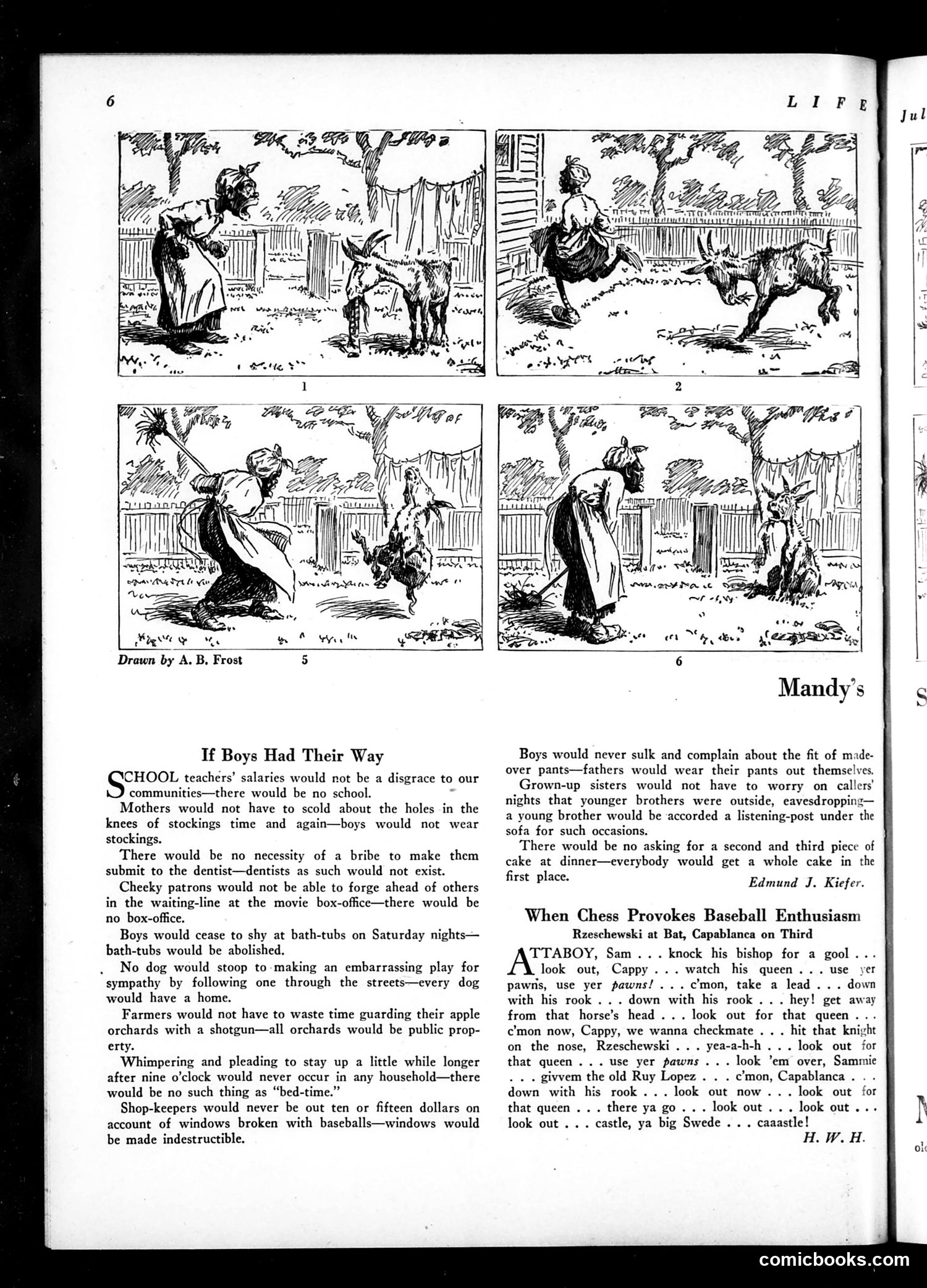
This page contains two separate pieces of satirical commentary on early 20th-century American life. **"If Boys Had Their Way"** (top four panels, drawn by A.B. Frost) depicts humorous scenarios imagining a world without parental/societal constraints: boys avoiding dentists, ceasing shyness, abandoning bath time, playing rough without consequences. The satire gently mocks boyish behavior while implicitly endorsing adult supervision and social norms. **"When Chess Provokes Baseball Enthusiasm"** (bottom section) appears to be a chess match commentary where players use chess terminology mixed with baseball slang and exclamations. The satire likely jokes about how different sports attract overlapping enthusiast communities, with their distinct vocabularies colliding amusingly. Both pieces represent *Life*'s characteristic lighthearted social observation humor, targeting American middle-class life and cultural habits.
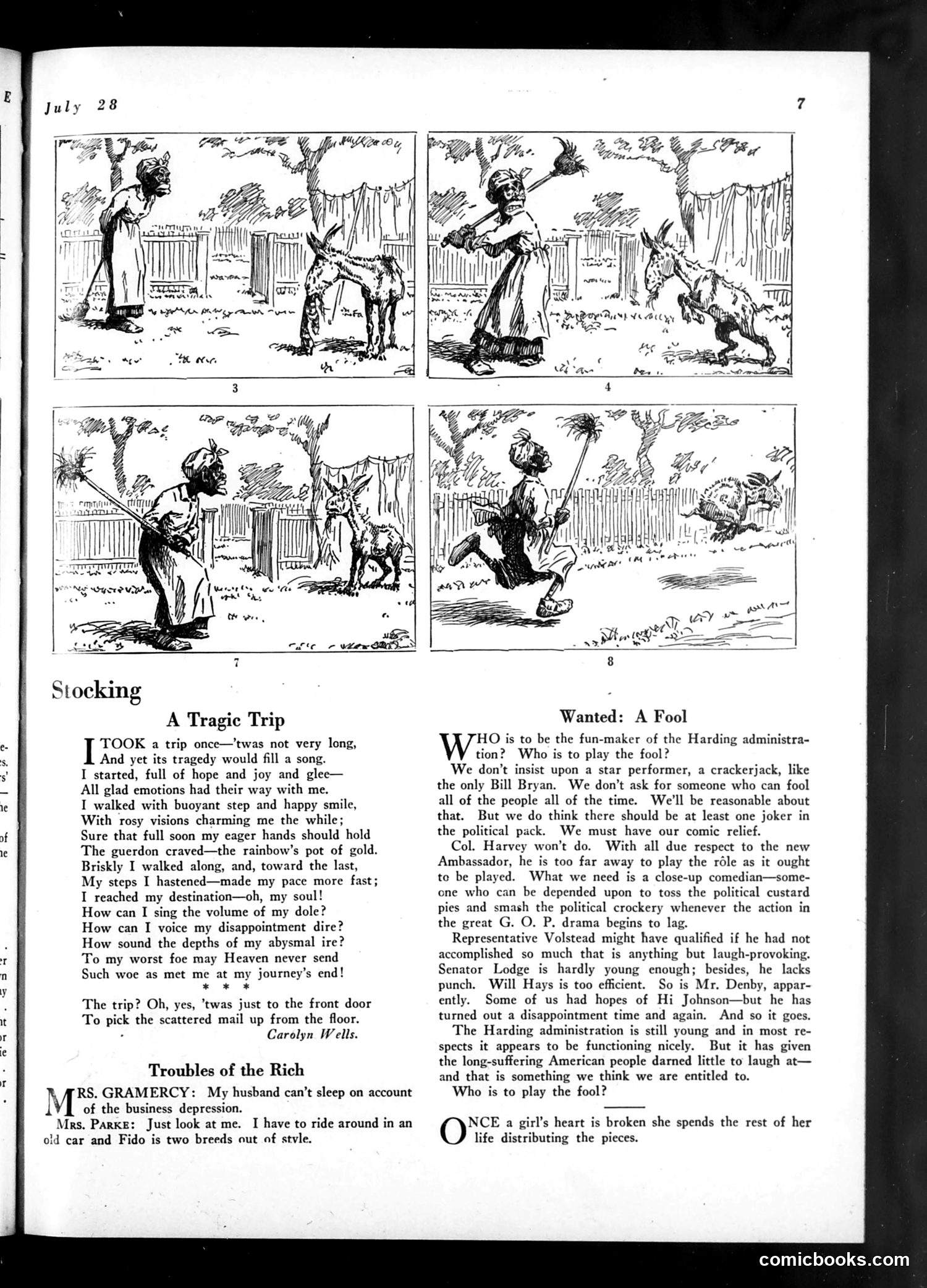
**The four-panel comic "Stocking"** (panels 3-4, unlabeled) depicts a woman attempting to put stockings on a young child or small person who resists and struggles. The visual joke appears to center on the difficulty of dressing an uncooperative subject. **"A Tragic Trip"** is a poem by Carolyn Wells describing disappointed travel expectations. **"Wanted: A Fool"** critiques the Harding administration, specifically targeting Secretary of Commerce Herbert Hoover and Senator Henry Cabot Lodge. The piece sarcastically suggests the administration needs a "comedian" to distract the public from its failures, implying the political leadership itself is foolish. **"Troubles of the Rich"** presents brief humorous complaints from wealthy individuals about minor inconveniences—satire on privileged complaints during economic hardship.
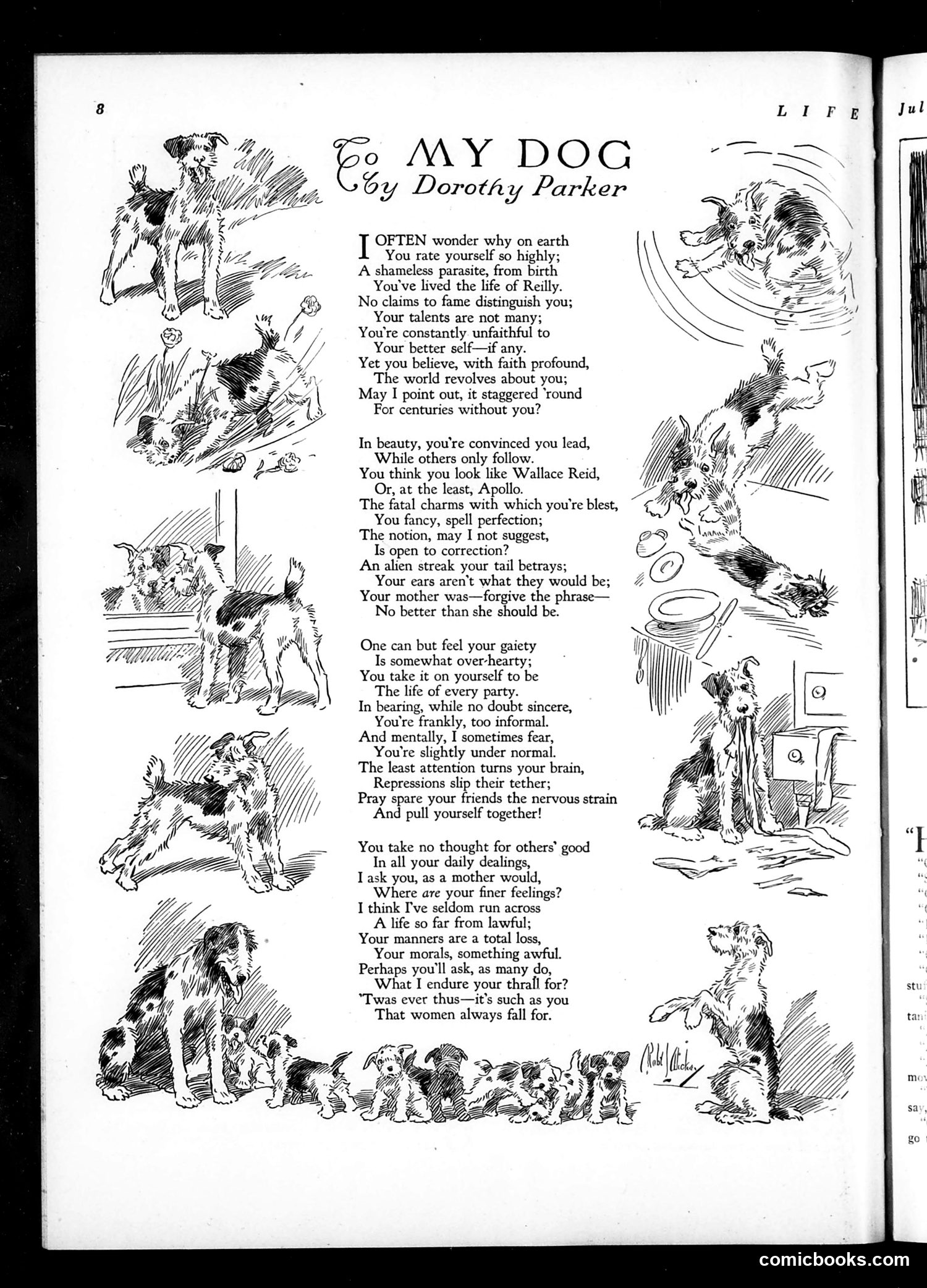
This is a humorous poem by celebrated writer Dorothy Parker, illustrated with sketches of various dog poses and expressions. The poem is a mock-serious "letter" to the speaker's dog, addressing its character flaws with satirical affection. Parker critiques the dog's vanity, unfaithfulness, lack of intelligence, and self-centered behavior—comparing it mockingly to handsome actor Wallace Reid. The poem's humor lies in applying human moral judgment to typical dog behavior: the dog's tail "betrays" it, it causes nervousness in friends, and it embodies poor manners and morals. The concluding couplet reveals the satire's target: "That women always fall for" dogs like this one, suggesting human (particularly female) susceptibility to charm over substance. It's social commentary disguised as pet criticism.
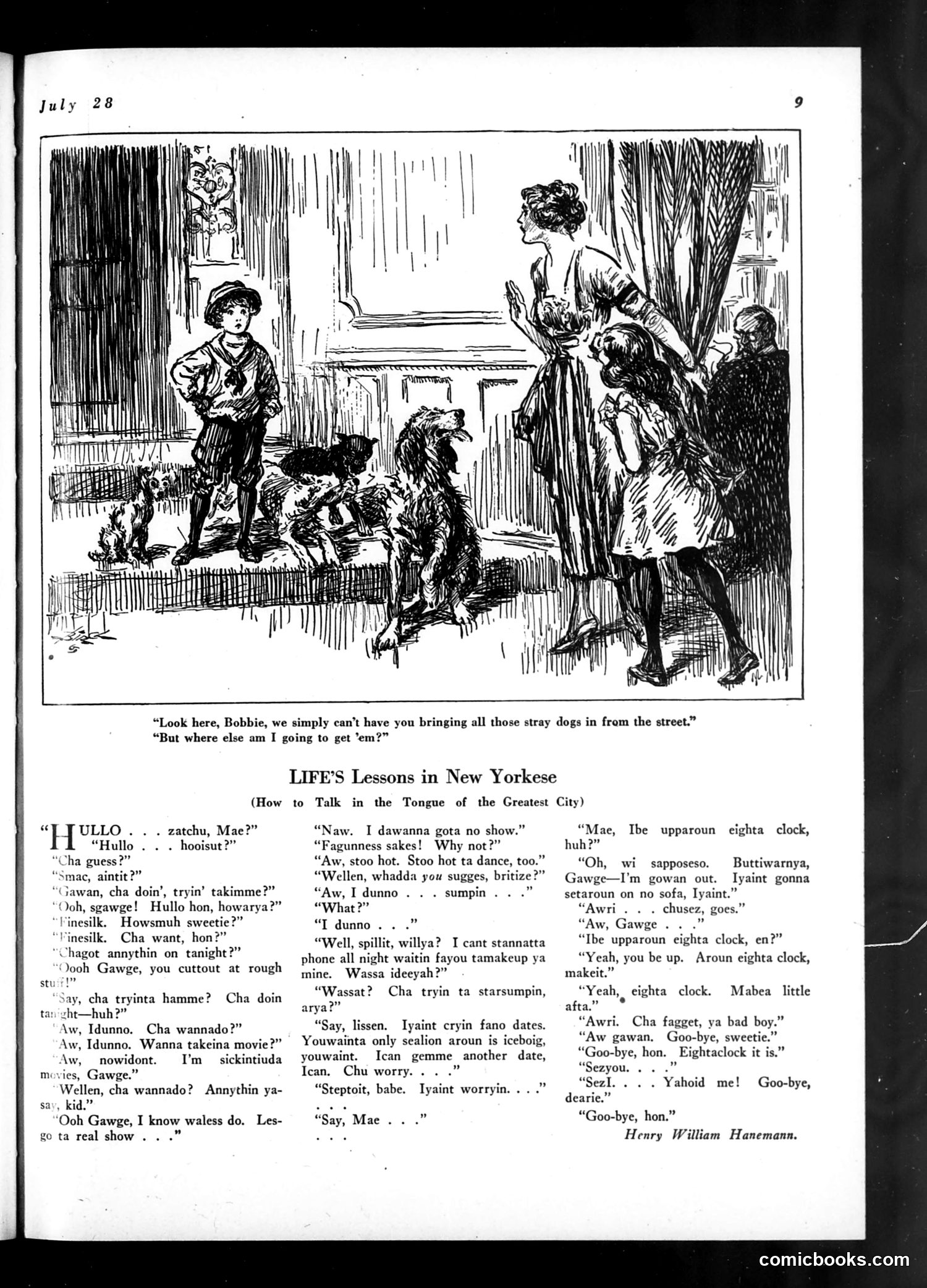
This page from *Life* magazine features a cartoon and linguistic humor piece titled "Life's Lessons in New Yorkese (How to Talk in the Tongue of the Greatest City)." The cartoon depicts a domestic scene where a boy named Bobbie has brought stray dogs into the house. An adult woman (likely his mother) protests: "Look here, Bobbie, we simply can't have you bringing all those stray dogs in from the street." Bobbie responds: "But where else am I going to get 'em?" The satire mocks both parental exasperation at children's logic and, more broadly, New York City street life—suggesting strays are plentiful in urban areas. The accompanying text is comedic linguistic commentary translating exaggerated New York working-class and immigrant-influenced dialect into standard English, satirizing how distinctive New York speech patterns appeared to outsiders.
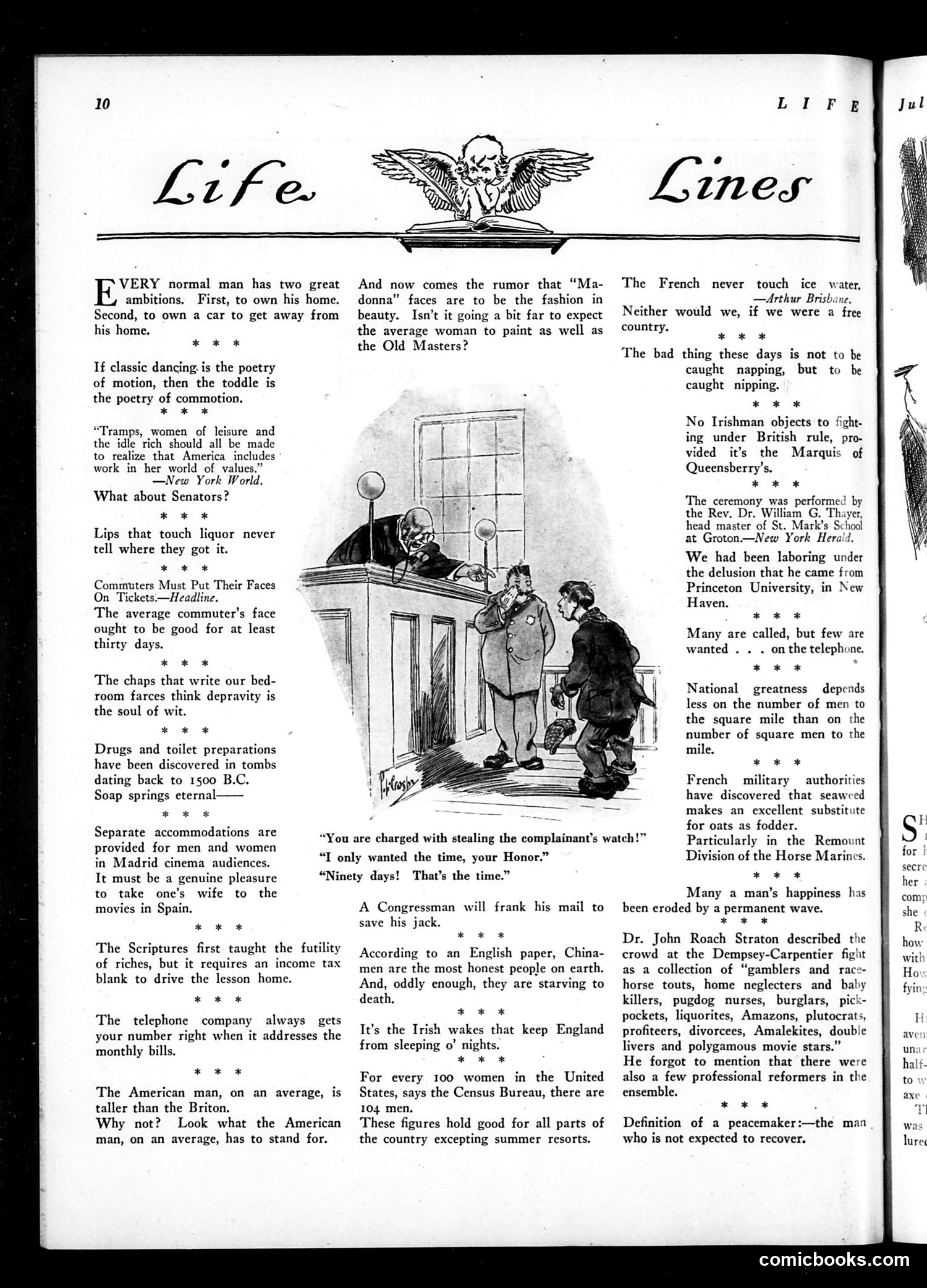
The main cartoon depicts a police officer at a window arresting two young people, saying: "You are charged with stealing the complainant's watch!" One responds: "I only wanted the time, your Honor." "Ninety days! That's the time." This is a joke about judicial harshness and semantic wordplay. The arrested youth's claim—that they only wanted to know the time, not steal the watch—is technically true but obviously disingenuous. The humor lies in the judge's sardonic response: by sentencing them to "ninety days," he's literally giving them "the time" they claimed to want, while punishing their obvious theft with prison time. It satirizes both petty criminals' thin excuses and the rigid application of justice.
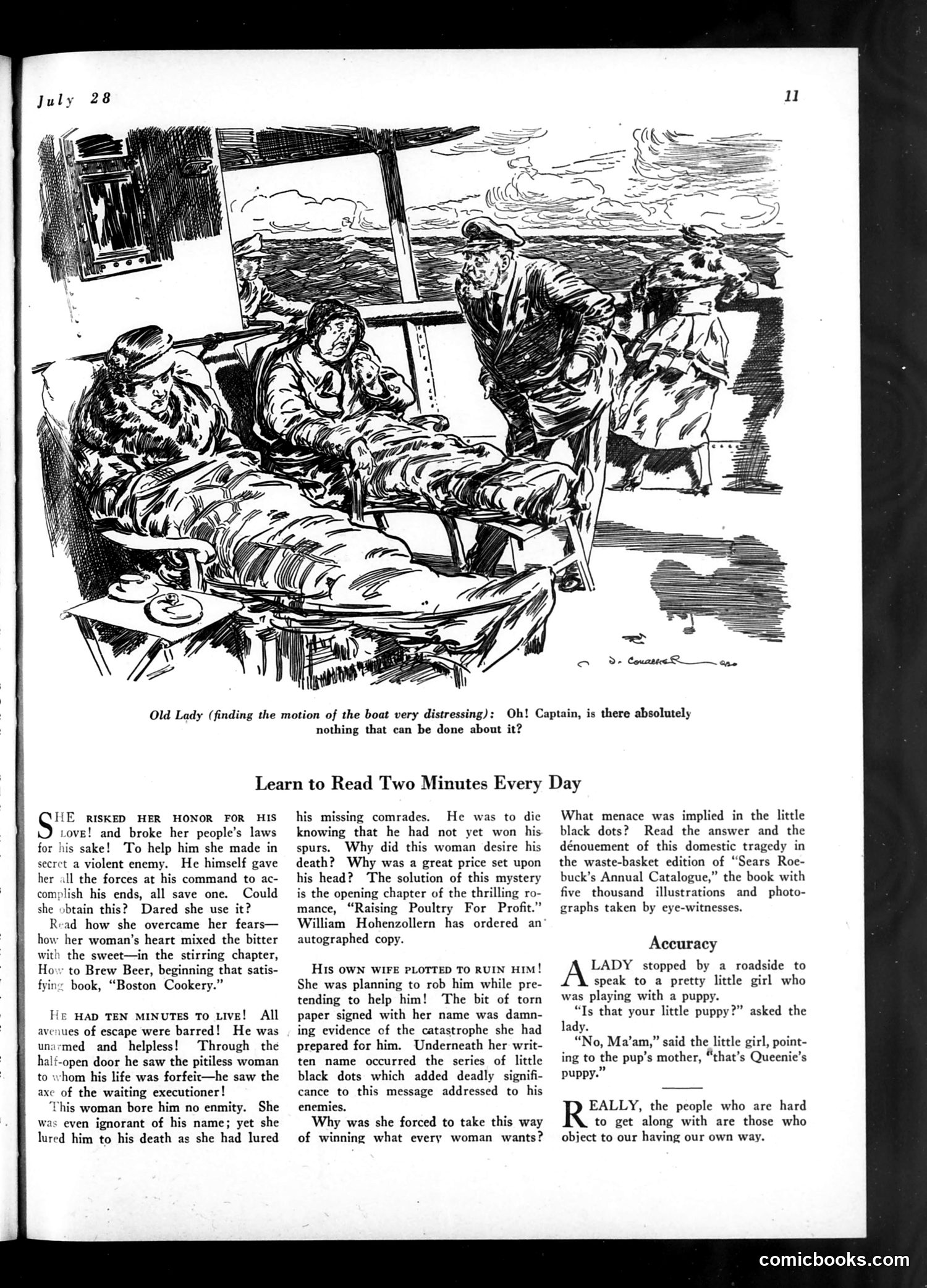
**The Cartoon:** The illustration depicts an elderly woman on a boat experiencing seasickness, asking the Captain if anything can be done about the vessel's motion. This is a straightforward visual gag about motion sickness—the humor relies on the woman's discomfort and the Captain's likely unhelpful response. **The Text Sections:** Below are three separate short stories or anecdotes: 1. **"Learn to Read Two Minutes Every Day"** - A melodramatic narrative about a woman who betrayed a man to his death, appearing to reference a mystery novel or serialized story. 2. **"Accuracy"** - A brief humorous exchange where a lady corrects a child's identification of a puppy's breed. 3. **"Really"** - A brief comment about difficult people and personal autonomy. These appear to be typical Light entertainment content for the era.
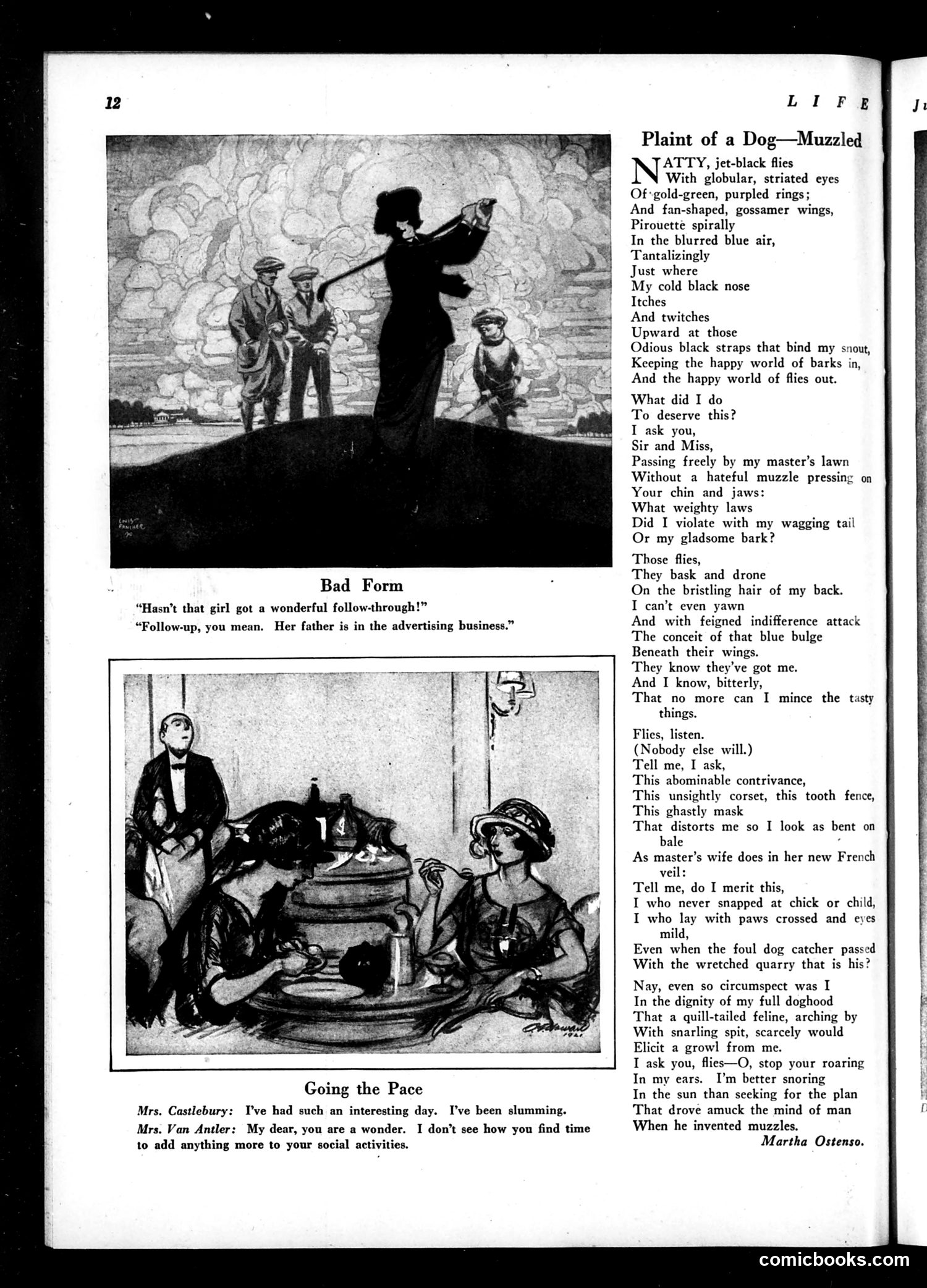
This page contains two satirical pieces: **"Bad Form"** (top cartoon): Depicts a woman in silhouette pointing at two men. The caption jokes about her being well-connected because "her father is in the advertising business." This satirizes the social climbing and status-seeking among the wealthy, where professional connections matter more than actual merit or character. **"Going the Pace"** (bottom cartoon): Shows two society women in conversation. Mrs. Castlebury brags about her busy social schedule ("slumming"), while Mrs. Van Antler expresses wonder at finding time for additional activities. This mocks the leisure-class obsession with constant social engagement and fashionable activities—even pretending to visit poor neighborhoods ("slumming") as entertainment. Both pieces ridicule upper-class frivolity and social pretension.
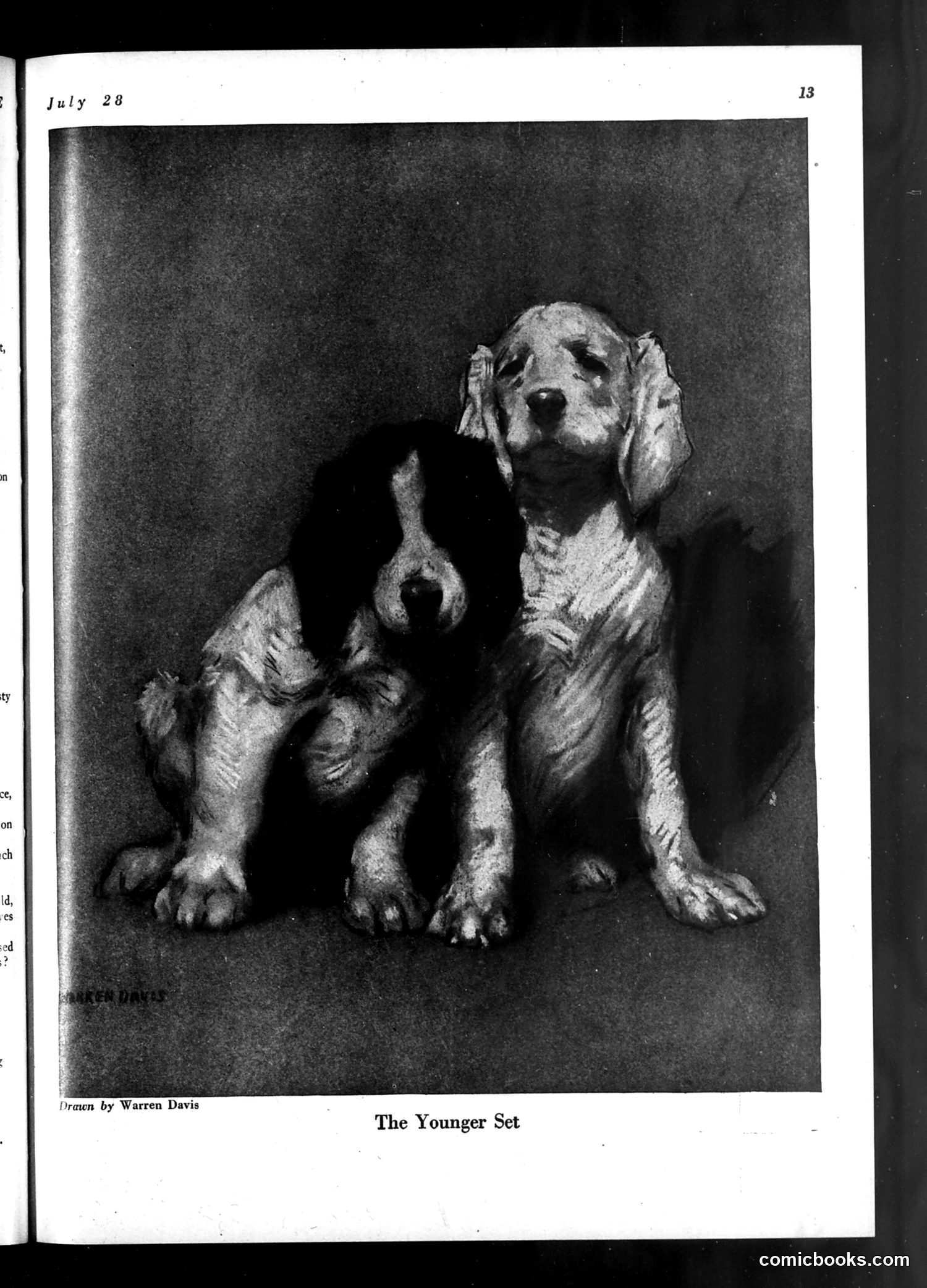
This page features a black and white photograph by Warren Davis showing two dogs sitting upright against a dark background. The caption reads "The Younger Set." This appears to be satirical commentary using dogs to represent young people of the era. Without additional context from the magazine's surrounding content, the specific satire is unclear—it may mock younger generation attitudes, fashions, or social behaviors common to Life magazine's satirical approach. The formal photographic treatment of the dogs positioned like people suggests ironic comparison between canine and human "society." The page is dated July 28 (year unclear from image), identifying this as a specific Life magazine issue, likely from the early-to-mid 20th century based on the photography style and publication format.
This page discusses post-WWI disarmament conferences and President Harding's diplomatic efforts. The text references troublesome Irish independence negotiations and international naval reduction talks occurring in London. The **decorative header illustration** (top) appears to be a general artistic masthead rather than political satire—showing a pastoral/fantastical landscape. The **small owl illustrations** (mid-page) likely represent wisdom or observation, accompanying discussion of the Endeavorer convention's policies on morality and censorship—opposing cigarette sales to minors, Sunday commercialization, and regulation of women's fashion and makeup. The **bottom illustration** showing figures appears decorative rather than satirical. The page functions primarily as political commentary and social criticism rather than sharp cartoon satire.
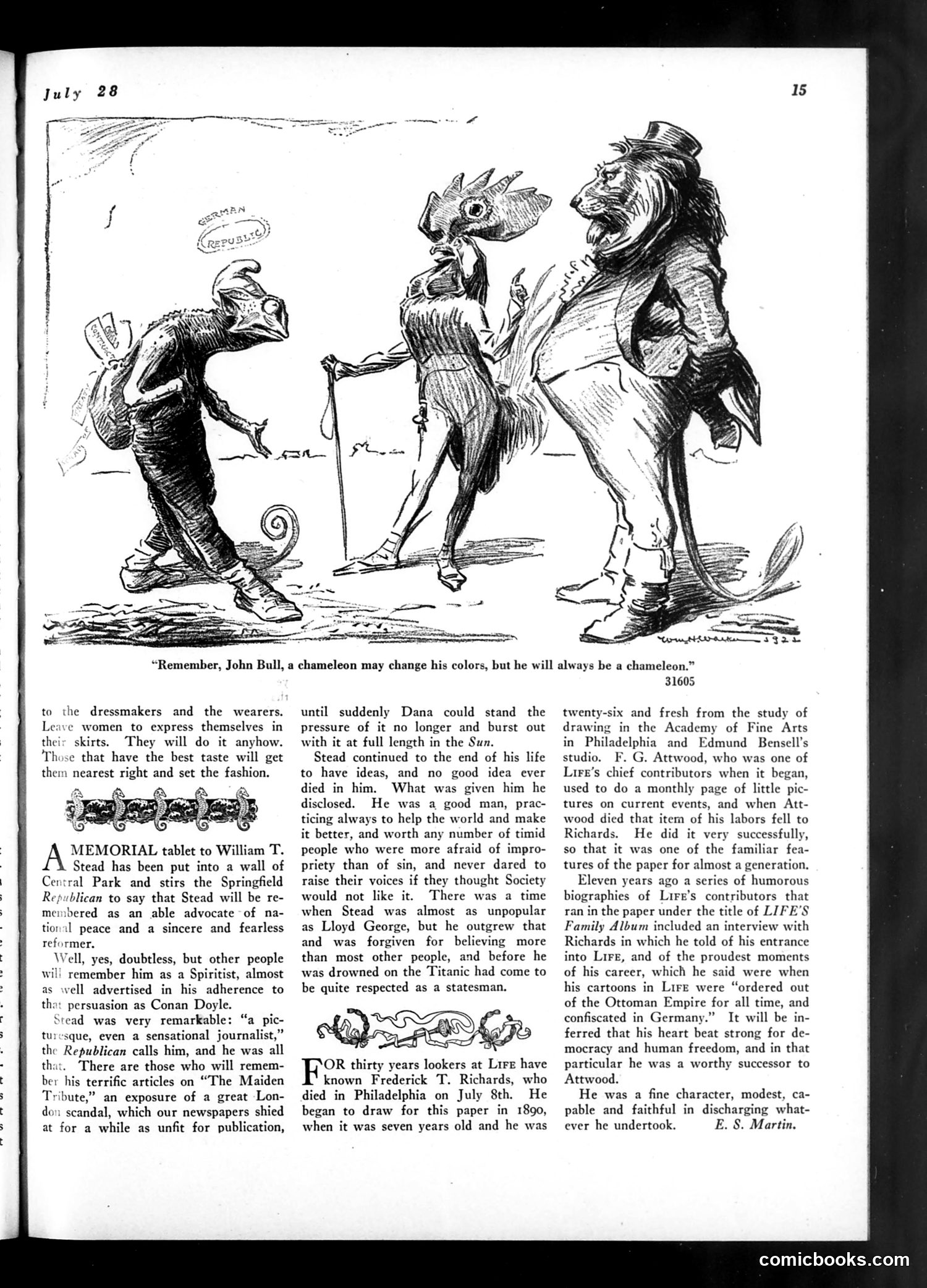
The cartoon depicts **John Bull** (the anthropomorphic personification of Britain, shown as the rotund figure on the right) alongside two other figures representing political entities or nations. The caption quotes a proverb about chameleons changing colors but remaining chameleons—a commentary on **British foreign policy's inconsistency**. The satire suggests that despite Britain's shifting diplomatic alliances or stated positions, its fundamental nature and interests remain unchanged. This likely references early 20th-century concerns about British political reliability or hypocrisy regarding international commitments. The other figures appear to represent different nations or political factions engaging with Britain, though their specific identities aren't entirely clear from the image alone. The overall point is that **rhetorical claims of change mask unchanged underlying character**—a common satirical critique of government duplicity. The page also includes obituaries for journalist William T. Stead and cartoonist Frederick T. Richards, reflecting *Life* magazine's editorial content.
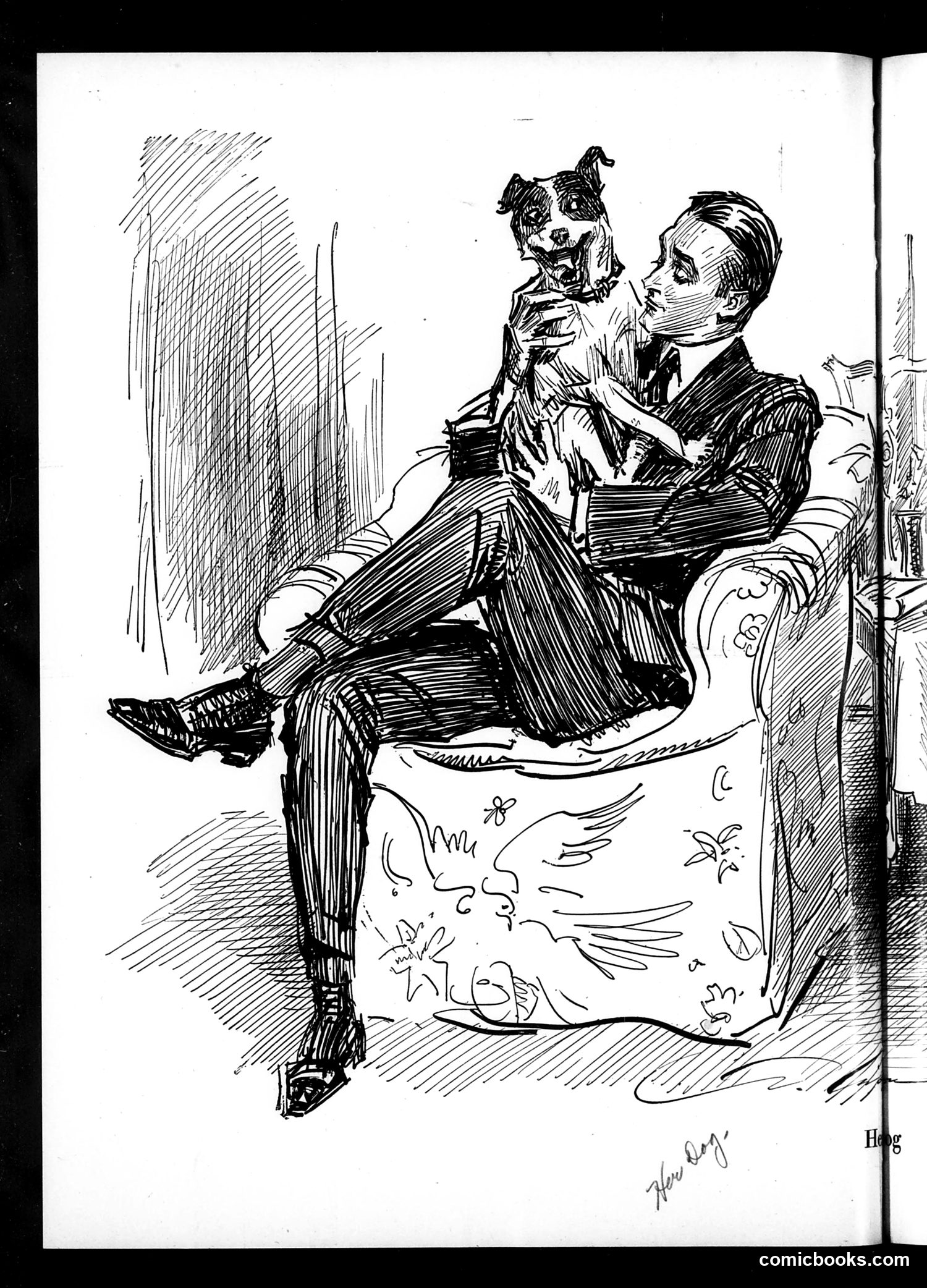
This pen-and-ink cartoon shows a well-dressed man in a pinstriped suit relaxing in a chair, holding a small dog. The dog appears somewhat anxious or alert, while the man gazes upward contentedly. The OCR text is largely unreadable, and the artist signature appears to read "Hoag." Without clearer text or caption, the specific political reference is unclear. However, the composition suggests satire about a figure of authority or wealth enjoying leisure while his "companion" (the dog, possibly representing the public or a political ally) remains nervous or uncertain about the future. The style is consistent with early-to-mid 20th century American political cartooning, but without legible accompanying text or context, I cannot definitively identify the subject or the intended critique.
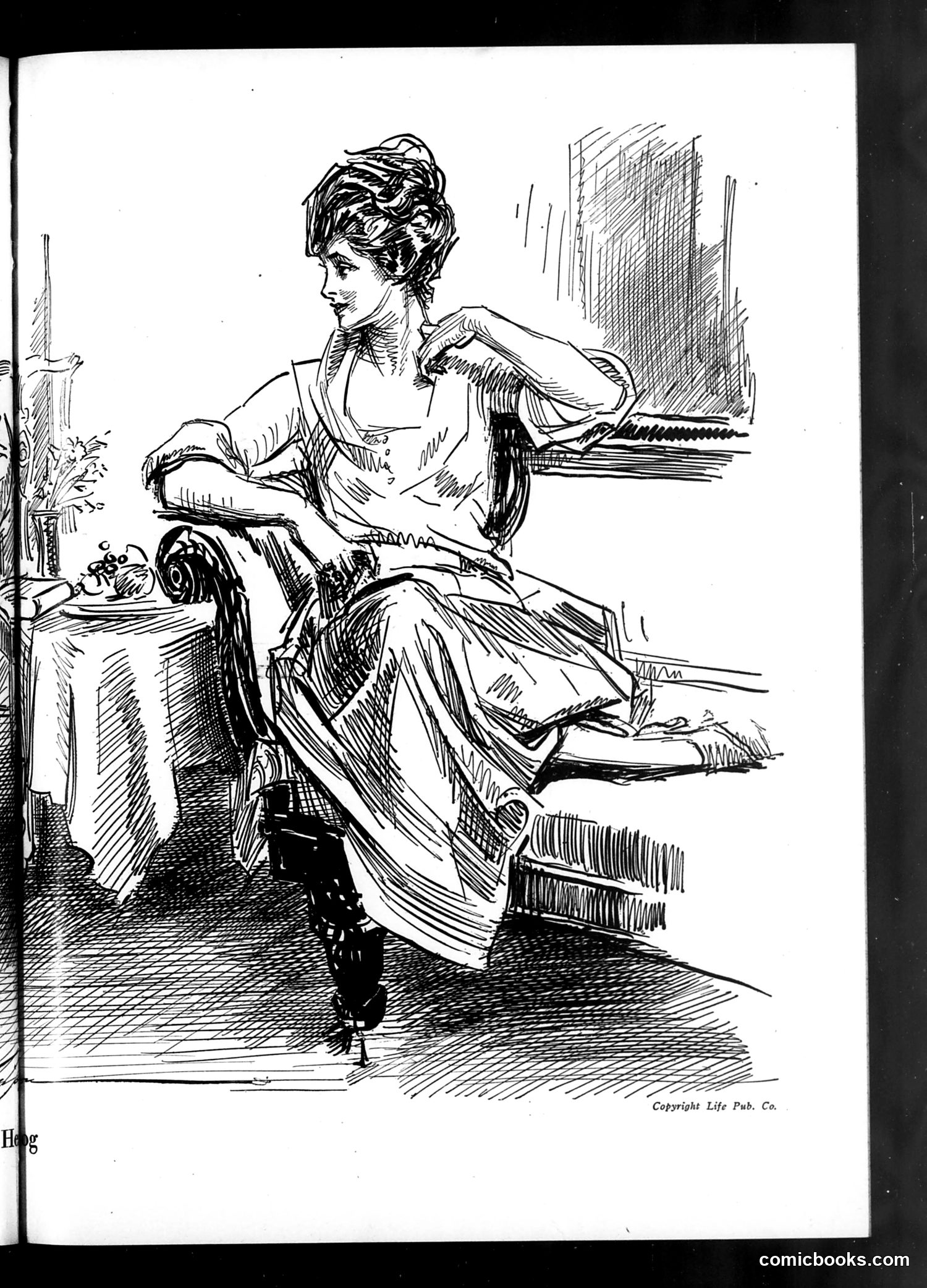
This is a pen-and-ink illustration from *Life* magazine (copyright noted) showing a fashionably dressed woman in early 20th-century attire, seated in an interior setting. She wears an elaborate upswept hairstyle typical of the Gibson Girl era and a flowing dress with puffy sleeves. The OCR text provides no readable caption or context explaining the cartoon's satirical point. Without accompanying text identifying the subject or the specific social/political reference, I cannot determine what aspect of contemporary society this image satirizes or whom it may caricature. The artistic style and fashion suggest Edwardian-era commentary on women's fashion, leisure, or social roles, but the specific satirical message remains unclear from the image alone.
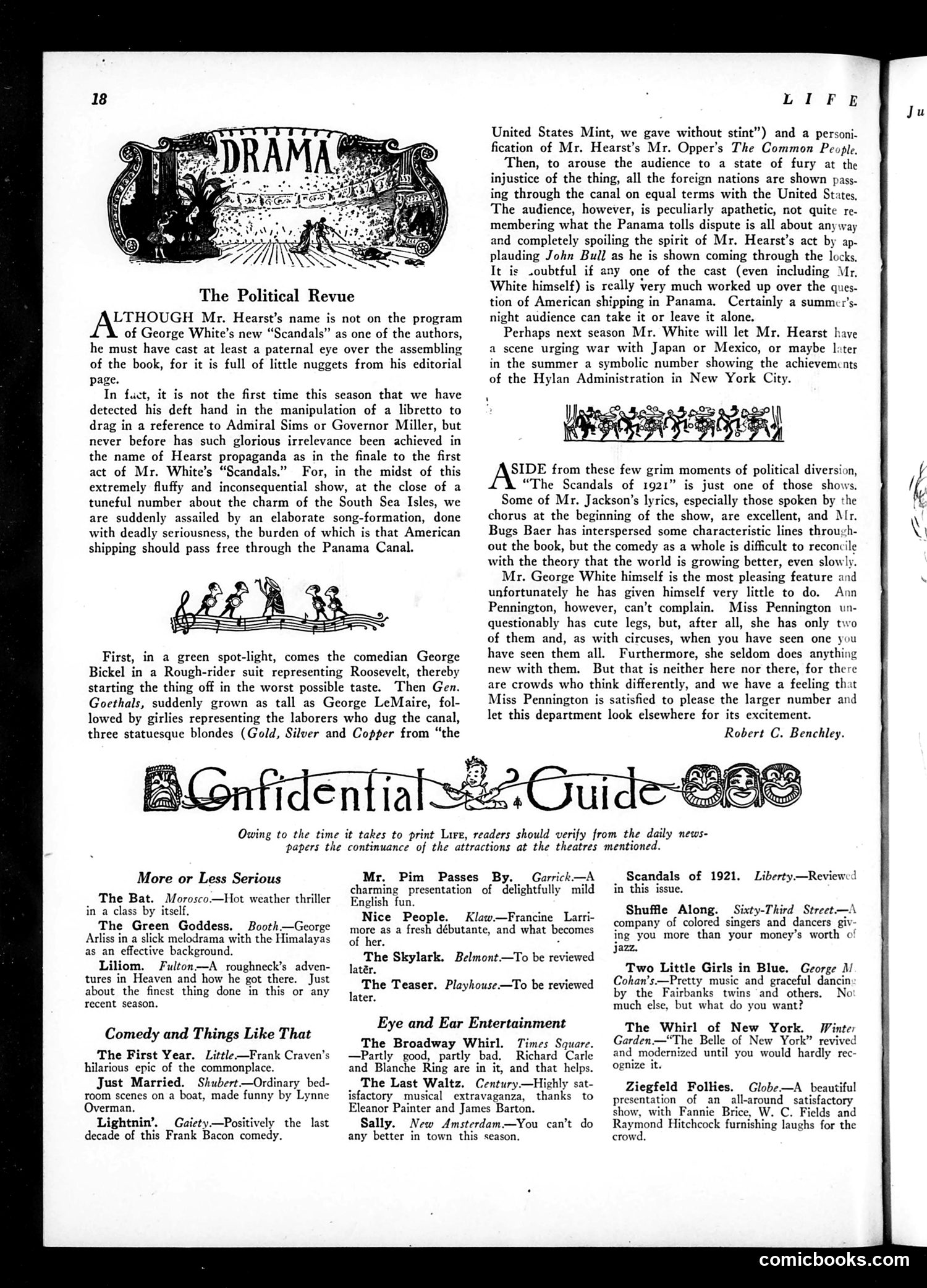
This theater review satirizes how newspaper magnate William Randolph Hearst infiltrated his political agenda into George White's Broadway musical "Scandals." Though uncredited, Hearst shaped the show to promote his editorial positions. The critic highlights an absurd finale: a solemn musical number about the Panama Canal, featuring comedian George Bickel as Theodore Roosevelt in a Rough Rider costume, followed by General Goethals, chorus girls representing "Gold, Silver and Copper," and a personification of "The Common People." The scene argues American ships should pass through the canal toll-free—Hearst's actual political cause. The satire's point: inserting heavy-handed propaganda into frivolous entertainment is ridiculous. The audience couldn't even muster appropriate outrage, applauding "John Bull" (Britain) passing through the locks. The critic sarcastically suggests Hearst next push war with Japan or Mexico through the same theatrical vehicle, mocking the shameless abuse of popular entertainment for editorial purposes.
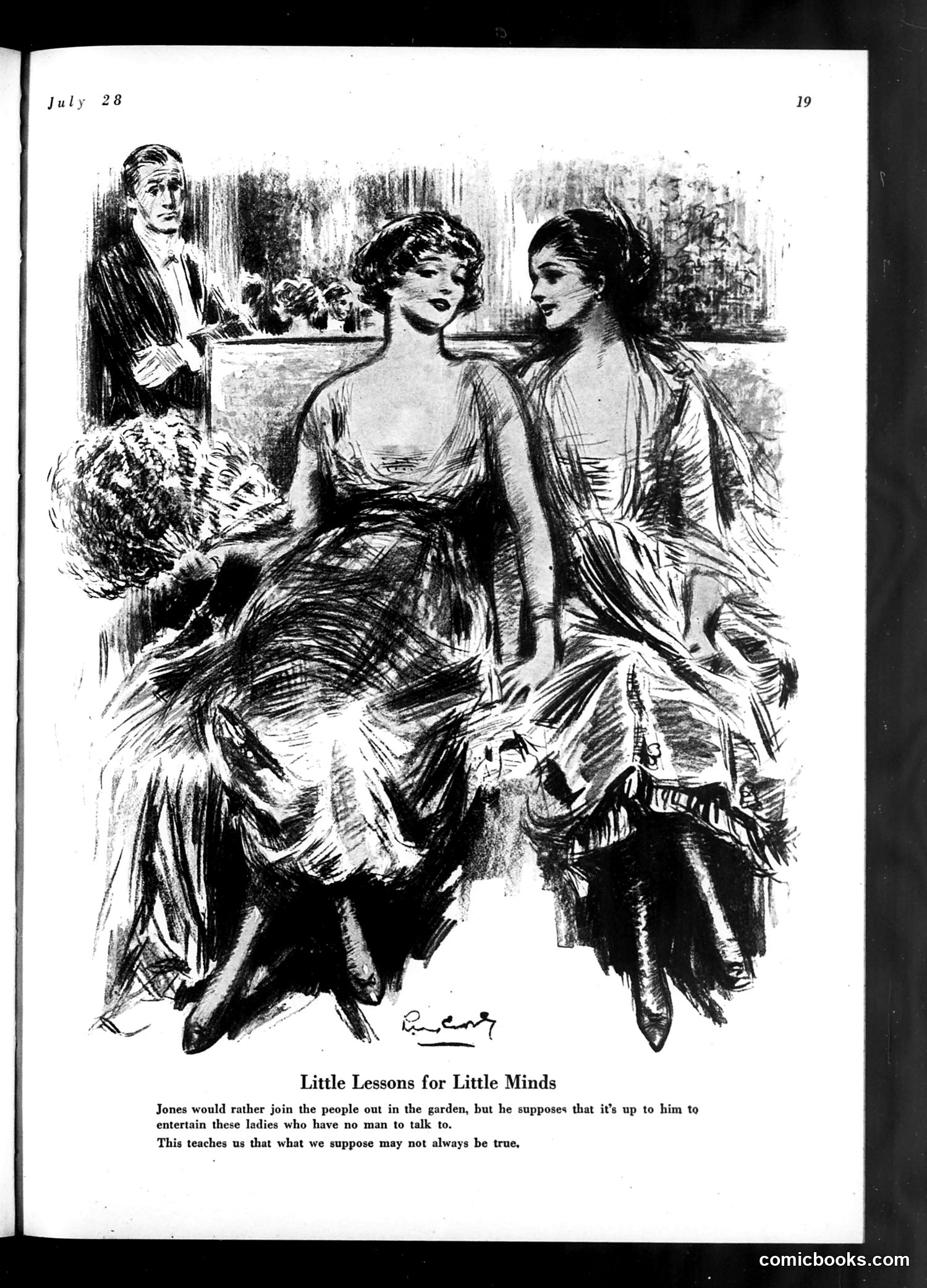
This satirical cartoon critiques gender assumptions and social obligation. A man (Jones) stands with two unattached women in an interior setting, apparently feeling obligated to entertain them because they lack male companionship. The "Little Lessons for Little Minds" title sardonically suggests this reveals a moral teaching: our assumptions aren't always correct. The satire targets the era's expectation that single women require male attention for entertainment, and that men bear responsibility for their amusement. By framing Jones's dutiful sacrifice as potentially misguided, the cartoon mocks both the women's supposed helplessness and the social convention demanding men serve as their entertainers. The moral lesson—that assumptions deceive—undercuts the very assumption the scenario reinforces.
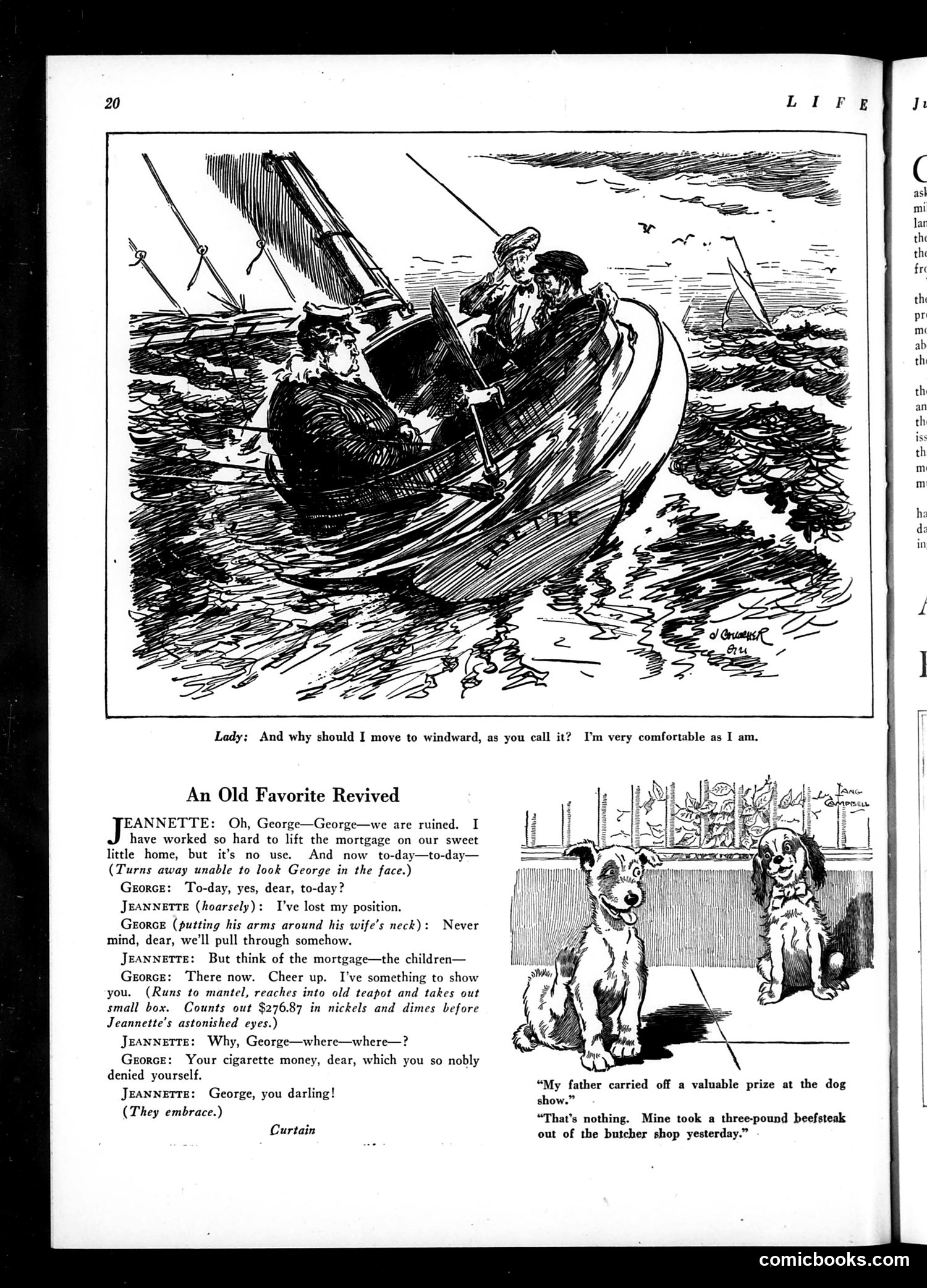
This page contains two separate pieces of satirical humor: **Top cartoon:** A woman in a boat refuses to adjust position, claiming she's "very comfortable." The satire mocks stubborn wives who won't cooperate with their husbands' practical suggestions—a common domestic stereotype of early 20th-century humor. **"An Old Favorite Revived" sketch:** A melodramatic play about a working-class couple facing financial ruin when the wife loses her job. The twist: the husband has secretly saved her cigarette money—$276.87 in nickels and dimes—which miraculously solves their crisis. This satirizes both the sentimentality of Victorian-era domestic theater and gently mocks women's spending habits, portraying smoking as an indulgence that, if foregone, yields substantial savings. **Bottom cartoon:** Two men boast about their dogs' thefts—one stole a prize at a show, the other a beefsteak from a butcher. The joke relies on absurdist humor treating petty theft as something to brag about. All three pieces reflect early 20th-century attitudes toward gender roles, class, and domestic life.
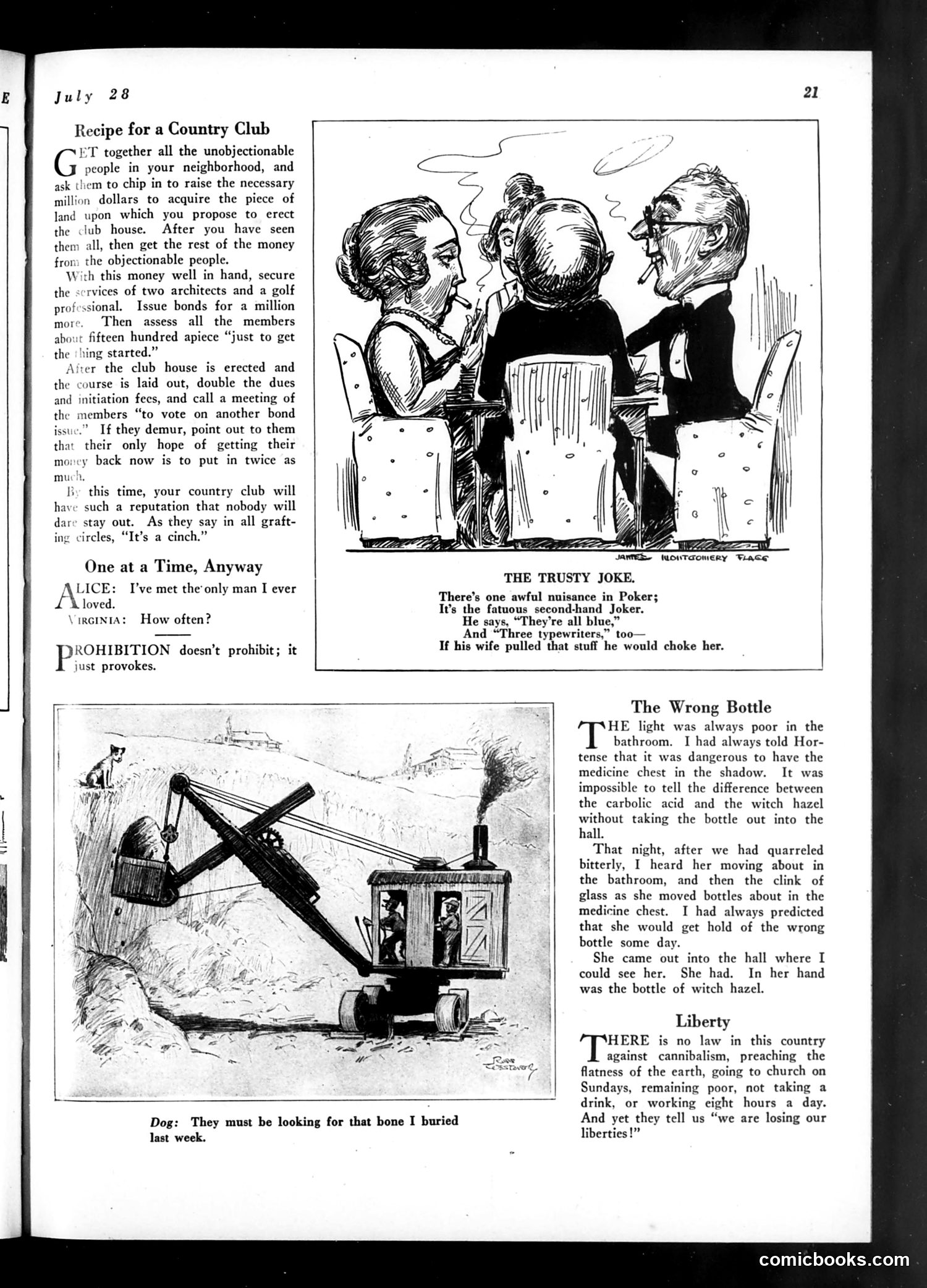
**"Recipe for a Country Club":** A satirical how-to guide mocking the hypocrisy and financial schemes of exclusive country clubs. The joke: solicit money from "unobjectionable" (respectable) neighbors, then extract funds from "objectionable" (undesirable) people to build the club that will exclude the latter. Once established, continuously raise dues and issue bonds—trapping members financially. The satire targets both the snobbish gatekeeping of social clubs and their predatory financing practices. **"The Trusty Joke":** A brief poem about annoying poker players who repeatedly retell the same worn-out jokes about cards and typewriters. **"The Wrong Bottle":** A domestic drama story setup (text only) hinting at dark marital discord—a husband suspects his quarreling wife may deliberately grab poison from a medicine cabinet. **"Liberty":** Political commentary on American freedom. The text ironically notes there are no laws against various personal choices, yet people claim liberties are being lost—likely referencing Prohibition-era restrictions on alcohol and other emerging government regulations limiting individual behavior.
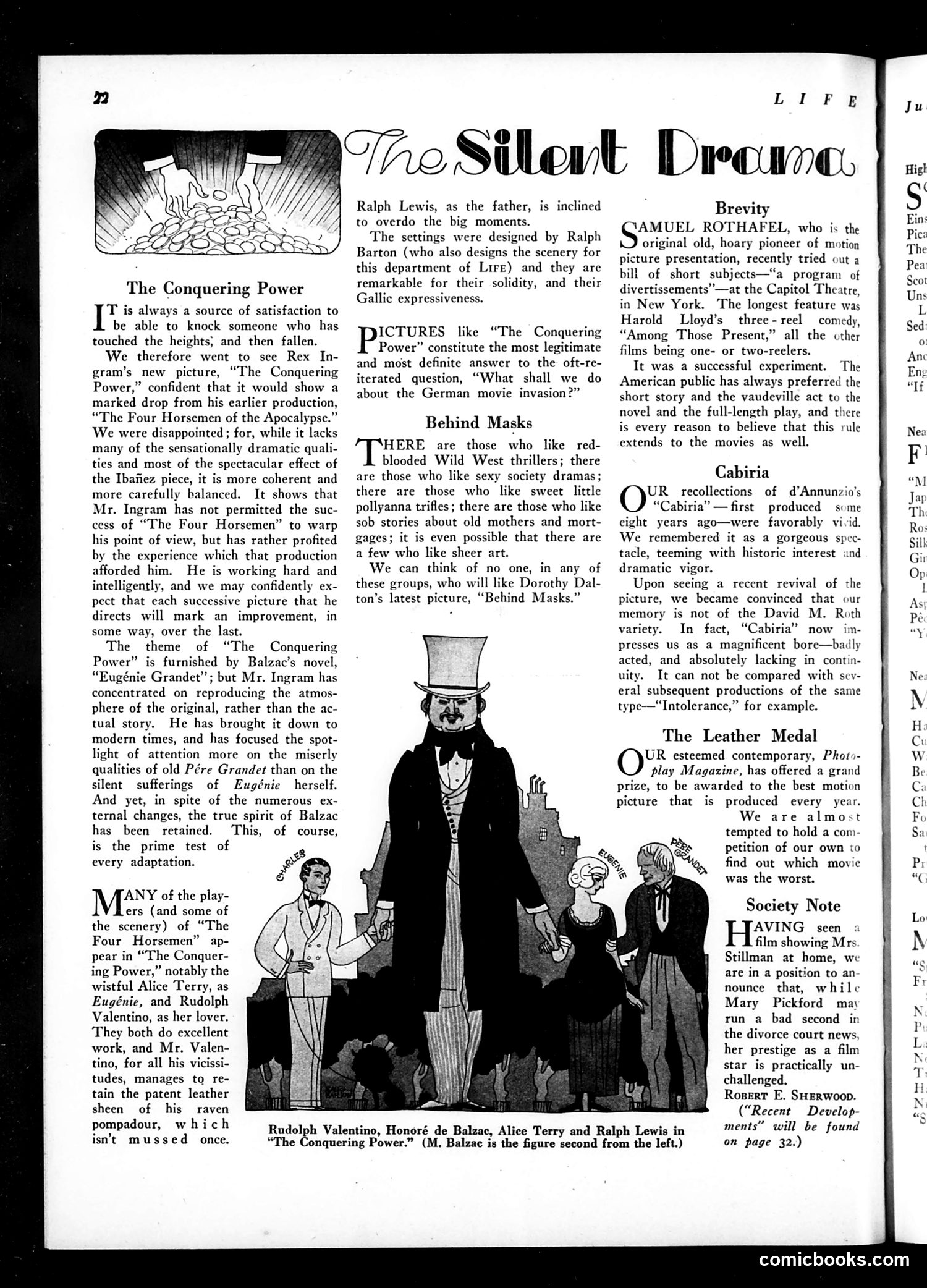
This page contains three film reviews from Life magazine's cinema section. The main review praises Rex Ingram's *The Conquering Power*, adapted from Balzac's novel, as evidence that American cinema can compete with German film productions—a contemporary concern about Hollywood's market position. The review commends the film's coherence and notes Rudolph Valentino's continued appeal ("patent leather sheen of his raven pompadour"). A secondary review dismisses Dorothy Dalton's *Behind Masks* as having no audience appeal across any genre preference. A brief note celebrates Samuel Rothafel's experimental short-film program at the Capitol Theatre, arguing American audiences prefer short stories to full-length narratives. The satire reflects 1920s cinema anxieties: foreign competition, star power, and changing audience tastes during silent film's golden age.
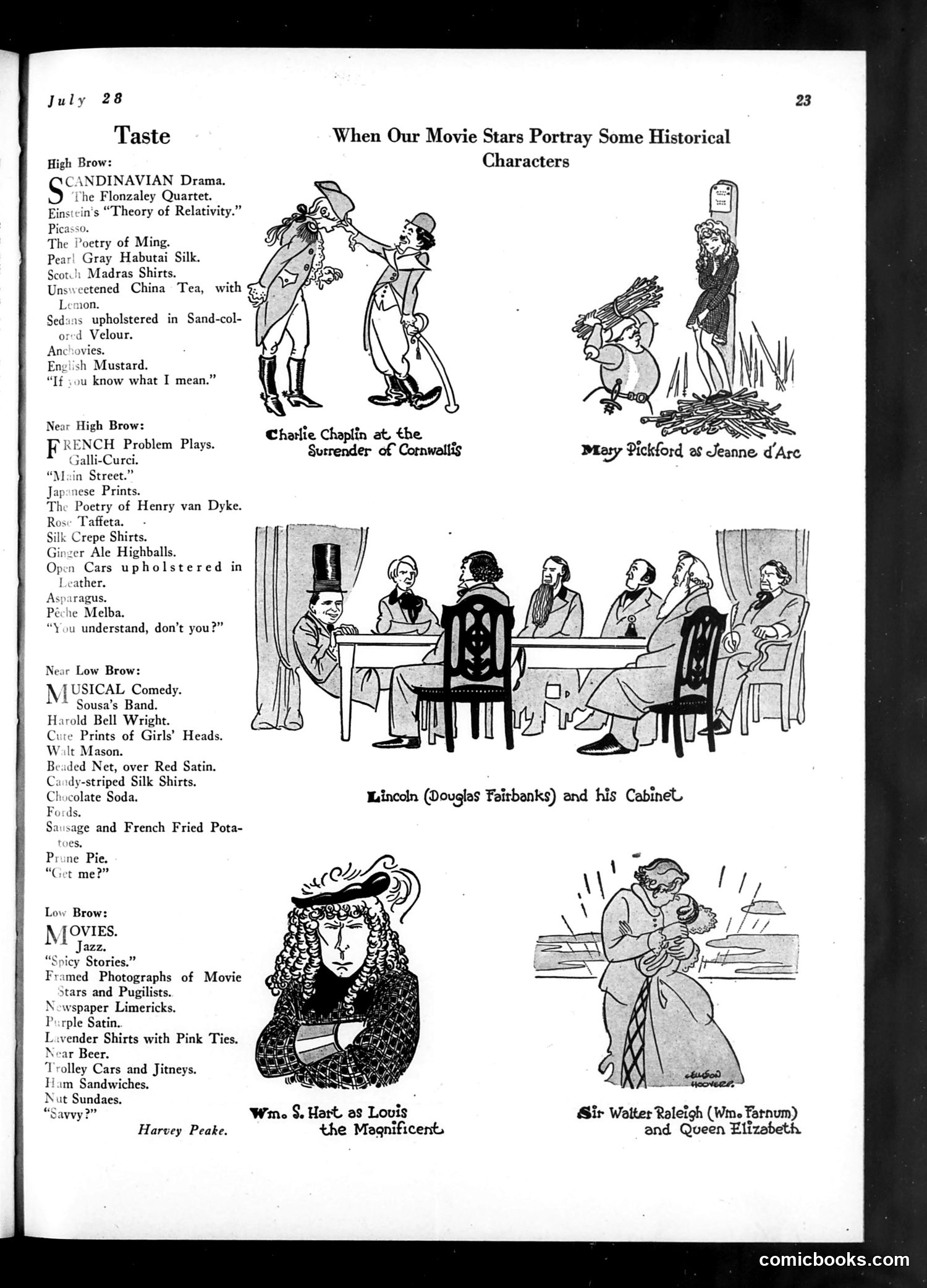
This page satirizes **class distinctions in American taste** through two separate features: **Left side** presents a hierarchical ranking of cultural preferences—from "High Brow" (Einstein, Picasso, fine fabrics) down to "Low Brow" (jazz, movies, beer). The joke is that each tier includes its own clichéd markers of sophistication or vulgarity, mocking how Americans use consumption to signal social status. **Right side** ridicules **silent film stars portraying historical figures**. The cartoons show how movies trivialize history: Charlie Chaplin as a Revolutionary War general (at Cornwallis's surrender), Mary Pickford as Joan of Arc, William S. Hart as Louis XIV, and William Farnum as Sir Walter Raleigh. The satire suggests that Hollywood's casting and dramatization reduce serious history to entertainment spectacle, with actors chosen for star power rather than authenticity. This mocks both cinema's historical pretensions and audiences who consumed these anachronistic portrayals uncritically.
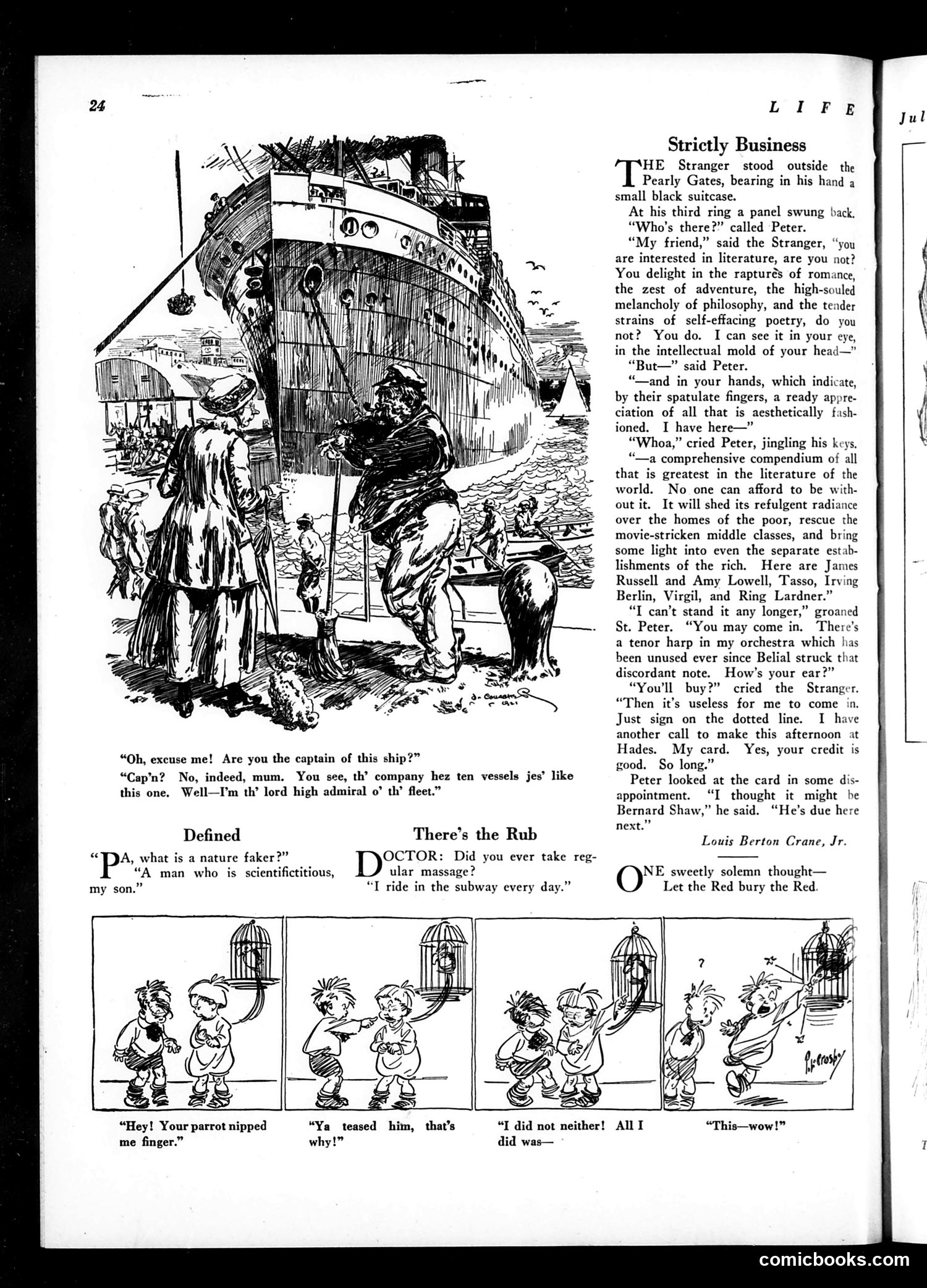
**Top Section - "Strictly Business":** A con artist pitches a book compendium to St. Peter at Heaven's gates, using flowery language about literature and aesthetics. Peter initially welcomes him, but when the Stranger reveals his actual purpose is sales (not gift-giving), Peter refuses. The joke satirizes aggressive salesmanship and con artists who use intellectual pretense to manipulate customers. The mention of "Bernard Shaw" suggests this targets real salesmen of the era who exploited cultural snobbery. **Middle Jokes:** - "Nature faker" = a scientifictitious (fake scientific) person - Subway massage = ironic comment on rough urban transit as unintentional massage **Bottom Comic Strip - "There's the Rub":** Children argue over a caged bird. One claims the parrot bit him; another says he was teasing it; the third denies involvement—a simple children's blame-shifting scenario with no clear political meaning. The page demonstrates *Life* magazine's satirical humor targeting American commerce, pseudo-intellectualism, and everyday social absurdities circa early 20th century.
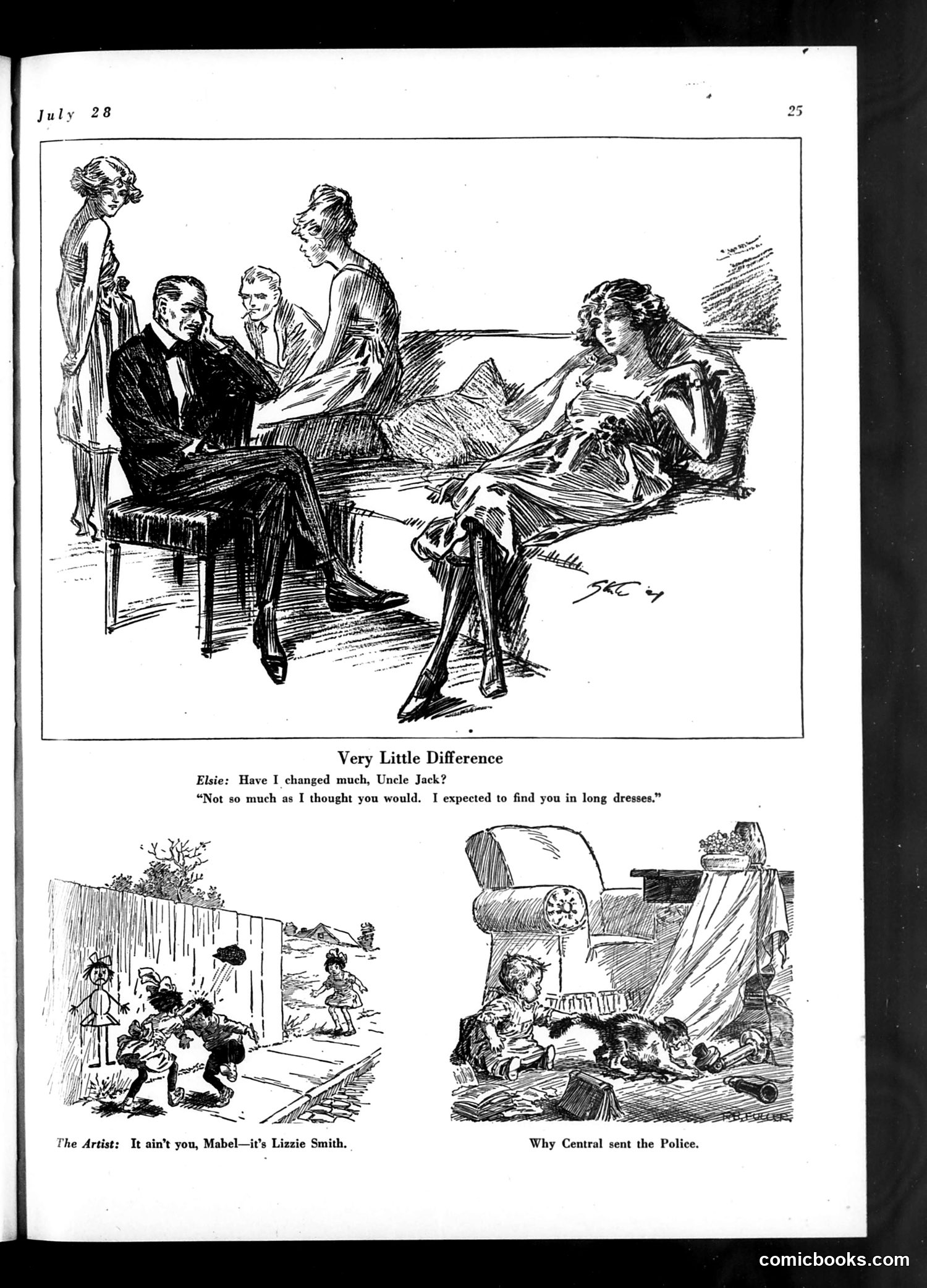
This page contains three separate satirical sketches commenting on women's fashion and social behavior circa early 1900s. The top cartoon jokes about a young woman (Elsie) disappointing her uncle by not adopting "long dresses"—formal adult women's wear—suggesting she remains girlish despite maturation. The bottom-left sketch implies an artist mistook one woman (Lizzie Smith) for another (Mabel), apparently due to similar appearance or dress. The bottom-right cartoon references "Central" (a telephone switchboard operator) sending police, likely because a woman's unconventional behavior—possibly related to her dress or public conduct—warranted police intervention. The sketch appears to satirize both women's changing social roles and the shocked responses they provoked from authorities and society.
This page contains **not a political cartoon, but rather humorous essays and book reviews** from *Life* magazine's "Books" section. **Main Content:** Robert C. Benchley's essay satirizes the middle-class vacation ritual of packing books with good intentions. He mocks how vacationers bring unread books they've been "meaning to read all Spring," imagine leisurely reading in hammocks, then—due to ferry delays, nice weather, and general distraction—don't actually read them. The book arrives water-damaged and dog-eared, relegated to tables and ignored. **Secondary Content:** Poet Arthur Guiterman parodies contemporary book reviews of H.G. Wells's *Outline of History*. He mocks the promotional "Rhymed Review" contest (where publications compete for prize money by praising the book), satirizing how newspapers like the *Chicago Evening Post* and magazines like *The New Republic* manufacture enthusiastic reviews rather than offering honest criticism. **The Satire:** Both pieces target 1920s consumer culture—performative intellectualism and manufactured marketing replacing genuine literary engagement.
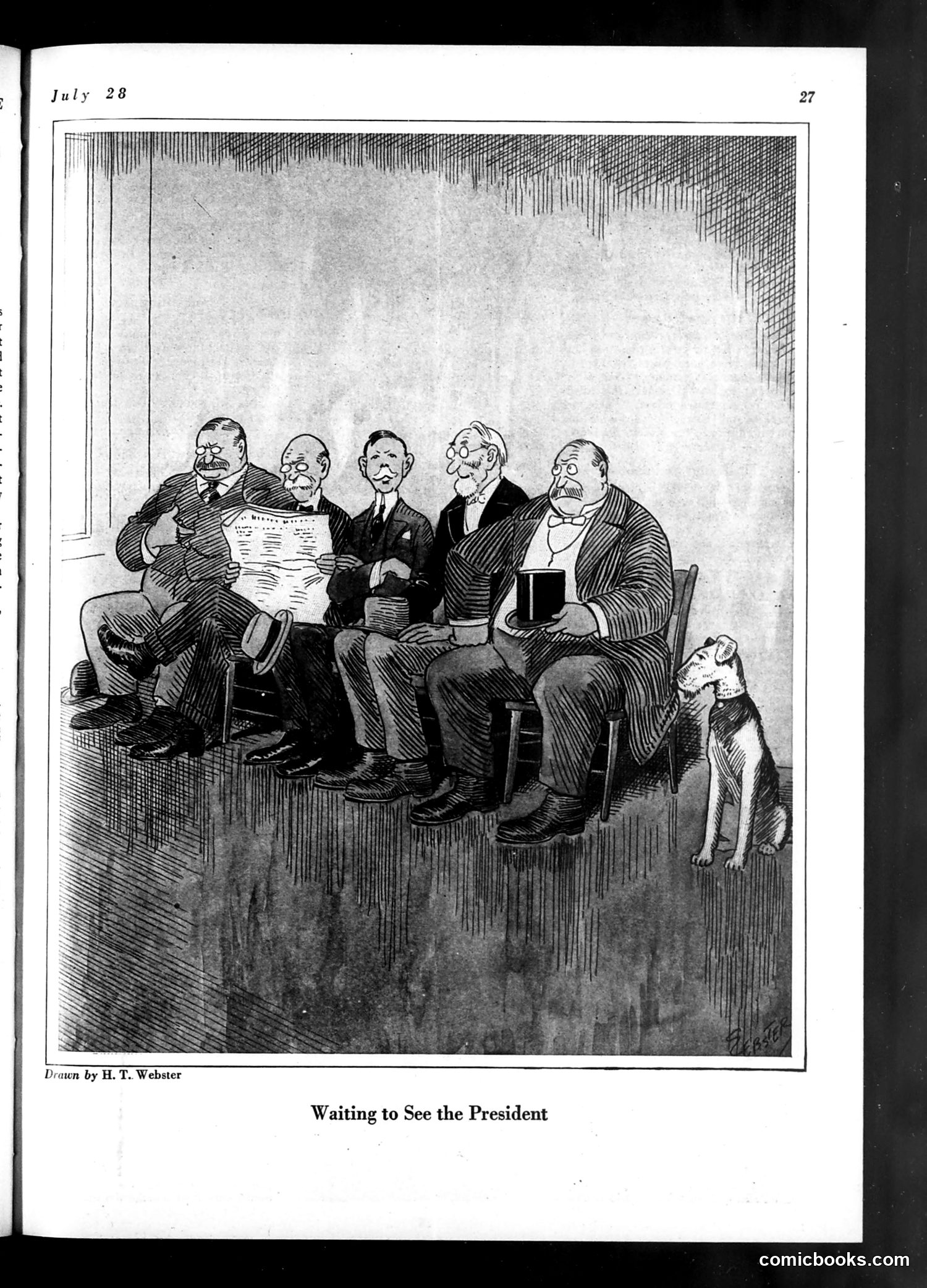
This cartoon by H.T. Webster depicts five men and a dog sitting together in what appears to be an anteroom or waiting area. The men are dressed formally in suits and carry reading materials—one holds a newspaper, another a book. Their expressions suggest boredom or resignation. The satire critiques the common experience of citizens or petitioners waiting for an audience with the President—a situation implying bureaucratic inefficiency, delayed access, and wasted time. The inclusion of the dog, treated as just another "visitor," adds humorous commentary, suggesting that even animals might wait alongside people seeking presidential attention. Webster's point likely mocks both the tedium of political access and the somewhat absurd formality surrounding presidential meetings in the early 20th century.
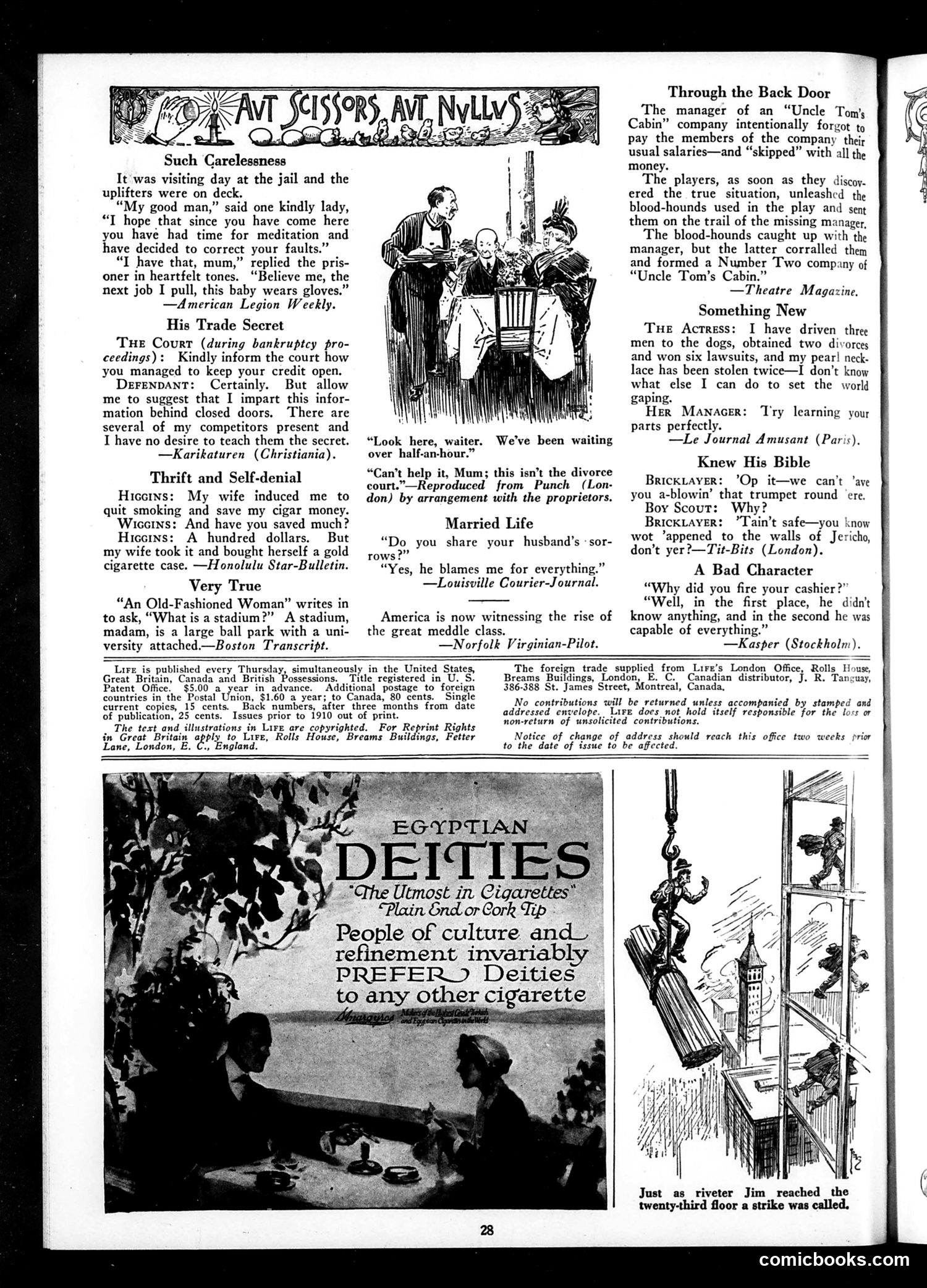
This page from *Life* magazine (a satirical weekly) collects brief humorous anecdotes sourced from newspapers and magazines worldwide, mocking human folly across various social situations. The jokes target: **Criminals and justice**: A prisoner promises to wear gloves on his next heist—satirizing criminals' lack of genuine reform. **Business ethics**: A bankrupt defendant refuses to reveal his credit secrets lest competitors learn them—mocking dishonest business practices. **Marriage and gender**: A wife saves her husband's cigar money by quitting smoking, then spends his savings on a gold cigarette case—lampooning female hypocrisy and materialism. **Class commentary**: A reference to "the great meddle class" criticizes middle-class busybodies. **Theater mishap**: Managers of *Uncle Tom's Cabin* productions absconding with actors' pay—exposing theatrical industry fraud. The advertisements (Egyptian Deities cigarettes, a building illustration) are secondary. The page's humor relies on audience familiarity with contemporary social types and concerns: fraud, marital discord, and working-class struggles.
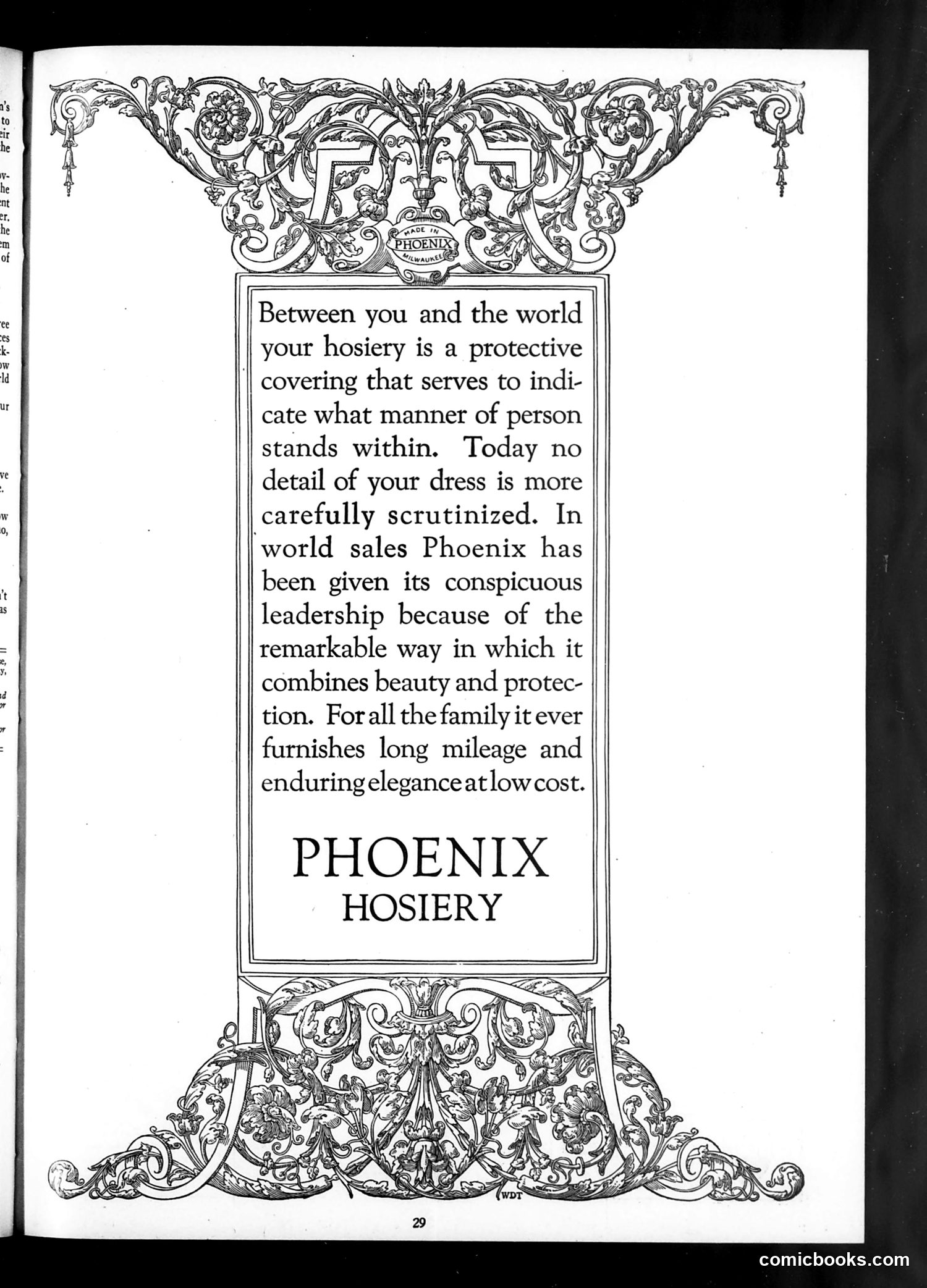
This is a **full-page advertisement**, not political satire. It's a vintage ad for Phoenix brand hosiery (socks/stockings) from Life magazine's early 20th-century period. The ad uses ornate Art Nouveau-style decorative borders framing the text. Its key message: hosiery functions as a social indicator revealing one's character and status to observers. Phoenix hosiery supposedly combines beauty with durability at affordable prices, marketed as suitable "for all the family." The appeal is class-conscious and appearance-focused—typical of the era's advertising, which emphasized how clothing choices communicated respectability. The elaborate design itself signals quality and sophistication, positioning Phoenix as an upscale yet economical choice. There is no political cartoon or satire present on this page.
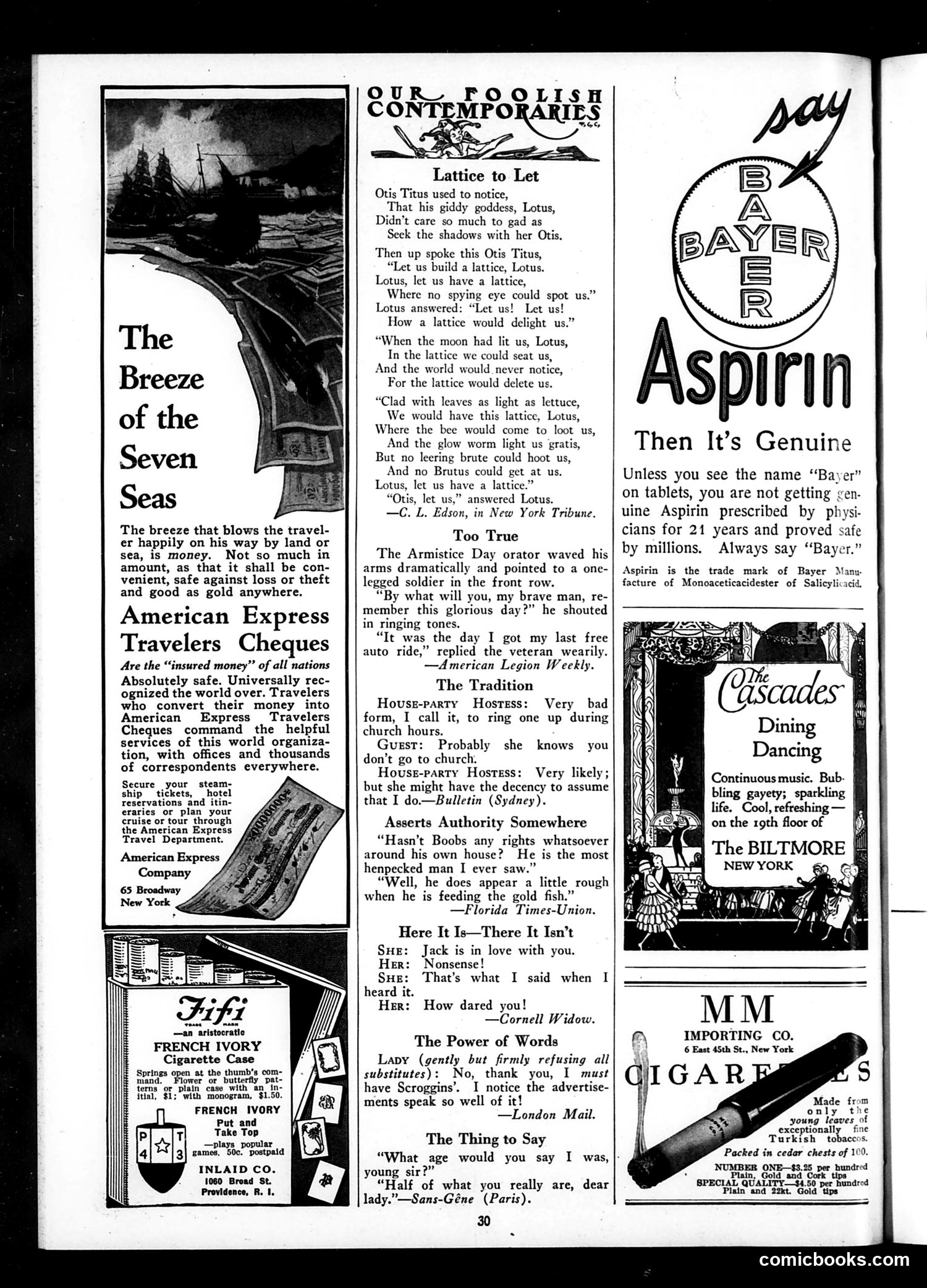
This page is primarily **advertisements and humor pieces** from Life magazine's "Our Foolish Contemporaries" section. The main cartoon content includes short satirical anecdotes mocking social conventions: - **"Lattice to Let"**: A playful poem about a couple named Otis and Lotus seeking privacy in a lattice-covered hideaway—gentle satire on courting customs and desire for seclusion. - **"Too True"**: Dark post-WWI humor where a one-legged veteran, asked what he'll remember about Armistice Day, replies he'll remember his "last free auto ride"—mocking empty patriotic rhetoric and the government's failure to adequately support disabled veterans. - Other brief jokes mock social etiquette (calling during church hours), domestic power dynamics ("henpecked" husbands), and flattery. The **advertisements** (American Express, Aspirin, cigarette cases, The Biltmore) reflect 1920s consumer culture and luxury travel. The satire targets superficial respectability, patriotic hypocrisy, and social pretension—typical of Life's irreverent approach to post-war American society.
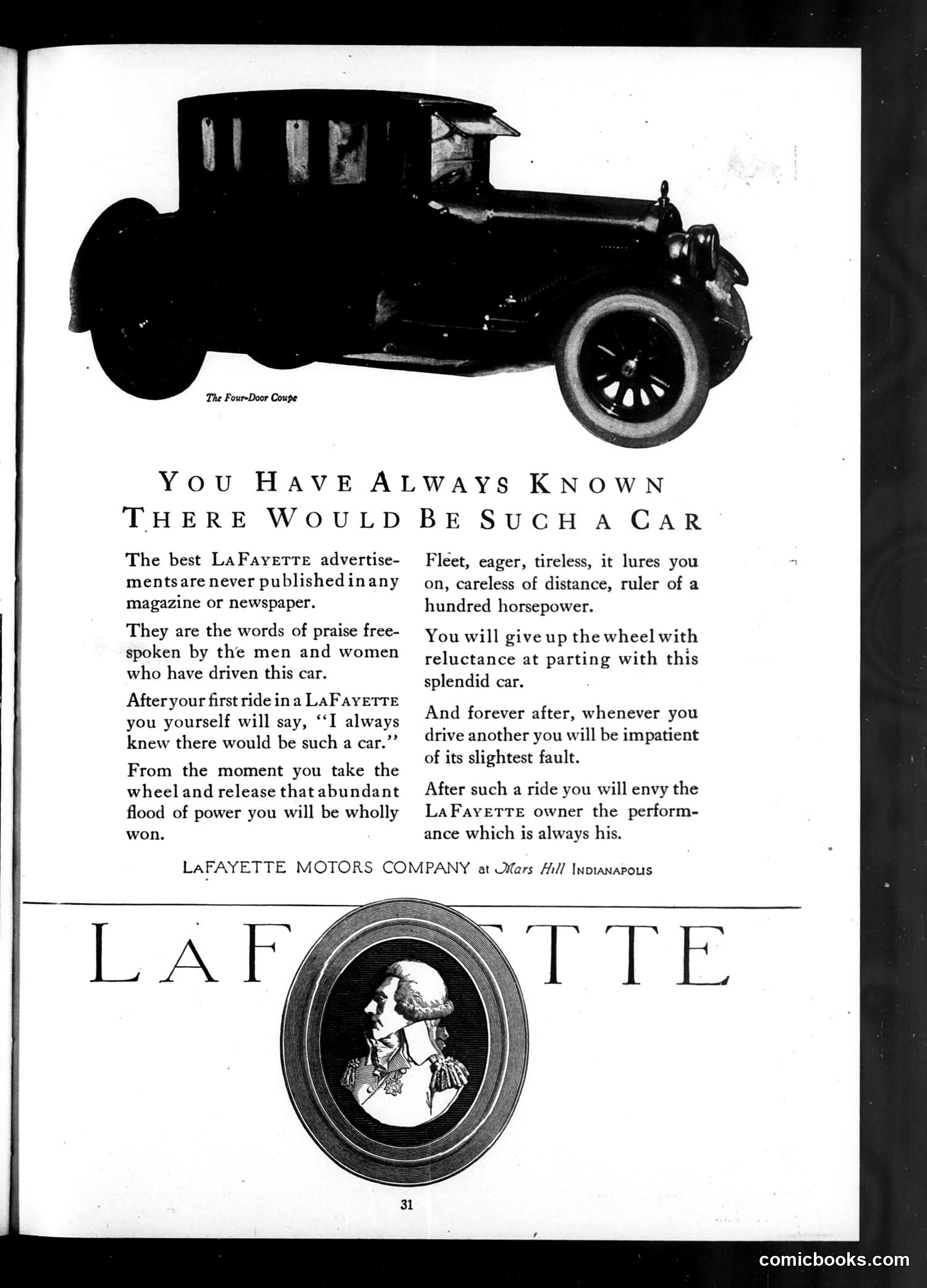
This is **not a political cartoon or satire** — it's a straightforward automobile advertisement for the Lafayette motor car, made by Lafayette Motors Company in Indianapolis. The page features: - **Top**: An illustration of "The Four-Door Coupe," a 1920s-era automobile shown in profile - **Text**: Marketing copy promising that after driving a Lafayette, owners will find all other cars inadequate by comparison - **Bottom**: The Lafayette brand name with a portrait of the Marquis de Lafayette (the Revolutionary War general), which appears to be the company's logo The advertisement uses emotional persuasion rather than specifications—emphasizing the car's power (100 horsepower), reliability, and the lasting impression it makes on drivers. The historical portrait lends prestige through association with the famous French military figure. This is standard early automotive advertising, not editorial commentary or satire.
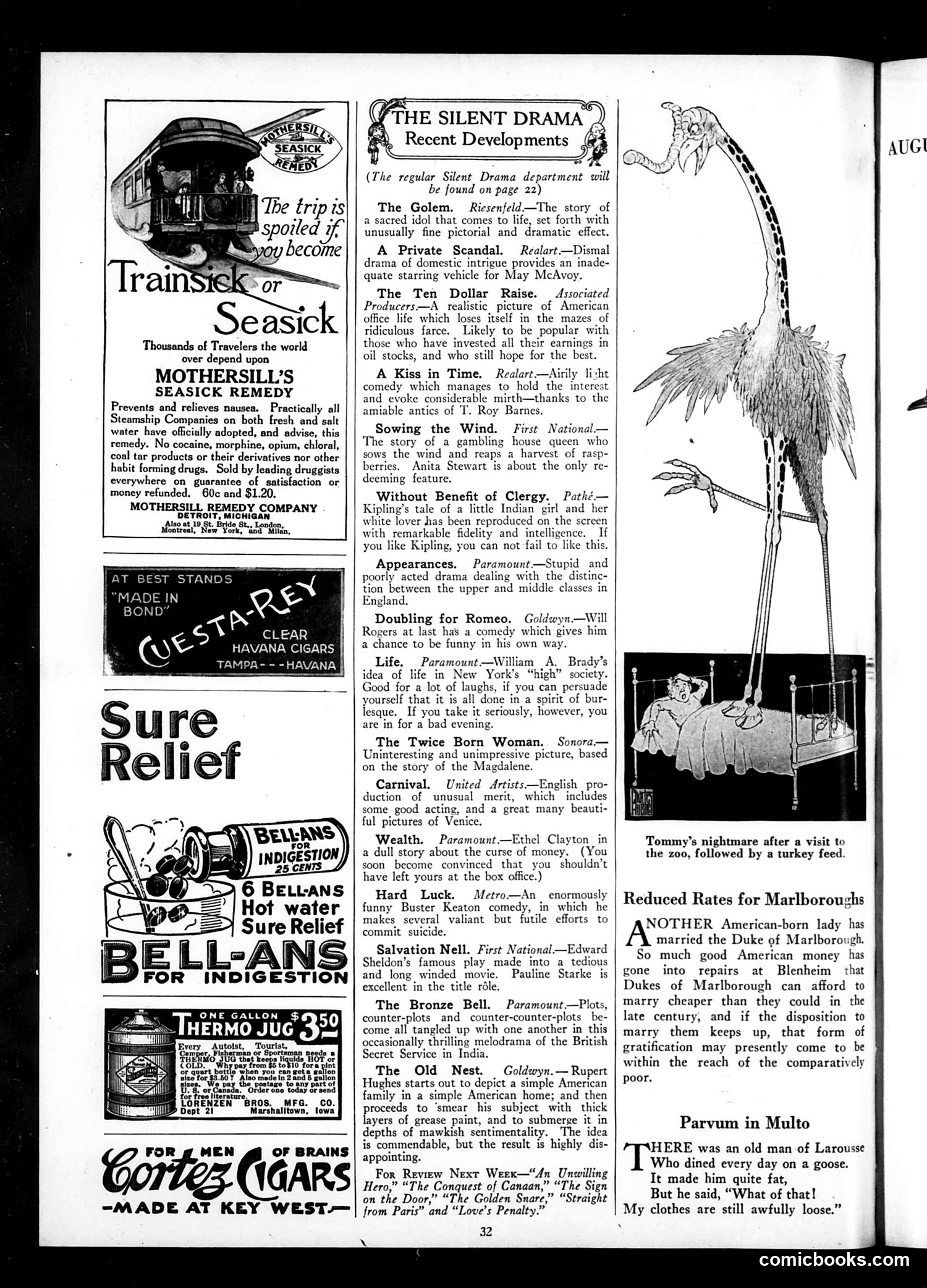
This page is primarily a **film review column** for silent movies, not political satire. It surveys current theatrical releases with brief critical commentary—typical entertainment journalism of the era. Key observations: The reviews are witty and dismissive of mediocre films (describing one drama as "dismal," another as having "ridiculous farce"). Notably, they reference actual stars like May McAvoy, Will Rogers, and Buster Keaton, whose comedies are praised. The surrounding **advertisements** (Mothersill's Seasick Remedy, Bell-Ans indigestion tablets, cigars) target travelers and businessmen—the magazine's affluent male readership. One review quips that audiences investing in oil stocks will appreciate a film about financial hopes, suggesting contemporary economic speculation was satirized even then. The overall tone reflects 1920s commercial entertainment criticism rather than political commentary.