
Life, 1921-07-28 · page 17 of 34
Life — July 28, 1921 — page 17: what you’re looking at
What you’re looking at
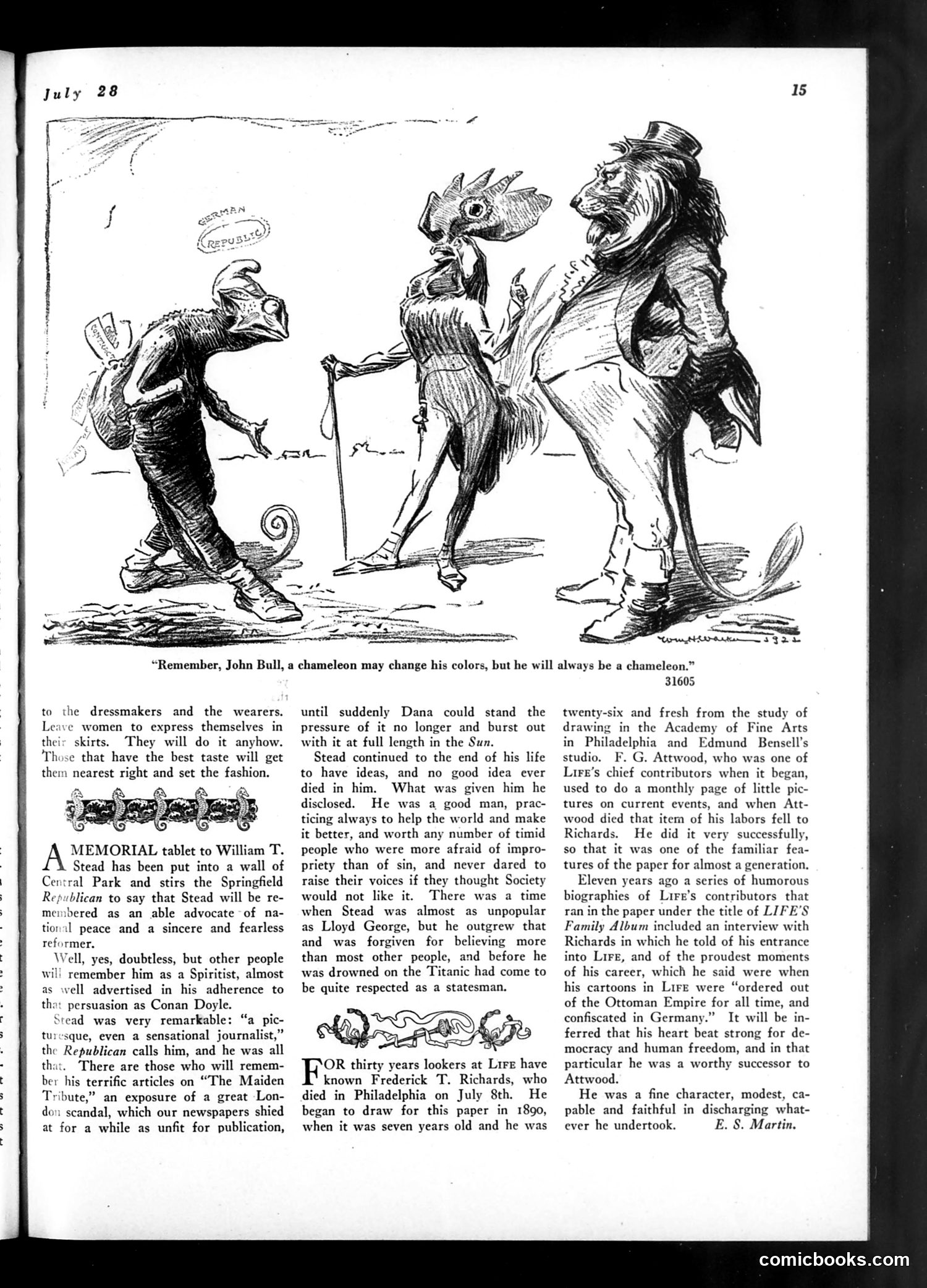
The cartoon depicts **John Bull** (the anthropomorphic personification of Britain, shown as the rotund figure on the right) alongside two other figures representing political entities or nations. The caption quotes a proverb about chameleons changing colors but remaining chameleons—a commentary on **British foreign policy's inconsistency**. The satire suggests that despite Britain's shifting diplomatic alliances or stated positions, its fundamental nature and interests remain unchanged. This likely references early 20th-century concerns about British political reliability or hypocrisy regarding international commitments. The other figures appear to represent different nations or political factions engaging with Britain, though their specific identities aren't entirely clear from the image alone. The overall point is that **rhetorical claims of change mask unchanged underlying character**—a common satirical critique of government duplicity. The page also includes obituaries for journalist William T. Stead and cartoonist Frederick T. Richards, reflecting *Life* magazine's editorial content.
📄 Transcribed text from this page (OCR, searchable)
Machine-transcribed from the original scan — historical spelling and the odd misread are preserved.
“Remember, John Bull, a chameleon may change his colors, but he will always be a chameleon.” 31605 to the dressmakers and the wearers. Leave women to express themselves in their skirts. They will do it anyhow. Those that have the best taste will get them nearest right and set the fashion. MEMORIAL tablet to William T. Stead has been put into a wall of Central Park and stirs the Springfield Republican to say that Stead will be re- membered as an able advocate of na- tional peace and a sincere and fearless reformer. Well, yes, doubtless, but other people will remember him as a Spiritist, almost as well advertised in his adherence to tha: persuasion as Conan Doyle. Stead was very remarkable: “a pic- turesque, even a sensational journalist,” the Republican calls him, and he was all that. There are those who will remem- ber his terrific articles on “The Maiden Tribute,” an exposure of a great Lon- don scandal, which our newspapers shied at for a while as unfit for publication, until suddenly Dana could stand the pressure of it no longer and burst out with it at full length in the Sun. Stead continued to the end of his life to have ideas, and no good idea ever died in him. What was given him he disclosed. He was a good man, prac- ticing always to help the world and make it better, and worth any number of timid people who were more afraid of impro- priety than of sin, and never dared to raise their voices if they thought Society would not like it. There was a time when Stead was almost as unpopular as Lloyd George, but he outgrew that and was forgiven for believing more than most other people, and before he was drowned on the Titanic had come to be quite respected as a statesman. OR thirty years lookers at Lire have known Frederick T. Richards, who died in Philadelphia on July 8th. He began to draw for this paper in 1890, when it was seven years old and he was twenty-six and fresh from the study of drawing in the Academy of Fine Arts in Philadelphia and Edmund Bensell’s studio, F. G. Attwood, who was one of Lire’s chief contributors when it began, used to do a monthly page of little pic- tures on current events, and when Att- wood died that item of his labors fell to Richards. He did it very successfully, so that it was one of the familiar fea- tures of the paper for almost a generation, Eleven years ago a series of humorous biographies of Lire’s contributors that ran in the paper under the title of LIFE’S Family Album included an interview with Richards in which he told of his entrance into Lire, and of the proudest moments of his career, which he said were when his cartoons in Lire were “ordered out of the Ottoman Empire for all time, and confiscated in Germany.” It will be in- ferred that his heart beat strong for de- mocracy and human freedom, and in that particular he was a worthy successor to Attwood. He was a fine character, modest, ca- pable and faithful in discharging what- ever he undertook. E. 8. Martin. comicbooks.com