
Life, 1921-07-28 · page 28 of 34
Life — July 28, 1921 — page 28: what you’re looking at
What you’re looking at
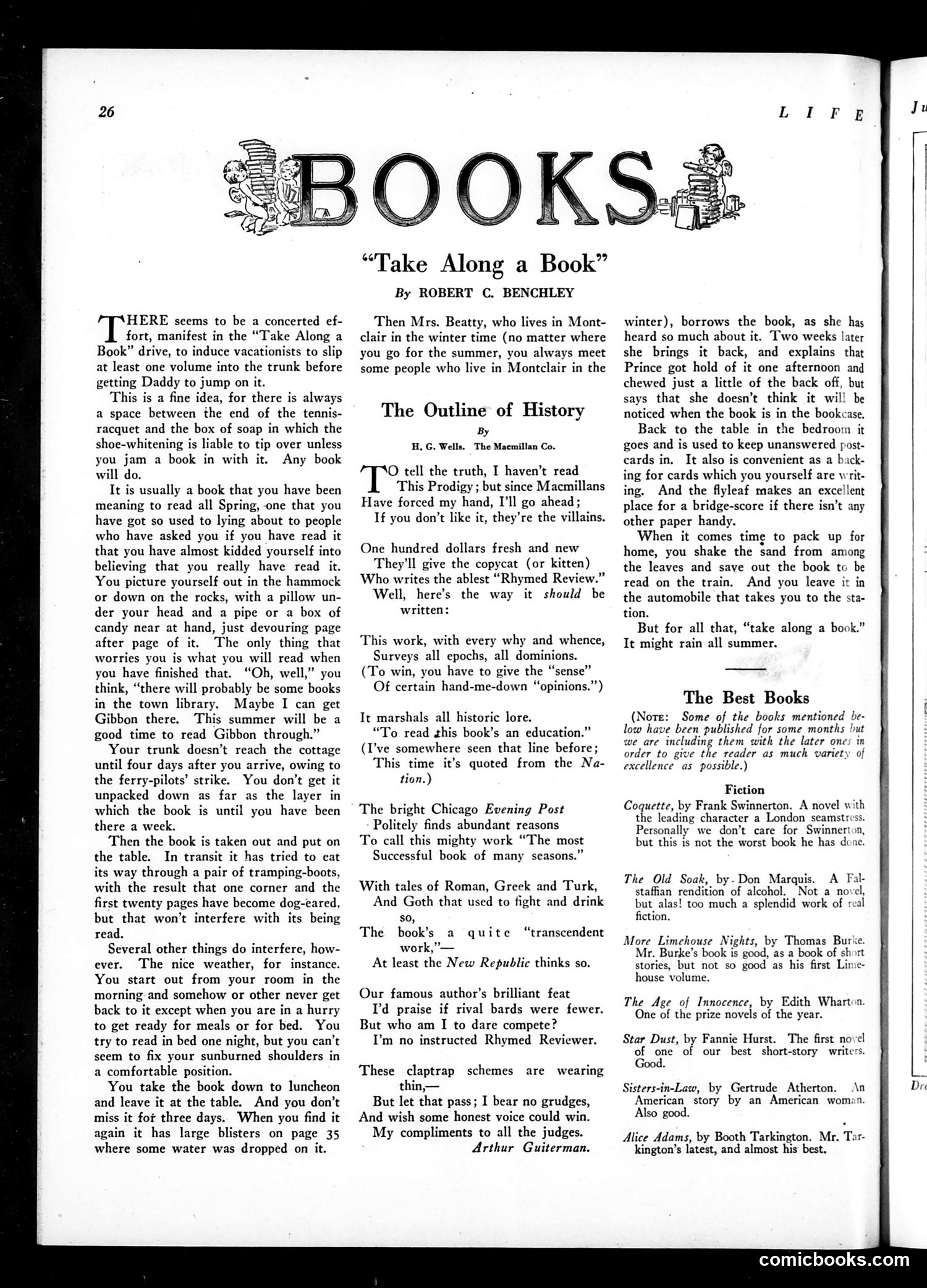
This page contains **not a political cartoon, but rather humorous essays and book reviews** from *Life* magazine's "Books" section. **Main Content:** Robert C. Benchley's essay satirizes the middle-class vacation ritual of packing books with good intentions. He mocks how vacationers bring unread books they've been "meaning to read all Spring," imagine leisurely reading in hammocks, then—due to ferry delays, nice weather, and general distraction—don't actually read them. The book arrives water-damaged and dog-eared, relegated to tables and ignored. **Secondary Content:** Poet Arthur Guiterman parodies contemporary book reviews of H.G. Wells's *Outline of History*. He mocks the promotional "Rhymed Review" contest (where publications compete for prize money by praising the book), satirizing how newspapers like the *Chicago Evening Post* and magazines like *The New Republic* manufacture enthusiastic reviews rather than offering honest criticism. **The Satire:** Both pieces target 1920s consumer culture—performative intellectualism and manufactured marketing replacing genuine literary engagement.
📄 Transcribed text from this page (OCR, searchable)
Machine-transcribed from the original scan — historical spelling and the odd misread are preserved.
HERE seems to be a concerted ef- fort, manifest in the “Take Along a Book” drive, to induce vacationists to slip at least one volume into the trunk before getting Daddy to jump on it. This is a fine idea, for there is always a space between the end of the tennis- racquet and the box of soap in which the shoe-whitening is liable to tip over unless you jam a book in with it. Any book will do. It is usually a book that you have been meaning to read all Spring, one that you have got so used to lying about to people who have asked you if you have read it that you have almost kidded yourself into believing that you really have read it. You picture yourself out in the hammock or down on the rocks, with a pillow un- der your head and a pipe or a box of candy near at hand, just devouring page after page of it. The only thing that worries you is what you will read when you have finished that. “Oh, well,” you think, “there will probably be some books in the town library. Maybe I can get Gibbon there. This summer will be a good time to read Gibbon through.” Your trunk doesn’t reach the cottage until four days after you arrive, owing to the ferry-pilots’ strike. You don’t get it unpacked down as far as the layer in which the book is until you have been there a week. Then the book is taken out and put on the table. In transit it has tried to eat its way through a pair of tramping-boots, with the result that one corner and the first twenty pages have become dog-eared, but that won't interfere with its being read. Several other things do interfere, how- ever. The nice weather, for instance. You start out from your room in the morning-and somehow or other never get back to it except when you are in a hurry to get ready for meals or for bed. You try to read in bed one night, but you can’t seem to fix your sunburned shoulders in a comfortable position. You take the book down to luncheon and leave it at the table. And you don’t miss it fot three days. When you find it again it has large blisters on page 35 where some water was dropped on it. “Take Along a Book” By ROBERT C. BENCHLEY Then Mrs. Beatty, who lives in Mont- clair in the winter time (no matter where you go for the summer, you always meet some people who live in Montclair in the The Outline of History By H, G. Wells. The Macmillan Co. O tell the truth, I haven’t read This Prodigy ; but since Macmillans Have forced my hand, I’ll go ahead; If you don’t like it, they’re the villains. One hundred dollars fresh and new They'll give the copycat (or kitten) Who writes the ablest “Rhymed Review.” Well, here’s the way it should be written: This work, with every why and whence, Surveys all epochs, all dominions. (To win, you have to give the “sense” Of certain hand-me-down “opinions.” It marshals all historic lore. “To read this book’s an education.” (I’ve somewhere seen that line before; This time it’s quoted from the Na- tion.) The bright Chicago Evening Post Politely finds abundant reasons To call this mighty work “The most Successful book of many seasons.” With tales of Roman, Greek and Turk, And Goth that used to fight and drink a quite “transcendent work,”— At least the New Republic thinks so. Our famous author's brilliant feat I'd praise if rival bards were fewer. But who am I to dare compete? I’m no instructed Rhymed Reviewer. These claptrap schemes are wearing thin,— But let that pass; I bear no grudges, And wish some honest voice could win. My compliments to all the judges. Arthur Guiterman. winter), borrows the book, as she has heard so much about it. Two weeks later she brings it back, and explains that Prince got hold of it one afternoon and chewed just a little of the back off, but says that she doesn’t think it will be noticed when the book is in the bookcase, Back to the table in the bedroom it goes and is used to keep unanswered post- cards in. It also is convenient as a back- ing for cards which you yourself are writ- ing. And the flyleaf makes an excellent place for a bridge-score if there isn’t any other paper handy. When it comes time to pack up for home, you shake the sand from among the leaves and saye out the book to be read on the train. And you leave it in the automobile that takes you to the sta- tion. But for all that, “take along a book.” It might rain all summer. The Best Books (Nore: Some of the books mentioned be- low have been published for some months but we are including them with the later ones in order to give the reader as much variety of excellence as possible.) Fiction Coquette, by Frank Swinnerton. A novel with the leading character a London seamstress. Personally we don’t care for Swinnerton, but this is not the worst book he has done. The Old Soak, by-Don Marquis. A Fal- staffian rendition of alcohol. Not a novel, but alas! too much a splendid work of real fiction. More Limehouse Nights, by Thomas Burke. Mr. Burke’s book is good, as a book of s| stories, but not so good as his first Lime- house volume. The Age of Innocence, by Edith Wharton. One of the prize novels of the year. Star Dust, by Fannie Hurst. The first novel of one of our best short-story writers. Good. Sisters-in-Law, by Gertrude Atherton. .\n American story by an American woman. Also good. Alice Adams, by Booth Tarkington. Mr. Tar- kington’s latest, and almost his best. Dri comicbooks.com