
Life, 1921-07-28 · page 20 of 34
Life — July 28, 1921 — page 20: what you’re looking at
What you’re looking at
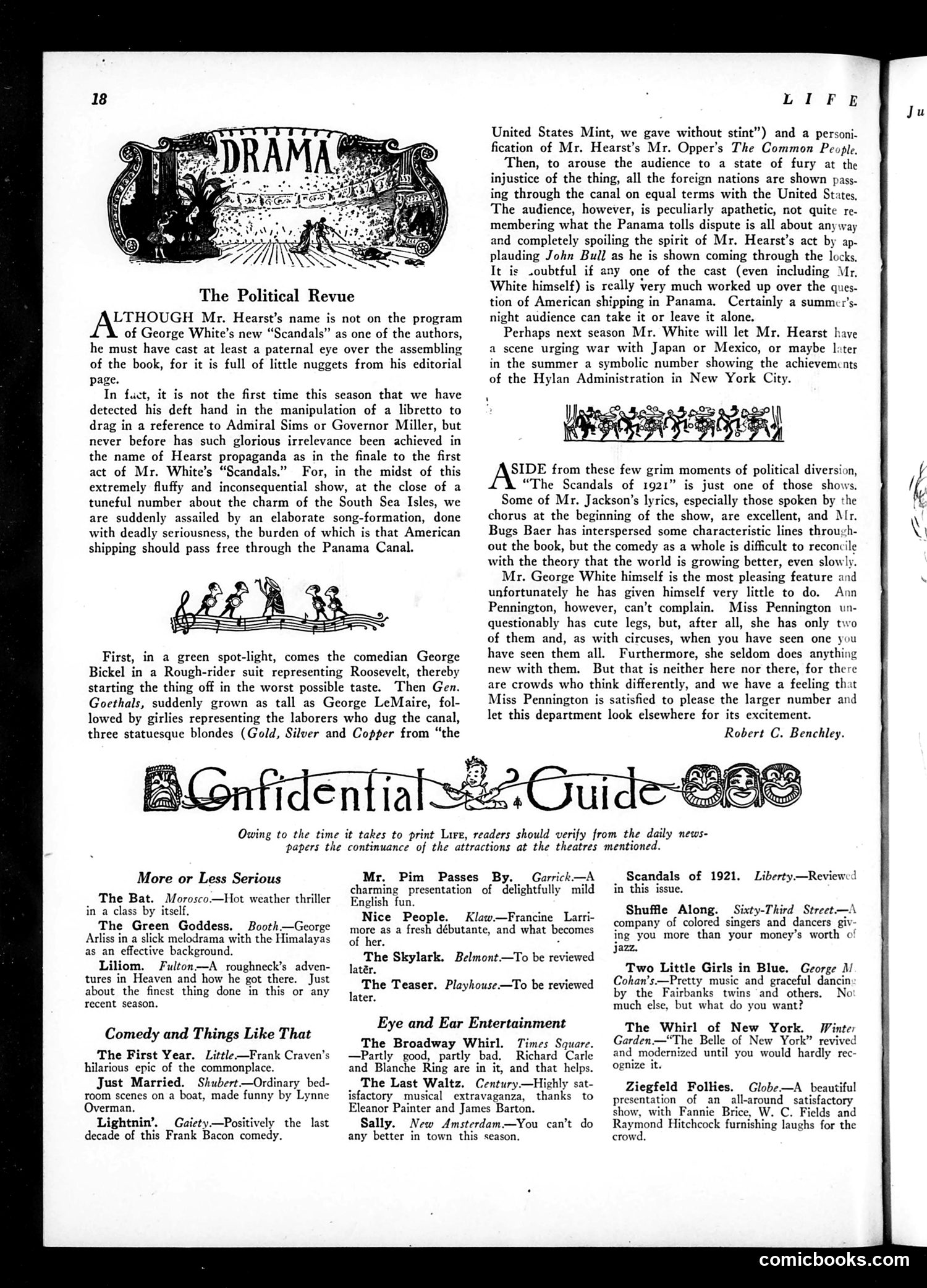
This theater review satirizes how newspaper magnate William Randolph Hearst infiltrated his political agenda into George White's Broadway musical "Scandals." Though uncredited, Hearst shaped the show to promote his editorial positions. The critic highlights an absurd finale: a solemn musical number about the Panama Canal, featuring comedian George Bickel as Theodore Roosevelt in a Rough Rider costume, followed by General Goethals, chorus girls representing "Gold, Silver and Copper," and a personification of "The Common People." The scene argues American ships should pass through the canal toll-free—Hearst's actual political cause. The satire's point: inserting heavy-handed propaganda into frivolous entertainment is ridiculous. The audience couldn't even muster appropriate outrage, applauding "John Bull" (Britain) passing through the locks. The critic sarcastically suggests Hearst next push war with Japan or Mexico through the same theatrical vehicle, mocking the shameless abuse of popular entertainment for editorial purposes.
📄 Transcribed text from this page (OCR, searchable)
Machine-transcribed from the original scan — historical spelling and the odd misread are preserved.
The Political Revue LTHOUGH Mr. Hearst’s name is not on the program of George White’s new “Scandals” as one of the authors, he must have cast at least a paternal eye over the assembling of the book, for it is full of little nuggets from his editorial page. In fuct, it is not the first time this season that we have detected his deft hand in the manipulation of a libretto to drag in a reference to Admiral Sims or Governor Miller, but never before has such glorious irrelevance been achieved in the name of Hearst propaganda as in the finale to the first act of Mr. White’s “Scandals.” For, in the midst of this extremely fluffy and inconsequential show, at the close of a tuneful number about the charm of the South Sea Isles, we are suddenly assailed by an elaborate song-formation, done with deadly seriousness, the burden of which is that American shipping should pass free through the Panama Canal. First, in a green spot-light, comes the comedian George Bickel in a Rough-rider suit representing Roosevelt, thereby starting the thing off in the worst possible taste. Then Gen. Goethals, suddenly grown as tall as George LeMaire, fol- lowed by girlies representing the laborers who dug the canal, three statuesque blondes (Gold, Silver and Copper from “the LIFE United States Mint, we gave without stint”) and a personi- fication of Mr. Hearst’s Mr. Opper’s The Common People. Then, to arouse the audience to a state of fury at the injustice of the thing, all the foreign nations are shown pass- ing through the canal on equal terms with the United States, The audience, however, is peculiarly apathetic, not quite re- membering what the Panama tolls dispute is all about anyway and completely spoiling the spirit of Mr. Hearst’s act by ap- plauding John Bull as he is shown coming through the locks, It is soubtful if any one of the cast (even including Mr. White himself) is really very much worked up over the ques- tion of American shipping in Panama. Certainly a summer’s- night audience can take it or leave it alone. Perhaps next season Mr. White will let Mr. Hearst have a scene urging war with Japan or Mexico, or maybe later in the summer a symbolic number showing the achievements of the Hylan Administration in New York City. SIDE from these few grim moments of political diversion, “The Scandals of 1921” is just one of those shows. Some of Mr. Jackson’s lyrics, especially those spoken by the chorus at the beginning of the show, are excellent, and Mr. Bugs Baer has interspersed some characteristic lines throug! out the book, but the comedy as a whole is difficult to reconcile with the theory that the world is growing better, even slowly. Mr. George White himself is the most pleasing feature and unfortunately he has given himself very little to do. Ann Pennington, however, can’t complain. Miss Pennington un- questionably has cute legs, but, after all, she has only two of them and, as with circuses, when you have seen one you have seen them all. Furthermore, she seldom does anything new with them. But that is neither here nor there, for there are crowds who think differently, and we have a feeling that Miss Pennington is satisfied to please the larger number and let this department look elsewhere for its excitement. Robert C. Benchley. Owing to the time it takes to print Lire, readers should verify from the daily news- papers the continuance of the attractions at the theatres mentioned. More or Less Serious The Bat. Morosco—Hot weather thriller in a class by itself, The Green Goddess. Booth—George Arliss in a slick melodrama with the Himalayas as an effective background. Liliom. Fulton—A roughneck’s adven- tures in Heaven and how he got there. Just about the finest thing done in this or any recent season. Comedy and Things Like That The First Year. Little—Frank Craven's hilarious epic of the commonplace. Just Married. Shubert—Ordinary bed- room scenes on a boat, made funny by Lynne Overman. Lightnin’. Gaiety —Positively the last decade of this Frank Bacon comedy. Mr. Pim Passes By. Garrick—A charming presentation of delightfully mild English fun. Nice People. Klaw—Francine Larri- more as a fresh débutante, and what becomes of her. The Skylark. Belmont—To be reviewed latér. The Teaser. Playhouse—To be reviewed later. Eye and Ear Entertainment The Broadway Whirl. Times Square. —Partly good, partly bad. Richard Carle and Blanche Ring are in it, and that helps. _ The Last Waltz. Century—Highly sat- isfactory musical extravaganza, thanks to Eleanor Painter and James Barton. Sally. New Amsterdam—You can’t do any better in town this season. Scandals of 1921. in this issue. Shuffle Along. Sixty-Third Street. company of colored singers and dancers gi' ing you more than your money’s worth o! jazz. Two Little Girls in Blue. George M Cohan’s.—Pretty music and graceful dancin by the Fairbanks twins and others, No’ much else, but what do you want? The Whirl of New York. Minter Garden—*The Belle of New York” revived and modernized until you would hardly rec- ognize it. Ziegfeld Follies. Globe.—A beautiful presentation of an_all-around_ satisfactory show, with Fannie Brice, W. C. Fields and Raymond Hitchcock furnishing laughs for the crowd, Liberty —Reviewed comicbooks.com