
Life, 1921-07-28 · page 16 of 34
Life — July 28, 1921 — page 16: what you’re looking at
What you’re looking at
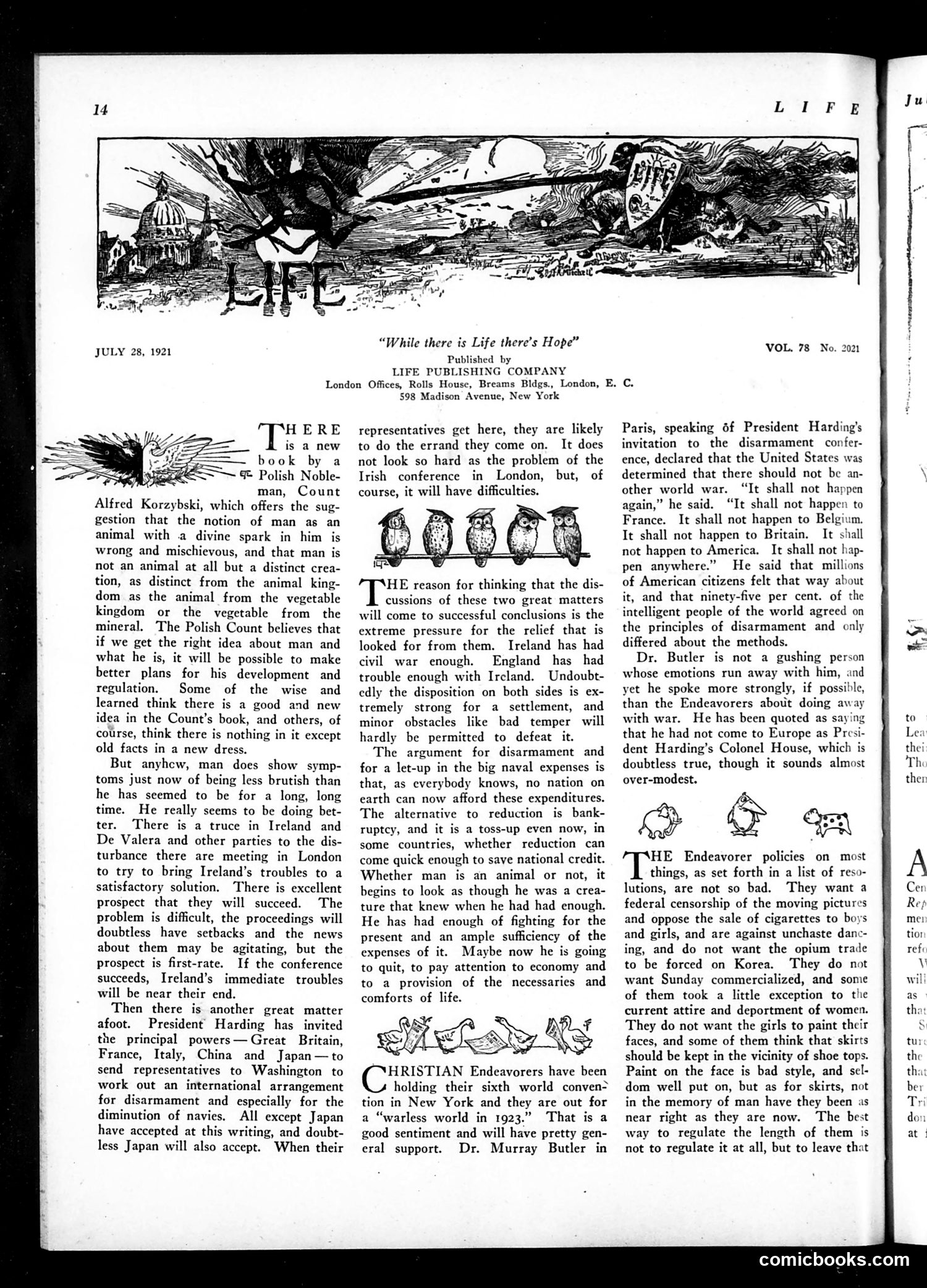
This page discusses post-WWI disarmament conferences and President Harding's diplomatic efforts. The text references troublesome Irish independence negotiations and international naval reduction talks occurring in London. The **decorative header illustration** (top) appears to be a general artistic masthead rather than political satire—showing a pastoral/fantastical landscape. The **small owl illustrations** (mid-page) likely represent wisdom or observation, accompanying discussion of the Endeavorer convention's policies on morality and censorship—opposing cigarette sales to minors, Sunday commercialization, and regulation of women's fashion and makeup. The **bottom illustration** showing figures appears decorative rather than satirical. The page functions primarily as political commentary and social criticism rather than sharp cartoon satire.
📄 Transcribed text from this page (OCR, searchable)
Machine-transcribed from the original scan — historical spelling and the odd misread are preserved.
JULY 28, 1921 “While there is Life there’s Hope” Published by LIFE PUBLISHING COMPANY VOL. 78 No. 2021 London Offices, Rolls House, Breams Bldgs., London, E. C. HERE is a new book by a Polish Noble- man, Count Alfred Korzybski, which offers the sug- gestion that the notion of man as an animal with a divine spark in him is wrong and mischievous, and that man is not an animal at all but a distinct crea- tion, as distinct from the animal king- dom as the animal from the vegetable kingdom or the vegetable from the mineral. The Polish Count believes that if we get the right idea about man and what he is, it will be possible to make better plans for his development and regulation. Some of the wise and learned think there is a good and new idea in the Count’s book, and others, of course, think there is nothing in it except old facts in a new dress. But anyhew, man does show symp- toms just now of being less brutish than he has seemed to be for a long, long time. He really seems to be doing bet- ter. There is a truce in Ireland and De Valera and other parties to the dis- turbance there are meeting in London to try to bring Ireland’s troubles to a satisfactory solution. There is excellent prospect that they will succeed. The problem is difficult, the proceedings will doubtless have setbacks and the news about them may be agitating, but the Prospect is first-rate. If the conference succeeds, Ireland’s immediate troubles will be near their end. Then there is another great matter afoot. President’ Harding has invited the principal powers— Great Britain, France, Italy, China and Japan—to send representatives to Washington to work out an international arrangement for disarmament and especially for the diminution of navies. All except Japan have accepted at this writing, and doubt- less Japan will also accept. When their 598 Madison Avenue, New York representatives get here, they are likely to do the errand they come on. It does not look so hard as the problem of the Irish conference in London, but, of course, it will have difficulties. HE reason for thinking that the dis- cussions of these two great matters will come to successful conclusions is the extreme pressure for the relief that is looked for from them. Ireland has had civil war enough. England has had trouble enough with Ircland. Undoubt- edly the disposition on both sides is ex- tremely strong for a settlement, and minor obstacles like bad temper will hardly be permitted to defeat it. The argument for disarmament and for a let-up in the big naval expenses is that, as everybody knows, no nation on earth can now afford these expenditures. The alternative to reduction is bank- ruptcy, and it is a toss-up even now, in some countries, whether reduction can come quick enough to save national credit. Whether man is an animal or not, it begins to look as though he was a crea- ture that knew when he had had enough. He has had enough of fighting for the present and an ample sufficiency of the expenses of it. Maybe now he is going to quit, to pay attention to economy and to a provision of the necessaries and comforts of life. erica XS HRISTIAN Endeavorers have been holding their sixth world conven> tion in New York and they are out for a “warless world in 1923.” That is a good sentiment and will have pretty gen- eral support. Dr. Murray Butler in Paris, speaking 6f President Harding's invitation to the disarmament confer- ence, declared that the United States was determined that there should not be an- other world war. “It shall not happen again,” he said. “It shall not happen to France. It shall not happen to Belgium. It shall not happen to Britain. It shall not happen to America. It shall not hap- pen anywhere.” He said that millions of American citizens felt that way about it, and that ninety-five per cent. of the intelligent people of the world agreed on the principles of disarmament and only differed about the methods. Dr. Butler is not a gushing person whose emotions run away with him, and yet he spoke more strongly, if possible, than the Endeavorers about doing away with war. He has been quoted as saying that he had not come to Europe as Presi- dent Harding’s Colonel House, which is doubtless true, though it sounds almost over-modest. HE Endeavorer policies on most things, as set forth in a list of reso- lutions, are not so bad. They want a federal censorship of the moving pictures and oppose the sale of cigarettes to boys and girls, and are against unchaste danc- ing, and do not want the opium trade to be forced on Korea. They do not want Sunday commercialized, and some of them took a little exception to tlie current attire and deportment of women. They do not want the girls to paint their faces, and some of them think that skirts should be kept in the vicinity of shoe tops. Paint on the face is bad style, and sel- dom well put on, but as for skirts, not in the memory of man have they been as near right as they are now. The best way to regulate the length of them is not to regulate it at all, but to leave that LY! to Le: thei Th then comicbooks.com