
Life, 1921-07-28 · page 24 of 34
Life — July 28, 1921 — page 24: what you’re looking at
What you’re looking at
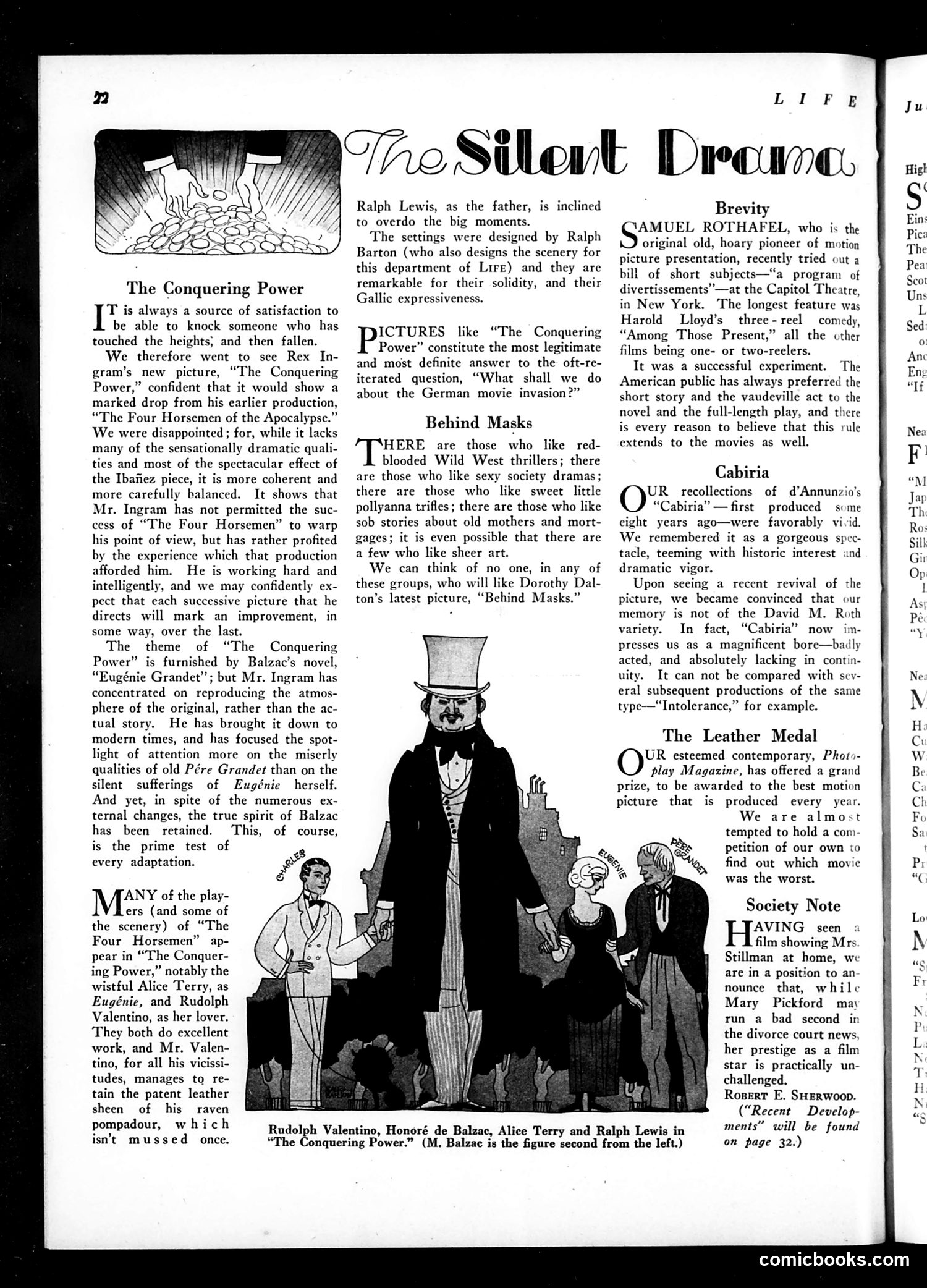
This page contains three film reviews from Life magazine's cinema section. The main review praises Rex Ingram's *The Conquering Power*, adapted from Balzac's novel, as evidence that American cinema can compete with German film productions—a contemporary concern about Hollywood's market position. The review commends the film's coherence and notes Rudolph Valentino's continued appeal ("patent leather sheen of his raven pompadour"). A secondary review dismisses Dorothy Dalton's *Behind Masks* as having no audience appeal across any genre preference. A brief note celebrates Samuel Rothafel's experimental short-film program at the Capitol Theatre, arguing American audiences prefer short stories to full-length narratives. The satire reflects 1920s cinema anxieties: foreign competition, star power, and changing audience tastes during silent film's golden age.
📄 Transcribed text from this page (OCR, searchable)
Machine-transcribed from the original scan — historical spelling and the odd misread are preserved.
The Conquering Power T is always a source of satisfaction to be able to knock someone who has touched the heights; and then fallen. We therefore went to see Rex In- gram’s new picture, “The Conquering Power,” confident that it would show a marked drop from his earlier production, “The Four Horsemen of the Apocalypse.” We were disappointed ; for, while it lacks many of the sensationally dramatic quali- ties and most of the spectacular effect of the Ibafiez piece, it is more coherent and more carefully balanced. It shows that Mr. Ingram has not permitted the suc- cess of “The Four Horsemen” to warp his point of view, but has rather profited by the experience which that production afforded him. He is working hard and intelligently, and we may confidently ex- pect that each successive picture that he directs will mark an improvement, in some way, over the last. The theme of “The Conquering Power” is furnished by Balzac’s novel, “Eugénie Grandet”; but Mr. Ingram has concentrated on reproducing the atmos- phere of the original, rather than the ac- tual story. He has brought it down to modern times, and has focused the spot- light of attention more on the miserly qualities of old Pére Grandet than on the silent sufferings of Eugénie herself. And yet, in spite of the numerous ex- ternal changes, the true spirit of Balzac has been retained. This, of course, is the prime test of every adaptation. ANY of the play- ers (and some of the scenery) of “The Four Horsemen” ap- pear in “The Conquer- ing Power,” notably the wistful Alice Terry, as Eugénie, and Rudolph Valentino, as her lover. They both do excellent work, and Mr. Valen- tino, for all his vicissi- tudes, manages to re- tain the patent leather sheen of his raven pompadour, which isn’t mussed once. LIFE Tao Stlevt Dreowme, Ralph Lewis, as the father, is inclined to overdo the big moments. The settings were designed by Ralph Barton (who also designs the scenery for this department of Lire) and they are remarkable for their solidity, and their Gallic expressiveness. ICTURES like “The Conquering Power” constitute the most legitimate and most definite answer to the oft-re- iterated question, “What shall we do about the German movie invasion?” Behind Masks HERE are those who like red- blooded Wild West thrillers; there are those who like sexy society dramas; there are those who like sweet little pollyanna trifles; there are those who like sob stories about old mothers and mort- gages; it is even possible that there are a few who like sheer art. We can think of no one, in any of these groups, who will like Dorothy Dal- ton’s latest picture, “Behind Masks.” Rudolph Valentino, Honoré de Balzac, Alice Terry and Ralph Lewis in “The Conquering Power.” (M. Balzac is the figure second from the left.) Brevity AMUEL ROTHAFEL, who is the original old, hoary pioneer of motion cture presentation, recently tried out a bill of short subjects—‘“a program of divertissements’’—at the Capitol Theatre, in New York. The longest feature was Harold Lloyd’s_ three-reel comedy, “Among Those Present,” all the other films being one- or two-reelers. It was a successful experiment. The American public has always preferred the short story and the vaudeville act to the novel and the full-length play, and there is every reason to believe that this rule extends to the movies as well. Cabiria UR recollections of d’Annunzio’s “Cabiria” — first produced some eight years ago—were favorably vivid. We remembered it as a gorgeous spec- tacle, teeming with historic interest and dramatic vigor. Upon seeing a recent revival of the picture, we became convinced that our memory is not of the David M. Roth variety. In fact, “Cabiria’” now im- presses us as a magnificent bore—ba acted, and absolutely lacking in contin- uity. It can not be compared with sey- eral subsequent productions of the same type—“Intolerance,” for example. The Leather Medal UR esteemed contemporary, Photo- play Magazine, has offered a grand prize, to be awarded to the best motion picture that is produced every year. We are almost tempted to hold a com- petition of our own to find out which movie was the worst. Society Note AVING seen a film showing Mrs. Stillman at home, we are in a position to an nounce that, while Mary Pickford may run a bad second in the divorce court news, her prestige as a film star is practically un- challenged. Rosert E. SHERWoop. (“Recent Develop- ments” will be found on page 32.) Ju 1 H N Oo. comicbooks.com