
A complete issue · 34 pages · 1921
Life — July 7, 1921
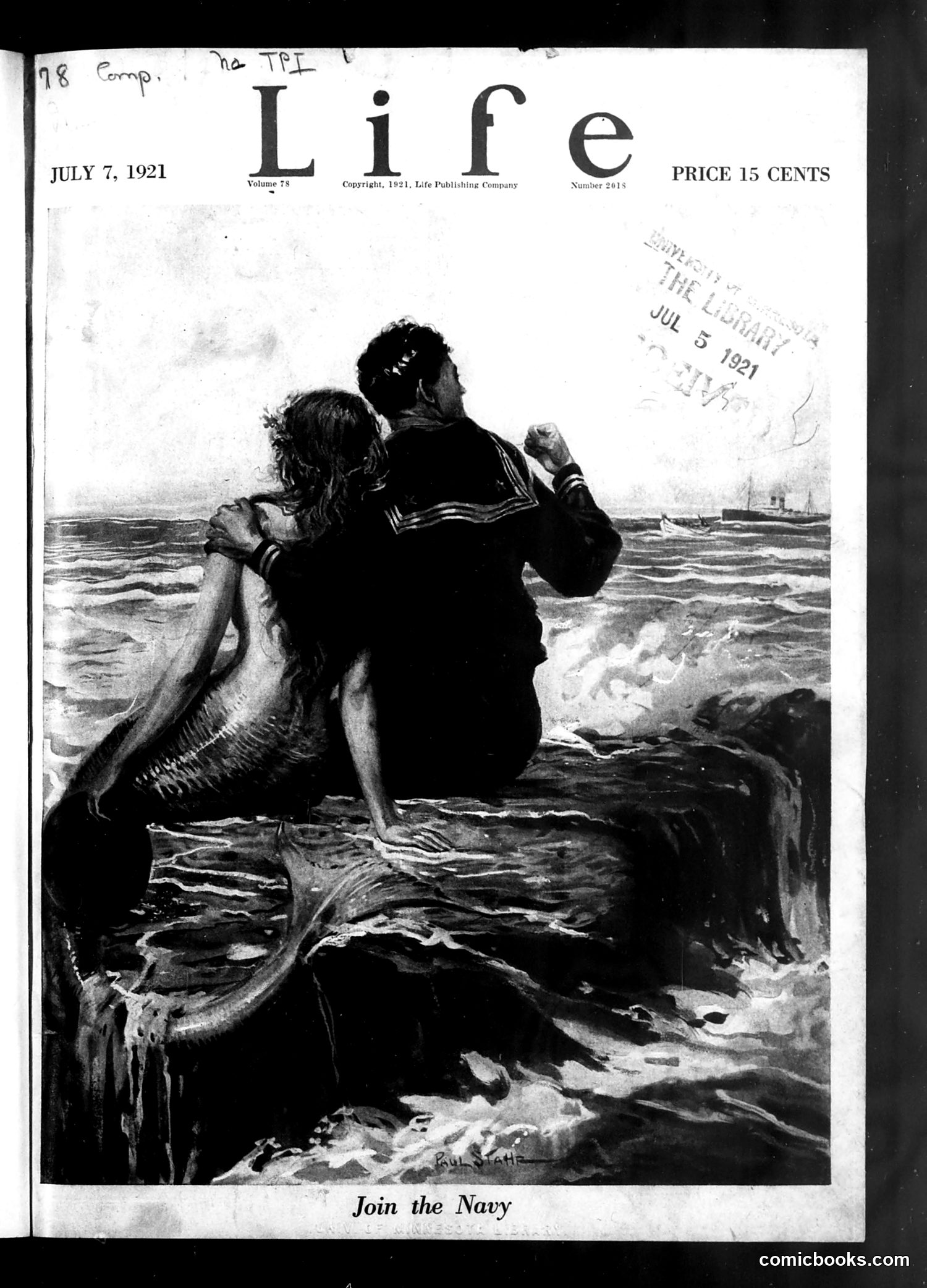
This is a recruitment poster rather than political satire. The image shows a sailor in uniform carrying a mermaid, positioned on rocks by a turbulent sea. The caption reads "Join the Navy." This appears to be a U.S. Navy recruitment advertisement from July 1921, using romantic imagery to appeal to young men. The mermaid—a mythological sea creature—evokes adventure, mystery, and the allure of maritime life. The dramatic ocean setting reinforces the excitement and drama of naval service. The poster's appeal is aspirational rather than satirical: it promises adventure, romance, and excitement to potential recruits. This was a common recruitment strategy of the era, using idealized imagery to attract volunteers during the post-World War I period.
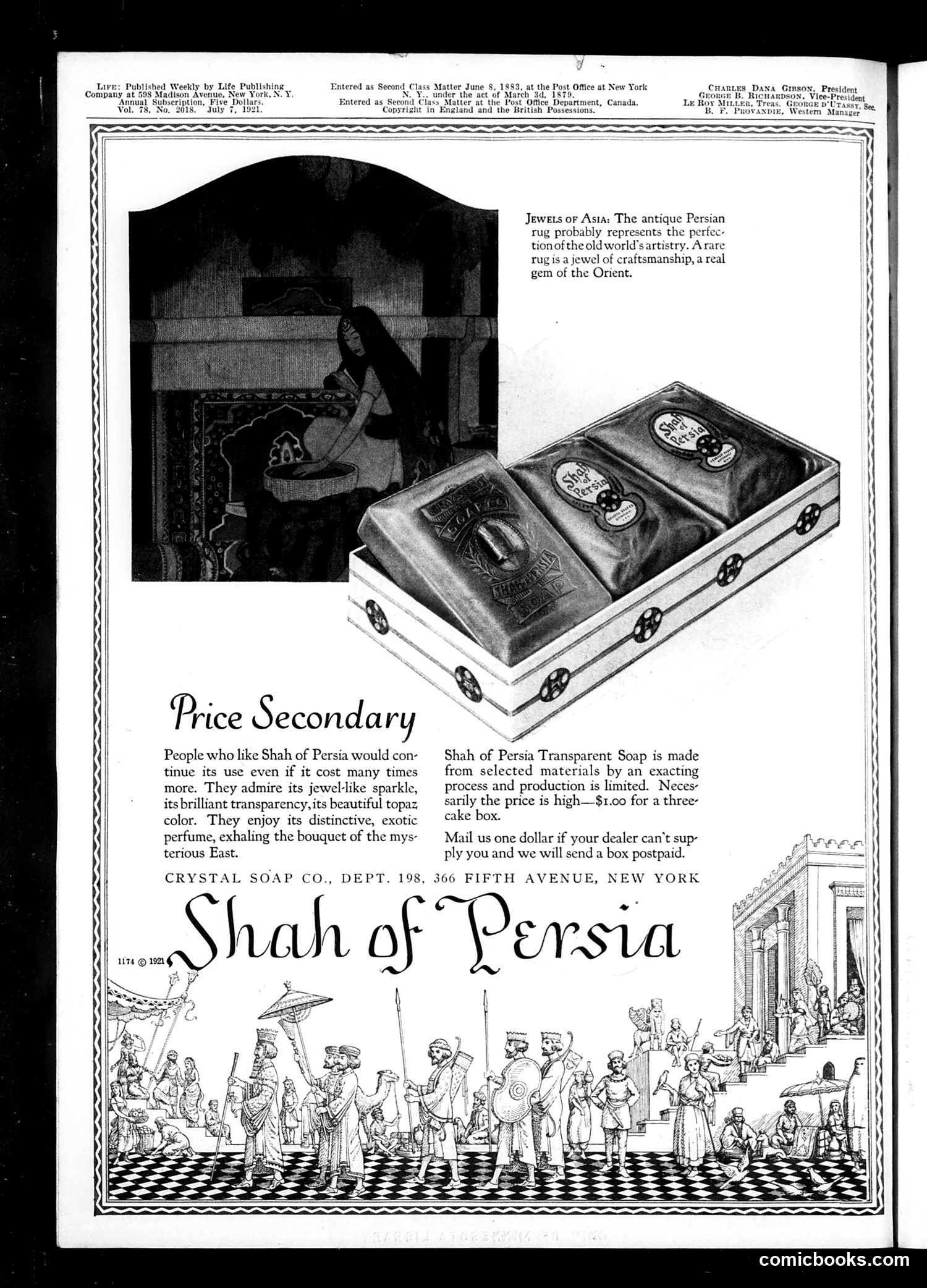
This is primarily a **luxury soap advertisement**, not political satire. The page promotes "Shah of Persia" transparent soap by Crystal Soap Co., priced at $1.00 for a three-cake box—expensive for 1921. The marketing strategy exploits **Orientalist exoticism**: the ad emphasizes the product's connection to Persian luxury, "jewel-like sparkle," and "exotic perfume." The imagery includes a woman in an Oriental interior and decorative Persian court scenes at the bottom. The headline "Price Secondary" acknowledges the high cost while suggesting that quality and prestige justify the expense. The advertisement trades on early-20th-century fascination with Persian aesthetics and consumer aspirations to exotic luxury goods. This reflects contemporary marketing tactics targeting affluent American consumers through cultural romanticism.
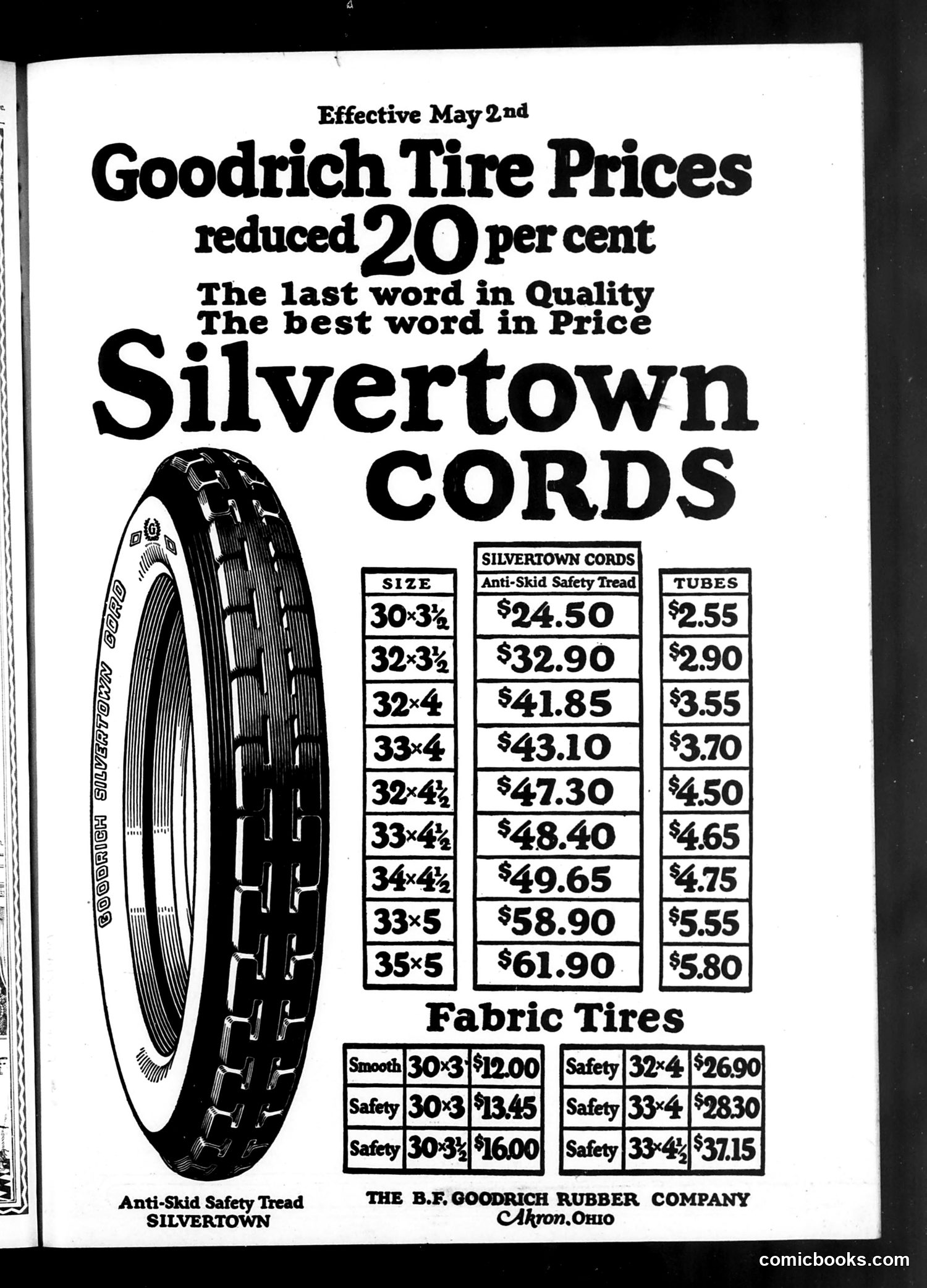
This page is **primarily advertising, not satire or political commentary**. It's a B.F. Goodrich Rubber Company advertisement for Silvertown Cords tires, effective May 2nd, announcing a 20% price reduction. The ad emphasizes quality ("The last word in Quality") while highlighting affordability ("The best word in Price"). The image shows a tire cross-section displaying the product's construction. Below are pricing tables for various tire sizes, tubes, and fabric tire options. The only potentially humorous element is the tagline positioning Silvertown as the final word in quality but best value in price—a mild marketing claim rather than political satire. This reflects 1920s advertising strategy of combining quality assurance with Depression-era price consciousness.
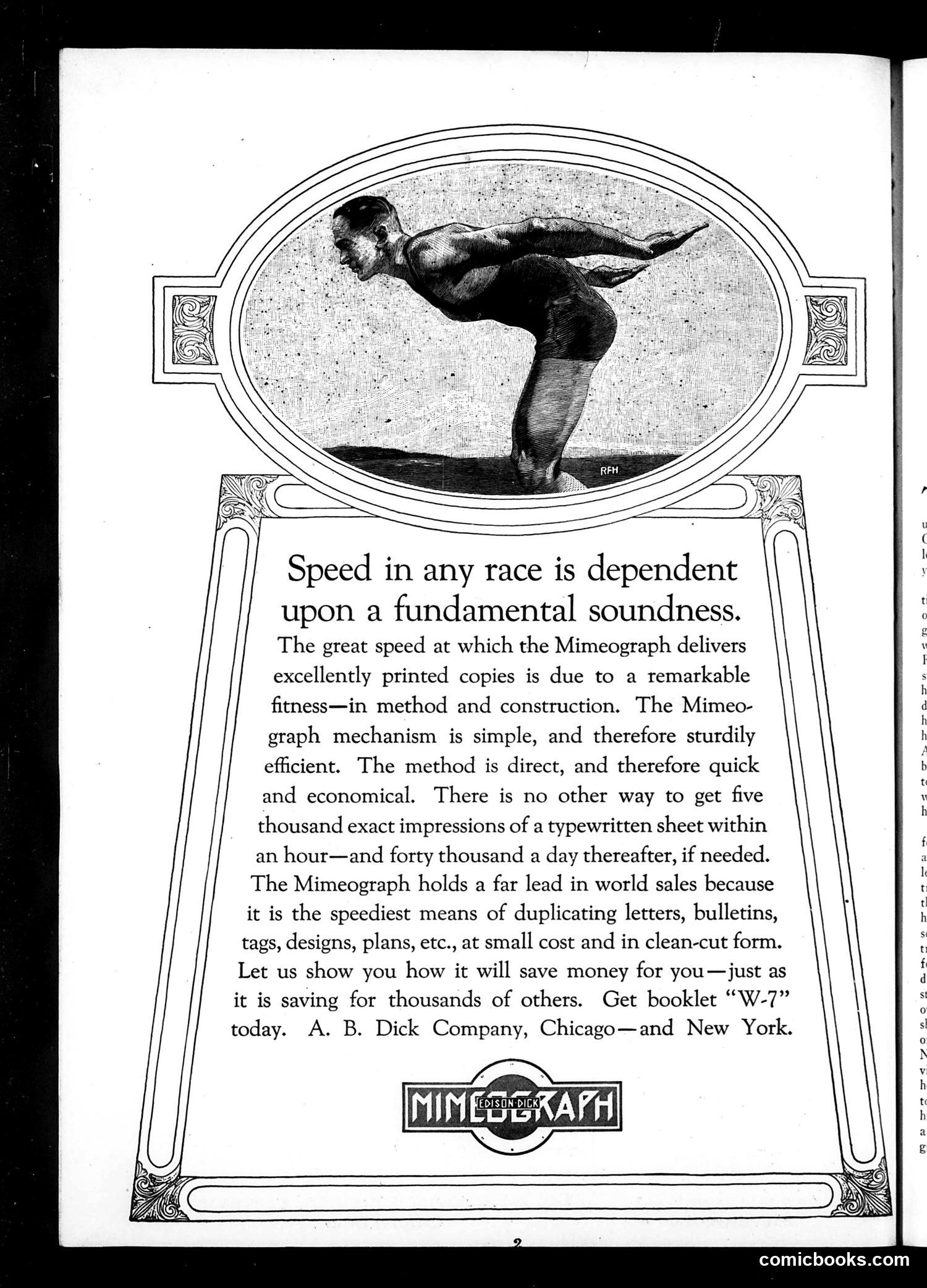
This is primarily **a commercial advertisement**, not satirical content. It promotes the Mimeograph machine, manufactured by A.B. Dick Company of Chicago and New York. The image shows a muscular man in an athletic pose, illustrating the metaphor of "speed in any race." The ad argues that the Mimeograph's mechanical efficiency—its simple, sturdy design and direct method—allows it to produce copies faster than competitors: "five thousand exact impressions of a typewritten sheet within an hour." The advertisement claims this speed advantage helps businesses duplicate letters, bulletins, and designs economically, and invites readers to request booklet "W-7" for more information. This reflects early 20th-century office technology marketing, positioning mechanical efficiency as a competitive advantage.
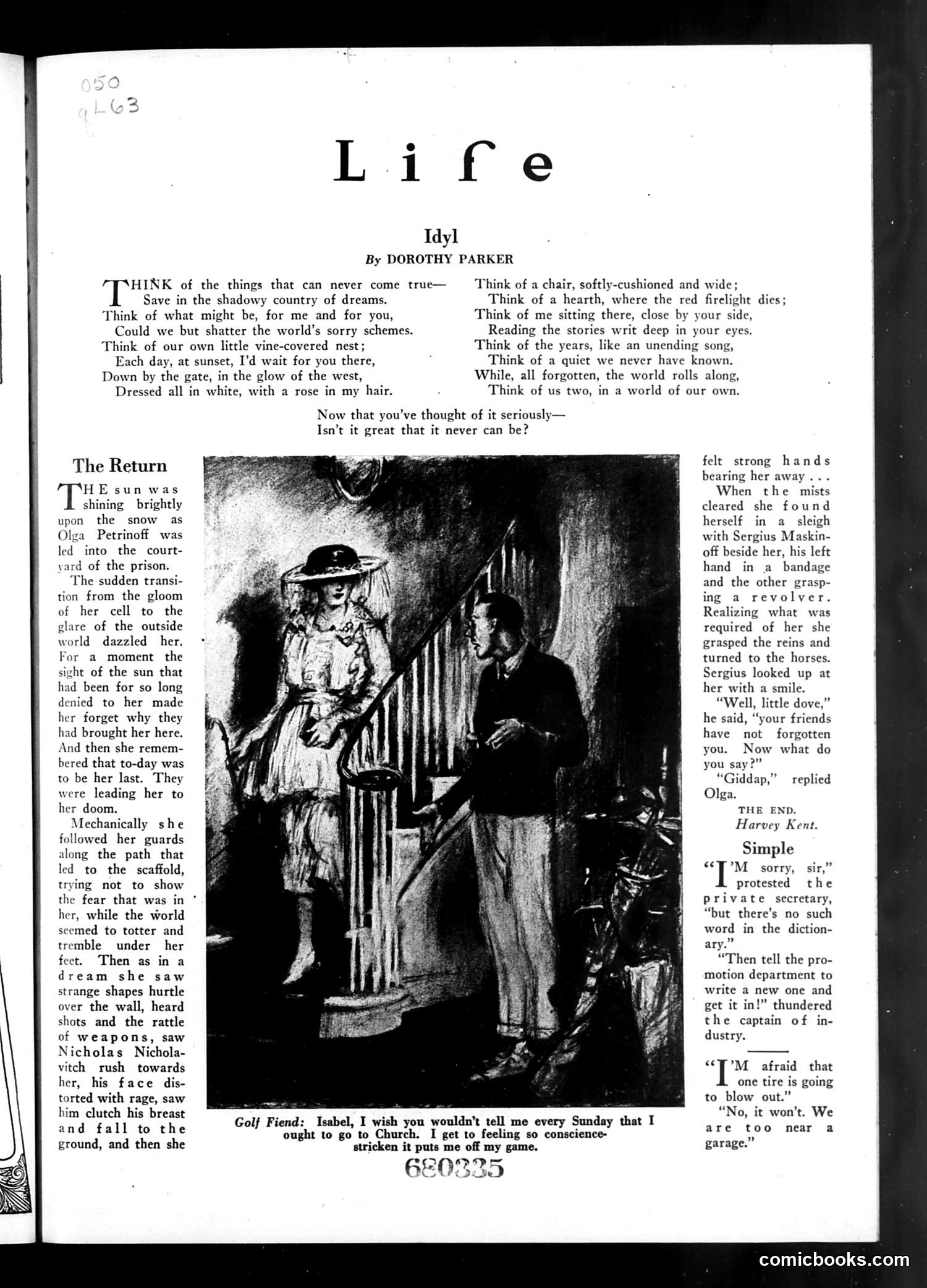
This page contains three distinct pieces: a poem titled "Life" by Dorothy Parker, a short story called "The Return," and a separate comic section titled "Simple." The main illustration depicts a scene from "The Return" story—a woman (Olga Petrinoff) being led from a prison courtyard, meeting with a man named Sergius. The narrative describes her release and emotional reunion. The "Golf Fiend" caption below the illustration is satirical, depicting a man telling his wife he must attend church on Sunday, when he's actually going to play golf—a common domestic comedy trope about men prioritizing leisure over religious/family obligations. The "Simple" section appears to be the start of another story about office workplace dynamics. This represents typical Life magazine content: literary fiction, poetry, and gentle social satire about everyday American life.
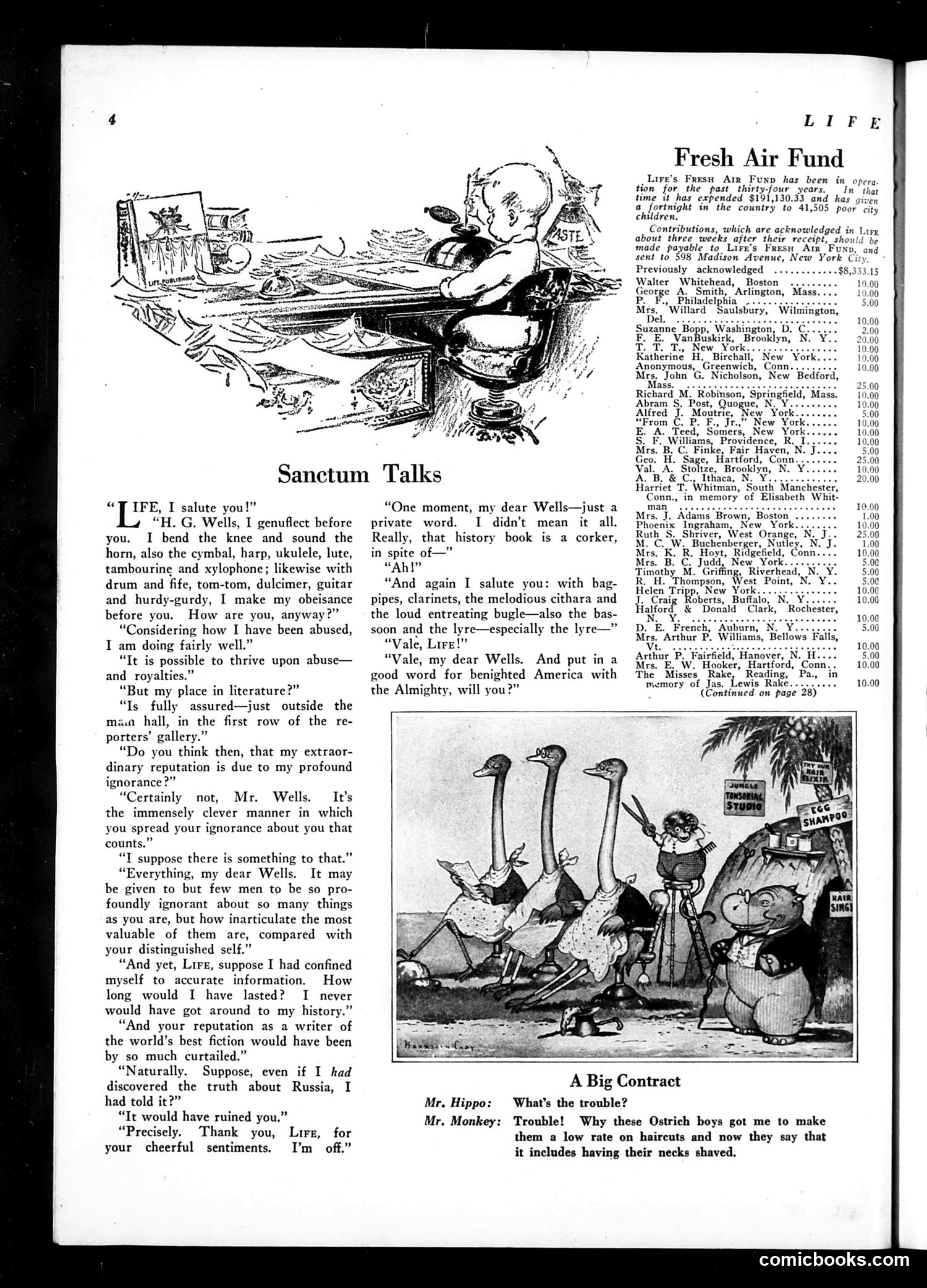
**"Sanctum Talks"** features a dialogue between "Life" (the magazine's personified mascot) and H.G. Wells, the famous science fiction author. Life congratulates Wells on his literary reputation while ironically suggesting his fame comes not from brilliance but from spreading ignorance cleverly. Wells responds that everything valuable derives from accurate information—then Life jokes that if Wells had discovered truth about Russia, he'd have kept quiet anyway. The satire mocks both Wells's tendency toward imaginative speculation presented as fact and the era's general skepticism about intellectuals' reliability. **"A Big Contract"** shows a hippo and monkey with ostriches. The monkey complains the ostriches charged low rates for haircuts but now demand extra payment because the contract includes "having their necks shaved"—a visual pun on ostrich physiology. This is simple comedic nonsense without deeper political meaning.
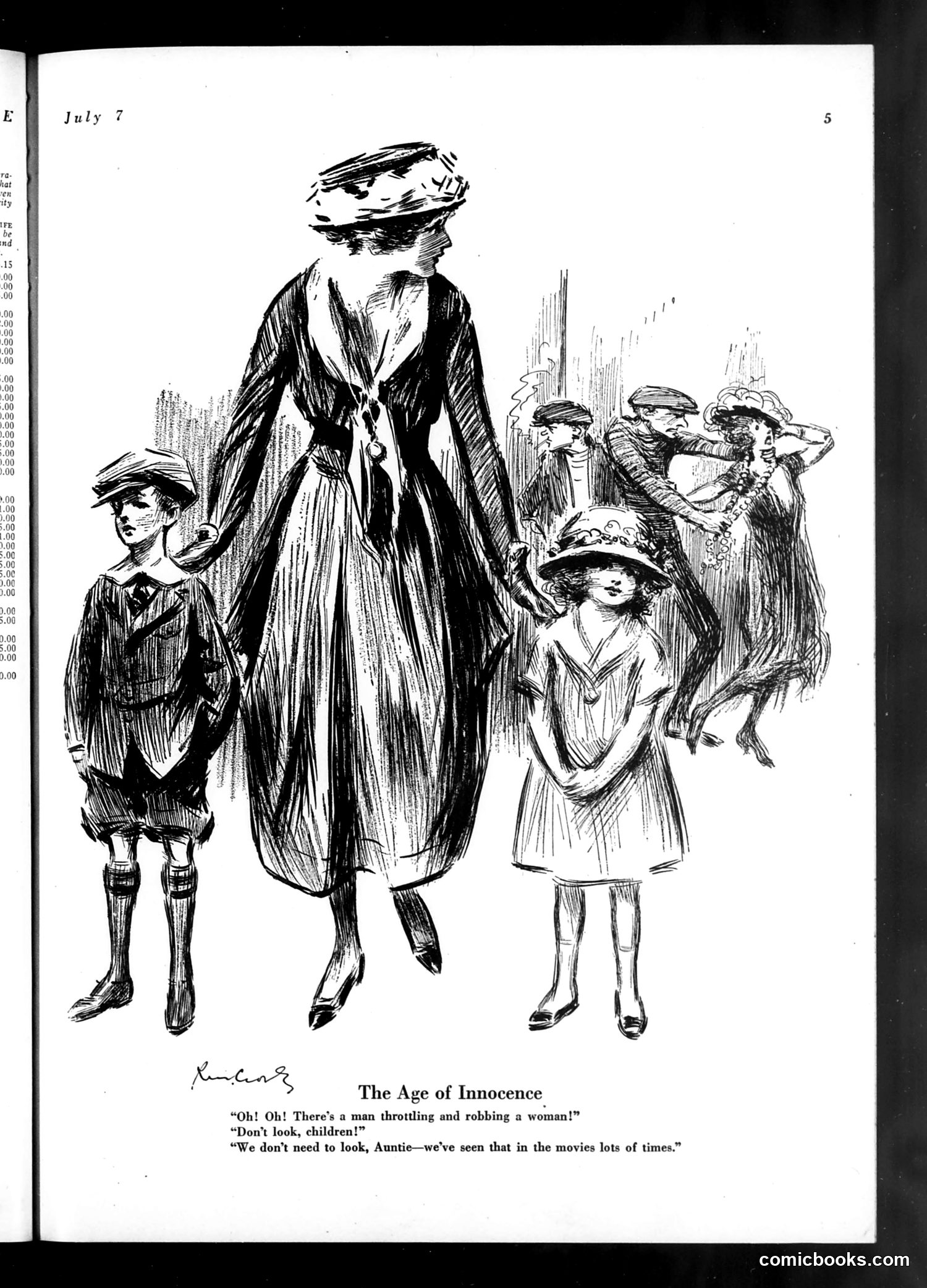
This cartoon satirizes children's claimed naïveté about crime and violence. An adult woman shepherds several children past what appears to be a street crime ("a man throttling and robbing a woman"). When she instructs them not to look, one child responds with knowing cynicism: "We don't need to look, Auntie—we've seen that in the movies lots of times." The satire targets early 20th-century anxieties about cinema's corrupting influence on youth. Rather than being innocent, the children have become desensitized to violence through repeated movie exposure. The cartoon suggests that films normalize criminal behavior, making children blasé witnesses to real violence. The irony—that protective adults underestimate children's prior exposure to such scenes—forms the joke's critical point about mass media's impact.
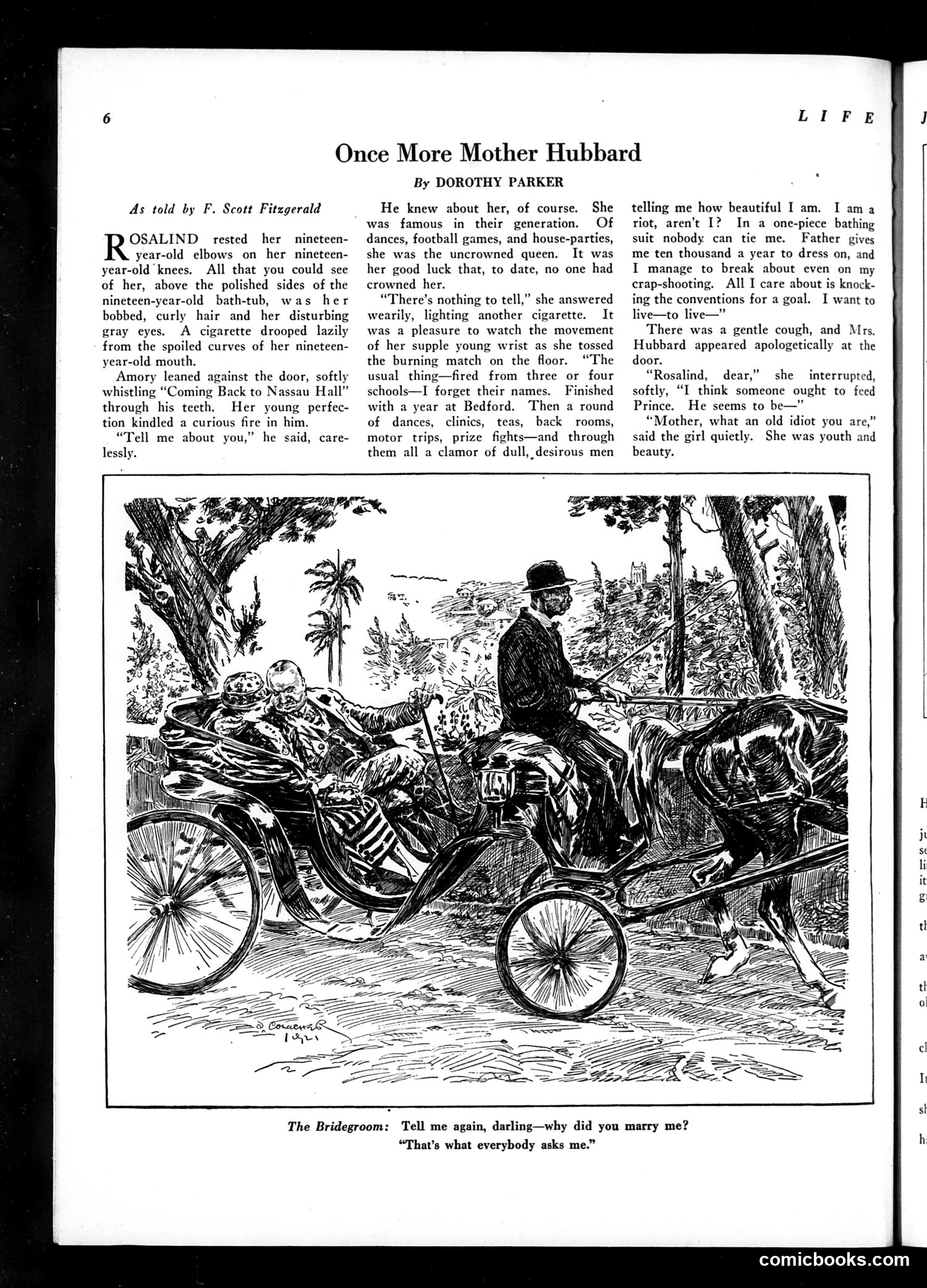
This is a satirical short story by Dorothy Parker about a woman named Rosalind, introduced as the famous "uncrowned queen" of her social generation. The accompanying illustration shows a bridegroom in a carriage asking his bride why she married him—"That's what everybody asks me." The satire targets wealthy society women of the era who were celebrated for their social prominence but lacked substance. Parker's narrative mocks Rosalind's superficiality: she's known for dances, parties, and fashion rather than meaningful accomplishments. The bridegroom's question implies her marriage was as puzzling and hollow as her celebrity itself—suggesting satirically that even she cannot justify why she chose this life or this husband.
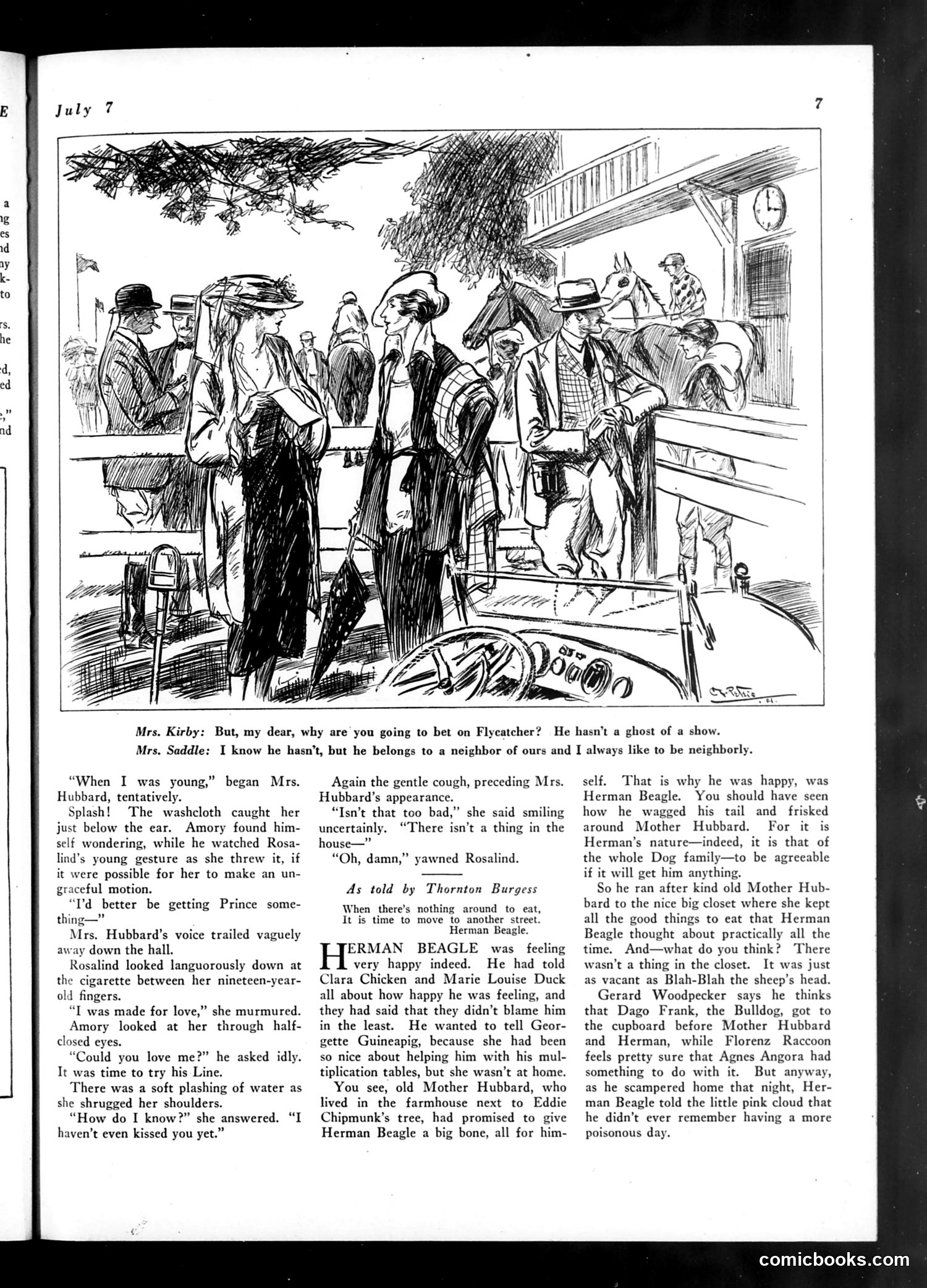
This page contains a humorous short story titled "As Told by Thorton Burgess" about Herman Beagle's romantic misadventures. The illustration depicts a horse racing or betting scene at what appears to be a track, with well-dressed men and women in period clothing (likely early 20th century). The dialogue between Mrs. Kirby and Mrs. Saddle discusses betting on "Flycatcher," a horse, with Mrs. Saddle defending the animal's ownership by a neighbor. The story itself humorously narrates Herman Beagle's failed romantic pursuits and his tendency to eat things he shouldn't—establishing him as a foolish, food-motivated character rather than a capable suitor. The satire targets romantic delusions and class pretensions among the leisure class who frequent racing venues.
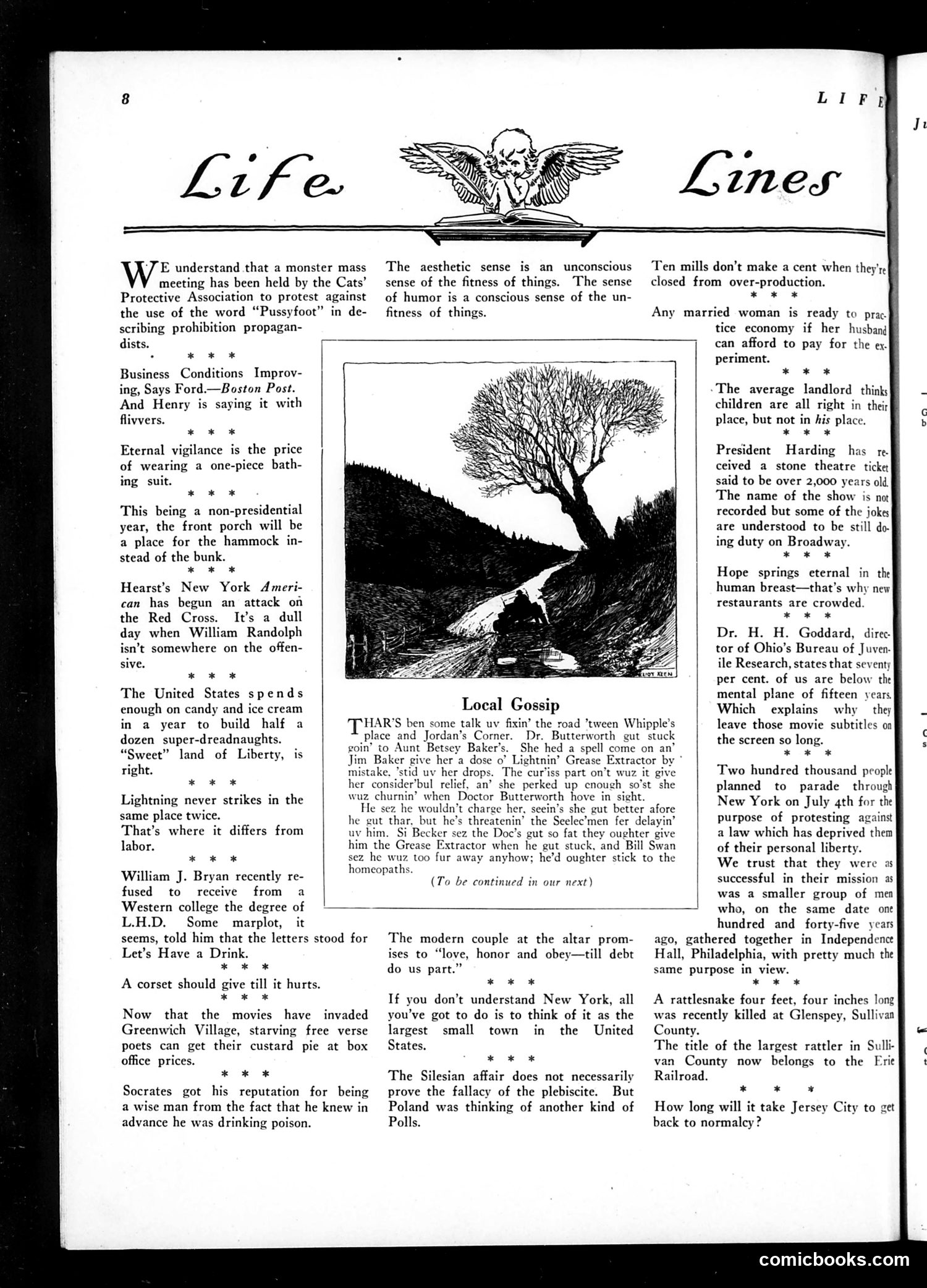
This page contains satirical commentary and local gossip rather than political cartoons. The central image shows a bent tree on a hillside—a naturalistic illustration rather than political satire. The text includes brief humorous observations about American life: complaints about business conditions, references to President Harding receiving an ancient stone theater, and commentary on restaurants being crowded. There's gossip about local New York figures (names like "Dr. Butterworth," "Lightnin' Grease Extractor"), and brief witticisms about marriage, corsets, and movies invading Greenwich Village. The page's humor relies on everyday social observations and local New York gossip rather than explicit political satire. Without dates or clearer attribution, the specific events referenced remain unclear to modern readers.
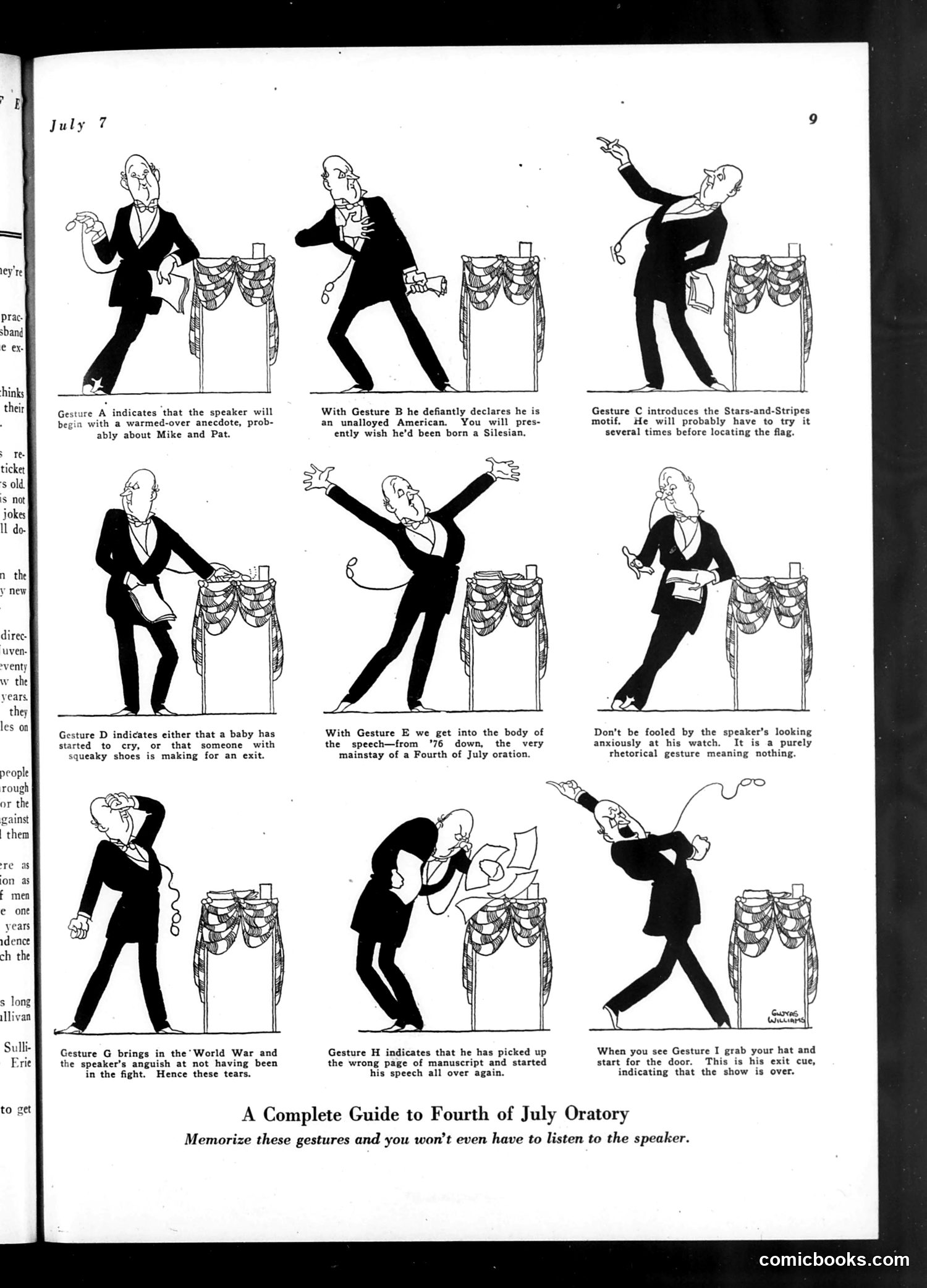
This satirical guide mocks predictable Fourth of July speeches through nine exaggerated gestures. The cartoon shows a speaker demonstrating typical rhetorical moves: opening with anecdotes (Gesture A), declaring patriotic sentiments (B), displaying the flag (C), addressing babies crying or squeaky shoes disrupting proceedings (D), building emotional intensity (E), recovering from fumbles like dropped manuscript pages (F), referencing World War involvement (G), recovering from mistakes (H), and finally signaling the speech's end (I). The satire targets the formulaic, theatrical nature of patriotic oratory—suggesting Fourth of July speakers follow predictable, often overwrought emotional and physical patterns regardless of substance. The tagline jokes that memorizing these gestures makes actually listening unnecessary. This reflects post-WWI American skepticism toward bombastic patriotic rhetoric.
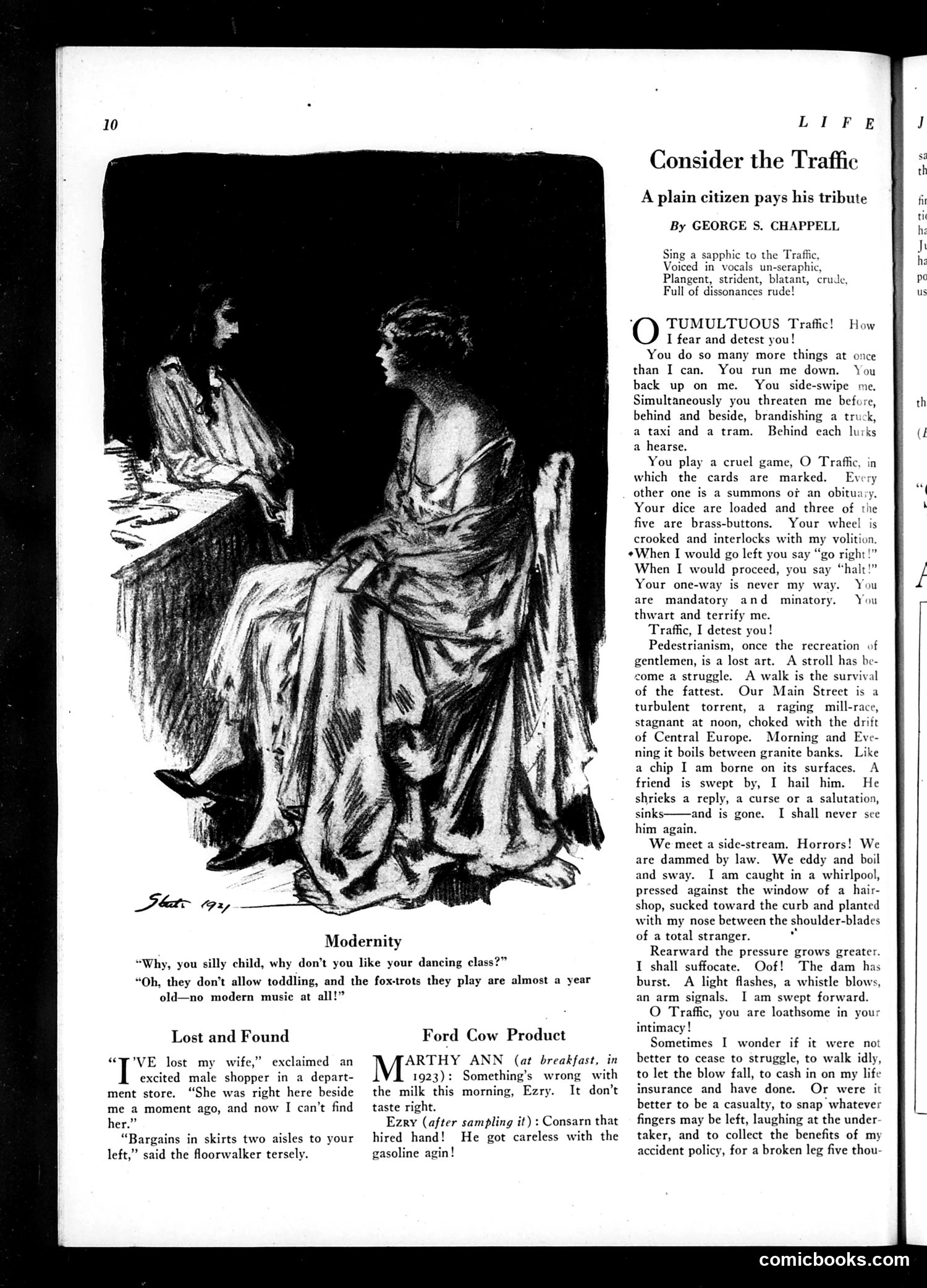
This cartoon satirizes changing social norms of the 1920s. A mother questions her child about disliking "dancing class," to which the child responds that instructors forbid "toddling" and play only outdated music—"not modern music at all!" The joke targets generational conflict over "modern" jazz and dance styles. "Toddling" refers to the energetic, often considered scandalous dances gaining popularity among youth in the Jazz Age. The cartoon mocks parents' attempts to enforce Victorian propriety while children embrace contemporary culture. The artist satirizes both the rigid older generation and their children's dismissive attitude toward tradition, capturing a common 1920s cultural anxiety about rapid social change and youth rebellion against established norms.
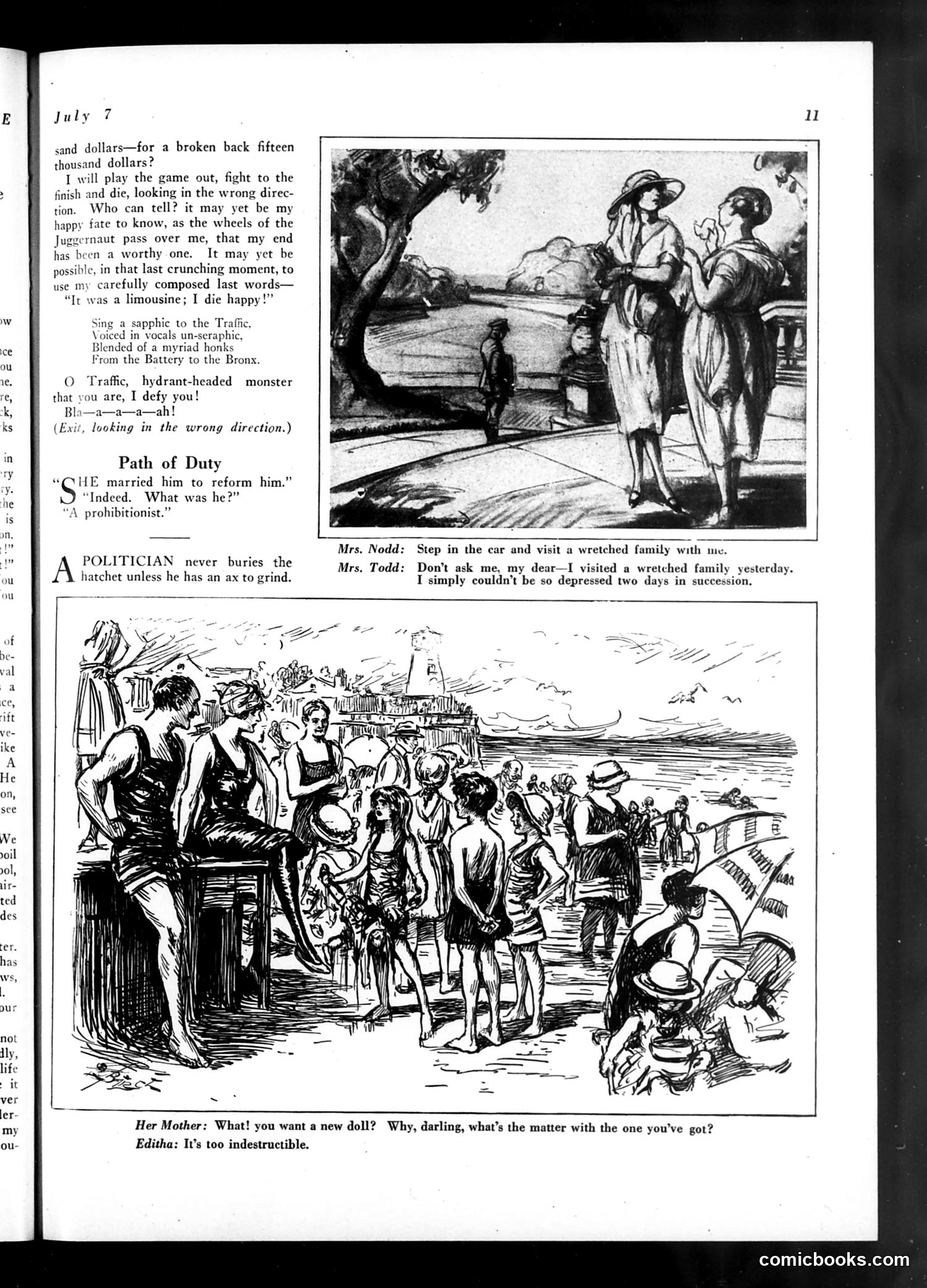
This page contains two distinct satirical pieces: **"Path of Duty"** presents a brief joke about marriage reform: a woman married a prohibitionist (a man opposed to alcohol) hoping to reform him, but he remained unchanged—the satire mocking both naive optimism about reforming spouses and prohibition advocates. **The beach scene cartoon** satirizes parental attitudes toward children's durability. A mother asks why her daughter wants a new doll when her current one is fine. The child responds "It's too indestructible"—humor derived from the irony that parents typically *want* toys to be durable, yet this child finds indestructibility boring. This reflects early 20th-century attitudes toward childhood entertainment and consumerism. Both pieces use domestic scenarios to mock social pretensions and family dynamics of the era.
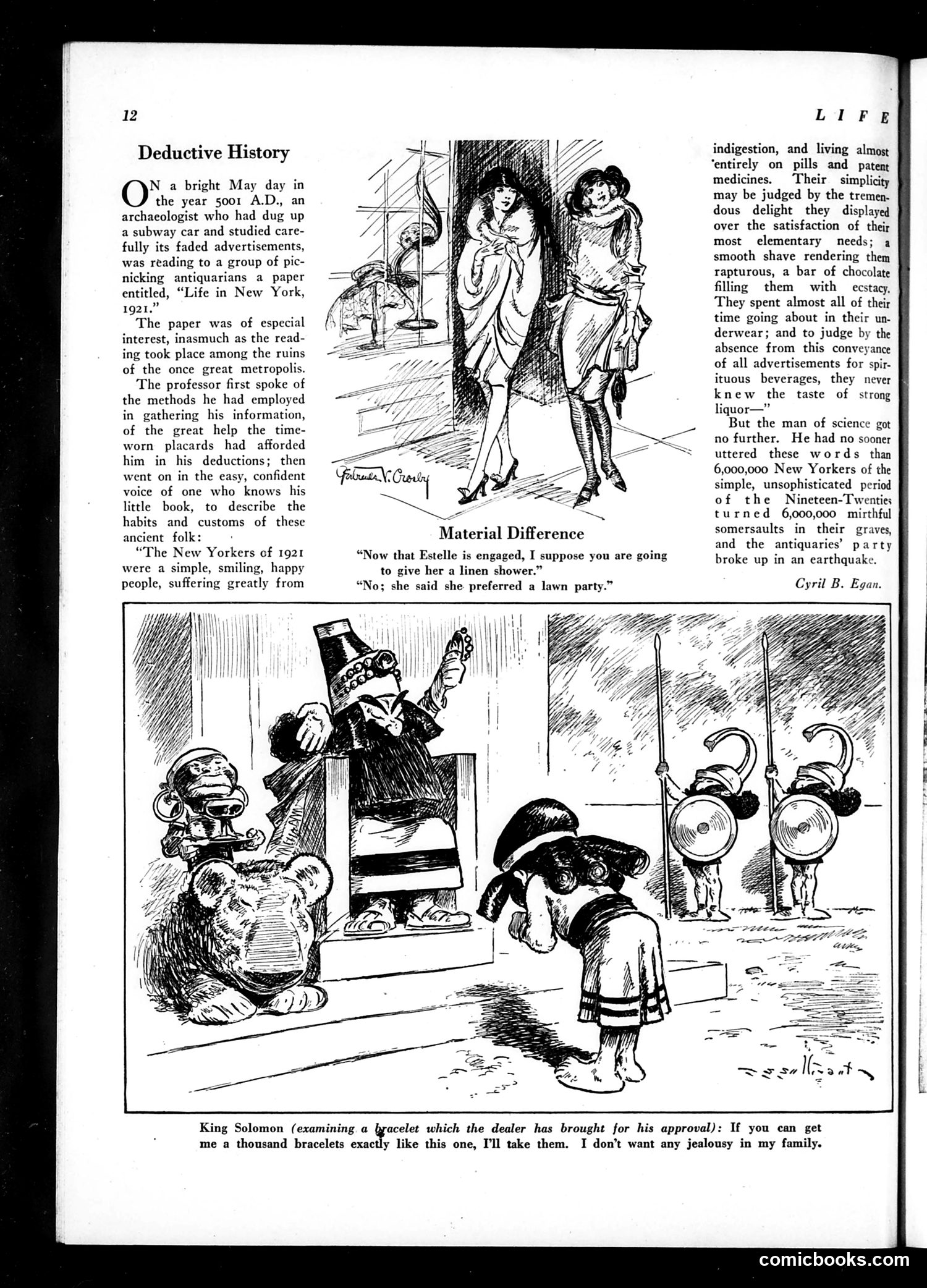
**"Deductive History"** (top): A satirical piece imagining an archaeologist in 5001 A.D. discovering a 1921 *Life* magazine in New York's ruins. The joke is that future scholars will misinterpret 1921 New Yorkers' habits—their constant use of patent medicines, smooth grooming, and obsession with underwear advertisements—as evidence of a civilization plagued by digestive problems and vanity. **"Material Difference"** (cartoon): Shows a couple debating party preferences; the joke turns on class differences in entertainment. **King Solomon cartoon** (bottom): Depicts Solomon examining bracelets, with the caption playing on jealousy and materialism—a satirical commentary on wealth, desire, and human nature across historical periods. All pieces use humor to critique 1921 American consumer culture and vanity.
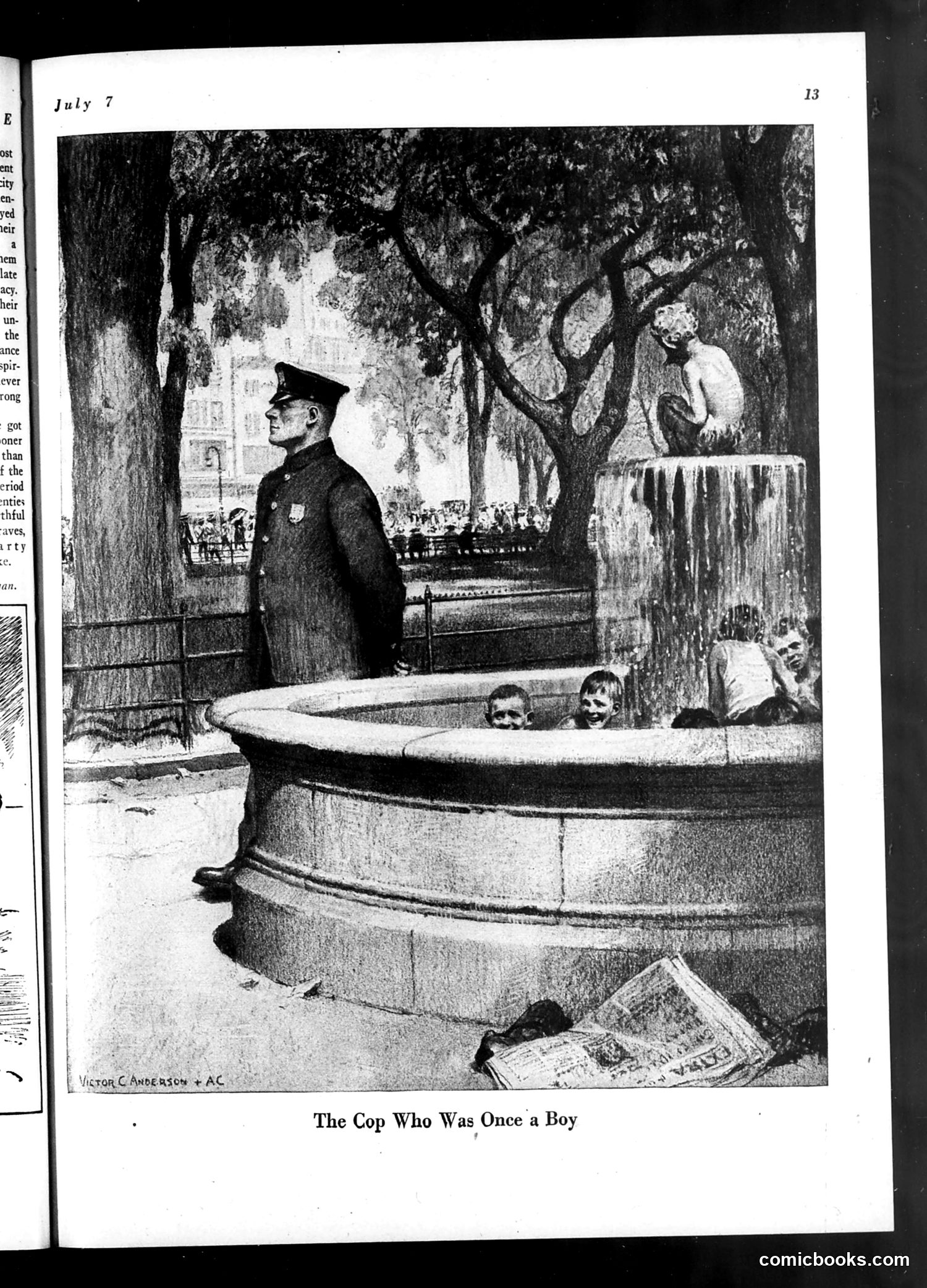
This illustration depicts a uniformed police officer observing children playing in what appears to be a public fountain or basin in a park setting. The title's ironic message suggests nostalgia—the cop, now an authority figure, was once a child himself like those he observes. The satire likely critiques the disconnect between childhood innocence and adult responsibility, or possibly comments on how authority figures enforce rules they once enjoyed breaking. The casual scene—children bathing in a fountain while a cop watches—invites reflection on whether he'll enforce regulations or remember his own youthful freedom. The photograph credit reads "Victor Camerason + AC." Without additional context, the specific social commentary remains somewhat unclear, though it appears to address themes of childhood, authority, and nostalgia.
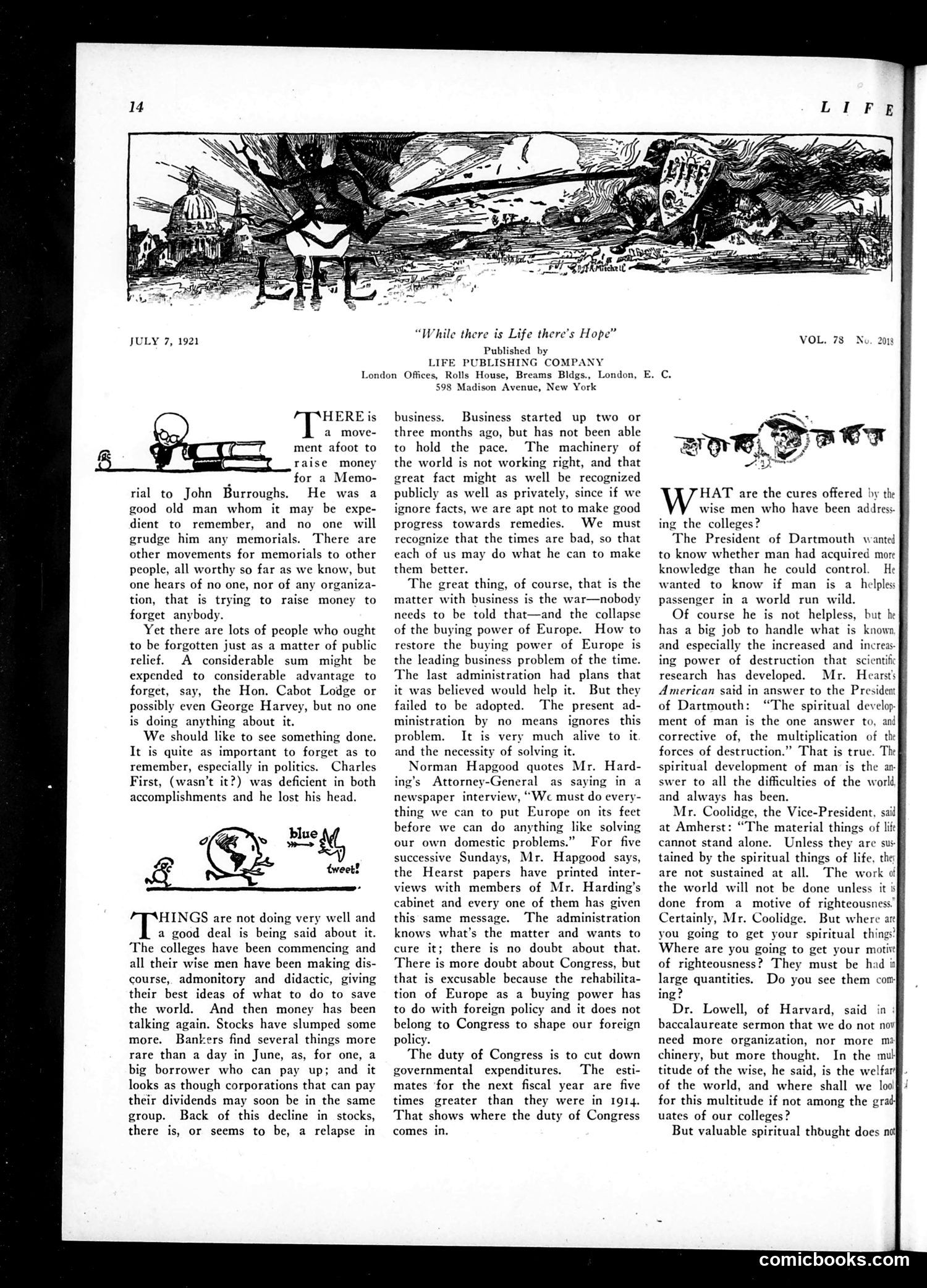
This July 1921 *Life* page contains editorial commentary about America's failing business recovery and political leadership. The text criticizes: **Business failure**: A memorial to raise money for John Burroughs (a naturalist) started strongly but lost momentum—used as metaphor for broader economic collapse. **Political ineptitude**: The Harding administration receives blame for ignoring Europe's buying power crisis and domestic problems. The article suggests Congress, bankers, and leadership lack vision for reconstruction. **College education**: Presidents from Dartmouth and Harvard are quoted discussing whether spiritual development and organized thought—not mere technical knowledge—can address societal problems. The decorative header illustrations appear generic rather than caricaturing specific individuals. The satire targets systemic failure of American institutions to solve post-war economic and social dysfunction.
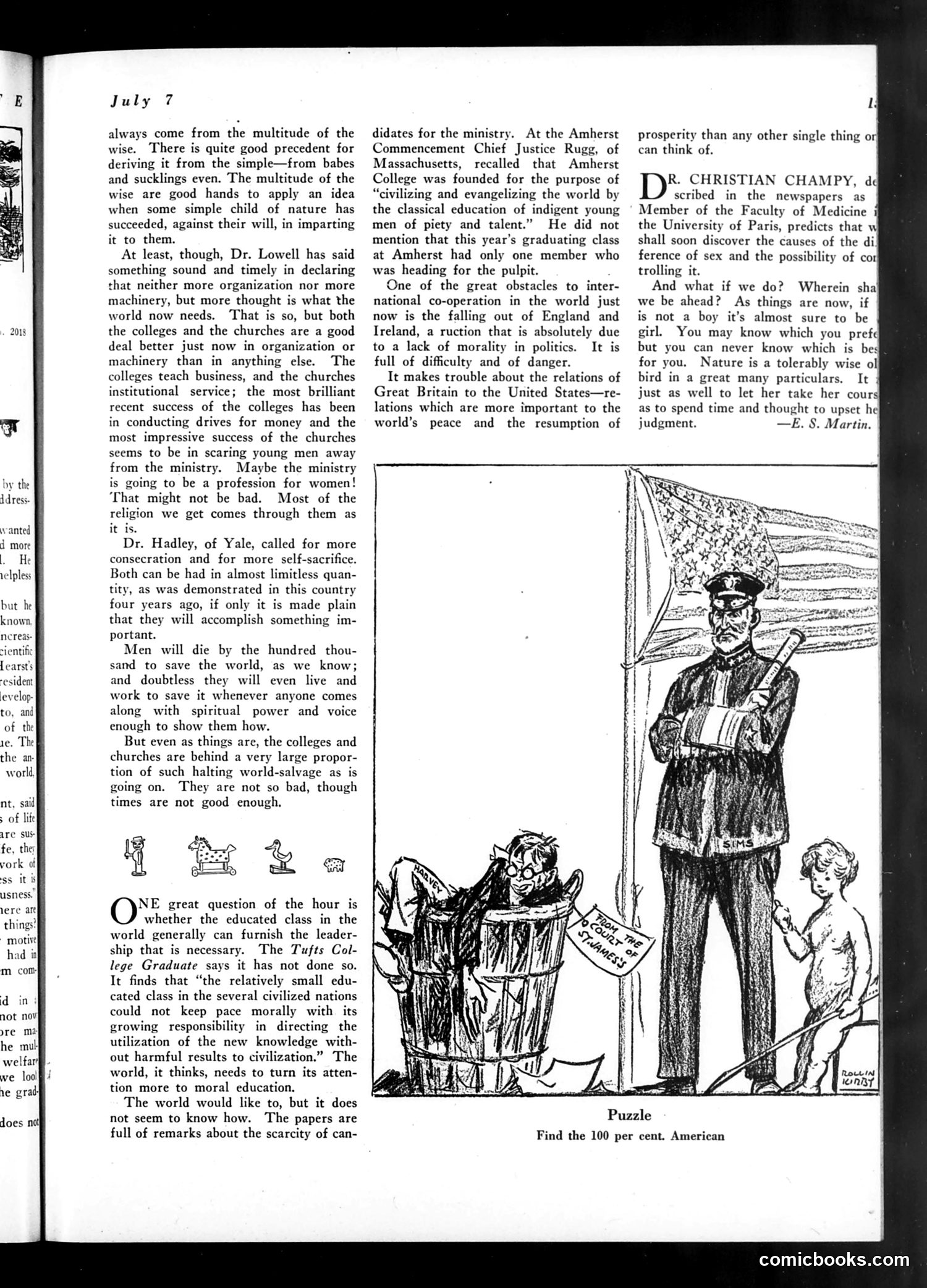
This page features editorial commentary on education, morality, and leadership, paired with a political cartoon titled "Find the 100 per cent American." **The Cartoon:** The illustration depicts a figure in military/official dress standing beside what appears to be a trash barrel labeled "RUBBISH" containing discarded items. A cherubic child points at the scene. The caption's challenge to "find" the perfect American suggests satire about American identity and purity—likely mocking nativist sentiment or post-WWI anxiety about immigration and national character. **The Text:** The article debates whether educated classes can provide moral leadership. It references declining ministry recruitment at Amherst College and cites Chief Justice Rugg's lament that the school was founded to educate "indigent young men of piety and talent," yet few graduates pursue the clergy. The piece criticizes how colleges emphasize business training and institutional mechanics over moral and spiritual development. **Context:** This reflects post-WWI American concerns about social leadership, education's purpose, and whether traditional institutions (churches, colleges) adequately addressed moral crises.
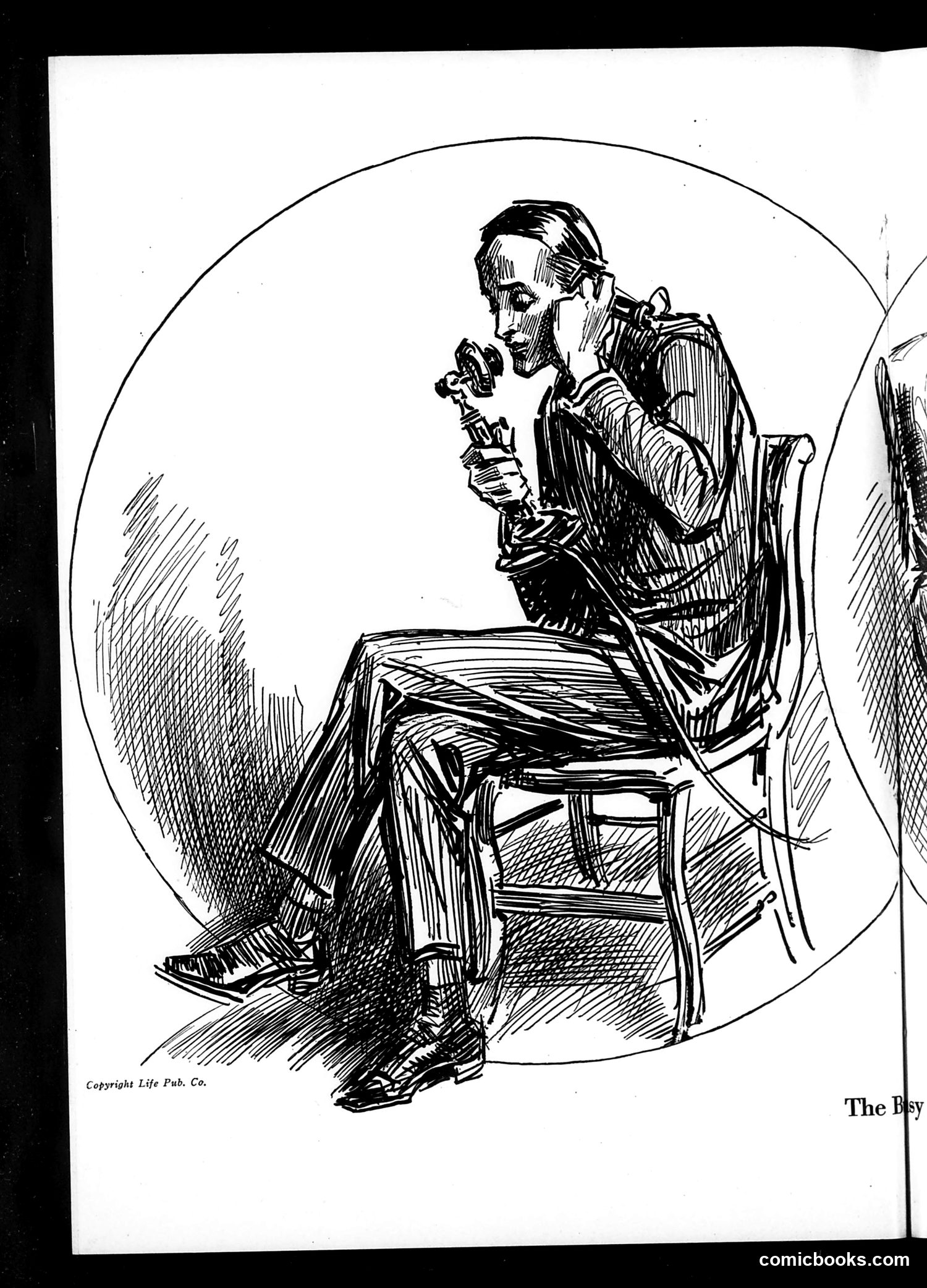
This ink sketch depicts a young man seated in a chair, hunched over in a contemplative or anxious pose with his hand to his face. The circular background suggests he's spotlit or isolated. The title "The Boy" and the figure's body language—tensed shoulders, worried gesture—suggest this is satirizing youthful anxiety or uncertainty, likely about career, romance, or social expectations. The artistic style is characteristic of early 20th-century Life magazine editorial illustration. Without additional context from surrounding text or articles on this page, the specific target of satire remains unclear. It may reference a contemporary social anxiety, coming-of-age concern, or character type familiar to Life's readers at the time of publication. The copyright attribution to "Life Pub. Co." confirms this is authentic period content.
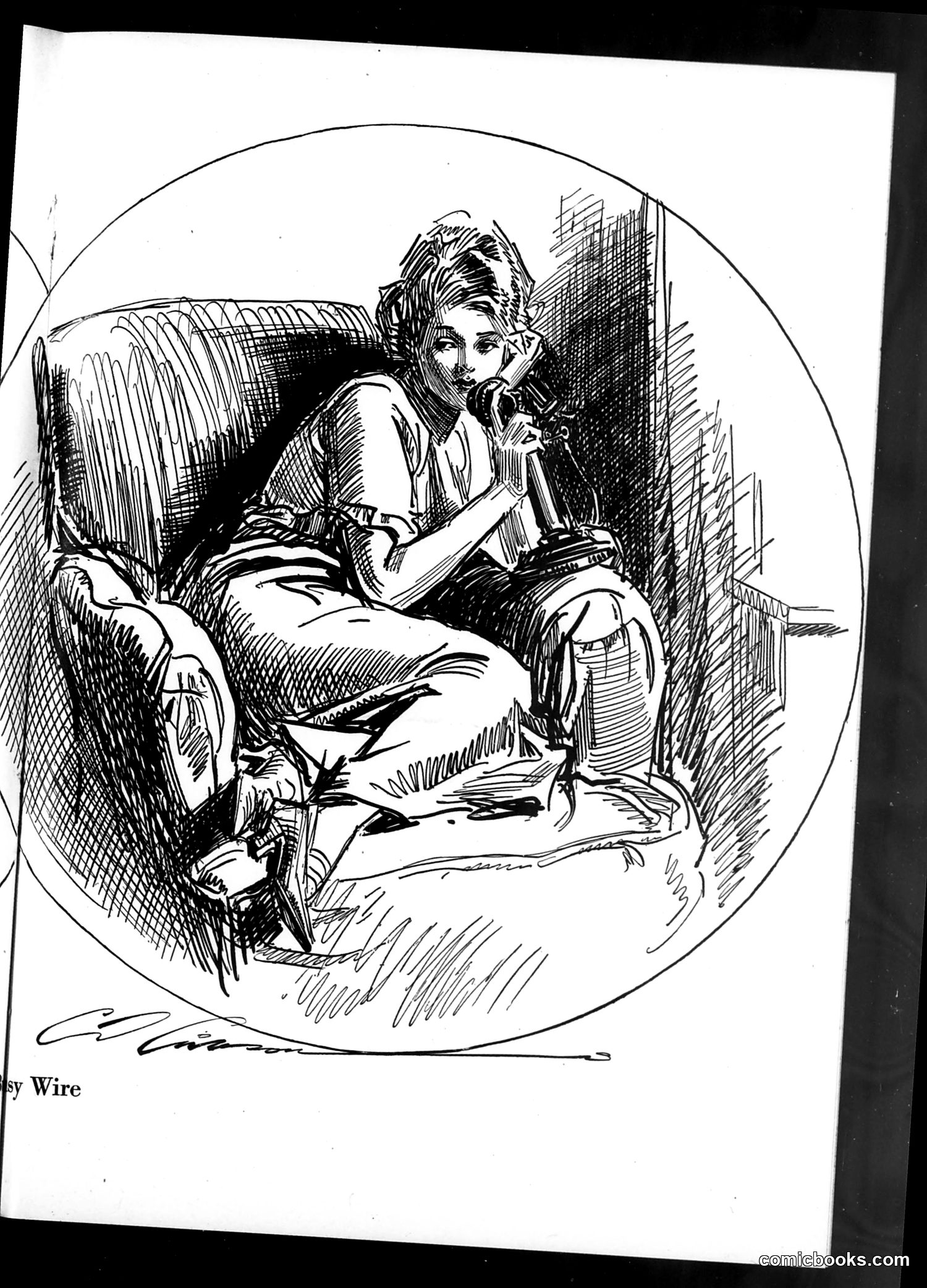
This is a pen-and-ink illustration showing a woman seated in a chair, speaking on a telephone. The drawing style is characteristic of early 20th-century satirical illustration. The circular framing and the artist's signature at the bottom suggest this is a standalone cartoon or illustration from *Life* magazine. The text visible reads "sy Wire" (likely "Daisy Wire" or similar), though this may be incomplete OCR. Without complete caption text, the specific satire is unclear. The image appears to comment on a woman using modern telephone technology, possibly satirizing women's increasing participation in public communication or business. However, the exact political or social point requires the full caption text, which the OCR has not fully captured.
This page discusses three theatrical productions with satirical commentary on American drama criticism and racial representation. **"Goat Alley"**: The author criticizes reviewers for dismissing this play about poor Black residents in Washington, D.C. as merely "sordid" sociology rather than legitimate art. The satire targets the double standard: if the same subject featured Russian peasants, it would be celebrated as avant-garde art. The author argues Black actors deserve credit for strong performances despite being confined to demeaning roles involving gambling ("sevens" and "elevens"). Charles Gilpin is noted as a rare exception breaking this pattern. **"The Harlequinade"**: A mythological burlesque involving classical figures (Mercury, Charon, Psyche). The critic admits initial reluctance to attend the downtown Neighborhood Playhouse but became impressed after seeing the uptown transfer. The underlying satire critiques how critics apply different aesthetic standards based on subject matter and race, while gatekeeping access to "legitimate" theater criticism itself.
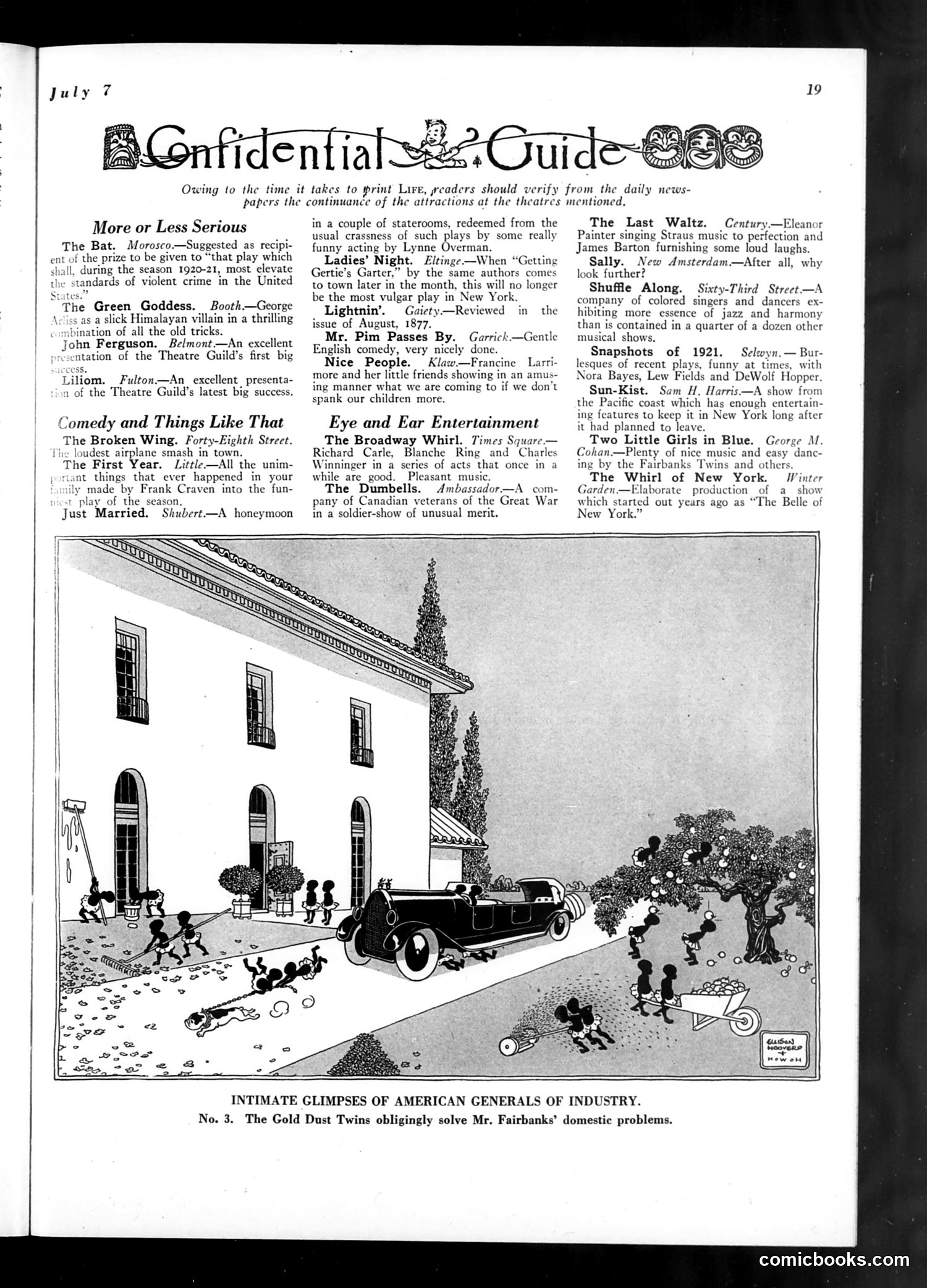
This page from *Life* magazine (dated July 7, likely 1921) contains theater reviews and a satirical cartoon about American industrialists. **The Cartoon:** The illustration depicts "The Gold Dust Twins" — a famous advertising mascot duo from a cleaning product brand — helping solve domestic problems for "Mr. Fairbanks" (likely Douglas Fairbanks, the famous silent film actor). The cartoon shows the twins at a grand estate managing children and household chaos while Fairbanks relaxes in an automobile. **The Satire:** The joke targets wealthy industrialists and celebrities who relied on commercial products and servants to handle domestic life. By literally inserting the "Gold Dust Twins" mascot into Fairbanks' home, the cartoonist mocks both consumer culture and the leisure lifestyle of the wealthy, who outsourced all family responsibilities. The caption indicates this is part of a series satirizing American industrial leaders' disconnection from ordinary household management. This reflects 1920s attitudes about class, advertising, and celebrity excess.
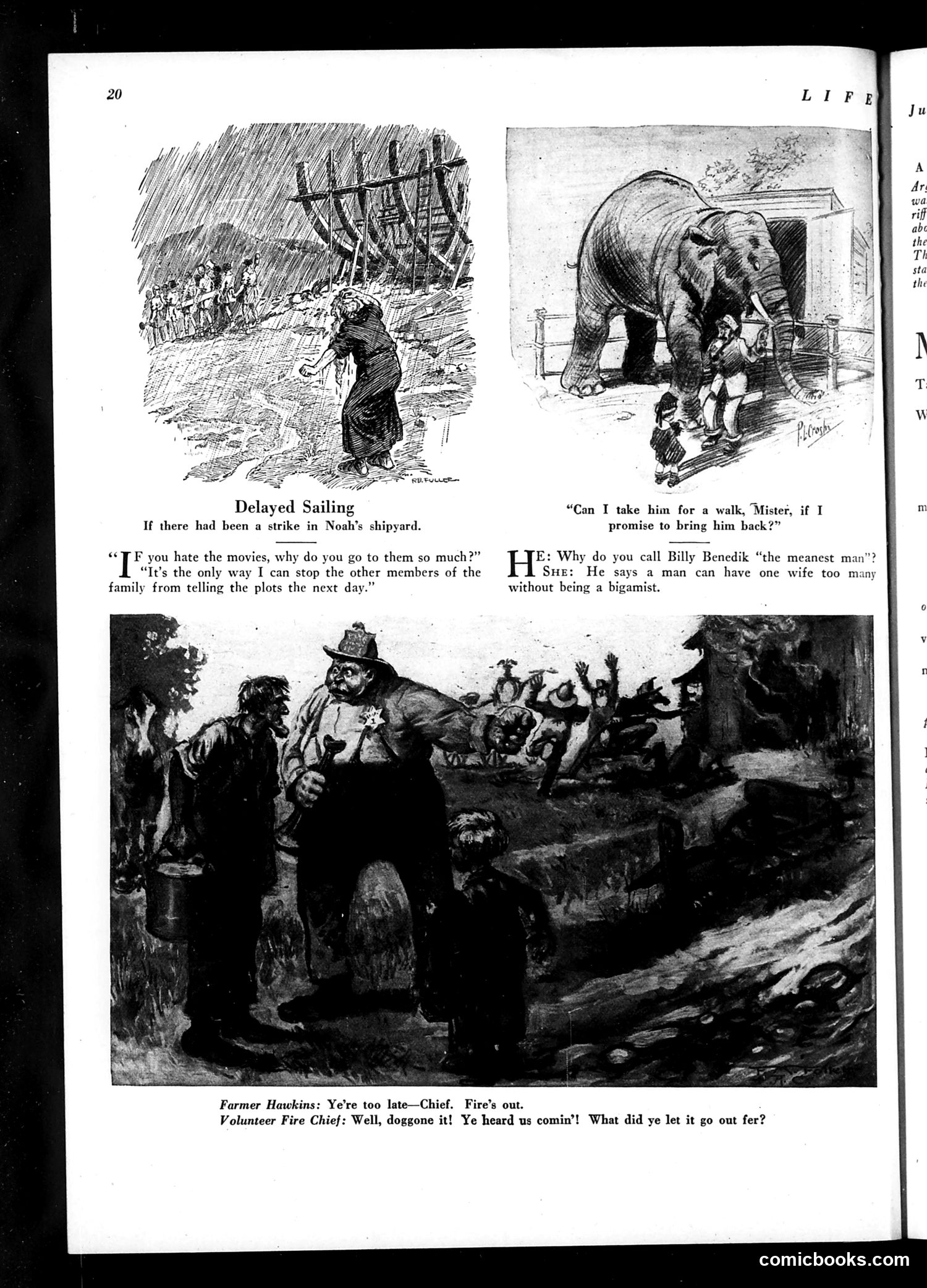
This page contains three separate humorous cartoons typical of early 20th-century satirical humor: 1. **"Delayed Sailing"**: A visual joke imagining Noah's ark delayed by a shipyard strike—combining biblical reference with contemporary labor disputes. 2. **Movie joke**: Satirizes how people attend films not for entertainment but to prevent family members from spoiling plot details by recounting them afterward—a commentary on social gossip and early cinema culture. 3. **Bigamy joke**: A wordplay gag where "Billy Benedik" is called "the meanest man" because he claims a man can have "one wife too many" without being a bigamist—joking that marriage itself is excessive. 4. **Fire chief cartoon**: Rural humor depicting a volunteer fire chief arriving too late to a fire, with the farmer sarcastically asking why he extinguished it since it's already out—poking fun at small-town volunteer emergency services. The page exemplifies Life's mix of verbal wit, visual gags, and social observation humor.
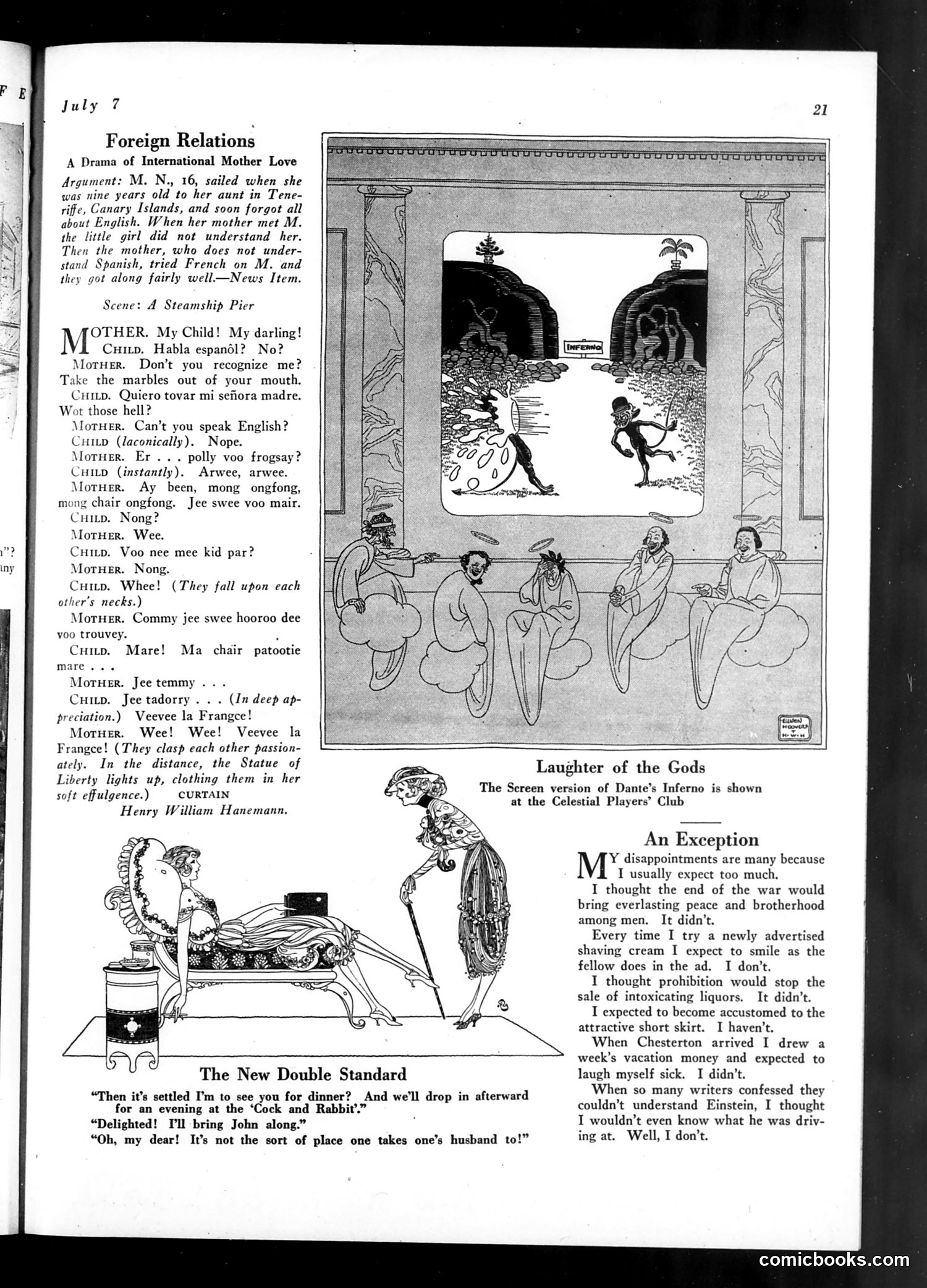
This satirical play depicts a mother-daughter reunion at a steamship pier after nine years of separation. The daughter, M.N., sailed to the Canary Islands as a child and forgot English, learning Spanish instead. When her mother retrieves her, neither speaks the other's language—the mother doesn't know Spanish, so she attempts French, which the daughter understands. The humor centers on their comically broken communication: the mother's mangled French ("Ay been, mong ongfong") and the daughter's Spanish responses create absurd exchanges. Yet they emotionally reconnect anyway, embracing passionately while the Statue of Liberty symbolically shines approval in the background. The cartoon satirizes post-WWI idealism about international understanding and "mother love" transcending language barriers—suggesting that emotional bonds overcome practical communication obstacles. It's a gentle jab at American optimism about cross-cultural harmony during a period of significant immigration and cultural mixing in the U.S.
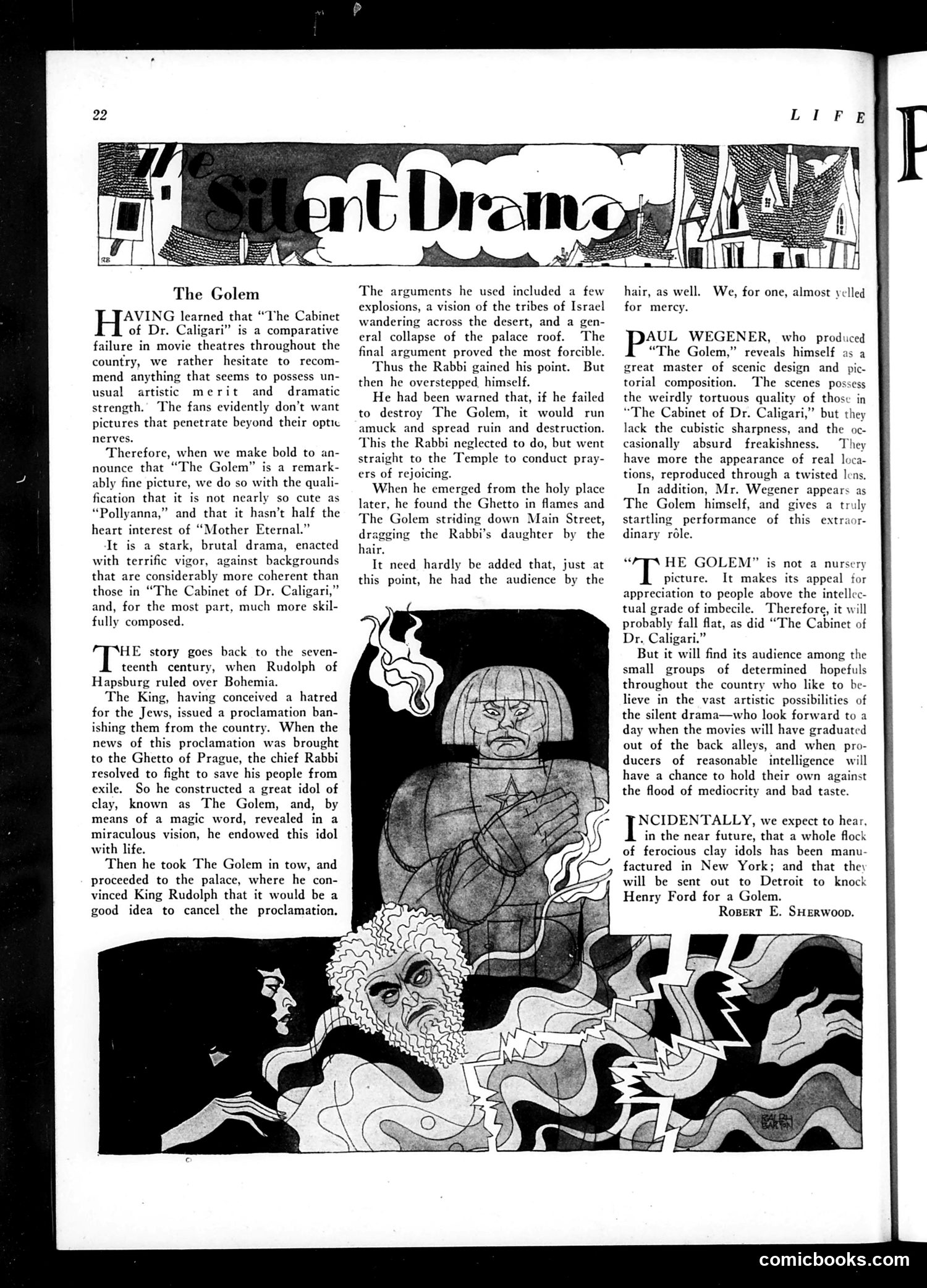
This is a review of the 1920 German Expressionist film *The Golem*, adapted from Jewish folklore. The reviewer (Robert E. Sherwood) praises director Paul Wegener's artistic achievement while acknowledging it will fail commercially—comparing it unfavorably to popular but artistically shallow films like *Pollyanna*. The plot concerns a Rabbi in 17th-century Prague who animates a clay statue to save Jews from King Rudolph's expulsion decree. After succeeding through dramatic supernatural demonstrations, the Rabbi neglects to destroy the creature, which runs amok through the ghetto. The review criticizes American audiences' indifference to serious cinema, lamenting that sophisticated films like *The Cabinet of Dr. Caligari* fail at the box office. The final joke suggests clay golems will soon be manufactured in New York to "knock Henry Ford"—likely referencing Ford's notorious antisemitism and implied suggestion that even industrialists deserve supernatural intervention.
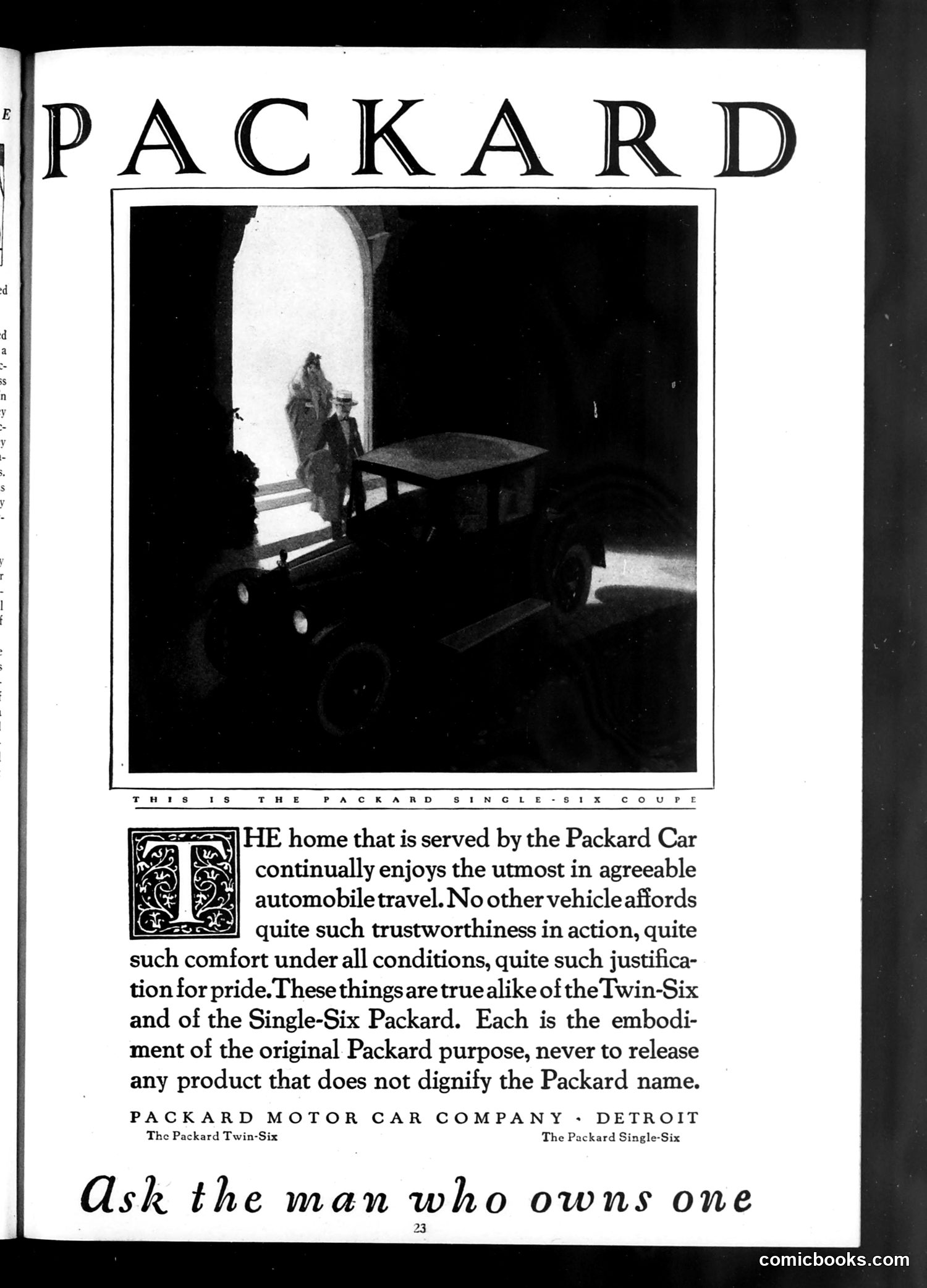
This is a **Packard automobile advertisement**, not political satire or a cartoon. The image shows a dramatic photograph of a Packard Single-Six coupe parked in what appears to be a classical archway or tunnel, with two figures silhouetted near the entrance—likely meant to evoke elegance and timeless sophistication. The text emphasizes Packard's reputation for quality, trustworthiness, and luxury. The famous closing tagline "Ask the man who owns one" was Packard's actual advertising slogan, suggesting that satisfied owners would testify to the car's superiority. This appears to be from the 1920s era when Packard was among America's most prestigious luxury automobile brands, competing with cars like Cadillac. The ad appeals to affluent readers seeking status and reliability rather than containing any satirical or political commentary.
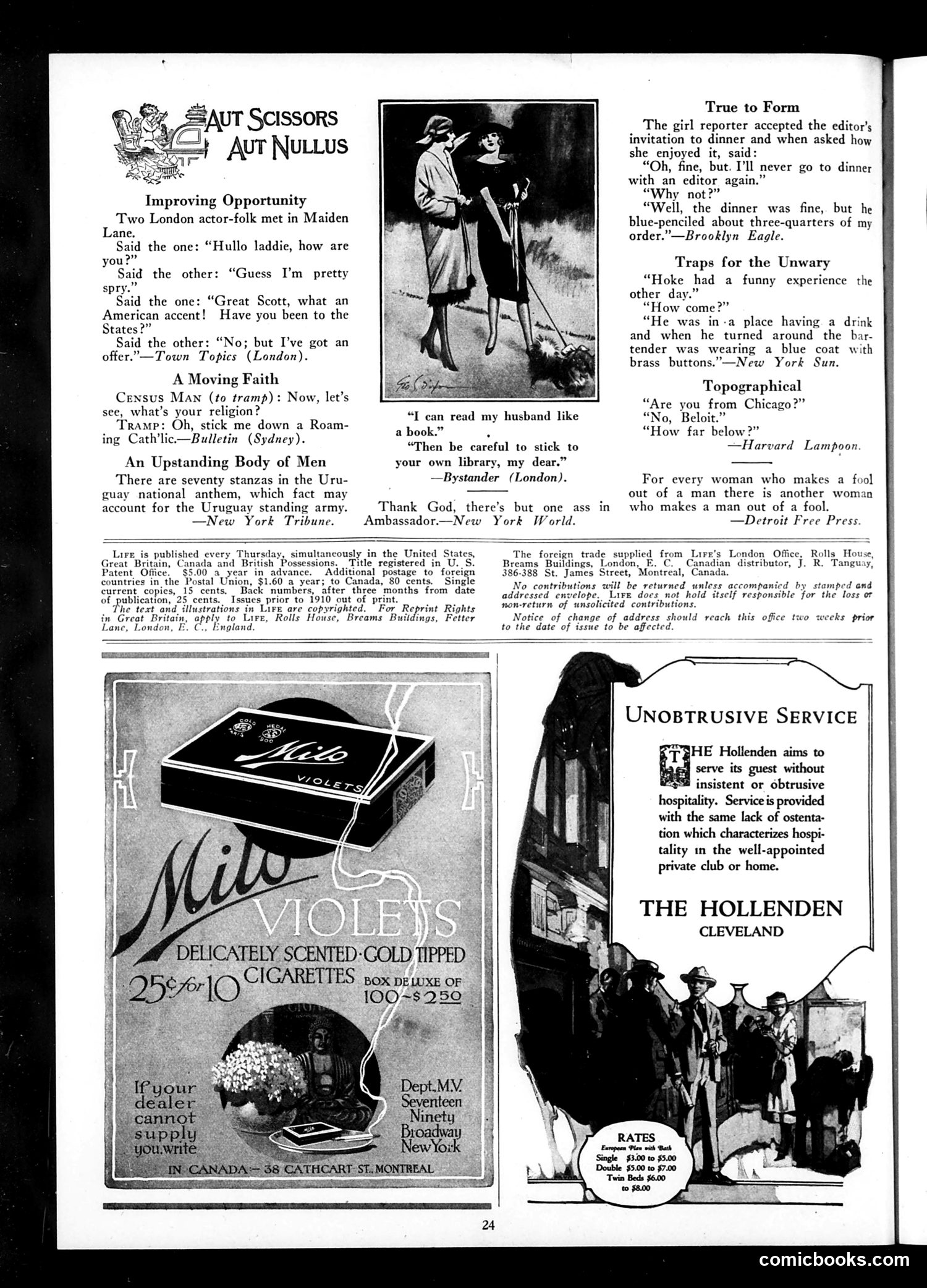
This page from Life magazine contains several short satirical jokes typical of early 20th-century humor, plus advertisements. The cartoons/jokes mock social conventions and human nature: - **"Improving Opportunity"**: Two London actors meet; one has adopted an American accent hoping for better theatrical prospects—satire on accent-climbing and professional ambition. - **"A Moving Faith"**: A census taker asks a homeless man's religion; he answers "Roman Catholic" but specifies "roaming"—wordplay mocking both bureaucratic surveys and religious hypocrisy. - **"An Upstanding Body of Men"**: A joke claiming Uruguay's 70-stanza national anthem explains why their army never stands (they're exhausted from singing). The remaining items are brief quips about relationships, infidelity, and gender dynamics typical of period humor—often crude by modern standards. The page also advertises Milo Violets cigarettes and The Hollenden hotel in Cleveland, reflecting contemporary commercial practices in magazines.
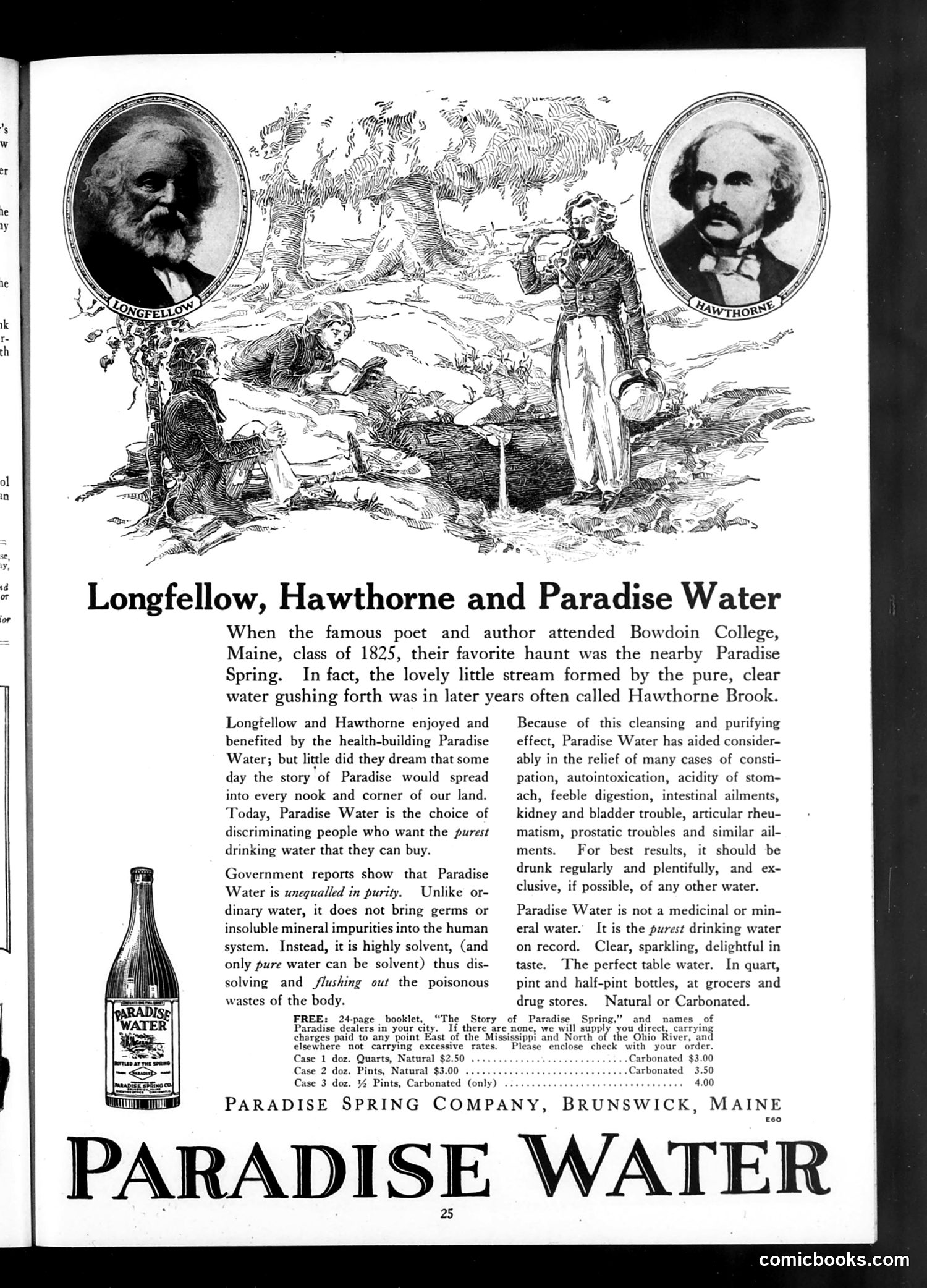
This is primarily a **product advertisement**, not political satire. It uses the prestige of famous American literary figures to market bottled spring water. The page features **portraits of Henry Wadsworth Longfellow and Nathaniel Hawthorne** (labeled at top), both Bowdoin College alumni (class of 1825). The ad claims they frequented Paradise Spring near campus and benefited from its pure water. The advertisement leverages their literary fame to establish credibility, suggesting that if these celebrated authors valued the water, discriminating consumers should too. The copy makes health claims—curing constipation, digestive issues, and various ailments—typical of early 20th-century patent medicine marketing before FDA regulations. The central illustration shows figures at the spring, romanticizing the water source. This is **advertising strategy**, not satire: associating a commercial product with cultural authority and nostalgia.
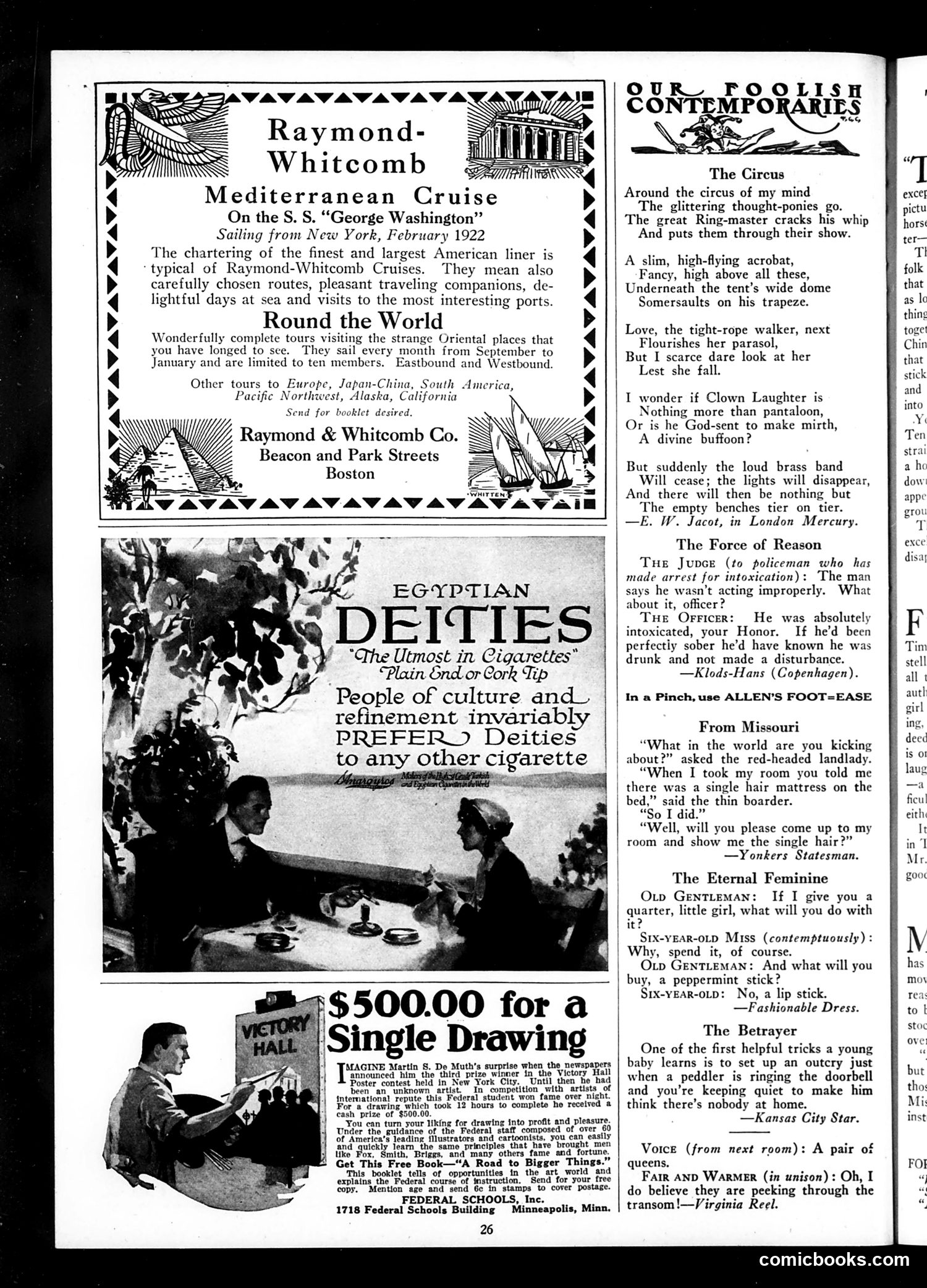
This page is primarily **advertising and light humor content**, not political satire. The main elements include: **Advertisements:** - Raymond-Whitcomb cruise lines promoting Mediterranean and world tours (February 1922) - Egyptian Deities cigarettes, marketed to "people of culture and refinement" - Federal Schools art correspondence course, highlighting a student who won $500 in a poster contest **Humor Pieces:** - "The Circus" — a whimsical poem about thoughts as circus performers (acrobats, tightrope walkers, clowns) - "The Force of Reason" — a brief joke where a drunk man's arrest is justified because a sober man wouldn't have caused a disturbance - Several short joke items ("From Missouri," "The Eternal Feminine," "The Betrayer") The page reflects 1920s consumer culture and genteel humor typical of Life magazine's style. There is **no significant political commentary** visible—the content targets educated, affluent readers with disposable income for cruises and art education.
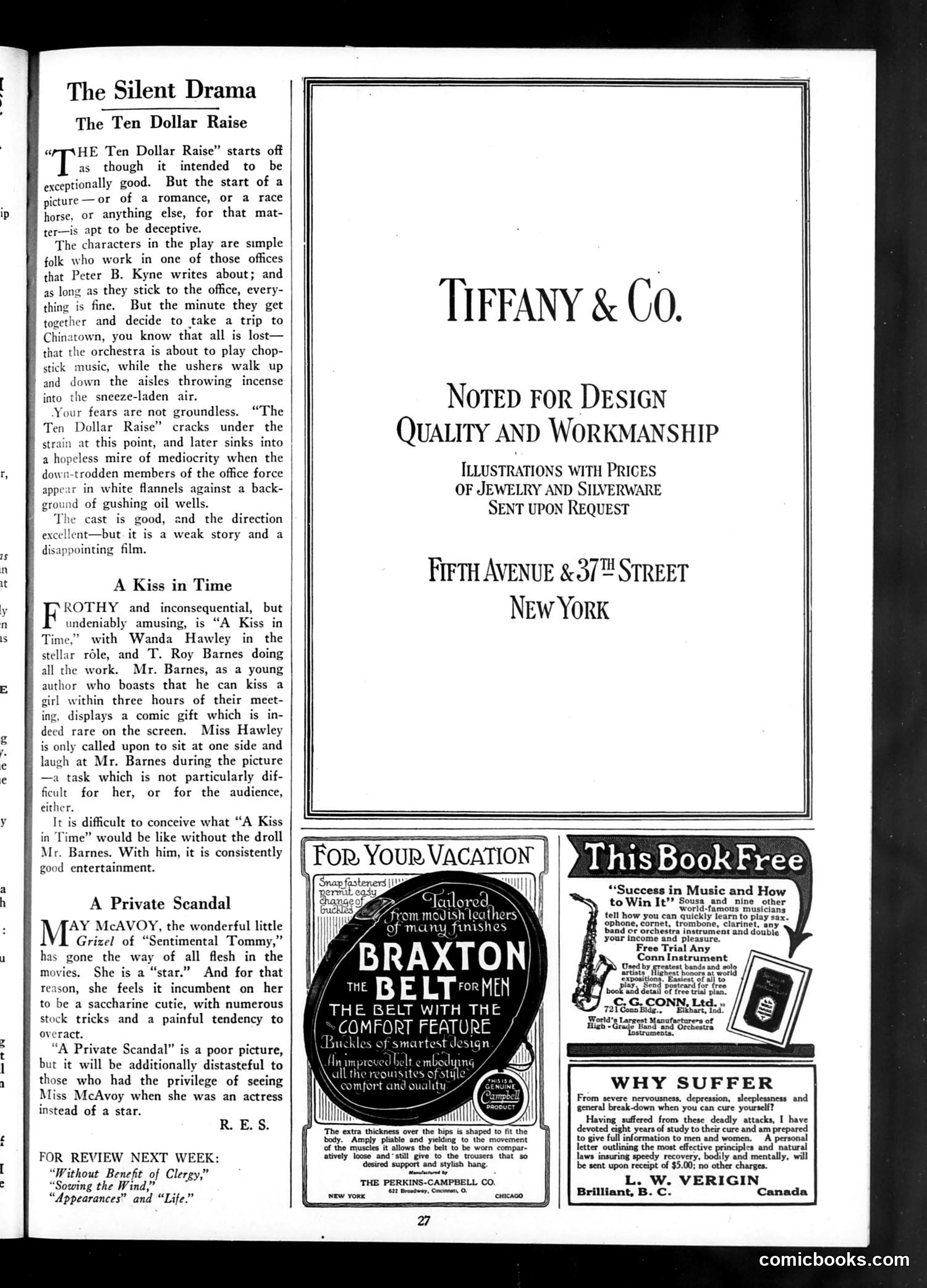
This page contains **film criticism** rather than political cartoons. The "Silent Drama" section reviews three 1920s movies: 1. **"The Ten Dollar Raise"** — criticized as starting promisingly but deteriorating when characters visit Chinatown, where the reviewer sarcastically notes the orchestra will play "chopstick music" while ushers throw incense. This reflects period stereotyping of Asian locations as exotic/comedic backdrops. 2. **"A Kiss in Time"** — praised primarily for T. Roy Barnes's physical comedy, with actress Wanda Hawley dismissed as merely sitting and laughing. 3. **"A Private Scandal"** — panned for featuring May McAvoy, whom the reviewer criticizes for becoming a vapid "star" rather than remaining a serious actress. The page also contains period **advertisements** for Tiffany & Co. jewelry, Braxton belts, music instruction books, and a nervousness cure—typical 1920s commercial content. The reviews reflect contemporary attitudes toward both cinema and gender roles in entertainment.
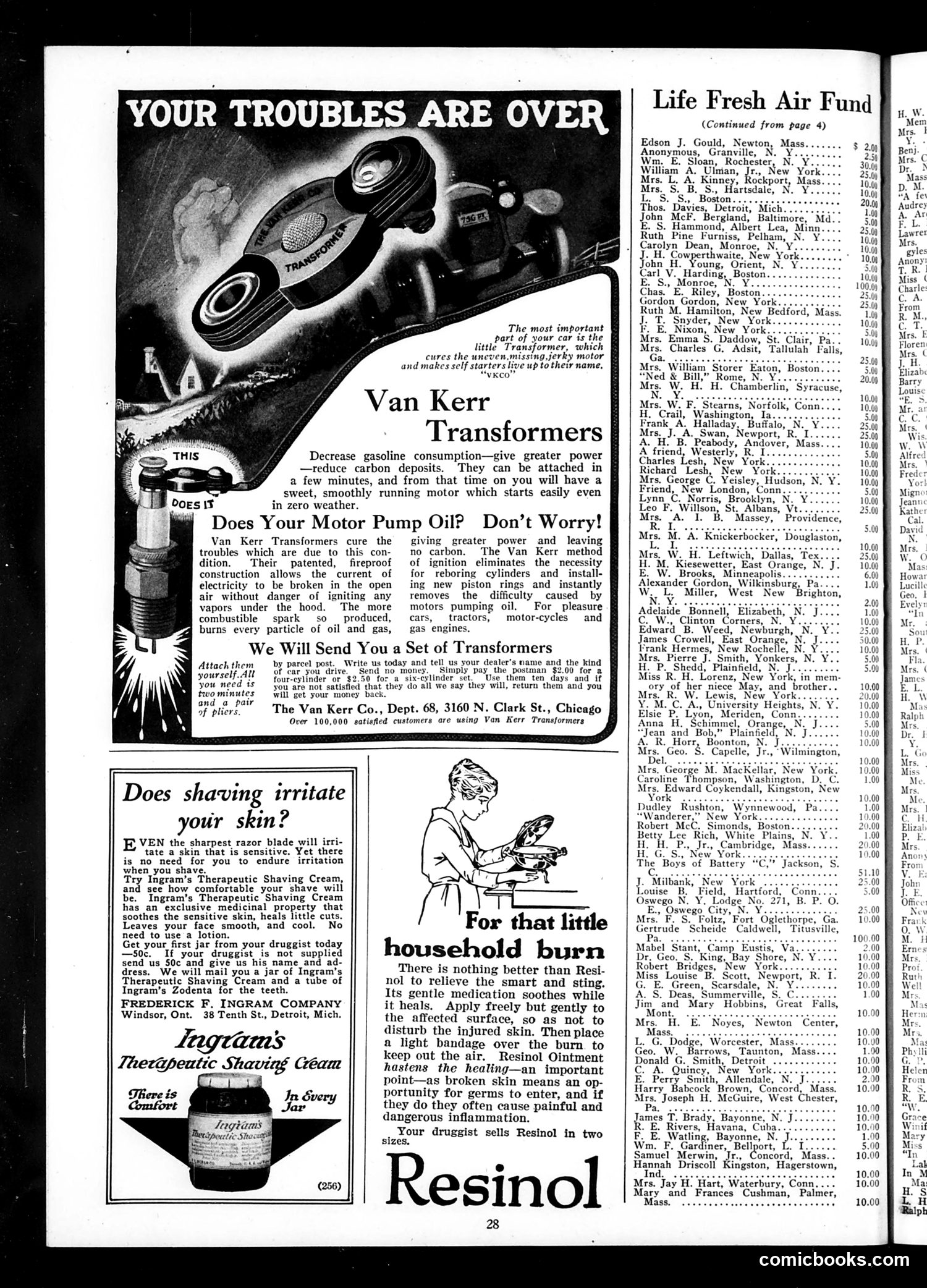
This page is primarily **advertising**, not satire or political commentary. The dominant content features three product advertisements: 1. **Van Kerr Transformers** (top): An automotive accessory claiming to improve engine performance, reduce gasoline consumption, and prevent oil leaks. The illustration shows a mechanical device. This represents early 1900s-era car modification products marketed with exaggerated performance claims typical of the era. 2. **Ingram's Therapeutic Shaving Cream** (bottom left): A medicinal shaving product targeting men with sensitive skin. 3. **Resinol Ointment** (bottom right): A topical burn treatment. The right column contains the **Life Fresh Air Fund** donor list—a charitable listing of contributors' names and donation amounts, likely supporting outdoor recreation for underprivileged children. No political cartoons, caricatures, or satire appear on this page. It represents typical early-20th-century magazine content: advertisements mixed with philanthropic announcements.
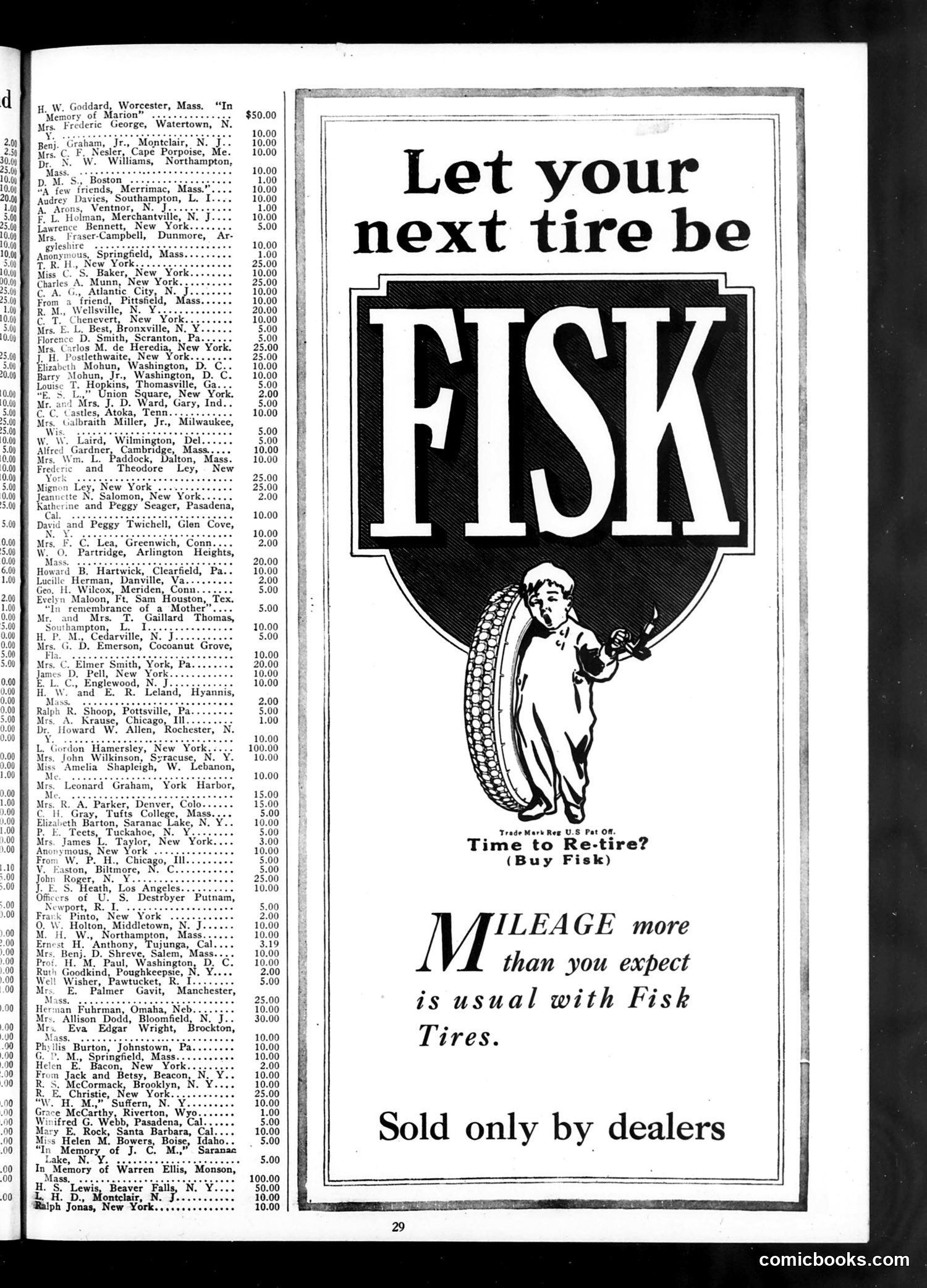
This page is primarily a **Fisk Tires advertisement**, not political satire. The right side features a full-page ad for Fisk automobile tires from the early 20th century. The advertisement uses a visual pun: a figure in pajamas (appearing to be a child or cherub) holds an oversized tire, playing on the phrase "time to re-tire" (rest/sleep). The tagline promises that Fisk tires deliver "MILEAGE more than you expect" — a common advertising claim of the era. The left side shows a list of names and donations, likely from a fundraising campaign or memorial collection unrelated to the tire advertisement. **For modern readers**: This represents early automotive advertising targeting car owners concerned about tire durability and value. The whimsical imagery (the pajama-clad figure) was typical marketing strategy of the 1910s-1920s era, when Fisk was a major American tire manufacturer.
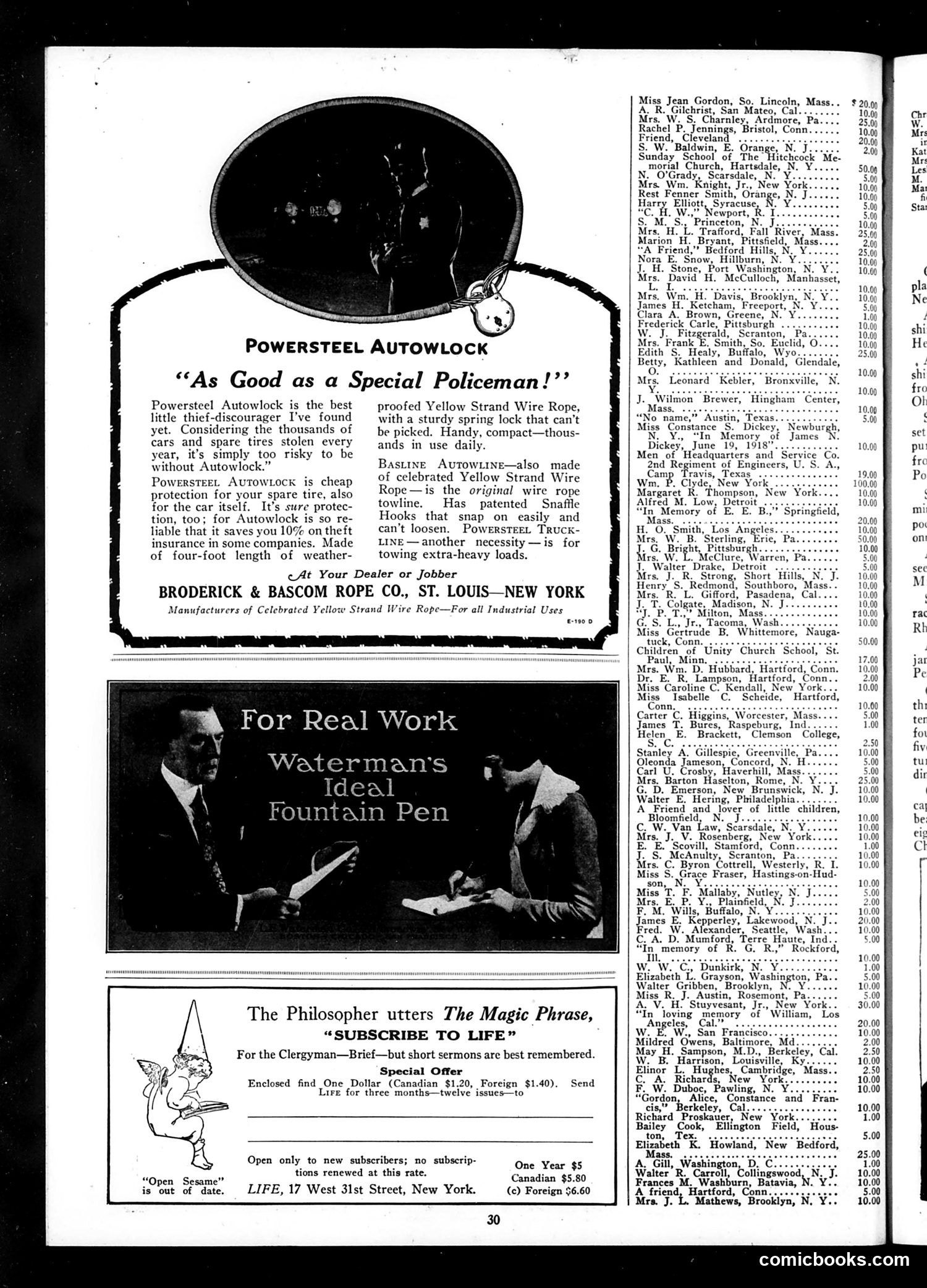
This page is primarily **advertising and subscription content**, not editorial cartoons. It contains three commercial advertisements: 1. **Powersteel Autowlock** (top): A car security device marketed as "as good as a special policeman"—a theft deterrent for spare tires and automobiles during an era of widespread car theft. 2. **Waterman's Ideal Fountain Pen** (middle): Pitched as reliable for serious work, appealing to professionals. 3. **Life Magazine subscription offer** (bottom): Includes a whimsical illustration of "The Philosopher" uttering "the magic phrase" to encourage subscriptions, with pricing for different regions. The bulk of the page consists of a **subscription list**—names and addresses of new Life magazine subscribers from across America, typical of the era's practice of publishing patron lists. This demonstrates the magazine's circulation reach and serves as public acknowledgment of supporters.
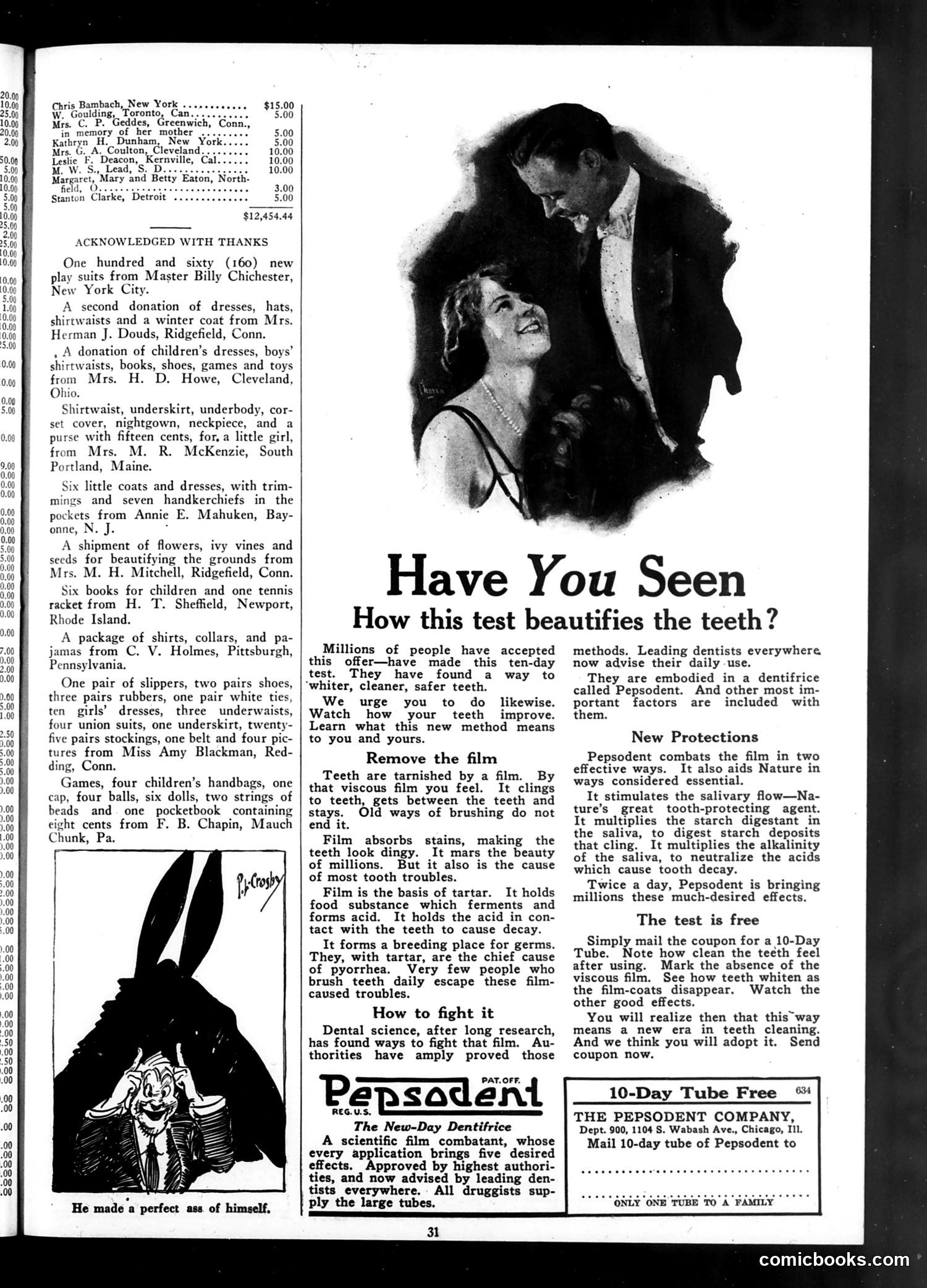
This page combines charitable donation acknowledgments with a **Pepsodent toothpaste advertisement**—typical of early 20th-century magazine layouts mixing public service and commerce. ## The Cartoon The small cartoon (bottom left) shows a figure saying "He made a perfect ass of himself," likely a visual pun about foolish behavior, though context for the specific reference is unclear from this page alone. ## The Advertisement The main content is a Pepsodent ad promoting a "10-Day Tube Free" test. It explains the product combats tooth film—a viscous coating that causes discoloration, decay, and gum disease. The ad emphasizes that Pepsodent works through scientific means: stimulating saliva flow and neutralizing acids. **Modern context**: This represents early mass-market dentistry marketing, when brushing teeth was still becoming routine. The emphasis on "film" and "scientific" methods reflects 1920s-30s advertising's appeal to scientific authority to sell consumer products. The charitable donations listed above suggest this is a **Life magazine issue supporting charitable causes**, juxtaposing philanthropy with commercial messaging.
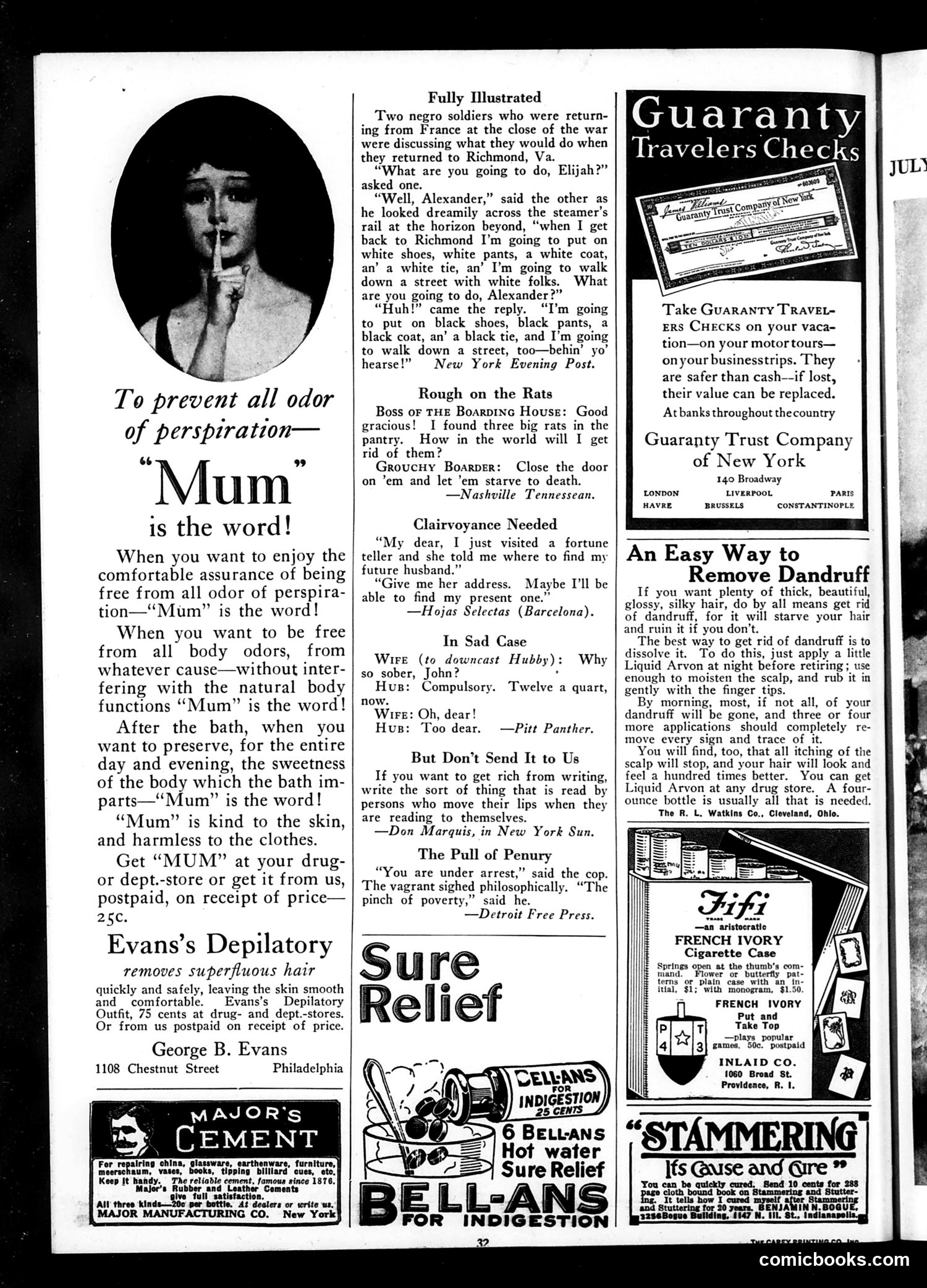
This page from *Life* magazine is primarily **advertising**, with a few humorous anecdotes interspersed. The most notable satirical content is a brief story about "Two negro soldiers" returning from France after WWI to Richmond, Virginia. One describes plans to wear all-white clothing and walk among white people; the other replies he'll wear all-black and walk "behin' yo' hearse"—a dark joke implying the first soldier will be killed for violating Jim Crow segregation laws. The satire critiques the cruel reality facing Black veterans who fought for America but returned to a segregated South where such behavior would be dangerous. The remaining content consists of commercial advertisements (Mum deodorant, Evans's Depilatory, Major's Cement, Bellans indigestion remedy, Fifi cigarette cases, etc.) and brief jokes from various newspapers about rats, fortune-telling, poverty, and dandruff removal—typical filler for the era.