
Life, 1921-07-07 · page 12 of 34
Life — July 7, 1921 — page 12: what you’re looking at
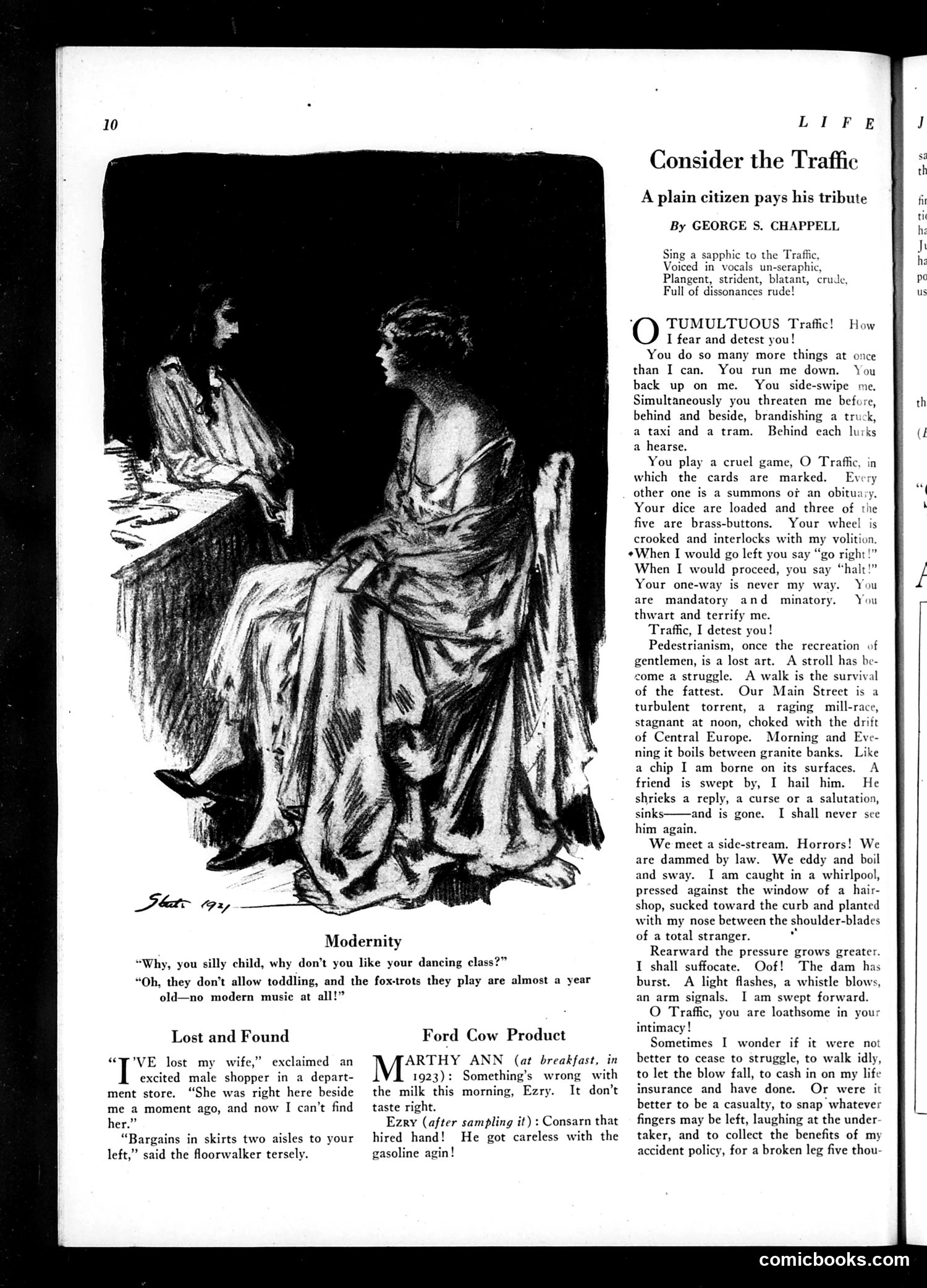
What you’re looking at
This cartoon satirizes changing social norms of the 1920s. A mother questions her child about disliking "dancing class," to which the child responds that instructors forbid "toddling" and play only outdated music—"not modern music at all!" The joke targets generational conflict over "modern" jazz and dance styles. "Toddling" refers to the energetic, often considered scandalous dances gaining popularity among youth in the Jazz Age. The cartoon mocks parents' attempts to enforce Victorian propriety while children embrace contemporary culture. The artist satirizes both the rigid older generation and their children's dismissive attitude toward tradition, capturing a common 1920s cultural anxiety about rapid social change and youth rebellion against established norms.
📄 Transcribed text from this page (OCR, searchable)
Machine-transcribed from the original scan — historical spelling and the odd misread are preserved.
Modernity “Why, you silly child, why don’t you like your dancing class?” “Oh, they don’t allow toddling, and the fox-trots they play are almost a year old—no modern music at all!” Lost and Found “SV ’VE lost my wife,” exclaimed an I excited male shopper in a depart- ment store. “She was right here beside me a moment ago, and now I can’t find her.” “Bargains in skirts two aisles to your left,” said the floorwalker tersely. Ford Cow Product ARTHY ANN (at breakfast, in 1923): Something’s wrong with the milk this morning, Ezry. It don’t taste right. Ezry (after sampling it) : Consarn that hired hand! He got careless with the gasoline agin! LIFE Consider the Traffic A plain citizen pays his tribute By GEORGE S. CHAPPELL Sing a sapphic to the Traffic, Voiced in vocals un-seraphic, Plangent, strident, blatant, crude, Full of dissonances rude! TUMULTUOUS Trafic! I fear and detest you! You do so many more things at once than I can. You run me down. back up on me. You side-swipe me. Simultaneously you threaten me before, behind and beside, brandishing a truck, a taxi and a tram. Behind each lurks a hearse. You play a cruel game, O Traffic, in which the cards are marked. Every other one is a summons o¢ an obituaiy. Your dice are loaded and three of the five are brass-buttons. Your wheel is crooked and interlocks with my volitio How When I would go left you say “go right When I would proceed, you say “ Your one-way is never my way. are mandatory and _ minatory. thwart and terrify me. Traffic, I detest you! Pedestrianism, once the recreation of gentlemen, is a lost art. A stroll has be- come a struggle. A walk is the survival of the fattest. Our Main Street is a turbulent torrent, a raging mill-race, stagnant at noon, choked with the drift of Central Europe. Morning and Eve- ning it boils between granite banks. Like a chip I am borne on its surfaces. A friend is swept by, I hail him. He shrieks a reply, a curse or a salutation, sinks: and is gone. I shall never sce him again. We meet a side-stream. Horrors! We are dammed by law. We eddy and boil and sway. I am caught in a whirlpool, pressed against the window of a hair- shop, sucked toward the curb and planted with my nose between the shoulder-blades of a total stranger. ? Rearward the pressure grows greater. I shall suffocate. Oof! The dam has burst. A light flashes, a whistle blows, an arm signals. I am swept forward. O Traffic, you are loathsome in your intimacy! Sometimes I wonder if it were not better to cease to struggle, to walk idly, to let the blow fall, to cash in on my life insurance and have done. Or were it better to be a casualty, to snap whatever fingers may be left, laughing at the under. taker, and to collect the benefits of my accident policy, for a broken leg five thou- You th comicbooks.com