
Life, 1921-07-07 · page 17 of 34
Life — July 7, 1921 — page 17: what you’re looking at
What you’re looking at
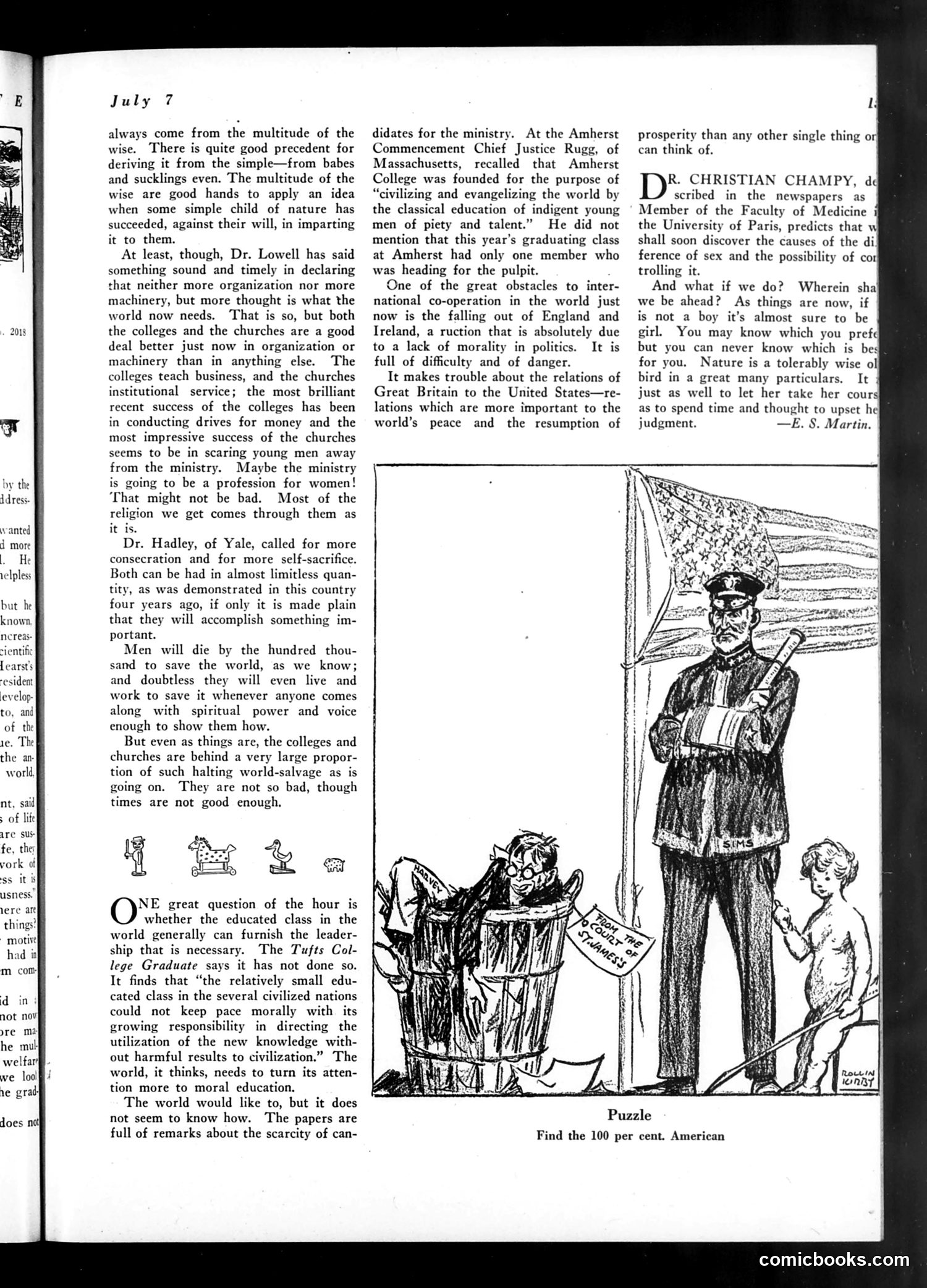
This page features editorial commentary on education, morality, and leadership, paired with a political cartoon titled "Find the 100 per cent American." **The Cartoon:** The illustration depicts a figure in military/official dress standing beside what appears to be a trash barrel labeled "RUBBISH" containing discarded items. A cherubic child points at the scene. The caption's challenge to "find" the perfect American suggests satire about American identity and purity—likely mocking nativist sentiment or post-WWI anxiety about immigration and national character. **The Text:** The article debates whether educated classes can provide moral leadership. It references declining ministry recruitment at Amherst College and cites Chief Justice Rugg's lament that the school was founded to educate "indigent young men of piety and talent," yet few graduates pursue the clergy. The piece criticizes how colleges emphasize business training and institutional mechanics over moral and spiritual development. **Context:** This reflects post-WWI American concerns about social leadership, education's purpose, and whether traditional institutions (churches, colleges) adequately addressed moral crises.
📄 Transcribed text from this page (OCR, searchable)
Machine-transcribed from the original scan — historical spelling and the odd misread are preserved.
cf by the dress. wanted d more . He relpless but he known, nereas- vork of ss it i usness. motirt had ia m com id in: not nov re ma he mul} welfar' we loo 1e grad} does noi July 7 always come from the multitude of the wise. There is quite good precedent for deriving it from the simple—from babes and sucklings even. The multitude of the wise are good hands to apply an idea when some simple child of nature has succeeded, against their will, in imparting it to them. At least, though, Dr. Lowell has said something sound and timely in declaring that neither more organization nor more machinery, but more thought is what the world now needs. That is so, but both the colleges and the churches are a good deal better just now in organization or machinery than in anything else. The colleges teach business, and the churches institutional service; the most brilliant recent success of the colleges has been in conducting drives for money and the most impressive success of the churches seems to be in scaring young men away from the ministry. Maybe the ministry is going to be a profession for women! ‘That might not be bad. Most of the religion we get comes through them as it is. Dr. Hadley, of Yale, called for more consecration and for more self-sacrifice. Both can be had in almost limitless quan- tity, as was demonstrated in this country four years ago, if only it is made plain that they will accomplish something im- portant. Men will die by the hundred thou- sand to save the world, as we know; and doubtless they will even live and work to save it whenever anyone comes along with spiritual power and voice enough to show them how. But even as things are, the colleges and churches are behind a very large propor- tion of such halting world-salvage as is going on. They are not so bad, though times are not good enough. { TH be NE great question of the hour is whether the educated class in the world generally can furnish the leader- ship that is necessary. The Tufts Col- lege Graduate says it has not done so. It finds that “the relatively small edu- cated class in the several civilized nations could not keep pace morally with its growing responsibility in directing the utilization of the new knowledge with- out harmful results to civilization.” The world, it thinks, needs to turn its atten- tion more to moral education. The world would like to, but it does not seem to know how. The papers are full of remarks about the scarcity of can- didates for the ministry. At the Amherst Commencement Chief Justice Rugg, of Massachusetts, recalled that Amherst College was founded for the purpose of “civilizing and evangelizing the world by the classical education of indigent young men of piety and talent.” He did not mention that this year’s graduating class at Amherst had only one member who was heading for the pulpit. One of the great obstacles to inter- national co-operation in the world just now is the falling out of England and Ireland, a ruction that is absolutely due to a lack of morality in politics. It is full of difficulty and of danger. It makes trouble about the relations of Great Britain to the United States—re- lations which are more important to the world’s peace and the resumption of prosperity than any other single thing or] can think of. R. CHRISTIAN CHAMPY, dé scribed in the newspapers as Member of the Faculty of Medicine the University of Paris, predicts that w shall soon discover the causes of the di ference of sex and the possibility of cor trolling it. And what if we do? Wherein shal we be ahead? As things are now, if is not a boy it’s almost sure to be girl. You may know which you prefd but you can never know which is bed for you. Nature is a tolerably wise ol bird in a great many particulars. It 4 just as well to let her take her cours as to spend time and thought to upset he judgment. —E. S§. Martin. Puzzle Find the 100 per cent. American comicbooks.com