
Life, 1921-07-07 · page 20 of 34
Life — July 7, 1921 — page 20: what you’re looking at
What you’re looking at
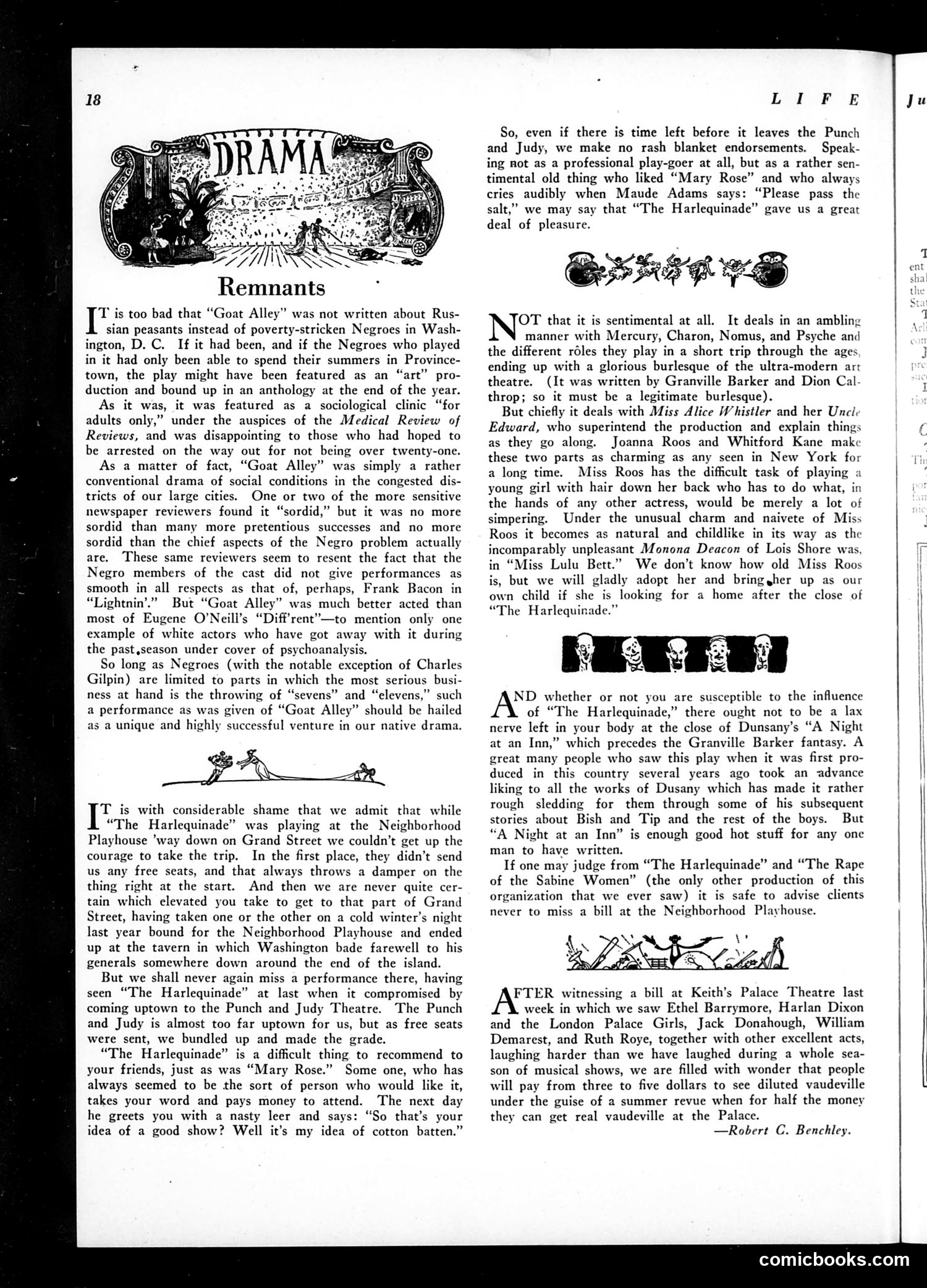
This page discusses three theatrical productions with satirical commentary on American drama criticism and racial representation. **"Goat Alley"**: The author criticizes reviewers for dismissing this play about poor Black residents in Washington, D.C. as merely "sordid" sociology rather than legitimate art. The satire targets the double standard: if the same subject featured Russian peasants, it would be celebrated as avant-garde art. The author argues Black actors deserve credit for strong performances despite being confined to demeaning roles involving gambling ("sevens" and "elevens"). Charles Gilpin is noted as a rare exception breaking this pattern. **"The Harlequinade"**: A mythological burlesque involving classical figures (Mercury, Charon, Psyche). The critic admits initial reluctance to attend the downtown Neighborhood Playhouse but became impressed after seeing the uptown transfer. The underlying satire critiques how critics apply different aesthetic standards based on subject matter and race, while gatekeeping access to "legitimate" theater criticism itself.
📄 Transcribed text from this page (OCR, searchable)
Machine-transcribed from the original scan — historical spelling and the odd misread are preserved.
Remnants T is too bad that “Goat Alley” was not written about Rus- sian peasants instead of poverty-stricken Negroes in Wash- ington, D. C. If it had been, and if the Negroes who played in it had only been able to spend their summers in Province- town, the play might have been featured as an “art” pro- duction and bound up in an anthology at the end of the year. As it was, it was featured as a sociological clinic “for adults only,” under the auspices of the Medical Review of Reviews, and was disappointing to those who had hoped to be arrested on the way out for not being over twenty-one. As a matter of fact, “Goat Alley” was simply a rather conventional drama of social conditions in the congested dis- tricts of our large cities. One or two of the more sensitive newspaper reviewers found it “sordid,” but it was no more sordid than many more pretentious successes and no more sordid than the chief aspects of the Negro problem actually are. These same reviewers seem to resent the fact that the Negro members of the cast did not give performances as smooth in all respects as that of, perhaps, Frank Bacon in “Lightnin’.”. But “Goat Alley” was much better acted than most of Eugene O’Neill’s “Diff'rent”—to mention only one example of white actors who have got away with it during the past,season under cover of psychoanalysis. So long as Negroes (with the notable exception of Charles Gilpin) are limited to parts in which the most serious busi- ness at hand is the throwing of “sevens” and “elevens,” such a performance as was given of “Goat Alley” should be hailed as a unique and highly successful venture in our native drama. _ PA ate T is with considerable shame that we admit that while “The Harlequinade” was playing at the Neighborhood Playhouse ’way down on Grand Street we couldn’t get up the courage to take the trip. In the first place, they didn’t send us any free seats, and that always throws a damper on the thing right at the start. And then we are never quite cer- tain which elevated you take to get to that part of Grand Street, having taken one or the other on a cold winter's night last year bound for the Neighborhood Playhouse and ended up at the tavern in which Washington bade farewell to his generals somewhere down around the end of the island. But we shall never again miss a performance there, having seen “The Harlequinade” at last when it compromised by coming uptown to the Punch and Judy Theatre. The Punch and Judy is almost too far uptown for us, but as free seats were sent, we bundled up and made the grade. “The Harlequinade” is a difficult thing to recommend to your friends, just as was “Mary Rose.” Some one, who has always seemed to be the sort of person who would like it, takes your word and pays money to attend. The next day he greets you with a nasty leer and says: “So that’s your idea of a good show? Well it’s my idea of cotton batten.” EU F EF So, even if there is time left before it leaves the Punch and Judy, we make no rash blanket endorsements. Speak- ing not as a professional play-goer at all, but as a rather sen- timental old thing who liked “Mary Rose” and who always cries audibly when Maude Adams says: “Please pass the salt,” we may say that “The Harlequinade” gave us a great deal of pleasure. GSFRIG ES OT that it is sentimental at all. It deals in an ambling manner with Mercury, Charon, Nomus, and Psyche and the different roles they play in a short trip through the ages ending up with a glorious burlesque of the ultra-modern art theatre. (It was written by Granville Barker and Dion Cal- throp; so it must be a legitimate burlesque). But chiefly it deals with Miss Alice Whistler and her Unel: Edward, who superintend the production and explain things as they go along. Joanna Roos and Whitford Kane make these two parts as charming as any seen in New York for a long time. Miss Roos has the difficult task of playing a young girl with hair down her back who has to do what, in the hands of any other actress, would be merely a lot of simpering. Under the unusual charm and naivete of Miss Roos it becomes as natural and childlike in its way as the incomparably unpleasant Monona Deacon of Lois Shore was, in “Miss Lulu Bett.” We don’t know how old Miss Roos is, but we will gladly adopt her and bringgher up as our own child if she is looking for a home after the close of “The Harlequinade.” ND whether or not you are susceptible to the influence of “The Harlequinade,” there ought not to be a lax nerve left in your body at the close of Dunsany’s “A Night at an Inn,” which precedes the Granville Barker fantasy. A great many people who saw this play when it was first pro- duced in this country several years ago took an advance liking to all the works of Dusany which has made it rather rough sledding for them through some of his subsequent stories about Bish and Tip and the rest of the boys. But “A Night at an Inn” is enough good hot stuff for any one man to have written. If one may judge from “The Harlequinade” and “The Rape of the Sabine Women” (the only other production of this organization that we ever saw) it is safe to advise clients never to miss a bill at the Neighborhood Playhouse. FTER witnessing a bill at Keith’s Palace Theatre last week in which we saw Ethel Barrymore, Harlan Dixon and the London Palace Girls, Jack Donahough, William Demarest, and Ruth Roye, together with other excellent acts, laughing harder than we have laughed during a whole sea- son of musical shows, we are filled with wonder that people will pay from three to five dollars to see diluted vaudeville under the guise of a summer revue when for half the money they can get real vaudeville at the Palace. —Robert C. Benchley. comicbooks.com