
Life, 1921-07-07 · page 16 of 34
Life — July 7, 1921 — page 16: what you’re looking at
What you’re looking at
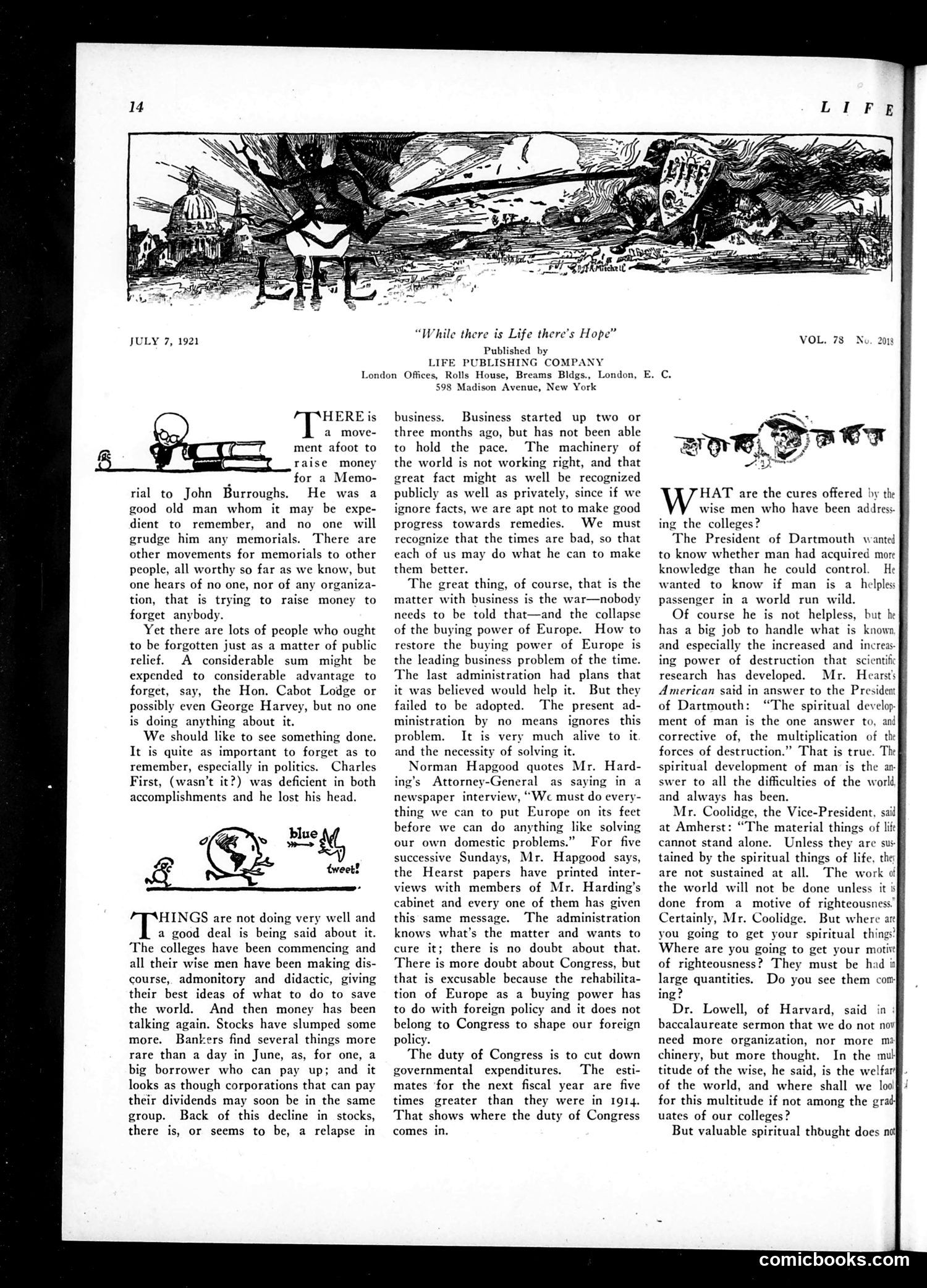
This July 1921 *Life* page contains editorial commentary about America's failing business recovery and political leadership. The text criticizes: **Business failure**: A memorial to raise money for John Burroughs (a naturalist) started strongly but lost momentum—used as metaphor for broader economic collapse. **Political ineptitude**: The Harding administration receives blame for ignoring Europe's buying power crisis and domestic problems. The article suggests Congress, bankers, and leadership lack vision for reconstruction. **College education**: Presidents from Dartmouth and Harvard are quoted discussing whether spiritual development and organized thought—not mere technical knowledge—can address societal problems. The decorative header illustrations appear generic rather than caricaturing specific individuals. The satire targets systemic failure of American institutions to solve post-war economic and social dysfunction.
📄 Transcribed text from this page (OCR, searchable)
Machine-transcribed from the original scan — historical spelling and the odd misread are preserved.
JULY 7, 1921 London Offices, Rolls House, Breams Bldgs. HERE is a move- ment afoot to raise money ; for a Memo- rial to John Burroughs. He was a good old man whom it may be expe- dient to remember, and no one will grudge him any memorials. There are other movements for memorials to other people, all worthy so far as we know, but one hears of no one, nor of any organiza- tion, that is trying to raise money to forget anybody. Yet there are lots of people who ought to be forgotten just as a matter of public relief. A considerable sum might be expended to considerable advantage to forget, say, the Hon. Cabot Lodge or possibly even George Harvey, but no one is doing anything about it. We should like to see something done. It is quite as important to forget as to remember, especially in politics. Charles First, (wasn’t it?) was deficient in both accomplishments and he lost his head. blue »_— g tweet! HINGS are not doing very well and a good deal is being said about it. The colleges have been commencing and all their wise men have been making dis- course, admonitory and didactic, giving their best ideas of what to do to save the world. And then money has been talking again. Stocks have slumped some more. Bankers find several things more rare than a day in June, as, for one, a big borrower who can pay up; and it looks as though corporations that can pay their dividends may soon be in the same group. Back of this decline in stocks, there is, or seems to be, a relapse in “While there is Life there's Hope” Published by LIFE PUBLISHING COMP! London, 598 Madison Avenue, New York business. Business started up two or three months ago, but has not been able to hold the pace. The machinery of the world is not working right, and that great fact might as well be recognized publicly as well as privately, since if we ignore facts, we are apt not to make good progress towards remedies. We must recognize that the times are bad, so that each of us may do what he can to make them better. The great thing, of course, that is the matter with business is the war—nobody needs to be told that—and the collapse of the buying power of Europe. How to restore the buying power of Europe is the leading business problem of the time. The last administration had plans that it was believed would help it. But they failed to be adopted. The present ad- ministration by no means ignores this problem. It is very much alive to it and the necessity of solving it. Norman Hapgood quotes Mr. Hard- ing’s Attorney-General as saying in a newspaper interview, “We must do every- thing we can to put Europe on its feet before we can do anything like solving our own domestic problems.” For five successive Sundays, Mr. Hapgood says, the Hearst papers have printed inter- views with members of Mr. Harding's cabinet and every one of them has given this same message. The administration knows what's the matter and wants to cure it; there is no doubt about that. There is more doubt about Congress, but that is excusable because the rehabilita- tion of Europe as a buying power has to do with foreign policy and it does not belong to Congress to shape our foreign policy. The duty of Congress is to cut down governmental expenditures. The esti- mates for the next fiscal year are five times greater than they were in 1914. That shows where the duty of Congress comes in. E. C. HAT are the cures offered by the wise men who have been addres: ing the colleges? The President of Dartmouth wanted to know whether man had acquired more knowledge than he could control. He wanted to know if man is a helpless passenger in a world run wild. Of course he is not helpless, but he has a big job to handle what is known and especially the increased and incr! ing power of destruction that scienti research has developed. Mr. Hearst’ American said in answer to the President of Dartmouth: “The spiritual develop- ment of man is the one answer to, and corrective of, the multiplication of the forces of destruction.” That is true. The spiritual development of man is the an- swer to all the difficulties of the world and always has been. Mr. Coolidge, the Vice-President, said at Amherst: “The material things of lift cannot stand alone. Unless they are sus tained by the spiritual things of life, the are not sustained at all. The work of the world will not be done unless it done from a motive of righteousness. Certainly, Mr. Coolidge. But where ar you going to get your spiritual things) Where are you going to get your motitt of righteousness? They must be had large quantities. Do you see them com ing? Dr. Lowell, of Harvard, said in baccalaureate sermon that we do not nov need more organization, nor more m* chinery, but more thought. In the mul} titude of the wise, he said, is the welfar' of the world, and where shall we loo for this multitude if not among the gra‘; uates of our colleges? But valuable spiritual thought does no comicbooks.com