
Life, 1921-07-07 · page 9 of 34
Life — July 7, 1921 — page 9: what you’re looking at
What you’re looking at
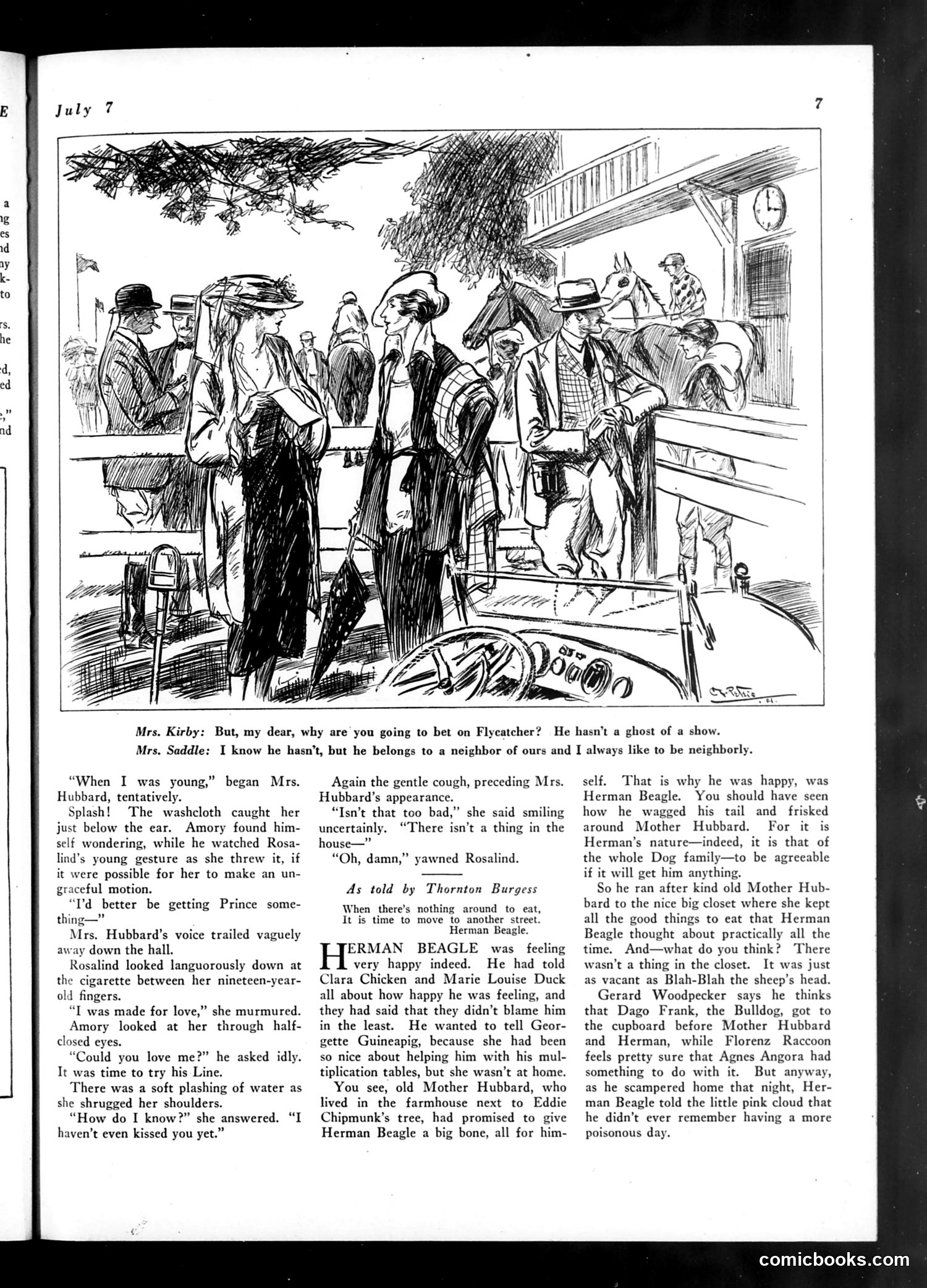
This page contains a humorous short story titled "As Told by Thorton Burgess" about Herman Beagle's romantic misadventures. The illustration depicts a horse racing or betting scene at what appears to be a track, with well-dressed men and women in period clothing (likely early 20th century). The dialogue between Mrs. Kirby and Mrs. Saddle discusses betting on "Flycatcher," a horse, with Mrs. Saddle defending the animal's ownership by a neighbor. The story itself humorously narrates Herman Beagle's failed romantic pursuits and his tendency to eat things he shouldn't—establishing him as a foolish, food-motivated character rather than a capable suitor. The satire targets romantic delusions and class pretensions among the leisure class who frequent racing venues.
📄 Transcribed text from this page (OCR, searchable)
Machine-transcribed from the original scan — historical spelling and the odd misread are preserved.
Mrs. Kirby: But, my dear, why are’ you going to bet on Flycatcher? He hasn't a ghost of a show. Mrs. Saddle: I know he hasn't, but he belongs to a neighbor of ours and I always like to be neighborly. “When I was young,” began Mrs. Hubbard, tentatively. Splash! The washcloth caught her just below the ear. Amory found him- self wondering, while he watched Rosa- lind’s young gesture as she threw it, if it were possible for her to make an un- graceful motion. “I'd better be getting Prince some- thing—” Mrs. Hubbard’s voice trailed vaguely away down the hall. Rosalind looked languorously down at the cigarette between her nineteen-year- old fingers. “I was made for love,” she murmured. Amory looked at her through half- closed eyes. “Could you love me?” he asked idly. It was time to try his Line. There was a soft plashing of water as she shrugged her shoulders. “How do I know?” she answered. “I haven’t even kissed you yet.” Again the gentle cough, preceding Mrs. Hubbard’s appearance. “Isn’t that too bad,” she said smiling uncertainly, “There isn’t a thing in the house—” “Oh, damn,” yawned Rosalind. As told by Thornton Burgess When there’s nothing around to eat, It is time to move to another street. Herman Beagle. ERMAN BEAGLE was feeling very happy indeed. He had told Clara Chicken and Marie Louise Duck all about how happy he was feeling, and they had said that they didn’t blame him in the least. He wanted to tell Geor- gette Guineapig, because she had been so nice about helping him with his mul- tiplication tables, but she wasn’t at home. You see, old Mother Hubbard, who lived in the farmhouse next to Eddie Chipmunk’s tree, had promised to give Herman Beagle a big bone, all for him- self. That is why he was happy, was Herman Beagle. You should have seen how he wagged his tail and frisked around Mother Hubbard. For it is Herman’s nature—indeed, it is that of the whole Dog family—to be agreeable if it will get him anything. So he ran after kind old Mother Hub- bard to the nice big closet where she kept all the good things to eat that Herman Beagle thought about practically all the time. And—what do you think? There wasn’t a thing in the closet. It was just as vacant as Blah-Blah the sheep’s head. Gerard Woodpecker says he thinks that Dago Frank, the Bulldog, got to the cupboard before Mother Hubbard and Herman, while Florenz Raccoon feels pretty sure that Agnes Angora had something to do with it. But anyway, as he scampered home that night, Her- man Beagle told the little pink cloud that he didn’t ever remember having a more poisonous day. comicbooks.com