
Life, 1921-07-07 · page 24 of 34
Life — July 7, 1921 — page 24: what you’re looking at
What you’re looking at
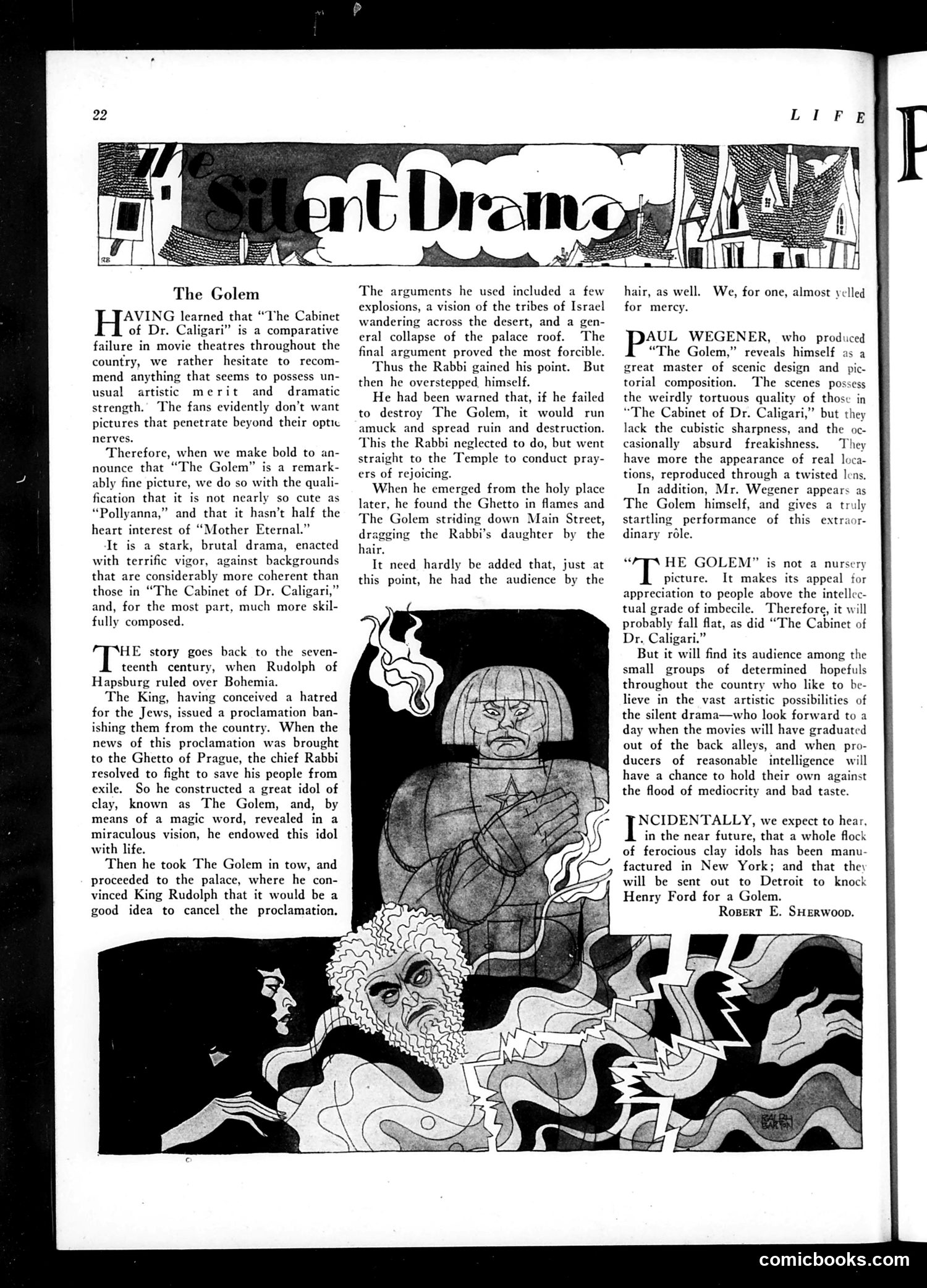
This is a review of the 1920 German Expressionist film *The Golem*, adapted from Jewish folklore. The reviewer (Robert E. Sherwood) praises director Paul Wegener's artistic achievement while acknowledging it will fail commercially—comparing it unfavorably to popular but artistically shallow films like *Pollyanna*. The plot concerns a Rabbi in 17th-century Prague who animates a clay statue to save Jews from King Rudolph's expulsion decree. After succeeding through dramatic supernatural demonstrations, the Rabbi neglects to destroy the creature, which runs amok through the ghetto. The review criticizes American audiences' indifference to serious cinema, lamenting that sophisticated films like *The Cabinet of Dr. Caligari* fail at the box office. The final joke suggests clay golems will soon be manufactured in New York to "knock Henry Ford"—likely referencing Ford's notorious antisemitism and implied suggestion that even industrialists deserve supernatural intervention.
📄 Transcribed text from this page (OCR, searchable)
Machine-transcribed from the original scan — historical spelling and the odd misread are preserved.
The Golem AVING learned that “The Cabinet of Dr. Caligari” is a comparative failure in movie theatres throughout the country, we rather hesitate to recom- mend anything that seems to possess un- usual artistic merit and dramatic strength. The fans evidently don’t want pictures that penetrate beyond their optic nerves. Therefore, when we make bold to an- nounce that “The Golem” is a remark- ably fine picture, we do so with the quali- fication that it is not nearly so cute as “Pollyanna,” and that it hasn’t half the heart interest of “Mother Eternal.” It is a stark, brutal drama, enacted with terrific vigor, against backgrounds that are considerably more coherent than those in “The Cabinet of Dr. Caligari,” and, for the most part, much more skil- fully composed. HE story goes back to the seven- teenth century, when Rudolph of Hapsburg ruled over Bohemia. The King, having conceived a hatred for the Jews, issued a proclamation ban- ishing them from the country. When the news of this proclamation was brought to the Ghetto of Prague, the chief Rabbi resolved to fight to save his people from exile. So he constructed a great idol of clay, known as The Golem, and, by means of a magic word, revealed in a miraculous vision, he endowed this idol with life. Then he took The Golem in tow, and proceeded to the palace, where he con- vinced King Rudolph that it would be a good idea to cancel the proclamation. The arguments he used included a few explosions, a vision of the tribes of Israel wandering across the desert, and a gen- eral collapse of the palace roof. The final argument proved the most forcible. Thus the Rabbi gained his point. But then he overstepped, himself. He had been warned that, if he failed to destroy The Golem, it would run amuck and spread ruin and destruction. This the Rabbi neglected to do, but went straight to the Temple to conduct pray- ers of rejoicing. When he emerged from the holy place later, he found the Ghetto in flames and The Golem striding down Main Street, dragging the Rabbi’s daughter by the hair. It need hardly be added that, just at this point, he had the audience by the hair, as well. We, for one, almost yelled for mercy. AUL WEGENER, who produced “The Golem,” reveals himself as a great master of scenic design and pic- torial composition. The scenes possess the weirdly tortuous quality of those in he Cabinet of Dr. Caligari,” but they ack the cubistic sharpness, and the oc- casionally absurd freakishness. They have more the appearance of real loca- tions, reproduced through a twisted | In addition, Mr. Wegener appear The Golem himself, and gives a truly startling performance of this extraor- dinary réle. % HE GOLEM” is not a nursery picture. It makes its appeal for appreciation to people above the intellec- tual grade of imbecile. Therefore, it will probably fall flat, as did “The Cabinet of Dr. Caligari.” But it will find its audience among the small groups of determined hopefuls throughout the country who like to be- lieve in the vast artistic possibilities of the silent drama—who look forward to a day when the movies will have graduated out of the back alleys, and when pro- ducers of reasonable intelligence will have a chance to hold their own against the flood of mediocrity and bad taste. NCIDENTALLY, we expect to hear, in the near future, that a whole flock of ferocious clay idols has been manu- factured in New York; and that they will be sent out to Detroit to knock Henry Ford for a Golem. Rosert E. SHERwoop. comicbooks.com