
A complete issue · 36 pages · 1921
Life — June 23, 1921
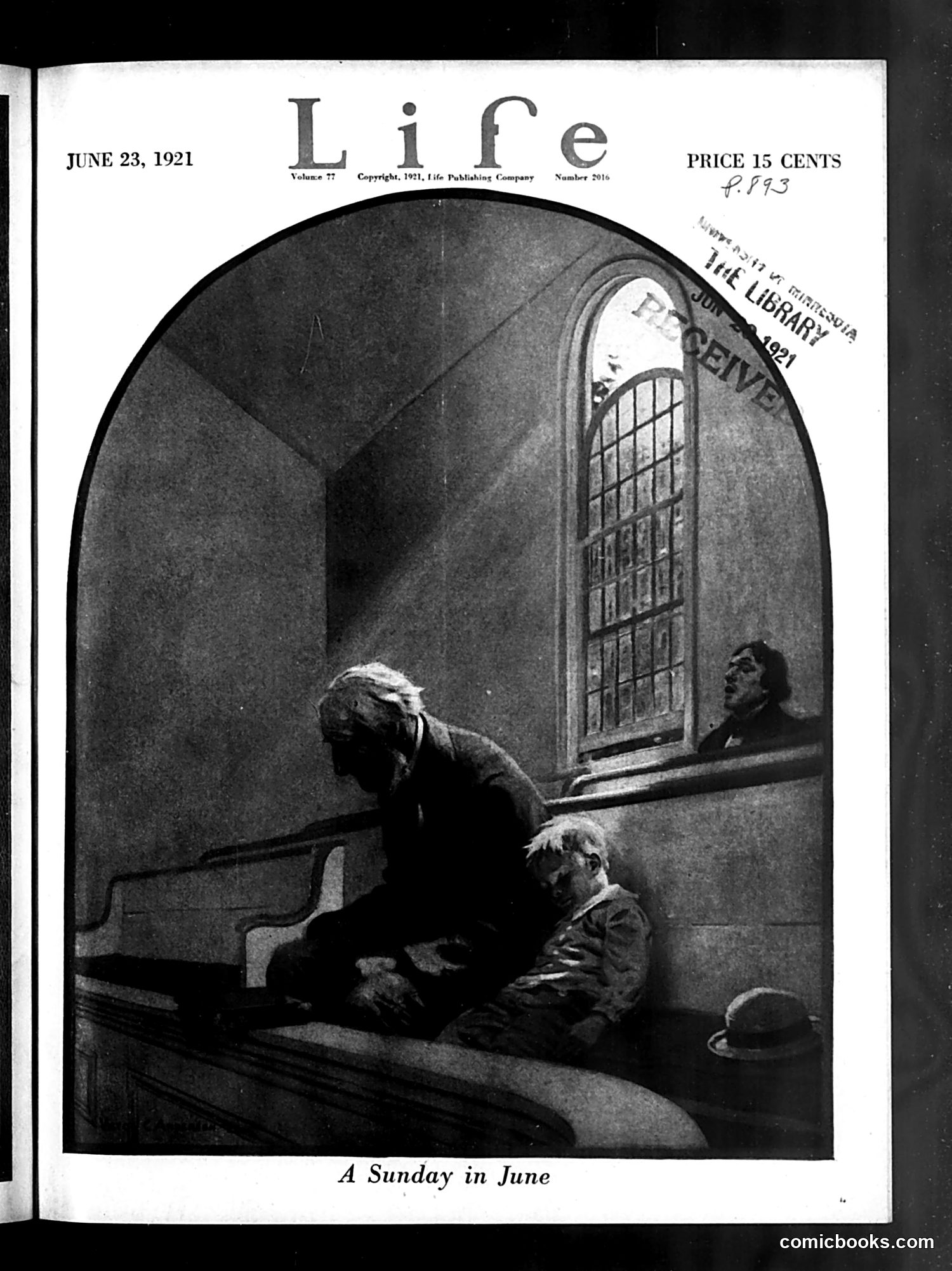
This *Life* magazine cover from June 23, 1921, titled "A Sunday in June," depicts what appears to be a prison or jail cell scene. An adult and child sit on a bench beneath a barred window, with a hat on the floor beside them. Light streams through the window, suggesting confinement. Without additional context or captions identifying specific figures, the image's satirical meaning remains unclear. It could reference contemporary criminal justice issues, poverty, or social conditions of the 1920s. The juxtaposition of a child in such a setting suggests social commentary on family hardship or the justice system's impact on vulnerable populations. The exact political or social target of this satire cannot be definitively determined from the image alone.
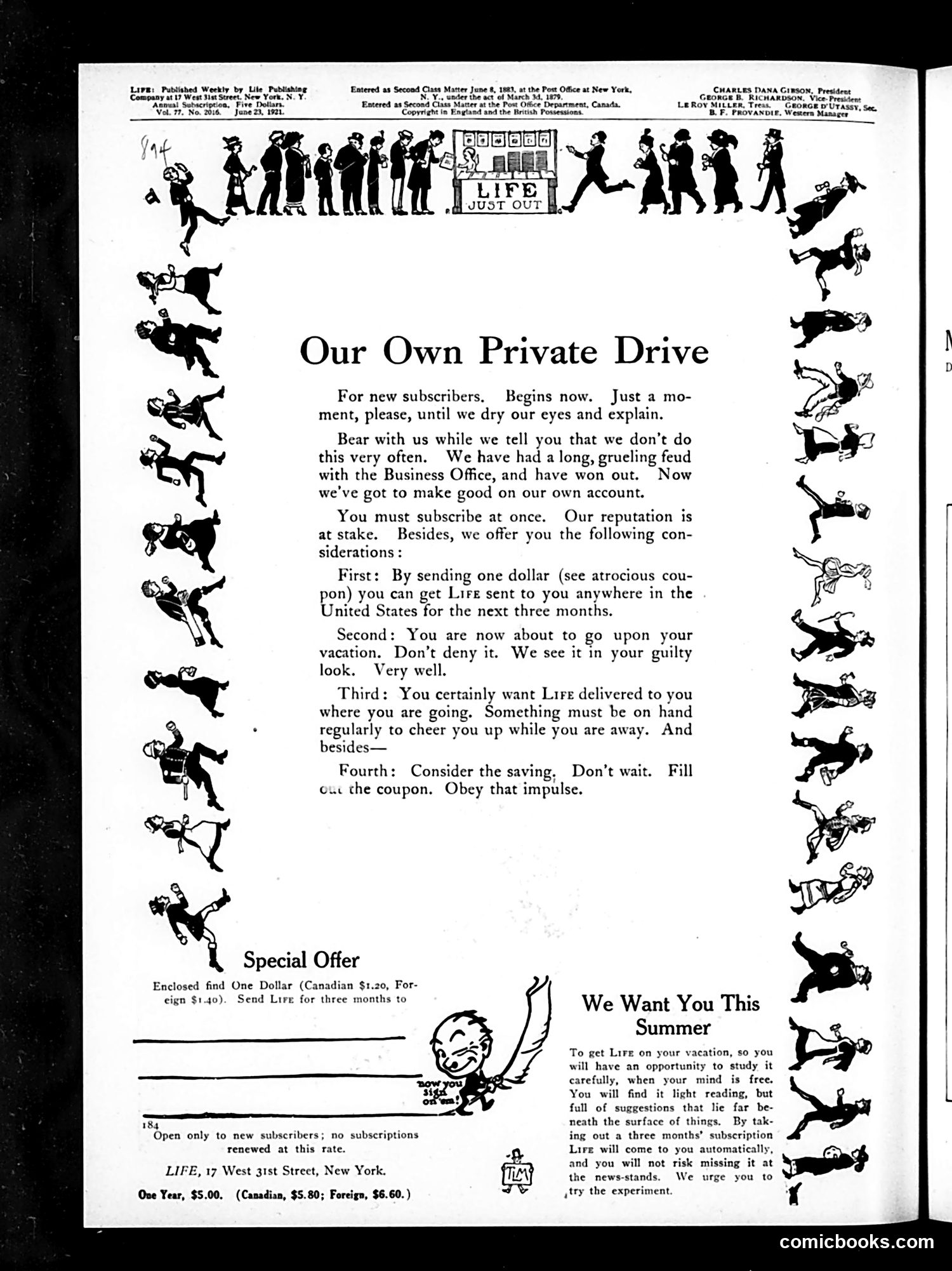
This page is primarily a **subscription advertisement**, not political satire. Life magazine is promoting a special offer to new subscribers: one dollar for three months of delivery. The design uses **humorous illustrations of falling/tumbling figures** lining both margins—a visual gag suggesting people should "fall" into subscribing. The top of the page shows a queue of people at a "Life" booth, with figures fleeing or being ejected, reinforcing the comedic premise. The text employs self-deprecating humor, claiming Life has "won out" against their Business Office in a "long, grueling feud." The pitch emphasizes vacation reading and affordability during summer, standard magazine marketing tactics of the 1920s. The mascot character (bottom left) appears to be Life's typical decorative emblem rather than a specific political figure.
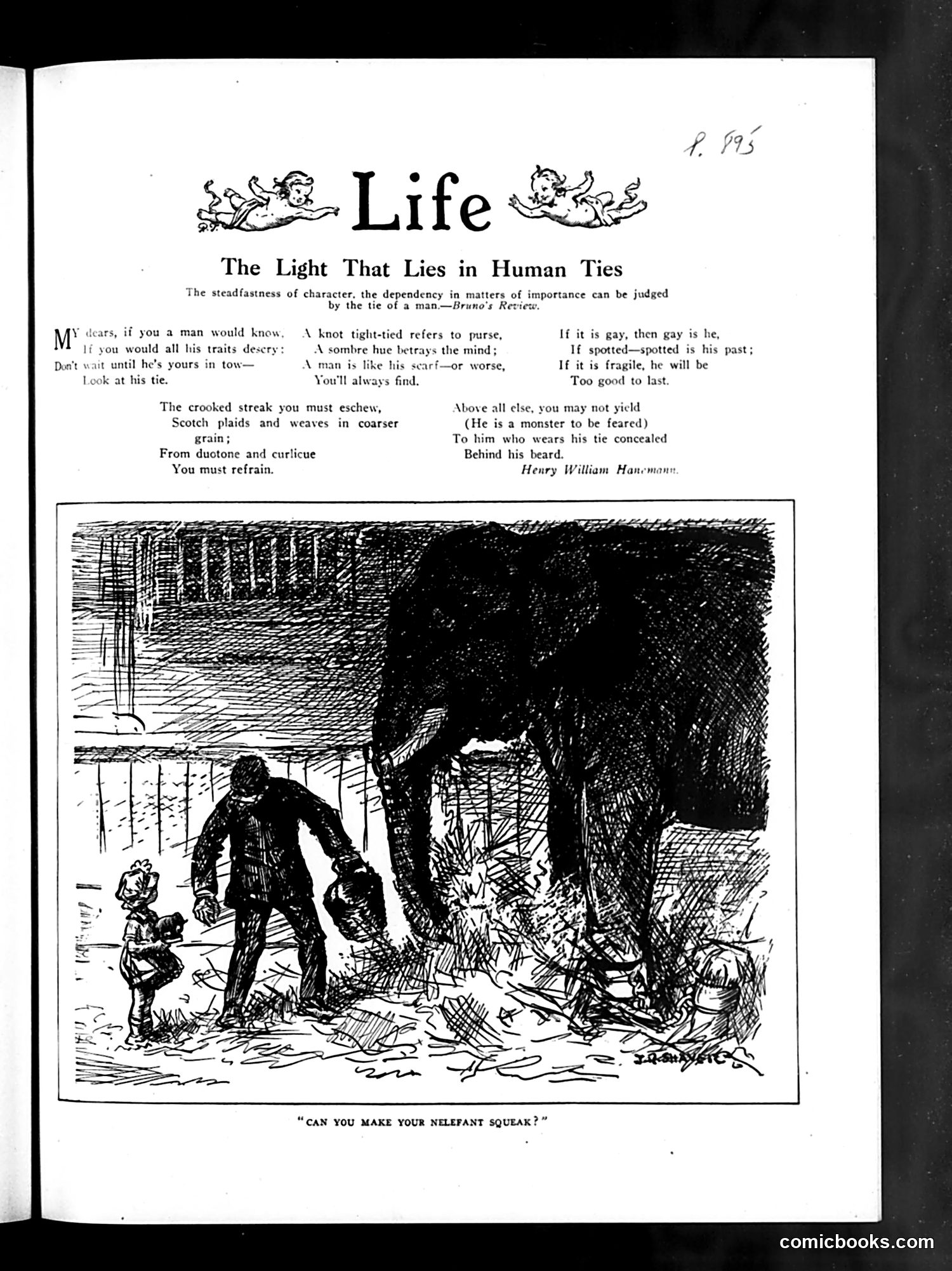
This page from *Life* magazine features a poem titled "The Light That Lies in Human Ties" attributed to Henry William Hannemann, with an accompanying illustration captioned "CAN YOU MAKE YOUR ELEPHANT SQUEAK?" The illustration depicts an adult man with a child and an elephant in what appears to be a farmyard or barn setting. The caption's phrasing—asking if the elephant can "squeak"—is humorous because elephants characteristically trumpet rather than squeak, making this an absurd request. The broader poem concerns human character and integrity, using metaphors about ties and appearance. The illustration likely offers a lighter, whimsical commentary on childhood curiosity and the impossible demands children sometimes make of adults or nature—a gentle satirical observation on human nature rather than political commentary.
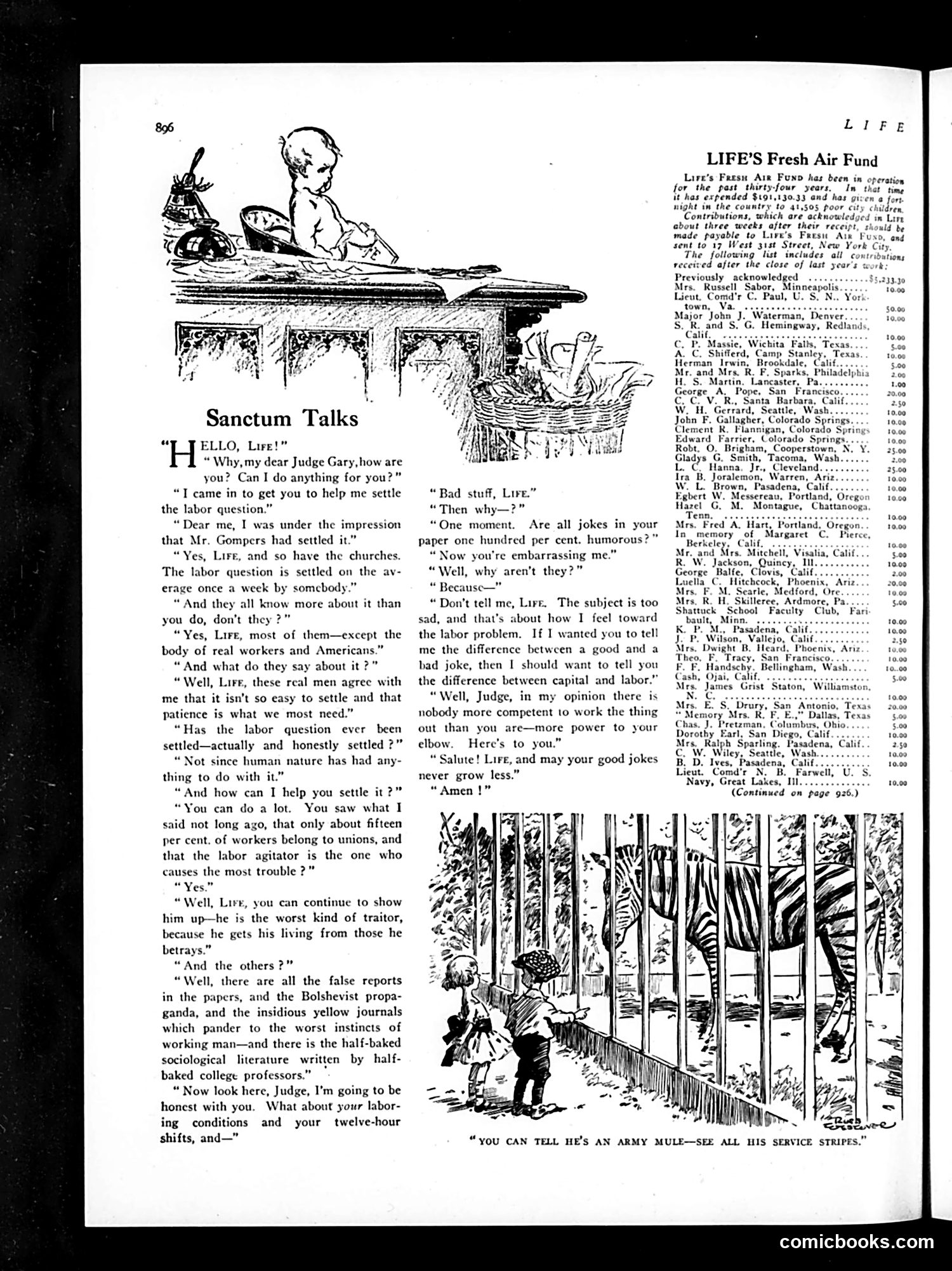
This page contains two distinct elements: **"Sanctum Talks"** (left): A dialogue between "Life" (the magazine personified) and Judge Gary about labor disputes. The conversation critiques those who blame labor unions for trouble, arguing instead that "false reports in the papers and the Bolshevik propaganda" and "half-baked sociological literature written by half-baked college professors" cause more harm. The satire targets sensationalist media coverage and anti-labor rhetoric rather than actual workers. **Cartoon (bottom right)**: Shows a small child viewing a large military mule, captioned "You can tell he's an army mule—see all his service stripes." This is a joke about the mule's age and hard military service, likely reflecting WWI-era humor about worn-out army equipment or animals. **Masthead section**: Lists contributions to "Life's Fresh Air Fund," a charitable initiative providing poor children respite.
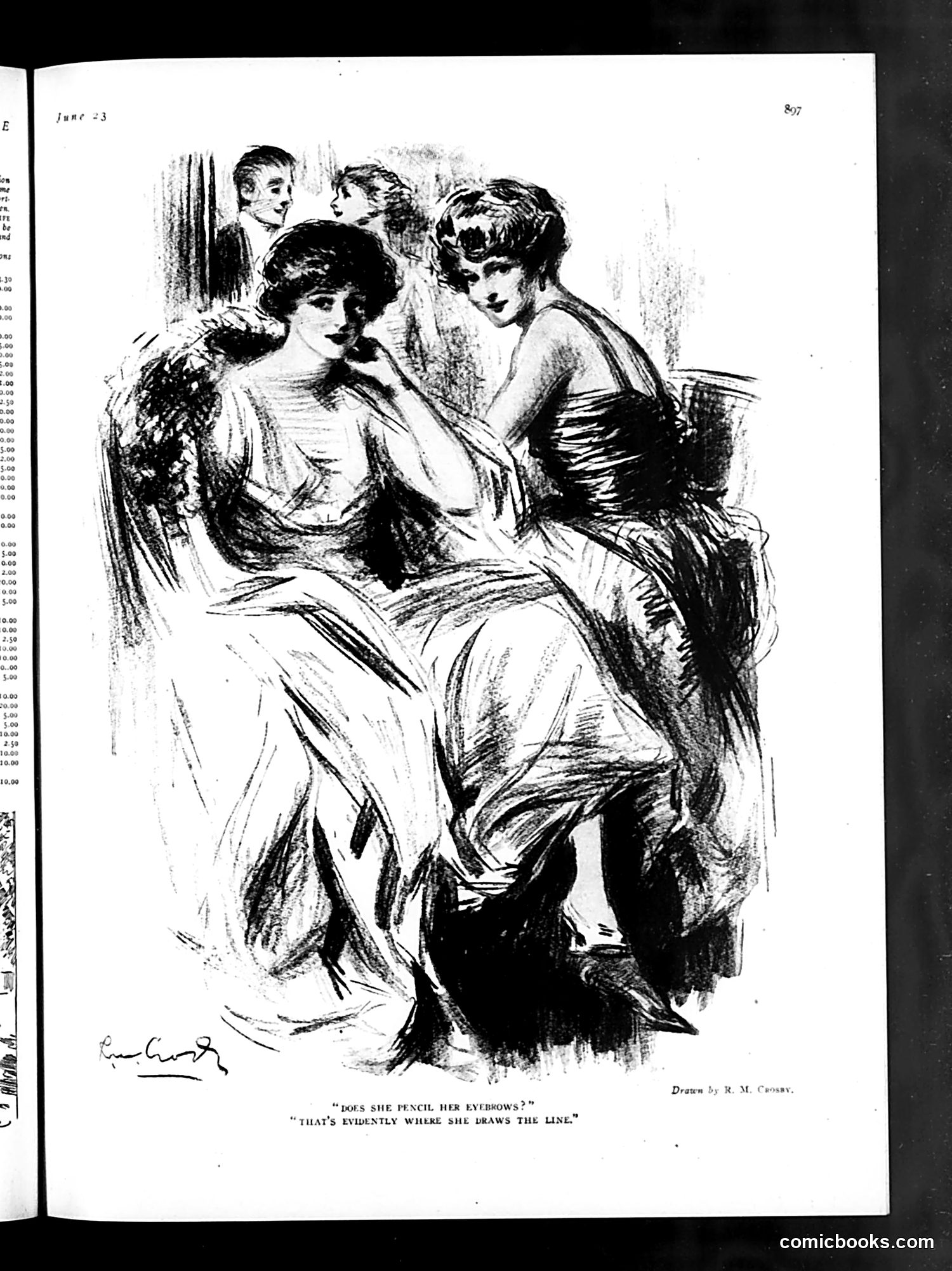
This sketch by H.M. Cravay depicts four fashionable women in an interior setting, examining what appears to be eyebrow styling. The caption reads: "Does she pencil her eyebrows?" / "That's evidently where she draws the line." This is a **visual pun about makeup and social propriety**. The joke plays on "drawing the line"—a phrase meaning to set a boundary or limit. Taken literally with the eyebrow pencil context, it suggests the woman's eyebrows reveal her personal standards or limits regarding cosmetic enhancement. The cartoon satirizes **early 20th-century anxieties about women's makeup use**, which was then considered scandalous or indicative of loose morality. By focusing on eyebrow penciling specifically, it mocks how people judged women's character based on cosmetic choices—suggesting one's makeup habits literally "draw the line" of one's respectability.
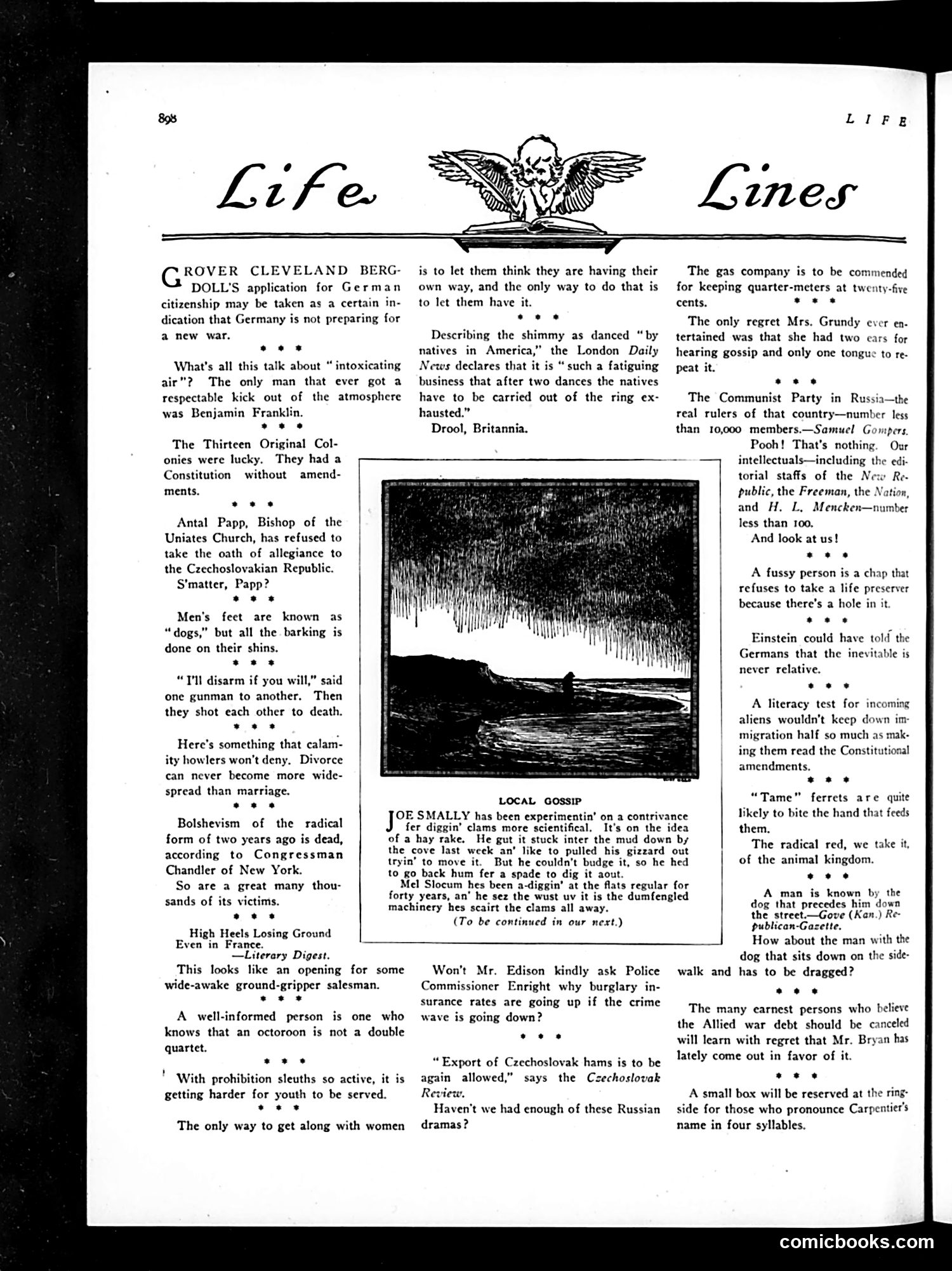
This satirical column page from *Life* magazine contains brief commentary on contemporary social and political issues, circa 1920s-1930s based on style and references. The main illustration appears to be a landscape or seascape scene, though details are unclear in reproduction. The text mocks various targets: Grover Cleveland Berg-Doll's pacifist stance on German rearmament; British attitudes toward "shimmy" dancing; the small Communist Party in Russia; prohibition's effects on youth access to alcohol; and divorce trends. A "Local Gossip" item discusses someone experimenting with clams as food. Other brief items satirize various social conventions—fussy people, Einstein, migration policy, and dog behavior. The overall tone is light satirical commentary on contemporary American society, politics, and absurdities rather than serious political cartooning.
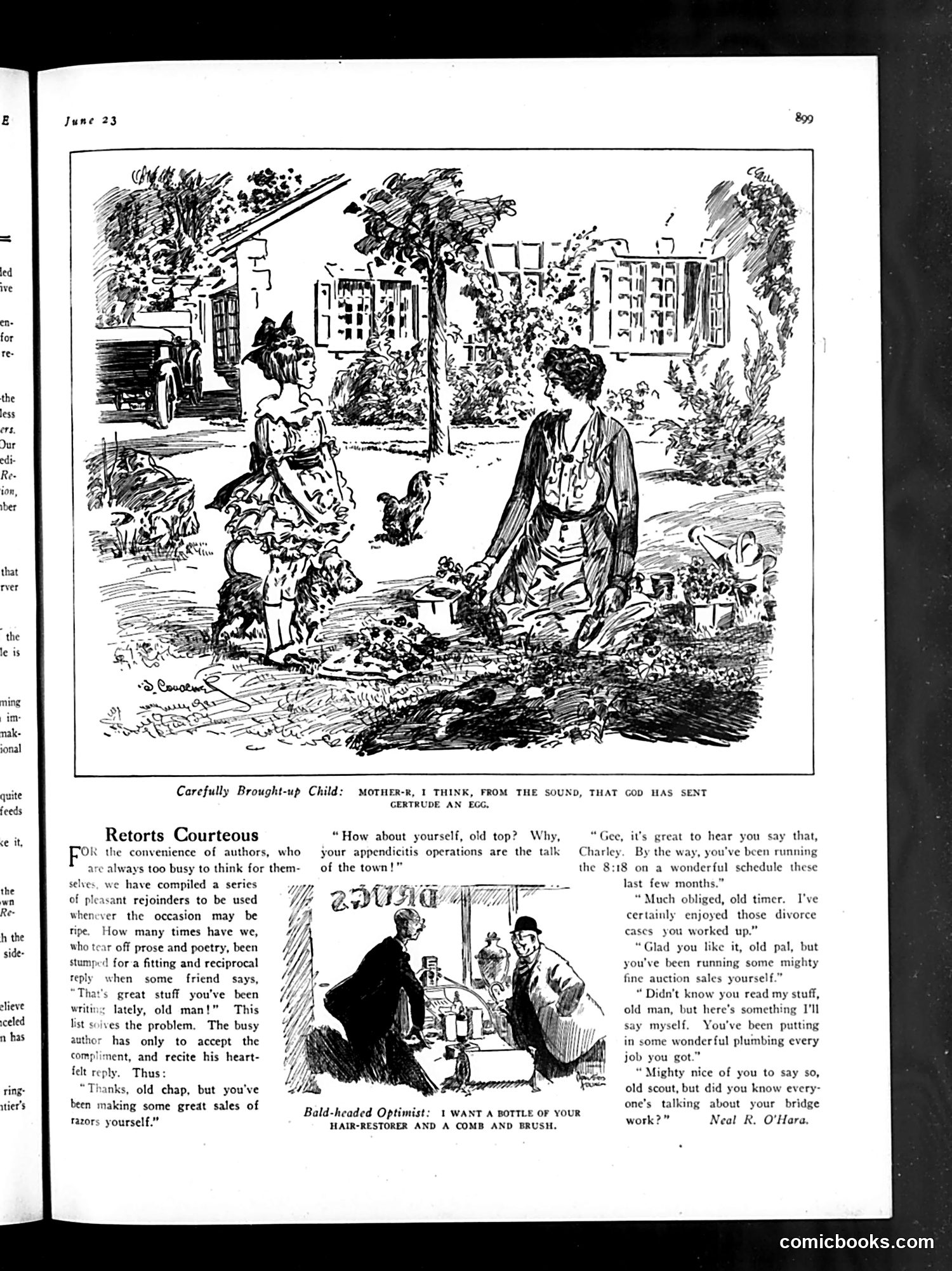
This page contains two separate comic pieces: **Top illustration**: "Carefully Brought-up Child" depicts a mother teaching a child about nature, with the caption attributing godly wisdom to a hen's egg—satirizing sentimental Victorian child-rearing philosophies. **Bottom section "Reports Courteous"**: A humorous piece about authors receiving polite rejection letters. The accompanying cartoon shows a bald man requesting hair-restorer and grooming supplies from a barber, labeled "Bald-headed Optimist." The joke satirizes salesmen who persistently pitch products despite obvious unsuitability—here, trying to sell hair products to a completely bald customer. The accompanying dialogue humorously documents various professional courtesies exchanged between acquaintances in business contexts.
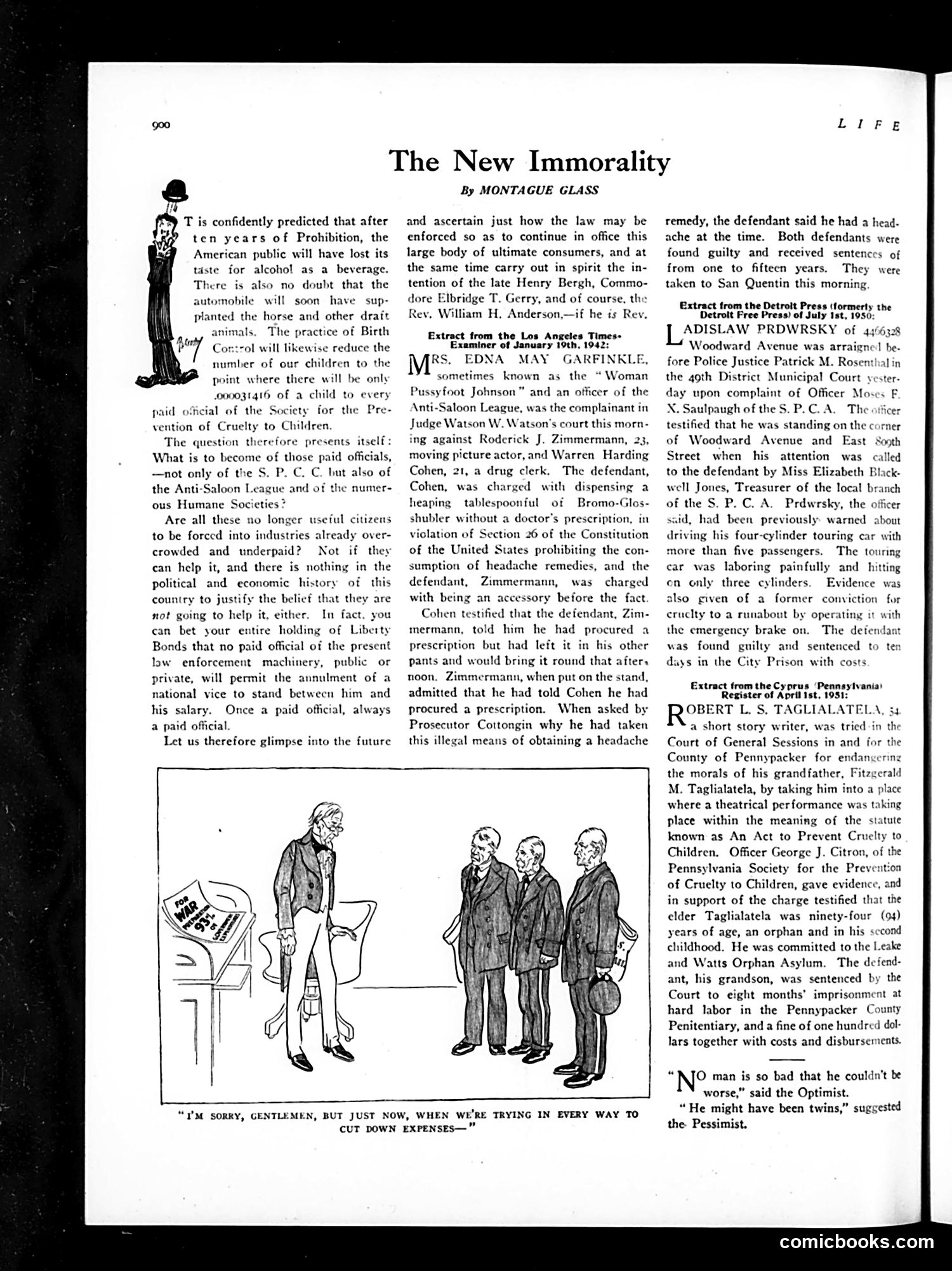
This satire criticizes the hypocrisy of morality enforcers. The article describes legal cases against individuals for violating obscenity laws and child welfare statutes—defendants prosecuted for minor infractions like dispensing headache medicine without prescription or taking children to theatrical performances. The cartoon illustrates the irony: a well-dressed official sits reading a "Liberty Bonds" newspaper while three stern-looking men (likely judges or prosecutors) stand before him. The caption reads: "I'M SORRY, GENTLEMEN, BUT JUST NOW, WHEN WE'RE TRYING IN EVERY WAY TO CUT DOWN EXPENSES—" The joke targets governmental and institutional hypocrisy: authorities zealously enforce minor moral violations against ordinary citizens while comfortably compromising their own principles through financial necessity or self-interest.
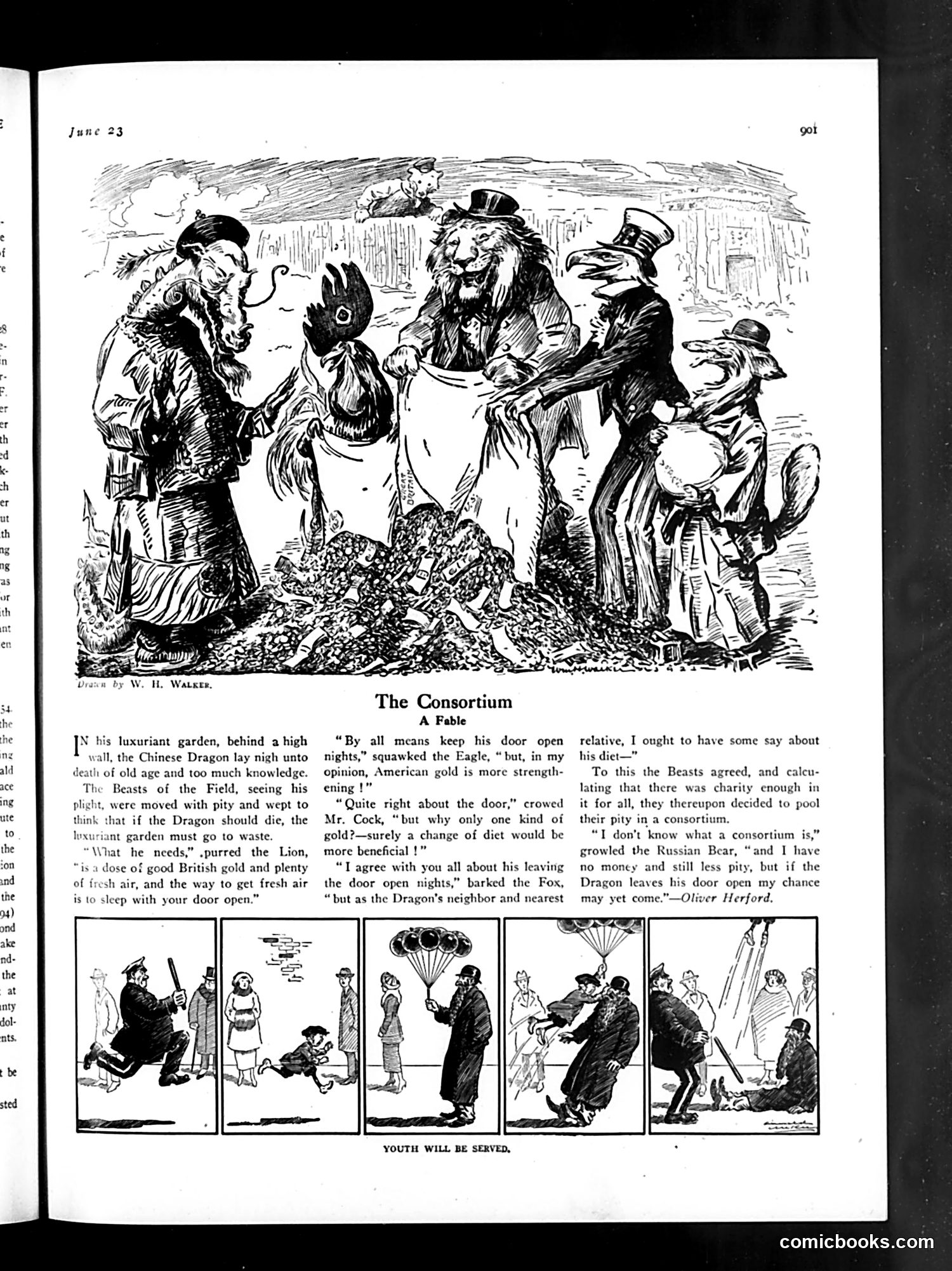
This satirical fable depicts various national figures as animals negotiating over a Chinese Dragon's corpse. The Lion (Britain), Eagle (America), Cock (France), Russian Bear, and Fox represent competing imperial powers seeking advantage from China's weakness during the early 20th century. The "consortium" refers to the international power-sharing agreements that Western nations and Russia used to exploit Chinese resources and territory. Each animal argues self-interested reasons for keeping the Dragon's "door open"—a reference to the Open Door Policy—while actually seeking economic dominance. The moral, delivered by Oliver Herford, satirizes how these powers hypocritically justify colonial exploitation as mutual benefit, when each nation primarily serves its own financial interests at China's expense.
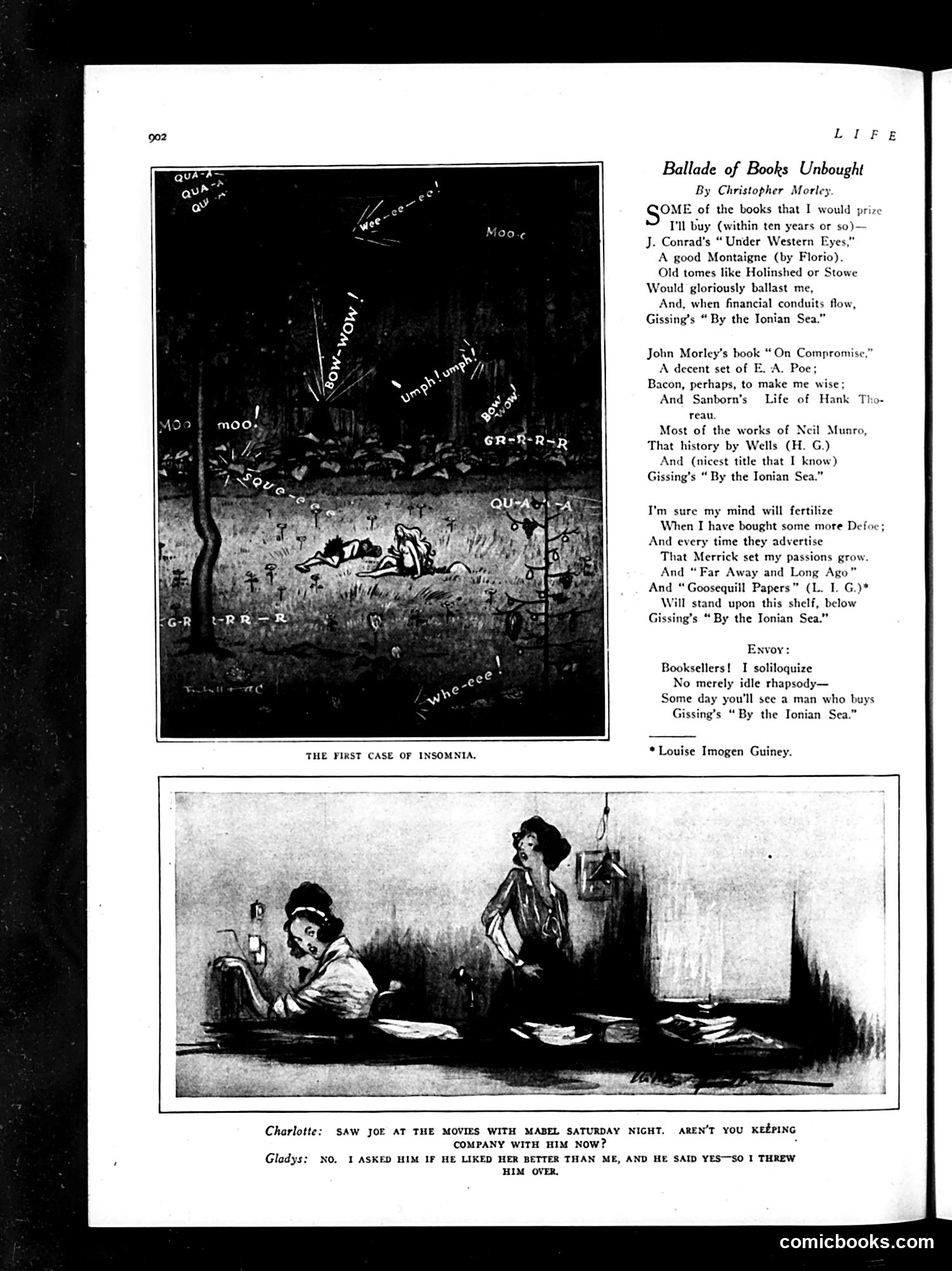
This page features Christopher Morley's poem about desired but unpurchased books, listing works by Conrad, Florio, Wells, Gissing, and others. The satirical point is that readers perpetually fantasize about owning books they never actually buy. **"The First Case of Insomnia"** (top illustration) appears to be a surrealist cartoon showing a figure lying awake in bed surrounded by floating words and sounds ("moo," "quack," "umph," etc.)—visual chaos representing an insomniac's restless mind. **The lower cartoon** depicts two women discussing a man (Joe) seen at the movies with another woman (Mabel). The joke is domestic drama: one woman suspects her companion of infidelity, and he admits preferring the other woman, so she "threw him over." This is relationship gossip humor typical of 1920s-era Life magazine.
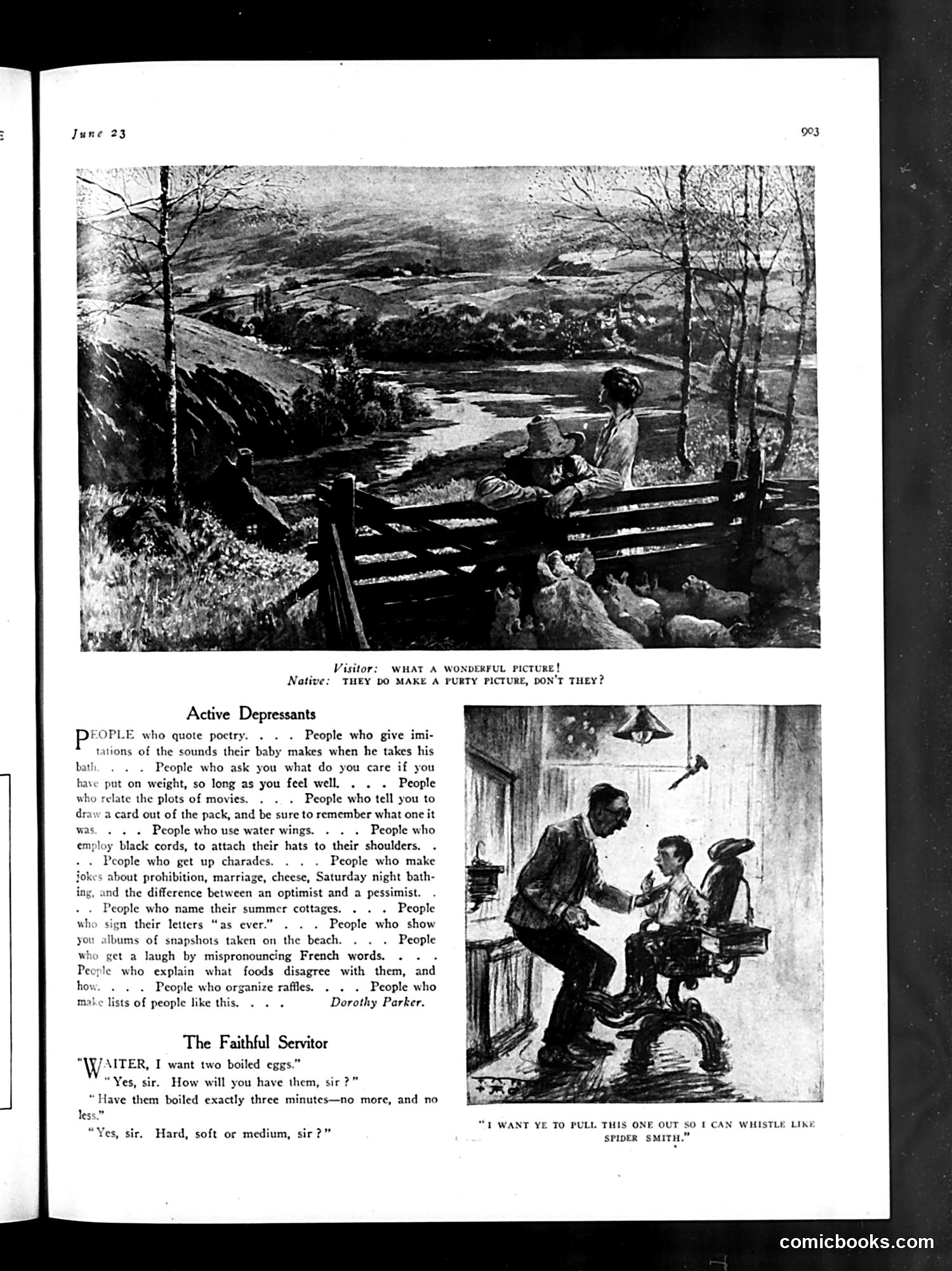
This page contains two distinct pieces: **Top Image**: A pastoral landscape scene showing two figures at a fence overlooking a river valley. The caption jokes that such "wonderful pictures" are made "furty" (dirty/crude), suggesting the romantic nature scene contrasts with bawdy humor. **"Active Depressants"**: A satirical list by Dorothy Parker mocking tedious social types—people who quote poetry, give unsolicited advice about weight, tell bad jokes, make puns about prohibition and marriage, mispronounce French, and organize raffles. It's social commentary critiquing boring conversationalists and annoying personality types. **"The Faithful Servitor"**: A brief comedic dialogue between a waiter and patron about boiling eggs precisely, demonstrating servant obsequiousness and class-based humor common to the era's satire.
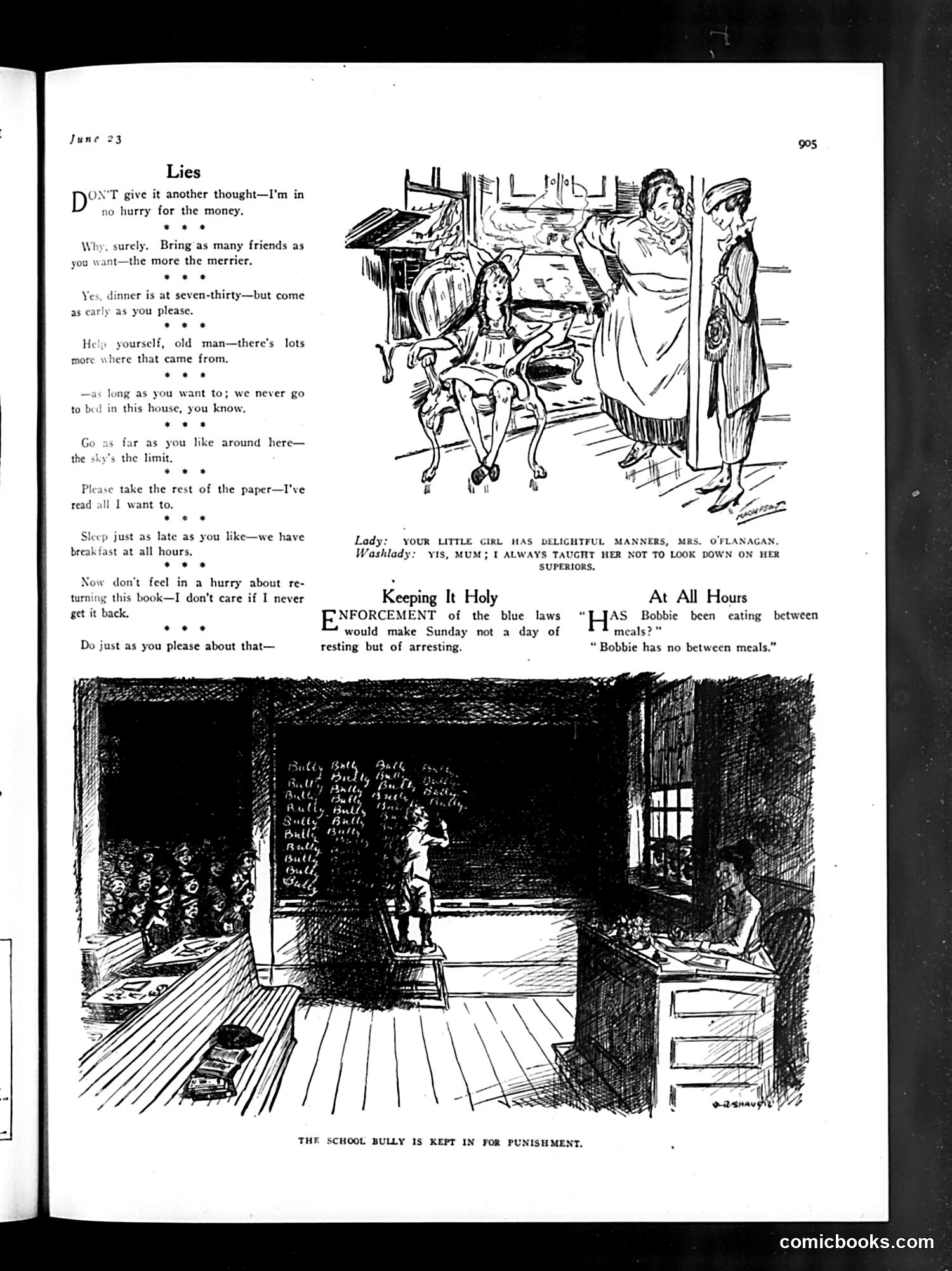
This page contains three satirical pieces about social conduct and discipline: **"Lies"** (top left) mocks casual social dishonesty—a host making excuses to avoid entertaining guests, claiming dinner is at 7:30 while actually requesting early arrival, and dismissing borrowed books. **"Keeping It Holy"** comments on blue laws (Sunday restrictions) that prevent arrests, suggesting selective law enforcement around religious observance. **"At All Hours"** (right) jokes about a child, Bobbie, constantly eating between meals—the accompanying illustration shows a schoolroom with a bully being punished, though the connection to the eating comment is unclear from the visible text. The satirical tone targets hypocrisy, arbitrary social rules, and parental permissiveness—typical Life magazine themes of the early 1900s.
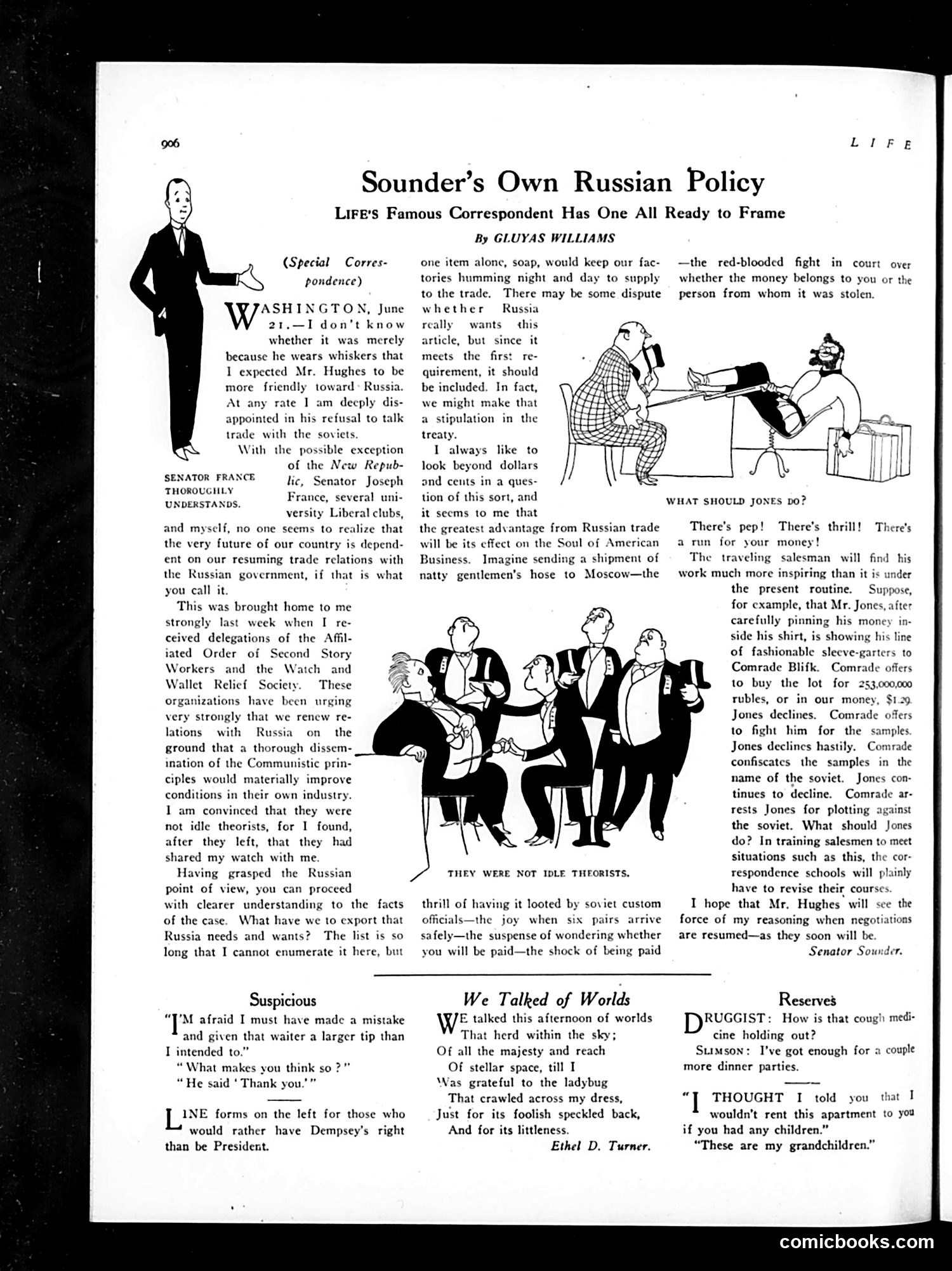
This 1920s *Life* magazine page satirizes Senator William Borah's proposed trade negotiations with Soviet Russia. The main cartoon shows American businessmen eagerly negotiating with Soviet officials, humorously depicting the absurdity of commercial dealings with the communist regime. The article by Gluyas Williams (attributed to "Senator Sounder") mocks the optimism about Soviet trade, using the example of a soap salesman trying to sell products to Russia. The satire suggests American businessmen are naively pursuing profit without understanding communist ideology or the practical difficulties. The smaller cartoons at bottom are unrelated humor pieces. The overall point: American capitalists are foolishly pursuing commerce with ideological enemies, driven purely by greed rather than reason.
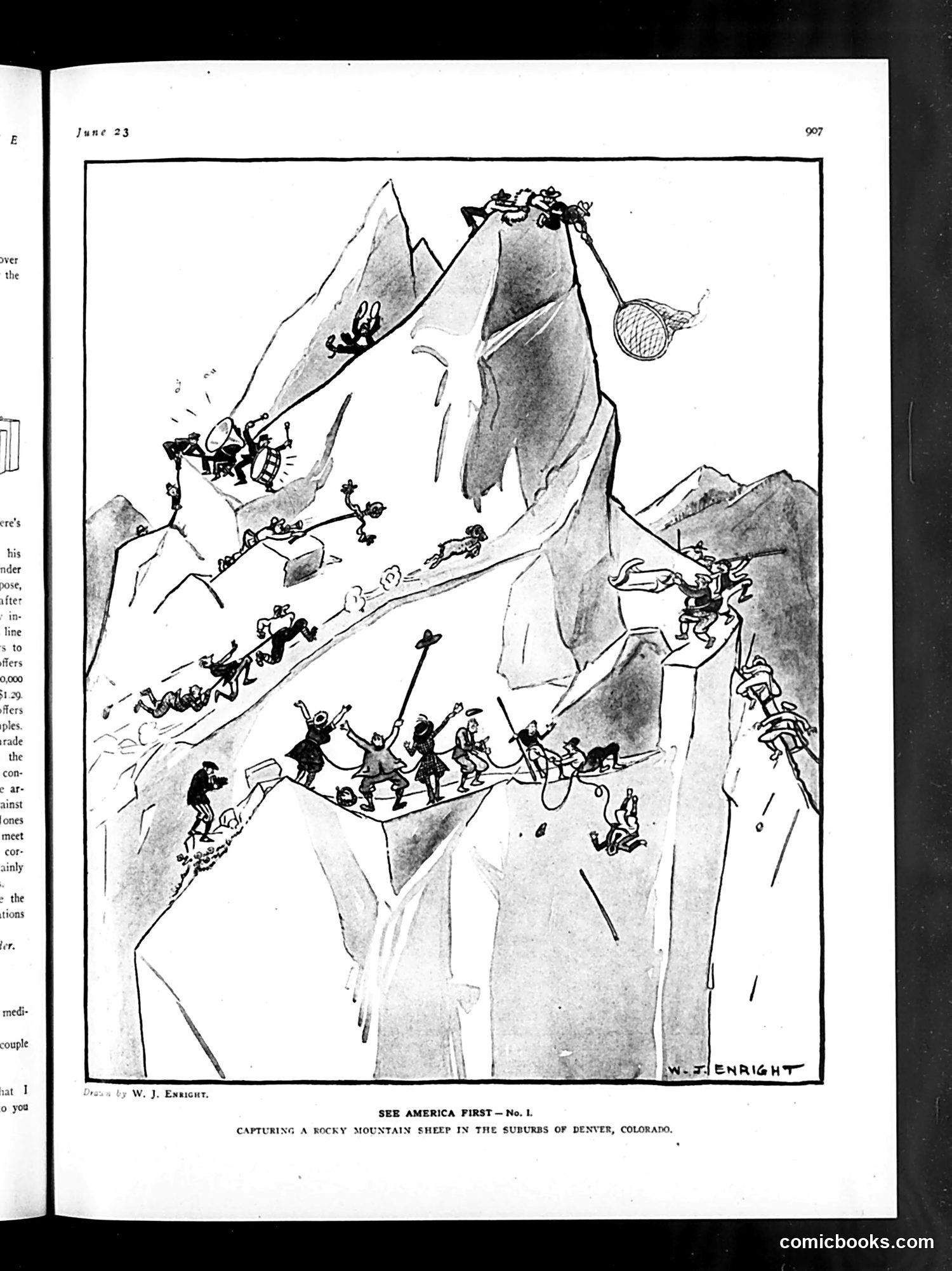
This is a W.J. Enright cartoon titled "See America First—No. 1: Capturing a Rocky Mountain Sheep in the Suburbs of Denver, Colorado." The satire depicts what appears to be a humorous take on the "See America First" travel campaign, which promoted domestic tourism in early 20th-century America. Rather than showing civilized sightseeing, the cartoon portrays chaotic scenes of city dwellers attempting to capture a wild mountain sheep near Denver using ropes, ladders, and improvised equipment on steep terrain. The joke likely mocks either tourist inexperience with wilderness activities, the absurdity of pursuing wildlife in suburban areas, or the gap between romanticized "American frontier" tourism marketing and actual reality. The bustling, frantic activity contrasts sharply with what should be straightforward wildlife observation.
This page discusses Princess Anesthesia of Greece, who reportedly underwent a successful operation and expected another. The article notes her various sufferings from internal disorders and ether use. The main piece features **Edward Bok**, retired editor of a successful periodical, who has established a charitable fund offering an annual $10,000 prize to whoever devises the best solution for improving Philadelphia. The satire appears to target Philadelphia's problems—suggesting they're severe enough to warrant a major prize—while gently mocking Bok's philanthropic efforts. The article humorously notes that stopping motor cars from causing trouble would help Philadelphia, implying automobiles represent modern urban chaos worth addressing. The page mixes light social commentary with personal interest stories typical of 1920s *Life* magazine's satirical approach.
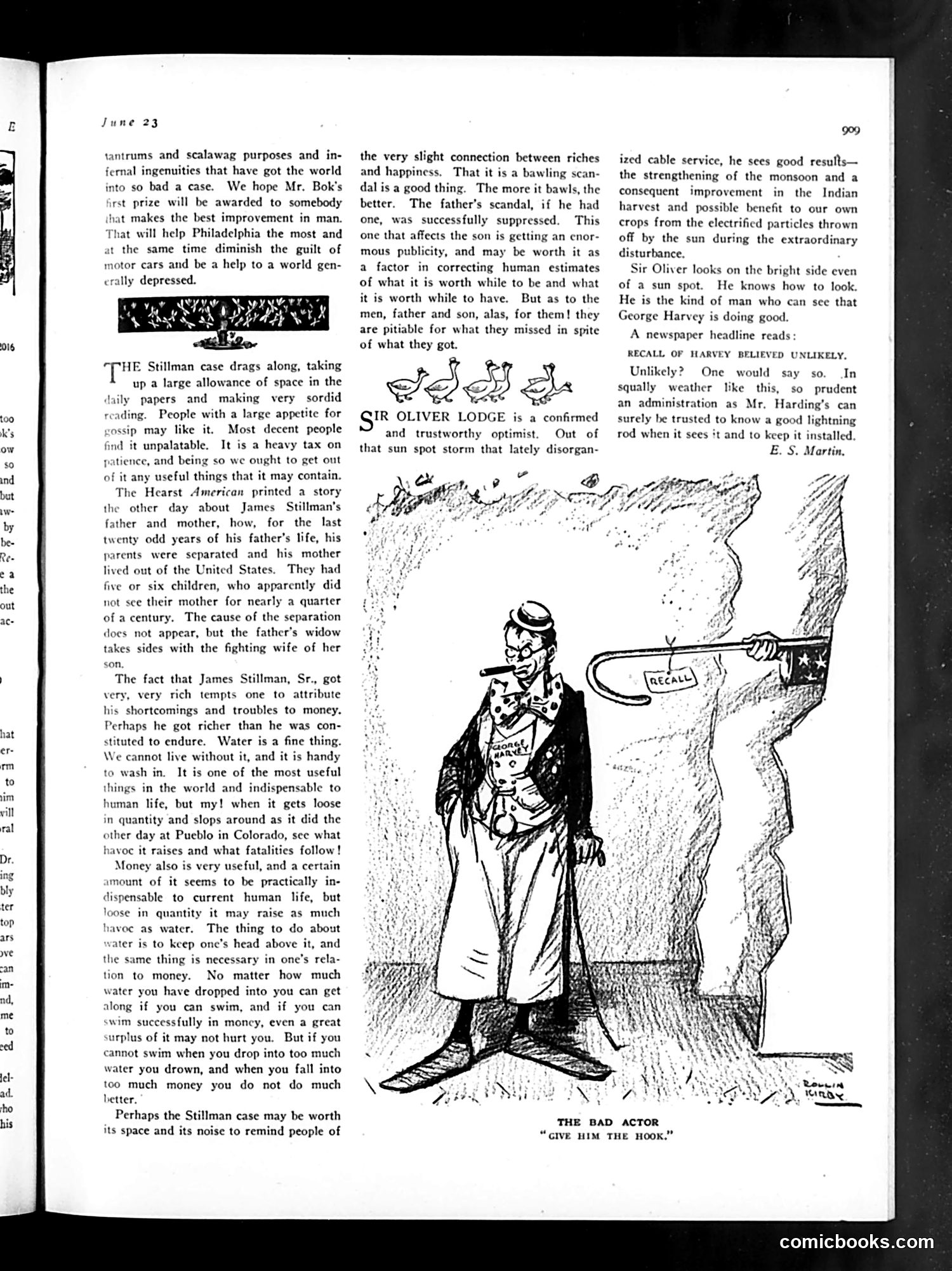
This page contains editorial commentary and a political cartoon satirizing public figures and social issues of the era. **The Cartoon ("The Bad Actor—Give Him the Hook"):** The illustration depicts a man in formal dress being "hooked" off stage, labeled as "the bad actor." This appears to reference a public figure being removed from position—likely Secretary of State Charles Evans Hughes or a similar official, though the specific identity isn't explicitly stated in visible text. **Main Editorial Topics:** 1. **The Stillman Case**: Extended commentary on the scandalous family dispute of wealthy banker James Stillman Sr., critiquing how wealth doesn't guarantee happiness and how the public's obsession with such "sordid" gossip reflects misplaced values. 2. **Oliver Lodge & George Harvey**: Brief notes praising physicist Oliver Lodge's optimism about solar disruptions, and sarcastically suggesting that the "recall of Harvey" (likely Secretary of State under Harding) is "unlikely"—implying the administration won't remove him despite controversy. The overall tone criticizes excess wealth, moral bankruptcy among the wealthy, and political ineptitude.
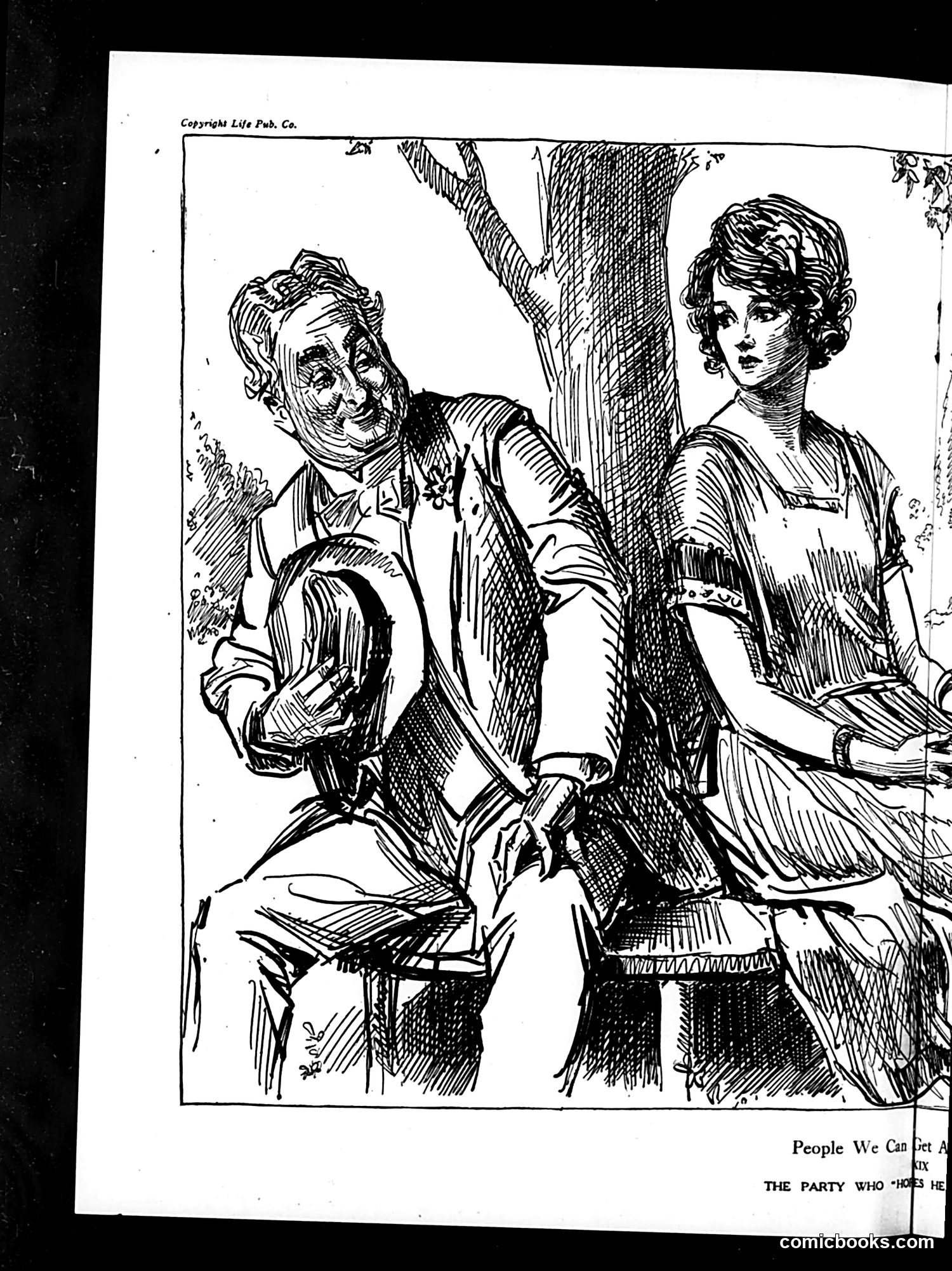
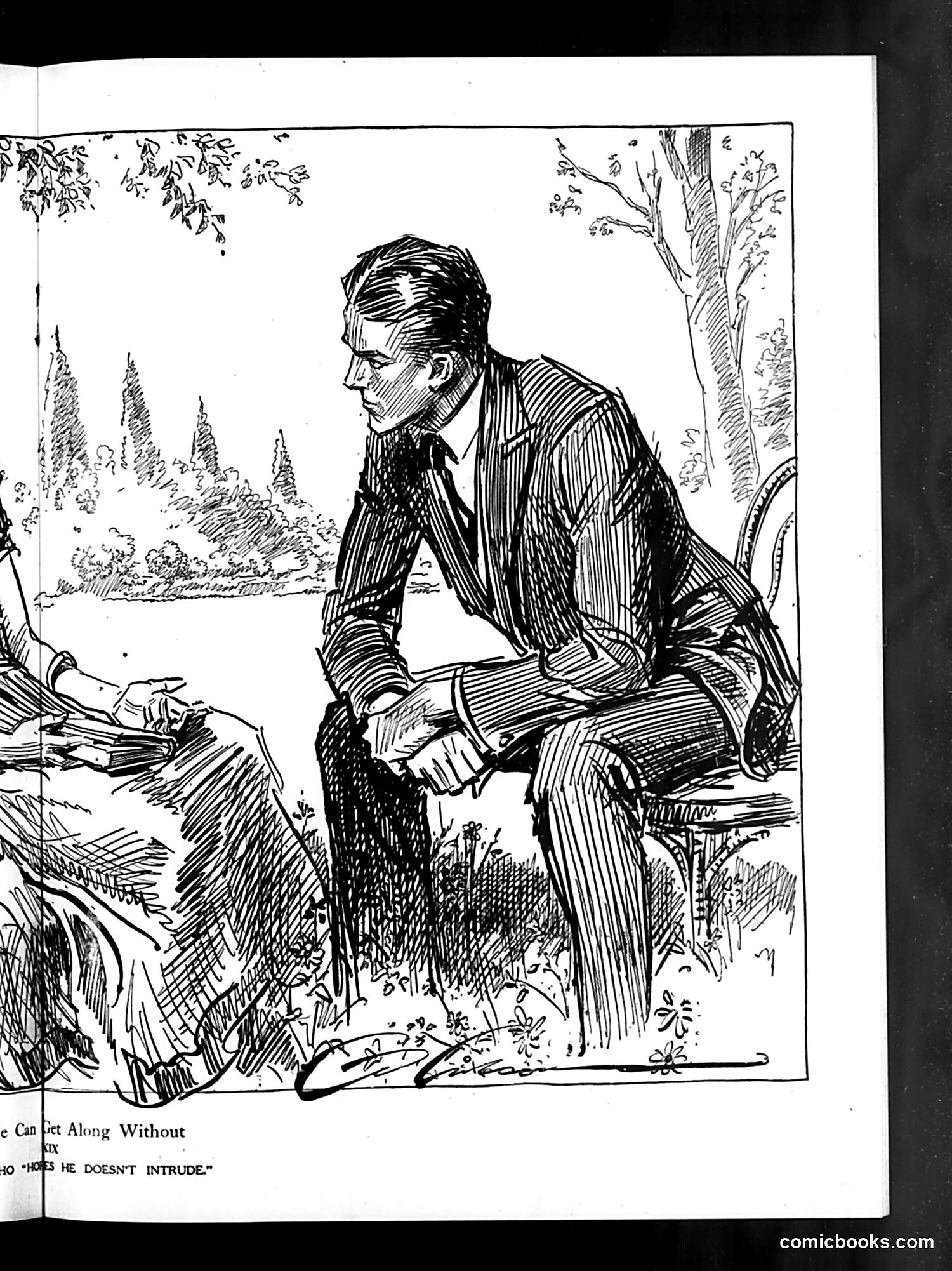
This is a single-panel cartoon showing a well-dressed man in a suit sitting outdoors in a natural setting with trees and vegetation. The caption reads "HE DOESN'T INTRUDE," with partial text below referencing someone who "can get along without" someone else. The cartoon appears to be social commentary about a person who maintains respectful distance or doesn't impose themselves on others. However, **without additional context about the specific issue of Life magazine, the date, or identifying details about the figure depicted, I cannot definitively identify who this man represents or what political/social situation is being satirized.** The artistic style and clothing suggest early-to-mid 20th century, but the precise target of the satire remains unclear from the image and OCR text alone.
This is a theater review from Life magazine critiquing the Broadway revue "Snapshots of 1921," which featured performers Nora Bayes, Lew Fields, and DeWolf Hopper. The reviewer discusses competing audience tastes: "Class 1A" audiences prefer the subtle triangle-drama burlesques written by John Hastings Turner and James Montgomery Flagg, while "Class 1B" audiences enjoy cruder comedy sketches like H.I. Phillips' "Clara Da Loon" and Frances Nordstrom's "Who Done It." The satire targets class-based theater preferences—sophisticated versus lowbrow humor—without declaring one superior. The reviewer diplomatically avoids pronouncing judgment, humorously noting that doing so "causes only hard feeling." James Montgomery Flagg is mentioned as the author/designer; he was a famous American illustrator of the era.
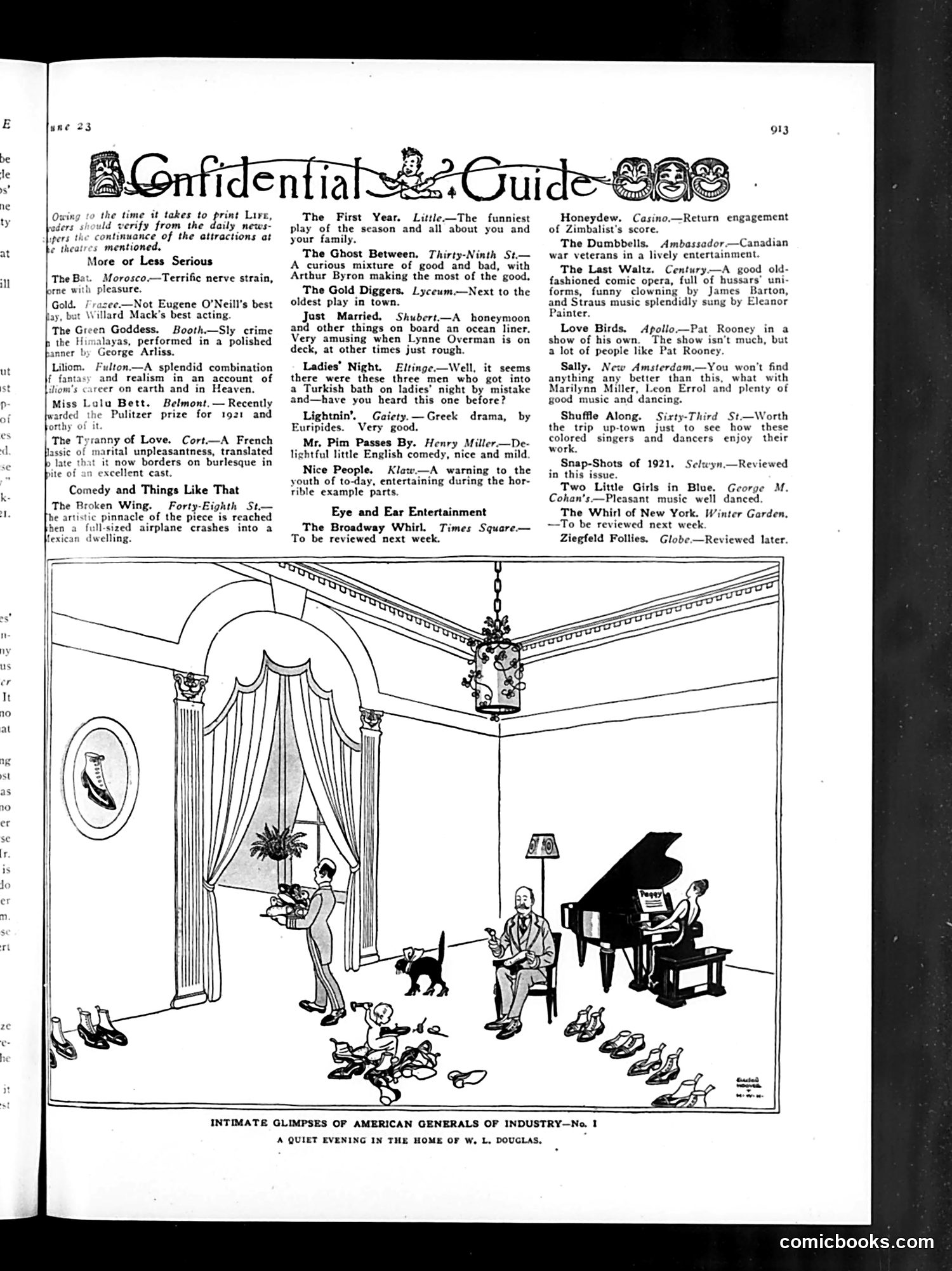
This cartoon satirizes the excessive wealth and leisure of W. L. Douglas, a prominent shoe manufacturer and industrialist. The image depicts his home as absurdly opulent: a grand piano, elaborate curtains, ornate ceiling fixtures, and scattered shoes everywhere—a visual pun on Douglas's shoe business. The joke targets the disconnect between industrial titans' luxurious lifestyles and ordinary workers' circumstances during the 1920s. The title mockingly refers to wealthy businessmen as "Generals of Industry," treating them like military commanders, while the scene's excess—particularly the carelessly strewn expensive shoes—suggests wasteful frivolity. This reflects post-WWI American anxieties about wealth inequality and corporate power, common satirical themes in *Life* magazine's social commentary. The cartoon uses domestic absurdity to critique industrial magnates' detachment from economic reality.
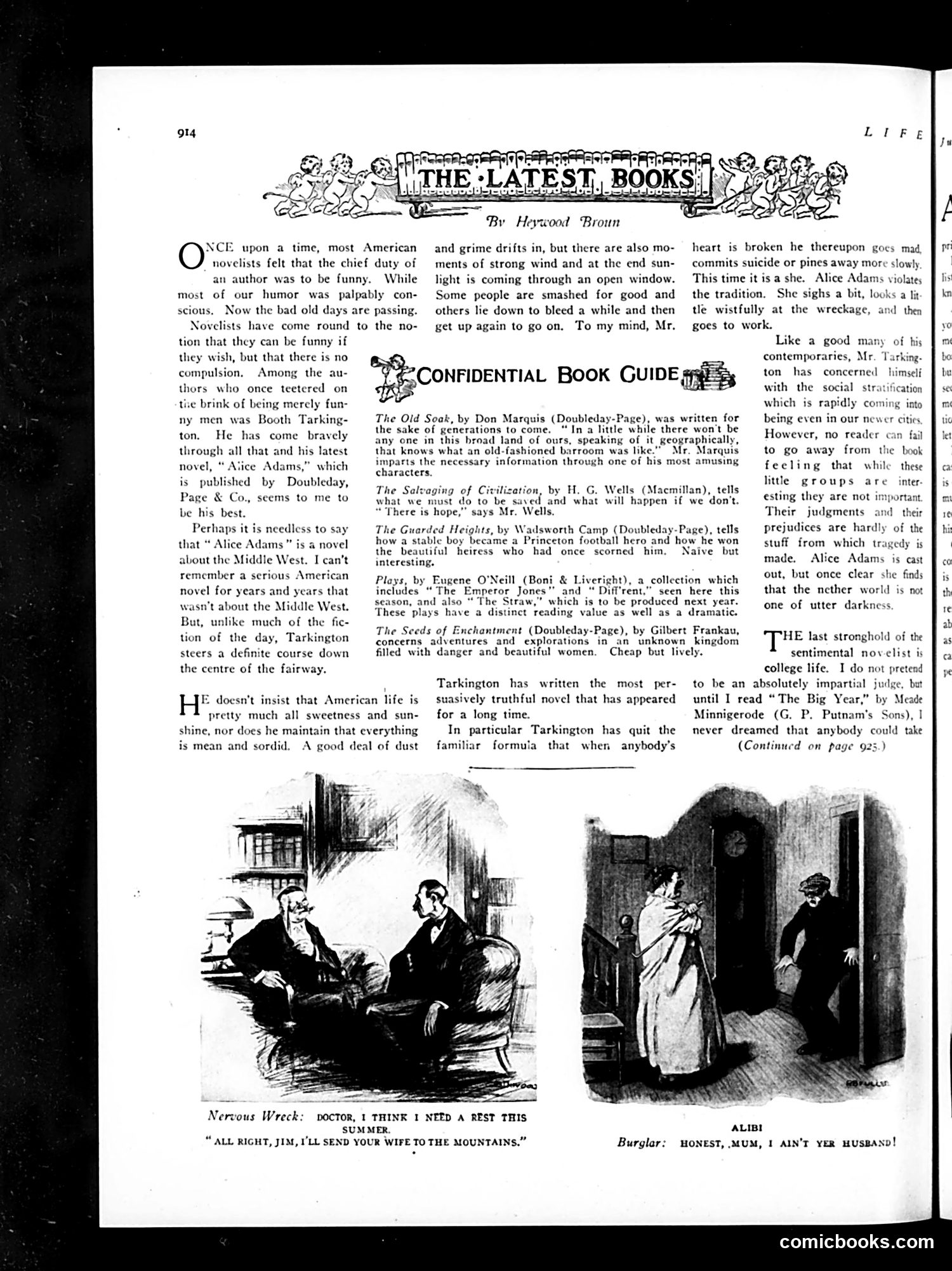
This page reviews recent novels by Booth Tarkington and others. The two cartoons illustrate common literary tropes that the reviewer discusses. **Left cartoon ("Nervous Wreck"):** A doctor tells a patient he needs rest and will send his wife to the mountains—a joke about husbands seeking relief from their spouses' presence. **Right cartoon ("Alibi"):** A burglar tells a woman "Honest, mum, I ain't yer husband!"—reversing the previous joke, suggesting husbands are as unwelcome as criminals. Both cartoons mock domestic discord, a recurring theme in American fiction of the era. Broun praises Tarkington's *Alice Adams* for departing from sentimental convention: rather than descending into madness or suicide when her heart breaks, the protagonist simply "sighs a bit" and returns to work—a more realistic portrayal of female resilience than typical of the period's novels.
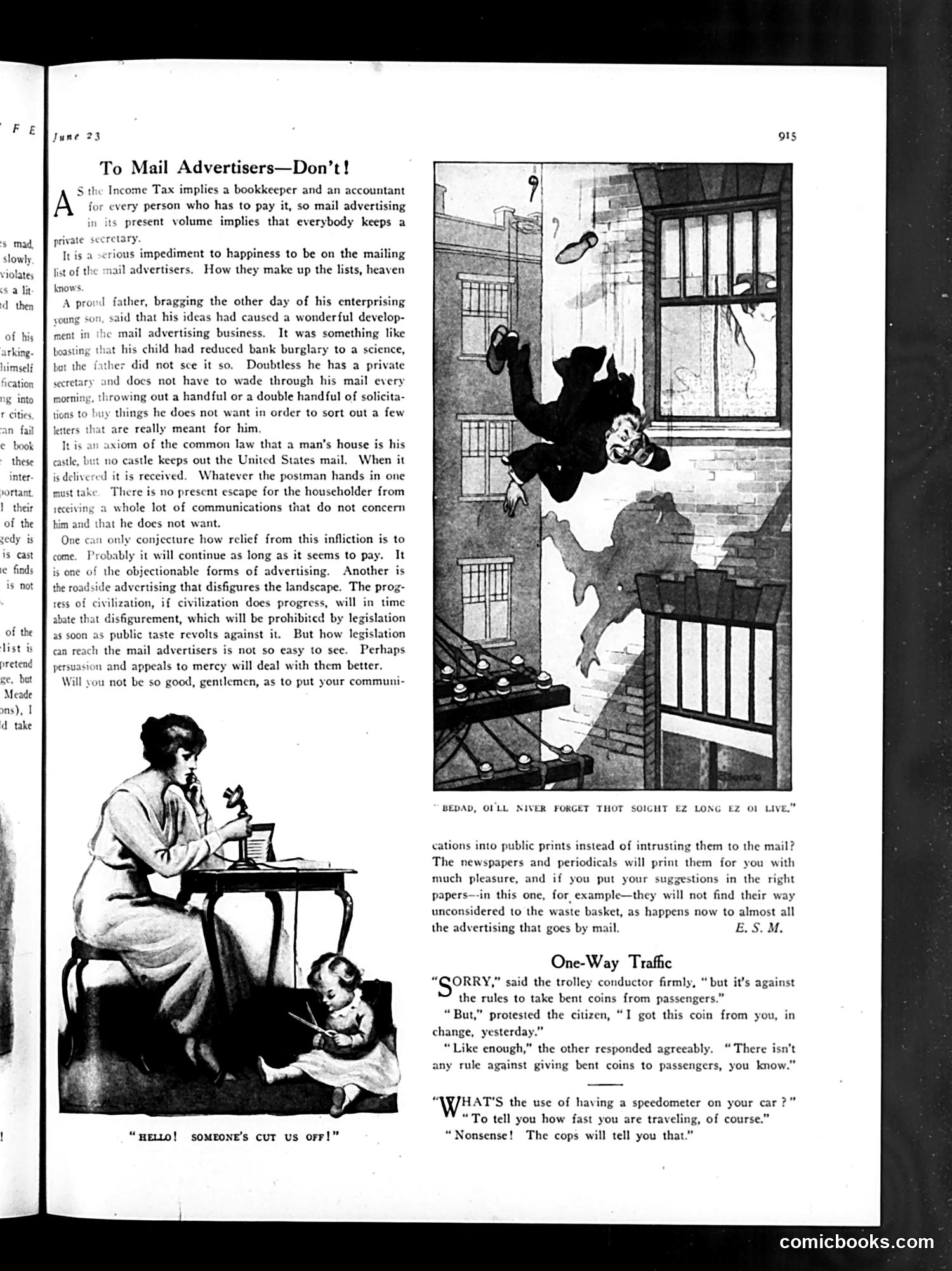
This page contains two distinct pieces of satire: **"To Mail Advertisers—Don't!"** (main editorial): A complaint about unsolicited mail advertising cluttering American homes. The author argues that widespread junk mail implies every household employs a private secretary to sort it. Two accompanying illustrations satirize the burden: one shows a woman overwhelmed sorting mail while ignoring her child ("HELLO! SOMEONE'S CUT US OFF!"), and another depicts a man literally falling out a window amid cascading advertisements. The piece advocates that advertisers use newspapers instead, appealing to advertisers' mercy and good manners. **"One-Way Traffic"** (brief comic section): Short jokes mocking urban absurdities—a streetcar conductor who refuses bent coins from passengers but admits he freely gives them, and a motorist who claims speedometers exist to inform drivers of speed while police actually perform that function. These highlight bureaucratic illogic and the gap between official rules and practical reality. Both sections criticize early 20th-century American consumer culture and institutional contradictions.
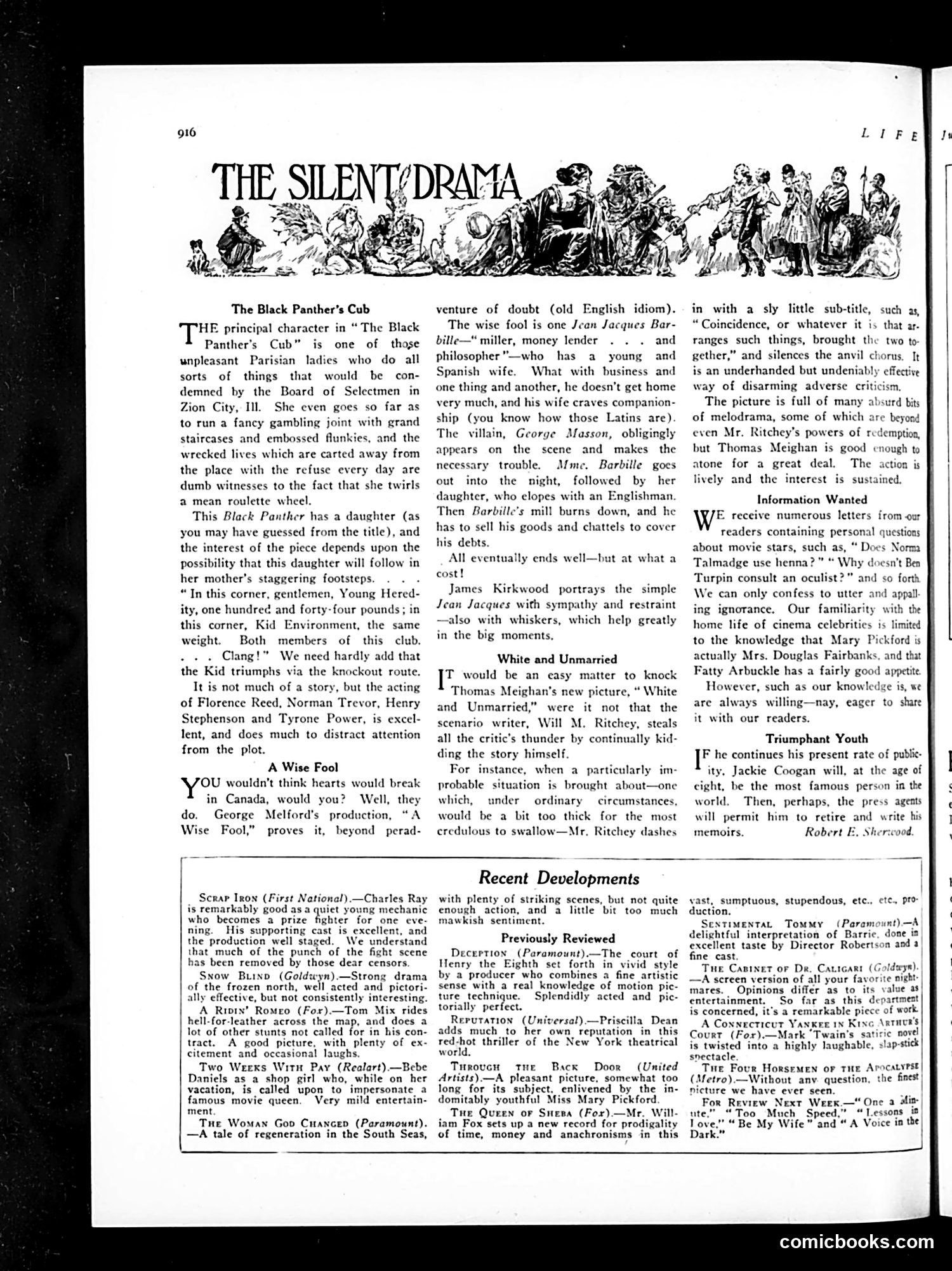
This page contains reviews of several silent films, not political cartoons. The header illustration shows characters from various movies being discussed. The reviews critique plot and acting in films like "The Black Panther's Cub" (about a Parisian woman running a gambling den, with moral stakes about whether her daughter will follow her path—resolved by "Kid Environment" defeating "Heredity"), "A Wise Fool" (a melodrama about a cuckolded miller), and "White and Unmarried" (criticized for heavy-handed plot devices and implausible scenarios). The "Information Wanted" section is humorous commentary: readers ask personal questions about movie stars (like whether Natalie Talmadge uses henna dye, or why Ben Turpin doesn't wear glasses). The magazine jokes that their knowledge of celebrities' private lives is limited to knowing Mary Pickford married Douglas Fairbanks and that Fatty Arbuckle has good appetite. This reflects 1920s movie fan culture and the emerging celebrity gossip industry.
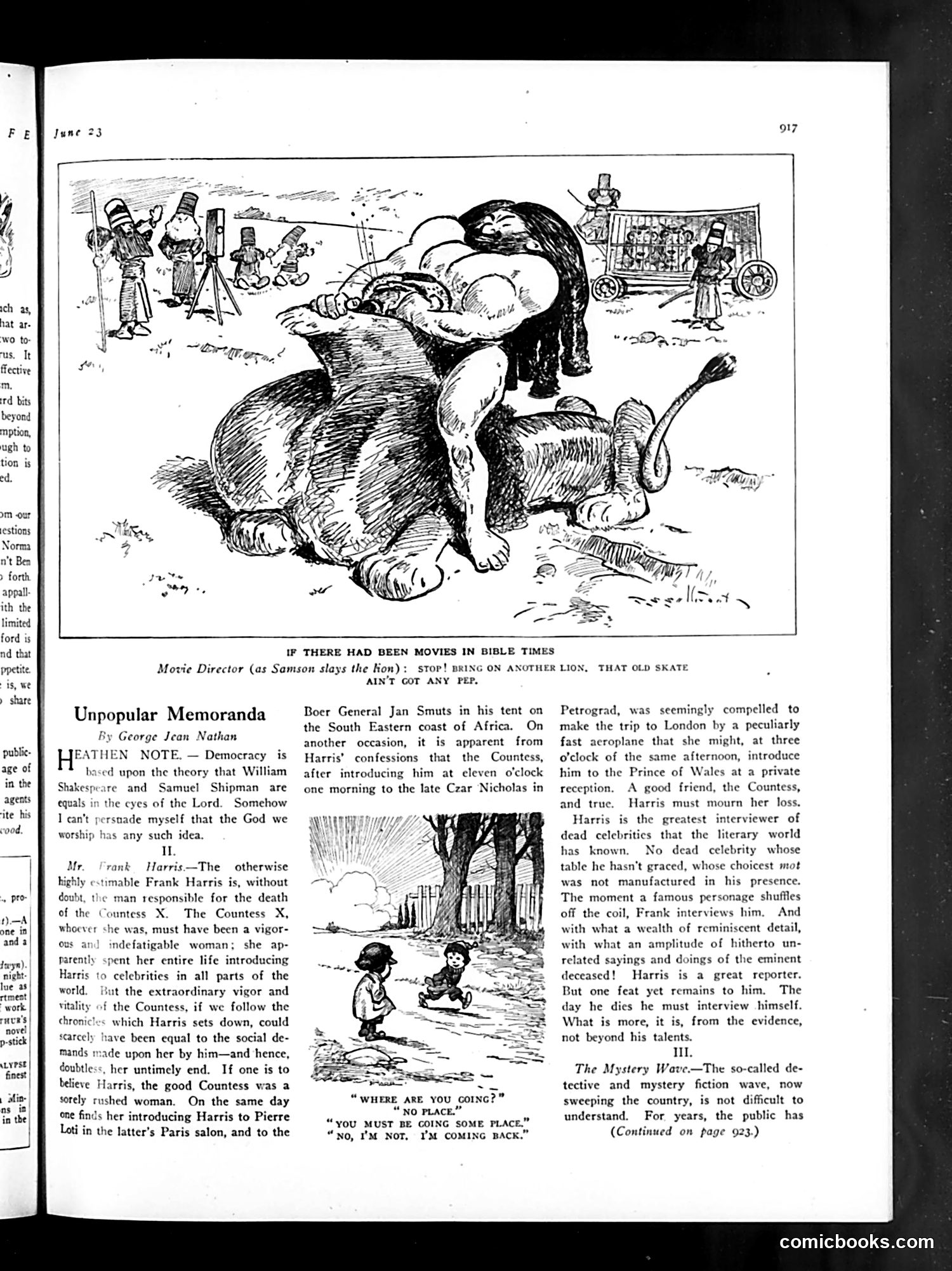
**The Main Cartoon:** This is a satirical jab at early cinema's dramatic excess. It depicts a movie director (shown as a caricatured figure) filming the biblical story of Samson slaying a lion. The director yells "STOP! BRING ON ANOTHER LION, THAT OLD SKATE AIN'T GOT ANY PEP"—mocking how silent-film directors would demand increasingly exaggerated, sensationalized action to satisfy audiences. The title "If There Had Been Movies in Bible Times" suggests that modern filmmaking's focus on spectacle and repetitive thrills would have corrupted even sacred biblical narratives. The humor targets Hollywood's emerging tendency toward over-the-top production values and the director's need to constantly escalate drama, treating even a monumental feat (Samson defeating a lion) as insufficient entertainment without amplification.
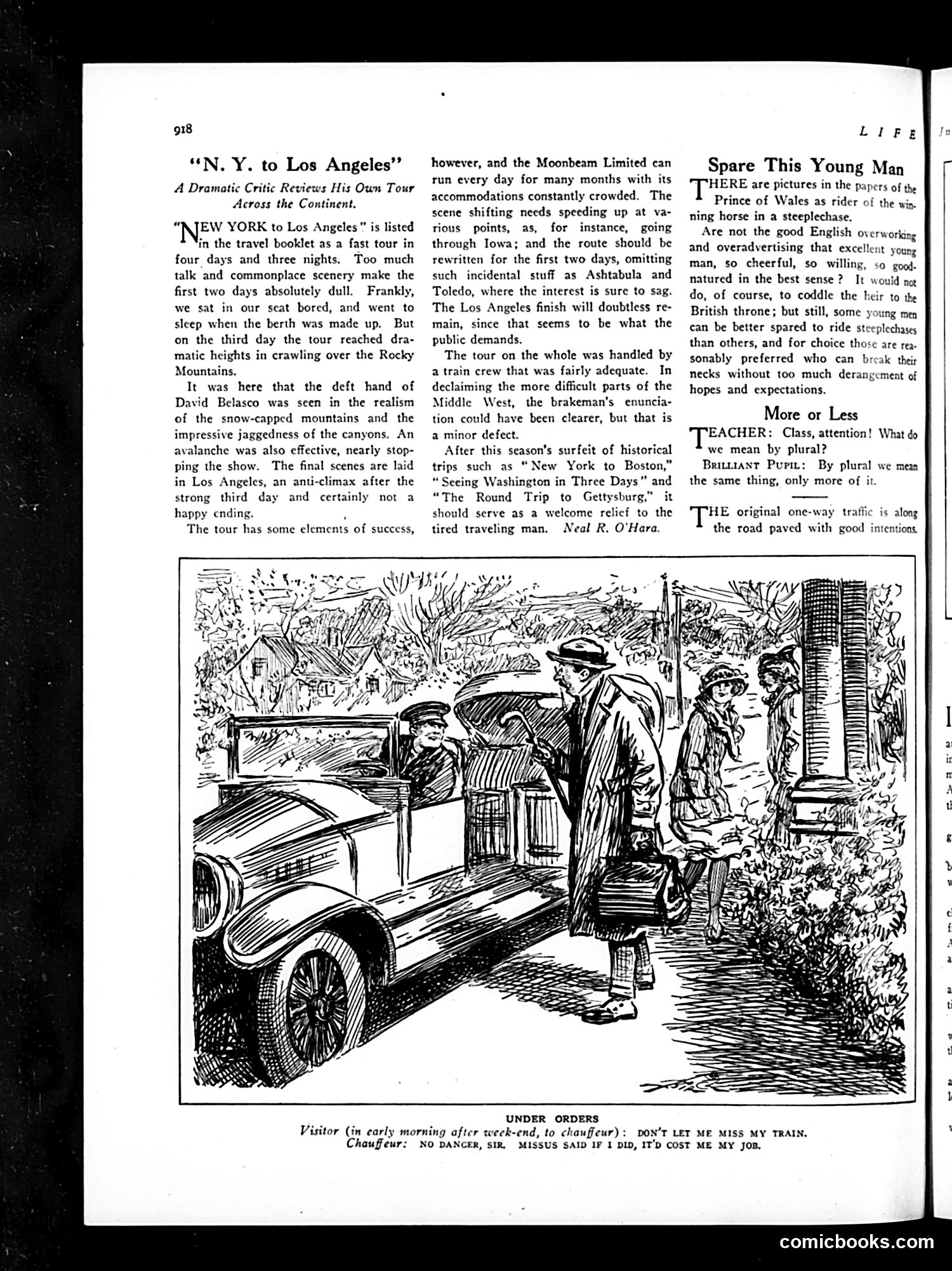
This page contains three separate satirical pieces typical of *Life* magazine's humor: 1. **"N.Y. to Los Angeles"**: A dramatic critic reviews a cross-country train journey as if it were a theatrical production. The satire mocks both pretentious theater criticism and mundane travel—treating Iowa and Ohio towns as "poor scene work" while praising the Rocky Mountains as expertly staged drama (referencing David Belasco, a famous theatrical producer known for realistic staging). The joke is applying high-art critique to ordinary transportation. 2. **"Spare This Young Man"**: Social commentary on the Prince of Wales being overexposed in newspapers through sports coverage (steeplechase riding). The author suggests Britain is unnecessarily risking injury to the royal heir for publicity, while other, less important people could more safely do dangerous activities. It's gentle criticism of overexposure and the public's obsession with royalty. 3. **"Under Orders"** (cartoon): A chauffeur ensures punctuality not from duty but from fear of his wife's disapproval—satirizing domestic dynamics where wives control husbands through threat of consequences.
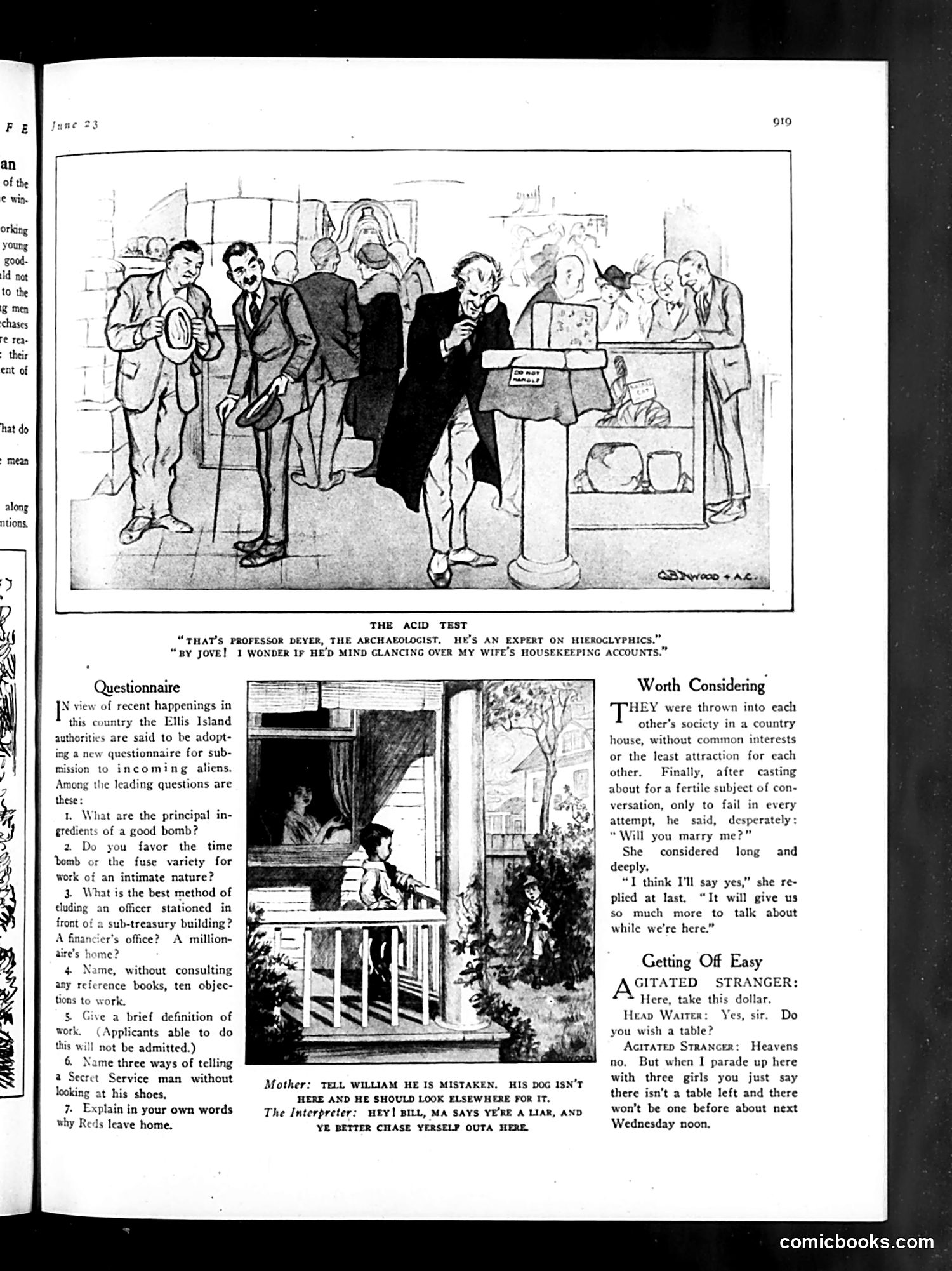
**Top Cartoon - "The Acid Test":** A joke about an archaeologist (Professor Deyer) being consulted on ancient hieroglyphics. The humor lies in the speaker's absurd non-sequitur: he asks if the professor would examine his wife's household accounts using the same expert analytical skills. The implication is that her accounting is so incomprehensible it requires archaeological decryption—satirizing wives' housekeeping management as mysterious or chaotic. **"Questionnaire" Section:** This satirizes anti-immigrant screening at Ellis Island by listing absurdly hostile questions ostensibly asked of incoming aliens. The questions focus on anarchist/radical concerns (bomb-making, evading authorities, anti-work sentiment)—reflecting 1920s American anxiety about foreign radicals and the "Red Scare." The satire criticizes this paranoid vetting process as ridiculous. **Other Sections:** Minor humor pieces about miscommunication ("The Interpreter") and social situations, typical of Life's light satirical content. These don't carry significant political weight—they're domestic comedy sketches common to the era's magazines.
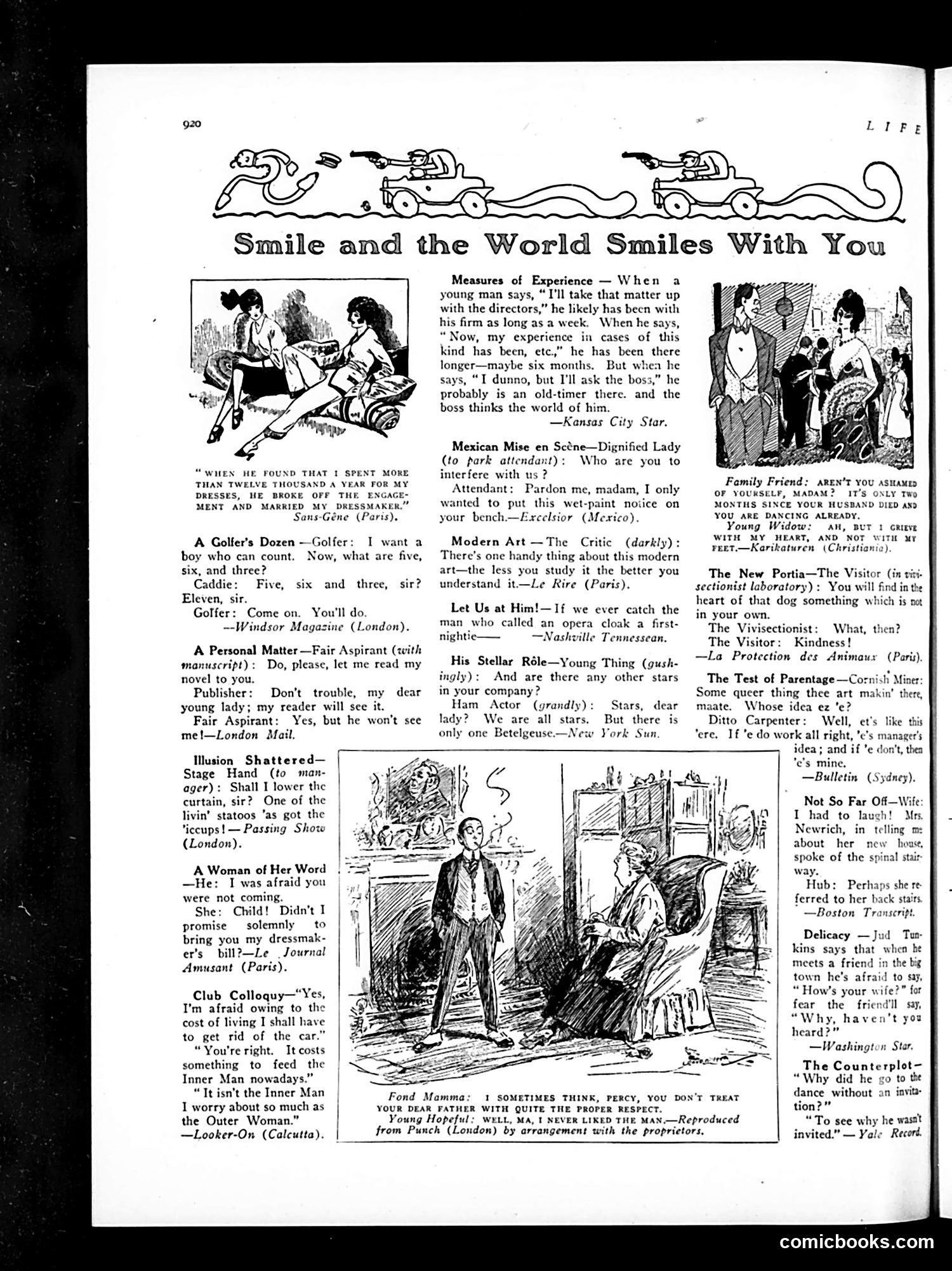
This page collects brief humorous anecdotes and jokes from international publications, reflecting early 20th-century social satire. Key themes include: **Marriage & Money**: The opening joke mocks wealthy fiancées—a man breaks his engagement upon learning his bride-to-be spends $12,000 annually on dresses, then marries the dressmaker instead (implied to be more practical). **Class & Pretension**: Multiple jokes satirize social climbing and false sophistication—a "dignified lady" in Mexico, a "ham actor" claiming stellar status, a widow dancing too soon after her husband's death. **Gender Dynamics**: Women are portrayed as spendthrifts ("Outer Woman"), vain, and socially ambitious. A wife threatens to bore her husband with her dressmaker's bills as "punishment." **Work & Authority**: Jokes about golf caddies, publishers, and workers reveal workplace hierarchies and the performative nature of experience claims. The cartoons depict domestic and social scenes illustrating these points. The satire targets pretension, materialism, and gender relations among the middle and upper classes.
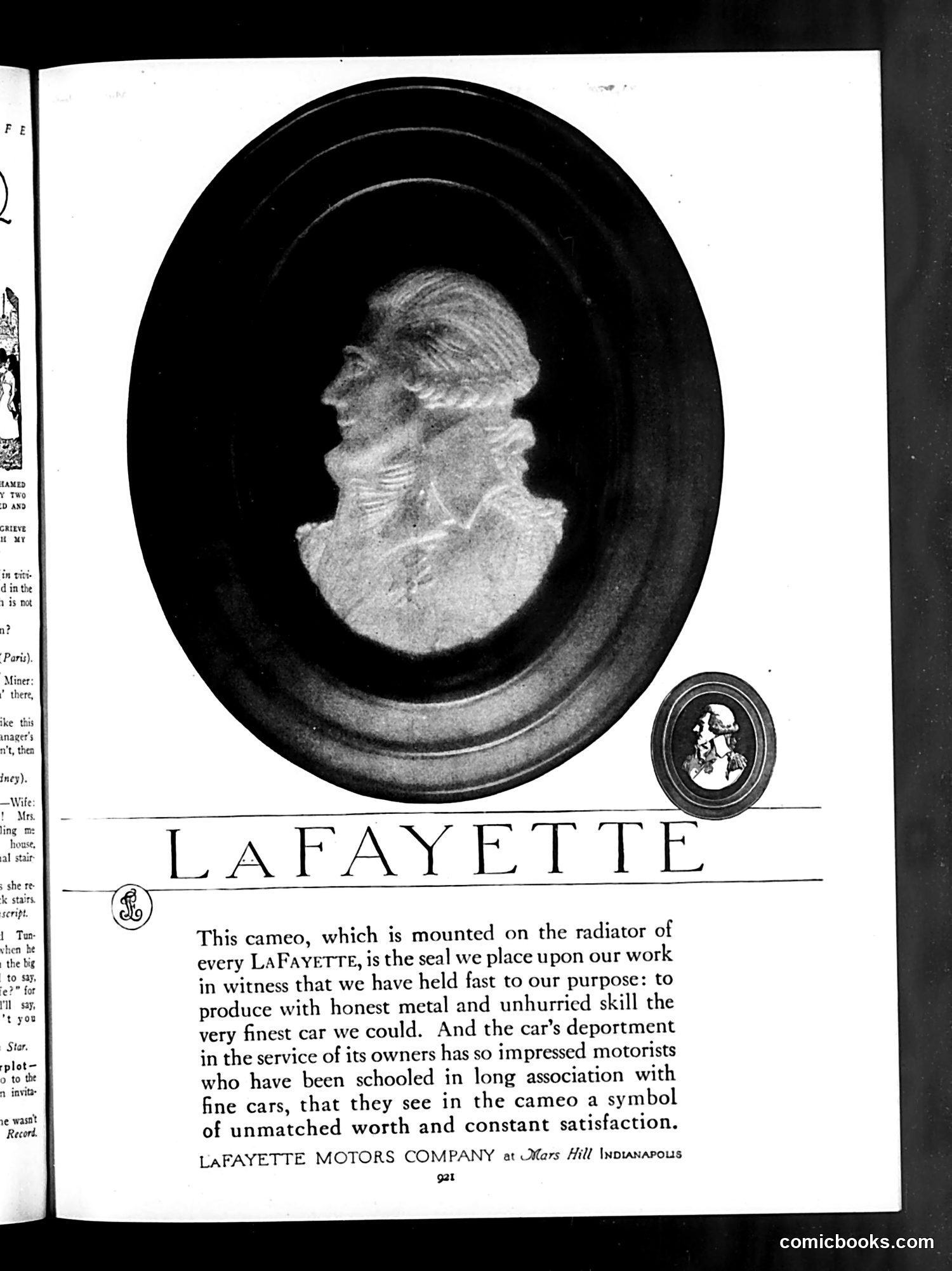
This is a **car advertisement**, not political satire. It features a cameo portrait of **the Marquis de Lafayette**, the French Revolutionary War general and American ally. Lafayette Motors Company uses his likeness as their radiator emblem—a seal of quality and prestige. The ad argues that owners of fine cars recognize this cameo as symbolizing "unmatched worth and constant satisfaction," leveraging Lafayette's historical reputation for honor and excellence to market their automobiles. The company was based in Mars Hill, Indianapolis. This represents early 20th-century advertising strategy: associating mass-produced consumer goods with historical prestige and Old World craftsmanship to appeal to aspirational middle-class buyers.
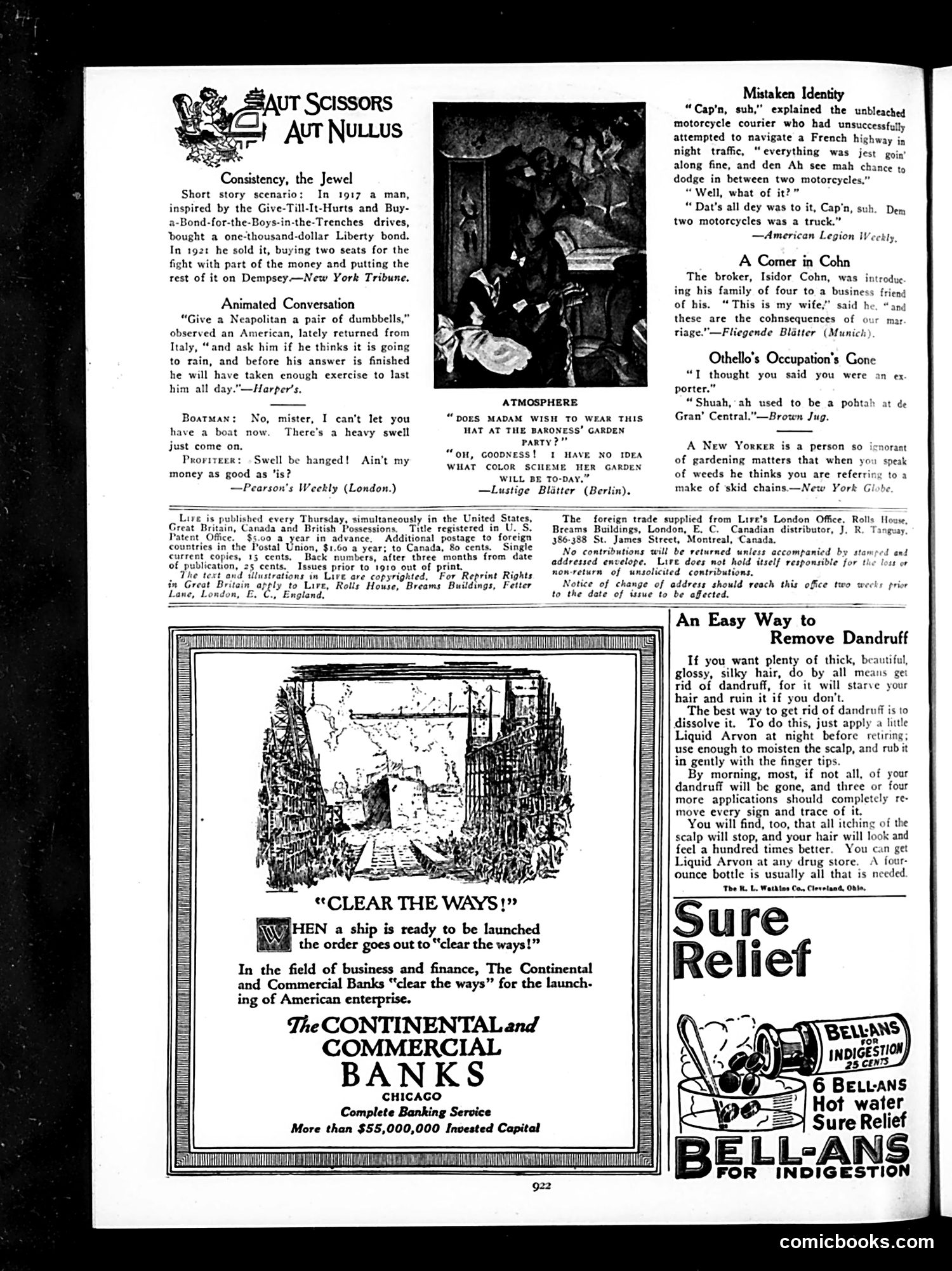
This page comprises several brief humorous anecdotes and advertisements typical of Life's satirical format. The main cartoons mock: 1. **"Consistency, the Jewel"**: A 1917 man who bought Liberty bonds (WWI patriotic investment) then sold them in 1921 to bet on boxer Dempsey—satirizing inconsistent patriotism and the era's gambling culture. 2. **Character sketches** from various international sources (Harper's, Lustige Blatter, Pearson's Weekly) offering observational humor about Italians, fashion, boating, and New York gardeners—typical period ethnic and class-based jokes. 3. **"Othello's Occupation's Gone"**: References the Shakespeare character, implying former jobs (porter at Grand Central station) have disappeared—likely reflecting post-WWI employment shifts. The advertisements include banking services ("Clear the Ways!") and dandruff remedy (Liquid Arvon), typical of the era's medical product marketing. The page reflects 1920s American humor: patriotism satire, ethnic stereotypes, class commentary, and emerging consumer culture.
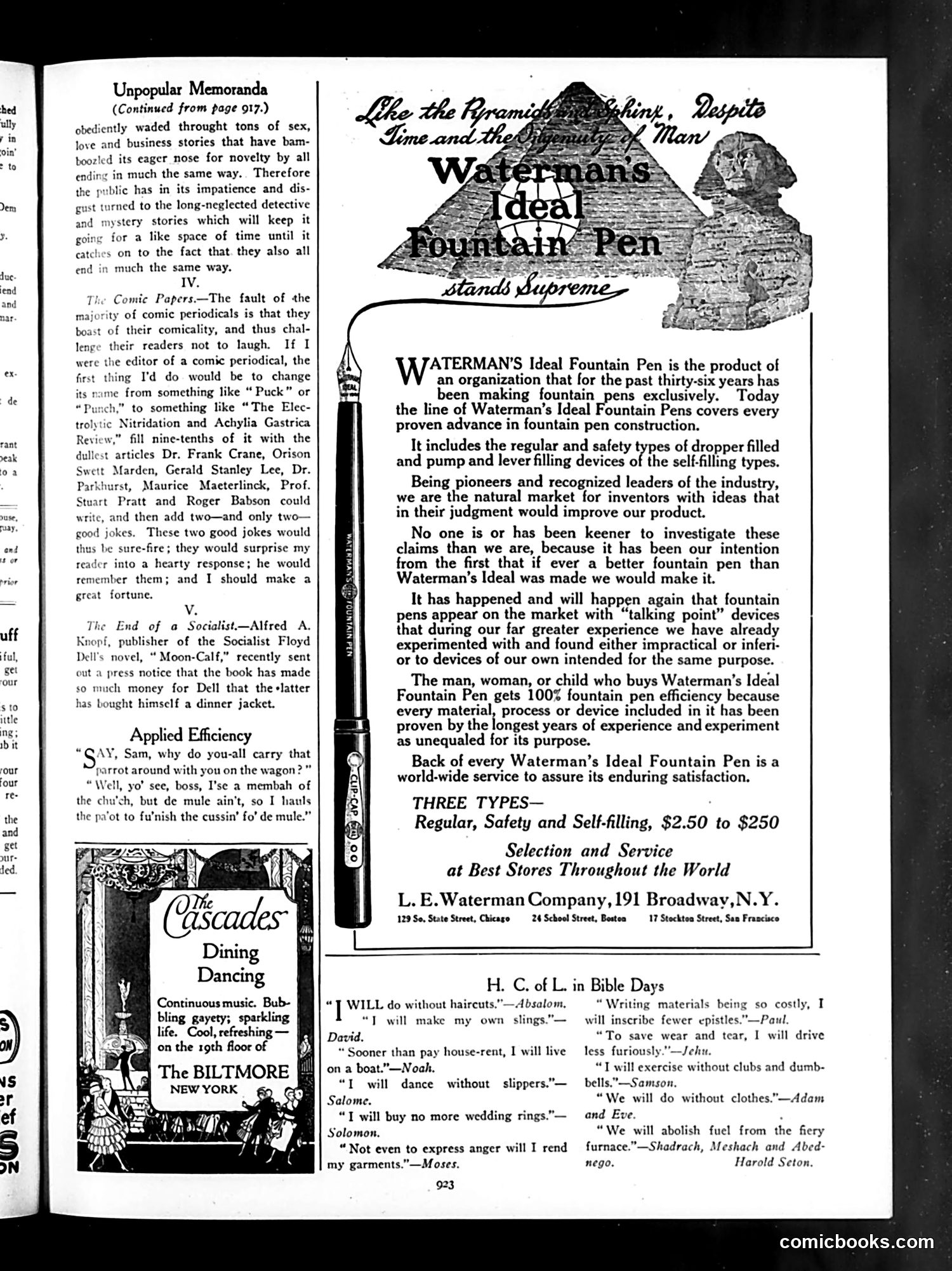
This is primarily a satirical commentary column with advertisements, not political cartoons. The main content critiques American magazines: **The satire:** The author mocks comic periodicals for failing to be funny, suggesting editors rename publications with deliberately dull titles (citing real intellectuals like Frank Crane and Orison Swett Marden) so readers would be *shocked* into laughter at the rare actual jokes. The underlying point: comic magazines have become predictable and unfunny. **Other items:** A brief jab at socialist publisher Alfred Knopf, whose author Floyd Dell's novel made enough money that Dell bought formal wear—mocking socialist pretensions about rejecting materialism. A dialect joke about a mule and a parrot adds period-typical racial humor. **Advertisements** dominate the page: Waterman fountain pens (emphasizing quality and innovation) and The Biltmore hotel in New York. The page reflects 1910s-era magazine humor conventions and consumer culture.
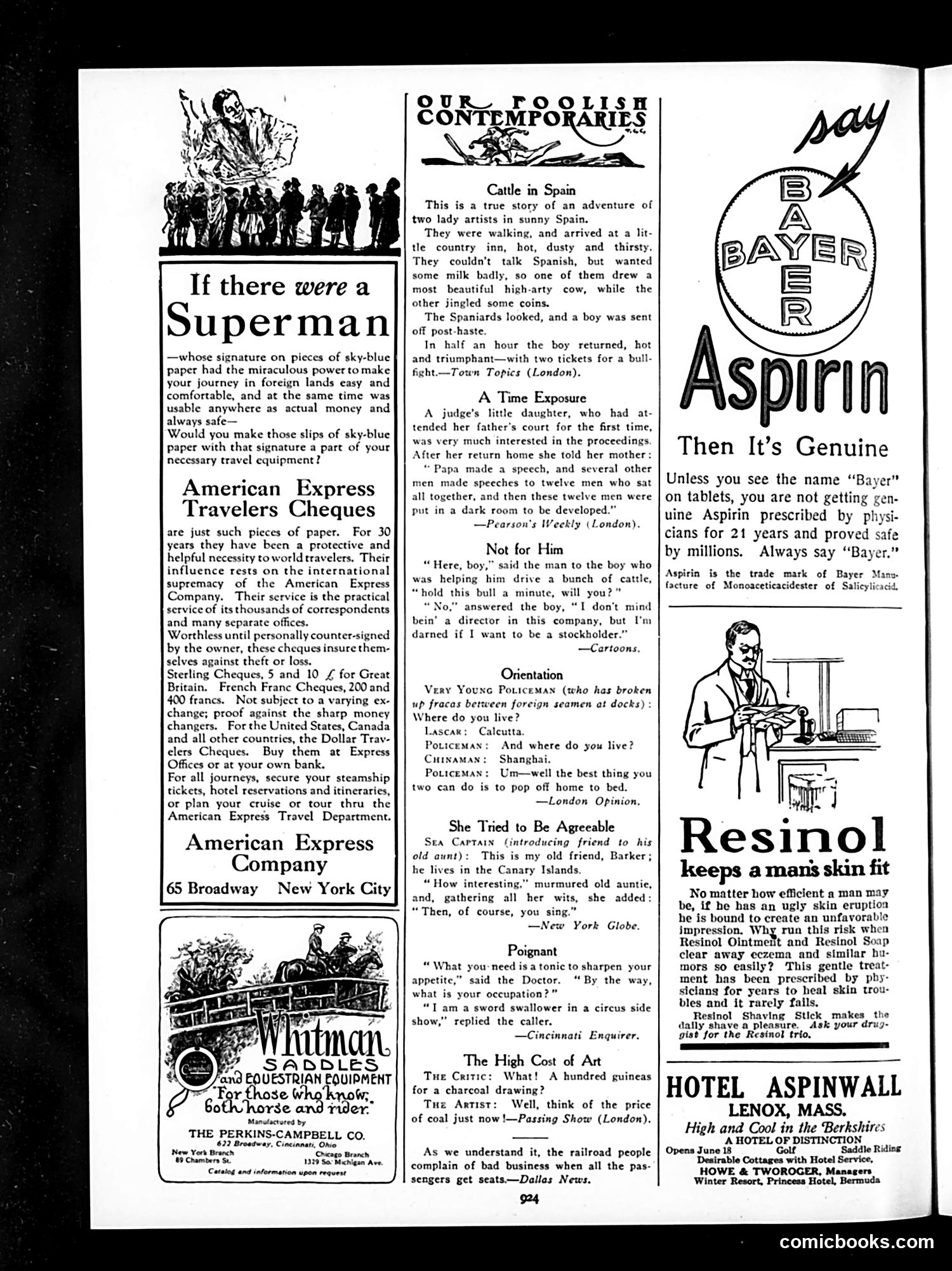
This page is primarily **advertising and humor content**, typical of early 20th-century Life magazine. **Main Advertisement:** American Express Travelers Cheques dominates the left side. The "Superman" concept is metaphorical—if a signature could magically ease foreign travel, wouldn't you use it? The ad positions traveler's cheques as that solution, emphasizing their international acceptance and security against theft. **Humor Section:** The right side contains short jokes satirizing various professions and situations: - **"Cattle in Spain"**: Two lady artists communicate through drawing rather than language—mocking foreigners' travel struggles - **"Not for Him"**: A boy refuses to be a cattle company "stockholder," playing on corporate terminology - **"Orientation"**: A young policeman mediates between foreign dock workers, suggesting cultural confusion - **"The High Cost of Art"**: Critiquing inflated art prices These jokes reflect early 1900s attitudes about travel, class distinctions, and professional pretension. The humor is mild, situational rather than political—appealing to middle-class readers planning travel or appreciating gentle social observation.
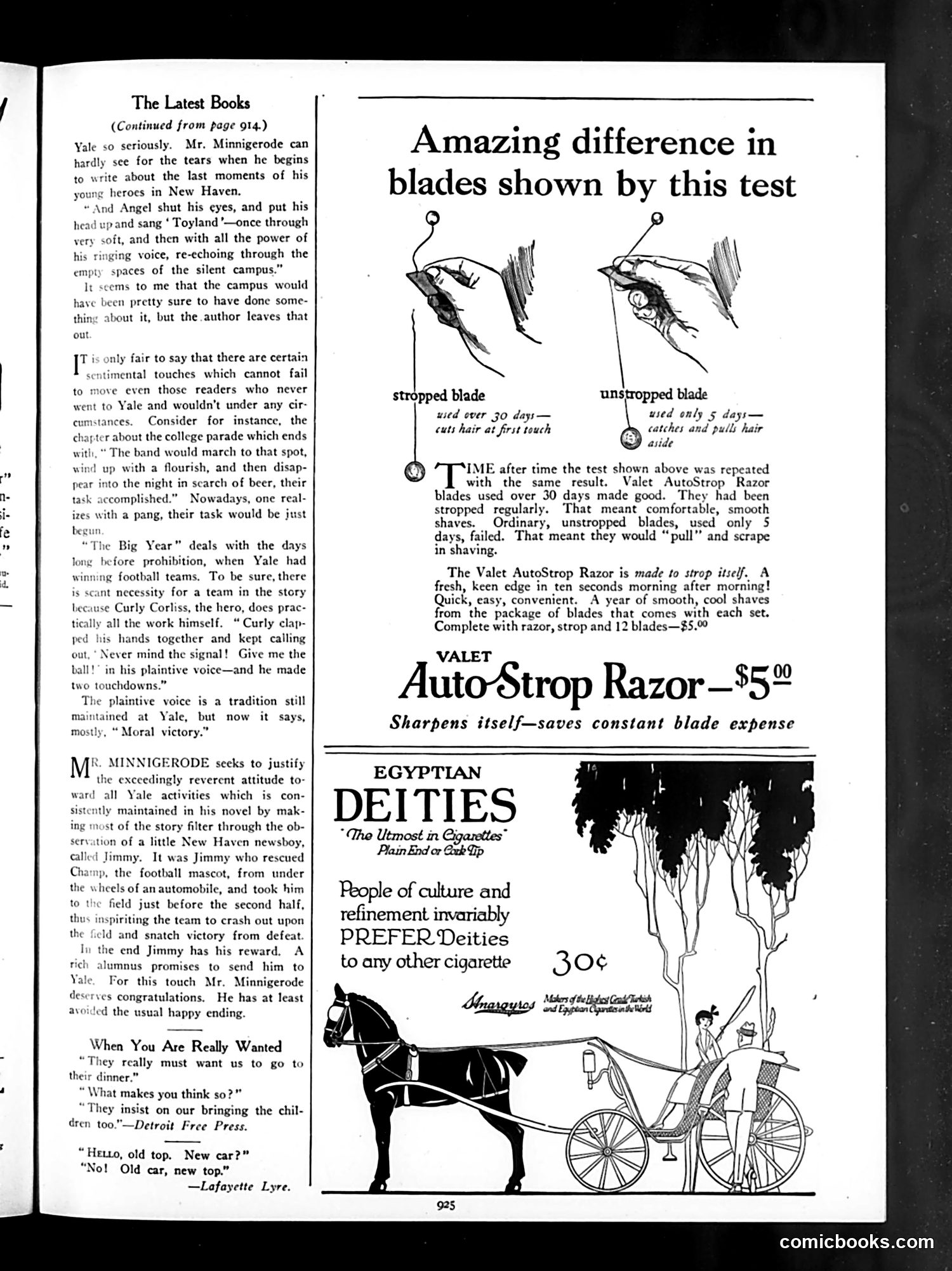
This page contains two advertisements and book reviews. The main content is a **book review** criticizing novels set at Yale University that sentimentalize college life—particularly one where a newsboy hero rescues the football mascot, inspiring victory. The reviewer mocks the overwrought emotionalism and notes that Prohibition has made the realistic details (like teams searching for beer) now dated and absurd. The advertisements are period products: 1. **Valet AutoStrop Razor** ($5.00)—a self-sharpening razor marketed to men, showing a before/after test claiming stropped blades cut cleanly while unstropped ones "pull" hair. 2. **Egyptian Deities cigarettes** (30¢)—positioned as a luxury cigarette for cultured people, featuring an Egyptian motif illustration. The page reflects 1920s consumer culture and post-Prohibition nostalgia, with advertising designed to appeal to educated, affluent readers of *Life* magazine.
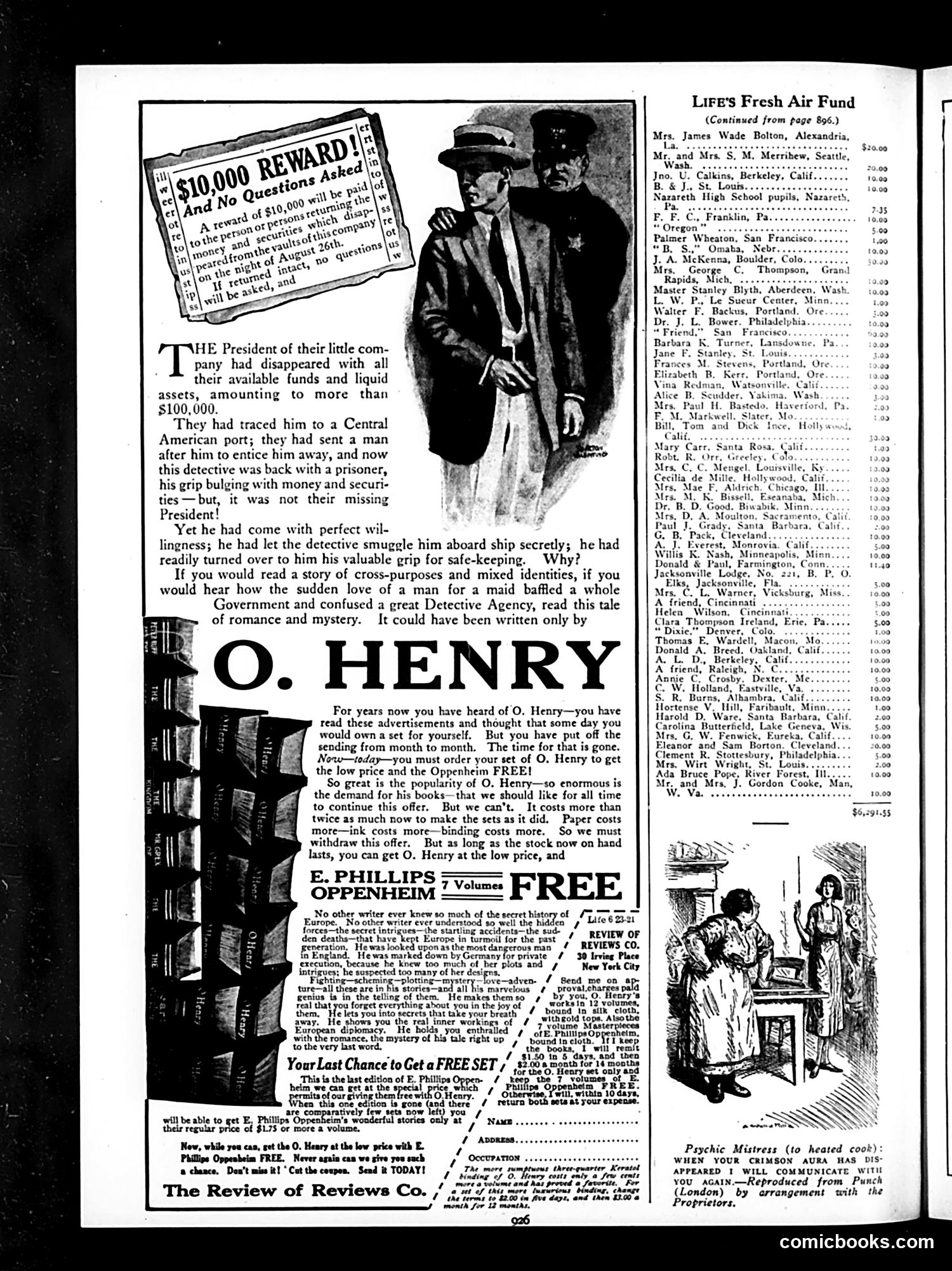
This page combines two distinct elements: a serialized O. Henry story advertisement and the continuation of *Life* magazine's "Fresh Air Fund" (a charitable giving list). **The Main Content:** The large advertisement promotes a complete set of O. Henry's collected works, claiming the author possessed secret knowledge of European politics, espionage, and intrigue. The accompanying short story excerpt—about a company president who disappears with funds, only to have the wrong man returned—exemplifies Henry's interest in "cross-purposes and mixed identities." **The Sales Pitch:** The publisher urgently pressures readers to order *now*, claiming paper and binding costs have risen so dramatically that this low-price offer cannot continue. This is a classic scarcity/urgency marketing tactic. **The Charitable Element:** The right column lists donors to *Life*'s Fresh Air Fund (providing outdoor experiences for underprivileged children), showing contemporary philanthropic concerns. The page reflects early 20th-century magazine advertising strategies while documenting period charitable causes.
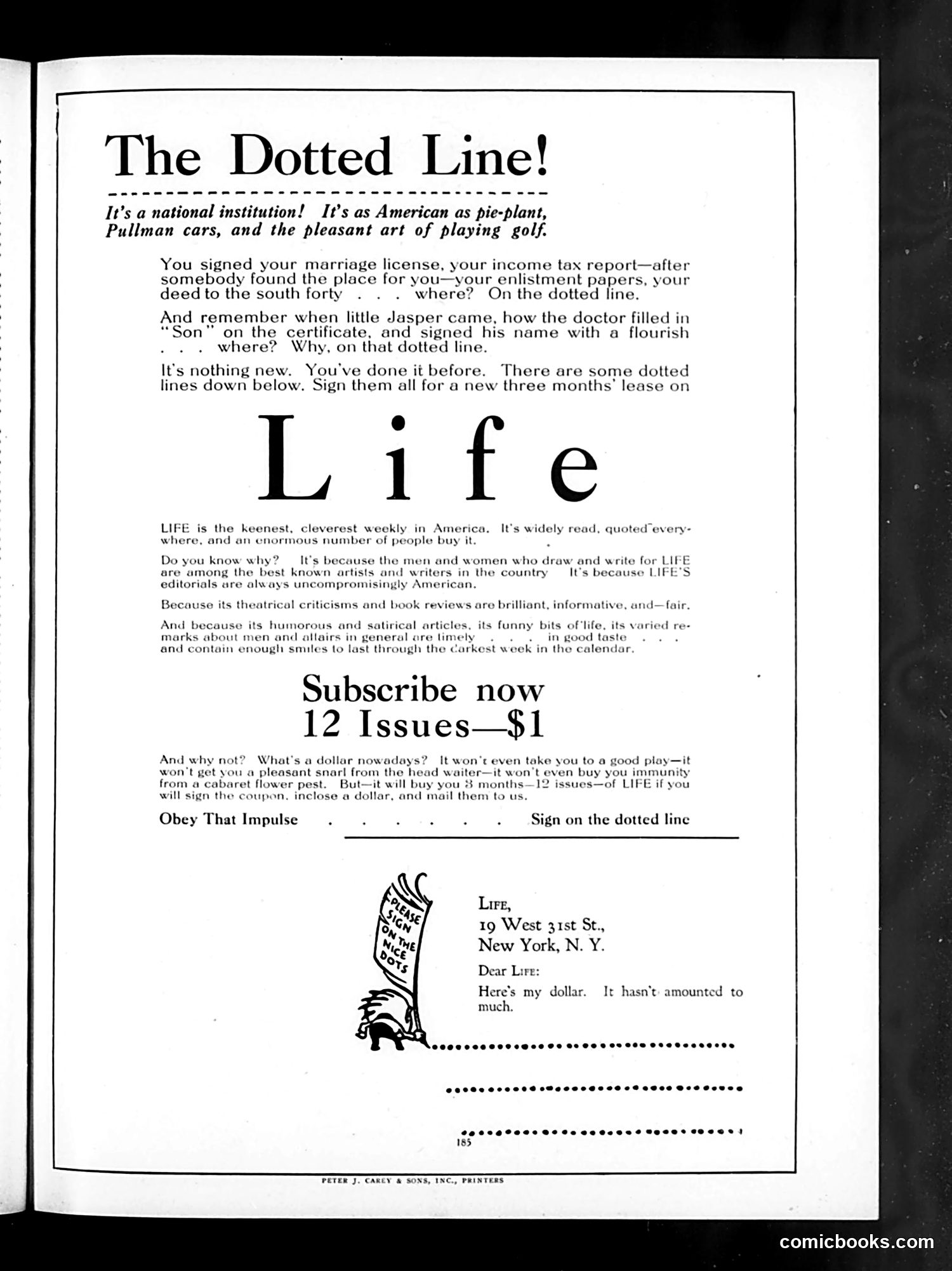
This is primarily a **subscription advertisement** for *Life* magazine, not a political cartoon. The humor exploits a relatable American experience: signing dotted lines for life's major events—marriage licenses, tax forms, birth certificates, property deeds. The satire works by positioning *Life* magazine subscription as another inevitable "dotted line" Americans must sign, part of the natural bureaucratic rhythms of citizenship and adulthood. The accompanying coupon reinforces this by presenting subscription as an impulsive, routine obligation. The ad's appeal emphasizes *Life's* editorial quality—its artists, writers, theater criticism, and "uncompromisingly American" editorial stance—justifying the dollar cost as entertainment value during uncertain economic times (the reference to dollars' diminished purchasing power suggests economic hardship, possibly the Depression era). The cartoon figure holding the "Life" banner appears to personify the magazine itself, encouraging readers to "obey that impulse" and sign on the dotted line.
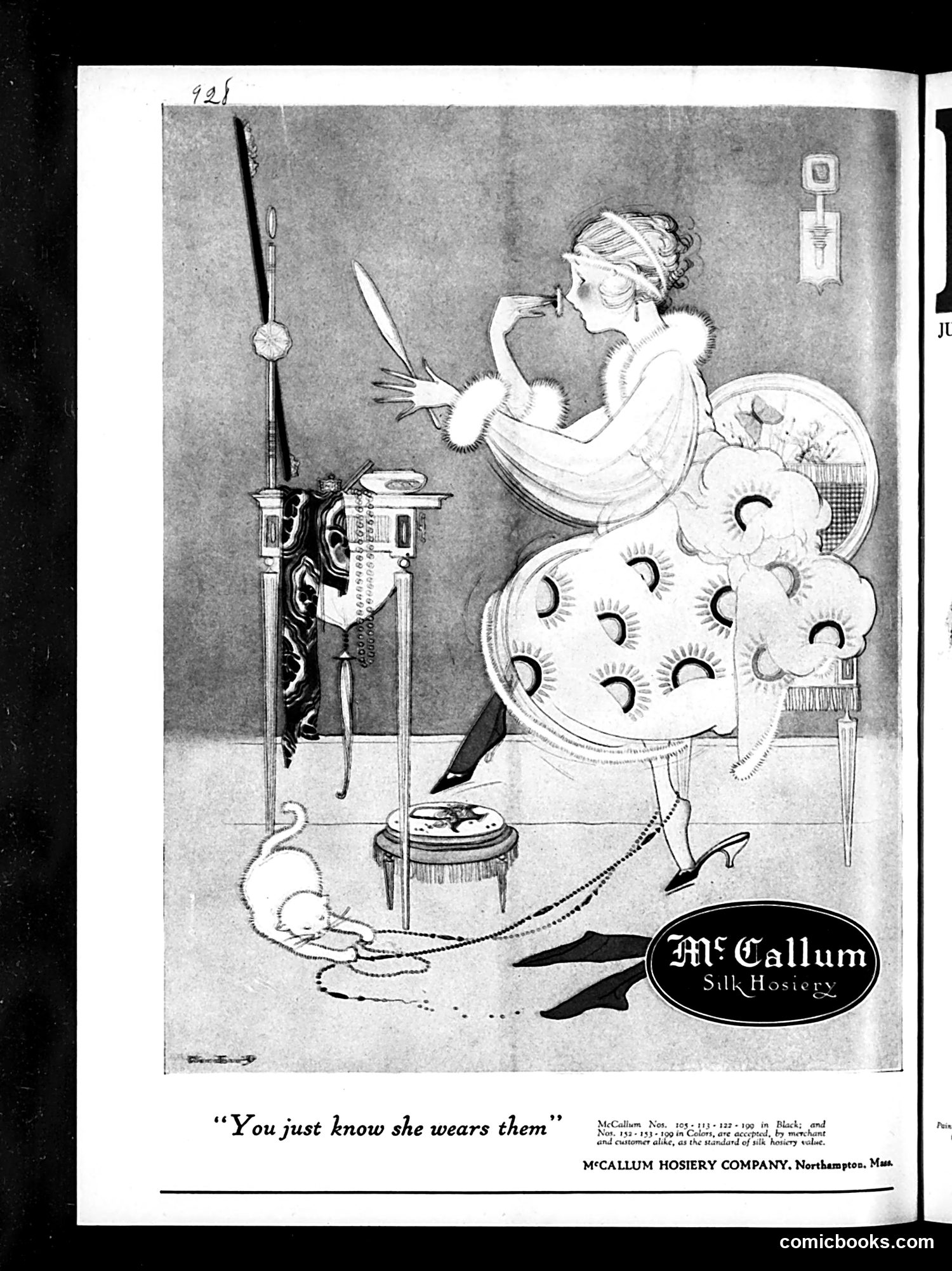
This is a vintage advertisement for McCallum silk hosiery, not political satire. The illustration shows an elegantly dressed woman in 1920s style clothing, surrounded by decorative elements including flowers with closed eyes and a small mouse or rat. The tagline "You just know she wears them" is a marketing appeal suggesting that quality hosiery is both fashionable and noticeable to observers. The artwork reflects Art Deco aesthetic popular in that era. The elaborate dress with puffy sleeves and the refined presentation emphasize luxury and sophistication—qualities the brand associated with their product. The dreamy, whimsical visual style was typical of aspirational advertising from this period, designed to make consumers desire the product by associating it with elegance and social status.