
Life, 1921-06-23 · page 24 of 36
Life — June 23, 1921 — page 24: what you’re looking at
What you’re looking at
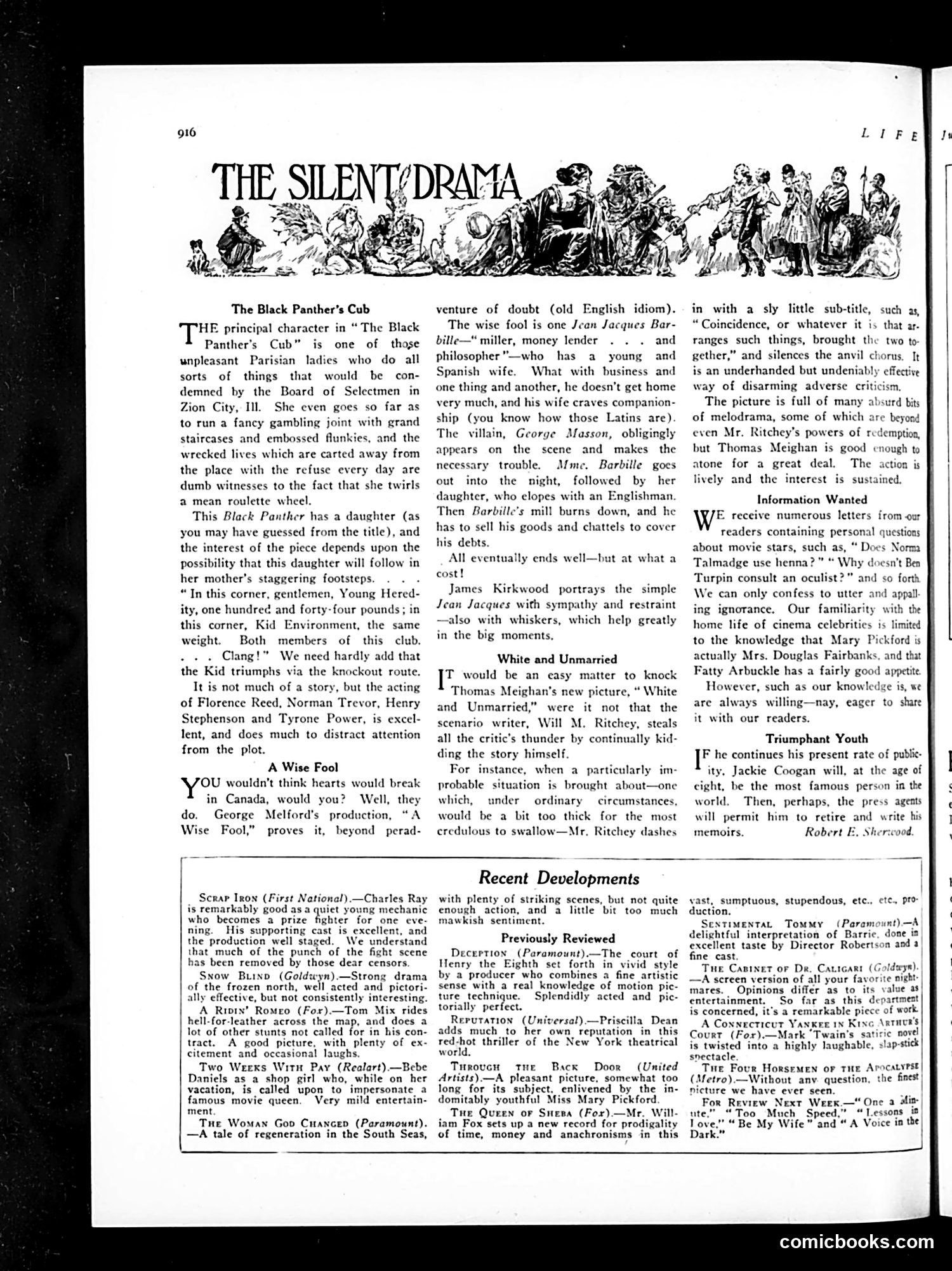
This page contains reviews of several silent films, not political cartoons. The header illustration shows characters from various movies being discussed. The reviews critique plot and acting in films like "The Black Panther's Cub" (about a Parisian woman running a gambling den, with moral stakes about whether her daughter will follow her path—resolved by "Kid Environment" defeating "Heredity"), "A Wise Fool" (a melodrama about a cuckolded miller), and "White and Unmarried" (criticized for heavy-handed plot devices and implausible scenarios). The "Information Wanted" section is humorous commentary: readers ask personal questions about movie stars (like whether Natalie Talmadge uses henna dye, or why Ben Turpin doesn't wear glasses). The magazine jokes that their knowledge of celebrities' private lives is limited to knowing Mary Pickford married Douglas Fairbanks and that Fatty Arbuckle has good appetite. This reflects 1920s movie fan culture and the emerging celebrity gossip industry.
📄 Transcribed text from this page (OCR, searchable)
Machine-transcribed from the original scan — historical spelling and the odd misread are preserved.
The Black Panther’s Cub HE principal character in “ The Black Panther’s Cub” is one of those unpleasant Parisian ladies who do all sorts of things that would be con- demned by the Board of Selectmen in Zion City, Ill. She even goes so far as to run a fancy gambling joint with grand staircases and embossed flunkies, and the wrecked lives which are carted away from the place with the refuse every day are dumb witnesses to the fact that she twirls a mean roulette wheel. This Black Panther has a daughter (as you may have guessed from the title), and the interest of the piece depends upon the possibility that this daughter will follow in her mother’s staggering footsteps. “In this corner, gentlemen, Young Hered- ity, one hundred and forty-four pounds; in this corner, Kid Environment, the same weight. Both members of this club. + . Clang!” We need hardly add that the Kid triumphs via the knockout route. It is not much of a story, but the acting of Florence Reed, Norman Trevor, Henry Stephenson and Tyrone Power, is excel- lent, and does much to distract attention from the plot. A Wise Fool OU wouldn't think hearts would break in Canada, would you? Well, they do. George Melford’s production, “A Wise Fool,” proves it, beyond perad- venture of doubt (old English idiom). The wise fool is one Jean Jacques Bar- bille—* miller, money lender . . . and philosopher"”—who has a young and Spanish wife. What with business and one thing and another, he doesn’t get home very much, and his wife craves companion- ship (you know how those Latins are) The villain, George Masson, obligingly appears scene and makes the necessary trouble. Mme. Barbille goes out into the night, followed by her daughter, who elopes with an Englishman. Then Barbille’s mill burns down, and he has to sell his goods and chattels to cover his debts. All eventually ends well—but at what a on the James Kirkwood portrays the simple Jean Jacques with sympathy and restraint ~—also with whiskers, which help greatly in the big moments. White and Unmarried T would be an easy matter to knock Thomas Meighan’s new picture, “ White and Unmarried, that the steals ly kid- were it not Will M. Ritch all the critic’s thunder by continu ding the story himself. For instance, scenario writer, when a particularly im- probable situation is brought about—one which, under ordinary circumstances, would be a bit too thick for the most eredulous to swallow—Mr. Ritchey dashes in with a sly little sub-title, such as, “Coincidence, or whatever it is that ar- ranges such things, brought the two to- gether,” and silences the anvil chorus. [t is an underhanded but undeniably way of disarming adverse critic The picture is full of many absurd bits of melodrama, some of which are beyond even Mr. Ritchey’s powers of redemption, but Thomas Meighan is good cnough to atone for a great deal. The action is lively and the interest is sustained, effective Information Wanted E receive numerous letters from our readers containing personal questions about movie stars, such as, ma Talmadge use henna?” “ Why doesn't Ben Turpin consult an oculist?” and so forth We can only confess to utter appall- ing ignorance. Our familiarity with the home life of cinema celebrities is limited to the knowledge that Mary Pickford is actually Mrs. Douglas Fairbanks, and that Fatty Arbuckle has a fairly good appetite However, such as our knowledge is, we are always willing—nay, eager to share it with our readers. Triumphant Youth F he continues his present rate of public- ity, Jackie Coogan will, at the age of cight, be the most famous person in the world. Then, perhaps, the press agents will permit him to retire and write his memoirs. Robert E, Sherwood. Scrap Iron (First National).—Charles Ray is remarkably good asa quiet young mechanic who becomes a prize Fehter for one eve- ning. His supporting cast is excellent, and the production well staged. We understand that much of the punch of the fight scene has been removed by those dear censors. Sxow Bunn (Goldwyn).—Strong drama of the frozen north, well acted and pictor: ally effective, but not consistently interesting. A Rivtx’ Romeo (For).—Tom Mix rides hell-for-leather across the map, and does a lot of other stunts not called for in his con- tract. A good picture, with plenty of ex- citement and occasional laughs. Two Weexs Wit Pay (Realart).—Bebe Daniels as a shop girl who, while on her vacation, is called upon to impersonate a famous movie queen. Very mild entertain- ment Tue Woman Goo Cuancen (Paramount). —A tale of regeneration in the South Seas, Recent Developments with plenty of striking scenes, but not quite enough action, and a mawkish sentiment. little bit too much Previously Reviewed Deception (Paramount).—The court of Henry the Eighth set forth in vivid style by a producer who combines a fine artistic sense with a real knowledge of motion pic- ture technique. Splendidly acted and pic- torially perfect. Rerutation (Universal)—Priscilla Dean adds much to her own reputation in this red-hot thriller of the New York theatrical world, Turovch tne Back Door (United Artists).—A pleasant picture, somewhat too long for its subject, enlivened by the in- domitably youthful Miss Mary Pickford. Tue Queen or Sneva (Foxr).—Mr. Will- iam Fox sets up a new record for prodigality of time, money and anachronisms in this vast, sumptuous, stupendous, etc., etc. pro duction. SextimentaL Tommy (Param delightful interpretation of Barric, done is excellent taste by Director Robertson anda fine cast. Tue Caninet or Dr. Caricart ( —A screen version of all your fave mares. Opinions differ as to its entertainment. So far as this departmest is concerned, it’s a remarkable piece of work A Connecticut Yaxxee 1x Kixc Articr’s Court (For).—Mark ‘Twain's satiric novel) is twisted into a highly laughable, slap~ si spectacle. Tue Four Horsemen or tHe Arm searsra| (Metro).—Without anv question, the finest) picture we have ever seen. Review Next Wee: “Too Much Be My Wife Dark.’ “One a afin comicbooks.com