
Life, 1921-06-23 · page 28 of 36
Life — June 23, 1921 — page 28: what you’re looking at
What you’re looking at
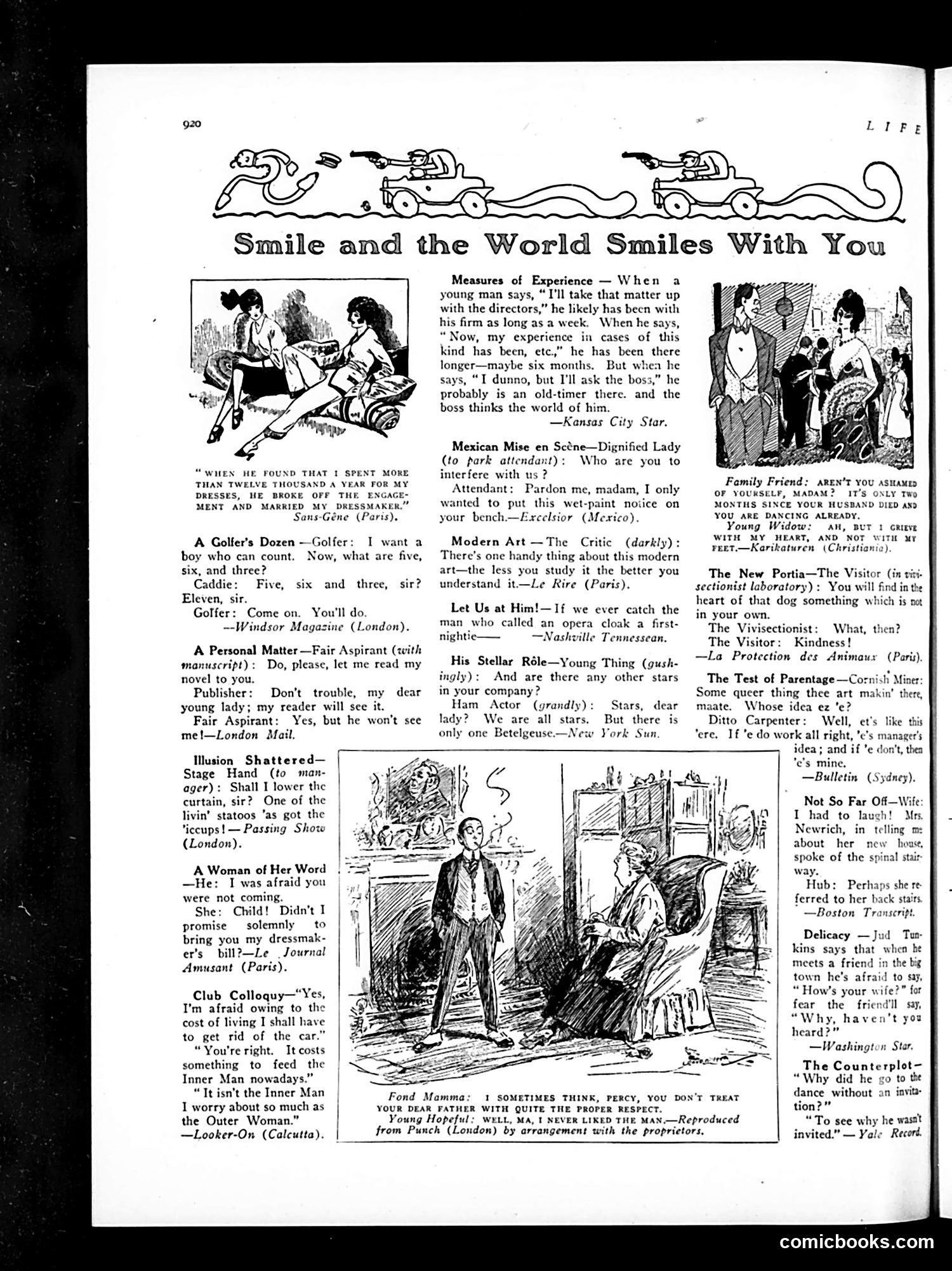
This page collects brief humorous anecdotes and jokes from international publications, reflecting early 20th-century social satire. Key themes include: **Marriage & Money**: The opening joke mocks wealthy fiancées—a man breaks his engagement upon learning his bride-to-be spends $12,000 annually on dresses, then marries the dressmaker instead (implied to be more practical). **Class & Pretension**: Multiple jokes satirize social climbing and false sophistication—a "dignified lady" in Mexico, a "ham actor" claiming stellar status, a widow dancing too soon after her husband's death. **Gender Dynamics**: Women are portrayed as spendthrifts ("Outer Woman"), vain, and socially ambitious. A wife threatens to bore her husband with her dressmaker's bills as "punishment." **Work & Authority**: Jokes about golf caddies, publishers, and workers reveal workplace hierarchies and the performative nature of experience claims. The cartoons depict domestic and social scenes illustrating these points. The satire targets pretension, materialism, and gender relations among the middle and upper classes.
📄 Transcribed text from this page (OCR, searchable)
Machine-transcribed from the original scan — historical spelling and the odd misread are preserved.
Smile and the World Smiles With You “WHEN HE FOUND THAT I SPENT MORE THAN TWELVE THOUSAND A YEAR FOR MY DRESSES, HE BROKE OFF THE ENGAGE- MENT AND MARRIED MY DRESSMAKER.” Sans-Géne (Paris), A Golfer's Dozen —Golfer: I want a boy who can count. Now, what are five, six, and three? Caddie: Five, Eleven, sir. Golfer: Come on. You'll do. --Windsor Magazine (London). six and three, sir? A Personal Matter —Fair Aspirant (with manuscript): Do, please, let me read my novel to you. Publisher: Don’t trouble, my young lady; my reader will see it. Fair Aspirant: Yes, but he won't see me!—London Mail. dear Measures of Experience — When a young man says, “I'll take that matter up with the directors,” he likely has been with his firm as long as a week. When he says, “Now, my experience in cases of this kind has been, etc,” he has been there longer—maybe six months. But whea he says, “I dunno, but I'll ask the boss,” he probably is an old-timer there. and the boss thinks the world of him. —Kansas City Star. Mexican Mise en Sctne—Dignified Lady (to park attendant): Who are you to interfere with us ? Attendant: Pardon me, madam, I only wanted to put this wet-paint noiice on your bench.—Excelsior (Mexico). Modern Art —The Critic (darkly): There's one handy thing about this modern art—the less you study it the better you understand it—Le Rire (Paris), Let Us at Him!—If we ever catch the man who called an opera cloak a first- nightie. —Nashville Tennessean. His Stellar Réle—Young Thing (gush- ingly): And are there any other stars in your company? Ham Actor (grandly): Stars, dear lady? We are all stars, But there is only one Betelgeuse.—New York Sun Family Friend: aren’t you Astana OF YOUKSELF, MADAM? 11's ONLY Two MONTHS SINCE YOUR HUSBAND DIED Axo YOU ARE DANCING ALREADY. Young Widow: an, nut 1 crttve WITH MY HEART, AND NOT \ reet.—Karikaturen (Christiania) The New Portia—The Visitor (in sectionist laboratory): You will it heart of that dog something which is not in your own. The Vivisectionist: What, then? The Visitor: Kindness! —La Protection des Animaux (Paris). The Test of Parentage—Cornisli Miner: Some queer thing thee art makin’ there maate. Whose idea ez 'e? Ditto Carpenter: Well, et's like this "ere, If ’e do work all right, ’e’s manager's Illusion Shattered— Stage Hand (to man- ager): Shall I lower the curtain, sir? One of the livin’ statoos ‘as got the ‘iccups! — Passing Show (London). A Woman of Her Word —He: I was afraid you were not coming. She: Child! Didn't I promise solemnly to bring you my dressmak- er’s bill?—Le _ Journal Amusant (Paris). Club Colloquy—“Yes, I’m afraid owing to the cost of living I shall have to get rid of the car.” “You're right. It costs something to feed the Inner Man nowadays.” “Tt isn't the Inner Man I worry about so much as the Outer Woman.” | —Looker-On (Calcutta). | _ Fond Mamma: 1 SOMETIMES THINK, PERCY, YOU DON'T TREAT YOUR DEAR FATHER WITH QUITE THE PROPER RESPECT. Young Hopeful; weit, MA, 1 NEVER LIKED THE MAN—Reproduced from Punch (London) by arrangement with the proprietors, idea; and if ’e don't, thea ‘e's mine. —Bulletin (Sydney), Not So Far Off—Wife I had to laugh! Mrs. Newrich, in telling m: about her house, spoke of the spinal stair way. Hub: Perhaps she re ferred to her back stairs —Boston Transcript. Delicacy —Jud Tun kins says that when be meets a friend in the big town he’s afraid to say, “How's your wife?” for fear the friend'll say, “Why, haven't you heard?” —Washington Star new The Counterplot— “Why did he go to the dance without an invite tion?” “To see why he wastt invited.” — Yale Record. comicbooks.com