
Life, 1921-06-23 · page 23 of 36
Life — June 23, 1921 — page 23: what you’re looking at
What you’re looking at
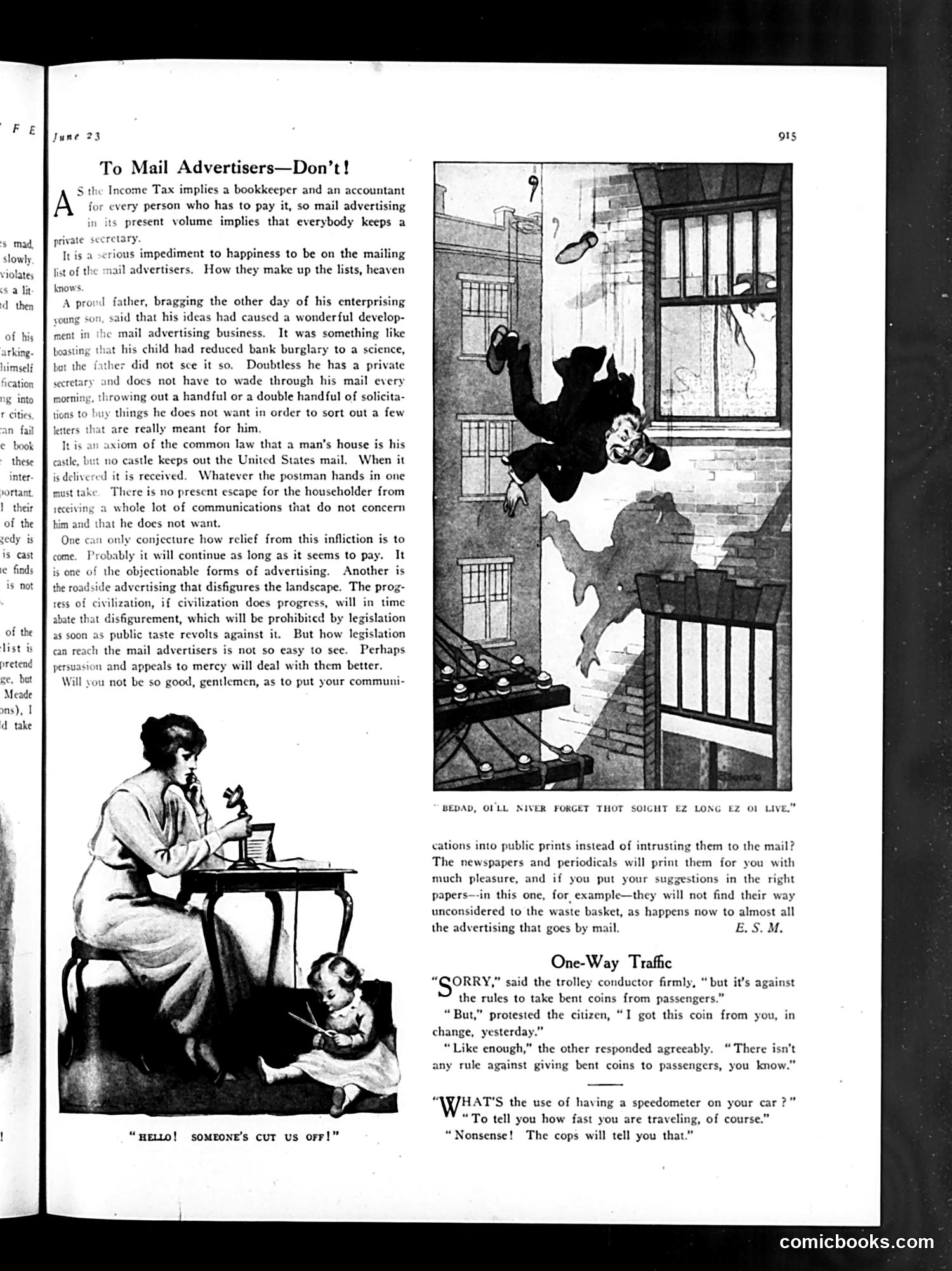
This page contains two distinct pieces of satire: **"To Mail Advertisers—Don't!"** (main editorial): A complaint about unsolicited mail advertising cluttering American homes. The author argues that widespread junk mail implies every household employs a private secretary to sort it. Two accompanying illustrations satirize the burden: one shows a woman overwhelmed sorting mail while ignoring her child ("HELLO! SOMEONE'S CUT US OFF!"), and another depicts a man literally falling out a window amid cascading advertisements. The piece advocates that advertisers use newspapers instead, appealing to advertisers' mercy and good manners. **"One-Way Traffic"** (brief comic section): Short jokes mocking urban absurdities—a streetcar conductor who refuses bent coins from passengers but admits he freely gives them, and a motorist who claims speedometers exist to inform drivers of speed while police actually perform that function. These highlight bureaucratic illogic and the gap between official rules and practical reality. Both sections criticize early 20th-century American consumer culture and institutional contradictions.
📄 Transcribed text from this page (OCR, searchable)
Machine-transcribed from the original scan — historical spelling and the odd misread are preserved.
June 23 To Mail Advertisers—Don’t! the Income Tax implies a bookkeeper and an accountant for every person who has to pay it, so mail advertising s present volume implies that everybody keeps a 5 mad, f private secretary. slowly It is a serious impediment to happiness to be on the mailing violates list of the mail advertisers. How they make up the lists, heaven sa lit knows. d then A proud father, bragging the other day of his enterprising young son, said that his ideas had caused a wonderful develop- of his | ment in the mail advertising business. It was something like arking- | boasting that his child had reduced bank burglary to a science, himself | but the father did not sce it so. Doubtless he has a private ication |} secretary and does not have to wade through his mail every ng into | morning, throwing out a handful or a double hand ful of solicita- r cities, | tions to buy things he does not want in order to sort out a few in fail [letters that are really meant for him. book It is axiom of the common law that a man’s house is his these ff castle, but no castle keeps out the United States mail. When it inter. ff is delivered it is received. Whatever the postman hands in one vortant. [| must take. There is no present escape for the householder from | their ff receiving a whole lot of communications that do not concern of the ff him and that he does not want. dy is One can only conjecture how relief from this infliction is to is cast F come. Probably it will continue as long as it seems to pay. It e finds J is one of the objectionable forms of advertising. Another is is not J the roadside advertising that disfigures the landscape. The prog- ress of civilization, if civilization does progress, will in time abate that disfigurement, which will be prohibited by legislation of the J as soon as public taste revolts against it. But how legislation list is J can reach the mail advertisers is not so easy to see. Perhaps pretend FP persuasion and appeals to mercy will deal with them better. ge, but Will you not be so good, gentlemen, as to put your communi- Meade ons), I d take BEDAD, OLLL NIVER FORGET THOT SOIGHT EZ LONG EZ OL cations into public prints instead of intrusting them to the mail? The newspapers and periodicals will print them for you with much pleasure, and if you put your suggestions in the right papers—-in this one, for example—they will not find their way unconsidered to the waste basket, as happens now to almost all the advertising that goes by mail. E.S.M. One-Way Traffic “GORRY,” said the trolley conductor firmly, “ but it’s against the rules to take bent coins from passengers.” “But,” protested the citizen, “I got this coin from you, in change, yesterday.” “Like enough,” the other responded agreeably. “There isn’t any rule against giving bent coins to passengers, you know.” “Ww AT'S the use of having a speedometer on your car?” “To tell you how fast you are traveling, of course.” HELLO! SOMEONE’s CUT US OFF!” “Nonsense! The cops will tell you that.” comicbooks.com