
Life, 1921-06-23 · page 22 of 36
Life — June 23, 1921 — page 22: what you’re looking at
What you’re looking at
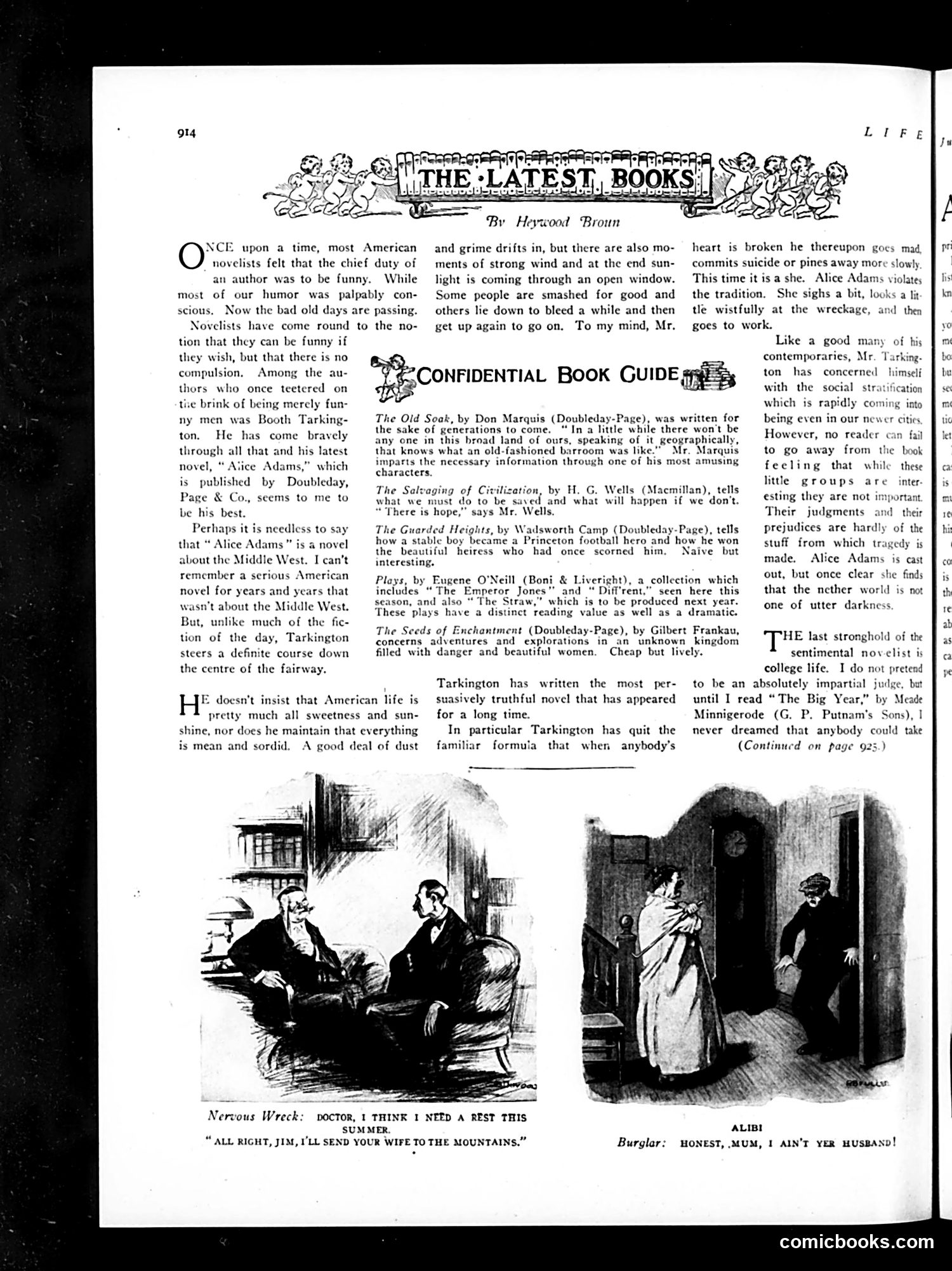
This page reviews recent novels by Booth Tarkington and others. The two cartoons illustrate common literary tropes that the reviewer discusses. **Left cartoon ("Nervous Wreck"):** A doctor tells a patient he needs rest and will send his wife to the mountains—a joke about husbands seeking relief from their spouses' presence. **Right cartoon ("Alibi"):** A burglar tells a woman "Honest, mum, I ain't yer husband!"—reversing the previous joke, suggesting husbands are as unwelcome as criminals. Both cartoons mock domestic discord, a recurring theme in American fiction of the era. Broun praises Tarkington's *Alice Adams* for departing from sentimental convention: rather than descending into madness or suicide when her heart breaks, the protagonist simply "sighs a bit" and returns to work—a more realistic portrayal of female resilience than typical of the period's novels.
📄 Transcribed text from this page (OCR, searchable)
Machine-transcribed from the original scan — historical spelling and the odd misread are preserved.
CE upon a time, most American novelists felt that the chief duty of an author was to be funny. While most of our humor was palpably con- scious, Now the bad old days are passing. Novelists have come round to the no- tion that they can be funny if they wish, but that there is no compulsion. Among the au- thors who once teetered on the brink of being mercly fun- ny men was Booth Tarkin; ton. val He has come bravely through all that and his latest novel, “ Atice Adams,” which is published by Doubleday, Page & Co., seems to me to be his best Perhaps it is needless to say that “ Alice Adams” is a novel about the Middle West. I can’t remember a serious American the b novel for years and years that includes wasn’t about the Middle West. But, unlike much of the fic- tion of the day, Tarkington steers a definite course down the centre of the fairway. I | doesn't insist that American life is pretty much all sweetness and sun- shine, nor does he maintain that everything is mean and sordid. A good deal of dust Nervous Wrec SUMMER. The Old Soa the sake of generations to come. how a stable boy tiful interesting. Plays, by Eugene O'Neill (Boni & Liveright), season, and also “ The Straw These ‘plays have a dist concerns adventures and filled with danger and beautiful women. By Heywood Broun and grime drifts in, but there are also mo- ments of strong wind and at the end sun- light is coming through an open window. Some people are smashed for good and others lie down to bleed a while and then get up again to go on. To my mind, Mr. CONFIDENTIAL BOOK GUIDE; st do to be save The Guarded Heights, by Wadsworth Camp (Doubleday-Page), tells ne a Princeton football hero and how he won Naive heiress who had once scorned him, he Emperor Jones” and " Diff'ren The Seeds of Enchantment (Doubleday-Page), by Gilbert Frankau, explorations in an unknown kingdom Cheap but lively. Tarkington has written the most per- suasively truthful novel that has appeared for a long time. In particular Tarkington has quit the familiar formula that when anybody's DOCTOR, I THINK I NEED A REST THIS. “ ALL RIGHT, JIM, I'LL SEND YOUR WIFE TO THE MOUNTAINS.” by Don Marquis (Doubleday-Page), was written for “Ina little while there won't be any one in this broad land of ours, speaking of it geographically, that knows what an old-fashioned barroom was like. imparts the necessary information through one of his mos' characters. The Salvaging of Civili what we m “There is hope,” says Mr. Wells. Mr. Marquis n, by H. G. Wells (Macmillan), tells and what will happen if we don’t. collection which " seen here this .” which is to be produced next year. ct reading value as well as a dramatic. heart is broken he thereupon goes mad, commits suicide or pines away more slowly This time it isa she. Alice Adams violates the tradition. She sighs a bit, looks a lit tle wistfully at the wreckage, and then goes to work, Like a good many contemporaries, Mr. ton with of his Tarking- has the tion which is rapidly coming into being even in our newer cities concerned himself social strati However, no reader « to go away from the feeling that book these inter: amusing while are litle groups judgments their prejudices are hardly of the stuff from which tra made. Ali out, but once clear she finds that the nether world is not one of utter darkness. but HE last stronghold of the sentimental nov-clist is college life. I do not pretend to be an absolutely impartial judge, but until I read “The Big Year,” by Meade Minnigerode (G. P. Putnam's Sons), | never dreamed that anybody could take (Continued on page 92 HONEST, .MUM, I AIN'T YER HUSBAND! comicbooks.com