
A complete issue · 36 pages · 1921
Life — June 16, 1921
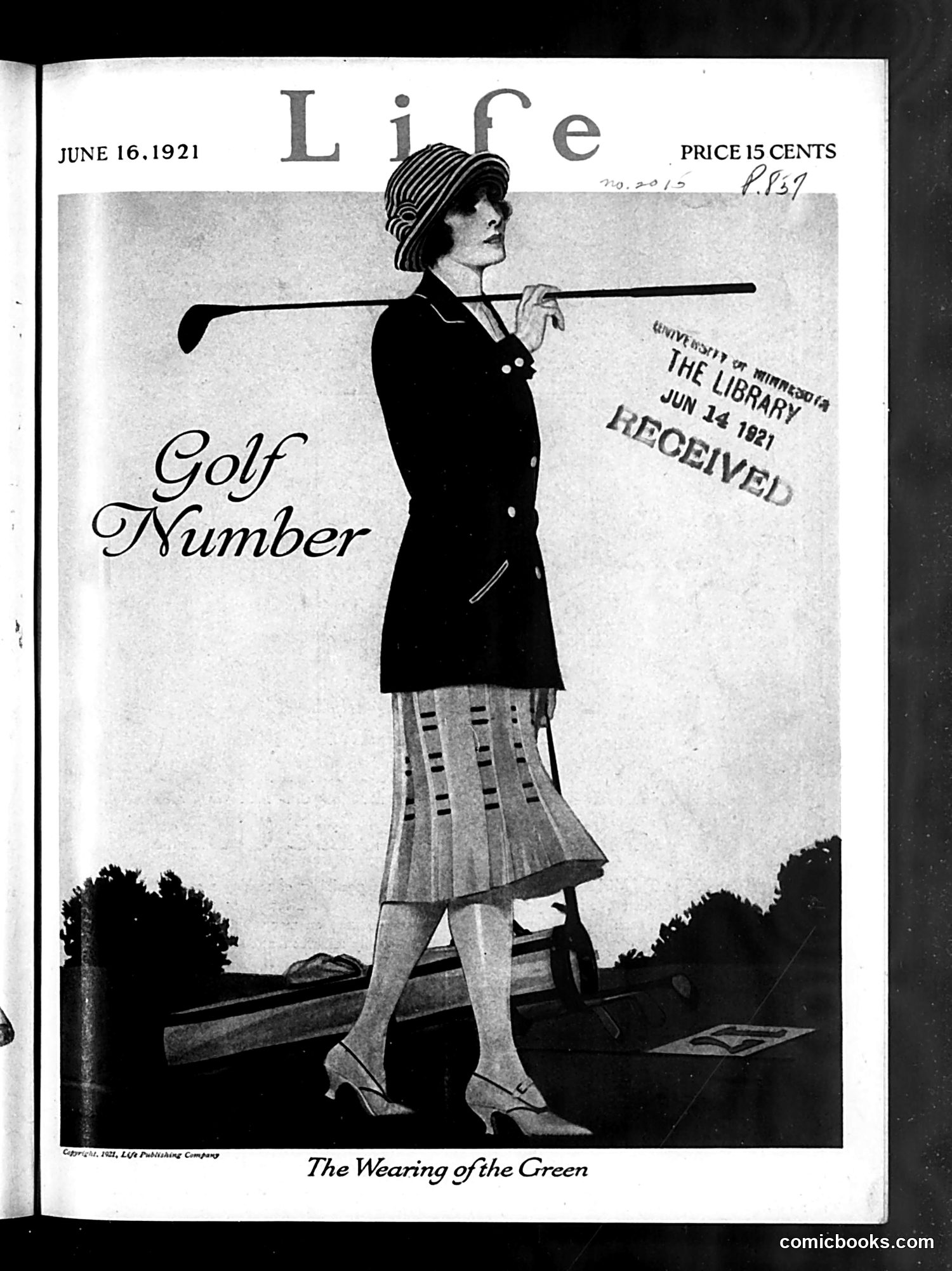
This cover satirizes women's increasing participation in golf during the 1920s. The illustration shows a fashionably dressed woman in modern athletic wear—a short pleated skirt, jacket, and hat—preparing to swing a golf club on a course. The satire targets "The Wearing of the Green," a phrase suggesting both the golf course and the social implications of women entering this traditionally male-dominated sport. The woman's confident posture and stylish outfit reflect the "New Woman" of the Jazz Age, challenging conventional gender roles. At 15 cents, this "Golf Number" likely contained articles and advertisements about women's growing participation in sports and leisure activities—a significant cultural shift in post-WWI America when women had recently gained voting rights.
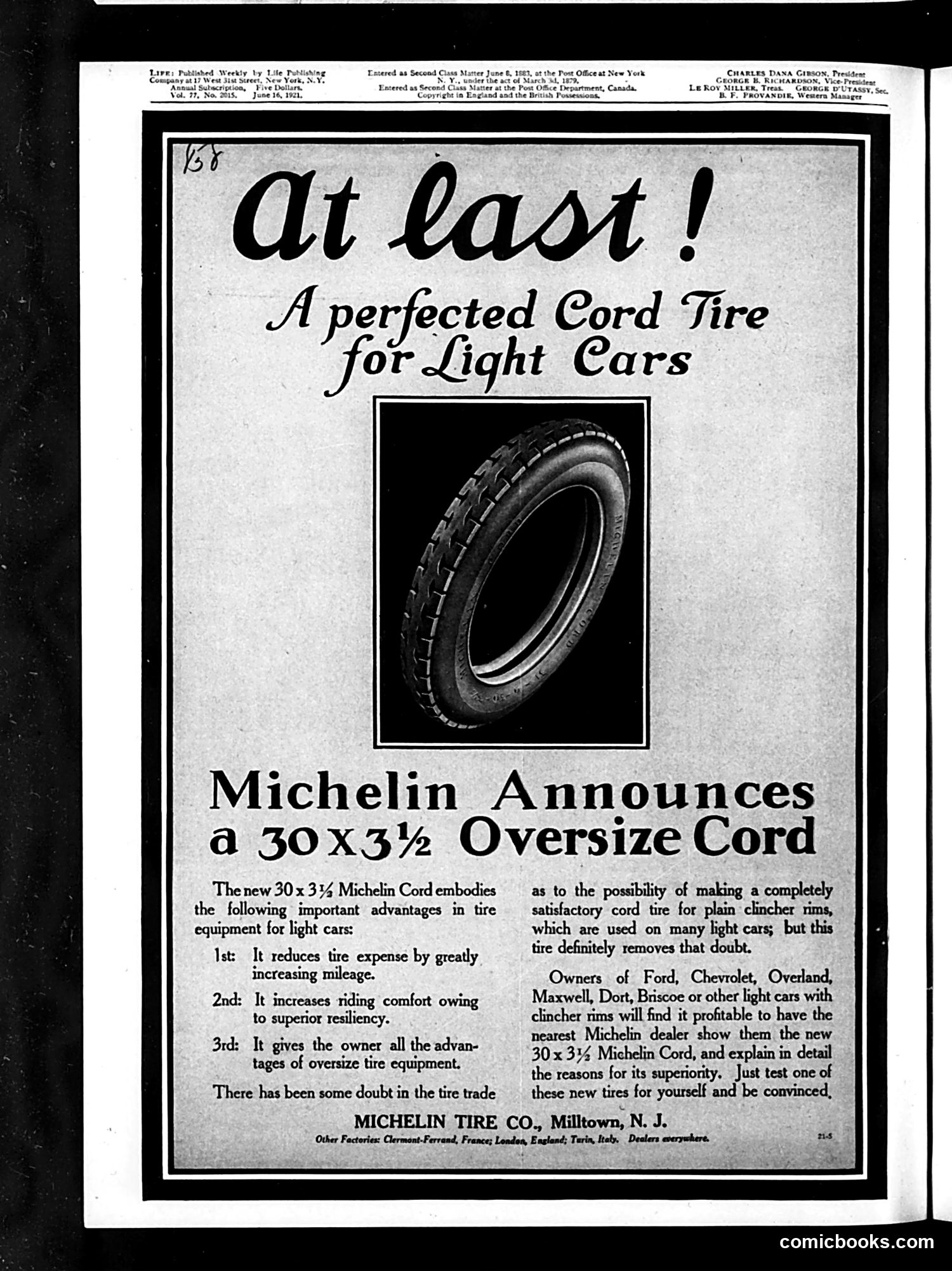
This page is **primarily an advertisement**, not satirical content. It's a Michelin Tire Company advertisement announcing a new 30x3½ oversized cord tire designed for light cars (Ford, Chevrolet, Overland, Maxwell, Dort, Briscoe models are mentioned). The ad emphasizes three benefits: reduced tire expenses through increased mileage, improved riding comfort, and access to oversize tire equipment advantages. It addresses skepticism in the tire industry about manufacturing satisfactory cord tires for plain clincher rims commonly used on light cars. The layout and typography are typical early 1920s advertising design, with the product image centered and benefit statements clearly listed. There are no political references, caricatures, or satire present—this is straightforward commercial promotion.
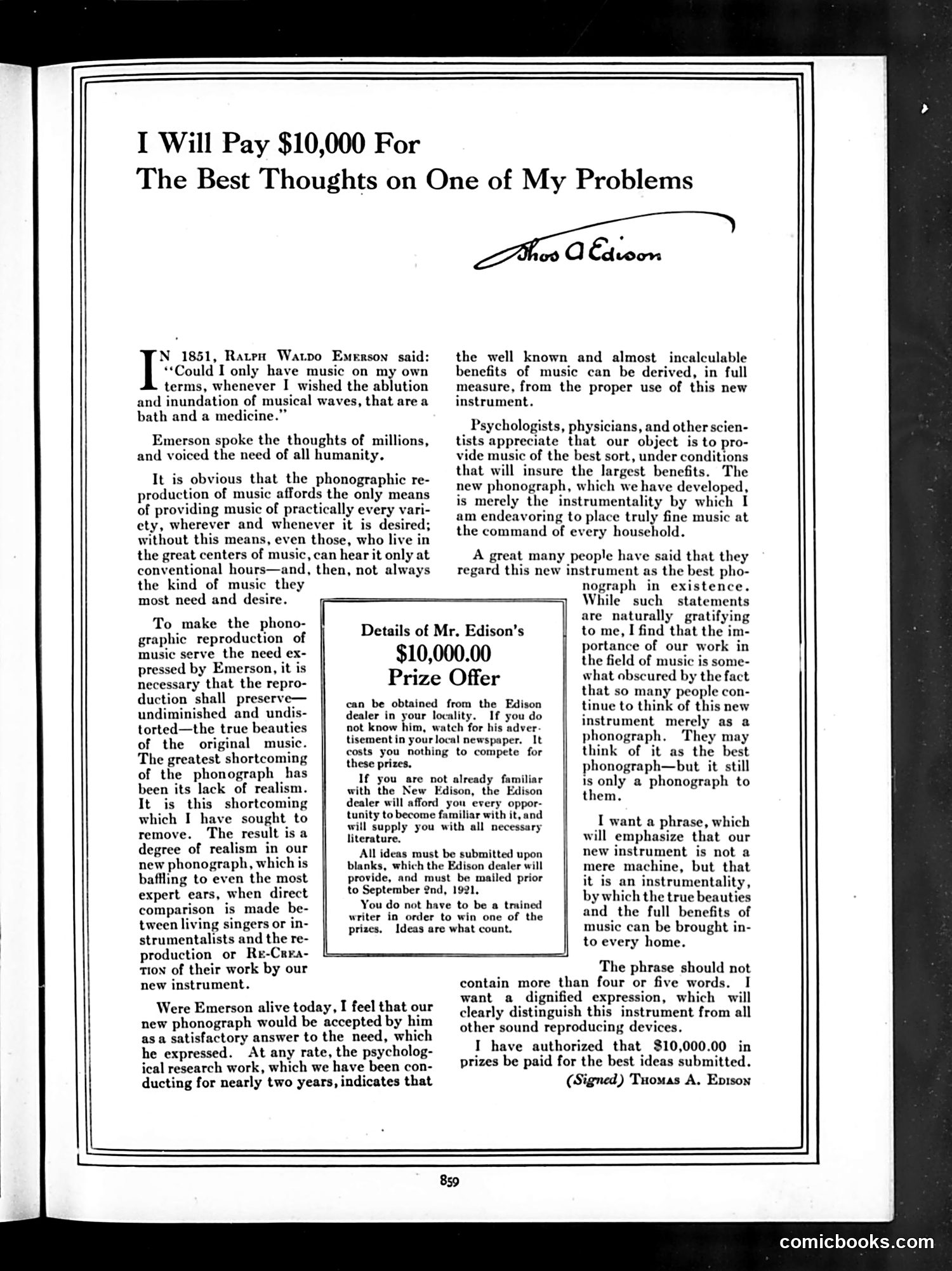
This is **not a political cartoon or satire**—it's a straightforward advertisement and business announcement from Thomas A. Edison. Edison is offering **$10,000 (substantial money in 1921) for the best written phrase** describing his phonograph. He wants a short, dignified expression (4-5 words maximum) that distinguishes his phonograph from other sound-reproduction devices. The contest rules are clear: ideas must be submitted to Edison dealers by September 2, 1921. Edison emphasizes that trained writers needn't apply—"Ideas are what count." The underlying pitch is that Edison's phonograph isn't merely a machine but an "instrumentality" bringing music into every home. This represents Edison promoting his phonograph technology during the era when recorded music was becoming a consumer product.
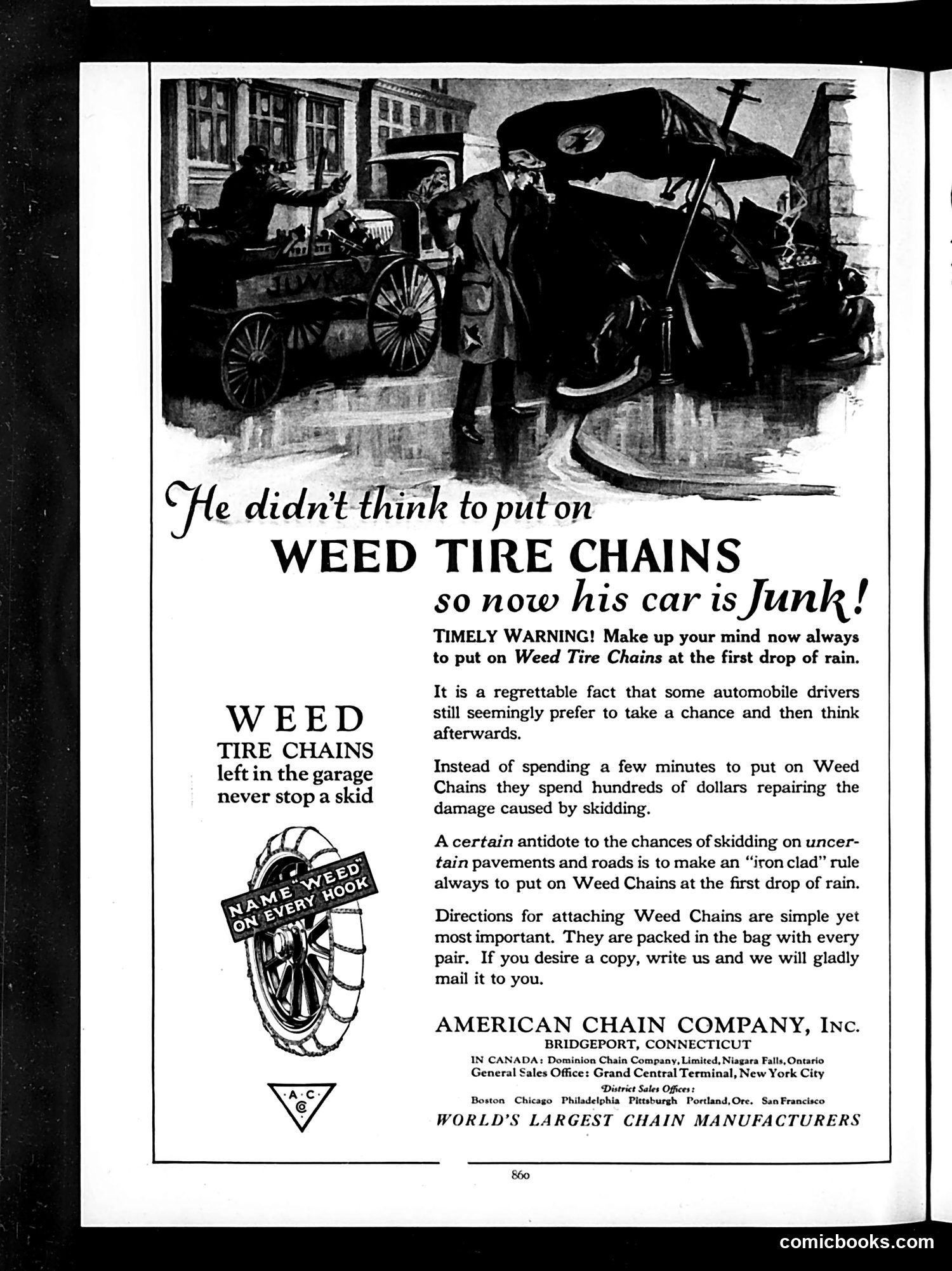
This is **not a satirical cartoon but a straightforward advertisement** for Weed Tire Chains, a safety product for automobiles. The image shows a cautionary scenario: a man standing between two vehicles in what appears to be wet or icy conditions, illustrating the consequence of failing to install tire chains. The headline "He didn't think to put on WEED TIRE CHAINS so now his car is junk!" serves as a warning about vehicle skidding accidents. The ad emphasizes that drivers should proactively install chains "at the first drop of rain" rather than risk costly damage from skidding on uncertain pavement. It positions Weed Tire Chains as the preventive solution, manufactured by American Chain Company of Bridgeport, Connecticut. This represents straightforward early-20th-century safety advertising using fear and consequence to motivate consumer behavior.
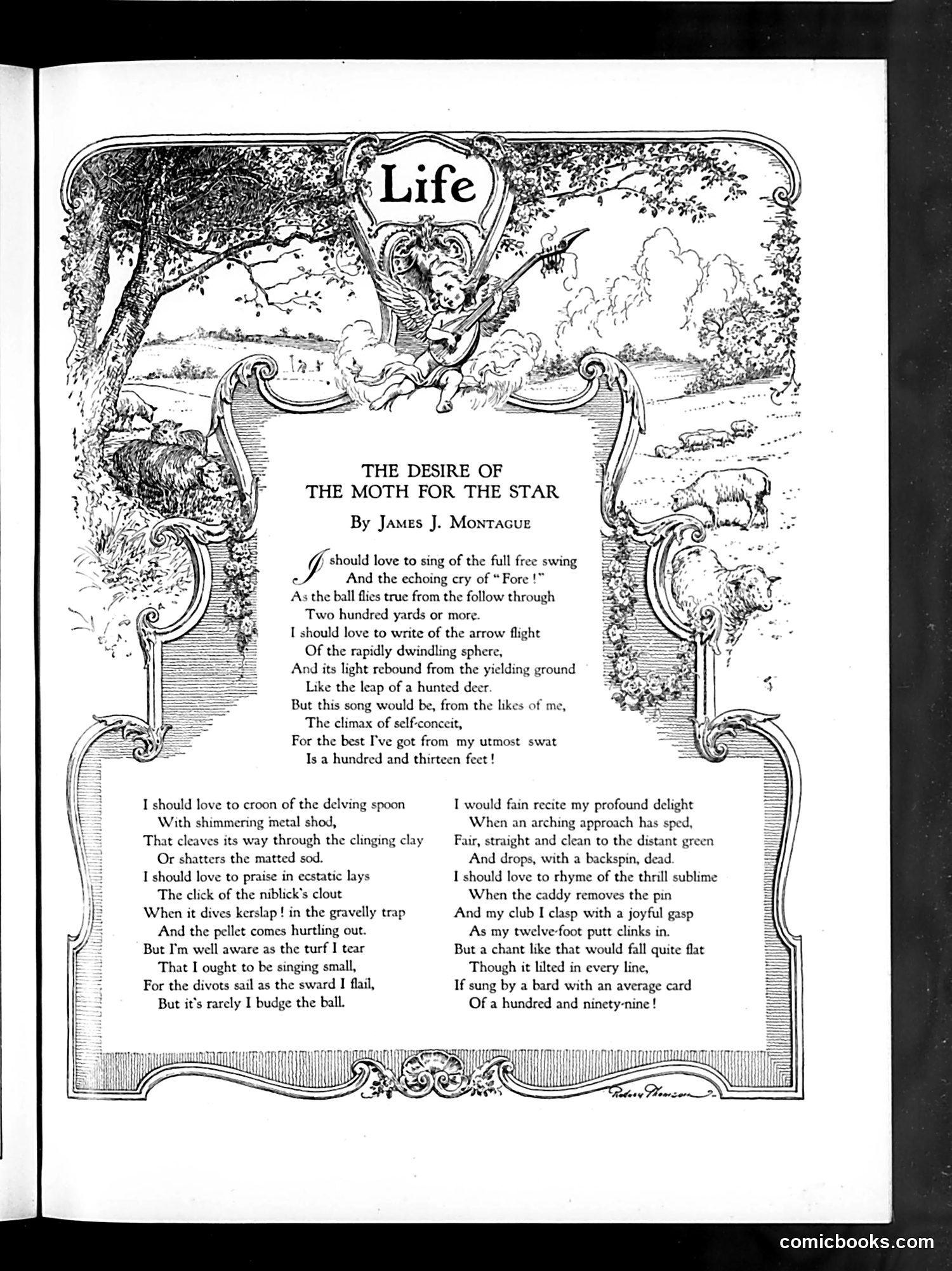
This is a humorous poem by James J. Montague published in *Life* magazine. The piece gently mocks golfers' aspirations versus their actual abilities. The poem contrasts what the speaker *wishes* to accomplish on the golf course—long, powerful drives with perfect form—against the reality of his mediocre performance. He dreams of hitting 200+ yard drives and making graceful shots, but admits his best actual distance is "a hundred and thirteen feet." The satirical conceit compares the golfer's unrealistic ambitions to a moth's futile desire to reach a star. The decorative border illustration shows a pastoral landscape, reinforcing the leisure-sport context. This is gentle satire of recreational golf culture and human overconfidence in one's abilities.
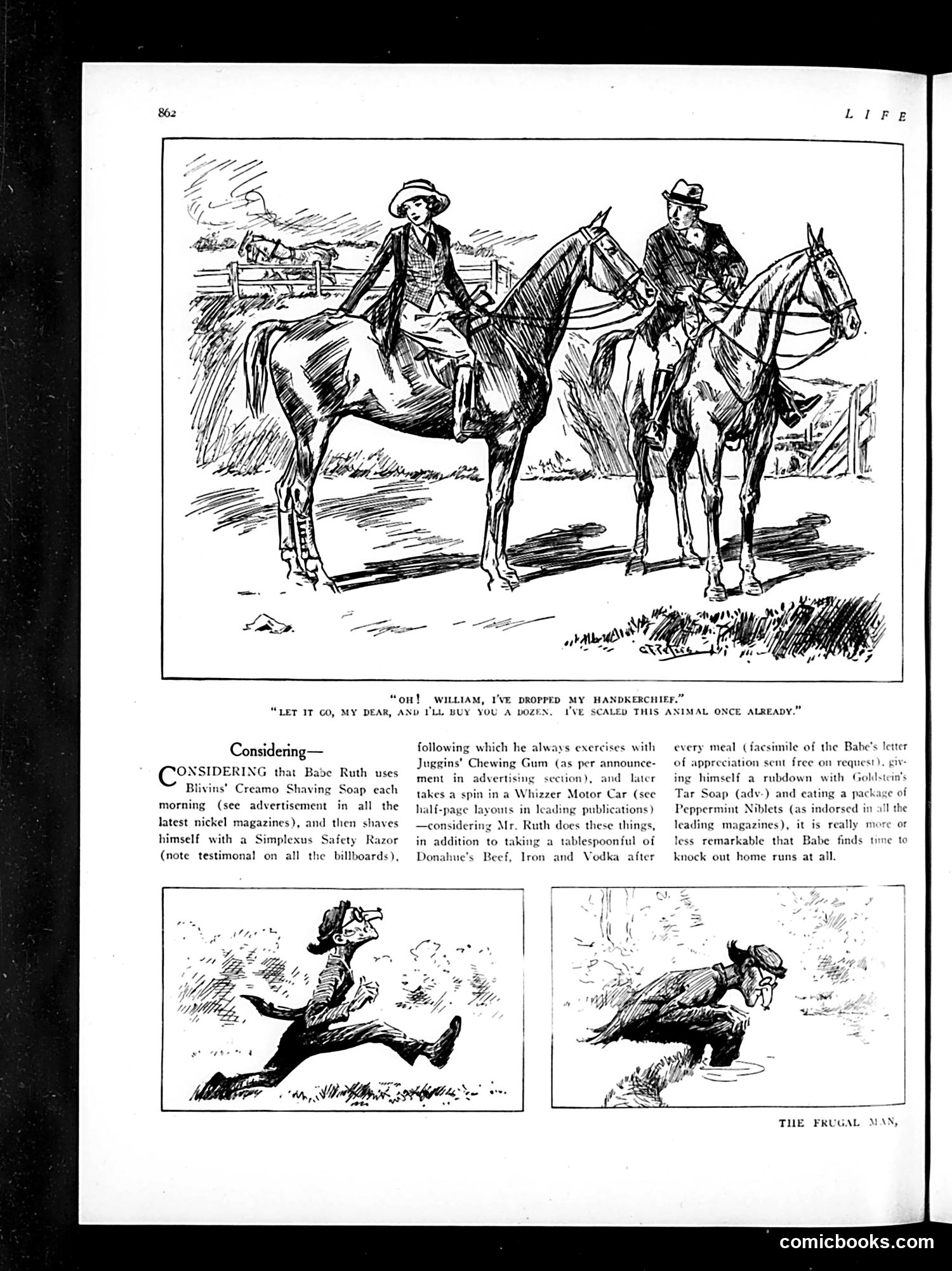
This page satirizes **Babe Ruth**, the famous baseball player. The top cartoon shows Ruth on horseback, having dropped his handkerchief—a genteel mishap. The caption jokes that he's "scaled this animal once already," suggesting Ruth is an inexperienced rider attempting aristocratic pursuits. The text below describes Ruth's daily routine with humorous exaggeration: using Blivin's Creamo Shaving Soap, a Simplexus Safety Razor, Juggins' Chewing Gum, and a Whizzer Motor Car. The satire portrays Ruth as a commercial product endorser consuming branded goods constantly—mocking both celebrity advertising and Ruth's rapid ascent from baseball player to cultural icon. The bottom cartoons labeled "The Frugal Man" appear unrelated side-gags about economical behavior.
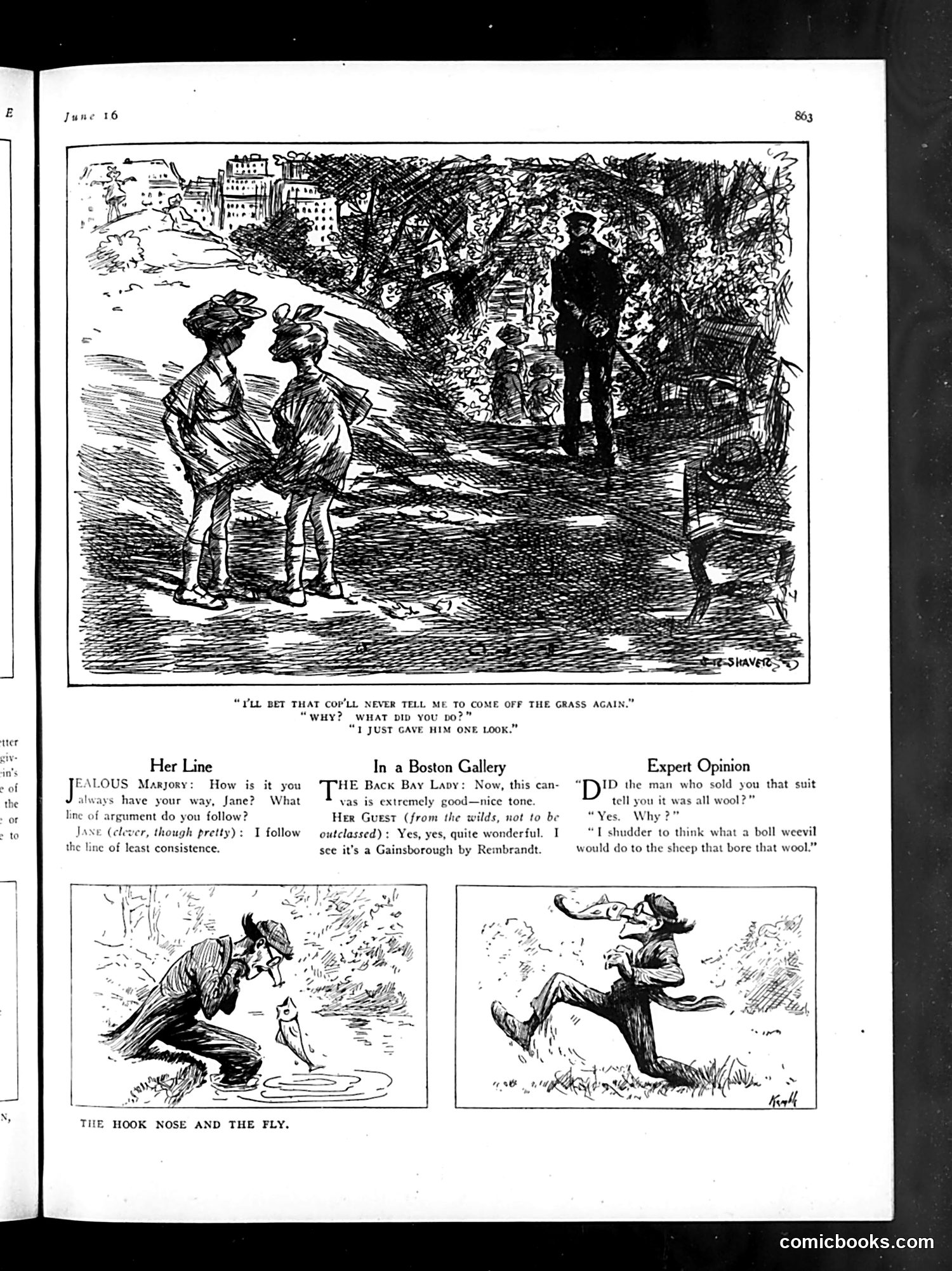
This page contains three separate humorous sketches with minimal political content: **Top cartoon**: A social scene where a woman warns a man never to come off the grass again after she "gave him one look." The joke relies on the power of a woman's disapproving glance as social punishment. **"Her Line"**: A dialogue joke about logical consistency—a woman follows the "line of least resistance" in arguments. **"In a Boston Gallery"**: Art appreciation humor where a guest mistakes a Gainsborough painting for an authentic work. **"Expert Opinion"**: A joke about wool expertise—a man who bought a suit is told it's actually sheep's wool. **Bottom sketches** ("The Hook Nose and the Fly" and another illustration): Appear to be slapstick physical comedy, though details are unclear. The page is primarily **social satire and domestic humor** rather than political commentary.
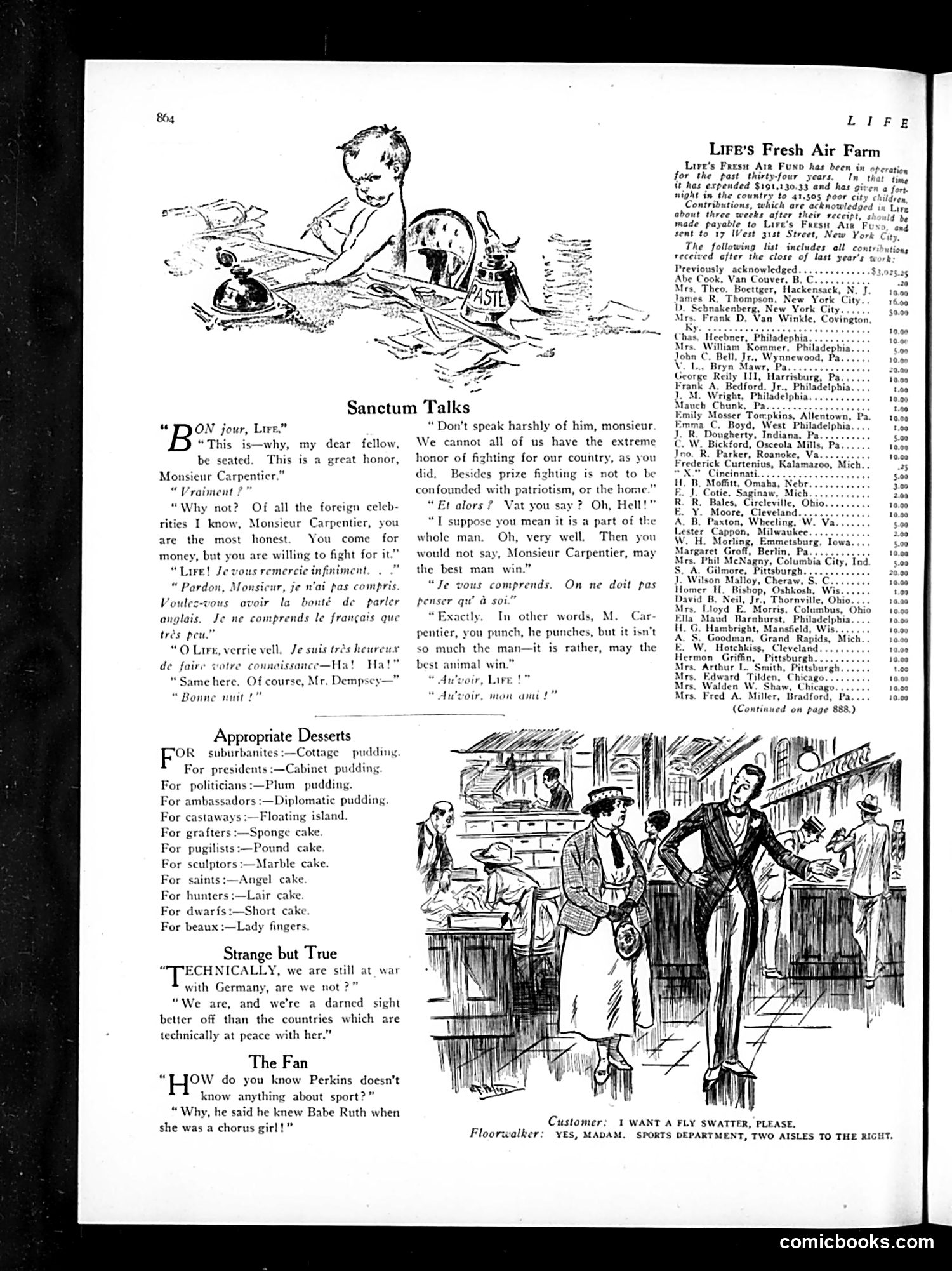
This page contains three separate pieces of humor rather than a unified cartoon. **"Sanctum Talks"** presents a dialogue between "LIFE" and "Monsieur Carpentier" (likely boxer Georges Carpentier), discussing fighting, patriotism, and honor. The joke plays on linguistic misunderstandings and cultural differences. **"Appropriate Desserts"** is a humorous list matching dessert types to social classes—cottage pudding for suburbanites, plum pudding for politicians, etc. It's satirical social commentary about class stereotypes. **"The Fan"** and **"Strange but True"** are brief jokes about sports knowledge and wartime Germany. The right side shows a department store scene with the caption about a customer seeking a "fly swatter" in the sports department, a visual pun playing on the phrase "fly swatter."
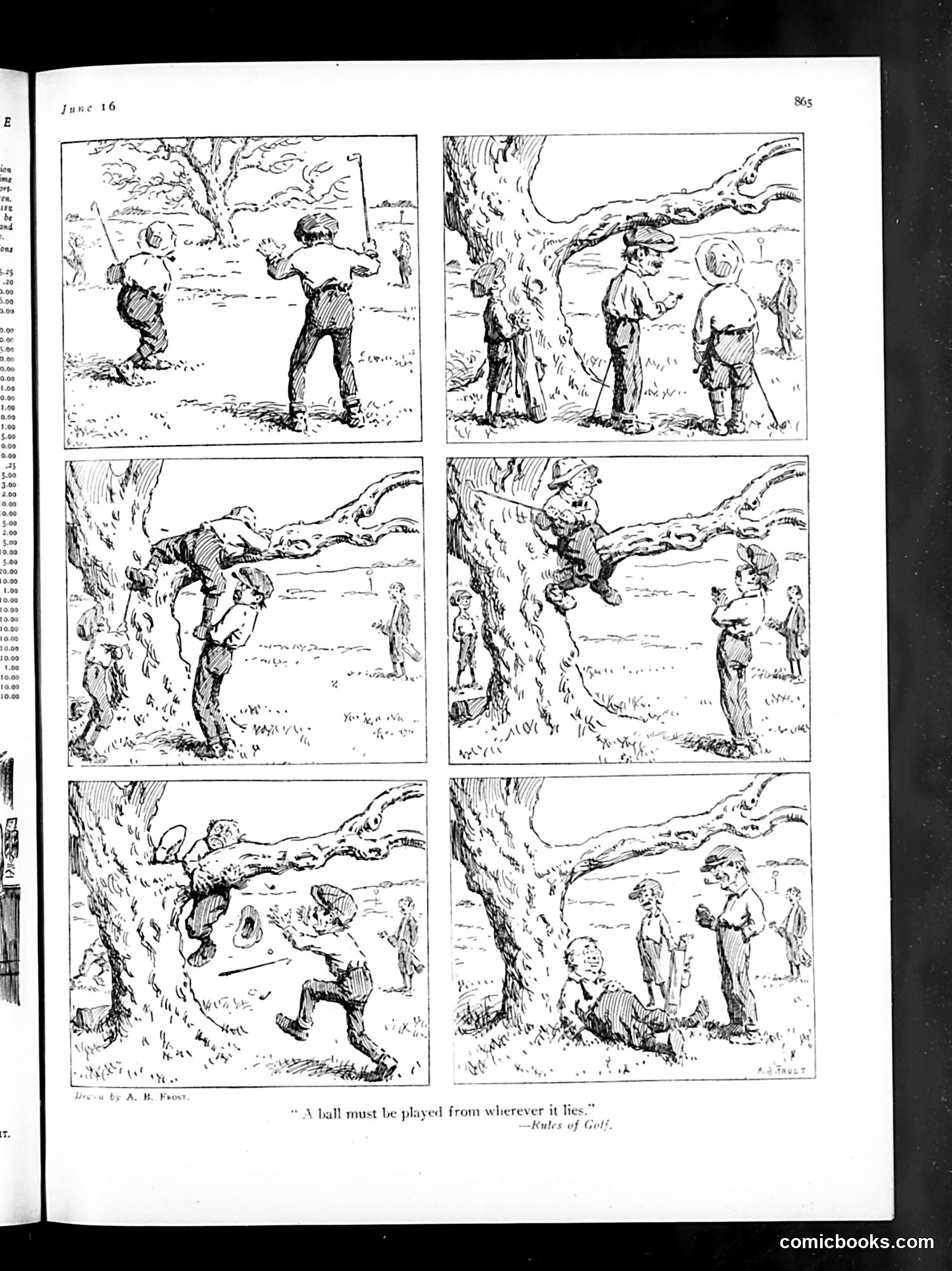
This is a six-panel comic strip showing golfers playing around a large tree. The narrative appears to depict a ball landing in increasingly difficult positions near or against the tree's trunk and roots, forcing players to attempt increasingly awkward shots. The caption quotes the "Rules of Golf": "A ball must be played from wherever it lies." This is straightforward sports humor—a visual joke about golf's actual rules. The comic illustrates the frustration players face when their ball lands in impossible-to-reach spots, forcing them to contort themselves physically to comply with the game's regulations. The artist is credited as A. H. Frost. No political or social satire is evident; this is simply recreational humor about the sport of golf and the literal application of its rules.
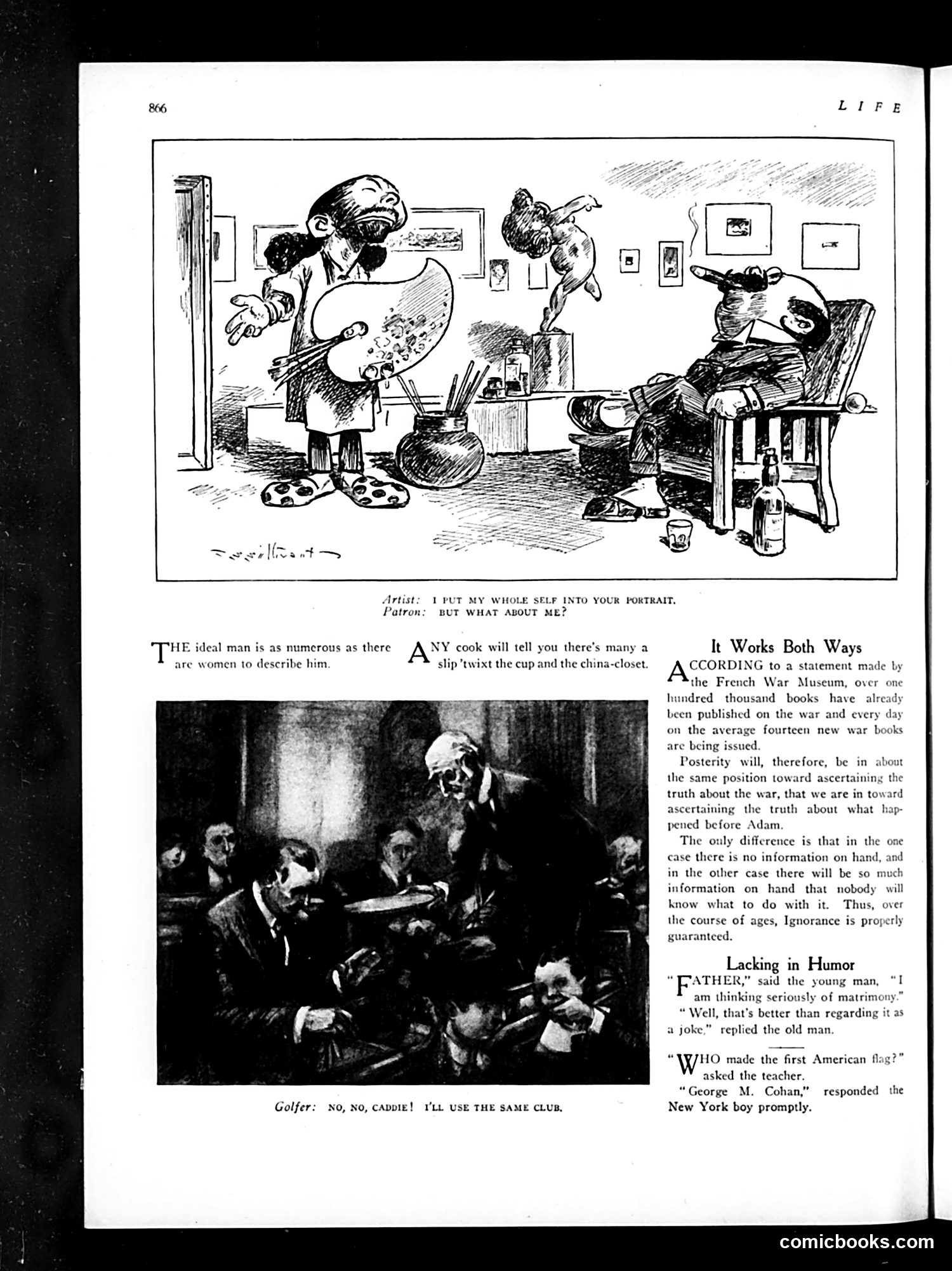
**Top Cartoon**: An artist shows a patron his portrait work, saying "I put my whole self into your portrait. But what about me?" This satirizes artistic ego—the painter wants credit alongside the subject's likeness. **Bottom Cartoon**: A golfer tells his caddie "No, no, caddie! I'll use the same club," mocking a golfer's tendency to blame equipment rather than skill for poor shots. **Articles**: "It Works Both Ways" discusses WWI book publishing (over 100,000 war books published, fourteen new ones daily), comparing historical uncertainty about war to biblical uncertainty about Adam. "Lacking in Humor" features a brief joke about an American boy answering "George M. Cohan" when asked who made the first American flag. The page combines visual humor with light commentary on contemporary issues.
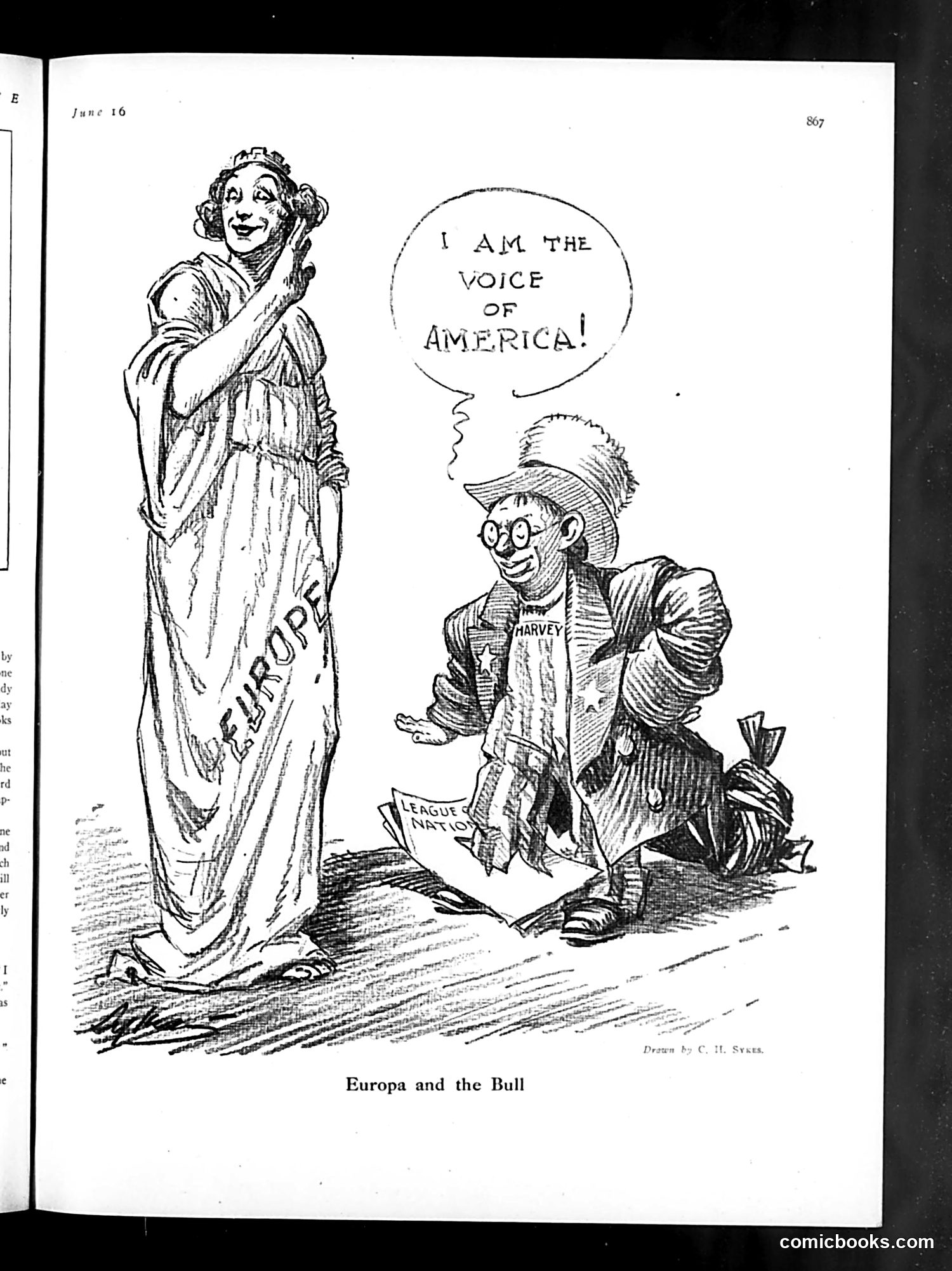
This political cartoon depicts the classical mythological figure of Europa (the robed woman on the left, labeled "EUROPE") alongside a caricatured man labeled "HARVEY" wearing a cap and suit. Europa declares "I AM THE VOICE OF AMERICA!" The cartoon satirizes American political or cultural influence over Europe. The title references the Greek myth where Zeus, transformed into a white bull, abducts Europa—suggesting Europe is being "carried away" by American interests or ideology, personified here as "Harvey" (likely a contemporary political figure, though the specific identity isn't clear from the visible text). The satire critiques American dominance or interference in European affairs, drawn by C.H. Sykes for Life magazine's June 16 issue.
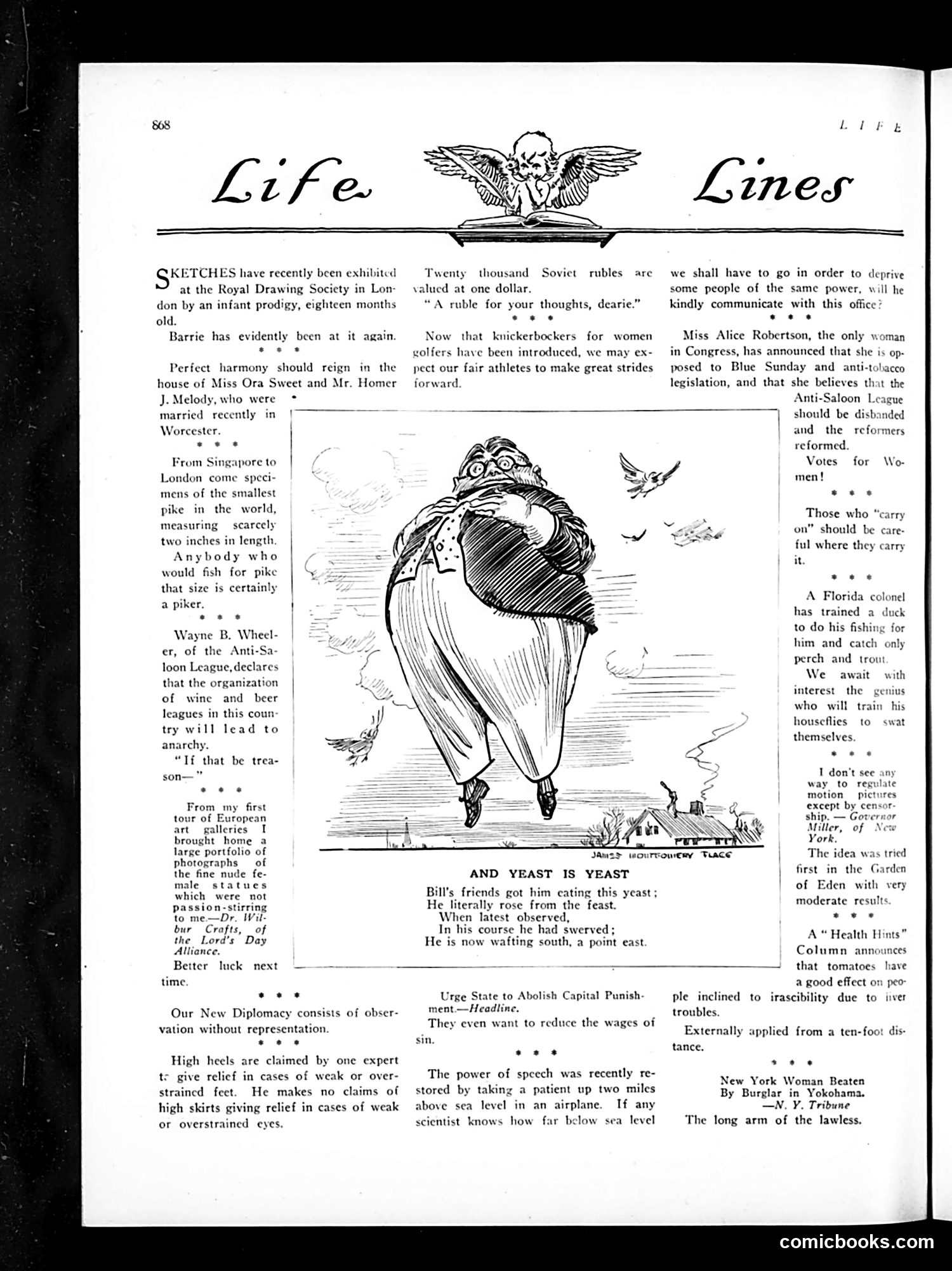
The central cartoon titled "AND YEAST IS YEAST" depicts a rotund figure in formal attire rising upward—a visual pun on yeast's leavening properties. The accompanying verse states: "Bill's friends met him eating this yeast; / He literally rose from the feast. / When last observed, / In his course he had swerved; / He is now wafting south, a point east." The joke plays on the dual meaning of "rise"—both the literal rising of yeast in baking and the figurative rise in social status or fortune. The cartoon suggests someone named Bill has been transformed by consuming yeast, now floating upward and away. This appears to be a whimsical, nonsensical satire typical of Life's absurdist humor from this era, rather than commentary on specific political figures or events.
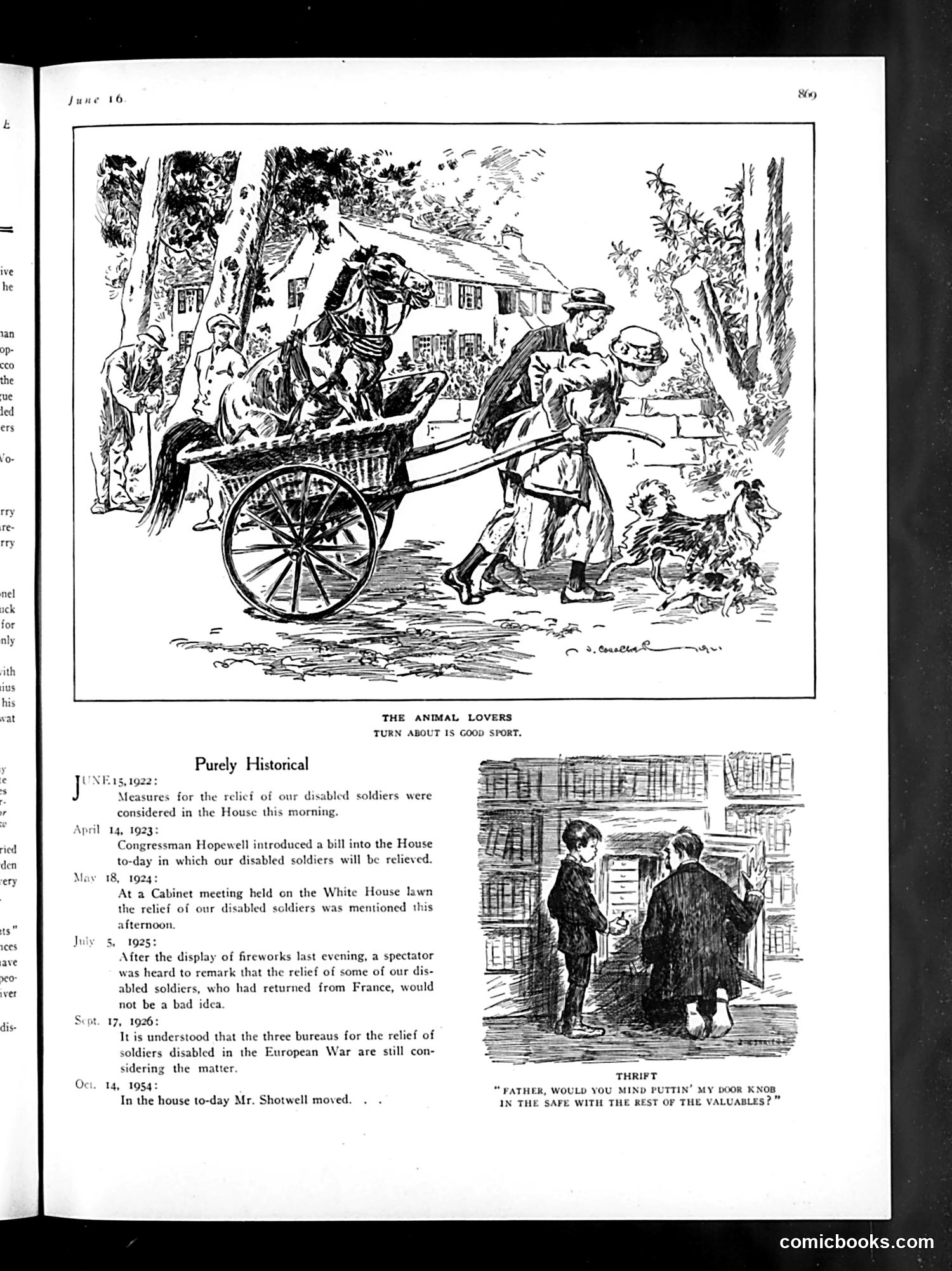
This page contains two distinct cartoons: **Top cartoon ("The Animal Lovers Turn About Is Good Sport"):** Shows well-dressed people in a cart being pulled by a man, with a dog running alongside. The satire appears to criticize wealthy "animal lovers"—people who advocate for animal welfare while treating working-class humans poorly. The ironic reversal (humans pulling the cart instead of horses) mocks their hypocrisy. **Bottom cartoon ("Thrift"):** Depicts two men in a library. The dialogue reads: "Father, would you mind puttin' my book knob in the safe with the best of the valuables?" This jokes about a young person asking his father to safeguard a cheap item as if it were precious—satirizing either foolish sentimentality or exaggerated caution about worthless possessions. Both cartoons use visual irony to mock contemporary social attitudes.
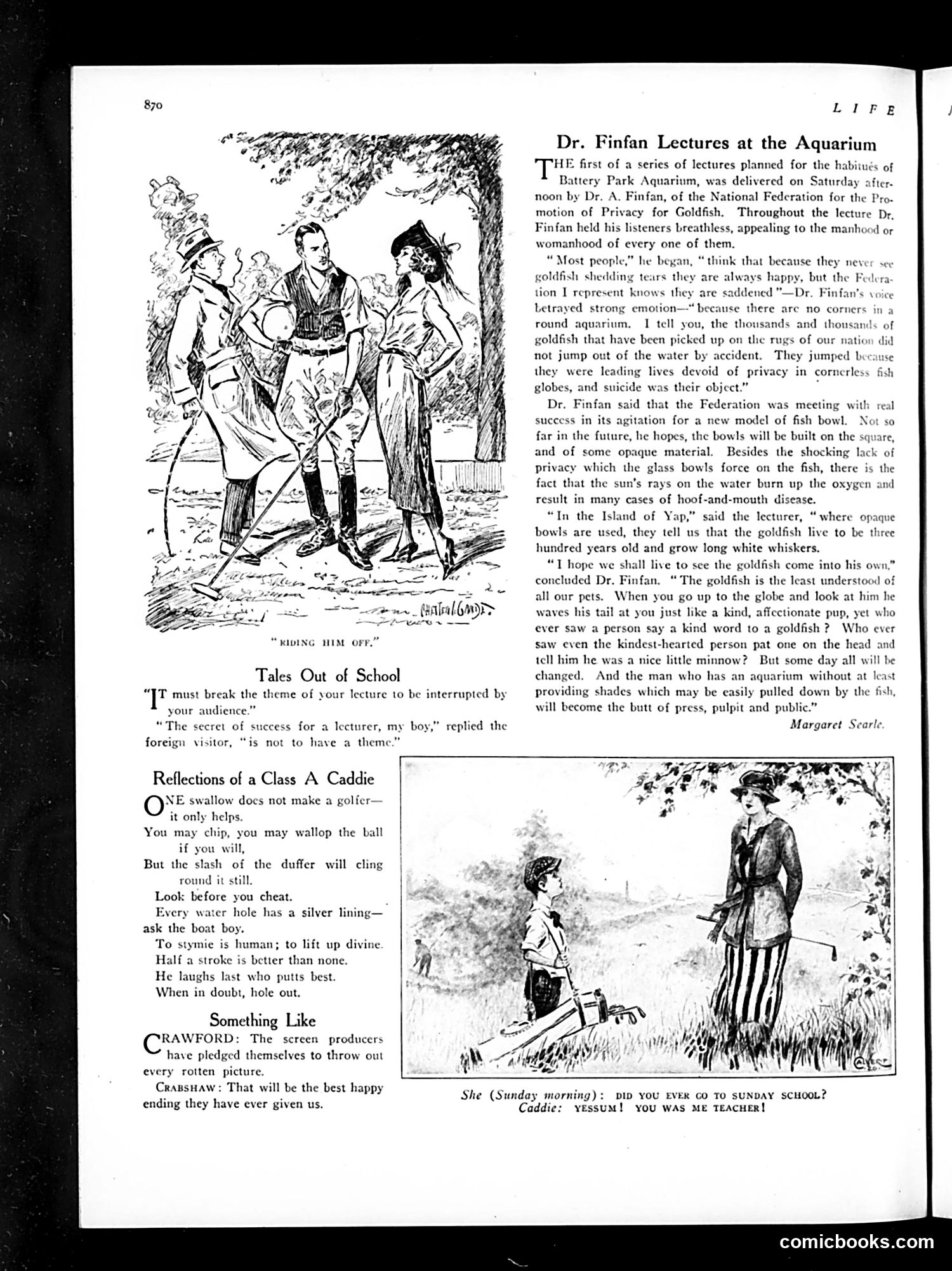
This page contains three distinct items: 1. **"Dr. Finnan Lectures at the Aquarium"**: An article with accompanying sketch about a lecture promoting privacy for goldfish in aquariums. The satire mocks the Federation for the Promotion of Privacy for Goldfish—a humorous fictional organization—arguing that fish suffer psychological distress from constant visibility in glass bowls. The piece is tongue-in-cheek social commentary using animal welfare as absurdist humor. 2. **"Tales Out of School"**: A brief anecdote about lecture interruption, unrelated to the fish content. 3. **"Reflections of a Class A Caddie"** and **"Something Like Crawford"**: Golf-themed humor pieces. The caddie poem offers wry observations about golf etiquette; the Crawford item jokes about screen producers throwing out "rotten pictures." The page primarily features light humor and social satire typical of *Life* magazine's satirical style.
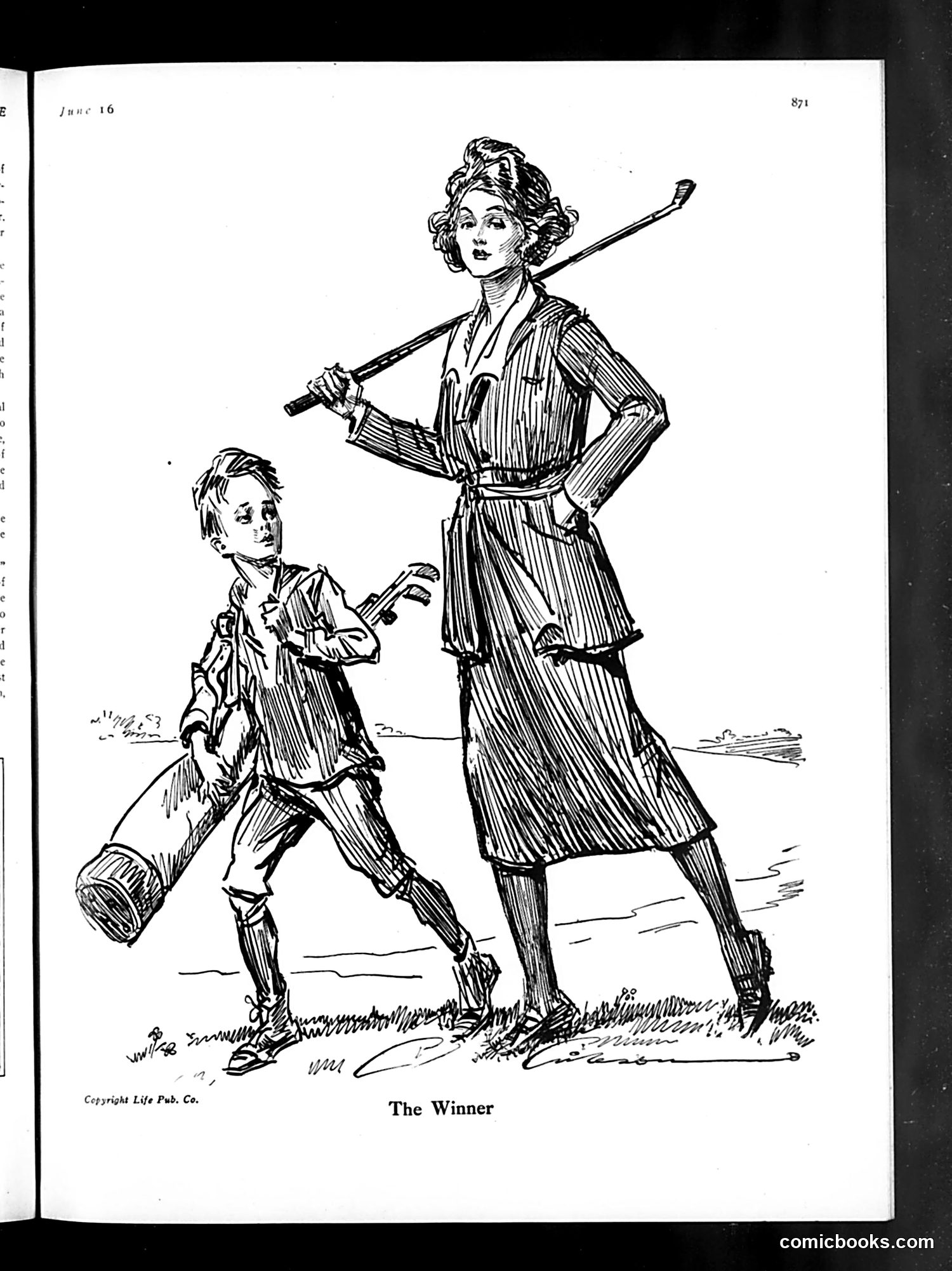
This illustration depicts a woman and child playing hockey together, titled "The Winner." The image appears to be satirical commentary on early 20th-century gender roles and women's athletics. The adult woman is portrayed actively engaged in sports—wielding a hockey stick with confidence and athleticism. The child mirrors her pose, suggesting intergenerational participation in athletics. This likely mocks contemporary anxieties about women's increasing involvement in sports and physical activity, which traditionalists viewed as unfeminine or socially inappropriate. The cartoon probably references debates over women's emancipation and changing social norms during the progressive era. By depicting athletic women and children together, the illustrator may be satirizing either progressive acceptance of female athleticism or conservative fears about its cultural impact. The specific satirical stance (pro or con) remains unclear from the image alone.
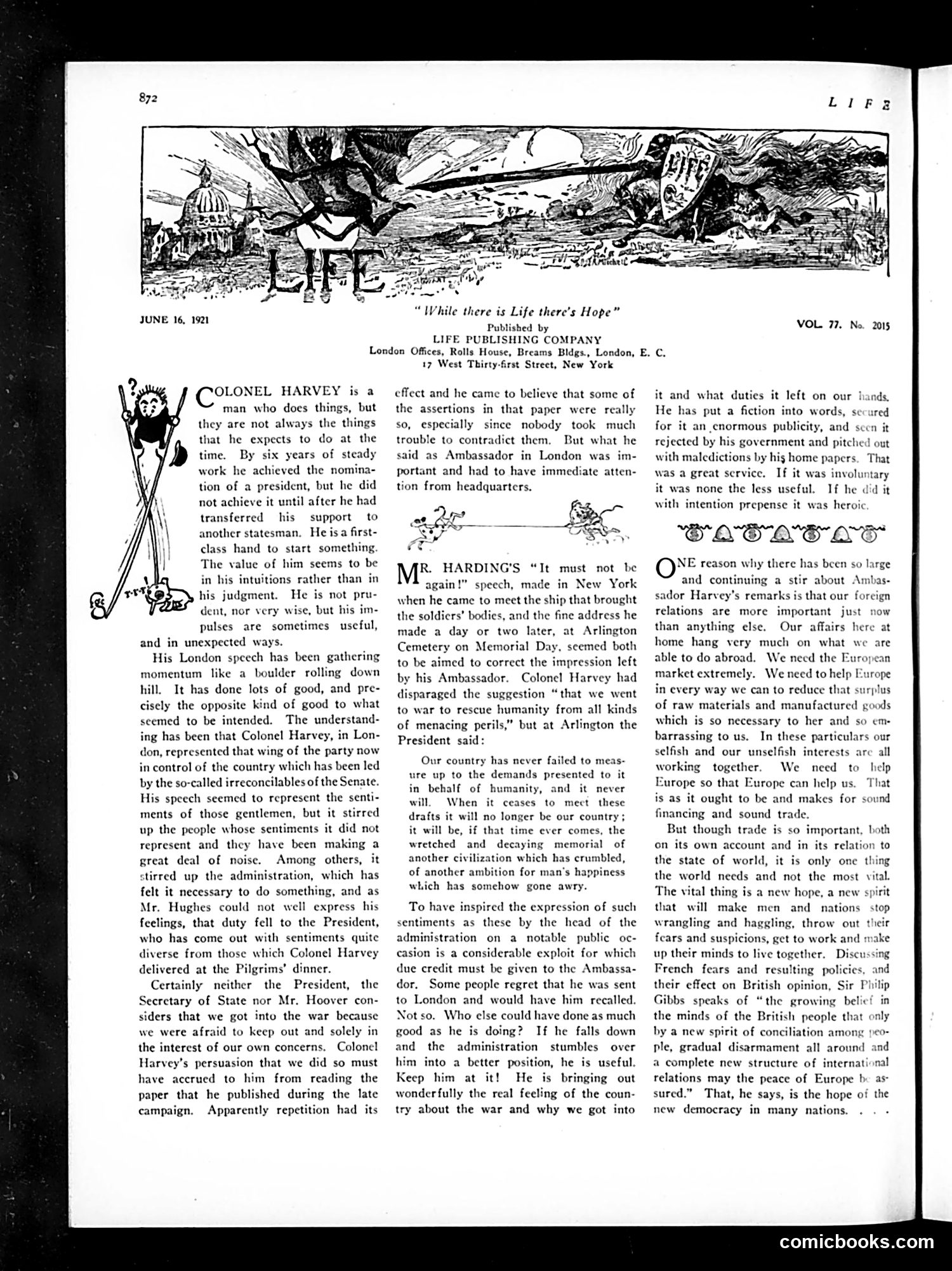
This page discusses **Colonel Harvey**, an American diplomat and politician who served as Ambassador to London. The article defends Harvey against criticism for statements he made publicly during his tenure, particularly remarks about foreign relations that stirred controversy. The text reveals Harvey had made assertions in newspapers that attracted unwanted attention from the State Department, prompting criticism he should be recalled. The article argues Harvey was performing a valuable service by frankly addressing America's post-WWI role and responsibilities toward Europe. The cartoon at top left (artist signature visible) appears to satirize the situation, though specific figures are difficult to identify clearly. The overall piece represents debate over diplomatic propriety and free speech during the early post-war period.
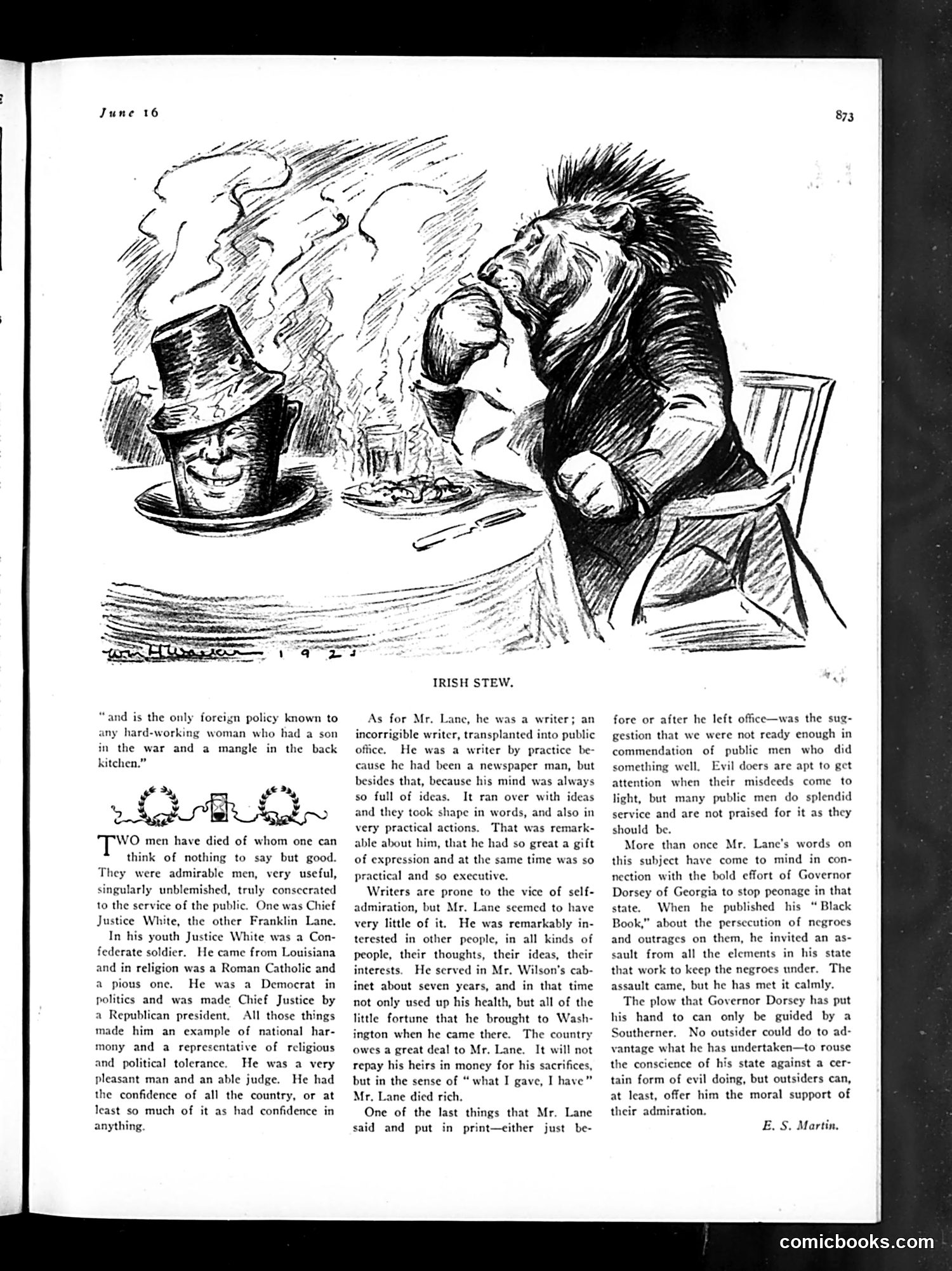
The cartoon depicts two figures at a table with a steaming pot—likely caricaturing political or public figures of the era through exaggerated facial features typical of period satire. The title "Irish Stew" suggests ethnic stereotype humor common to 1920s American satirical magazines. The accompanying text is an obituary-style tribute to two recently deceased men: Chief Justice Edward Douglass White and Franklin Lane (Secretary of the Interior under Wilson). The piece praises their public service and contrasts them—White as a symbol of sectional reconciliation (former Confederate, made Chief Justice by a Republican), Lane as a prolific writer and selfless government servant. The text also discusses Governor Hugh M. Dorsey of Georgia's efforts combating racial peonage through his "Black Book," suggesting the magazine supported this anti-peonage stance while acknowledging Southern resistance. The satire's specific target remains unclear from the image alone, though it likely comments on contemporary political figures or policies.
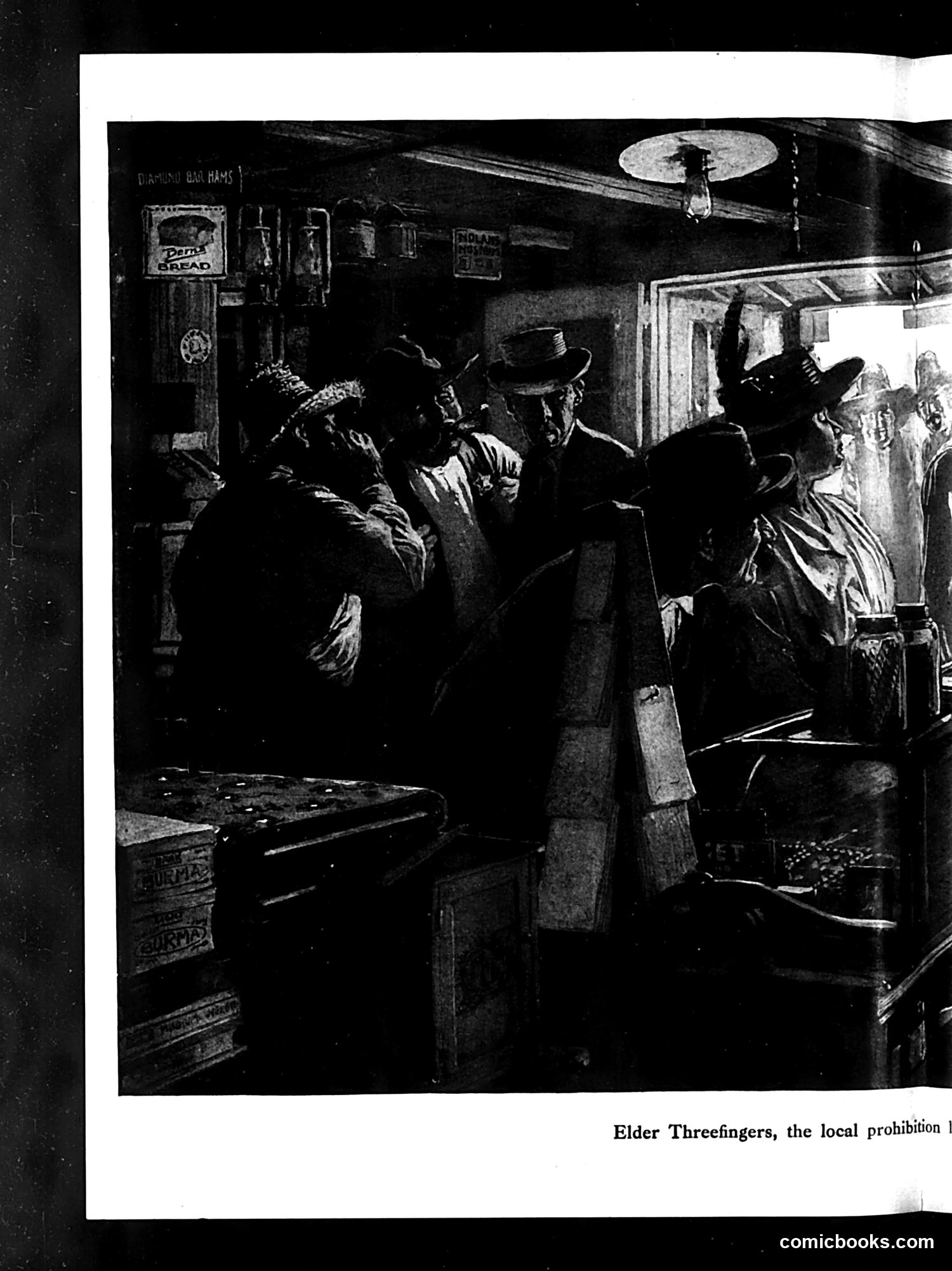
This appears to be a scene from a Prohibition-era satire in Life magazine. The caption identifies "Elder Threefingers" as "the local prohibition" figure—likely an authority enforcing alcohol bans. The image shows multiple men in period clothing (hats, coats) crowded inside what appears to be an illicit establishment or speakeasy. A door is open to bright exterior light on the right, suggesting either discovery or escape. Various period signs and fixtures are visible on the walls. The satire mocks Prohibition enforcement: "Elder Threefingers" (a comical name, possibly suggesting incompetence or graft) oversees a thriving secret drinking operation anyway. The packed interior jokes that despite official prohibition efforts, illegal bars flourished openly. This reflects real 1920s-30s social commentary about Prohibition's failure and corruption of local authorities.
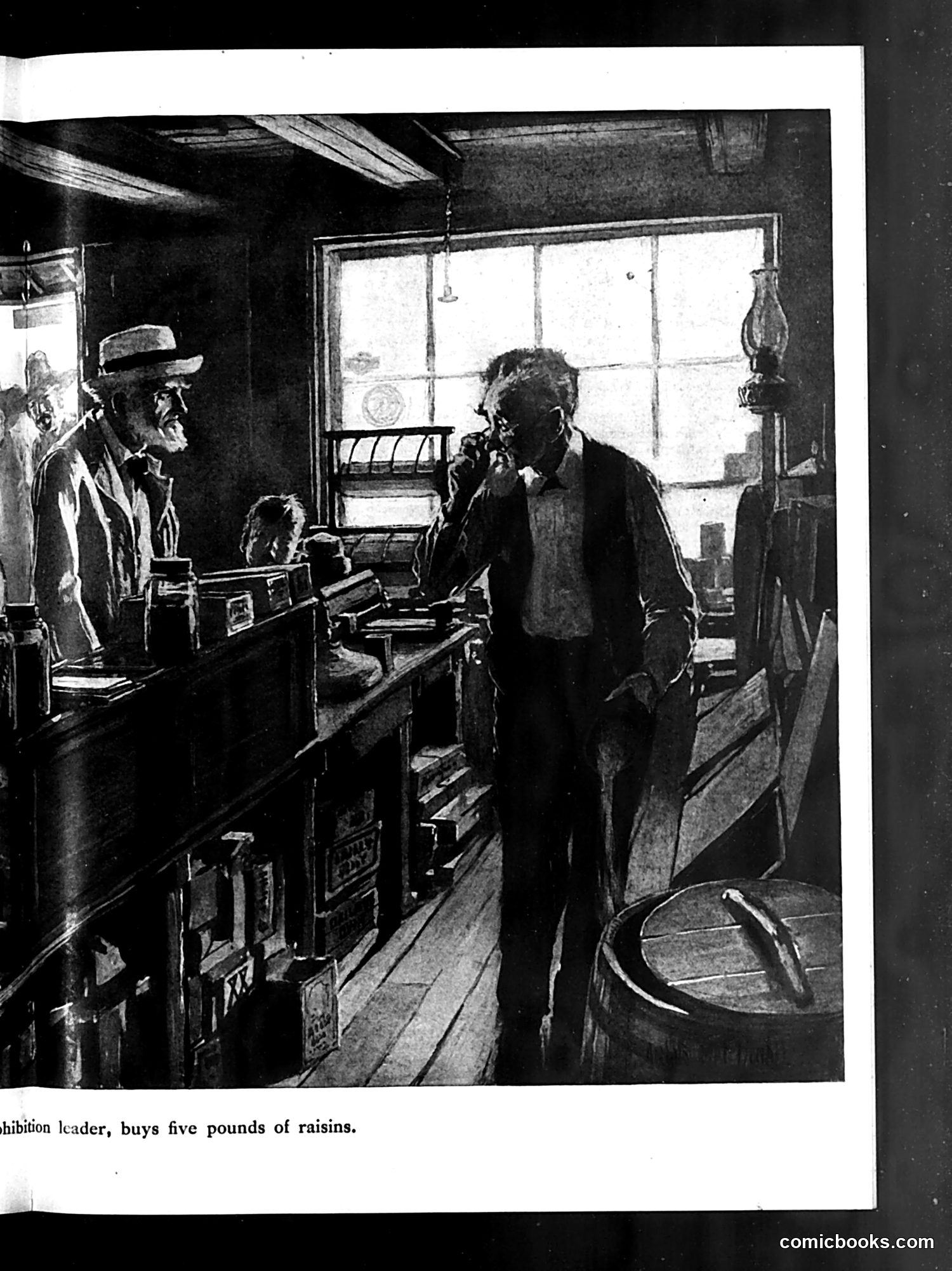
This black-and-white photograph shows what appears to be a general store or shop interior from the Prohibition era. The caption reads "hibition leader, buys five pounds of raisins" (likely reading "Prohibition leader, buys five pounds of raisins"). The satire is straightforward: a prominent Prohibition advocate is purchasing raisins—which were commonly used to make homemade wine or alcohol during Prohibition (1920-1933). This captures the hypocrisy of the movement: leaders publicly championed alcohol bans while privately circumventing them. The humor relies on the contradiction between the figure's public stance and private behavior, a common theme in Life magazine's political satire. Without seeing the full caption or identifying details, the specific individual remains unclear, but the target is clear: Prohibition movement leadership's moral inconsistency.
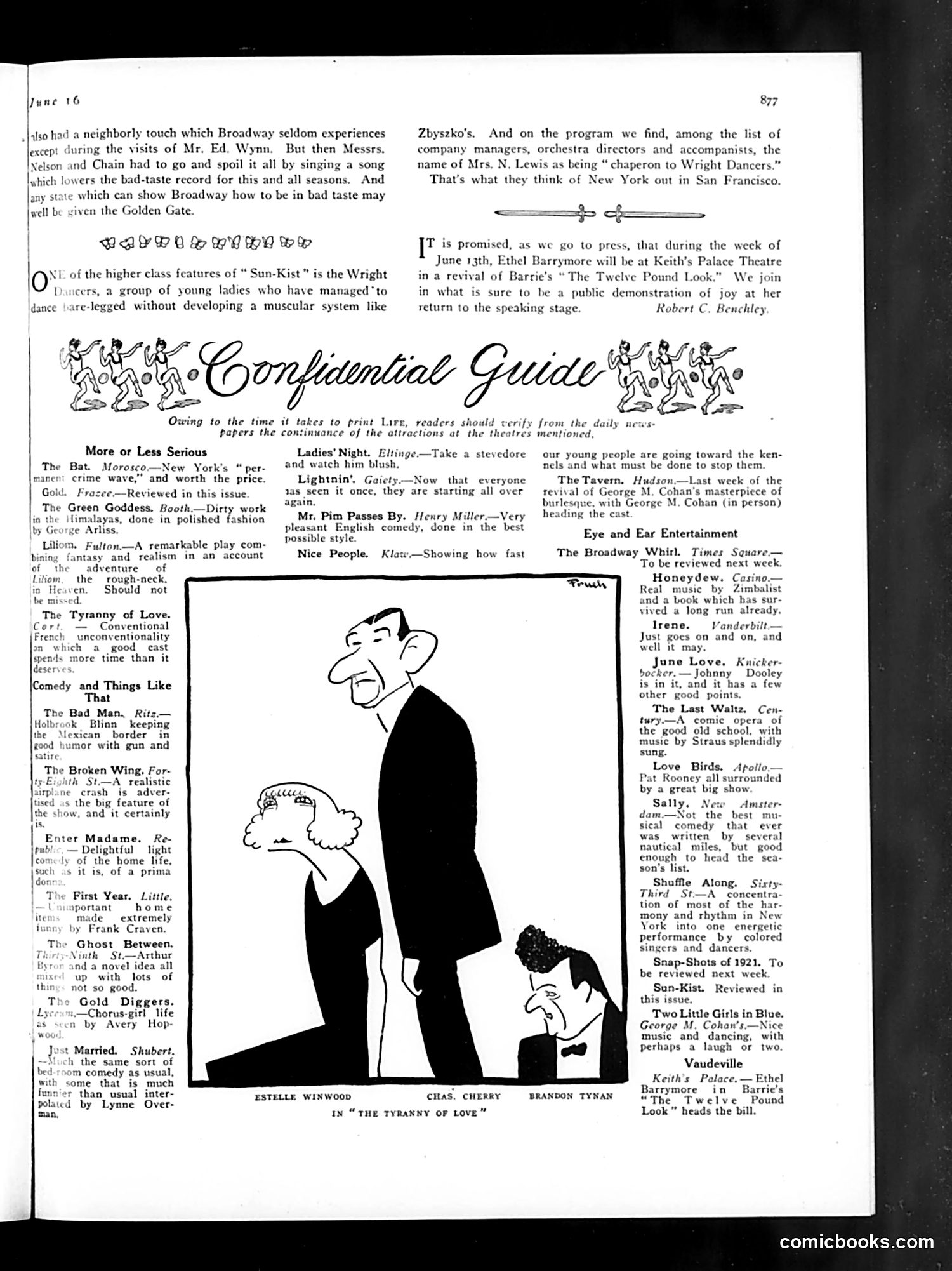
This page from Life magazine (June 16, 1921) features a cartoon illustrating the theatrical production "The Tyranny of Love" at the Cort Theatre. The image shows three figures: a tall man in formal attire (identified as Charles Cherry), a small woman (Estelle Wiswood), and a diminutive man (Brandon Tynan) positioned at his feet in a comical pose. The joke appears to satirize the play's theme about "conventional French unconventionality." The exaggerated size difference between characters and the absurd positioning of the tiny man suggests mockery of theatrical melodrama—specifically how stage productions handle romantic power dynamics and social pretense. The caption credits indicate these are the play's actual performers, making this a direct commentary on the production's premise and execution for Life's theater-going readership.
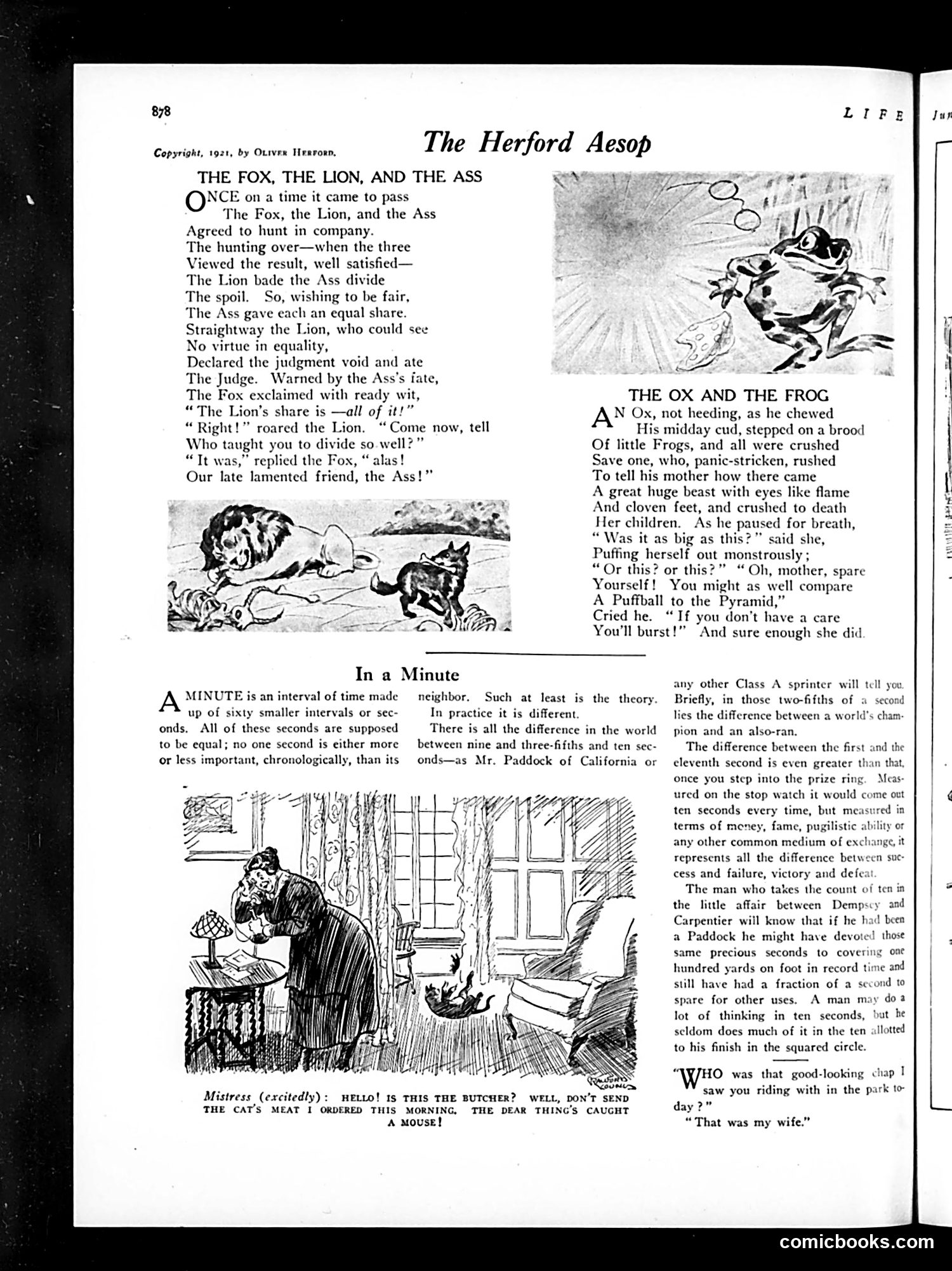
This page from *Life* magazine (1921) presents classic Aesop's fables with modern illustrations and commentary. **"The Fox, the Lion, and the Ass"** satirizes equality and power dynamics. When the Ass divides prey fairly among three hunters, the Lion—rejecting equality as having "no virtue"—devours the judge. The Fox, learning from this fate, cynically declares "The Lion's share is—all of it!" The fable's message: might makes right; appeals to fairness are futile against raw power. **"The Ox and the Frog"** humorously illustrates maternal pride and delusion. A frog mother, wanting to seem impressive to her panicked son (who witnessed oxen crush her children), puffs herself up repeatedly asking "Was the beast as big as *this*?" She literally bursts from vanity—the moral: excessive pride leads to self-destruction. The page also includes unrelated humor: a "In a Minute" article about athletic timing differences (likely referencing boxer Jack Dempsey's 1921 fight with Georges Carpentier), and a domestic joke about a butcher's cat catching a mouse.
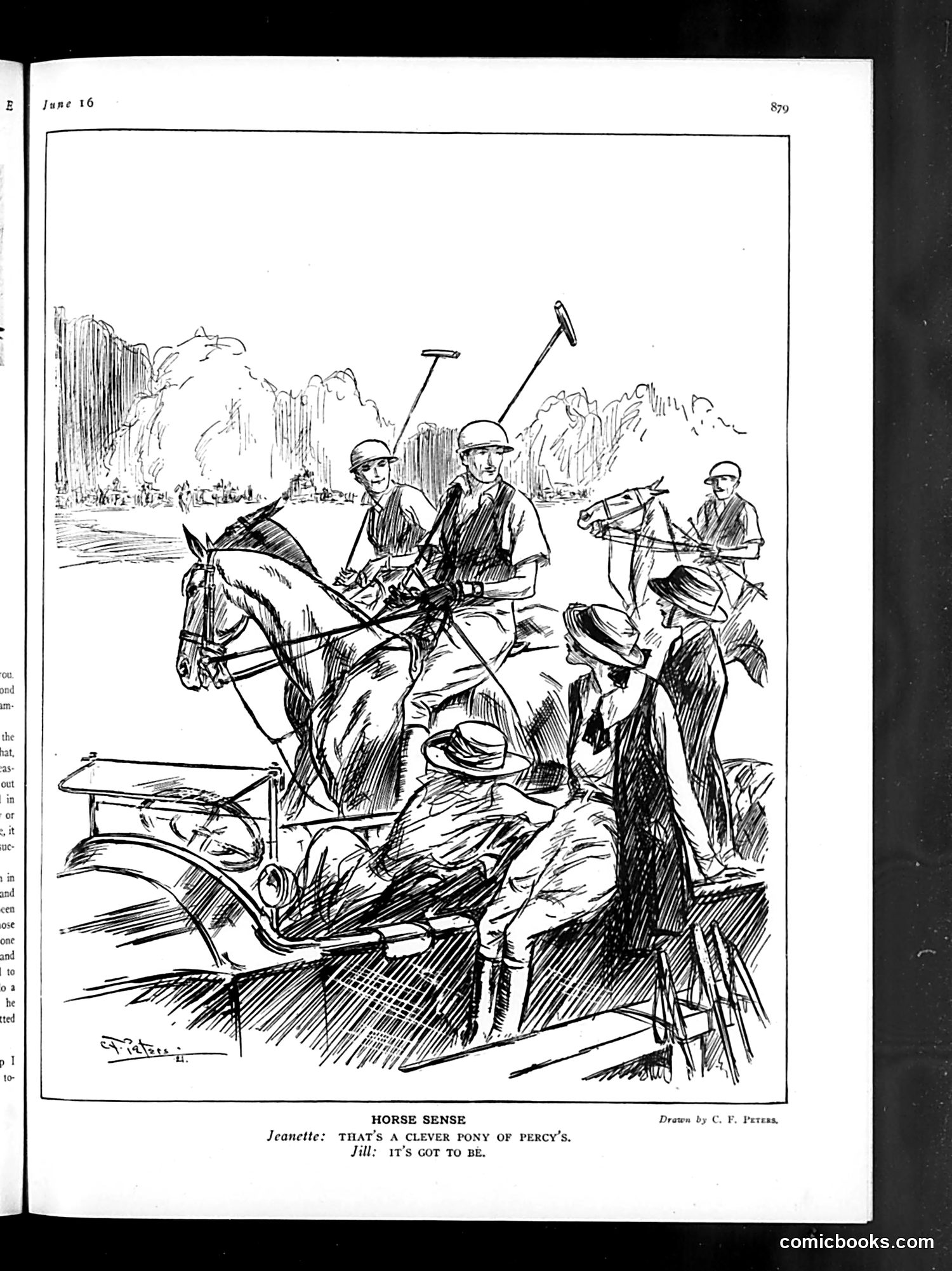
This is a humorous cartoon about polo, a wealthy sport. The caption presents a joke where Jeanette comments that Percy owns a clever pony, and Jill responds that it must be clever—the implication being that any pony capable of playing polo with Percy must be exceptionally intelligent to compensate for Percy's apparent lack of skill or sense. The cartoon depicts a polo match in progress, with players on horseback wielding mallets. The satire targets Percy specifically, suggesting he's not a naturally talented player. The joke relies on the era's association of polo with the upper class and the assumption that some wealthy people participated in such sports despite limited aptitude—their ponies had to be particularly smart to succeed despite their riders' limitations.
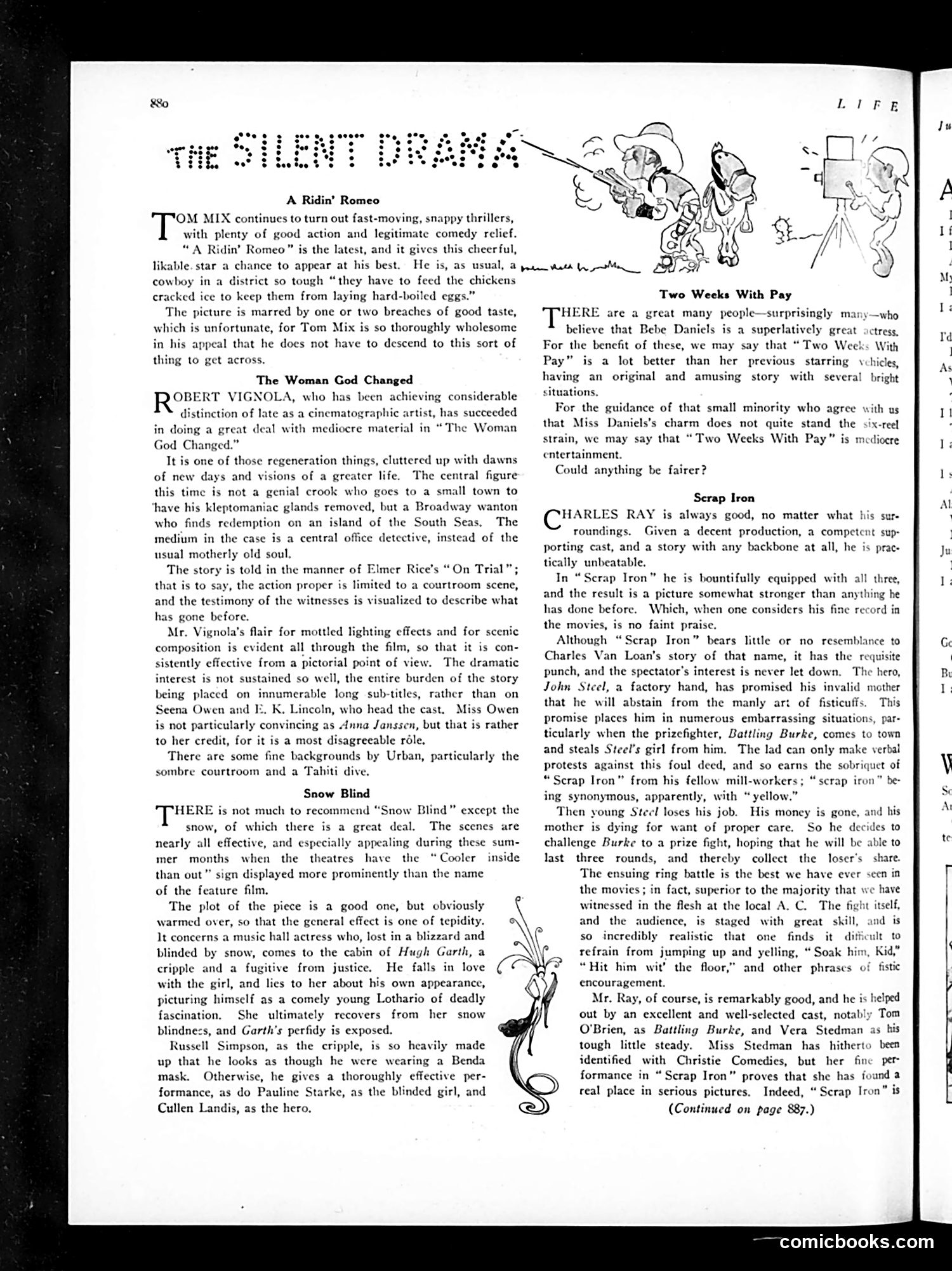
This page contains four film reviews from Life's "Silent Drama" section, critiquing contemporary movies: **"A Ridin' Romeo"** praises Tom Mix as a reliable Western star, though notes the film has minor lapses in taste. **"The Woman God Changed"** reviews director Robert Vignola's work adapting a redemption narrative (a Broadway woman finding salvation in the South Seas). The critic admires the cinematography but finds the story tedious, relying too heavily on title cards rather than the performances of leads Seena Owen and I.K. Lincoln. **"Snow Blind"** dismisses this blizzard-set romance as recycled plot material, though acknowledges appealing snowy scenery. Russell Simpson's heavy makeup as a cripple is criticized as unconvincing. **"Two Weeks With Pay"** defends Bebe Daniels as charming, acknowledging she works better in lighter material with good writing than in dramatic roles requiring sustained performance across multiple reels. The reviews reflect silent-era conventions: heavy reliance on intertitles, makeup extremity, and genre formulas.
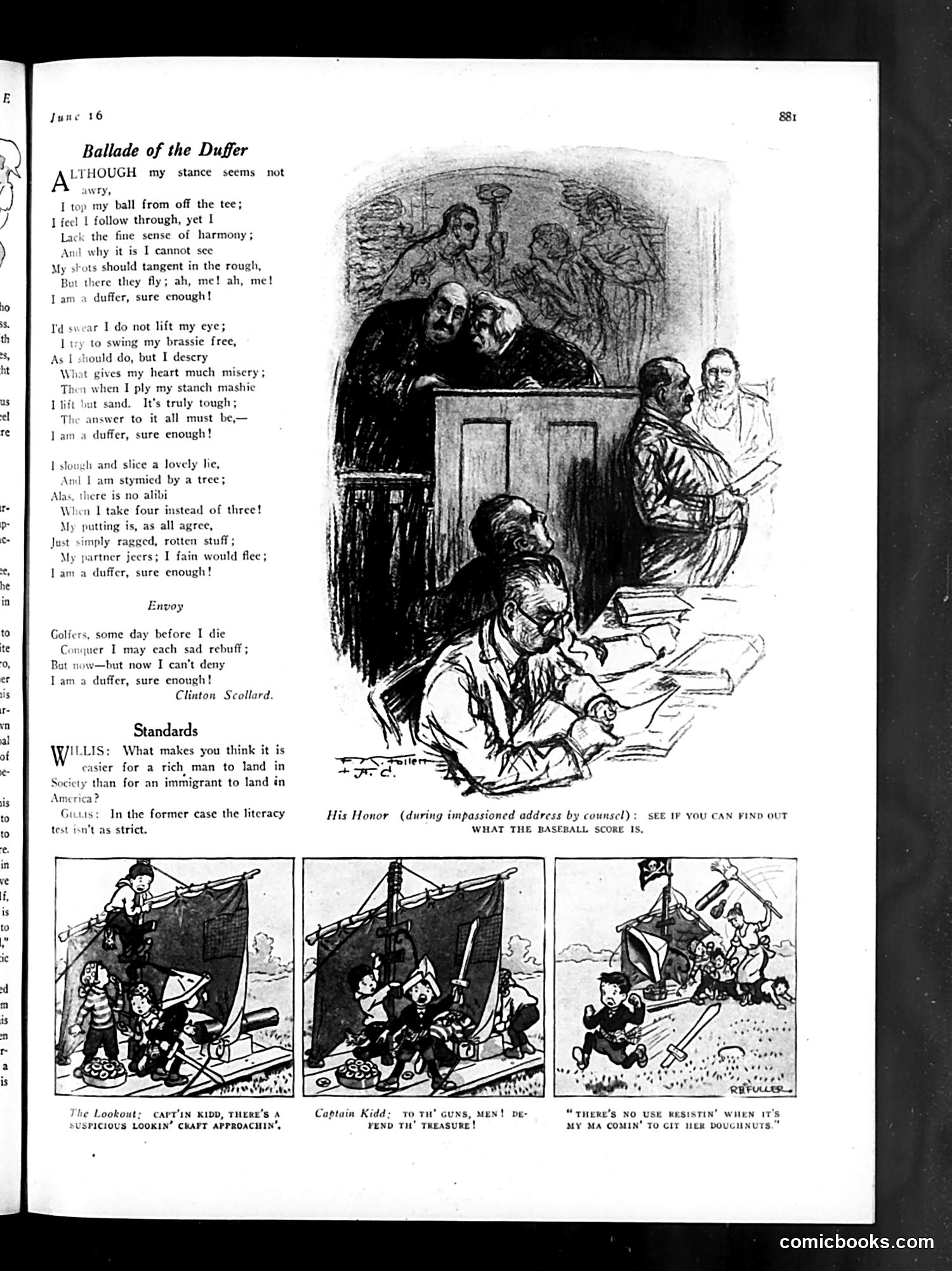
This page contains three distinct satirical pieces: **"Ballade of the Duffer"** (top): A humorous poem by Clinton Scollard mocking amateur golfers. The speaker complains about poor golf performance—bad shots, slicing, sand traps—despite believing his technique is sound. It's self-deprecating satire about incompetent recreational golfers who blame bad luck rather than skill. **"Standards"** (middle): A brief joke contrasting social access. A wealthy person entering high society faces easier standards than an immigrant entering America—because society's "literacy test" is less rigorous than immigration requirements. This satirizes both class privilege and American immigration policies. **Bottom cartoons**: Three pirate-themed comic strips featuring "Captain Kidd," apparently depicting children's play-acting as pirates. The humor comes from childish misunderstandings (confusing a "doughnut" errand with pirate treasure, etc.). The page overall satirizes American leisure culture, class divisions, and innocence—typical of Life magazine's social comedy.
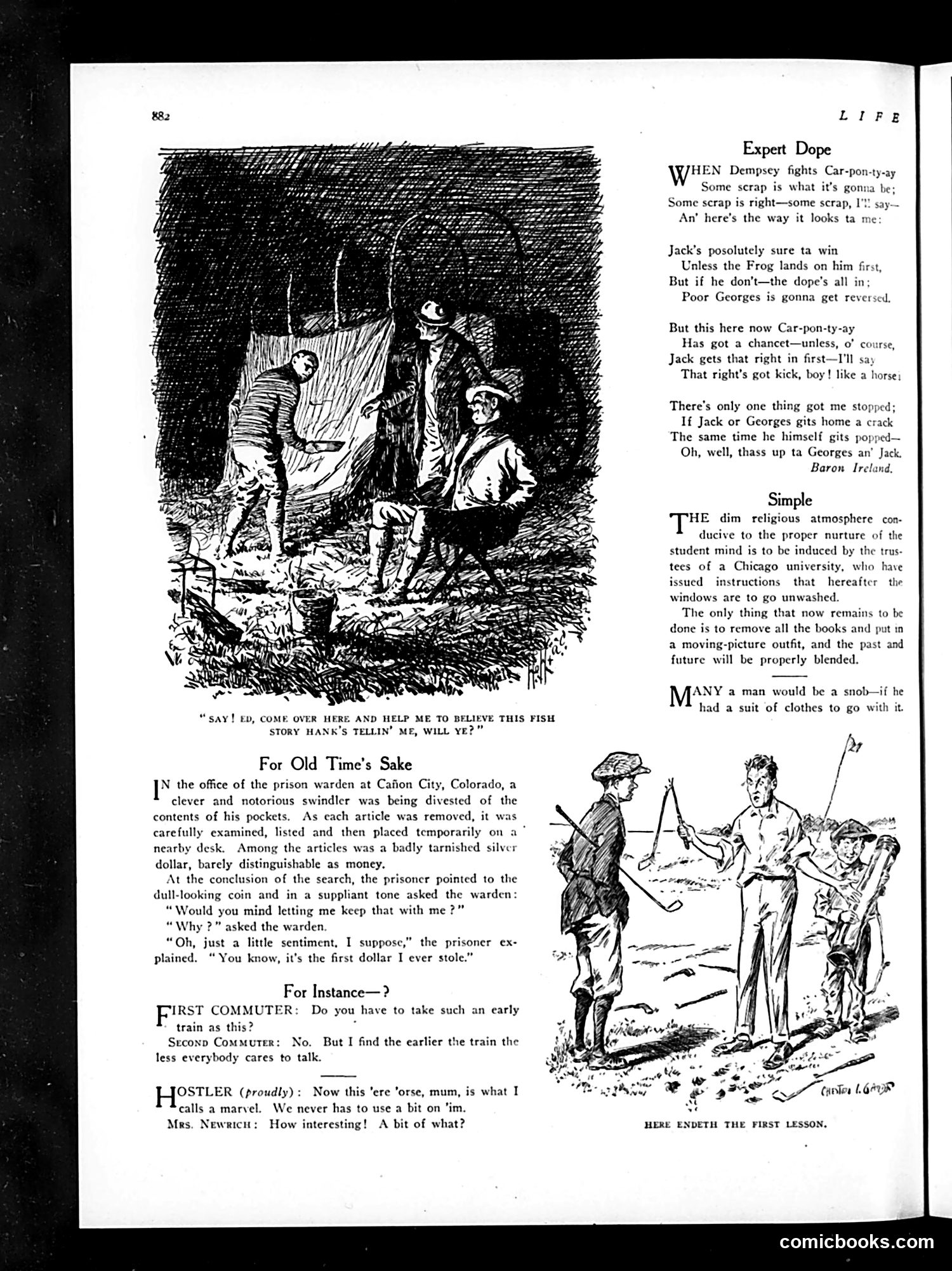
This page contains several satirical pieces typical of Life's humor: **"Expert Dope"** — A poem about the Dempsey-Carpentier boxing match, written in vernacular dialect. It playfully predicts the fight's outcome between Jack Dempsey and Georges Carpentier ("Car-pon-ty-ay"), with humorous uncertainty about who will win. **"Simple"** — Two brief satirical jabs: one mocking a Chicago university's directive to leave windows unwashed as creating a "dim religious atmosphere" for proper study (absurdist humor), and another joke about snobbery and clothing. **"For Old Time's Sake"** — A anecdote about a swindler in prison who sentimentally requests to keep his first stolen dollar, the point being criminal nostalgia. **"For Instance"** — Three brief conversational jokes about commuter trains, a horse that needs no bridle, and unstated punchlines. The illustrations show period scenes matching the text. The page exemplifies Life's mix of sporting commentary, social satire, and gentle humor typical of early-20th-century American magazines.
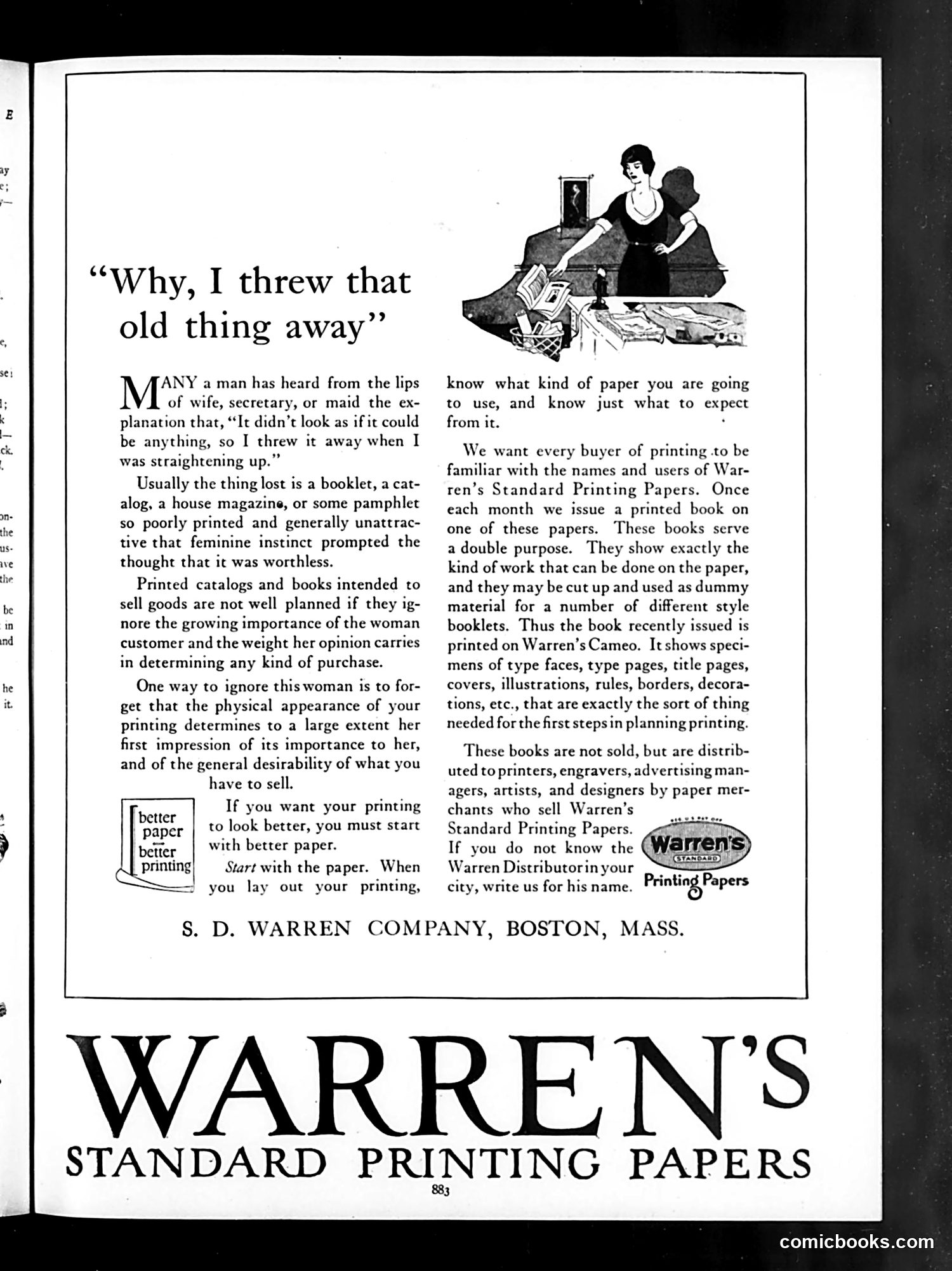
This is primarily an advertisement for printing paper, not political satire. The "cartoon" depicts a domestic scene where a woman discards poorly printed materials, establishing the ad's central argument: **bad printing quality makes customers—particularly women—throw products away.** The satirical angle targets businesses and printers who ignore the woman consumer's aesthetic judgment. The ad argues that women shoppers judge products by their physical appearance, and poorly designed catalogs and pamphlets get dismissed as worthless trash. The solution: use Warren's Standard Printing Papers to create professional-looking materials that women won't discard. The subtext reflects early 20th-century attitudes acknowledging women's purchasing power while also stereotyping them as instinctively discerning (or dismissive) of design quality. The ad positions better paper as the foundation for professional printing that respects the female consumer's influence on purchasing decisions.
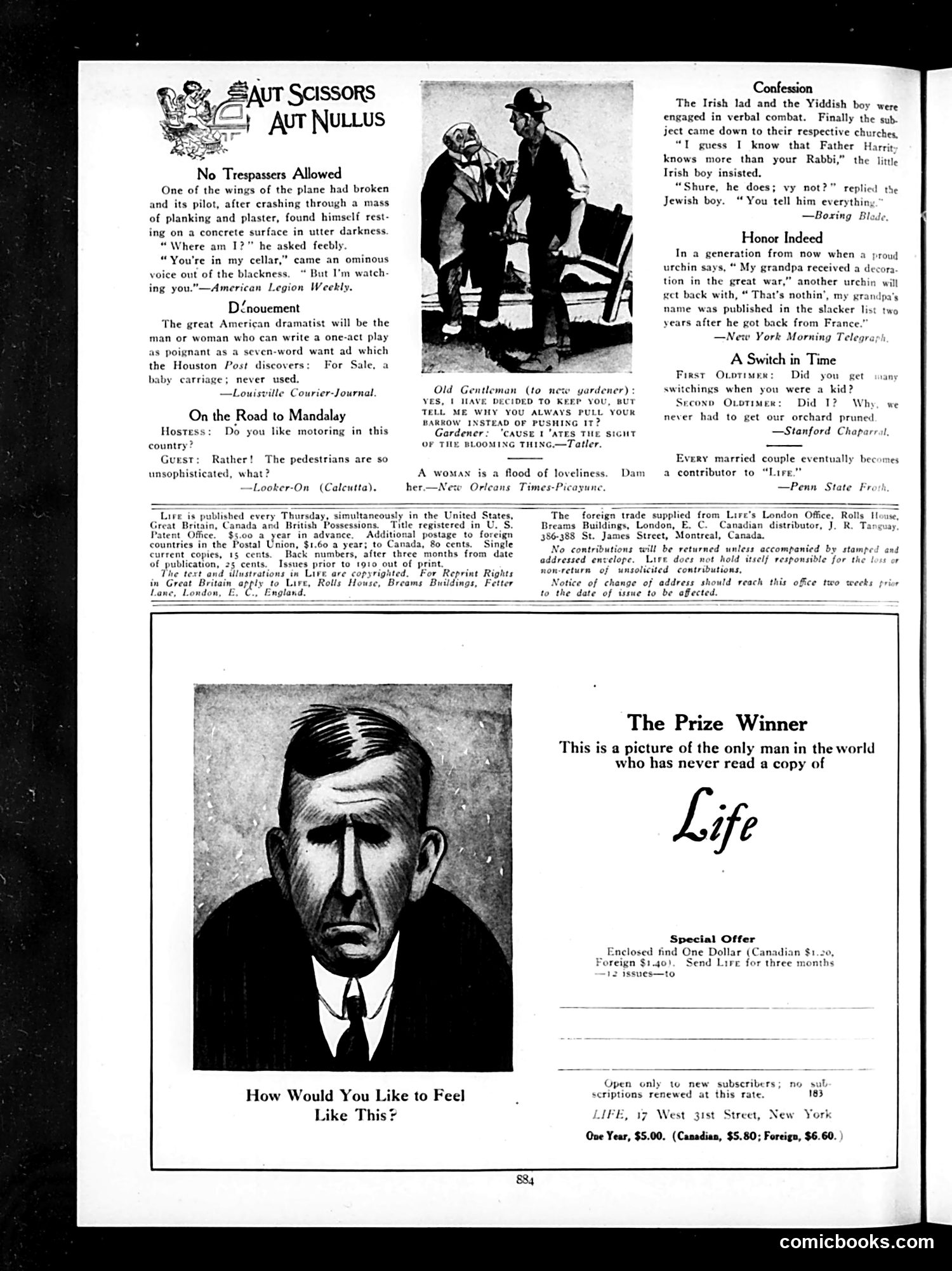
This page contains several brief humorous anecdotes typical of Life magazine's satirical content, plus advertising. **The cartoons/jokes address:** 1. **"No Trespassers Allowed"** — A pilot crashes into someone's cellar; the homeowner threatens him. The joke mocks invasive wartime aviation incidents. 2. **"Dnouement"** — Satirizes overwrought literary drama by contrasting it with a humble classified ad about an unused baby carriage—suggesting ordinary life contains more genuine pathos than theatrical artifice. 3. **"Road to Mandalay"** — A guest complains about pedestrians being "unsophisticated"; the British class-consciousness joke mocks snobbery about common people. 4. **"The Irish Lad and the Yiddish Boy"** — An interfaith dispute where both boys acknowledge their respective priests/rabbis know more because they "tell them everything"—gentle humor about childhood religious instruction and confession. 5. **"Honor Indeed"** — Dark WWI satire: future children will brag grandfathers received war decorations, but one will counter that his grandfather was merely published on a "slacker list" (cowards who avoided service). The page is primarily **humorous filler content**, with heavy advertising for Life magazine subscriptions below.
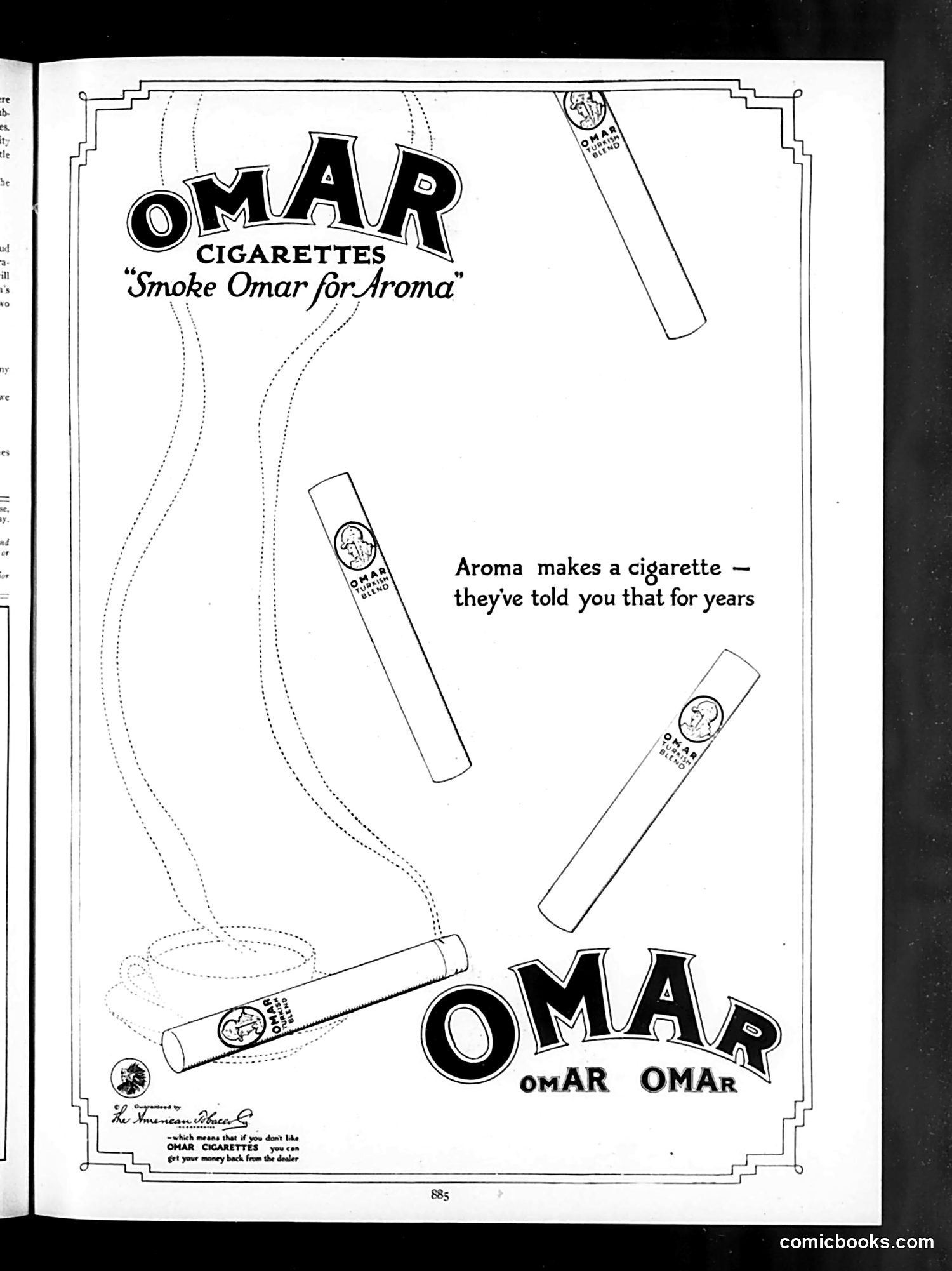
This is a full-page advertisement for Omar cigarettes, not political satire. The ad promotes "aroma" as the cigarette's defining feature, with the tagline "Smoke Omar for Aroma." Multiple cigarettes are illustrated with dotted lines suggesting aromatic smoke dispersal. The copy claims aroma is what distinguishes a quality cigarette—"they've told you that for years." The bottom includes a money-back guarantee: if you dislike Omar cigarettes, the dealer will refund your money. This was a common marketing tactic to reduce purchase risk and build consumer confidence in the product. The ad presents smoking as an acceptable, even desirable consumer choice—typical of pre-health-warning cigarette advertising from the early-to-mid twentieth century.
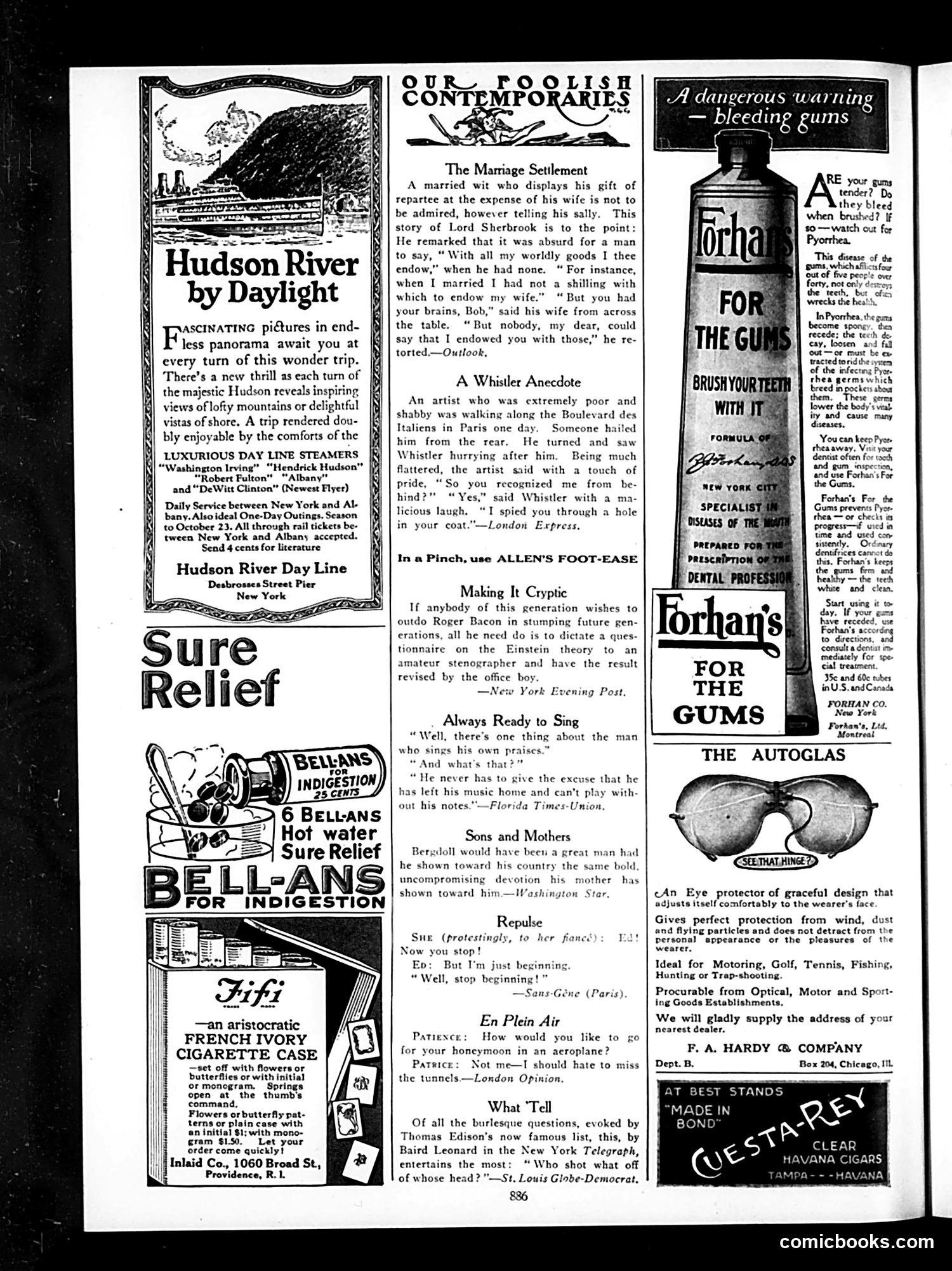
This page is primarily **advertising and humor content** rather than political satire. It features: **Advertisements:** - Hudson River Day Line steamers (travel) - Bell-ans antacid (indigestion relief) - French ivory cigarette case - Forhan's toothpaste (targeting pyorrhea/gum disease) - AutoGlas eyeglasses - Cuesta-Rey cigars **Humor Section ("Our Foolish Contemporaries"):** Brief anecdotes mocking social pretension and human folly, including: - Lord Sherbrook's failed wit at his wife's expense - James McNeill Whistler's cruel joke about a shabby artist's torn coat - Various puns about Einstein's theory, singing one's own praises, and honeymooning by airplane The satire targets personal vanity and social awkwardness rather than political figures. The page reflects 1920s consumer culture and genteel humor typical of *Life* magazine's audience.
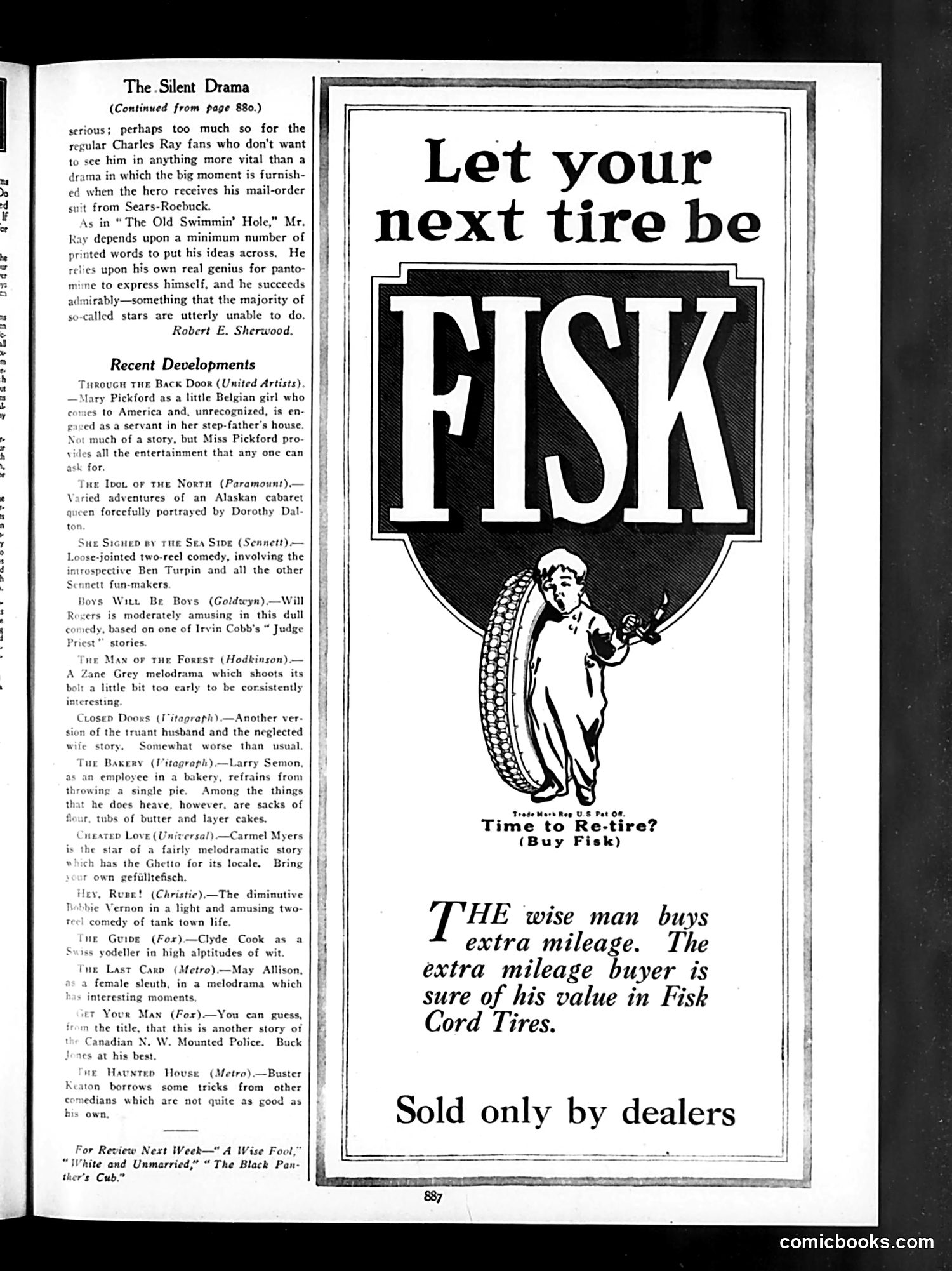
This page is primarily an **advertisement for Fisk Cord Tires**, not a political cartoon. The ad features an illustration of the "Fisk Boy"—a cherubic, barefoot child character—carrying an oversized tire. The ad's appeal targets practical motorists: "The wise man buys extra mileage. The extra mileage buyer is sure of his value in Fisk Cord Tires." It's a straightforward pitch emphasizing tire durability and value rather than satire. The left column contains film reviews from *Life* magazine's entertainment section, discussing silent films of the era (Charlie Ray, Mary Pickford, Will Rogers, Buster Keaton). The reviews mock melodramatic plots and praise actors' pantomime abilities—appropriate criticism for 1920s silent cinema. There is **no political satire** on this page; it's a commercial advertisement positioned alongside entertainment content.
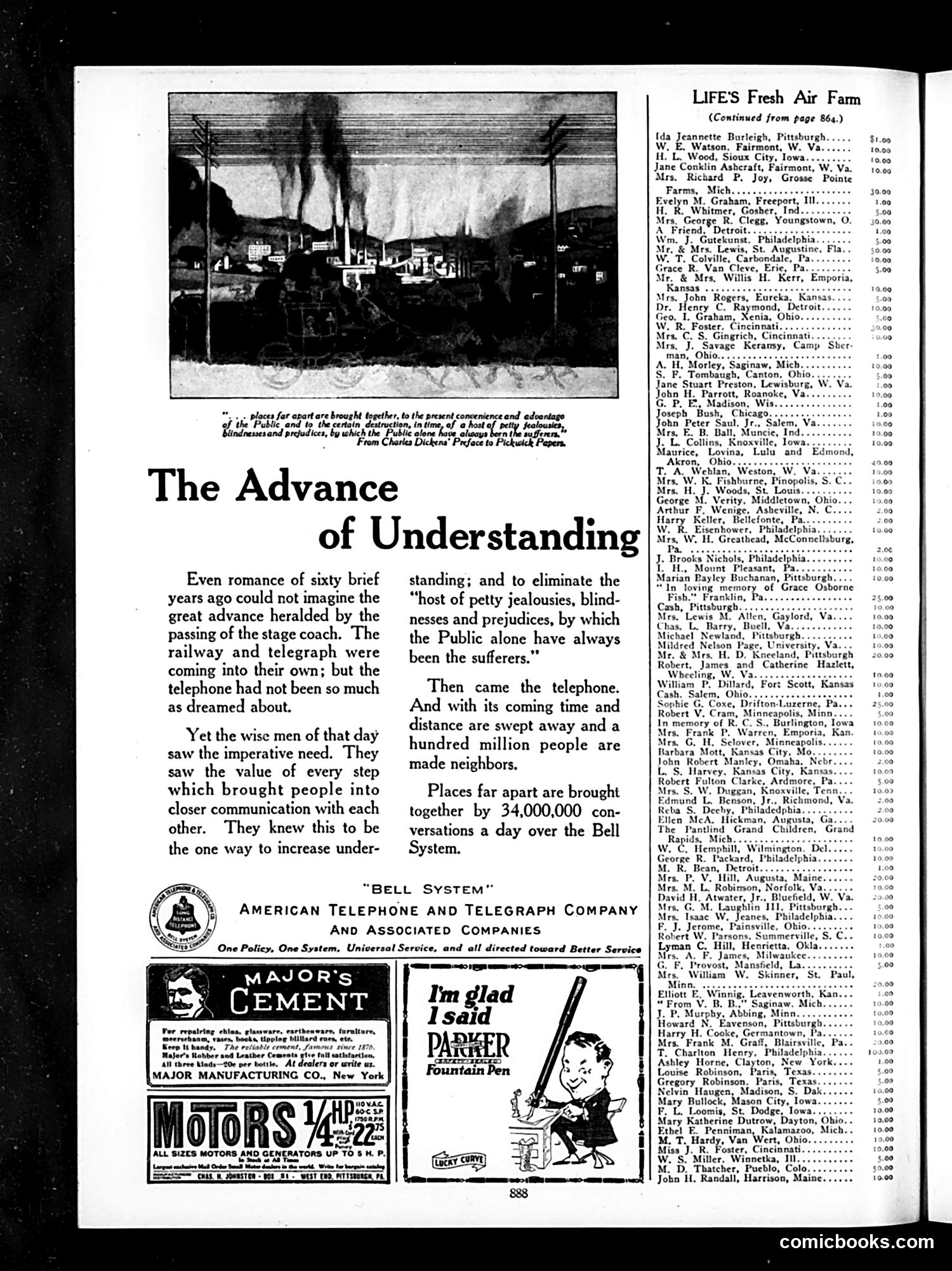
This page is primarily **advertising and donor listings**, not political satire. The main content is a Bell System advertisement titled "The Advance of Understanding." It argues that the telephone represents human progress by connecting distant people and eliminating "petty jealousies, blindnesses and prejudices." The ad cites a Charles Dickens preface and claims 34 million daily conversations occur over Bell System lines. Below is a lengthy list of donors to "Life's Fresh Air Farm" (a charitable program providing country vacations to those in need), organized by name and location. Three smaller ads appear at bottom: Mayor's Cement, Parker Fountain Pen, and Motors. The satirical point, if any, is subtle—Life magazine may be gently mocking corporate claims about technology's moral benefits while simultaneously fundraising for charity. However, this reads primarily as a **house advertisement and donor acknowledgment** rather than pointed satire.
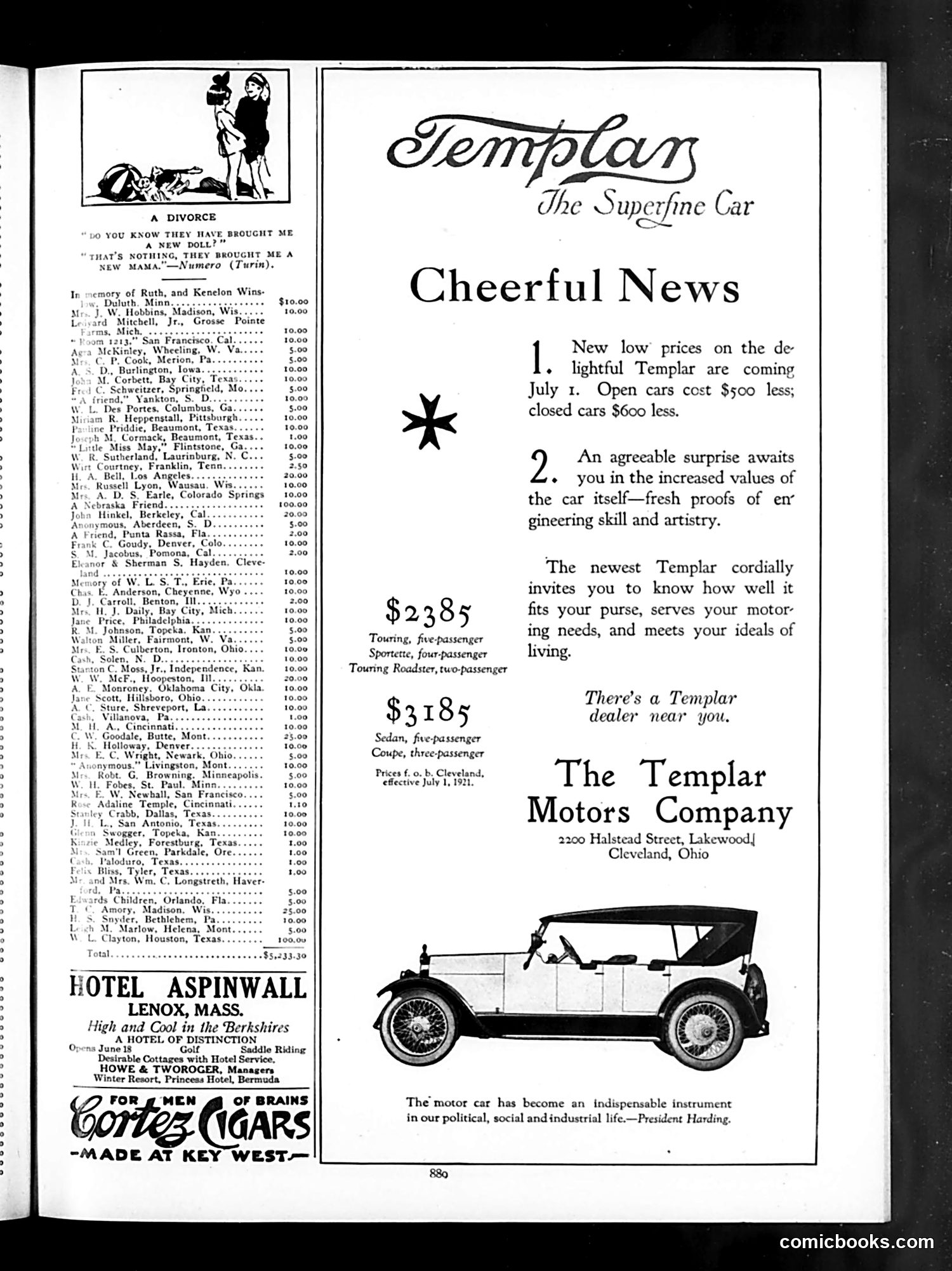
This page is primarily **advertising and filler content** rather than satirical editorial material. The small cartoon at top left shows a divorce joke: a child tells another that her parents bought her a new doll, to which the other responds they bought her a new mother—a quip about remarriage following divorce. This reflects 1920s social anxieties about rising divorce rates. The bulk of the page features a **Templar Motors automobile advertisement** with pricing ($2,385-$3,185) and a President Harding quote claiming the motor car is "indispensable" to modern life. This is corporate advertising, not satire. The left column contains memorial donations ("In memory of Ruth and Kenelon Winslow") and advertisements for Hotel Aspinwall and Cortez Cigars. **No significant political or social satire appears here**—it's a commercial page typical of Life magazine's mixed editorial-advertising format from the early 1920s.
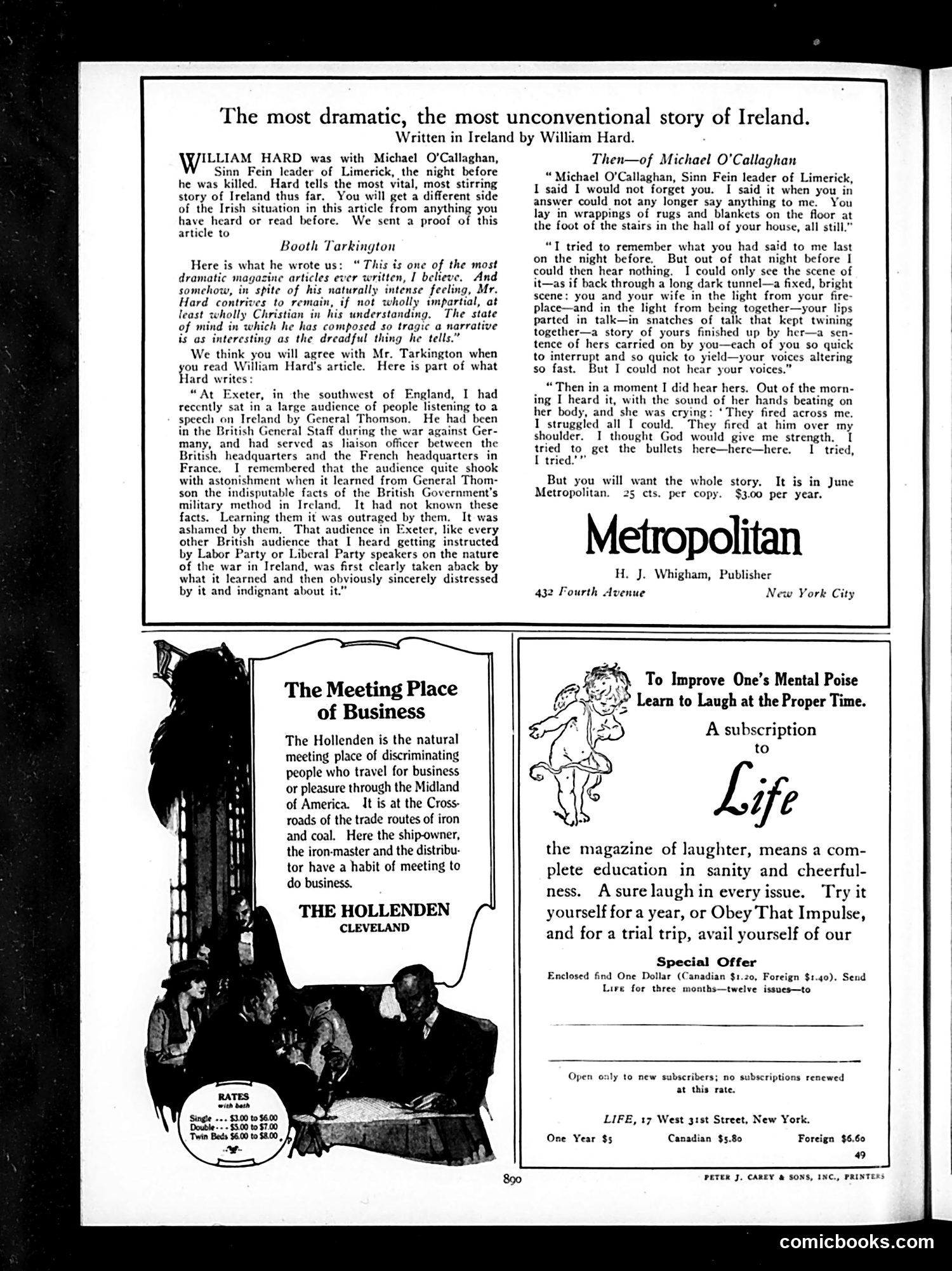
This page combines editorial promotion with advertisements. The main content promotes William Hard's article about Michael O'Callaghan, a **Sinn Féin leader from Limerick killed by British forces** during Ireland's War of Independence (early 1920s). Hard witnessed O'Callaghan the night before his death and describes the tragedy—O'Callaghan's wife's anguished account of the shooting. The text emphasizes the article's emotional power and moral seriousness, with novelist Booth Tarkington endorsing it as "one of the most dramatic magazine articles ever written." The editorial frames this as exposing British military brutality in Ireland to shocked British audiences. The surrounding advertisements—for *Life* magazine's humor subscription and The Hollenden hotel—are standard commercial content, contextually jarring against the tragic Irish independence narrative above them. This juxtaposition reflects the magazine's dual nature: serious journalism mixed with entertainment and advertising.
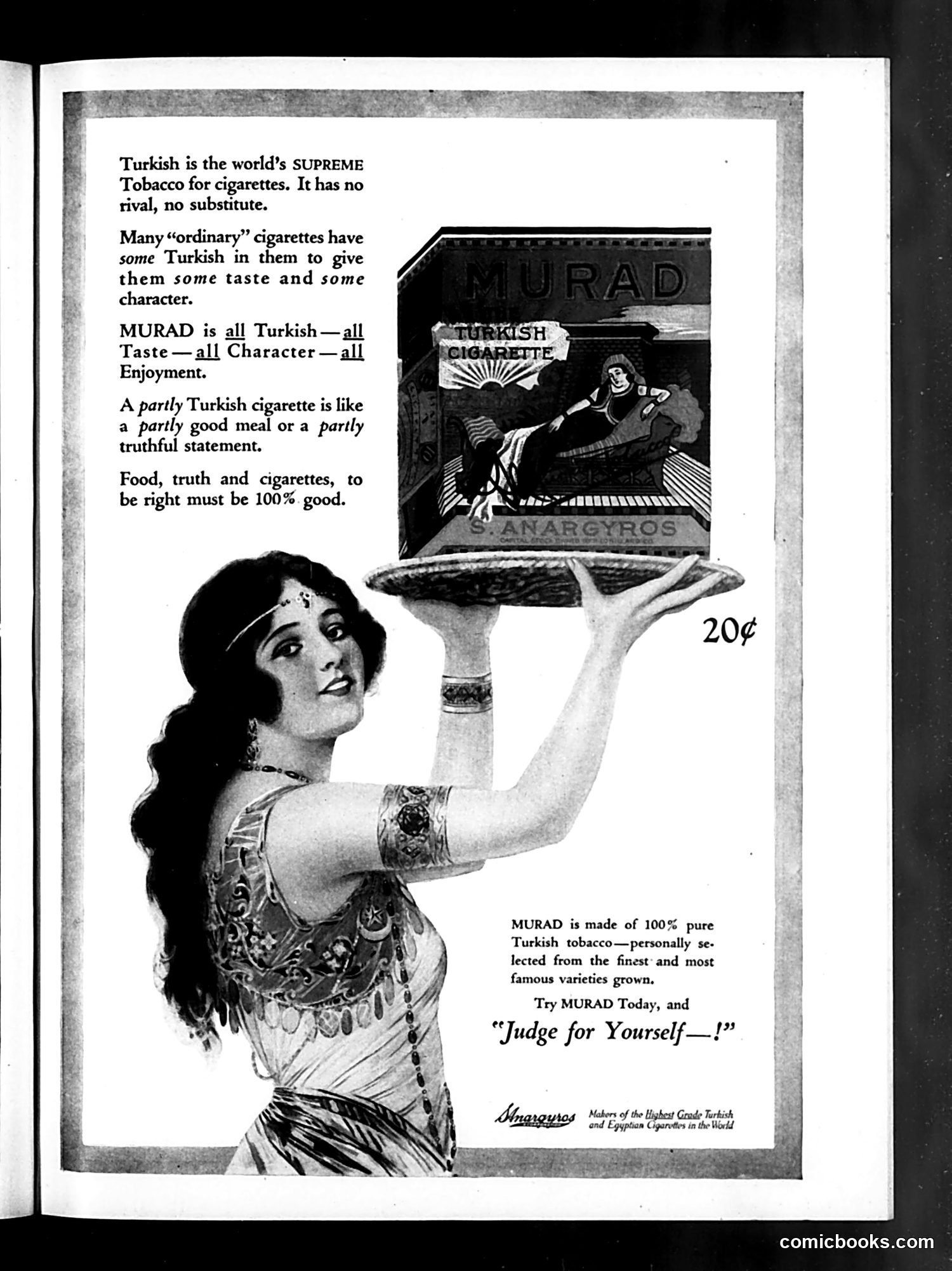
This is a **cigarette advertisement**, not political satire. It promotes Murad brand Turkish cigarettes to a 1920s American audience. The ad features a woman in orientalist costume (headband, decorative clothing) serving the cigarette package on a tray—a common advertising trope using exotic imagery to suggest luxury and sophistication. The "Turkish" branding appealed to American consumers who associated Turkish tobacco with premium quality. The text's rhetorical strategy equates cigarette quality with moral absolutes: comparing "partly Turkish" cigarettes to "partly good meals" or "partly truthful statements" to argue that only 100% pure Turkish tobacco is acceptable. This appeals to consumer desire for authenticity and completeness. The 20¢ price point and manufacturer credit ("Anargyros") date this to the early cigarette marketing era, before mid-century health concerns emerged.
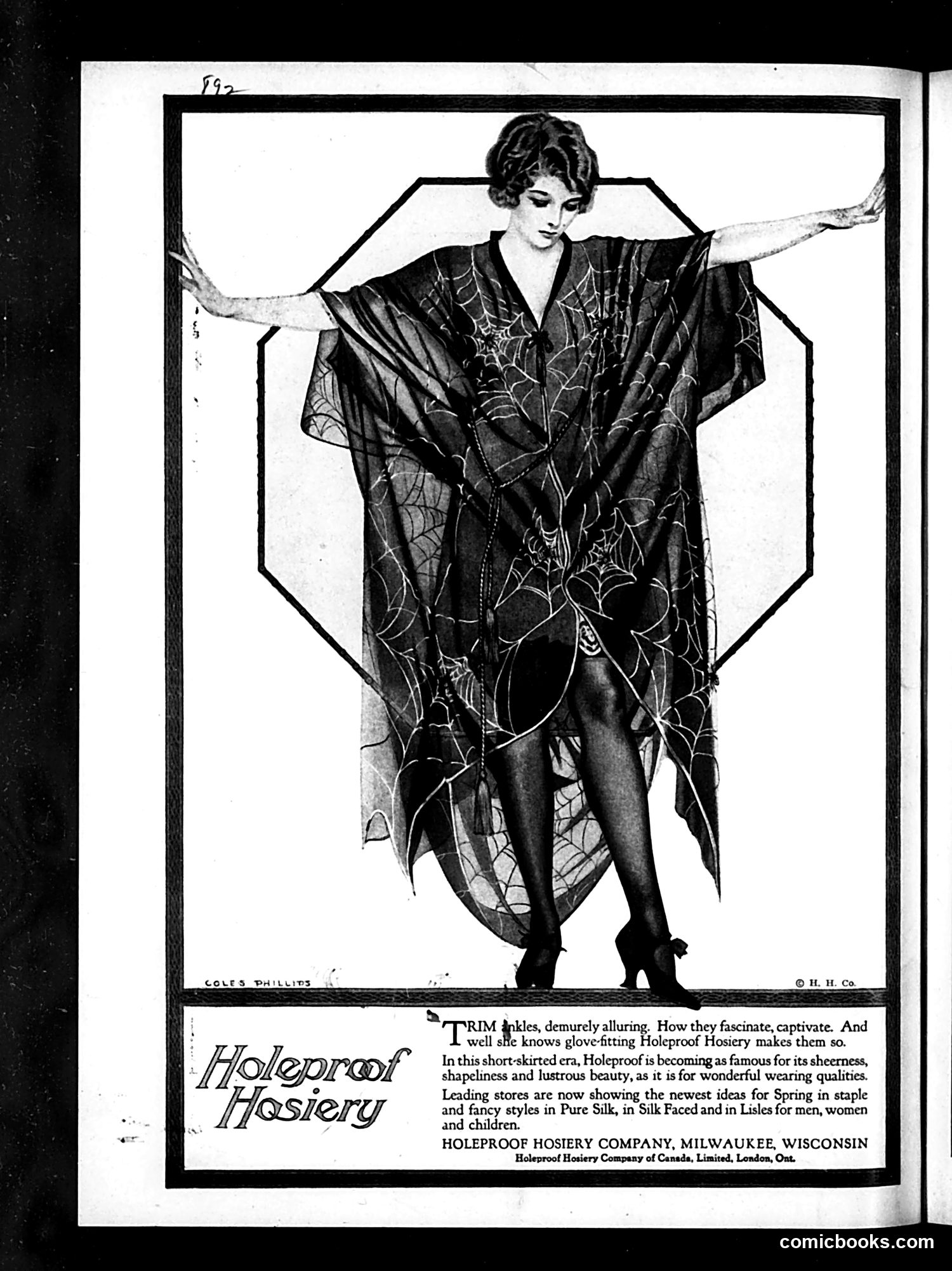
This is **not a political cartoon** but a **commercial advertisement** from Life magazine's early 20th century. The page advertises Holeproof brand hosiery (stockings) using an illustration of a woman in a spider-web patterned robe with arms outstretched. The advertisement plays on the "trim ankles" visible beneath the short skirt—a noteworthy fashion detail for the era when hemlines were rising. The text uses suggestive language ("demurely alluring," "fascinate, captivate") linking the hosiery's appeal to the woman's attractiveness. It emphasizes the product's sheer, lustrous quality and durability ("wonderful wearing qualities"), positioning stockings as both fashionable and functional. The spider-web motif appears decorative rather than satirical. This reflects the period's marketing strategy: selling practical goods by associating them with female beauty and allure.