
Life, 1921-06-16 · page 24 of 36
Life — June 16, 1921 — page 24: what you’re looking at
What you’re looking at
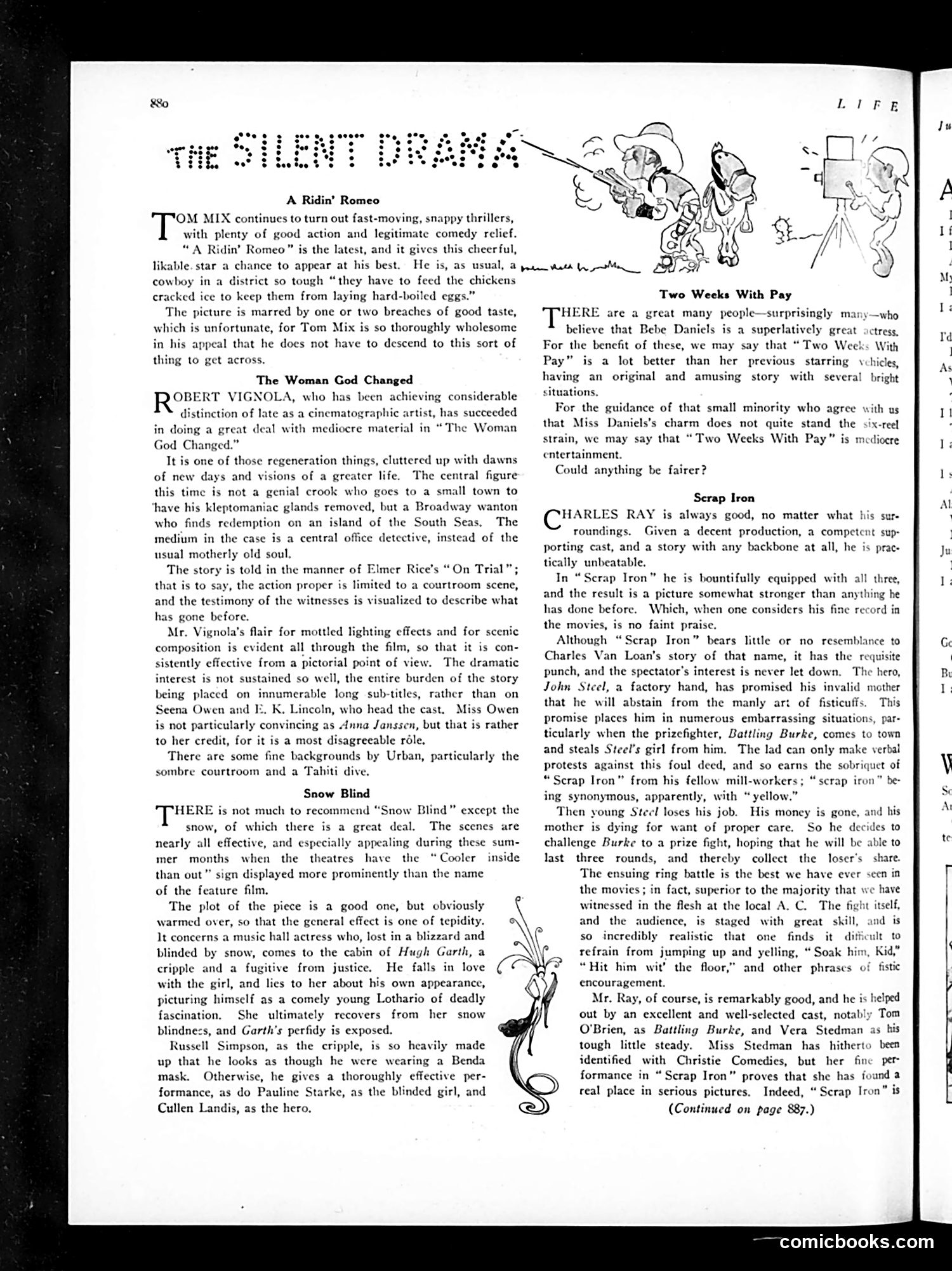
This page contains four film reviews from Life's "Silent Drama" section, critiquing contemporary movies: **"A Ridin' Romeo"** praises Tom Mix as a reliable Western star, though notes the film has minor lapses in taste. **"The Woman God Changed"** reviews director Robert Vignola's work adapting a redemption narrative (a Broadway woman finding salvation in the South Seas). The critic admires the cinematography but finds the story tedious, relying too heavily on title cards rather than the performances of leads Seena Owen and I.K. Lincoln. **"Snow Blind"** dismisses this blizzard-set romance as recycled plot material, though acknowledges appealing snowy scenery. Russell Simpson's heavy makeup as a cripple is criticized as unconvincing. **"Two Weeks With Pay"** defends Bebe Daniels as charming, acknowledging she works better in lighter material with good writing than in dramatic roles requiring sustained performance across multiple reels. The reviews reflect silent-era conventions: heavy reliance on intertitles, makeup extremity, and genre formulas.
📄 Transcribed text from this page (OCR, searchable)
Machine-transcribed from the original scan — historical spelling and the odd misread are preserved.
rear feos 8 A Ridin’ Romeo T° MIX continues to turn out fast-moving, snappy thrillers, with plenty of good action and legitimate comedy relief. “A Ridin’ Romeo” is the latest, and it gives this cheerful, likable. star a chance to appear at his best. He is, as usual, a cowboy in a district so tough “they have to feed the chickens cracked ice to keep them from laying hard-boiled eggs.” The picture is marred by one or two breaches of good taste, which is unfortunate, for Tom Mix is so thoroughly wholesome in his appeal that he does not have to descend to this sort of thing to get across. The Woman God Changed OBERT VIGNOLA, who has been distinction of late chieving considerable a cinematographic artist, has succeeded in doing a great deal with mediocre material in “The Woman God Changed. It is one of those regeneration things, cluttered up with dawns of new days and visions of a greater life. The central figure this time is not a genial crook who goes to a small town to ‘have his kleptomaniac glands removed, but a Broadway wanton who finds redemption on an island of the South Seas, The medium in the case is a central office detective, instead of the usual motherly old soul. The story is told in the manner of Elmer Rice’s “On Trial”; that is to say, the action proper is limited to a courtroom scene, and the testimony of the witnesses is visualized to describe what has gone before. Mr. Vignola’s flair for mottled lighting effects and for scenic composition is evident all through the film, so that it is con- sistently effective from a pictorial point of view. The dramatic interest is not sustained so well, the entire burden of the story being placed on innumerable long sub-titles, rather than on Seena Owen and I, K. Lincoln, who head the cast. Miss Owen is not particularly convincing as Anna Janssen, but that is rather to her credit, for it is a most disagreeable réle. There are some fine backgrounds by Urban, particularly the sombre courtroom and a Tahiti dive, Snow Blind HERE is not much to recommend “Snow Blind” except the snow, of which there is a great deal. The scenes are nearly all effective, and especially appealing during these sum- mer months when the theatres have the “Cooler inside than out” sign displayed more prominently than the name of the feature film, The plot of the piece is a good one, but obviously warmed over, so that the general effect is one of tepidity. It concerns a music hall actress who, lost in a blizzard and blinded by snow, comes to the cabin of Hugh Garth, a cripple and a fugitive from justice. He falls in love with the girl, and lies to her about his own appearance, picturing himself as a comely young Lothario of deadly fascination. She ultimately recovers from her snow blindnecs, and Garth's perfidy is exposed. Russell Simpson, as the cripple, is so heavily made up that he looks as though he were wearing a Benda mask. Otherwise, he gives a thoroughly effective per- formance, as do Pauline Starke, as the blinded girl, and Cullen Landis, as the hero, Two Weeks With Pay 2 are a great many people—surprisingly many—who that Bebe Daniels is a superlatively great actress, For the benefit of these, we may say that “Two Weeks With Pay” is a lot better than her previous starring vchicles, having an original and amusing story with several bright situations, For the guidance of that small minority who agree with us that Miss Daniels’s charm does not quite stand the six-reel strain, we may say that “Two Weeks With Pay” is mediocre entertainment. Could anything be fairer? Scrap Iron HARLES RAY is always good, no matter what his sur roundings. Given a decent production, a competent sup- porting cast, and a story with any backbone at all, he is prac- tically unbeatable. In “Scrap Iron” he is bountifully equipped with all three, and the result is a picture somewhat stronger than anything he has done before. Which, when one considers his fine record in the movies, is no faint praise. Although “Scrap Iron” bears little or no resemblance to Charles Van Loan’s story of that name, it has the requisite punch, and the spectator’s interest is never let down. The hero, John Steel, a factory hand, has promised his invalid mother that he will abstain from the manly art of fisticuffs. This promise places him in numerous embarrassing situations, par- ticularly when the prizefighter, Battling Burke, comes to town and steals Steel’s girl from him. The lad can only make verbal protests against this foul deed, and so earns the sobriquet of “Scrap Iron” from his fellow mill-workers; “scrap iron” be- ing synonymous, apparently, with “yellow Then young Steel loses his job. His money is gone, and his mother is dying for want of proper care. So he decides to challenge Burke to a prize fight, hoping that he will be able to last three rounds, and thereby collect the loser’s share. The ensuing ring battle is the best we have ever seen in the movies; in fact, superior to the majority that we have witnessed in the flesh at the local A. C. The fight itself, and the audience, is staged with great. skill, and is so incredibly realistic that one finds it dificult to refrain from jumping up and yelling, “ Soak him, Kid,” “Hit him wit’ the floor,” and other phrases of fistic encouragement. Mr. Ray, of course, is remarkably good, and he is helped out by an excellent and well-selected cast, nota Tom O'Brien, as Battling Burke, and Vera Stedman as bis tough little steady. Miss Stedman has hithe been identified with Christie Comedies, but her fine per formance in “Scrap Iron” proves that she has found a real place in serious pictures. Indeed, “Scrap Iron” is (Continued on page 887.) ~—comicbooks.com Ju Ge By