
Life, 1921-06-16 · page 17 of 36
Life — June 16, 1921 — page 17: what you’re looking at
What you’re looking at
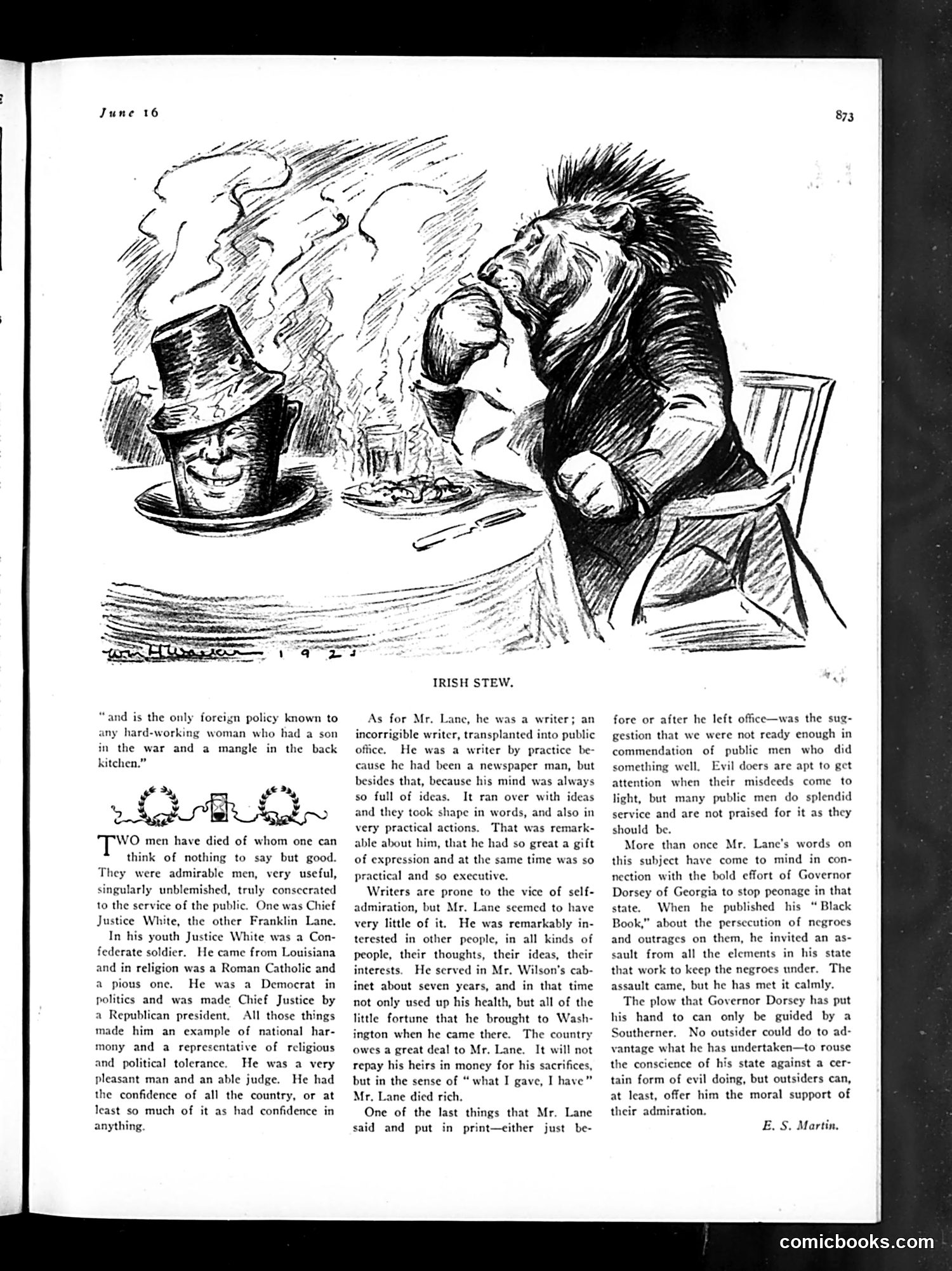
The cartoon depicts two figures at a table with a steaming pot—likely caricaturing political or public figures of the era through exaggerated facial features typical of period satire. The title "Irish Stew" suggests ethnic stereotype humor common to 1920s American satirical magazines. The accompanying text is an obituary-style tribute to two recently deceased men: Chief Justice Edward Douglass White and Franklin Lane (Secretary of the Interior under Wilson). The piece praises their public service and contrasts them—White as a symbol of sectional reconciliation (former Confederate, made Chief Justice by a Republican), Lane as a prolific writer and selfless government servant. The text also discusses Governor Hugh M. Dorsey of Georgia's efforts combating racial peonage through his "Black Book," suggesting the magazine supported this anti-peonage stance while acknowledging Southern resistance. The satire's specific target remains unclear from the image alone, though it likely comments on contemporary political figures or policies.
📄 Transcribed text from this page (OCR, searchable)
Machine-transcribed from the original scan — historical spelling and the odd misread are preserved.
“and is the only foreign policy known to any hard-working woman who had a son in the war and a mangle in the back kitchen.” a, ot 7% ~~ ¥ ¥ ‘WO men have died of whom one can think of nothing to say but good. They were admirable men, very useful, singularly unblemished, truly consecrated to the service of the public. One was Chief Justice White, the other Franklin Lane. In his youth Justice White was a Con- federate soldier. He came from Louisiana and in religion was a Roman Catholic and a pious one. He was a Democrat in politics and was made Chief Justice by a Republican president. All those things made him an example of national har- mony and a representative of religious and political tolerance. He was a very pleasant man and an able judge. He had the confidence of all the country, or at least so much of it as had confidence in anything. Nam ‘ds IRISH STEW. As for Mr. Lane, he was a writer; an incorrigible writer, transplanted into public office. He was a writer by practice be- cause he had been a newspaper man, but besides that, because his mind was always so full of ideas. It ran over with ideas and they took shape in words, and also in very practical actions. That was remark- able about him, that he had so great a gift of expression and at the same time was so practical and so executive. Writers are prone to the vice of self- admiration, but Mr. Lane seemed to have very little of it. He was remarkably in- terested in other people, in all kinds of people, their thoughts, their ideas, their interests. He served in Mr. Wilson's cab- inet about seven years, and in that time not only used up his health, but all of the little fortune that he brought to Wash- ington when he came there. The country owes a great deal to Mr. Lane. It will not repay his heirs in money for his sacrifices, but in the sense of “ what I gave, I have” Mr. Lane died rich. One of the last things that Mr. Lane said and put in print—either just be- fore or after he left office—was the sug- gestion that we were not ready enough in commendation of public men who did Evil doers are apt to get their misdeeds come to something well. attention when light, but many public men do splendid service and are not praised for it as they should be. More than once Mr. Lane's words on this subject have come to mind in con- nection with the bold effort of Governor Dorsey of Georgia to stop peonage in that state. When he published his “ Black Book,” about the persecution of negroes and outrages on them, he invited an as- sault from all the elements in his state that work to keep the negroes under. The assault came, but he has met it calmly. The plow that Governor Dorsey has put his hand to can only be guided by a Southerner. No outsider could do to ad- vantage what he has undertaken—to rouse the conscience of his state against a cer- tain form of evil doing, but outsiders can, at least, offer him the moral support of their admiration. E. S. Martin, comicbooks.com