
Life, 1921-06-16 · page 3 of 36
Life — June 16, 1921 — page 3: what you’re looking at
What you’re looking at
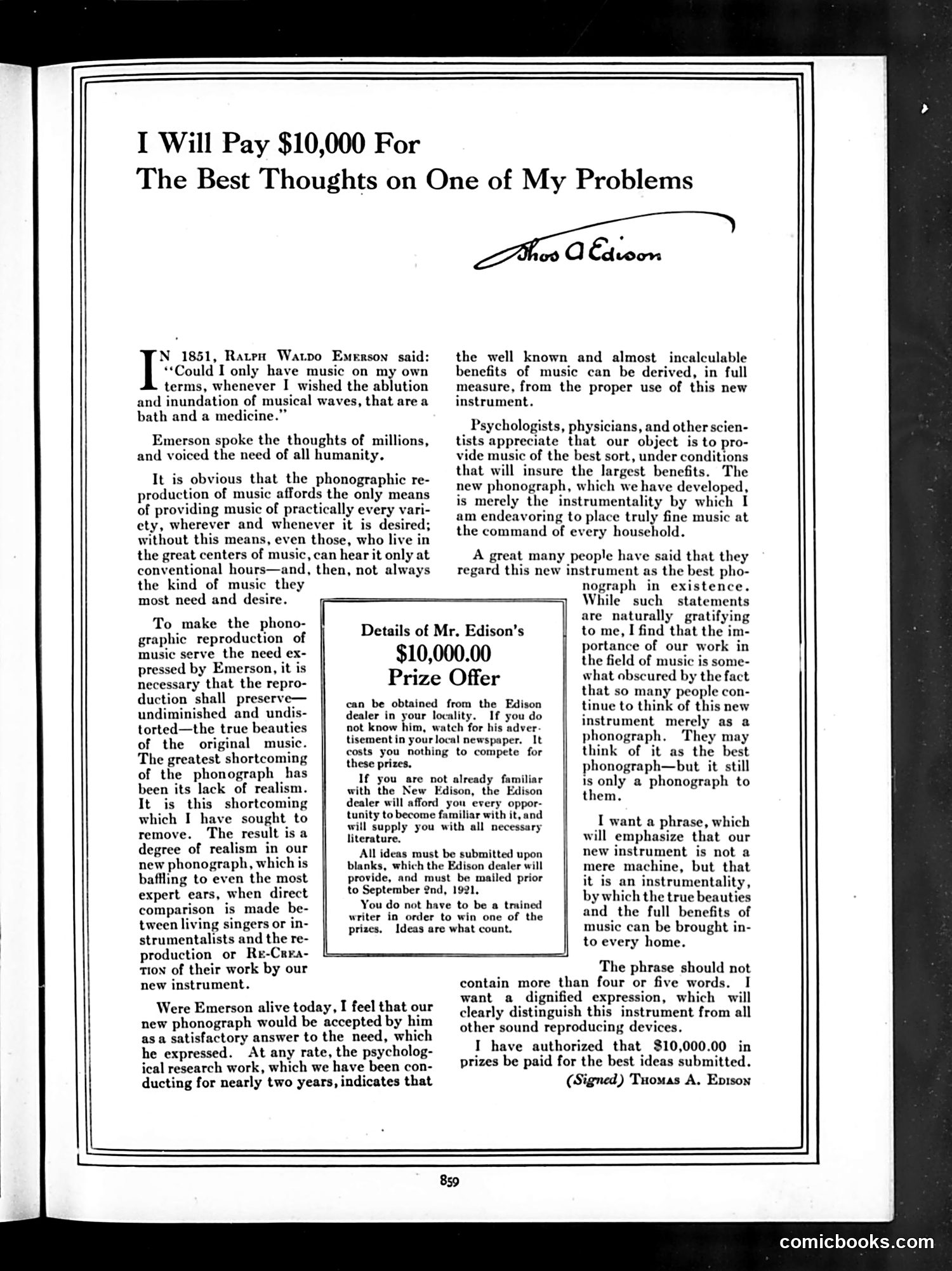
This is **not a political cartoon or satire**—it's a straightforward advertisement and business announcement from Thomas A. Edison. Edison is offering **$10,000 (substantial money in 1921) for the best written phrase** describing his phonograph. He wants a short, dignified expression (4-5 words maximum) that distinguishes his phonograph from other sound-reproduction devices. The contest rules are clear: ideas must be submitted to Edison dealers by September 2, 1921. Edison emphasizes that trained writers needn't apply—"Ideas are what count." The underlying pitch is that Edison's phonograph isn't merely a machine but an "instrumentality" bringing music into every home. This represents Edison promoting his phonograph technology during the era when recorded music was becoming a consumer product.
📄 Transcribed text from this page (OCR, searchable)
Machine-transcribed from the original scan — historical spelling and the odd misread are preserved.
I Will Pay $10,000 For The Best Thoughts on One of My Problems ‘Could I only have music on my own terms, whenever I wished the ablution and inundation of musical waves, that are a bath and a medicine.” I 1851, Rate Watpo Emerson said: Emerson spoke the thoughts of millions, and voiced the need of all humanity. It is obvious that the phonographic re- production of music affords the only means of providing music of practically every vari- ety, wherever and whenever it is desired; without this means, even those, who live in the great centers of music, can hear it only at conventional hours—and, then, not always the kind of music they most need and desire. To make the phono- the well known and almost incalculable benefits of music can be derived, in full measure, from the proper use of this new instrument. Psychologists, physicians, and other scien- tists appreciate that our object is to pro- vide music of the best sort, under conditions that will insure the largest benefits. The new phonograph, which we have developed, is merely the instrumentality by which I am endeavoring to place truly fine music at the command of every household. A great many people have said that they regard this new instrument as the best pho- nograph in existence. While such statements are naturally gratifying graphic reproduction of music serve the need ex- pressed by Emerson, it is necessary that the repro- duction shall preserve— undiminished and undis- torted—the true beauties of the original music. The greatest shortcoming of the phonograph has been its lack of realism. It is this shortcoming which I have sought to remove. The result is a degree of realism in our new phonograph, which is baffling to even the most expert ears, when direct comparison is made be- tween living singers or in- strumentalists and the re- production or Re-Crra- tion of their work by our new instrument. Details of Mr. Edison’s $10,000.00 Prize Offer can be obtained from the Edison dealer in your locality. If you do not know him, watch for his adver- tisement in your local newspaper. It costs you nothing to compete for these prizes, If you are not already familiar with the New Edison, the Edison dealer will afford you every oppor- tunity to become familiar with it, and will supply you with all necessary literature. blanks, which the Edison dealer will provide, and must be mailed prior to September 2nd, 1921, You do not have to be a trained writer in order to win one of the | prizes, Ideas are what count. | All ideas must be submitted upon to me, I find that the im- portance of our work in the field of music is some- what obscured by the fact that so many people con- tinue to think of this new instrument merely as a phonograph. They may think of it as the best phonograph—but it still is only a phonograph to them. I want a phrase, which will emphasize that our new instrument is not a mere machine, but that it is an instrumentality, by which the true beauties and the full benefits of music can be brought in- to every home. The phrase should not contain more than four or five words. I Were Emerson alive today, I feel that our new phonograph would be accepted by him asa satisfactory answer to the need, which he expressed. At any rate, the psycholog- ical research work, which we have been con- ducting for nearly two years, indicates that want a dignified expression, which will clearly distinguish this instrument from all other sound reproducing devices. I have authorized that $10,000.00 in prizes be paid for the best ideas submitted. (Signed) Tuomas A. Epison comicbooks.com