
Life, 1921-06-16 · page 16 of 36
Life — June 16, 1921 — page 16: what you’re looking at
What you’re looking at
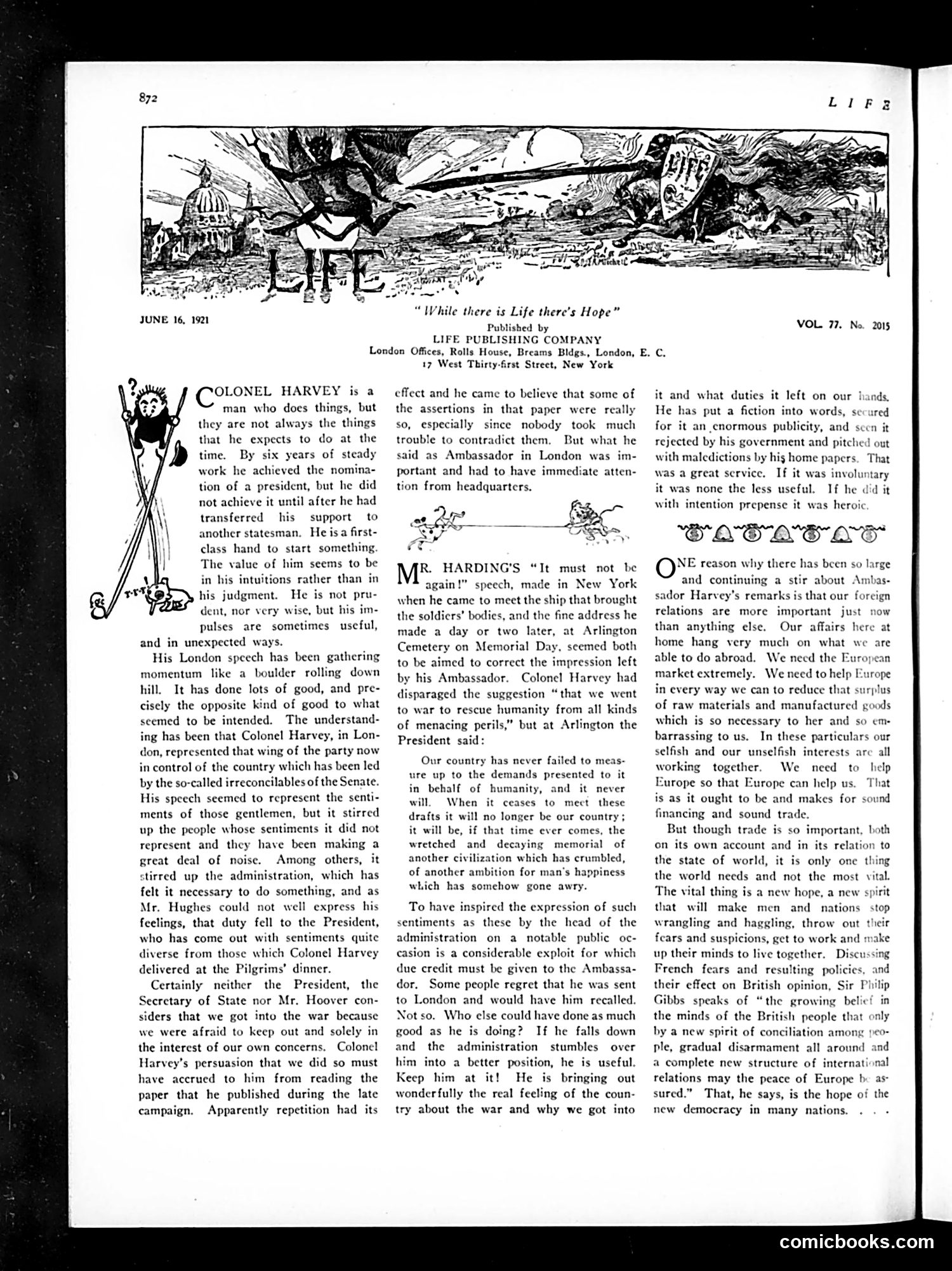
This page discusses **Colonel Harvey**, an American diplomat and politician who served as Ambassador to London. The article defends Harvey against criticism for statements he made publicly during his tenure, particularly remarks about foreign relations that stirred controversy. The text reveals Harvey had made assertions in newspapers that attracted unwanted attention from the State Department, prompting criticism he should be recalled. The article argues Harvey was performing a valuable service by frankly addressing America's post-WWI role and responsibilities toward Europe. The cartoon at top left (artist signature visible) appears to satirize the situation, though specific figures are difficult to identify clearly. The overall piece represents debate over diplomatic propriety and free speech during the early post-war period.
📄 Transcribed text from this page (OCR, searchable)
Machine-transcribed from the original scan — historical spelling and the odd misread are preserved.
JUNE 16, 1921 = ie Palle hed “While there is Life there's Hope” Published by LIFE PUBLISHING COMPANY London Offices, Rolls House, Breams Bldgs., London, OLONEL HARVEY is a man who does things, but they are not always the things that he expects to do at the time. By six years of steady work he achieved the nomina- tion of a president, but he did not achieve it until after he had transferred his support to another statesman. He isa first- class hand to start something. The value of him seems to be in his intuitions rather than in his judgment. He is not pru- dent, nor very wise, but his im- pulses are sometimes useful, and in unexpected ways. His London speech has been gathering momentum like a boulder rolling down hill. It has done lots of good, and pre- cisely the opposite kind of good to what seemed to be intended. The understand- ing has been that Colonel Harvey, in Lon- don, represented that wing of the party now in control of the country which has been led by the so-called irreconcilables of the Senate. His speech seemed to represent the senti- ments of those gentlemen, but it stirred up the people whose sentiments it did not represent and they have been making a great deal of noise. Among others, it stirred up the administration, which has felt it necessary to do something, and as Mr. Hughes could not well express his feelings, that duty fell to the President, who has come out with sentiments quite diverse from those which Colonel Harvey delivered at the Pilgrims’ dinner. Certainly neither the President, the Secretary of State nor Mr. Hoover con- siders that we got into the war because we were afraid to keep out and solely in the interest of our own concerns, Colonel Harvey’s persuasion that we did so must have acerued to him from reading the paper that he published during the late campaign. Apparently repetition had its 17 West Thirty-first Street, New York effect and he came to believe that some of the assertions in that paper were really so, especially since nobody took much trouble to contradict them. But what he said as Ambassador in London was im- portant and had to have imme tion from headquarters. So ite atten- R. HARDING'S “It again!” speech, made in New York when he came to meet the ship that brought the soldiers’ bodies, and the fine address he made a day or two later, at Arlington Cemetery on Memorial Day, seemed both to be aimed to correct the impression left by his Ambassador. Colonel Harvey had disparaged the suggestion “that we went to war to rescue humanity from all kinds of menacing perils,” but at Arlington the President said: must not be Our country has never failed to meas- ure up to the demands presented to it in behalf of humanity, and it never will, When it ceases to meet these drafts it will no longer be our country; it will be, if that time ever comes, the wretched and decaying memorial of another civilization which has crumbled, of another ambition for man’s happiness which has somehow gone awry. To have inspired the expression of such sentiments as these by the head of the administration on a notable public oc- casion is a considerable exploit for which due credit must be given to the Ambassa- dor. Some people regret that he was sent to London and would have him recalled. Not so. Who else could have done as much good as he is doing? If he falls down and the administration stumbles over him into a better position, he is useful. Keep him at it! He bringing out wonderfully the real feeling of the coun- try about the war and why we got into VOL. 77. No. 2015 E.C. it and what duties it left on our | He has put a fiction into words, se for it an cnormous publicity, and seen it rejected by his government and pitched out with maledictions by his home papers. That was a great service, If it was involuntary it was none the less useful. If he did it with intention prepense it was heroic CLSLS LOS NE reason why there has been so large and continuing a stir about Ambas- sador Harvey's remarks is that our foreign relations are more important just now than anything else. Our affairs here at home hang very much on what we are able to do abroad. We necd the European market extremely. We need to help Europe in every way we can to reduce that surplus of raw materials and manufactured goods which is so necessary to her and so em- barrassing to us. In these particulars our selfish and our unselfish interests arc all working together. We need to Pp Europe so that Europe can help us. That is as it ought to be and makes for sound financing and sound trade, But though trade is so important, both on its own account and in its relation to the state of world, it is only one thing the world needs and not the most vital. thing is a new hope, a new spirit vill make men and nations stop wrangling and haggling, throw out ir fears and suspicions, get to work and make up their minds to live together. Discussing French fears and resulting policies, and their effect on British opinion, Sir Philip Gibbs speaks of “the growing belief in the minds of the British people that only by a new spirit of conciliation among peo- ple, gradual disarmament all around and a complete new structure of international relations may the peace of Europe b as- sured.” That, he says, is the hope of the new democracy in many nations. comicbooks.com