
A complete issue · 34 pages · 1921
Life — February 17, 1921
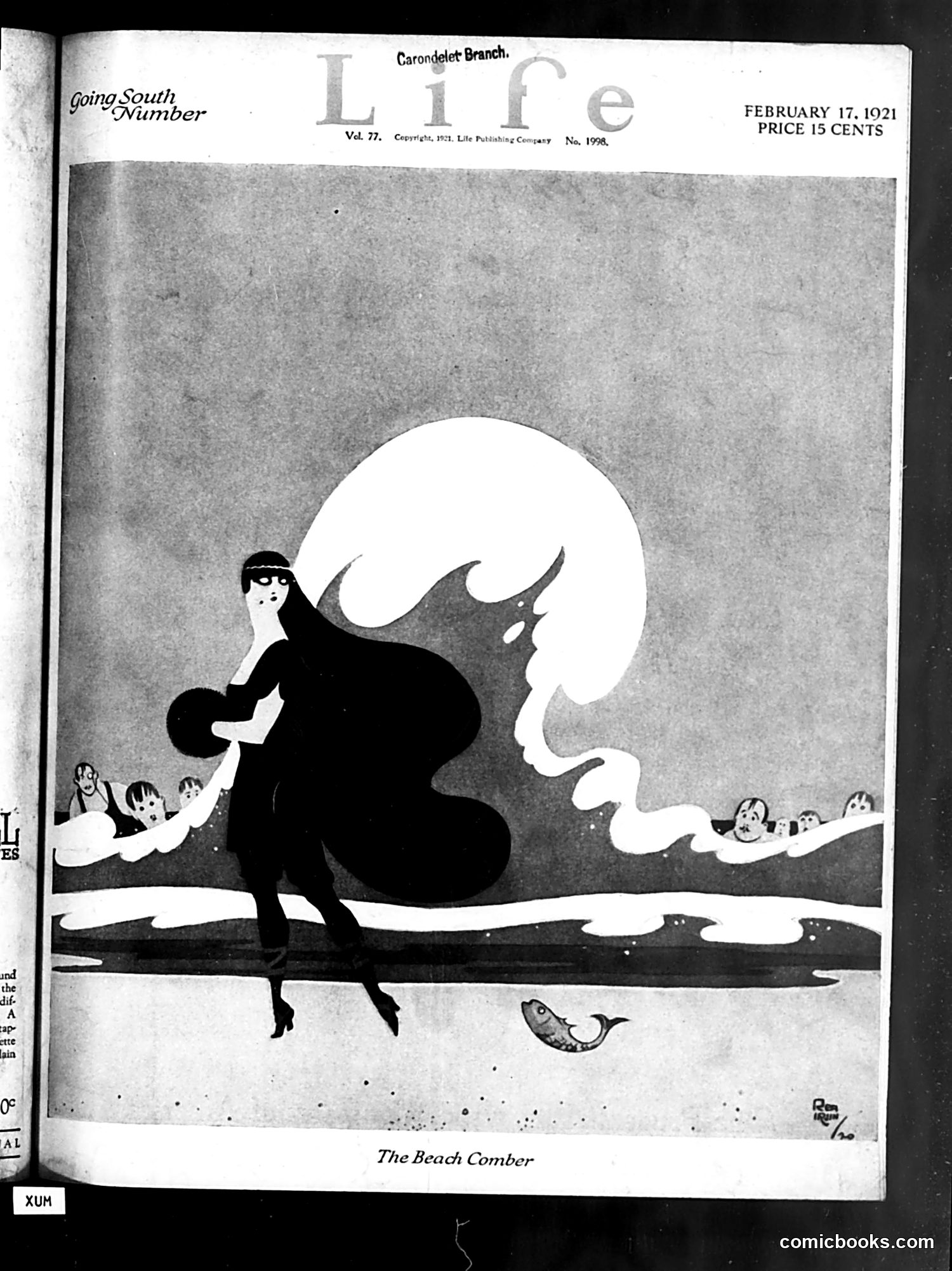
This illustration depicts a fashionable woman in 1920s attire combing her hair at the beach while sitting on what appears to be a large wave or sea creature. Small cherubs or putti flank her on either side, and a small fish appears in the water below. The cartoon plays on the term "beach comber"—literally someone who combs the beach—by showing a woman literally combing at the beach. It's a visual pun typical of Life magazine's humor style. The idealized, art deco aesthetic and the woman's confident pose reflect the "Modern Woman" aesthetic of the Jazz Age 1920s, celebrating the era's more liberated female fashion and leisure activities. The cherubs suggest romantic or fantastical themes common to period illustration.
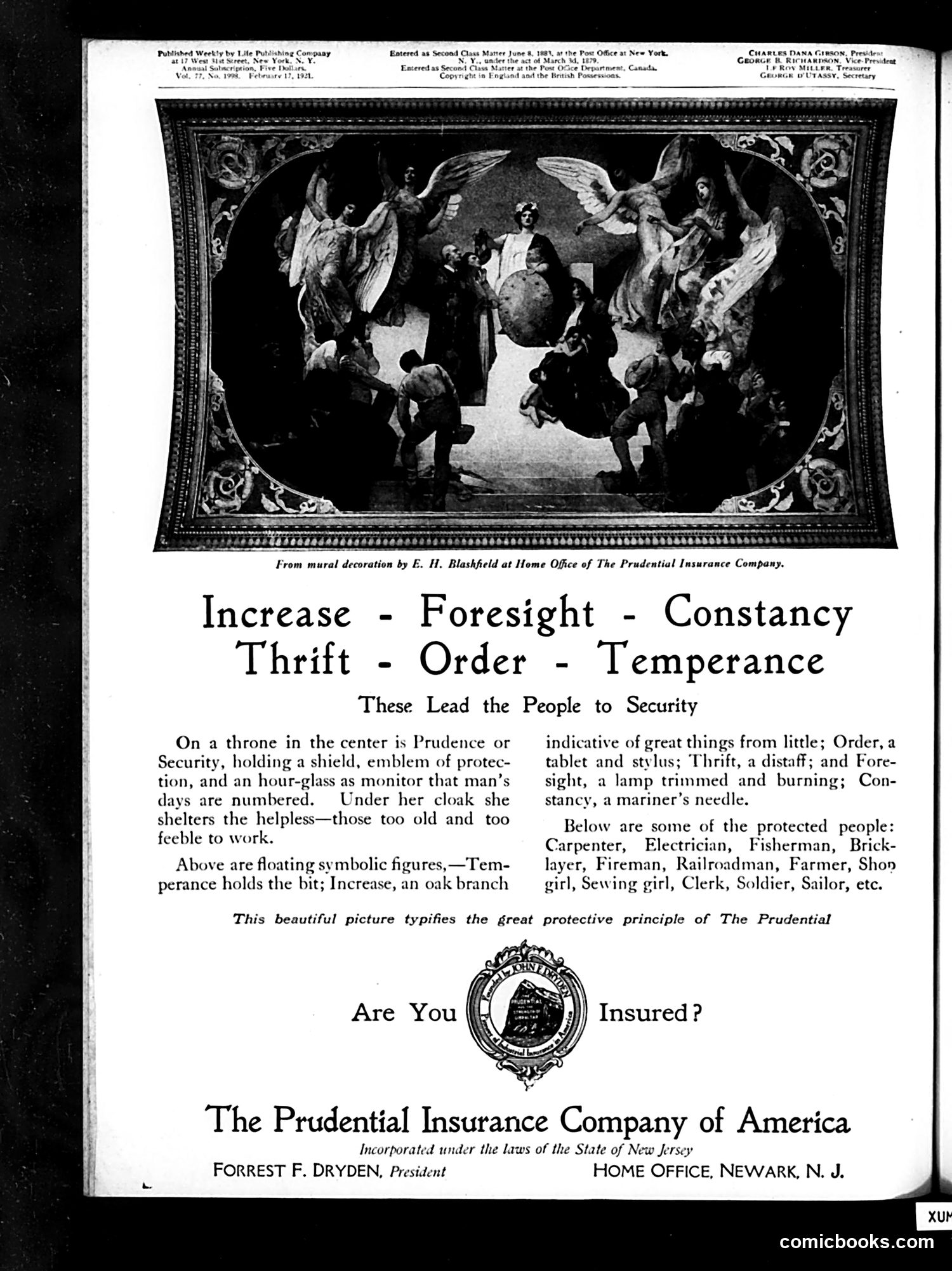
This page is primarily **advertising**, not satire or political commentary. It's a full-page ad for The Prudential Insurance Company of America (home office in Newark, N.J.). The mural artwork depicts an allegorical scene with a central female figure labeled "Prudence or Security" on a throne, surrounded by floating symbolic figures representing virtues (Temperance, Increase, Order, Thrift, Foresight, Constancy). Below them are silhouettes of working people—carpenters, electricians, fishermen, farmers, etc. The message is straightforward corporate messaging: insurance provides security and protection for workers through prudent financial planning. The classical allegorical style and list of protected occupations aims to make insurance seem both noble and universally beneficial. The headline "Are You Insured?" is a direct sales pitch.
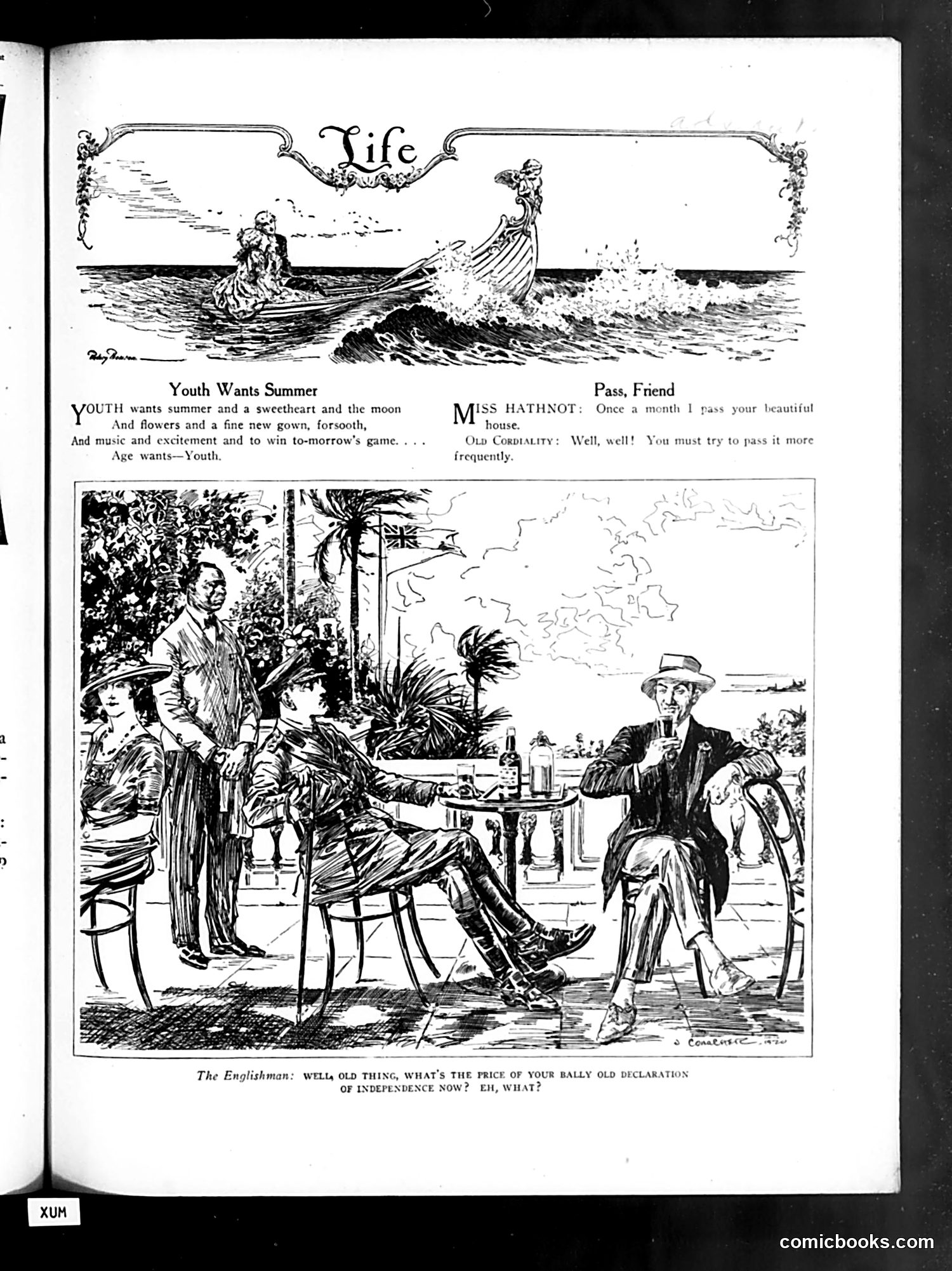
**Top Section:** Two poems—"Youth Wants Summer" and "Pass, Friend"—present contrasting perspectives on desire and access. The seaside illustration shows a woman being denied entry to what appears to be a private beach house, establishing a theme of exclusion. **Main Cartoon:** Titled "The Englishman," this depicts a colonial-era scene with British and local figures. An English gentleman asks about "the price of your bally old declaration of independence now?" This references American independence, suggesting British smugness about American colonial status or recent political tensions. The tropical setting and servant presence indicate imperial colonial dynamics. The satire mocks British condescension toward American sovereignty or post-independence struggles, though the specific historical moment remains unclear without additional context.
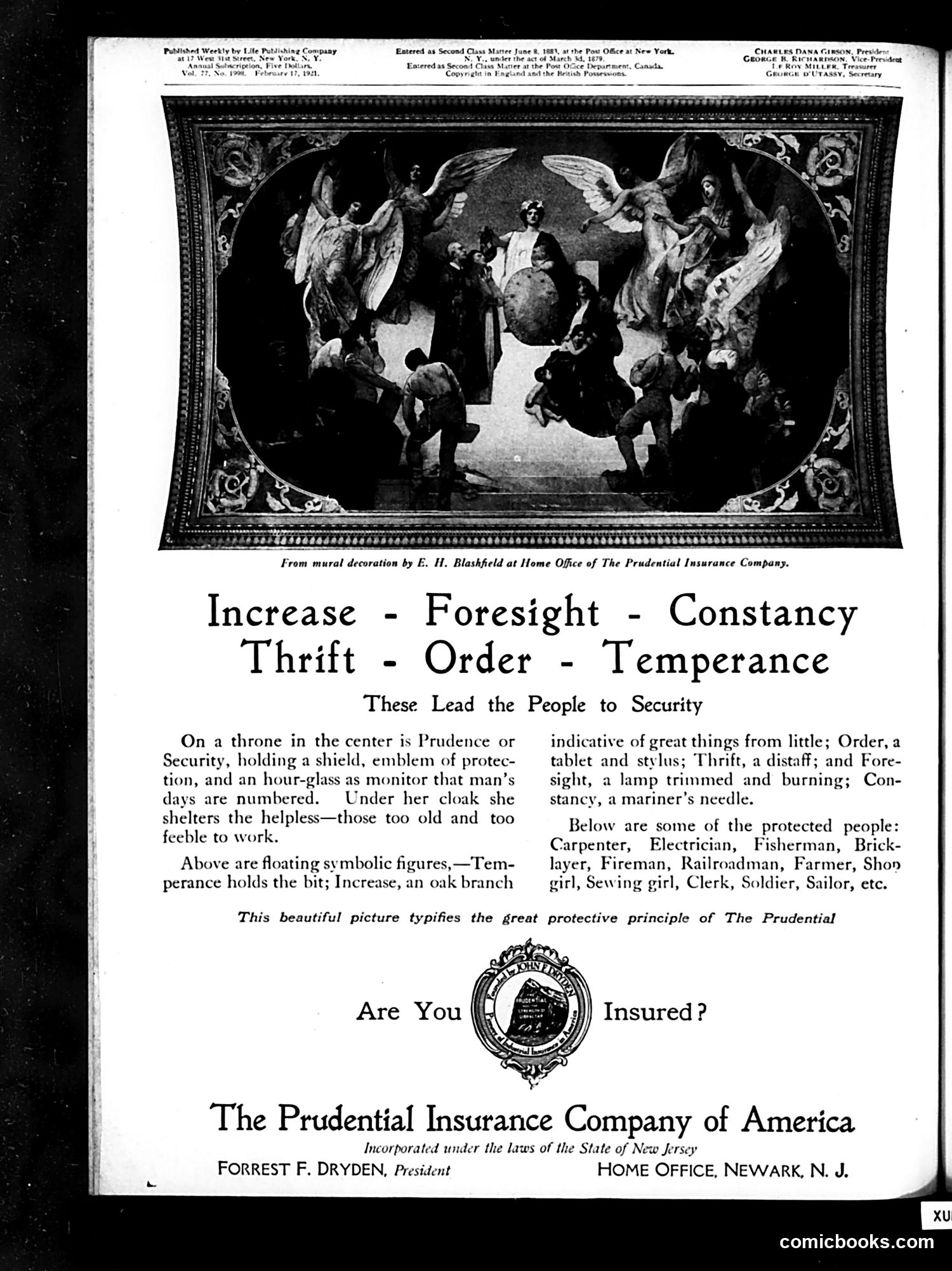
This page is primarily **advertising**, not satire or political commentary. It's a Life magazine advertisement for The Prudential Insurance Company of America (circa early 1900s, based on publication details). The mural decoration by E.H. Blakfield depicts allegorical figures representing virtues—Prudence (center, on throne with shield), Temperance, Increase, Foresight, Constancy, Thrift, and Order—that supposedly lead people to "Security." Below these symbolic figures are listed working-class occupations (carpenter, electrician, fisherman, etc.) the insurance company aims to protect. The ad's message: insurance provides security and protection for ordinary workers and their families, embodying the virtues depicted above. This is straightforward corporate messaging rather than satirical commentary.
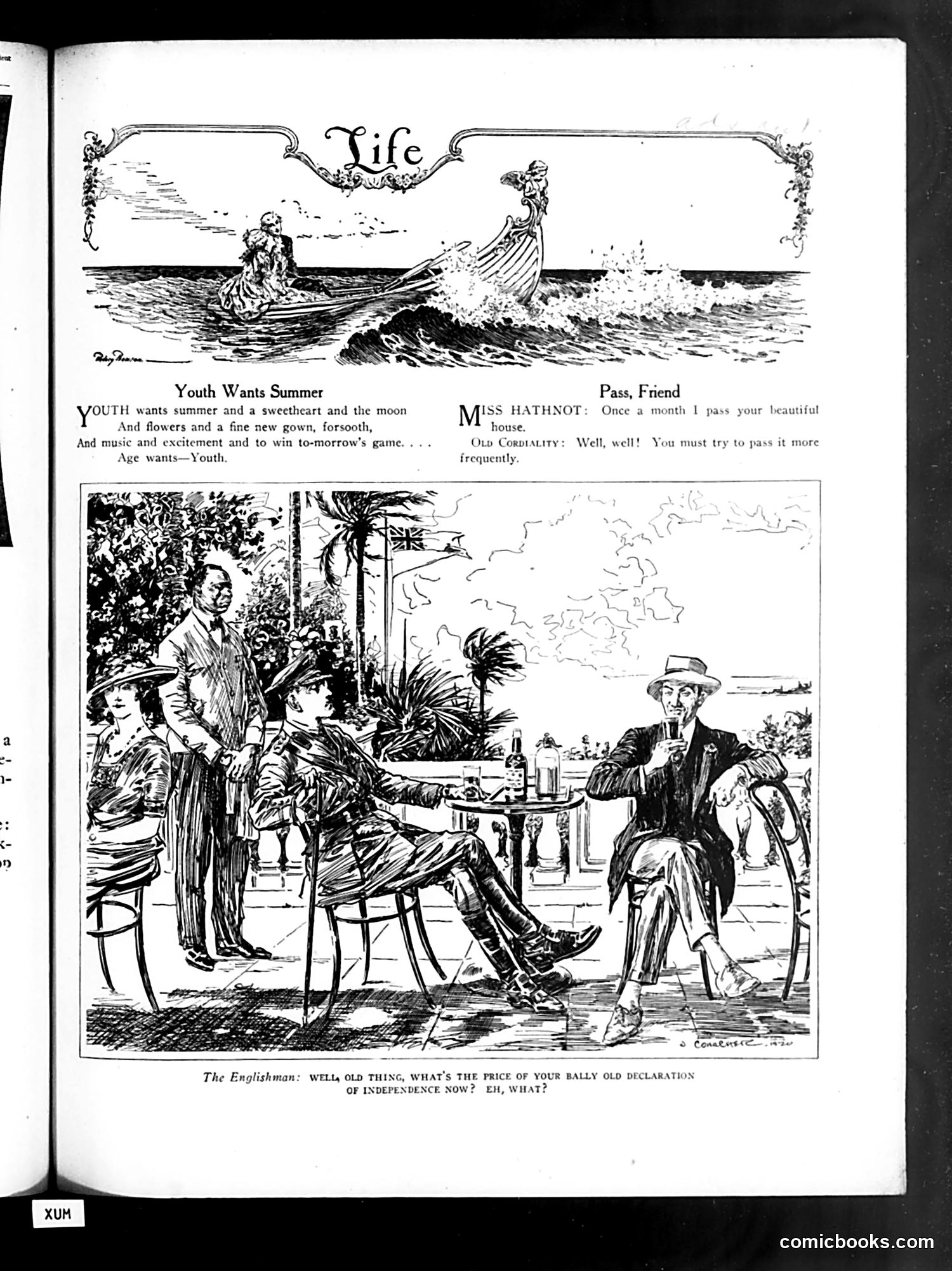
This page features satirical content about leisure and social commentary. The top illustration depicts figures in water, titled "Life," establishing a theme of living well. The main cartoon titled "The Englishman" shows a colonial-era scene with a British official (identifiable by the Union Jack flag) being questioned by what appears to be a local or American figure. The dialogue reads: "Well, old thing, what's the price of your bally old declaration of independence now? Eh, what?" This satirizes British attitudes toward American independence, suggesting a smug, dismissive English perspective on American sovereignty—likely commentary on British-American relations during the early 20th century. The "bally" exclamation is characteristically British slang, reinforcing the stereotype. The joke mocks British condescension toward colonial independence movements.
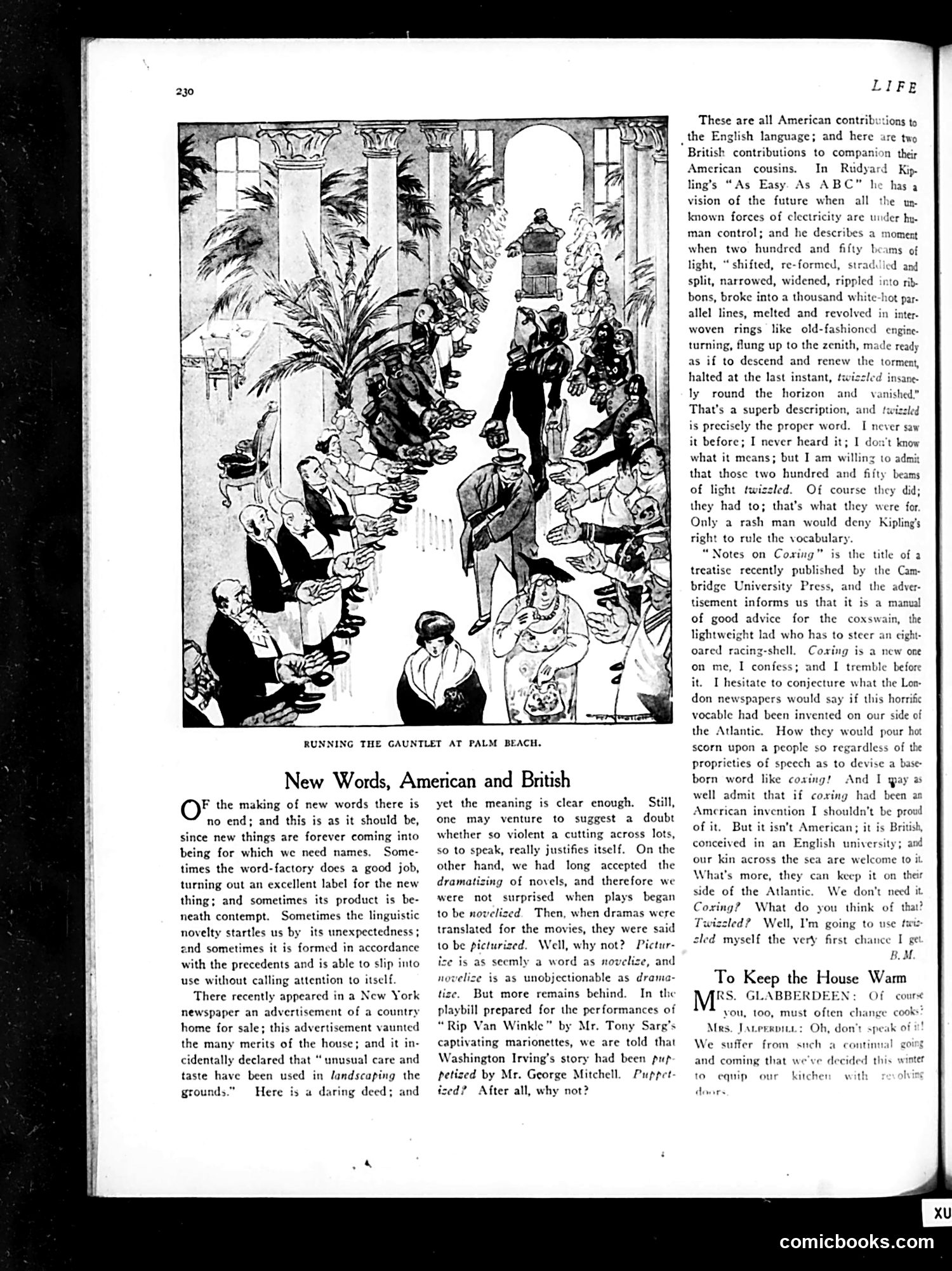
This cartoon satirizes the social scene at Palm Beach, Florida—a wealthy resort destination. The illustration shows fashionably dressed people (likely wealthy socialites and tourists) navigating through a crowded, ornate columned space, suggesting the gauntlet of social encounters and judgment one endures in high society. The "gauntlet" metaphor implies this is an ordeal—perhaps mocking how the wealthy must constantly display themselves, encounter rivals, or maintain their social standing in such exclusive spaces. The elaborate architecture and numerous figures emphasize the pretension and crowded competitiveness of the resort's social hierarchy. This reflects early 20th-century American satirical commentary on wealthy leisure culture and social pretension.
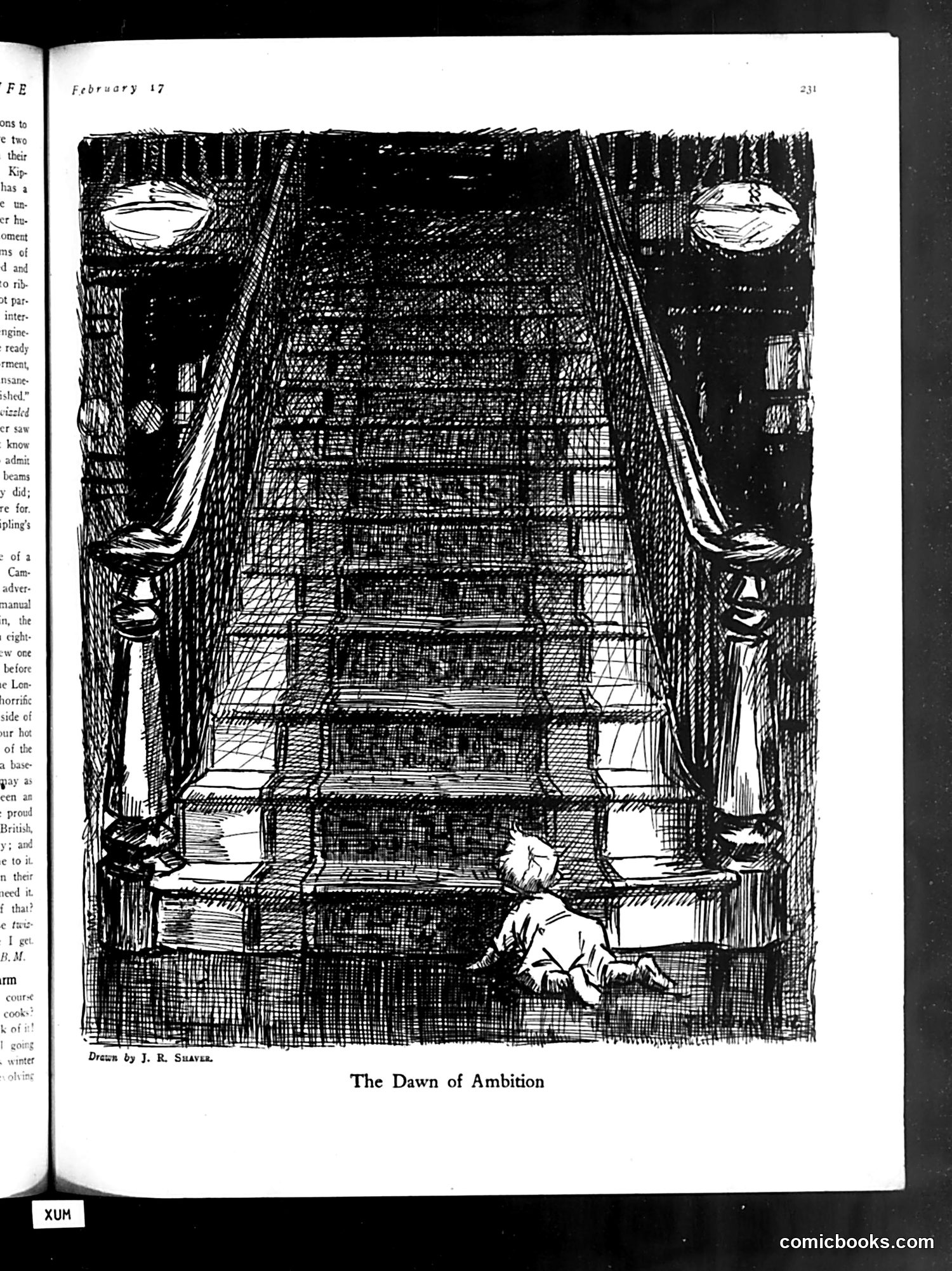
This ink drawing by J. R. Shaver depicts a child crawling up an imposing staircase in what appears to be a grand, institutional building with barred windows and classical architectural features. The stairs stretch upward into darkness, symbolizing aspiration and the difficult climb toward success or achievement. The title "The Dawn of Ambition" suggests the image represents youth beginning their journey toward adult goals and ambitions. The child's small figure contrasted against the massive, austere architecture emphasizes the enormity of the challenges ahead. The barred windows and fortress-like quality may suggest societal constraints or the formidable obstacles ambition must overcome. This appears to be social commentary on the nature of striving and ambition in American society.
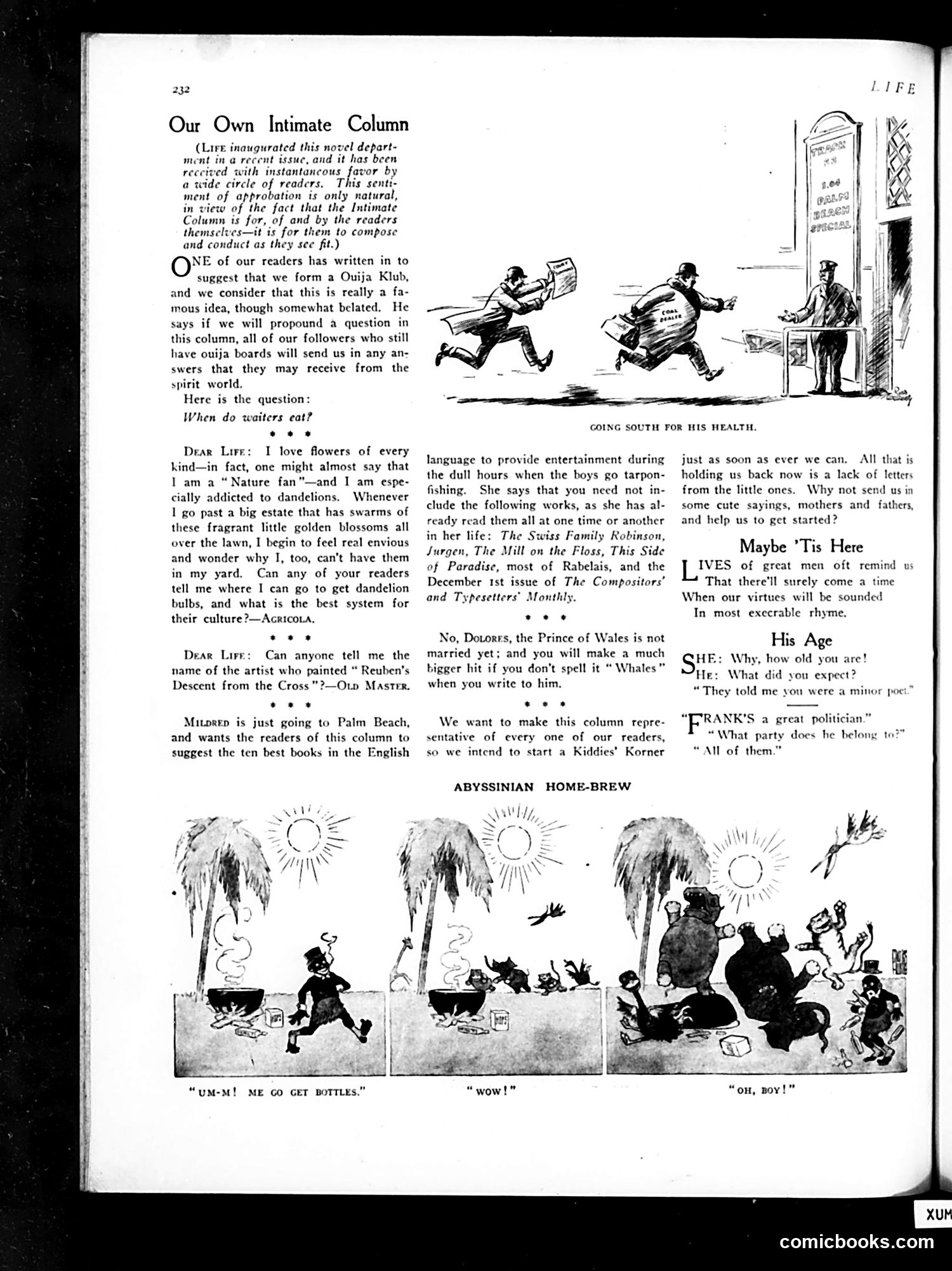
This page features **Life's advice column**, newly launched, inviting readers to submit questions. The illustrated cartoon at top shows a man fleeing an office building labeled "GOING SOUTH FOR HIS HEALTH"—likely satirizing the Victorian euphemism for seeking medical treatment or escape from urban life. The column includes reader letters addressing topics like growing flowers and identifying an artist ("Reuben's Descent from the Cross"). **"Abyssinian Home-Brew"** (bottom) is a three-panel comic strip showing someone collecting palm tree sap in a large pot, progressively attracting wild animals and chaos. The captions ("Um-m! me get bottles," "wow!", "Oh, boy!") suggest fermentation gone humorously wrong, poking fun at crude alcohol production.
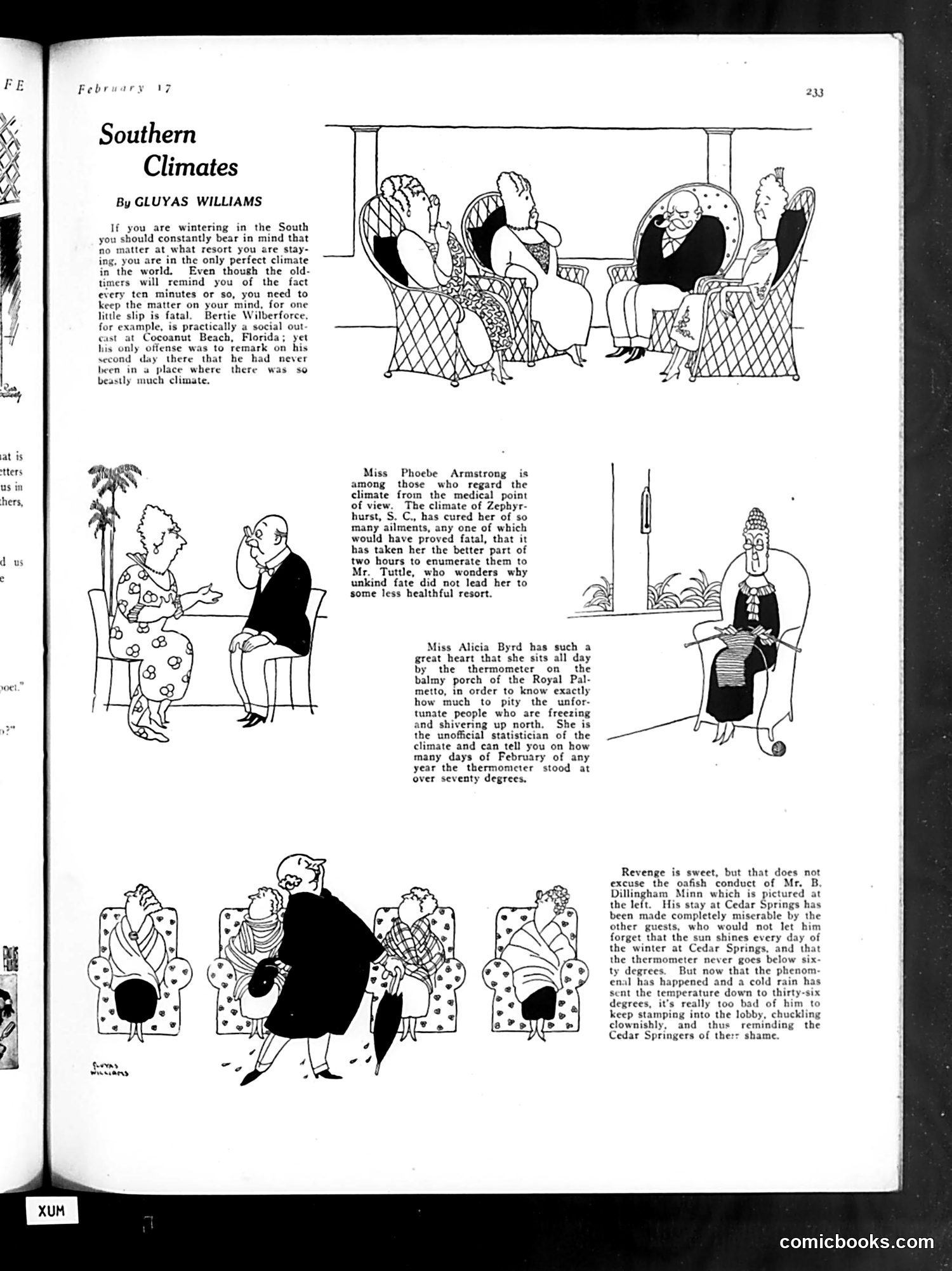
This humorous article satirizes wealthy Northern tourists wintering in the South, particularly Florida. The cartoons mock the pretense and exaggeration surrounding Southern resort destinations. The jokes target: - **Climate boasting**: Northerners arriving expecting perfect weather but encountering cold snaps (the article mentions Cedar Springs residents keeping thermometers below sixty degrees to shame visitors) - **Social posturing**: References to specific resorts like Coconut Beach and the Royal Palmetto, where guests compete to display their wealth - **Character types**: Miss Phoebe Armstrong and Miss Alicia Byrd appear to represent the stereotypical wealthy winter visitor concerned with status and climate statistics The bottom cartoon depicts what appears to be resort guests in wicker chairs, suggesting the idle leisure lifestyle. The satire emphasizes how Southerners gleefully embarrass wealthy Northerners when promised warm weather fails to materialize.
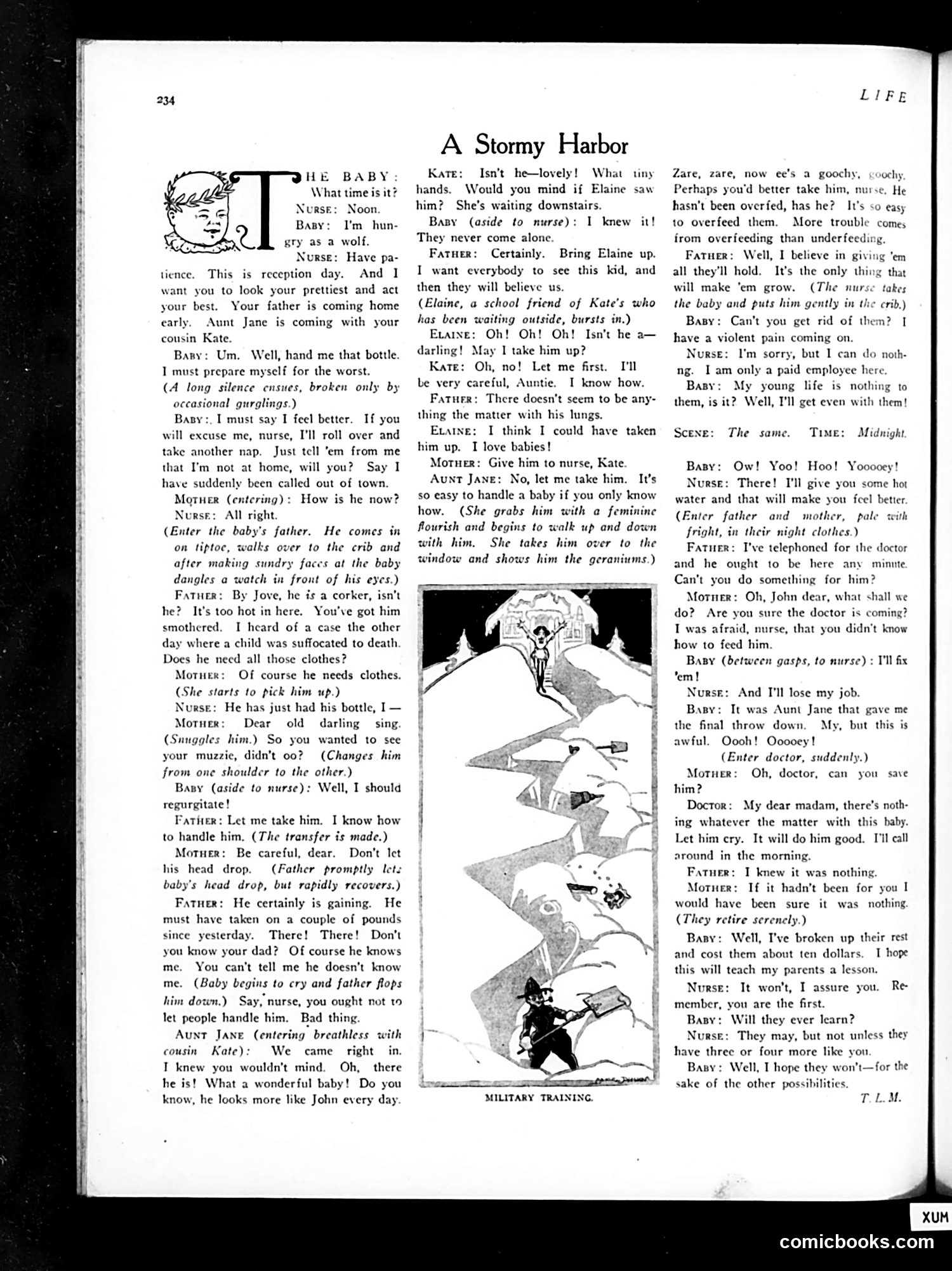
This page presents a dramatic play scene titled "A Stormy Harbor," depicting a domestic crisis involving a newborn baby. The left column contains dialogue among family members—a nurse, parents, and Aunt Jane—discussing an ill infant requiring medical attention. The accompanying illustration labeled "MILITARY TRAINING" shows soldiers in combat positions on what appears to be a hillside or fortification, seemingly unrelated to the play's domestic plot. The juxtaposition appears satirical: the play depicts civilian anxieties about childbirth and infant mortality (genuine period concerns), while the military illustration suggests Life magazine's commentary on military readiness or training. The contrast between intimate domestic drama and military preparation likely critiques societal priorities or reflects early 20th-century American preoccupations with both domestic welfare and military strength.
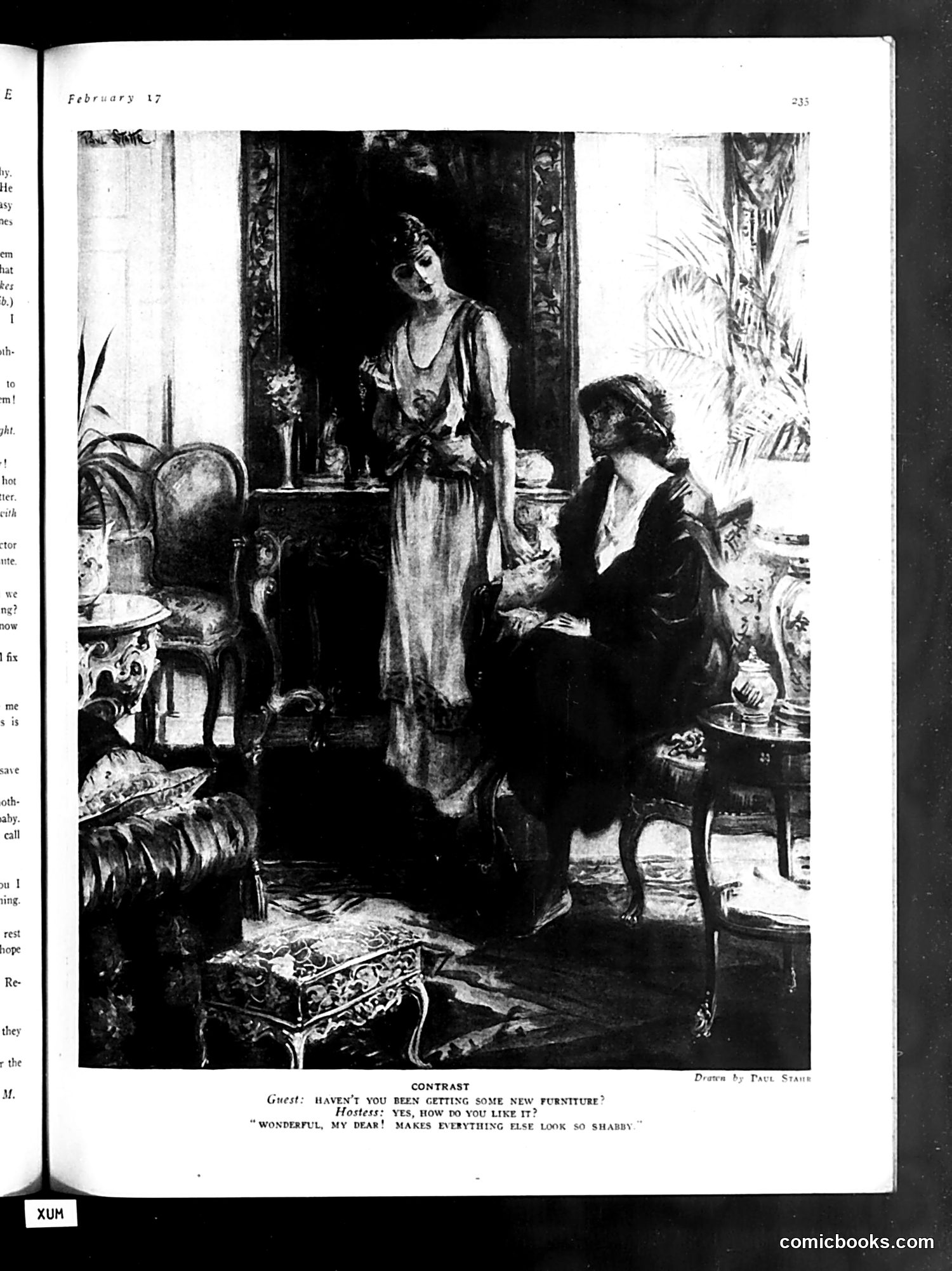
This drawing by Paul Stabb depicts a comedic scene about conspicuous consumption and social pretension. A fashionably dressed hostess stands while entertaining a seated guest in an ornate, plant-filled interior filled with luxury furnishings and decorative objects. The joke hinges on the guest's comment: the new furniture is "wonderful" but "makes everything else look so shabby." The satire targets the wealthy person's endless consumption cycle—acquiring expensive items creates pressure to replace everything else, leading to perpetual dissatisfaction and competitive spending. The title "Contrast" underscores the irony: despite surrounding herself with finery, the hostess cannot achieve the cohesive elegance she desires. It's social commentary on early 20th-century materialism and status anxiety among the affluent.
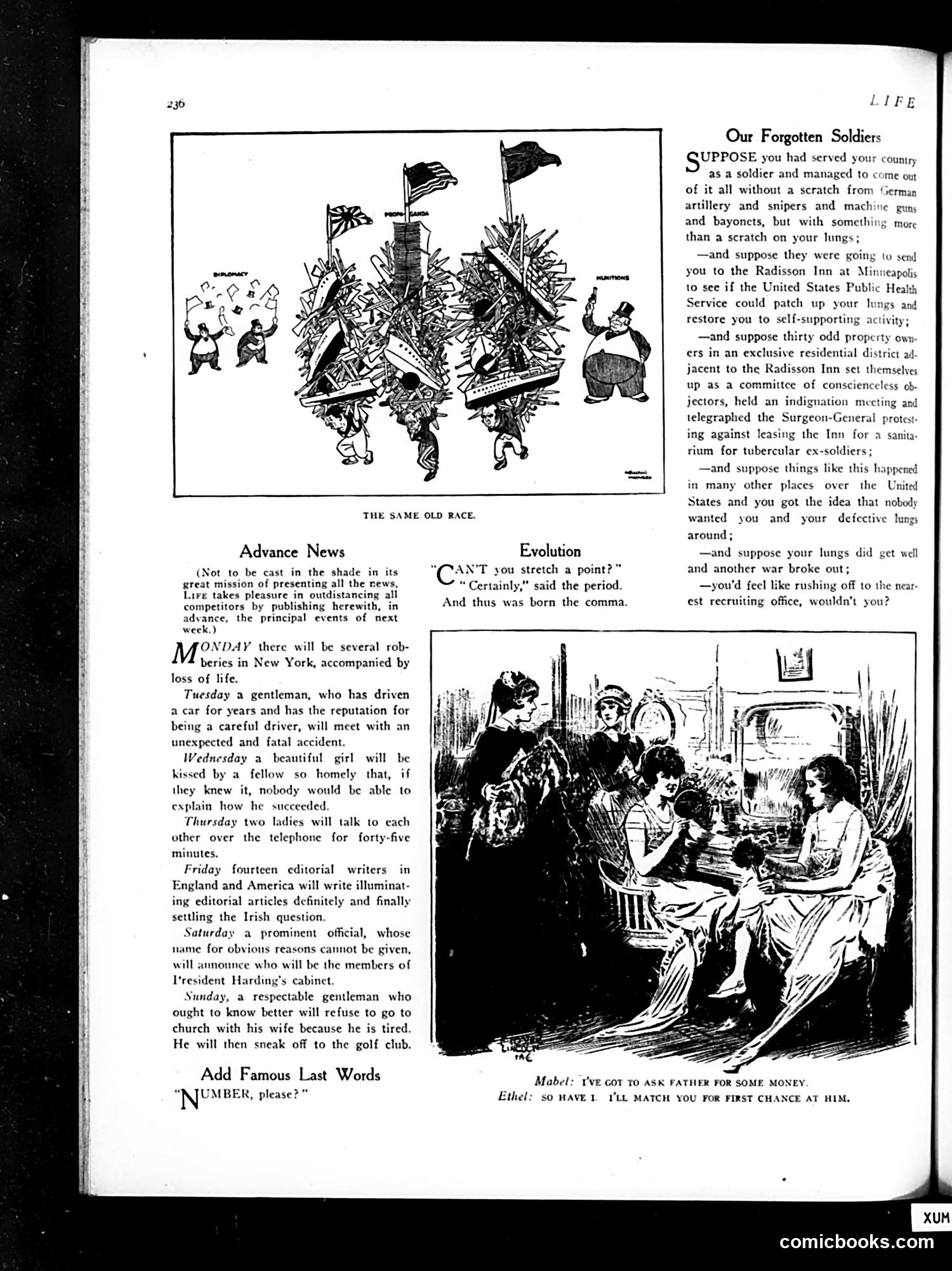
The main article criticizes inadequate government care for WWI veterans with lung disease (likely tuberculosis from gas exposure). It describes wealthy property owners near the Radisson Inn blocking a sanitarium for tubercular ex-soldiers, then sarcastically imagines how those veterans might feel if war broke out again and they had to rush back to recruiting. **"The Same Old Race"** (top cartoon) shows three figures in period costume carrying flags and weapons, suggesting this depicts recurring historical warfare—likely contrasting modern civilization's claims of progress with humanity's perpetual cycle of conflict. The other sections ("Advance News," "Evolution," "Add Famous Last Words") are brief satirical predictions about upcoming social/political events.
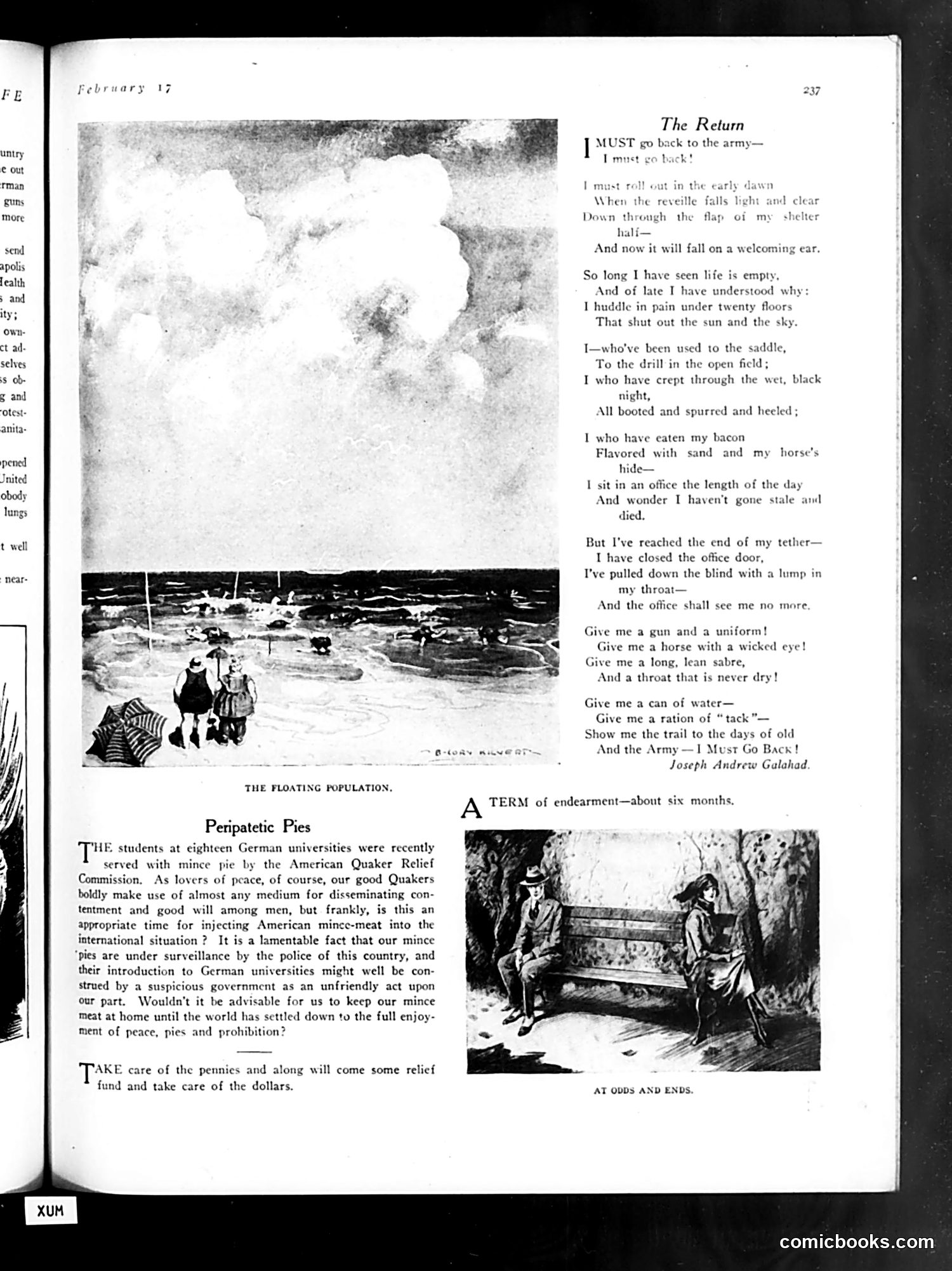
This page contains a WWI-era poem by Joseph Andrew Galahad titled "The Return," depicting a soldier's desperate wish to leave the army after enduring combat conditions—sleeping in mud, eating sand-flavored food, marching through darkness. The soldier begs for basic comforts: water, a working gun, a dry throat. Below, "Peripatetic Pies" satirizes American Quakers' attempts to send mincemeat pies to German universities as peace gestures during wartime. The author questions the wisdom of introducing American food to Germany while suggesting this could be viewed as a suspicious act by the German government—mocking both Quaker idealism and wartime paranoia about neutral gestures being misinterpreted.
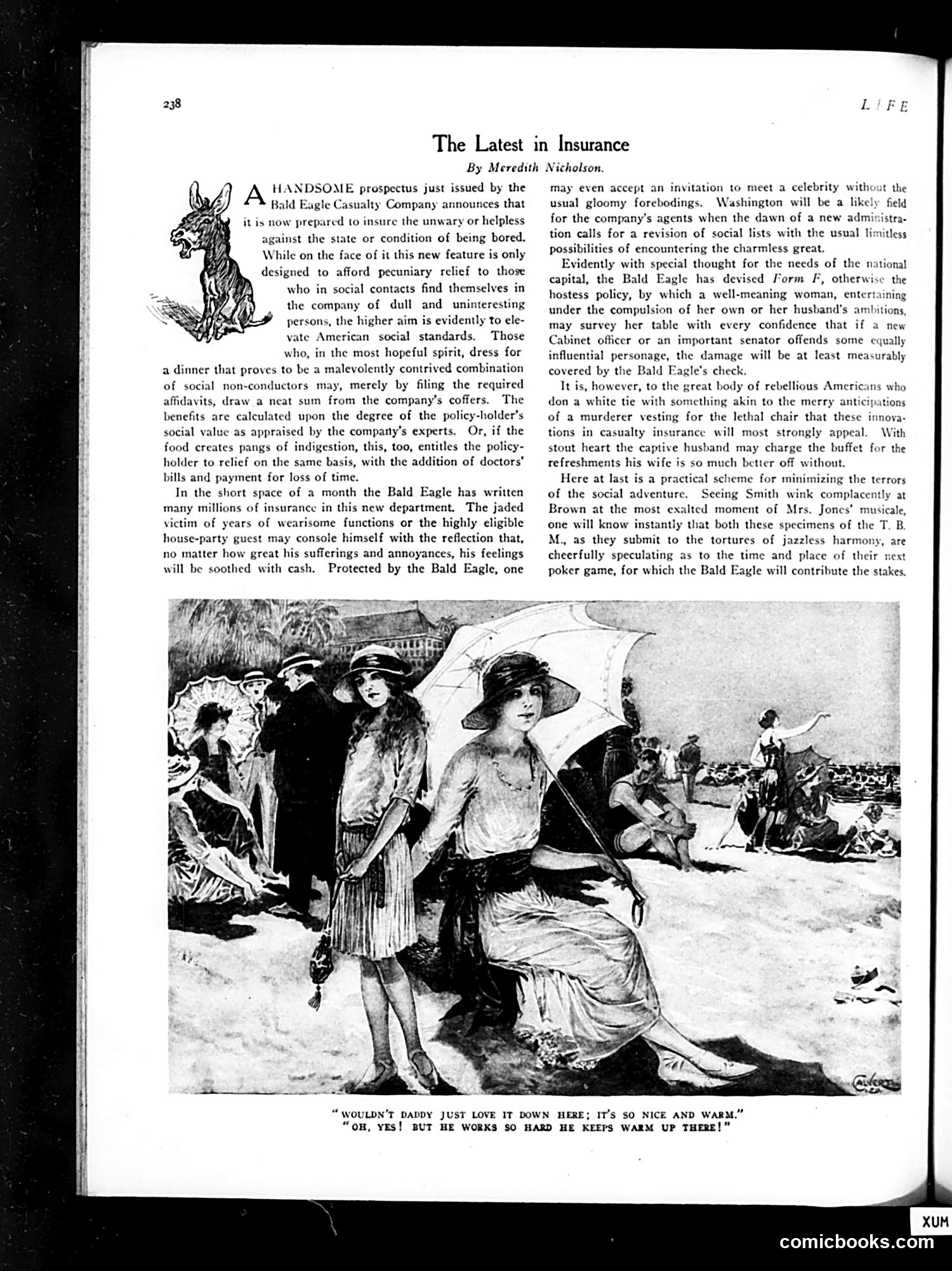
This satirical piece mocks the Bald Eagle Casualty Company's new insurance product—coverage for social embarrassments. The article humorously describes policies protecting the socially awkward from "gloomy forebodings" at dinner parties and social events. The accompanying cartoon depicts a beach scene where a woman holds a parasol while another sits nearby. The caption reads: "Wouldn't daddy just love it down here; it's so nice and warm." / "Oh, yes! But he works so hard he keeps warm up there!" The joke plays on working-class struggle—the father works so hard (likely in a hot, labor-intensive job) that he remains perpetually "warm" from exertion, making leisure impossible. The satire critiques both class divisions and the absurdity of insurance policies for trivial social anxieties while real workers suffer.
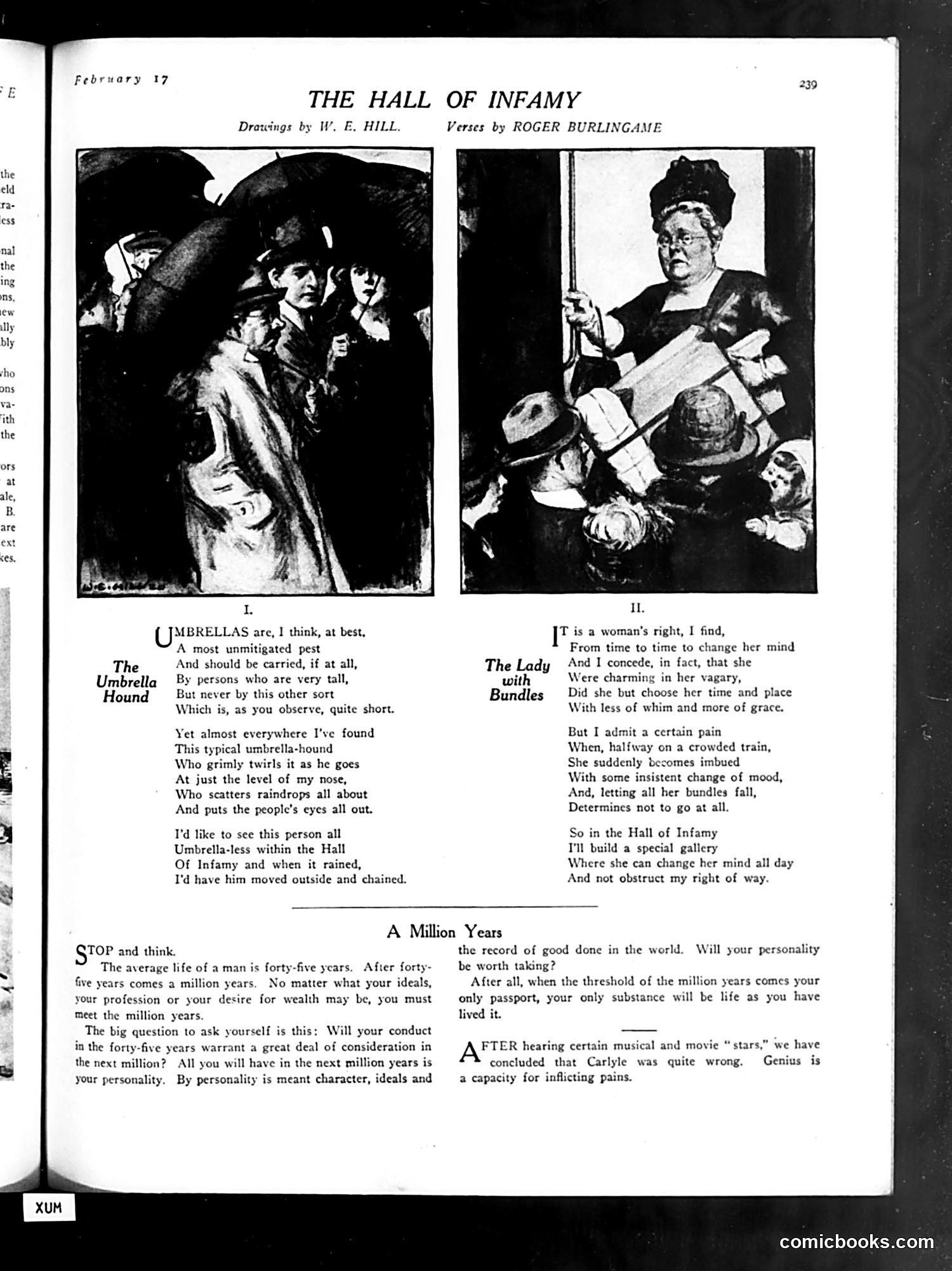
This page presents two illustrated satirical pieces by W.E. Hill with verses by Roger Burlingame. **"The Umbrella Hound"** (left image) depicts a tall person with children, mocking someone who uses umbrellas despite being very tall—suggesting this person's excessive height makes umbrella-carrying ridiculous and annoying to others. **"The Lady with Bundles"** (right image) shows a woman constantly changing her mind while shopping, becoming "imbued with some insistent change of mood." The satire criticizes women's supposed indecisiveness and shopping habits, arguing such behavior should be confined to a special gallery in the "Hall of Infamy." Both pieces represent typical early 20th-century humor targeting social types—tall men and indecisive women—through gentle, illustrated mockery.
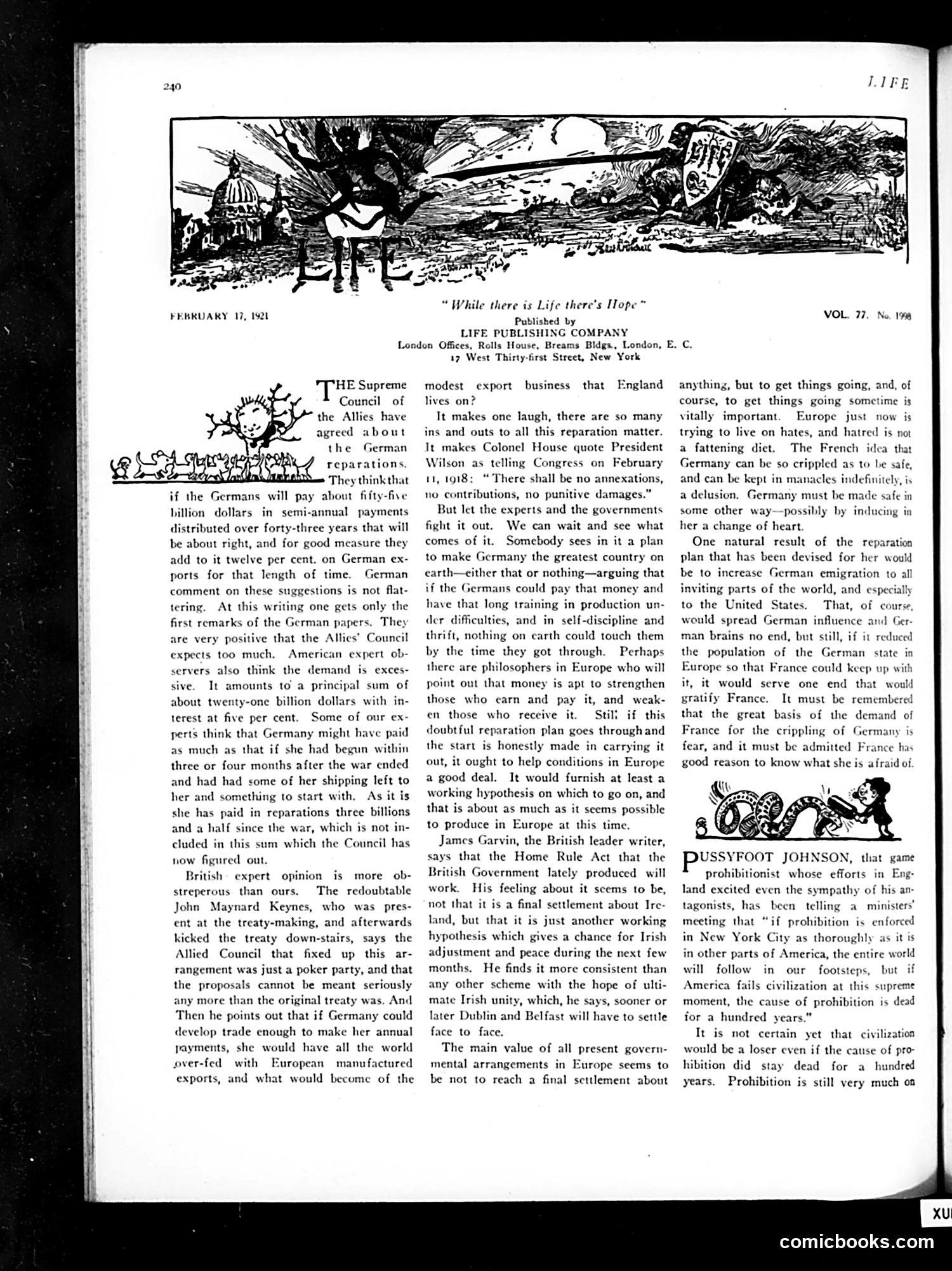
This page contains two editorial cartoons addressing post-WWI reparations and European politics. The **top cartoon** depicts the German reparations debate. The text discusses whether Germany's proposed sixty-billion-dollar payments are feasible, with experts disagreeing on amounts and timeline. The **bottom cartoon** titled "Pussyfoot Johnson" shows a temperance activist mocking prohibition's effectiveness. The caption references Johnson's efforts promoting prohibition in America and warns that if prohibition enforcement fails in New York City—a major metropolis—it will undermine civilization itself for a hundred years. Both cartoons reflect 1921 anxieties: post-war financial instability in Europe and America's newly implemented Prohibition (1920), questioning whether ambitious social policies could actually succeed.
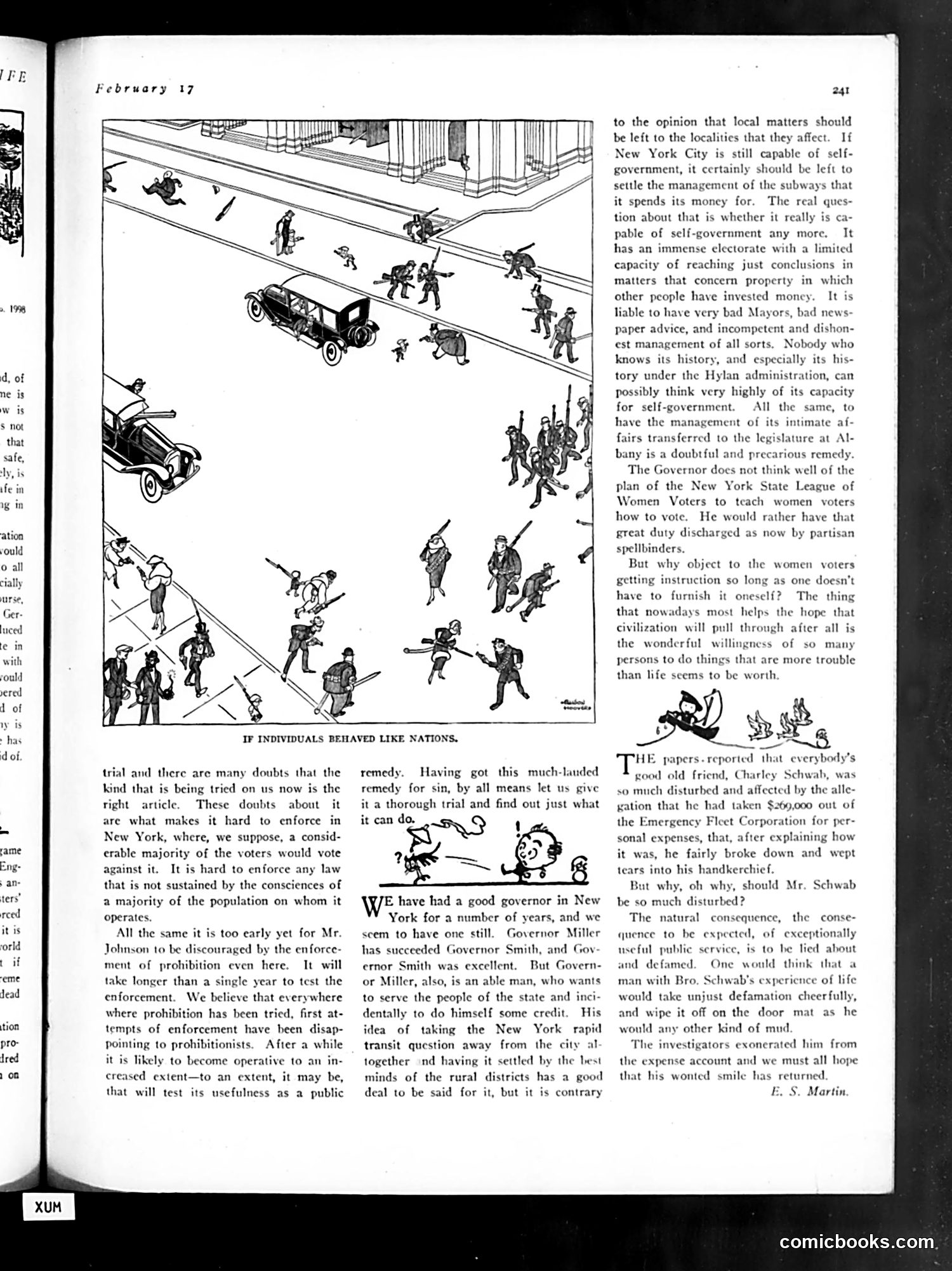
**Main Cartoon: "If Individuals Behaved Like Nations"** This untitled cartoon depicts street chaos—pedestrians, vehicles, and figures in apparent conflict—satirizing the absurdity of applying international relations (anarchic, lawless) to domestic urban life. The point: nations operate without enforceable rules; if individuals did likewise, cities would collapse into chaos. **Text Content:** The page discusses Prohibition enforcement in New York, questioning whether laws unsupported by public conscience can be enforced effectively. It critiques Governor Miller's plan to remove NYC subway management to the state legislature in Albany, arguing local matters should remain local. The piece also mocks women voter education initiatives and discusses Charles Schwab's distress over allegations he misused $269,000 from the Emergency Fleet Corporation during WWI. **Context:** This reflects 1920s debates over federal overreach, municipal autonomy, and newly enfranchised women voters—all controversial in that era.
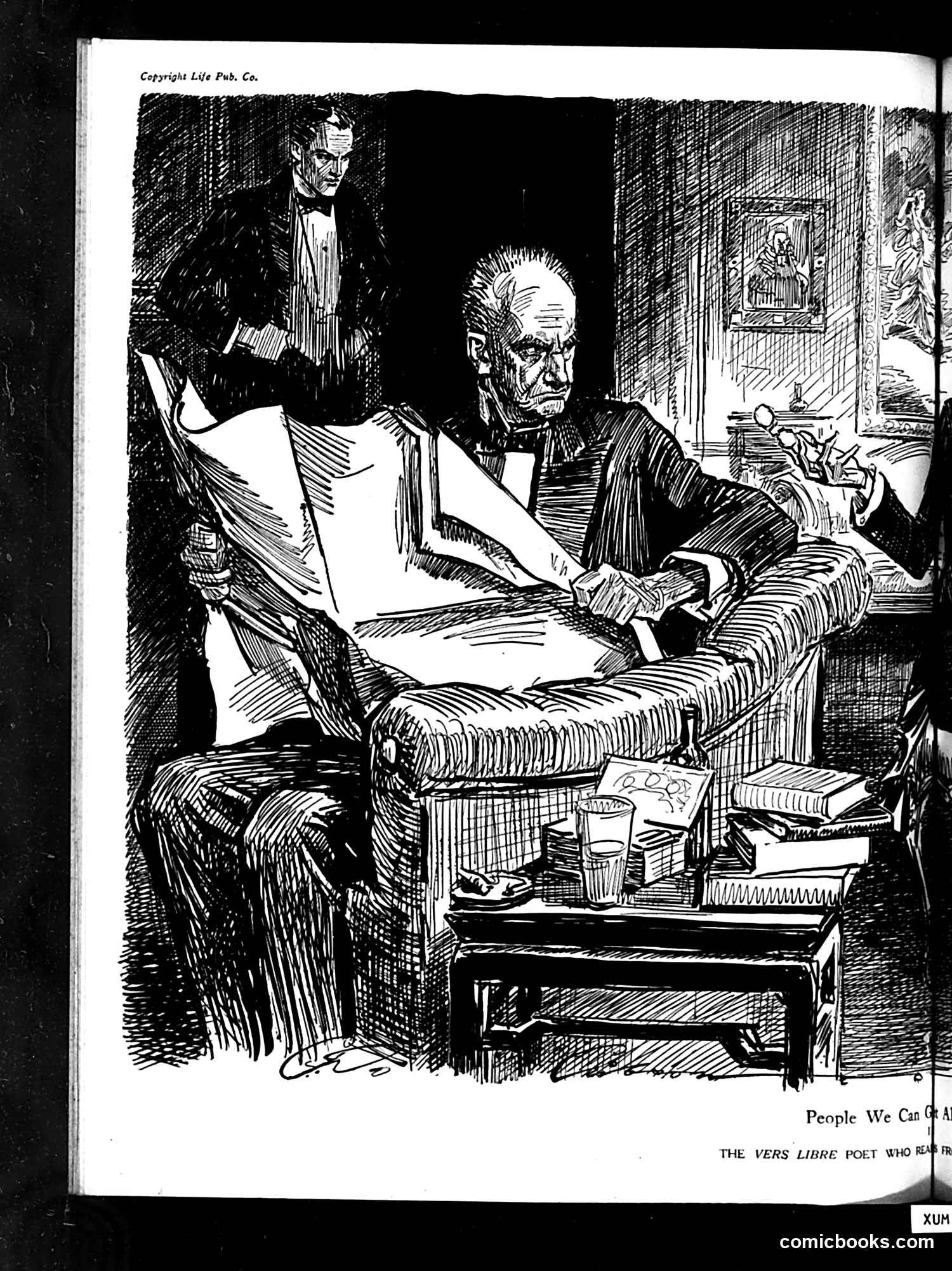
This appears to be a satirical cartoon about a "vers libre poet" (a free verse poet—a modernist literary movement). The image shows an elderly, stern-looking man seated at a desk examining papers, while a younger man stands behind him presenting work. The setting is an elegant interior with paintings visible. The satire likely mocks free verse poetry and its practitioners. The serious, almost judicial demeanor of the seated figure suggests he's evaluating or judging the presented work with skepticism. The cartoon's point appears to be ridiculing the pretension or obscurity of modernist free verse poetry—presenting it as something requiring intense, puzzled scrutiny rather than natural appreciation. The exact context and publication date are unclear from the visible text, though Life magazine was known for cultural satire.
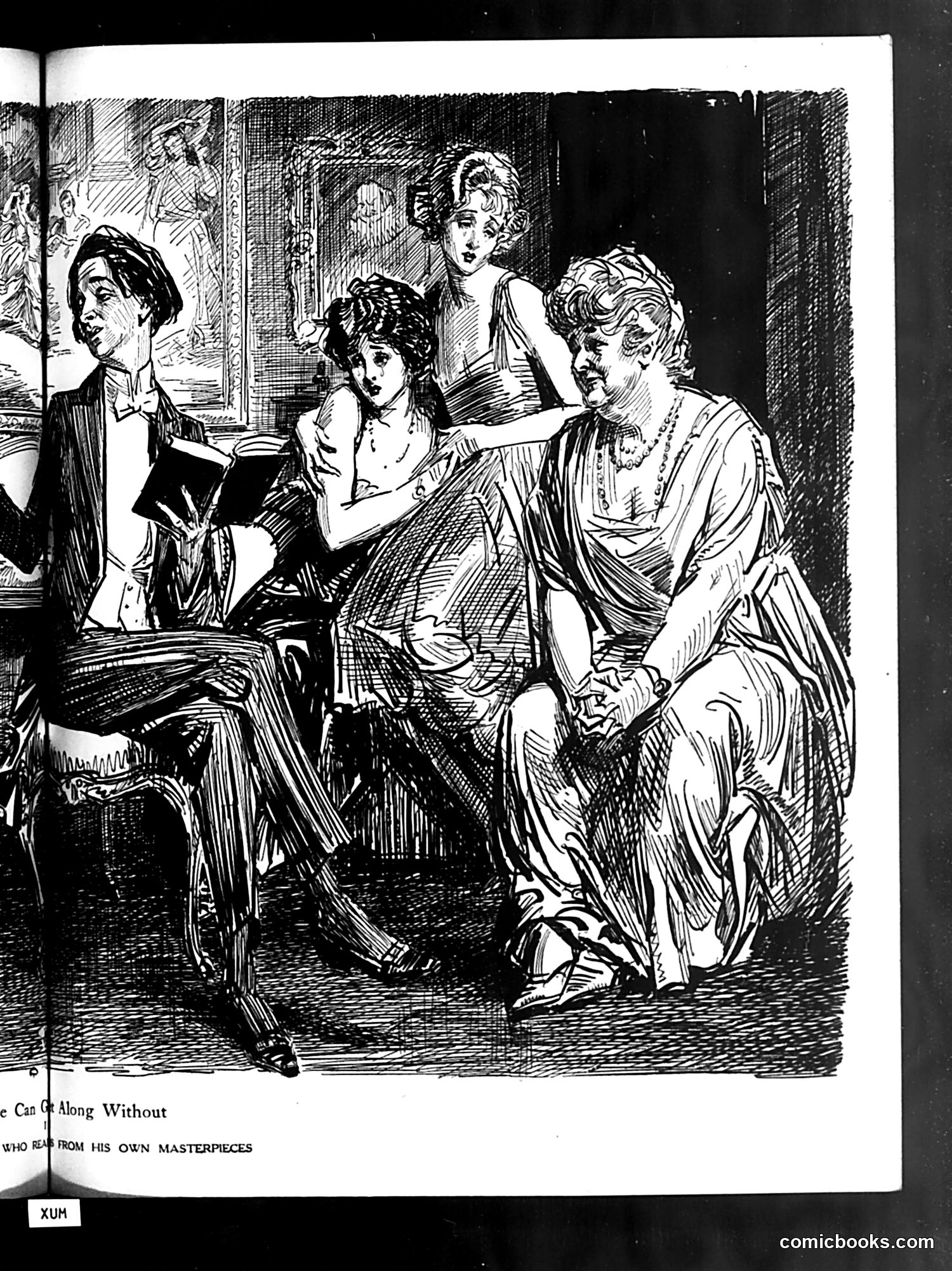
This appears to be a page from *Life* magazine showing a social scene illustration. The visible text fragment "Along Without" and partial caption "WHO READ FROM HIS OWN MASTERPIECES" suggest this depicts a literary or cultural gathering—possibly satirizing an author or intellectual figure reading their work to an assembled audience of well-dressed society figures. The illustration uses the magazine's characteristic pen-and-ink style to depict what appears to be an indoor social event with multiple figures in formal attire. However, the OCR text is too fragmentary and corrupted to determine the specific satire's target, the historical context, or which public figure is being lampooned. Without clearer caption text, I cannot reliably identify who this cartoon critiques or what social commentary it intends.
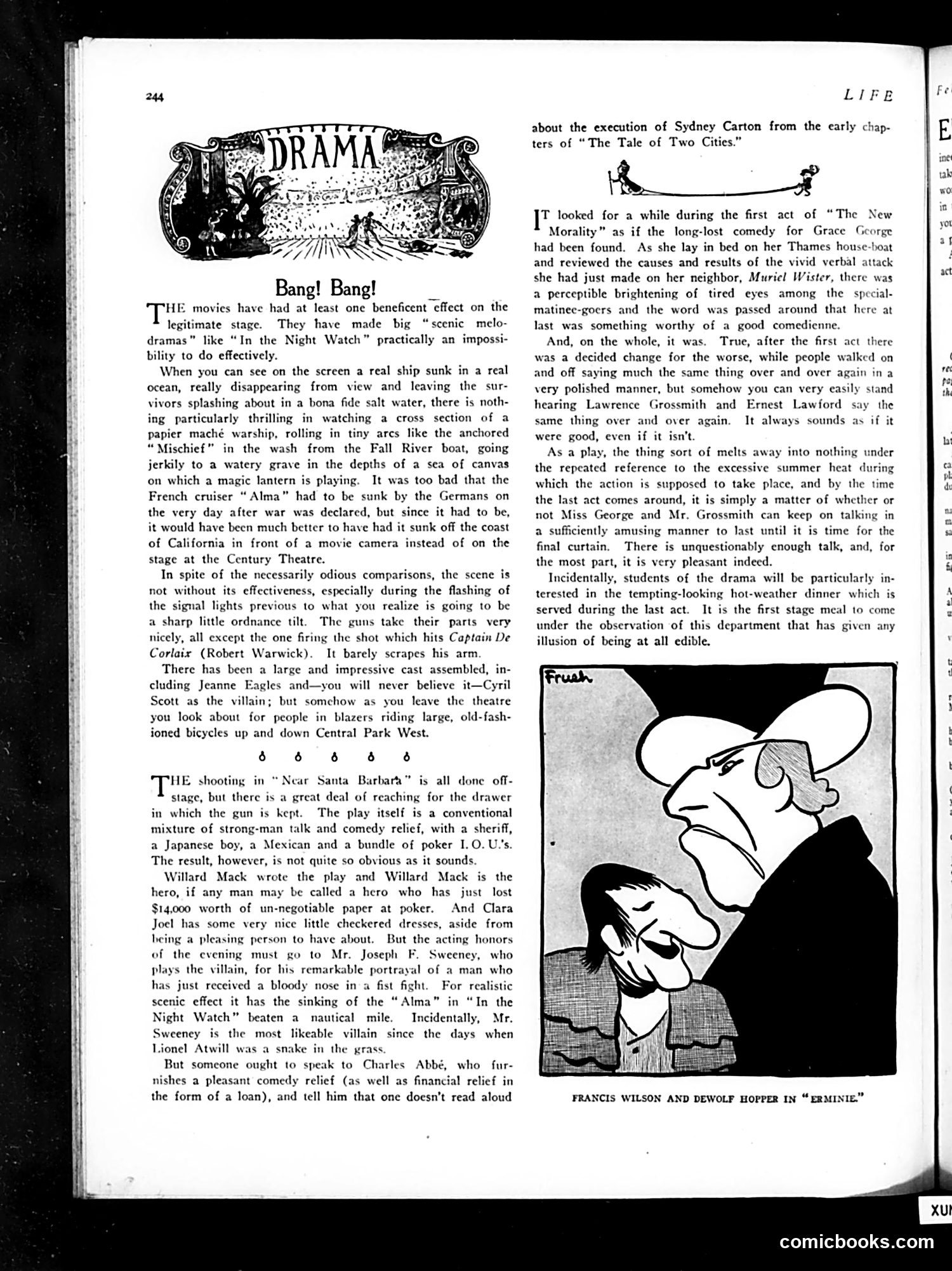
This page reviews three Broadway plays, with satire critiquing how cinema has undermined theatrical spectacle. The main article argues that movies' realistic effects (real ships sinking, actual ocean scenes) have made stage melodramas with painted backdrops and mechanical props laughably unconvincing. The accompanying caricature (captioned "Francis Wilson and Dewolf Hopper in 'Erminie'") appears to be a humorous exaggeration of performers' facial features, typical of Life's comedy illustrations. The reviews mock specific productions: "In the Night Watch" features an unconvincing papier-mâché warship; "Near Santa Barbara" is criticized as conventional melodrama; and "The New Morality" disappoints after a promising opening. The satire targets not the actors but the theatrical conventions themselves—suggesting early 1900s theater was struggling against cinema's competitive realism. References to Central Park West bicyclists and Thames houseboats ground the critique in contemporary New York society.
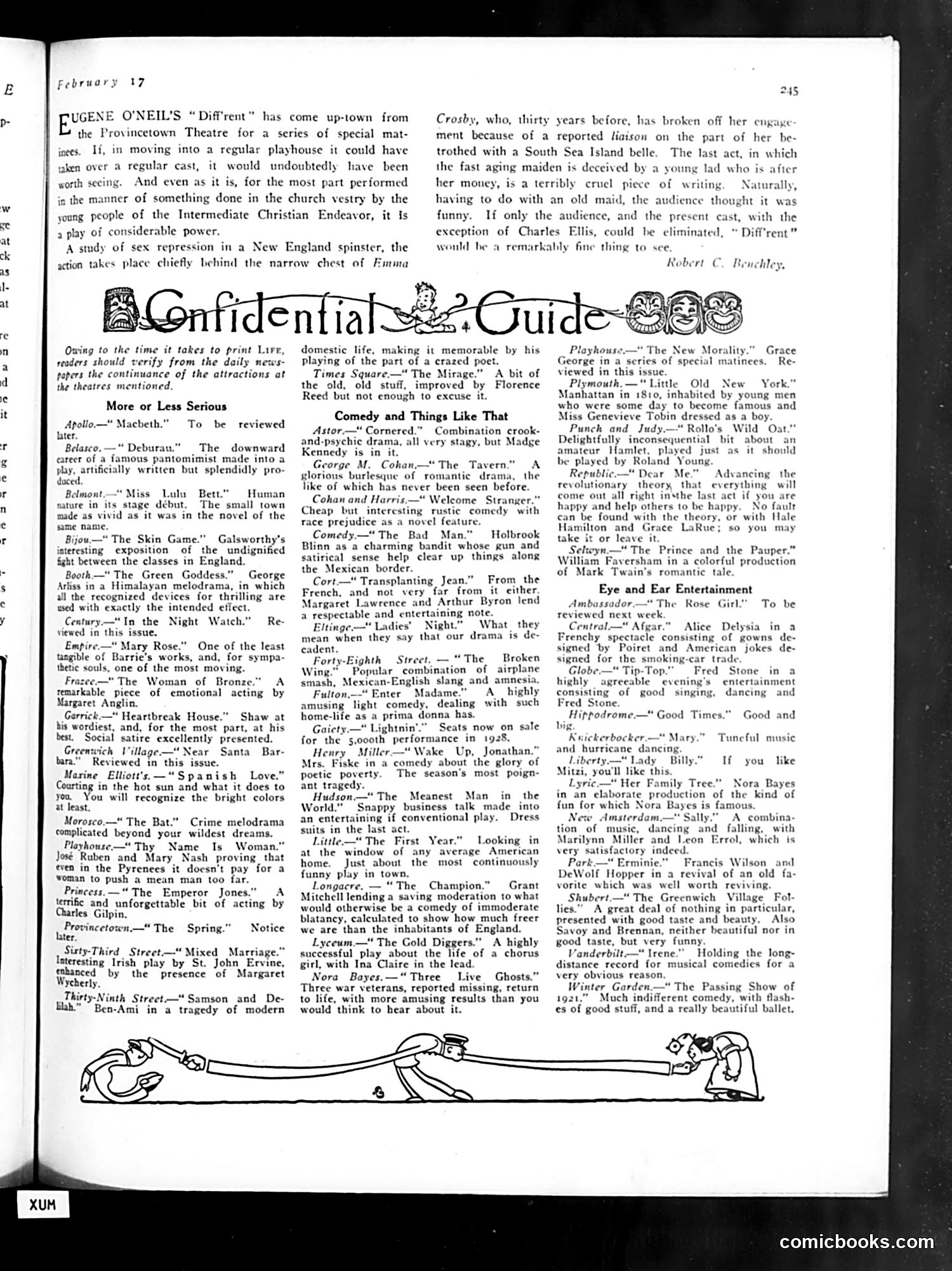
This page reviews Eugene O'Neill's play *"Diff'rent,"* which moved from the Provincetown Theatre to a commercial Broadway venue. The review is mixed: the play itself shows "considerable power" as a study of sexual repression in a New England spinster, but the amateur-like staging (described as resembling something performed by church youth groups) undermines it. The plot concerns a woman named Emma Crosby who broke off an engagement thirty years prior over rumors of her fiancé's liaison with a "South Sea Island belle." She's later deceived by a young man after her money—a "terribly cruel" conclusion. The reviewer suggests that only Charles Ellis's performance merits praise; eliminating the audience and rest of the cast would improve the production. The page also includes a theater guide listing other Broadway productions of the period, ranging from serious drama (Shaw's *Heartbreak House*, O'Neill's *Emperor Jones*) to comedies and melodramas.
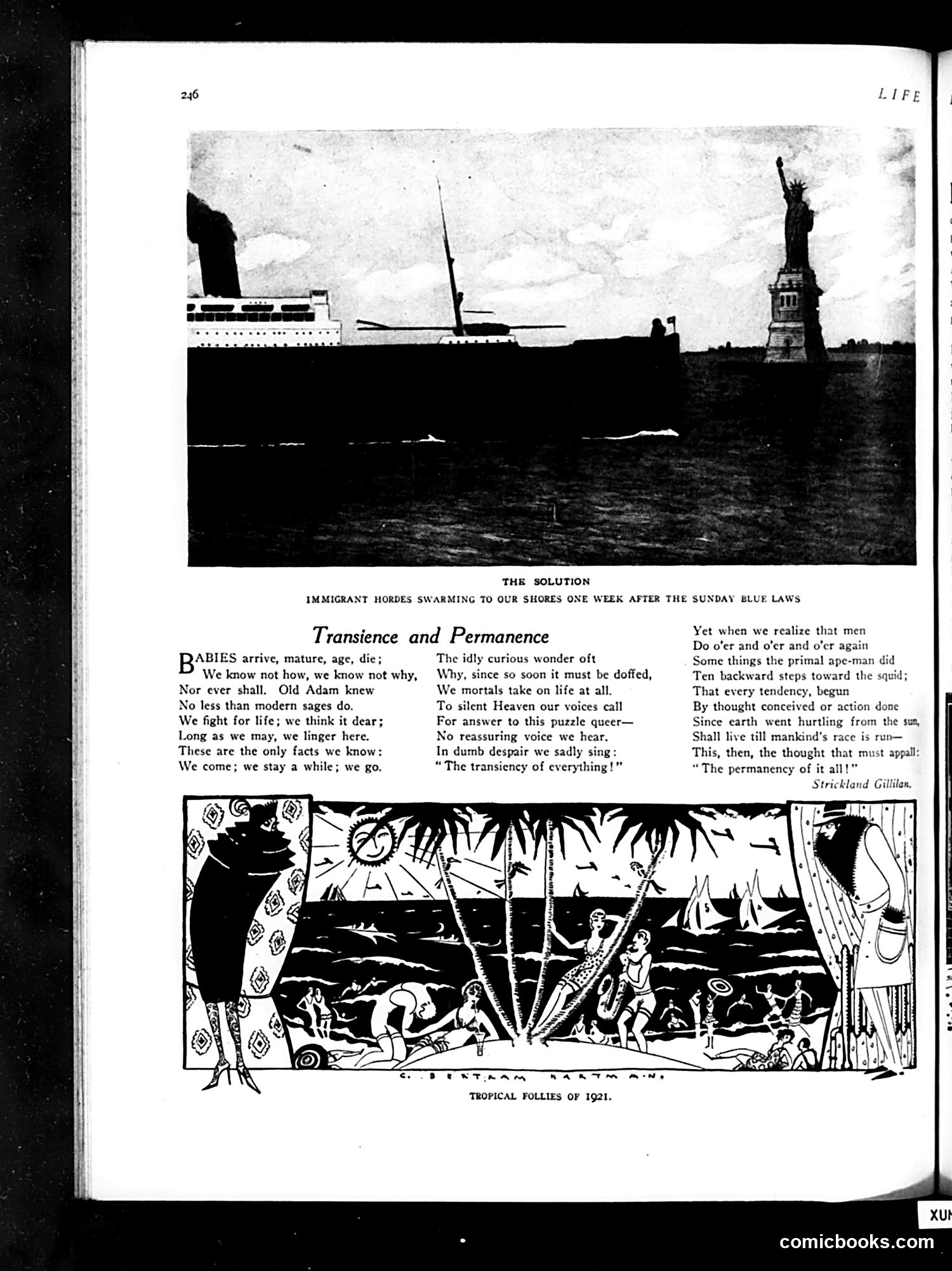
The top photograph satirizes immigration policy, captioned "Immigrant Hordes Swarming to Our Shores One Week After the Sunday Blue Laws." This appears to reference anti-immigration sentiment following Sunday blue laws (legislation restricting activities on Sundays). The silhouetted image shows a ship, the Statue of Liberty, and what appears to be incoming vessels—presenting immigration as an invading "solution" to enforcement efforts. The poem "Transience and Permanence" by Strickland Gillilan meditates on human mortality and life's fleeting nature—likely contextualizing broader anxieties about social change and demographic shifts. The lower illustration, "Tropical Follies of 1921," depicts an underwater scene with mermaids and dancers, apparently a theater or cabaret fantasy—possibly satirizing Jazz Age entertainment culture or escapism. The page conflates immigration fears, philosophical musings on impermanence, and frivolous entertainment, suggesting early-1920s anxieties about social upheaval and cultural change in postwar America.
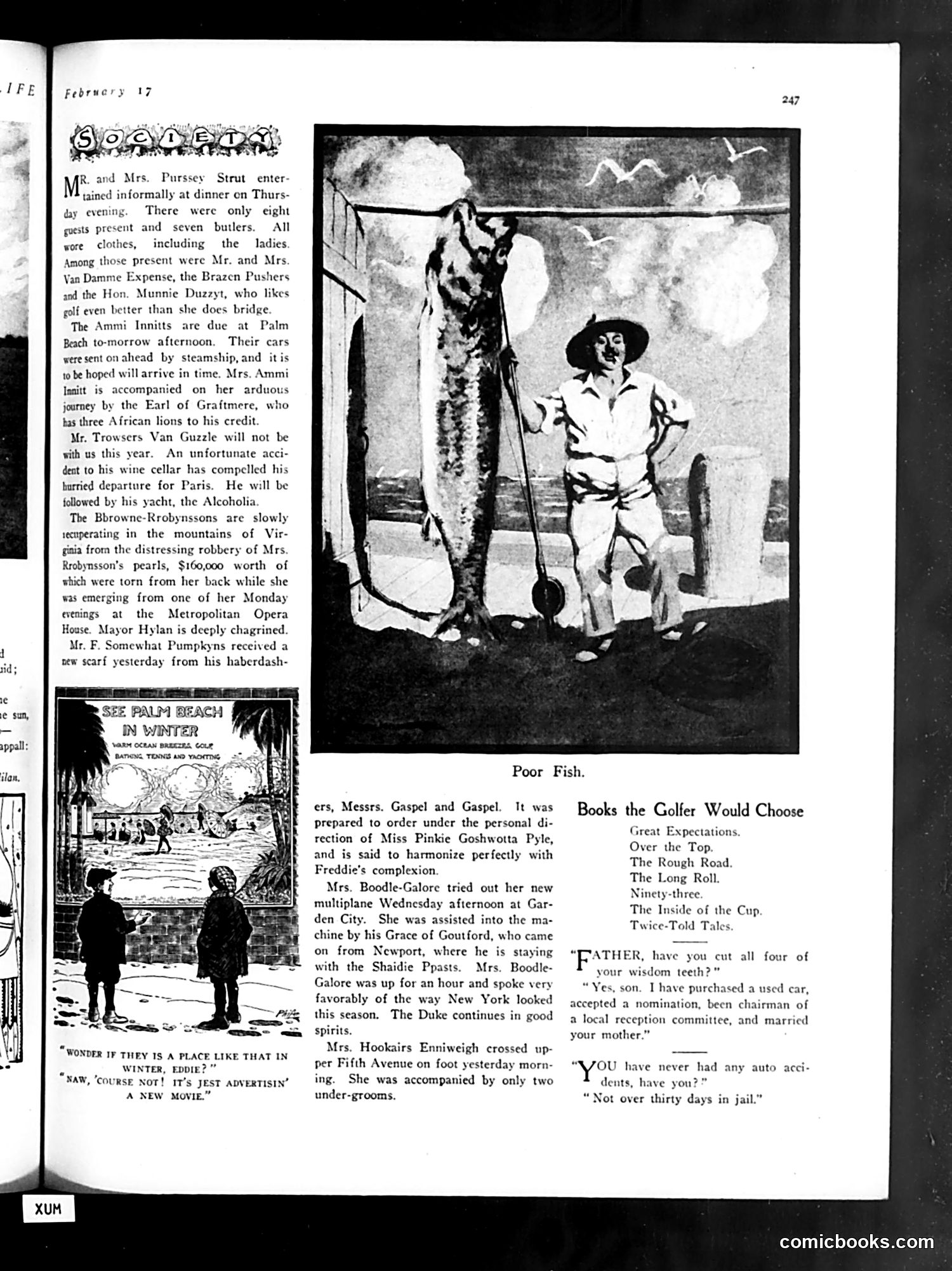
This page satirizes wealthy New York society through absurdist humor and invented aristocratic names. The "Society" column mocks the leisure class with ridiculous situations: a man whose "wine cellar accident" forces him to Paris (implying drunkenness), pearls stolen from a woman at the Metropolitan Opera, and casual references to African lions and European titles among the idle rich. The "Poor Fish" cartoon below depicts two men viewing a travel advertisement for Palm Beach, with one saying it's "just advertisin'" — mocking the gap between glamorous marketing and reality. The sidebar joke about "wisdom teeth" satirizes contemporary masculine anxieties: buying used cars, accepting political nominations, and accepting marriage as hardships equivalent to jail time — suggesting modern life burdens the formerly carefree wealthy. Overall, Life ridicules Gilded Age excess and the pretensions of America's social elite during what appears to be the 1920s.
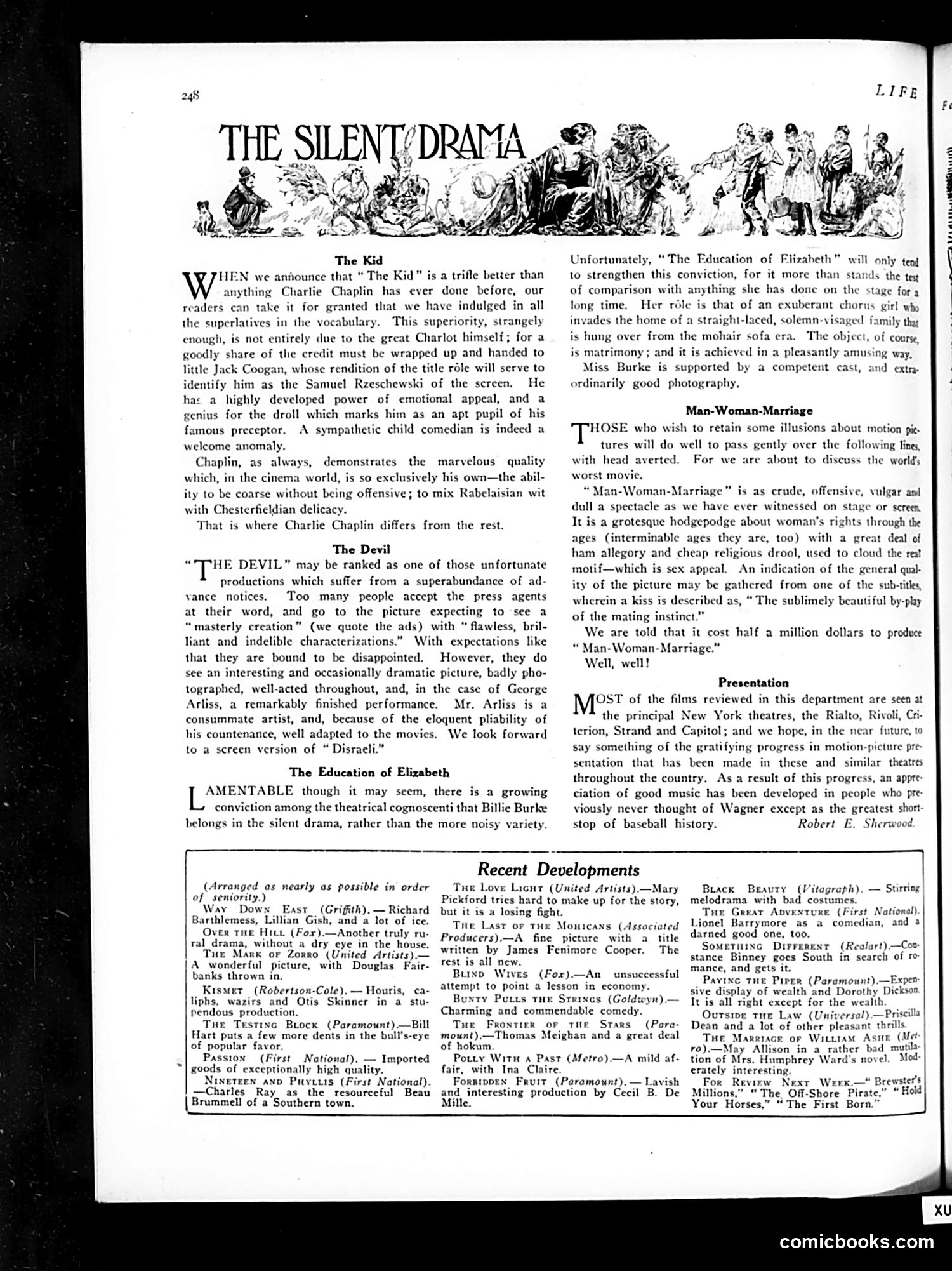
This page reviews four silent films. The magazine praises **"The Kid"** (featuring child actor Jack Coogan alongside Charlie Chaplin), calling it superior to Chaplin's previous work and highlighting Coogan's emotional talent. **"The Devil"** starring George Arliss receives mixed praise—the film itself disappoints despite hype, but Arliss's performance is commended for his expressive face. **"The Education of Elizabeth"** (featuring actress Billie Burke) is criticized as evidence that Burke belongs in silent film rather than theater, suggesting her stage performance style doesn't translate well to cinema. **"Man-Woman-Marriage"** is savagely dismissed as the "world's worst movie"—crude, offensive, and vulgar. The review mocks its ham-fisted attempt to address women's rights through history, buried under cheap allegory and sex appeal, while noting its astronomical half-million-dollar budget. The page exemplifies early cinema criticism's focus on acting style, production values, and moral content.
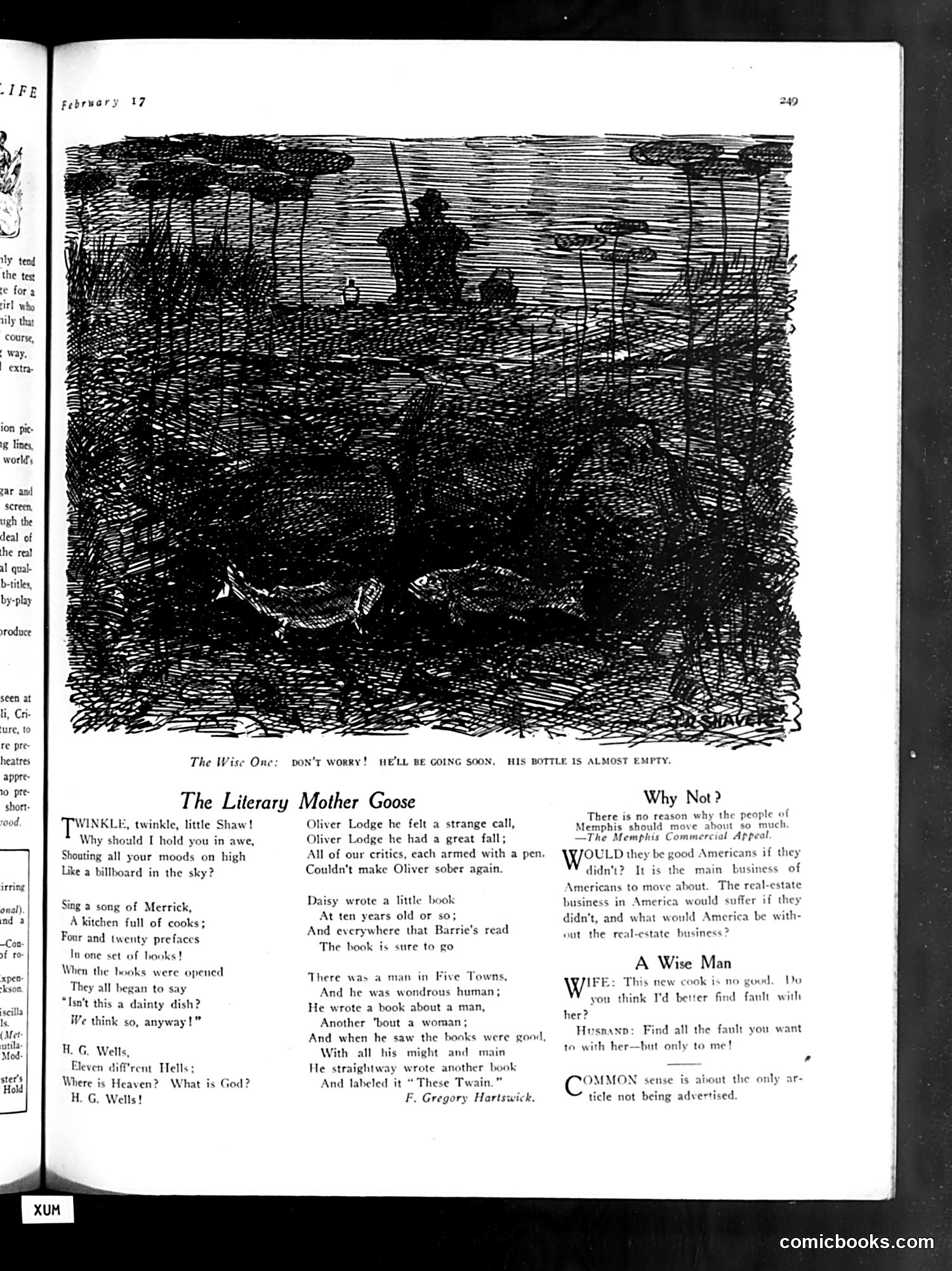
This page from *Life* contains satirical verse parodies and humorous commentary on early 20th-century literary figures. **"The Literary Mother Goose"** mocks prominent writers by recasting them in nursery-rhyme form: Shaw is criticized for loudly expressing opinions ("like a billboard in the sky"); H.G. Wells is ridiculed for his contradictory philosophical works; Oliver Lodge (a spiritualist) is portrayed as a drunkard; and J.M. Barrie's popularity is lampooned. The verses suggest these authors are overproductive, contradictory, or derivative. **"The Wise One"** cartoon (top) depicts a figure with an nearly-empty bottle, with another reassuring "don't worry, he'll be going soon"—likely satirizing a visiting celebrity or public figure expected to depart. **The three prose jokes** mock domestic life, real-estate culture, and advertising excess—suggesting Americans move constantly for real-estate profit, wives need tactful husbands to absorb criticism, and common sense remains the only thing society hasn't commercialized yet.
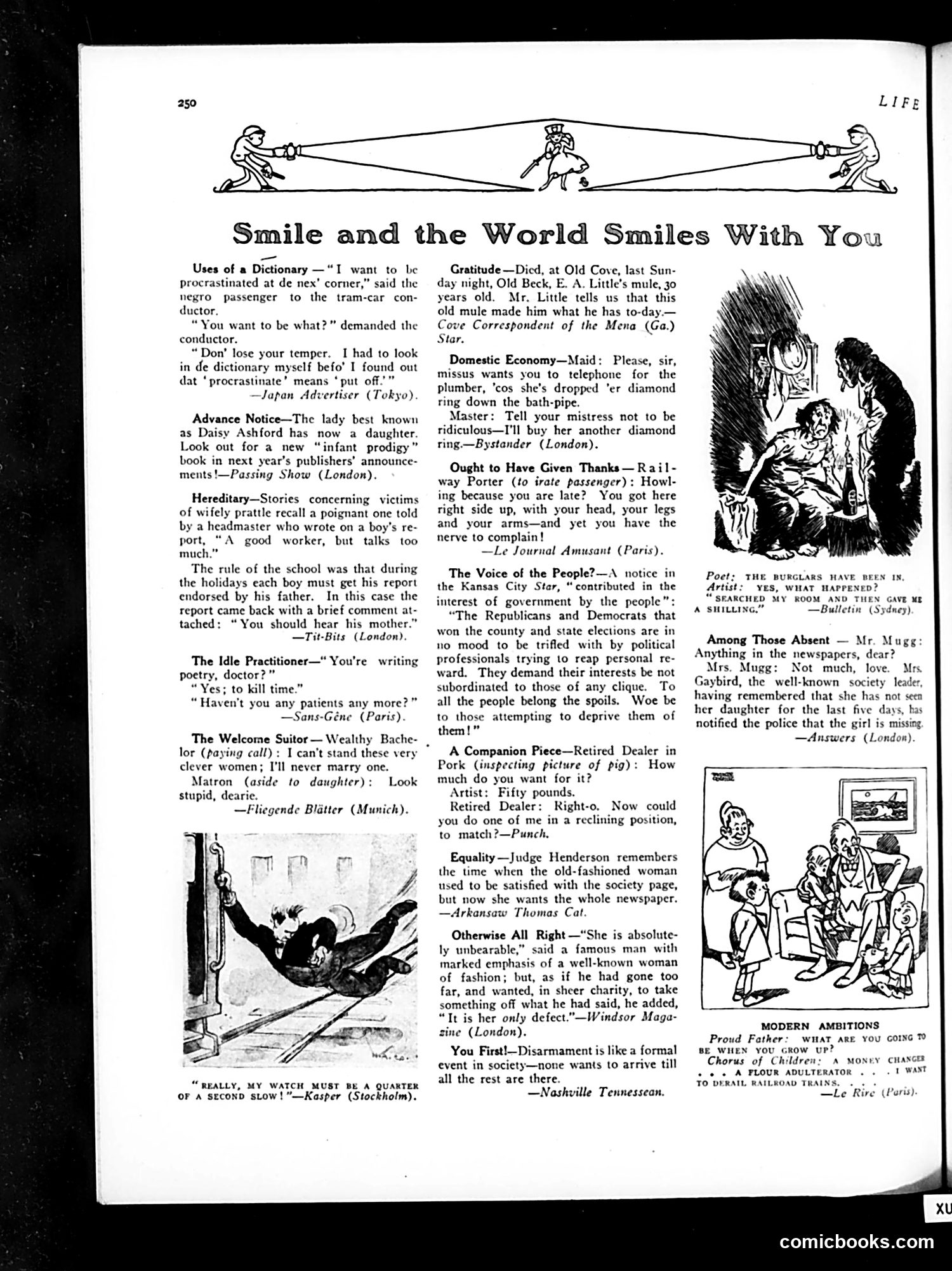
This page collects brief satirical anecdotes from international sources, mocking human nature and social pretension. Key items include: **"Uses of a Dictionary"**: A Black passenger misuses "procrastinate," revealing comic linguistic confusion. **"Hereditary"**: A schoolmaster's deadpan report—a boy talks too much; his father endorses it, noting the mother talks more—satirizes hereditary traits and marital dynamics. **"Domestic Economy"**: A wealthy master dismisses his wife's lost diamond ring, promising to buy another, mocking materialistic excess and indifference to waste. **"Equality"**: Judge Henderson observes that modern women now want entire newspapers instead of just the society page—satire on expanding female ambitions and media consumption. **"Otherwise All Right"**: A famous man calls a fashionable woman "absolutely unbearable" then awkwardly backtracks, claiming rudeness is "her only defect"—exposing social hypocrisy. **"You First!"**: Disarmament compared to formal events where no one arrives first—political satire on international hesitation. The page emphasizes universal follies across cultures through humor.
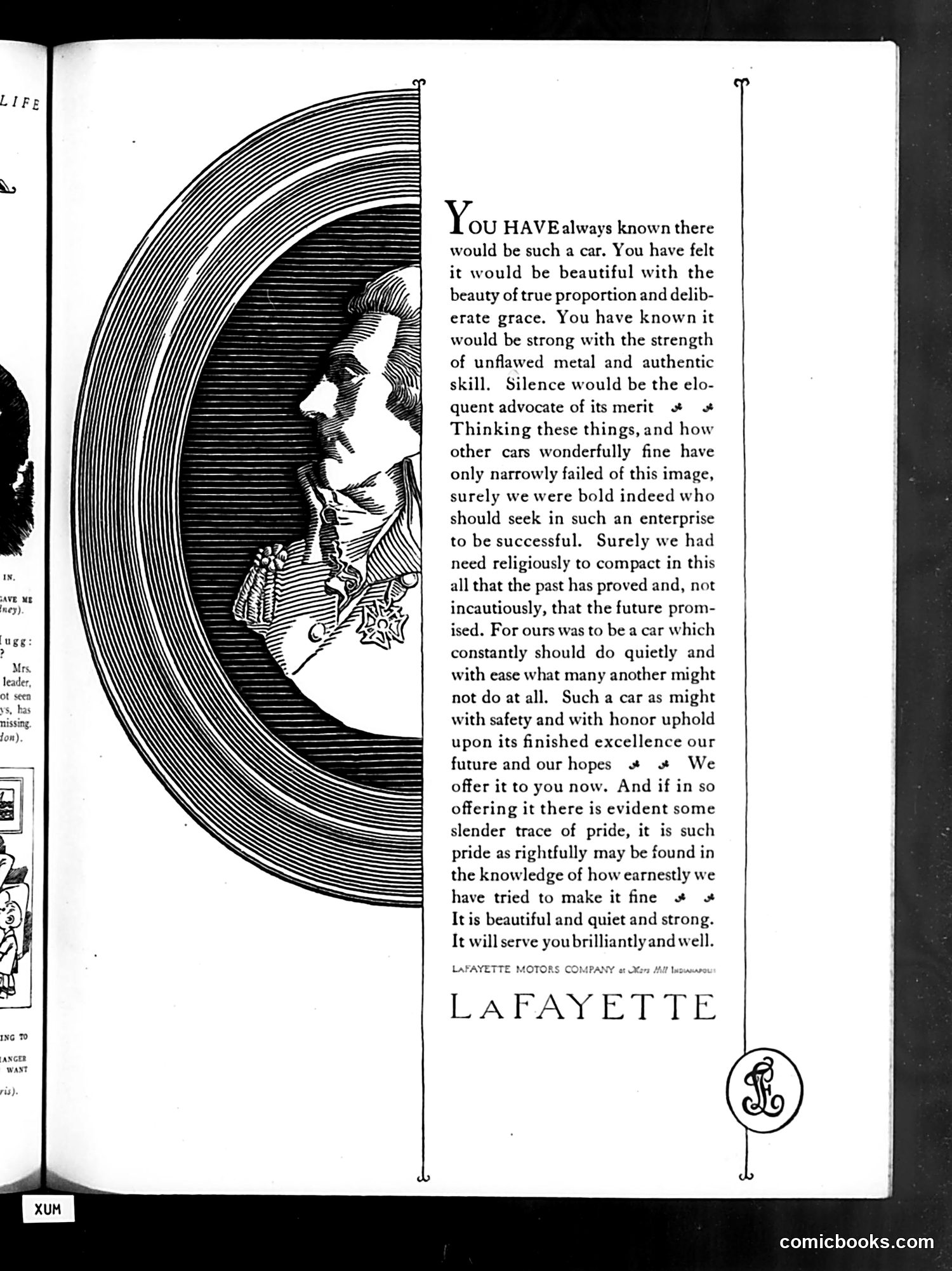
This is **not a cartoon or satire** — it's a luxury automobile advertisement for the Lafayette, a real car manufactured by Lafayette Motors Company (based in Indianapolis, per the text). The page features an ornate circular portrait (in the classical engraving style) of what appears to be the **Marquis de Lafayette**, the French Revolutionary War hero. The company borrowed his name and dignified image to brand their vehicle as embodying noble ideals: beauty, strength, precision, and quiet excellence. The lengthy text is aspirational marketing copy positioning the Lafayette as the culmination of automotive achievement — a car built with religious dedication to quality that will serve owners "brilliantly and well." The appeal is to affluent buyers valuing refinement over mere mechanical function. This represents early 20th-century luxury car marketing that emphasized heritage, craftsmanship, and aristocratic association rather than speed or power.
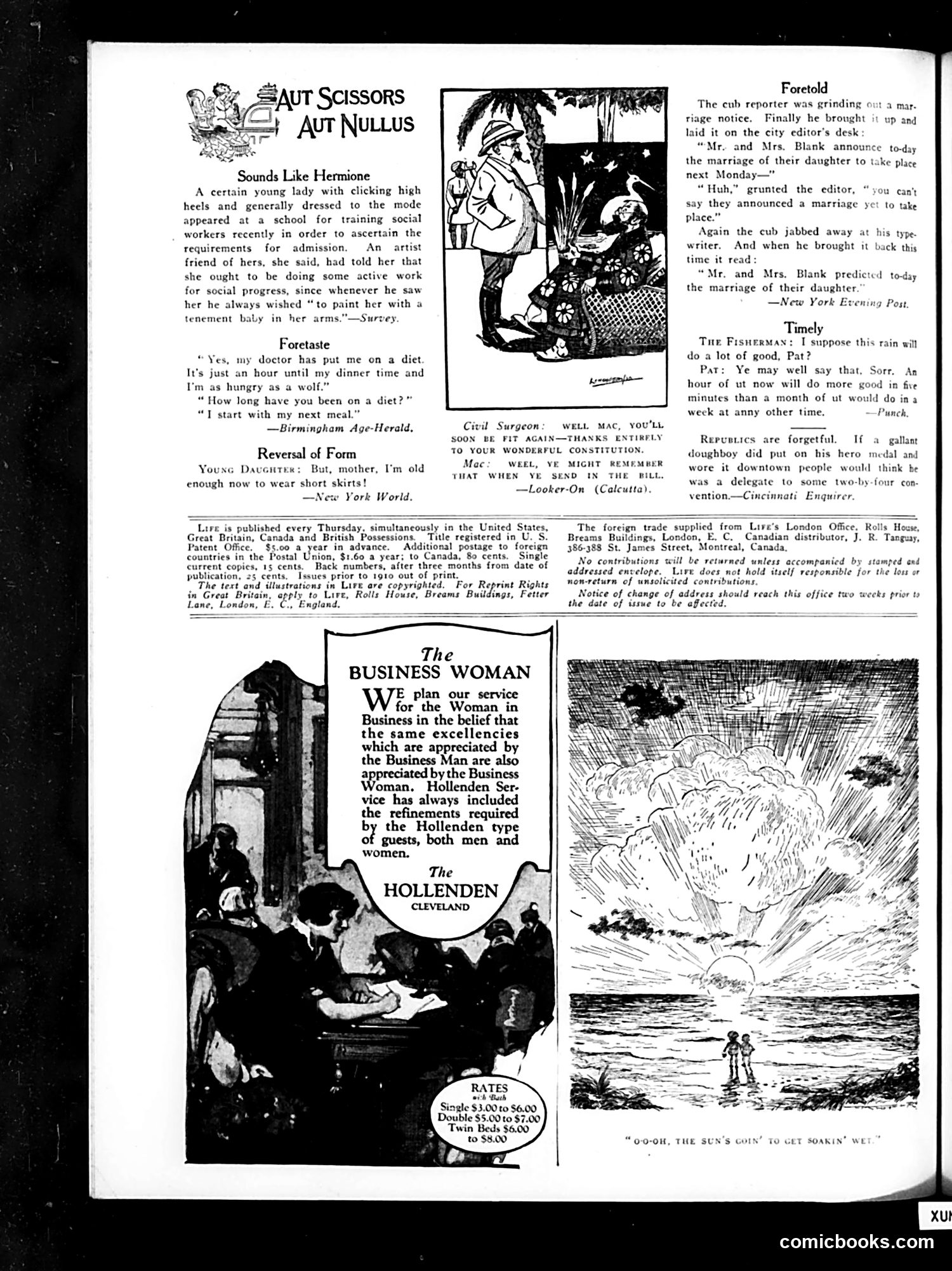
This page from Life magazine contains several short humorous pieces typical of early 20th-century satirical journalism: **"Sounds Like Hermione"**: Jokes about a fashionable young woman visiting a social work school, where an artist friend suggested she should be doing charitable work ("wish to paint a tenement baby in her arms"). The humor mocks vapid socialites performing charity as fashion. **"Foretaste"** and **"Reversal of Form"**: Brief jokes about dieting and a daughter demanding short skirts—typical domestic humor of the era poking fun at modern trends. **"Foretold"** and **"Timely"**: Satirical pieces about newspapers and Irish dialect humor. The page also includes a **Hollenden Hotel advertisement** aimed at businesswomen, reflecting the period's recognition of women entering the workforce. The illustrations are simple line drawings accompanying the jokes. The overall tone is gentle social commentary rather than sharp political satire—aimed at amusing middle-class readers about contemporary social changes, fashion, and everyday life.
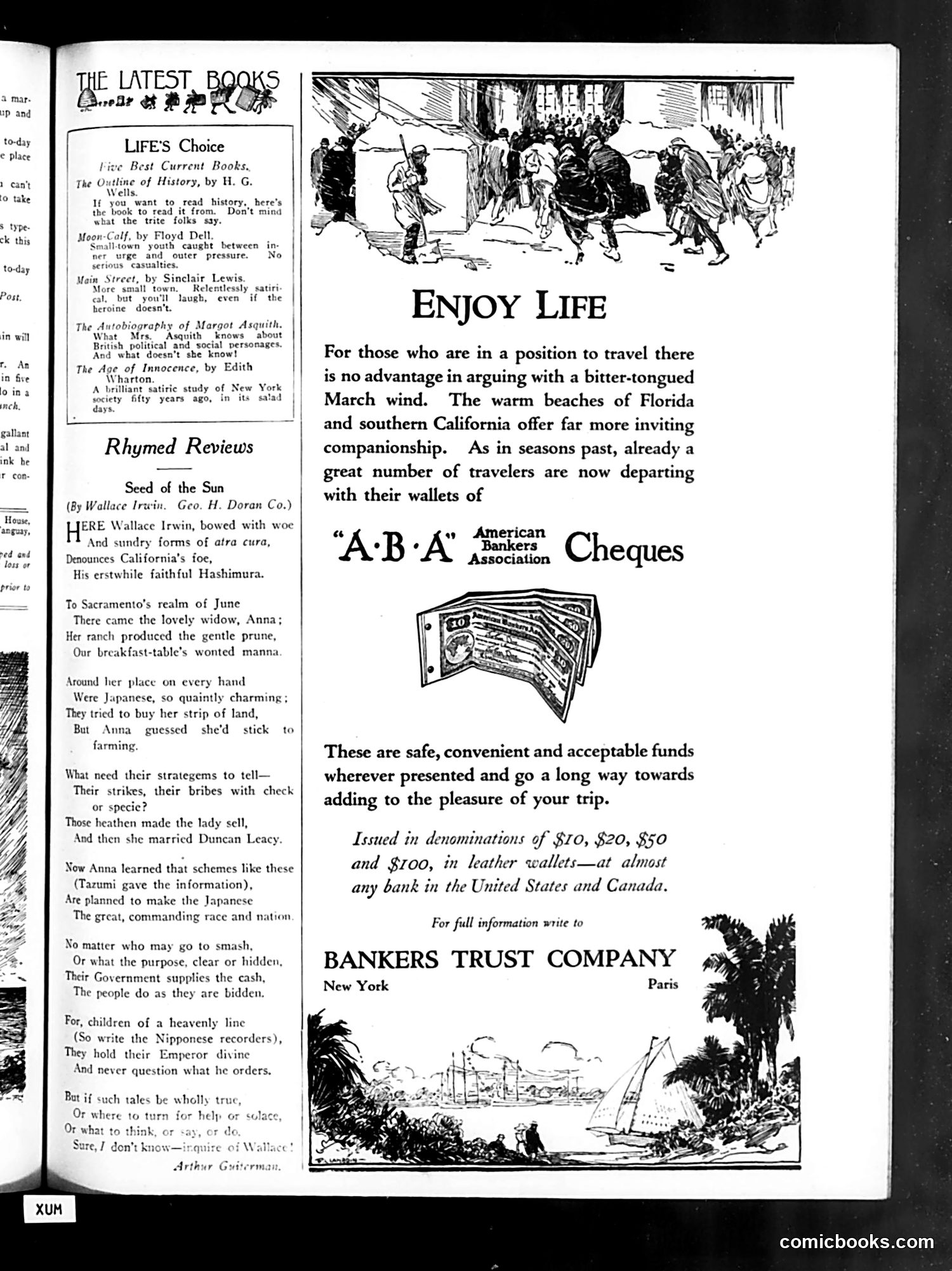
This page combines book reviews with advertising. The upper left features "Life's Choice," recommending contemporary bestsellers including H.G. Wells's *Outline of History* and Sinclair Lewis's *Main Street*—both 1920s modernist works critiquing American society. The main content is "Seed of the Sun," a satirical poem by Wallace Irwin about Japanese immigration to California. It describes a widow named Anna whose ranch attracts Japanese laborers attempting to purchase her land. The poem reflects anti-Japanese sentiment prevalent in 1920s America, particularly on the West Coast, where immigration restriction movements were strong. The narrative suggests a coordinated Japanese government scheme to acquire American property—a common xenophobic trope of the era. The right page advertises "A.B.A. Cheques" from Bankers Trust Company, encouraging travel to Florida and California with traveler's checks—practical rather than satirical content. The satire critiques both anti-Asian prejudice (through Irwin's exaggerated plot) and American gullibility regarding such fears.
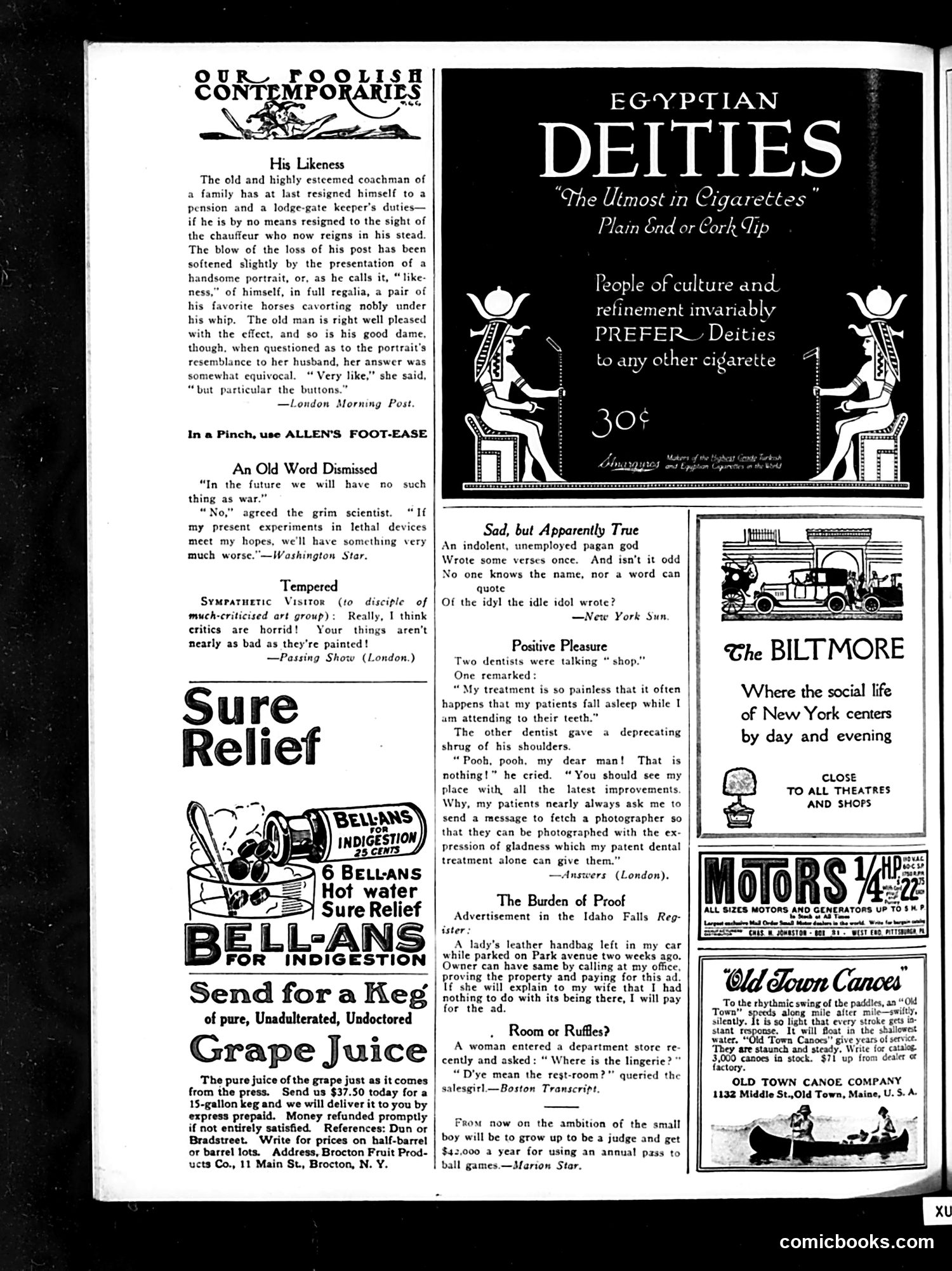
This page mixes humor columns with period advertisements. Key sections: **"His Likeness"**: A retiring coachman receives a portrait showing him with horses—the joke being his wife says it's "very like" him "but particular the buttons," suggesting the artist got minor details wrong while missing his essential character. **"An Old Word Dismissed"**: Dark satirical exchange where a scientist jokes that future warfare will be replaced by even worse lethal devices—commentary on escalating weapons technology and the inadequacy of traditional war language. **"Tempered"**: A sympathetic visitor awkwardly compliments a modernist artist's work by saying it's "not nearly as bad as they're painted"—mocking both pretentious modern art critics and defensive artists. **Advertisements**: Period products (Bellans indigestion remedy, grape juice, Egyptian Deities cigarettes, the Biltmore hotel, canoes) occupy significant space—typical for Life magazine's revenue model. The page reflects early-20th-century concerns: technological anxiety, class transitions (coachmen replaced by chauffeurs), and modern art skepticism.
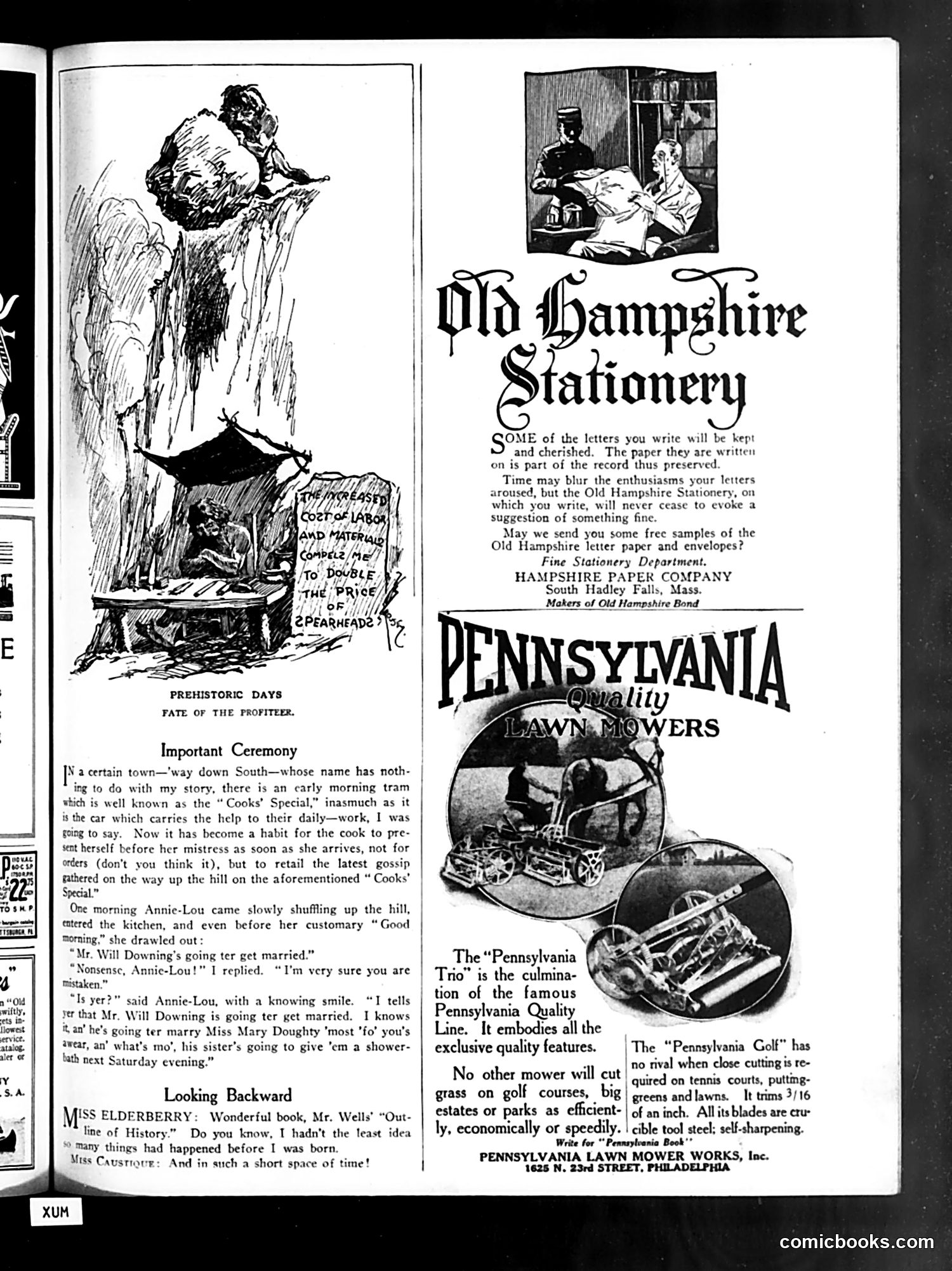
This page contains two distinct pieces: **Left side - "Prehistoric Days: Fate of the Profiteer"** is a cartoon satirizing war profiteers (likely from WWI era). The image shows a bloated man being crushed under the weight of "cost of labor and materials" and "double the price of spearheads"—suggesting that those who exploited wartime shortages to inflate prices face inevitable collapse and ruin. **Right side - Two short humor pieces**: "Important Ceremony" depicts Southern domestic life through a Black cook's gossip about her employer's neighbors. "Looking Backward" jokes about a woman's naïve amazement at H.G. Wells' history book, marveling that "things had happened" before her birth—mocking intellectual pretension. The rest is period advertising for stationery and lawn mowers—typical magazine filler of the era. The content reflects early 20th-century attitudes and racial dynamics now considered offensive.
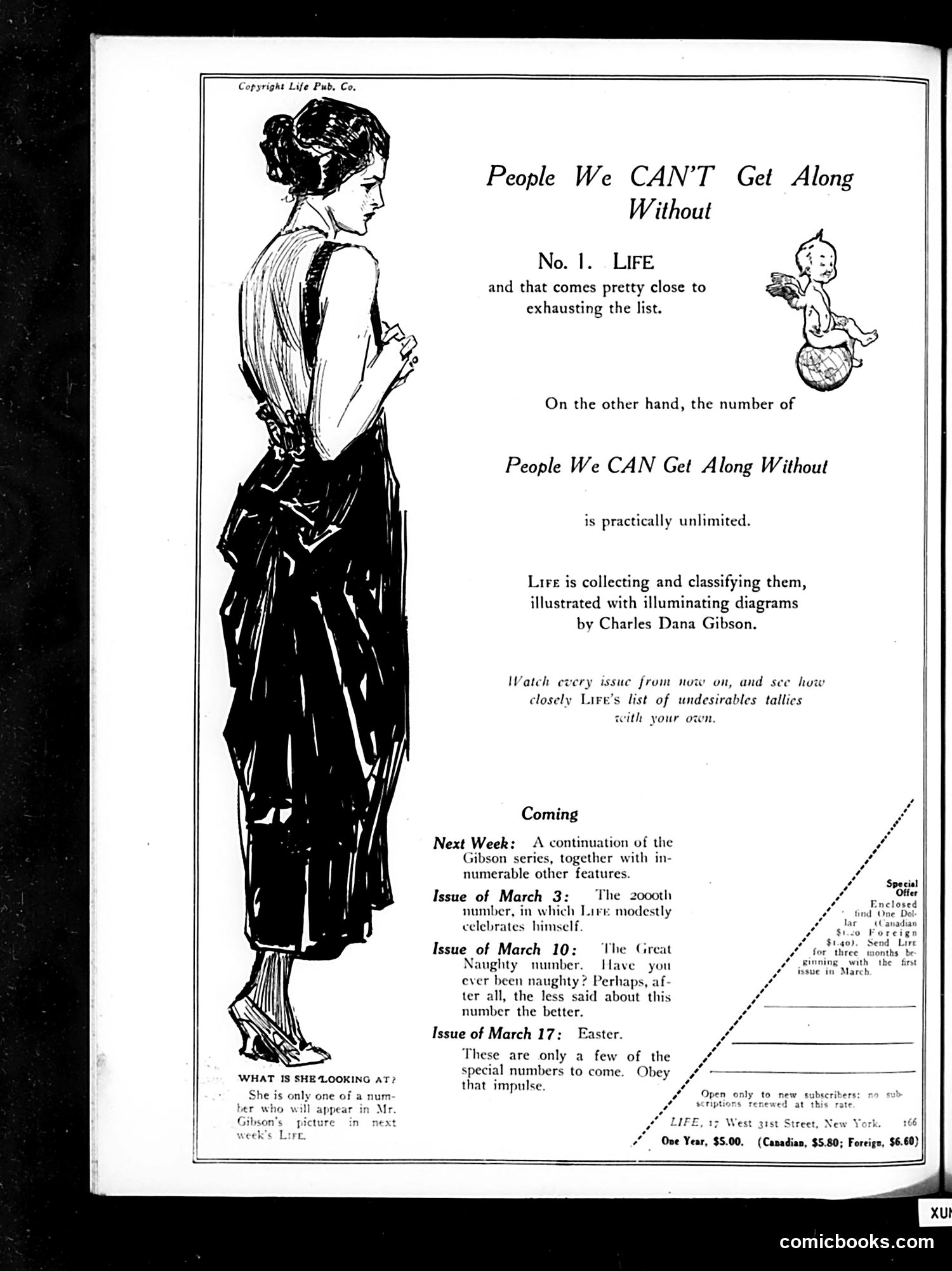
This is primarily an **advertisement for Life magazine's upcoming series** rather than a political cartoon. The page announces a new recurring feature titled "People We CAN'T Get Along Without" versus "People We CAN Get Along Without." The illustration shows a fashionable woman in profile, drawn by Charles Dana Gibson (the famous "Gibson Girl" artist). The series promises to classify and satirize different types of people through "illuminating diagrams." The advertisement teases upcoming issues: the "2000th number" (March 3), a "Great Naughty number" (March 10), and Easter (March 17). **The humor relies on social satire**—inviting readers to recognize themselves and others in Gibson's categorizations of desirable versus undesirable social types. It's essentially promotional material using the promise of humorous social commentary to attract subscribers.
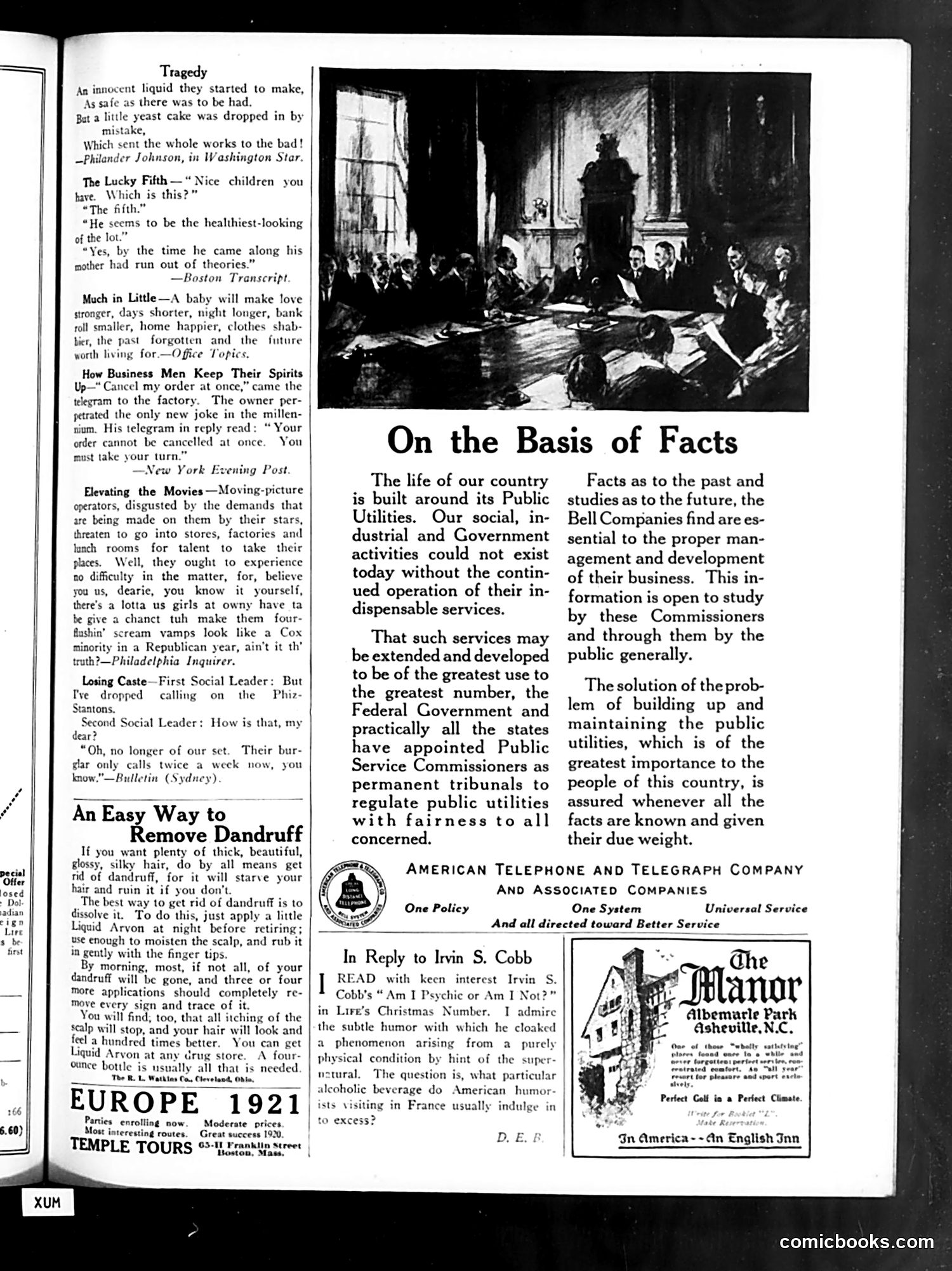
This page contains **brief satirical jokes** rather than political cartoons. The humor targets early-1920s American life: **"Tragedy"** mocks Prohibition-era home liquor-making—a common illegal practice after alcohol was banned in 1920. A yeast-cake accident ruins the operation, referencing the widespread amateur distilling that flourished during Prohibition. **"The Lucky Fifth"** jokes about large families and parenting theories (a dig at the era's pseudo-scientific parenting advice). **"Losing Caste"** satirizes class anxiety: a family's social status declines because their burglar only visits twice weekly instead of frequently—implying wealth through theft. The page is primarily **advertising and filler content** typical of Life magazine's format. The substantial block on "Public Utilities" is a **corporate advertisement** from Bell Telephone, framing themselves as factual, regulated, and essential—likely responding to Progressive Era criticism of monopolies. The satire reflects 1920s concerns: Prohibition enforcement, modern parenting debates, and class pretension.
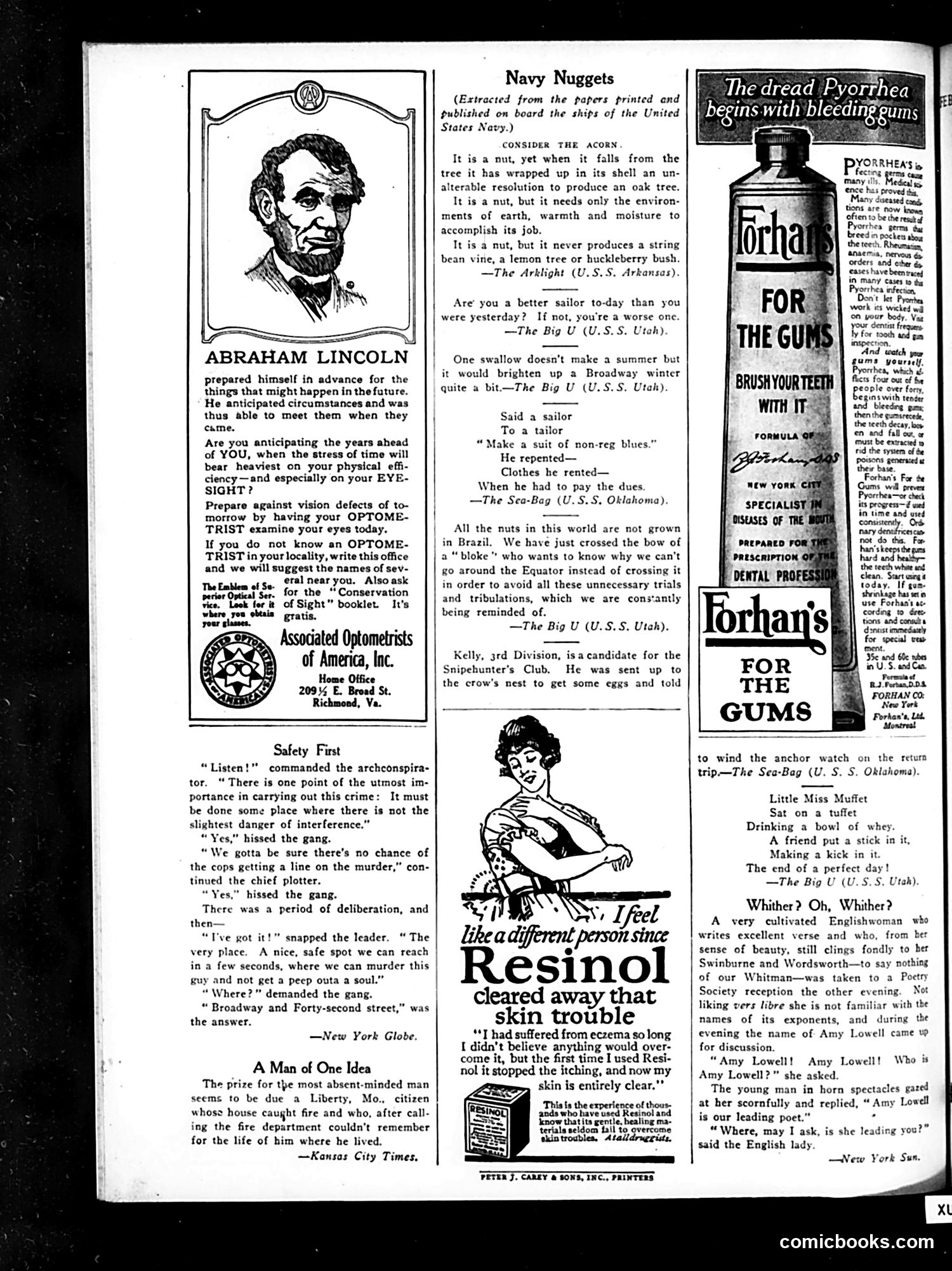
This page from *Life* magazine contains primarily **advertisements and humorous filler content**, rather than political satire. The Abraham Lincoln portrait is part of an **optometrist advertisement**—using Lincoln's foresight as a metaphor to encourage readers to get eye exams. The "Safety First" joke is a dark humor piece about criminals choosing Broadway and 42nd Street as a murder location because it's crowded enough to go unnoticed—satirizing the chaos of urban life. The "Navy Nuggets" section reprints humorous quotes from military newspapers aboard U.S. Navy ships, offering motivational wisdom and sailor jokes. The remaining content consists of **product advertisements**: Forhan's toothpaste and Resinol skin cream, with testimonials about their effectiveness. There is **no significant political commentary** on this page. It reflects early 20th-century magazine content mixing light humor, practical advice, and advertising.