
Life, 1921-02-17 · page 16 of 34
Life — February 17, 1921 — page 16: what you’re looking at
What you’re looking at
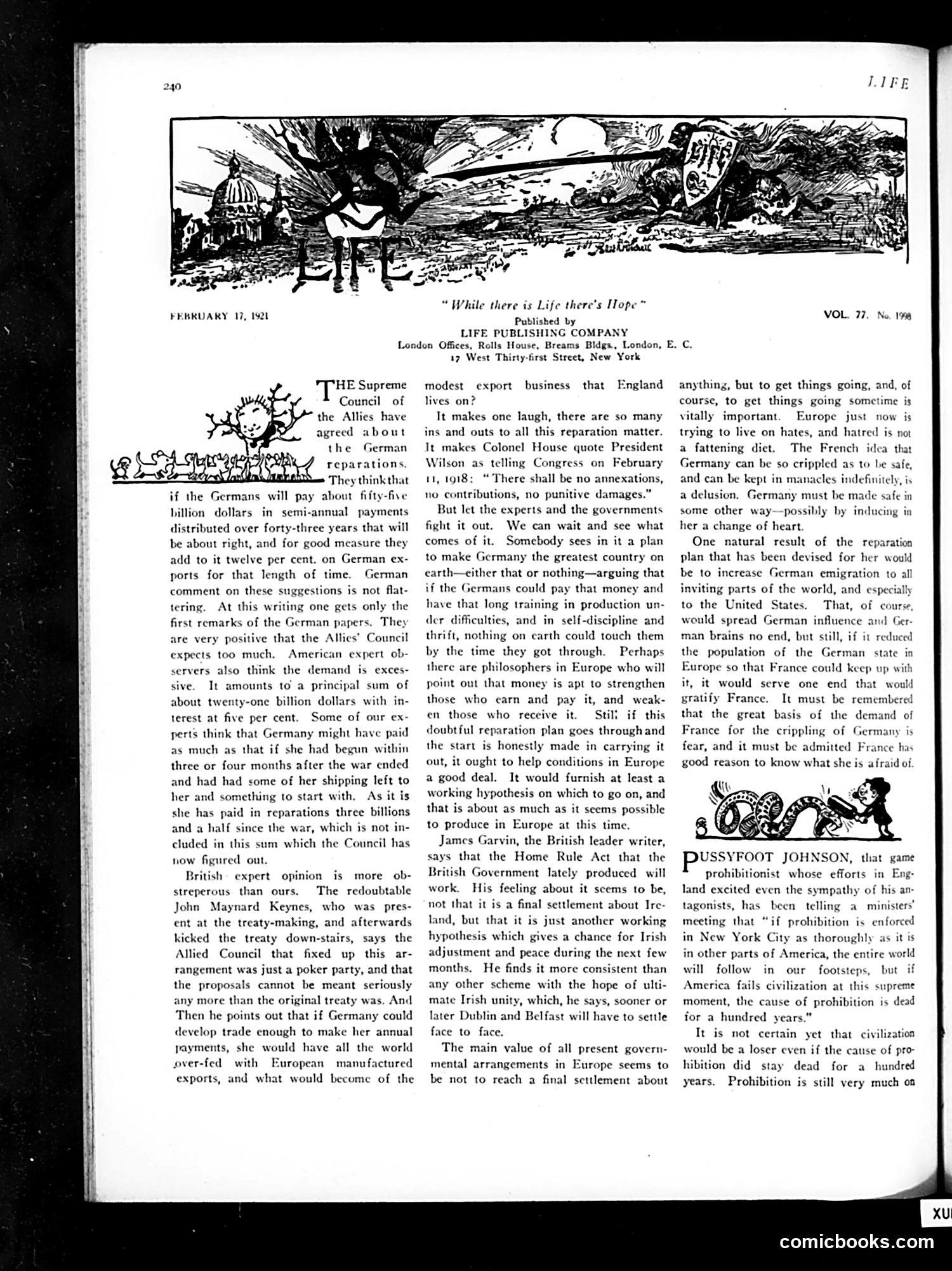
This page contains two editorial cartoons addressing post-WWI reparations and European politics. The **top cartoon** depicts the German reparations debate. The text discusses whether Germany's proposed sixty-billion-dollar payments are feasible, with experts disagreeing on amounts and timeline. The **bottom cartoon** titled "Pussyfoot Johnson" shows a temperance activist mocking prohibition's effectiveness. The caption references Johnson's efforts promoting prohibition in America and warns that if prohibition enforcement fails in New York City—a major metropolis—it will undermine civilization itself for a hundred years. Both cartoons reflect 1921 anxieties: post-war financial instability in Europe and America's newly implemented Prohibition (1920), questioning whether ambitious social policies could actually succeed.
📄 Transcribed text from this page (OCR, searchable)
Machine-transcribed from the original scan — historical spelling and the odd misread are preserved.
SNR a FEBRUARY 17, 1921 “While there is Life there's Hope” Published by LIFE PUBLISHING COMPANY VOL. 77. No. 198 London Offices, Rolls House, Breams Bldgs, London, E. C. HE Supreme Council of the Allies have agreed about the German reparations, They think that if the Germans will pay about fifty-five dollars payments distributed over forty-three years that will be about right, and for good measure they add to it twelve per cent. on German ex- ports for that length of time. German comment on these suggestions is not flat- billion in semi-annual tering. At this writing one gets only the first remarks of the German papers. They are very positive that the Allics’ Council expects too much, American expert ob- servers also think the demand is exces- sive. It amounts to a principal sum of about twenty-one billion dollars with in- terest at five per cent. Some of our ex- perts think that Germany might have paid as much as that if she had begun within three or four months after the war ended and had had some of her shipping left to her and something to start with. As it is she has paid in reparations three billions and a half since the war, which is not in- cluded in this sum which the Council has now figured out. British expert ob- than opinion is more streperous ours. The redoubtable John Maynard Keynes, who was pres- ent at the treaty-making, and afterwards kicked the treaty down-stairs, says the Allied Council that fixed up this ar- rangement was just a poker party, and that the proposals cannot be meant seriously any more than the original treaty was. And Then he points out that if Germany could develop trade enough to make her annual fayments, she would have all the world gover-fed with European manufactured exports, and what would become of the 17 West Thirty-first Street, New York modest business that lives on? export England It makes one laugh, there are so many ins and outs to all this reparation matter. It makes Colonel House quote President Wilson as telling Congress on February it, 1918: “ There shall be no annexations, no contributions, no punitive damages.” But let the experts and the governments fight it out. We can wait and see what comes of it. Somebody sees in it a plan to make Germany the greatest country on earth—either that or nothing—arguing that if the Germans could pay that money and have that long training in production un- der difficulties, and in self-discipline and thrift, nothing on earth could touch them by the time they got through. Perhaps there are philosophers in Europe who will point out that money is apt to strengthen those who earn and pay it, and weak- en those who receive it. Still if. this doubtful reparation plan goes through and the start is honestly made in carrying it out, it ought to help conditions in Europe a good deal. It would furnish at least a working hypothesis on which to go on, and that is about as much as it seems possible to produce in Europe at this time. James Garvin, the British leader writer, says that the Home Rule Act that the British Government lately produced will work. His feeling about it scems to be, not that it is a final settlement about Irc- land, but that it is just another working hypothesis which gives a chance for Irish adjustment and peace during the next few months. He finds it more consistent than any other scheme with the hope of ulti- mate Irish unity, which, he says, sooner or later Dublin and Belfast will have to settle face to face. The main value of all present govern- mental arrangements in Europe seems to be not to reach a final settlement about anything, but to get things going, and, of course, to get things going sometime is vitally important. Europe just trying to live on hates, and hatred is not a fattening diet. The French idea that Germany can be so crippled as to be safe, now is and can be kept in manacles indefinitely, is a delusion. Germany must be made safe in some other way—possibly by inducing in her a change of heart One natural result of the reparation plan that has been devised for her woul be to increase German emigration to all inviting parts of the world, and especially to the United States. That, of course, would spread German influence and Ger- man brains no end, but still, if it reduced the population of the German state in Europe so that France could keep up with it, it would serve one end that would gratify France. It must be remembered that the great basis of the demand of France for the crippling of Germany is fear, and it must be admitted France has good reason to know what she is afraid of. PUSsSYFOoT JOHNSON, that game prohibitionist whose efforts in Eng- land excited even the sympathy of his an- tagonists, has been telling a ministers’ meeting that “if prohibition is enforced in New York City in other parts of America, the entire world will follow in foots! but if America fails civilization at this supreme as thoroughly as it is our ps, moment, the cause of prohibition is dead for a hundred years.” It is not certain yet that civilization would be a loser even if the catse of pro- hibition did dead for a hundred years. Prohibition is still very much on stay comicbooks.com