
Life, 1921-02-17 · page 21 of 34
Life — February 17, 1921 — page 21: what you’re looking at
What you’re looking at
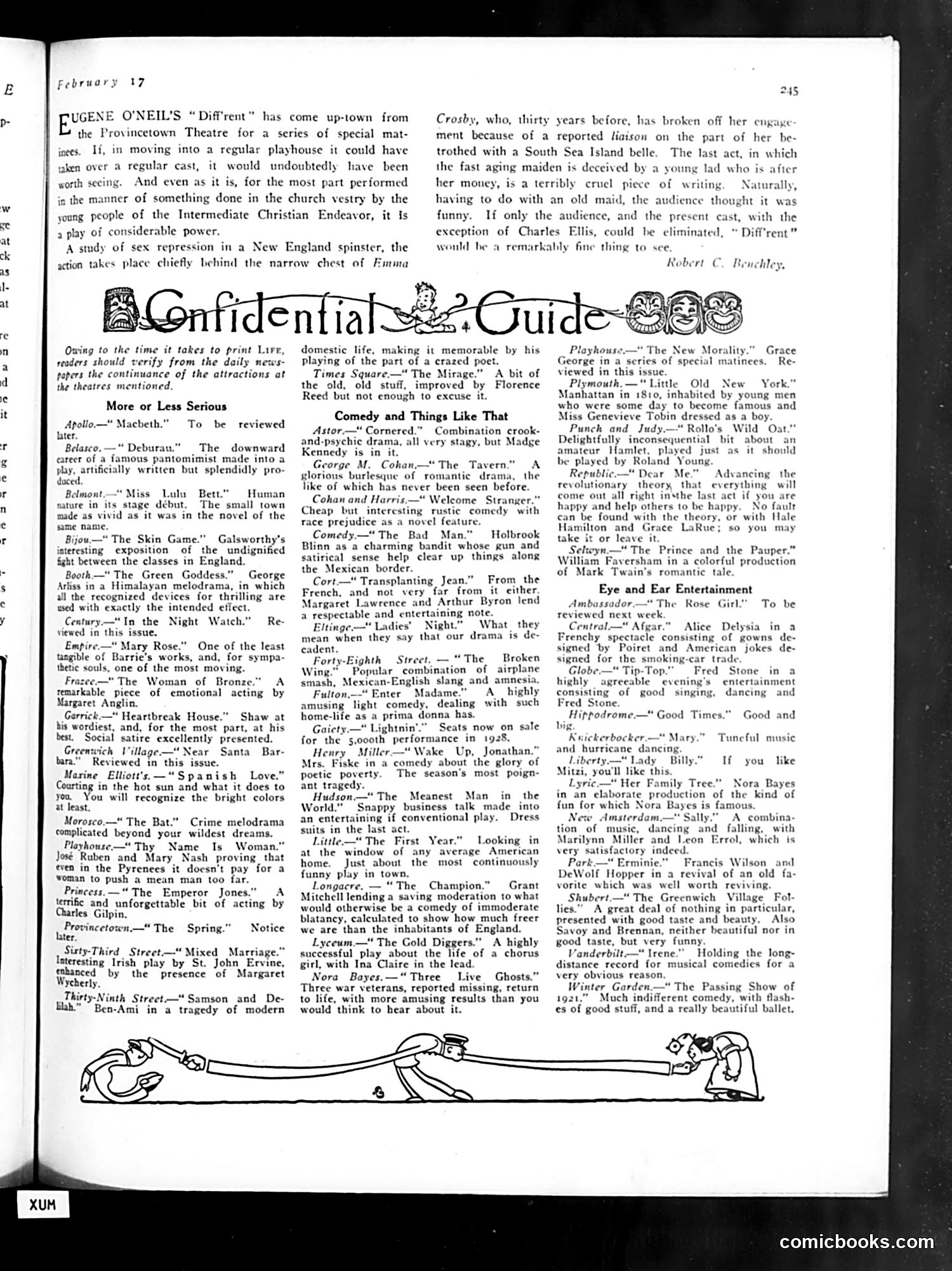
This page reviews Eugene O'Neill's play *"Diff'rent,"* which moved from the Provincetown Theatre to a commercial Broadway venue. The review is mixed: the play itself shows "considerable power" as a study of sexual repression in a New England spinster, but the amateur-like staging (described as resembling something performed by church youth groups) undermines it. The plot concerns a woman named Emma Crosby who broke off an engagement thirty years prior over rumors of her fiancé's liaison with a "South Sea Island belle." She's later deceived by a young man after her money—a "terribly cruel" conclusion. The reviewer suggests that only Charles Ellis's performance merits praise; eliminating the audience and rest of the cast would improve the production. The page also includes a theater guide listing other Broadway productions of the period, ranging from serious drama (Shaw's *Heartbreak House*, O'Neill's *Emperor Jones*) to comedies and melodramas.
📄 Transcribed text from this page (OCR, searchable)
Machine-transcribed from the original scan — historical spelling and the odd misread are preserved.
bruar UGENE O'NEIL'S “Diff'rent” has come up-town from the Provincetown Theatre for a series of special mat- li, in moving into a regular playhouse it could have ken over a regular cast, it would undoubtedly inees. worth seeing. aplay of considerable power. A study of sex repression in a New England spinster, the And even as it is, for the most part performed the manner of something done in the church vestry by the young people of the Intermediate Christ Crosby have been in Endeavor, it is funny. her money, is a terribly cruel piece of who, thirty years before, has broken off her cngaxe ment because of a reported liaison on the part of her be- trothed with a South Sea Island belle the fast aging maiden is deceived by a young lad who is after The last act, in which writing. Naturally having to do with an old maid, the audience thought it w If only the audience, and the present cast, with the exception of Charles Ellis, could be eliminated, * Diff'rent” action takes place chiefly behind the narrow chest of Emma Owing to the time it takes to print Lir readers should verify from the daily n popers the continuance of the attractions at the theatres mentioned. More or Less Serious Apollo.— Macbeth.” To be reviewed hater. Belasco. —“ Deburau.” The downward career of a famous pantomimist made into a ply, artificially written but splendidly pro- duced. Belmont Miss Lulu Bett.” Human nature in its stage début. The small town made as vivid as it was in the novel of the same name. Bijou—" The Skin Game." Galsworthy’s iateresting exposition of the undignified fght between the classes in England. Booth—" The Green Goddess.” George Arliss in a Himalayan melodrama, in which all the recognized devices for thrilling are wed with exactly the intended effect. Century—“In the Night Watch.” Re- viewed in this issue. Empire—* Mary Rose.” One of the least tangible of Barrie’s works, and, for sympa- thetic souls, one of the most moving. Frazee—" The Woman of Bronze.” A temarkable piece of emotional acting by Margaret Anglin. Gerrick.—* Heartbreak House.” Shaw at his wordiest, and, for the most part, at his best. Social satire excellently presented. Greenwich Village—" Near Santa Bar- bara.” Reviewed in this issue. Marine Elliott's. —“Spanish Love.” Courting in the hot sun and what it does to you. You will recognize the bright colors at least. Morosco— The Bat.” Crime melodrama complicated beyond your wildest dreams. Playhouse-—" Thy Name Is Woman.” José Ruben and Mary Nash proving that even in the Pyrenees it doesn’t pay for a woman to push a mean man too far. Princess. —“ The Emperor Jones. A terrific and unforgettable bit of acting by Charles Gilpin. Provincetown.—" The later. Sirty-Third | Street—“ Mixed Marriage.” Interesting Irish play by St. John Ervine, enhanced by the presence of Margaret Wycherly, Thirty-Ninth Street—* Samson and De- Ben-Ami in a tragedy of modern Spring.” Notice domestic life, making it memorable by his playing of the part of a crazed poet. Times Square.—“ The Mirage.” A bit of the old, old stuff, improved by Florence Reed but not enough to excuse it. Comedy and Things Like That Astor.— Cornered.” Combination crook- and-psychic drama, all very stagy, but Madge Kennedy is in it. George M. Cohan—“ The Tavern.” A glorious burlesque of romantic drama, the like of which has never been seen before. Cohan and Harris.—" Welcome Stranger. Cheap but interesting rustic comedy with race prejudice as a novel feature, Comedy.— The Bad Man Holbrook Blinn as a charming bandit whose gun and satirical sense help clear up things along the Mexican border. Cort.—" Transplanting Jean.” From the French, and not very far from it either. Margaret Lawrence and Arthur Byron lend a respectable and entertaini Eltinge —" Ladies’ Night mean when they say that our drama is de- cadent. ighth Street. —“ The Broken Wing.” Popular combination of airplane smash, Mexican-English slang and amnesia. Fulton.—-“ Enter Madame.” — A__ highly amusing light comedy, dealing with such home-life as a prima donna has. Gaicty—" Lightnin’.” Seats now on sale for the 5,oooth performance in 1928. Henry Miller—“ Wake Up, Jonathan. Mrs. Fiske in a comedy about the glory of poetic poverty. The season’s most poign- ant traged: Hudson—*" The Meanest Man in the World.” nappy business talk made into an entertaining if conventional play. Dress suits in the last act. Little —" The st at the window of any home. Just about the funny play in town, Longacre. — “The Champion.” Grant Mitchell lending a saving moderation to what would otherwise be a comedy of immoderate blatancy, calculated to show how much freer we are than the inhabitants of England. Lyceum.—" The Gold Diggers.” A highly successful play about the life of a chorus girl, with Ina Claire in the lead. Nora Bayes.—“ Three Live Ghosts.” Three war veterans, reported missing, return to life, with more amusing results than you would think to hear about it. Year.” Looking in average American most continuously wonld he a remarkably fine thing to see. Robert C.F Playhou The New Morality George in a series of special matinees. Re- viewed in this issue. Plymouth.—“ Little Old New York.” Manhattan in 1810, inhabited by young men who were some day to become famous and Miss Genevieve Tobin dressed as a boy. Punch and Judy.—" Rollo's Wild Oat.” Delightfully inconsequential bit about an amateur Hamlet. played just as it should be played by Roland Young “Dear Me.” revolutionary theory, tha come out all right insthe L happy and help others to be happy. No fault can be found with the theory, or with Hale Hamilton and Grace LaRue; so you may or leave it Selwyn.—" The Prince and the Pauper.” William Faversham in a colorful production of Mark Twain's romantic tale. Advancing the everything will tact if you are Eye and Ear Entertainment Ambassador.—" The Rose Girl.” reviewed next week Central—" Afgar.” Alice Delysia in a Frenchy spectacle consisting of gowns de- signed by Poiret and American jokes de- signed for the smoking-car trade Globe.—" Tip-Top. red Stone in a highly agreeable evening's entertainment consisting of good singing, dancing and Fred Stone. Hippodrome. big. To be “ Good Times.” Good and ckerbocker.—" Mary.” and burricane dancing Liberty—" Lady Billy." If Mitzi, you'll like this Lyric—" Her Family Tree.” in an elaborate production of the fun for which Nora Bayes is famous. New Amsterdam.— Sally.” A combina- tion of music, dancing and falling, with Marilynn Miller and Leon Errol, which is very satisfactory indeed. Park.—" Ermini Francis Wilson and DeWolf Hopper in a revival of an old fa- vorite which was well worth reviving. Shubert—" The Greenwich Village Fol- lies.” A great deal of nothing in particular, presented with good taste and beauty. Also voy and Brennan, neither beautiful nor in good taste, but very funny Vanderbilt-—" Irene.” Holding the long- distance record for musical comedies for a very obvious reason. Winter Garde The Passing Show of 19. Much indifferent comedy, with flash- es of good stuff, and a really beautiful ballet. ineful music you like Nora Bayes kind of comicbooks.com