
Life, 1921-02-17 · page 20 of 34
Life — February 17, 1921 — page 20: what you’re looking at
What you’re looking at
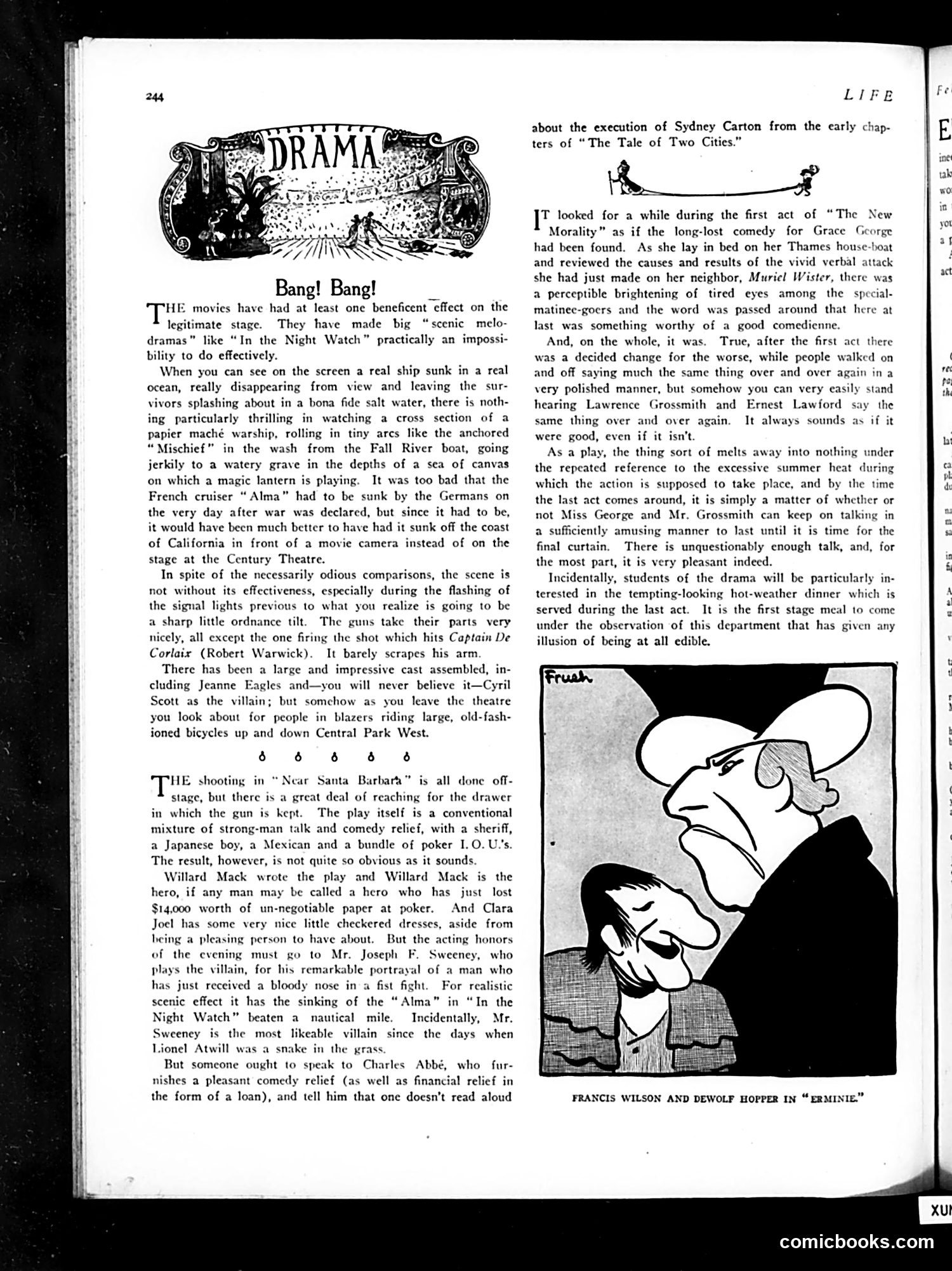
This page reviews three Broadway plays, with satire critiquing how cinema has undermined theatrical spectacle. The main article argues that movies' realistic effects (real ships sinking, actual ocean scenes) have made stage melodramas with painted backdrops and mechanical props laughably unconvincing. The accompanying caricature (captioned "Francis Wilson and Dewolf Hopper in 'Erminie'") appears to be a humorous exaggeration of performers' facial features, typical of Life's comedy illustrations. The reviews mock specific productions: "In the Night Watch" features an unconvincing papier-mâché warship; "Near Santa Barbara" is criticized as conventional melodrama; and "The New Morality" disappoints after a promising opening. The satire targets not the actors but the theatrical conventions themselves—suggesting early 1900s theater was struggling against cinema's competitive realism. References to Central Park West bicyclists and Thames houseboats ground the critique in contemporary New York society.
📄 Transcribed text from this page (OCR, searchable)
Machine-transcribed from the original scan — historical spelling and the odd misread are preserved.
Bang! Bang! _ HE movies have had at least one beneficent effect on the legitimate stage. They have made big “scenic melo- dramas” like “In the Night Watch” practically an impossi- bility to do effectively. When you can see on the screen a real ship sunk in a real ocean, really disappearing from view and leaving the sur- vivors splashing about in a bona fide salt water, there is noth- ing particularly thrilling in watching a cross section of a papier maché warship, rolling in tiny arcs like the anchored “Mischief” in the wash from the Fall River boat, going jerkily to a watery grave in the depths of a sea of canvas on which a magic lantern is playing. It was too bad that the French cruiser “Alma” had to be sunk by the Germans on the very day after war was declared, but since it had to be, it would have been much better to have had it sunk off the coast of California in front of a movie camera instead of on the stage at the Century Theatre. In spite of the necessarily odious comparisons, the scene is not without its effectiveness, especially during the flashing of the signal lights previous to what you realize is going to be a sharp little ordnance tilt. The guns take their parts very nicely, all except the one firing the shot which hits Captain De Corlaix (Robert Warwick). It barely scrapes his arm There has been a large and impressive cast assembled, in- cluding Jeanne Eagles and—you will never believe it—Cyril Scott as the villain; but somchow as you le the theatre you look about for people in blazers riding large, old-fash- ioned bicycles up and down Central Park West. é é 6 é é HE shooting in “Near Santa Barbara” is all done off- stage, but there is a great deal of reaching for the drawer in which the gun is kept. The play itself is a conventional mixture of strong-man talk and comedy relief, with a sheriff, a Japanese boy, a Mexican and a bundle of poker I. O. U.'s. The result, however, is not quite so obvious as it sounds. Willard Mack wrote the play and Willard Mack is the hero, if any man may be called a hero who has just lost $14,000 worth of un-negotiable paper at poker. And Clara Joel has some very nice little checkered dresses, aside from heing a pleasing person to have about. But the acting honors of the evening must go to Mr. Joseph F. Sweeney, who plays the villain, for his remarkable portrayal of a man who has just received a bloody nose in a fist fight. For realistic scenic effect it has the sinking of the “Alma” in “In the Night Watch” beaten a nautical mile. Incidentally, Mr. Sweeney is the most likeable villain since the days when Lionel Atwill was a snake in the grass. But someone ought to speak to Charles Abbé, who fur- nishes a pleasant comedy relief (as well as financial relief in the form of a loan), and tell him that one doesn’t read aloud LIFE about the execution of Sydney Carton from the early chap- ters of “The Tale of Two Cities.” ———— T looked for a while during the first act of “The New Morality” as if the long-lost comedy for Grace rge had been found. As she lay in bed on her Thames house-boat and reviewed the causes and results of the vivid verbal attack she had just made on her neighbor, Muriel Wister, there was a perceptible brightening of tired eyes among the special- matinee-goers and the word was passed around that here at last was something worthy of a good comedienne. And, on the whole, it was. True, after the first act there was a decided change for the worse, while people walked on and off saying much the same thing over and over again in a very polished manner, but somehow you can very easily stand hearing Lawrence Grossmith and Ernest Lawford say the same thing over and over again. It always sounds as if it were good, even if it isn't. As a play, the thing sort of melts away into nothing under the repeated reference to the excessive summer heat during which the action is supposed to take place, and by the time the last act comes around, it is simply a matter of whether or not Miss George and Mr. Grossmith can keep on talking in a sufficiently amusing manner to last until it is time for the final curtain, There is unquestionably enough talk, and, for the most part, it is very pleasant indeed. Incidentally, students of the drama will be particularly in- terested in the tempting-looking hot-weather dinner which is served during the last act. It is the first stage meal to come under the observation of this department that has given any illusion of being at all edible. FRANCIS WILSON AND DEWOLF HOPPER IN “ ERMINIE.” comicbooks.com