
Life, 1921-02-17 · page 6 of 34
Life — February 17, 1921 — page 6: what you’re looking at
What you’re looking at
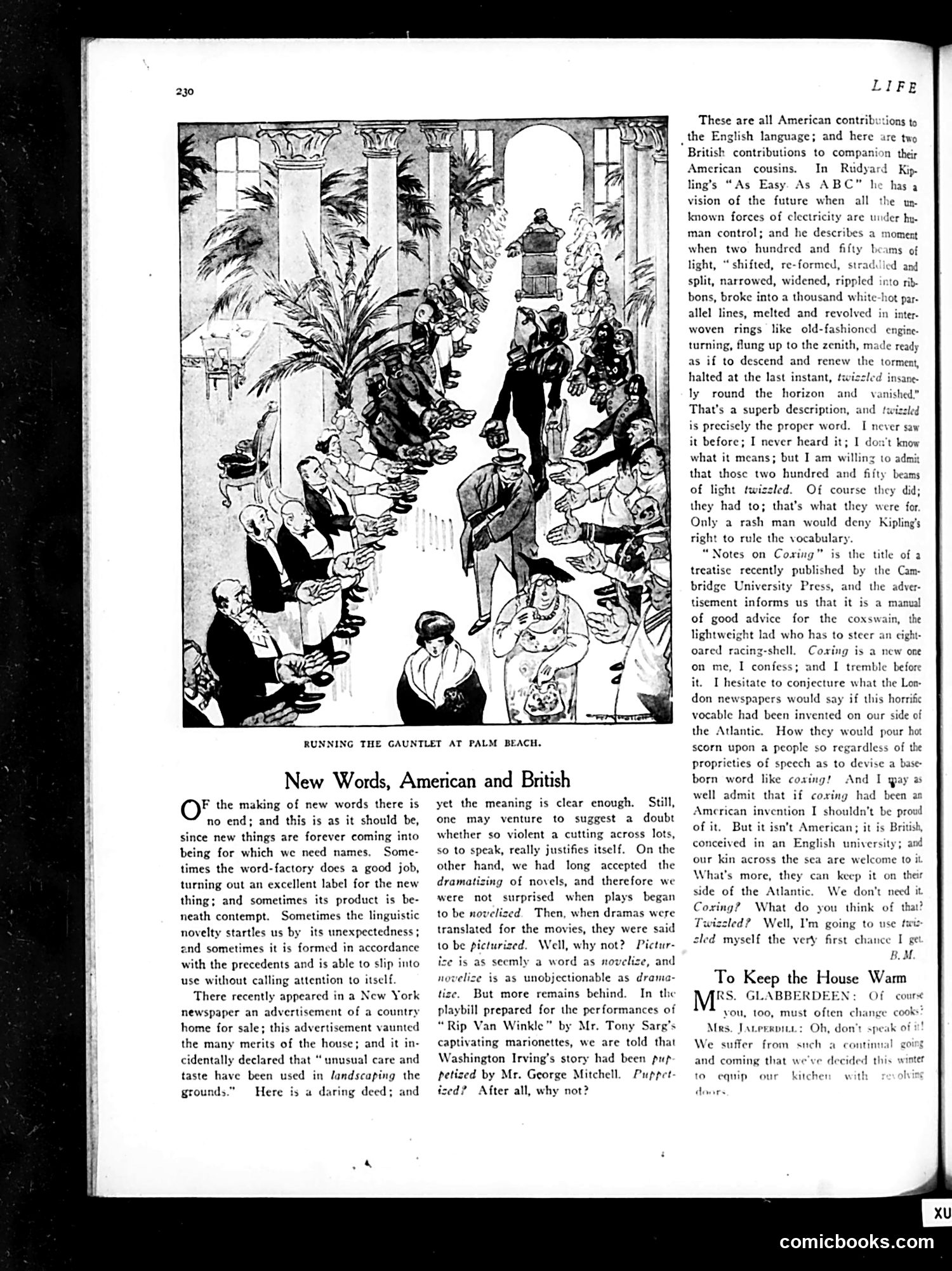
This cartoon satirizes the social scene at Palm Beach, Florida—a wealthy resort destination. The illustration shows fashionably dressed people (likely wealthy socialites and tourists) navigating through a crowded, ornate columned space, suggesting the gauntlet of social encounters and judgment one endures in high society. The "gauntlet" metaphor implies this is an ordeal—perhaps mocking how the wealthy must constantly display themselves, encounter rivals, or maintain their social standing in such exclusive spaces. The elaborate architecture and numerous figures emphasize the pretension and crowded competitiveness of the resort's social hierarchy. This reflects early 20th-century American satirical commentary on wealthy leisure culture and social pretension.
📄 Transcribed text from this page (OCR, searchable)
Machine-transcribed from the original scan — historical spelling and the odd misread are preserved.
RUNNING THE GAUNTLET AT PALM BEACH. New Words, American and British OF the making of new words there is no end; and this is as it should be, since new things are forever coming into being for which we need names. Some- times the word-factory does a good job, turning out an excellent label for the new thing; and sometimes its product is be- neath contempt. Sometimes the linguistic novelty startles us by its unexpectedness ; and sometimes it is formed in accordance with the precedents and is able to slip into use without calling attention to itself. There recently appeared in a New York newspaper an advertisement of a country home for sale; this advertisement vaunted the many merits of the house; and it in- cidentally declared that “ unusual care and taste ha been used in landscaping the grounds.” Here is a daring deed; and yet the meaning is clear enough. Still, one may venture to suggest a doubt whether so violent a cutting across lots, so to speak, really justifies itself. On the other hand, we had long accepted the dramatizing of novels, and therefore we were not surprised when plays began to be novelized Then, when dramas were translated for the movies, they were said to be picturized. Well, why not? Pictur- ize is as seemly a word as novelize, and novelize is as unobjectionable as drama- But more remains behind. In the playbill prepared for the performances of “Rip Van Winkle” by Mr. Tony Sarg’s captivating marionettes, we are told that Washington Irving’s story had been pup petized by Mr. George Mitchell. Puppet- ized? tize. After all, why not? LIFE These are all American contrib the English language; and here British contributions to comp: American cousins. In Rudya ling’s “As Easy. As ABC” 1 vision of the future when all known forces of clectrici when two hundred and fif light, “ shifted, re-formed, split, narrowed, widened, rippl bons, broke into a thousand white-l: 6 allel lines, melted and revolved in inter. woven rings like old-fashioned engine. turning, flung up to the zenith, made ready as if to descend and renew th halted at the last instant, twiscl torment, d insane ly round the horizon and vanished.” That's a superb description, and ttwissled is precisely the proper word. I never saw it before; I never heard it; 1 don’ what it means; but I am willing that those two hundred and fifty beams of light twit: Of course they did; they had to; that’s what they were for. Only a rash man would deny Kipling’s right to rule the vocabulary. otes on Coxing” is the title of a treatise recently published by the Cam- bridge University Press, and the adver- tisement informs us that it is a manual of good advice for the lightweight lad who has to steer an cij coxswain, oared racing-shell. Coxing is a new one on me, I confess; and I tremble before it. [hesitate to conjecture what the Lon- don newspapers would if this horrific vocable had been invented on our side of the Atlantic. How they would pour hot scorn upon a people so regardless of the propricties of speech as to devise a base- born word like coxing! And I way a well admit that if coxing had been a American invention I shouldn't be proud of it, conceived in an English university; and But it isn’t American; it is British, our kin across the sea are welcome to it What's more, they can keep it on their side of the Atlantic. We don’t need it Coxing? What do you think of that? Twizsled? Well, I'm going to use twi sled myself the very first chance I ge BLM. To Keep the House Warm M®s. GLABBERDEEN: Of cours you, too, must often change cooks? Mrs. We suffer from such a continual Jareerpiti.: Oh, don’t speak of A this win and coming that we've decid comicbooks.com