
Life, 1921-02-17 · page 24 of 34
Life — February 17, 1921 — page 24: what you’re looking at
What you’re looking at
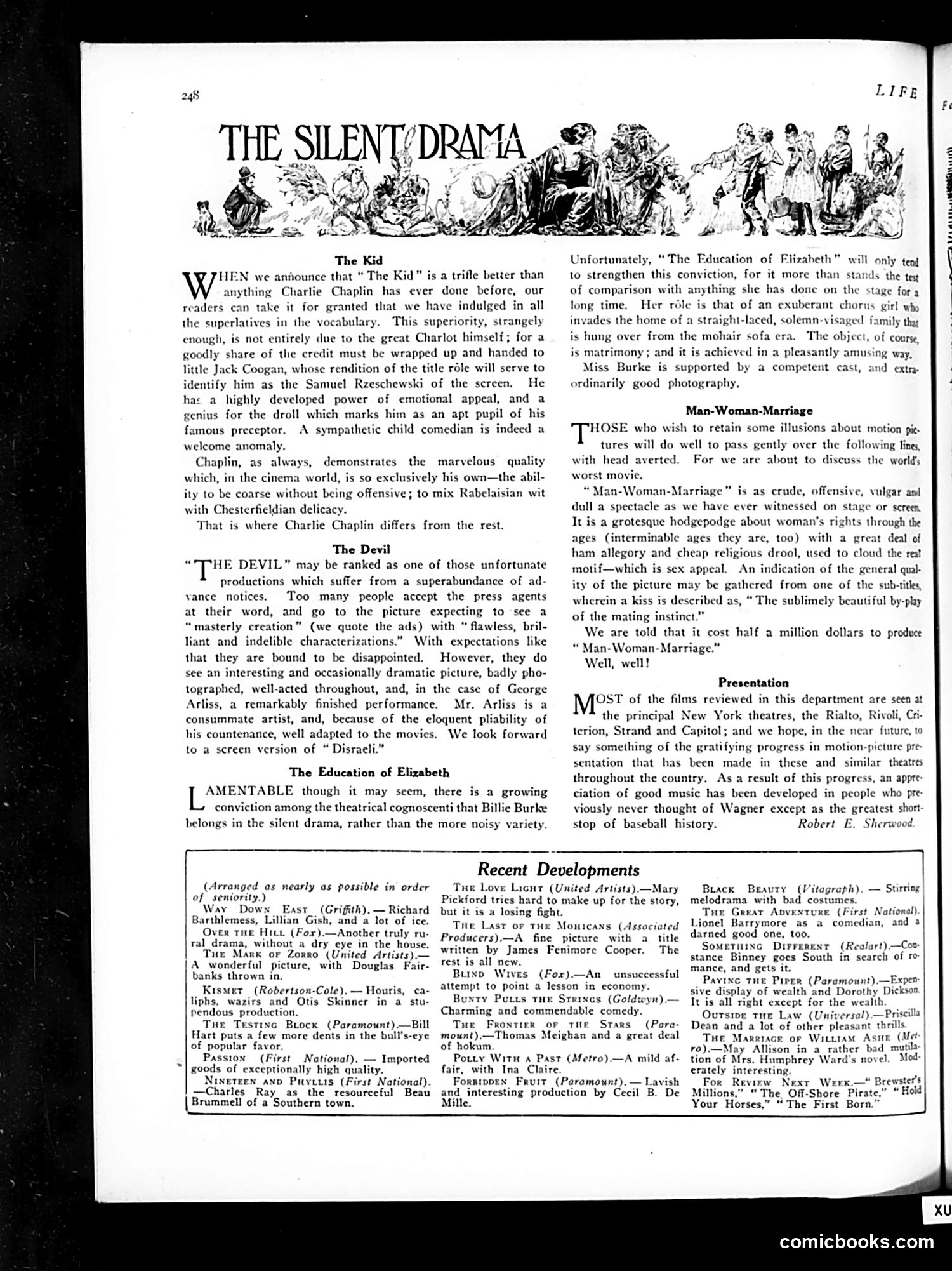
This page reviews four silent films. The magazine praises **"The Kid"** (featuring child actor Jack Coogan alongside Charlie Chaplin), calling it superior to Chaplin's previous work and highlighting Coogan's emotional talent. **"The Devil"** starring George Arliss receives mixed praise—the film itself disappoints despite hype, but Arliss's performance is commended for his expressive face. **"The Education of Elizabeth"** (featuring actress Billie Burke) is criticized as evidence that Burke belongs in silent film rather than theater, suggesting her stage performance style doesn't translate well to cinema. **"Man-Woman-Marriage"** is savagely dismissed as the "world's worst movie"—crude, offensive, and vulgar. The review mocks its ham-fisted attempt to address women's rights through history, buried under cheap allegory and sex appeal, while noting its astronomical half-million-dollar budget. The page exemplifies early cinema criticism's focus on acting style, production values, and moral content.
📄 Transcribed text from this page (OCR, searchable)
Machine-transcribed from the original scan — historical spelling and the odd misread are preserved.
WV THEN we anhounce that “ The Kid” is a trifle better than anything Charlie Chaplin has ever done before, our readers can take it for granted that we have indulged in all This superiority, strangely enough, is not entirely due to the great Charlot himself; for a goodly share of the credit must be wrapped up and handed to little Jack Coogan, whose rendition of the title rdle will serve to identify him as the Samuel Rzeschewski of the screen. He has a highly developed power of emotional appeal, and a genius for the droll which marks him as an apt pupil of his famous preceptor. A sympathetic child comedian is indeed a welcome anomaly, Chaplin, as always, which, in the cine: the superlatives in the vocabulary. quality world, is so exclusively his own—the abil- demonstrates the marvelous ity to be coarse without being offensive; to mix Rabelaisian wit with Chesterfieldian delicacy. That is where Charlie Chaplin differs from the rest. The Devil “CHE DEVIL” may be ranked as one of those unfortunate productions which suffer from a superabundance of ad- vance notices. Too many people accept the press agents at their word, and go to the picture expecting to see a masterly creation” (we quote the ads) with “ flawless, bril- liant and indelible characterizations.” With expectations like that they are bound to be disappointed. However, they do see an interesting and occasionally dramatic picture, badly pho- tographed, well-acted throughout, and, in the case of George Arliss, a remarkably finished performance. Mr, Arliss is a consummate artist, and, because of the eloquent pliability of his countenance, well adapted to the movies. We look forward to a screen version of “ Disraeli.” The Education of Elizabeth AMENTABLE though it may seem, there is a growing conviction among the theatrical cognoscenti that Billie Burke belongs in the silent drama, rather than the more noisy variety. Unfortunately, “The Education of Flizaheth” will onty tend to strengthen this conviction, for it more than sta of comparison with anything she has done on the long time. Her role is that of an exuberant chor invades the home of a straight-laced, solemn-visa is hung over from the mohair sofa era. The object, of course, is matrimony ; and it is achieved in a pleasantly amusing way, Miss Burke is supported by a competent cast, and extn ordinarily good photography. Man-Woman-Marriage a) ao who wish to retain some illusions about motion pic- tures will do well to pass gently over the following fines, with head averted. For we are about to discuss the world’s worst movic. “Man-Woman-Marriage” is as crude, offensive, vulgar and dull a spectacle as we have ever witnessed on stage or screen, It is a grotesque hodgepodge about woman's rights through the ages (interminable ages they are, too) with a great deal of ham allegory and cheap religious drool, used to cloud the real motif—which is sex appeal. An indication of the general qual- ity of the picture may be gathered from one of the sub-titls, wherein a kiss is described as, “ The sublimely beautiful by-play of the mating instinct.” We are told that it cost half a million dollars to produce “ Man-Woman- Marriage.” Well, well! Presentation OST of the films reviewed in this department are seen at the principal New York theatres, the Rialto, Rivoli, Cri- terion, Strand and Capitol; and we hope, in the near future, to say something of the gratifying progress in motion- sentation that cure pre- has been made in these and similar theatres throughout the country. As a result of this progress, an appre- ciation of good music has been developed in people who pre- viously never thought of Wagner except as the greatest short- stop of baseball history. Robert E. Sherwood. (Arranged as nearly as possible in order Recent Developments of seniority.) Way Down East_ (Griffith).— Richard Barthlemess, Lillian Gish, and a lot of ice. Over tHe Hitt (For).—Another truly ru- ral drama, without a dry eye in the house. Tue Marx or Zorro (United Artists) |A wonderful picture, with Douglas Fair- banks thrown in. Kismet (Robertson-Cole). — Houris, ca- liphs, wazirs and Otis Skinner in a stu- pendous production. Tne Testinc Brock (Paramount).—Bill Hart puts a few more dents in the bull’s-eye of popular favor, Passio (First National), — Imported goods of exceptionally high quality. Nineteen ano Puyttts (First National) —Charles Ray as the resourceful Beau | Brummell of a Southern town. Tue Love Licnt (United Artists) —Mary Pickford tries hard to make up for the story, but it is a losing fight. Tue Last or tHE Mouicans (Associated Producers).—A fine picture with a title written by James Fenimore Cooper. The rest is all new. Buxp Wives (Fox).—An unsuccessful attempt to point a lesson in economy. Bunty Putts tHe Steincs (Goldwyn),.— Charming and commendable comedy. Tue Frontier or tir Stars (Para- mount).—Thomas Meighan and a great deal of hokum. Potty With a Past (Metro).—A mild af- fair, with Ina Claire. Forstppen Fruit (Paramount). — Lavish and interesting production by Cecil B. De Mille. Buack Beauty (Vitagraph). — melodrama with bad costumes. Tne Great Apventure (First National). Lionel Barrymore as a comedian, and 3 darned good one, too. | Sometiinc Dirrerext (Realart)—Coe stance Binney goes South in search of ro mance, and gets it. Payine tHe Pirer (Paramount).—Exper sive display of wealth and Dorothy Dickson It is all right except for the wealth. Ovutsipe tHe Law (Universal) —Priscilla Dean and a lot of other pleasant thrills Tue Marrtace or Wittram Asie (Met ro).—May Allison in a rather bad mutila tion of Mrs, Humphrey Ward's novel. M erately interesting. For ew Next Weex.—" Brewster’ Millions,” “The Off-Shore Pirate,” “ Hold Your Horses,” “ The First Bor irring comicbooks.com