
Life, 1921-02-17 · page 17 of 34
Life — February 17, 1921 — page 17: what you’re looking at
What you’re looking at
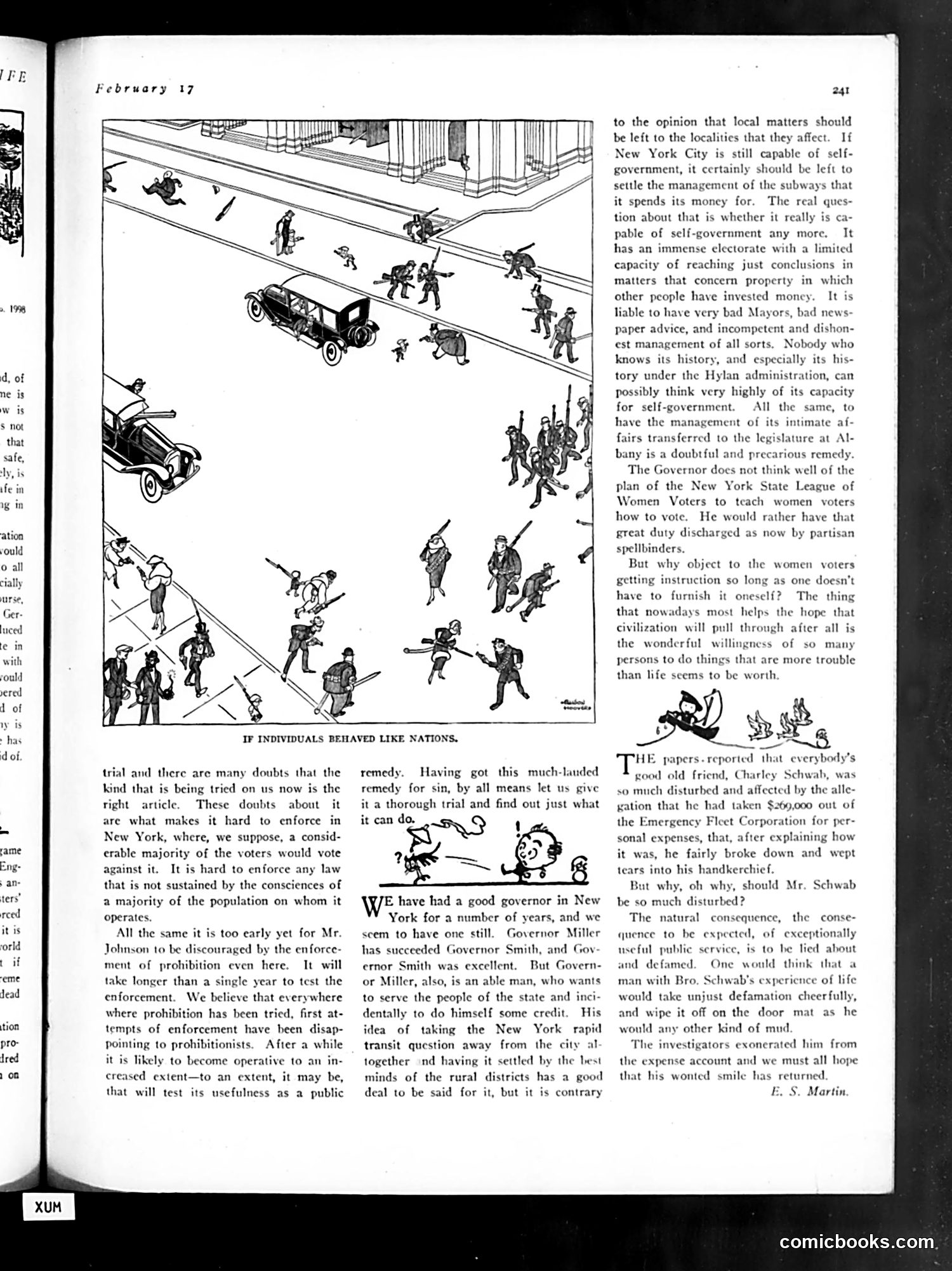
**Main Cartoon: "If Individuals Behaved Like Nations"** This untitled cartoon depicts street chaos—pedestrians, vehicles, and figures in apparent conflict—satirizing the absurdity of applying international relations (anarchic, lawless) to domestic urban life. The point: nations operate without enforceable rules; if individuals did likewise, cities would collapse into chaos. **Text Content:** The page discusses Prohibition enforcement in New York, questioning whether laws unsupported by public conscience can be enforced effectively. It critiques Governor Miller's plan to remove NYC subway management to the state legislature in Albany, arguing local matters should remain local. The piece also mocks women voter education initiatives and discusses Charles Schwab's distress over allegations he misused $269,000 from the Emergency Fleet Corporation during WWI. **Context:** This reflects 1920s debates over federal overreach, municipal autonomy, and newly enfranchised women voters—all controversial in that era.
📄 Transcribed text from this page (OCR, searchable)
Machine-transcribed from the original scan — historical spelling and the odd misread are preserved.
ife in ig in ation vould 0 all February IF INDIVIDUALS BEHAVED LIKE NATIONS. trial and there are many doubts that the kind that is being tried on us now is the right article. These doubts about it are what makes it hard to enforce in New York, where, we suppose, a consid- erable majority of the voters would vote against it. It is hard to enforce any law that is not sustained by the consciences of a majority of the population on whom it operates, All the same it is too early yet for Mr. Johnson to be discouraged by the enforce- ment of prohibition even here. It will take longer than a single year to test the enforcement. We believe that everywhere where prohibition has been tried, first at- tempts of enforcement have been disap- pointing to prohibitionists. After a while it is likely to become operative to an in- creased extent—to an extent, it may be, that will test its usefulness as a public remedy. Having got this much-lauded remedy for sin, by all means let us give it a thorough trial and find out just what it can ‘si ~SQ 9 ' WE have had a good governor in New York for a number of years, and we scem to have one still. Governor Miller has succeeded Governor Smith, and Gov ernor Smith was excellent. But Govern- or Miller, also, is an able man, who wants to serve the people of the state and inci- dentally to do himself some credit. His idea of taking the New York rapid transit question away from the city al together nd having it settled by the best minds of the rural districts has a ge deal to be said for it, but it is contrary 24t to the opinion that local matters should be left to the localities that they affect. If New York City is still capable of self- government, it certainly should be left to settle the management of the subways that it spends its money for. The real ques- tion about that is whether it really is ca- pable of self-government any more. It has an immense electorate with a limited capacity of reaching just conclusions in matters that concern property in which other people have invested money. It is liable to have very bad Mayors, bad news- paper advice, and incompetent and dishon- est management of all sorts. Nobody who knows its history, and especially its his- tory under the Hylan administration, can possibly think very highly of its capacity for self-government. All the have the management of its intimate af- fairs transferred to the legislature at Al- bany is a doubtful and precarious remedy. The Governor does not think well of the plan of the New York State League of Women Voters to teach women voters how to vote. He would rather have that great duty discharged as now by partisan spellbinders. But why object to the women voters getting instruction so long as one doesn’t have to furnish it oneself? The thing that nowadays most helps the hope that civilization will pull through after all is the wonderful willingness of so many persons to do things that are more trouble than life seems to be worth. SEs HE. papers. reported that everybor good old friend, Charley Schwab, was so much disturbed and affected by the alle- gation that he had taken $269,000 out of the Emergency Fleet Corporation for per- sonal expenses, that, it was, he fairly broke down and wept tears into his handkerchief. er explaining how But why, oh why, should Mr. Schwab be so much disturbed? The natural consequence, the conse- quence to be expected exceptionally useful public service, is to he lied about and defamed. One would think that a man with Bro, Schwab's experience of life would take unjust defamation cheerfully, and wipe it off on the door mat as he would any other kind of mud. The investigators exonerated him from the expense account and we must all hope that his wonted smile has returned. S. Martin. comicbooks.com