
A complete issue · 44 pages · 1920
Life — October 21, 1920
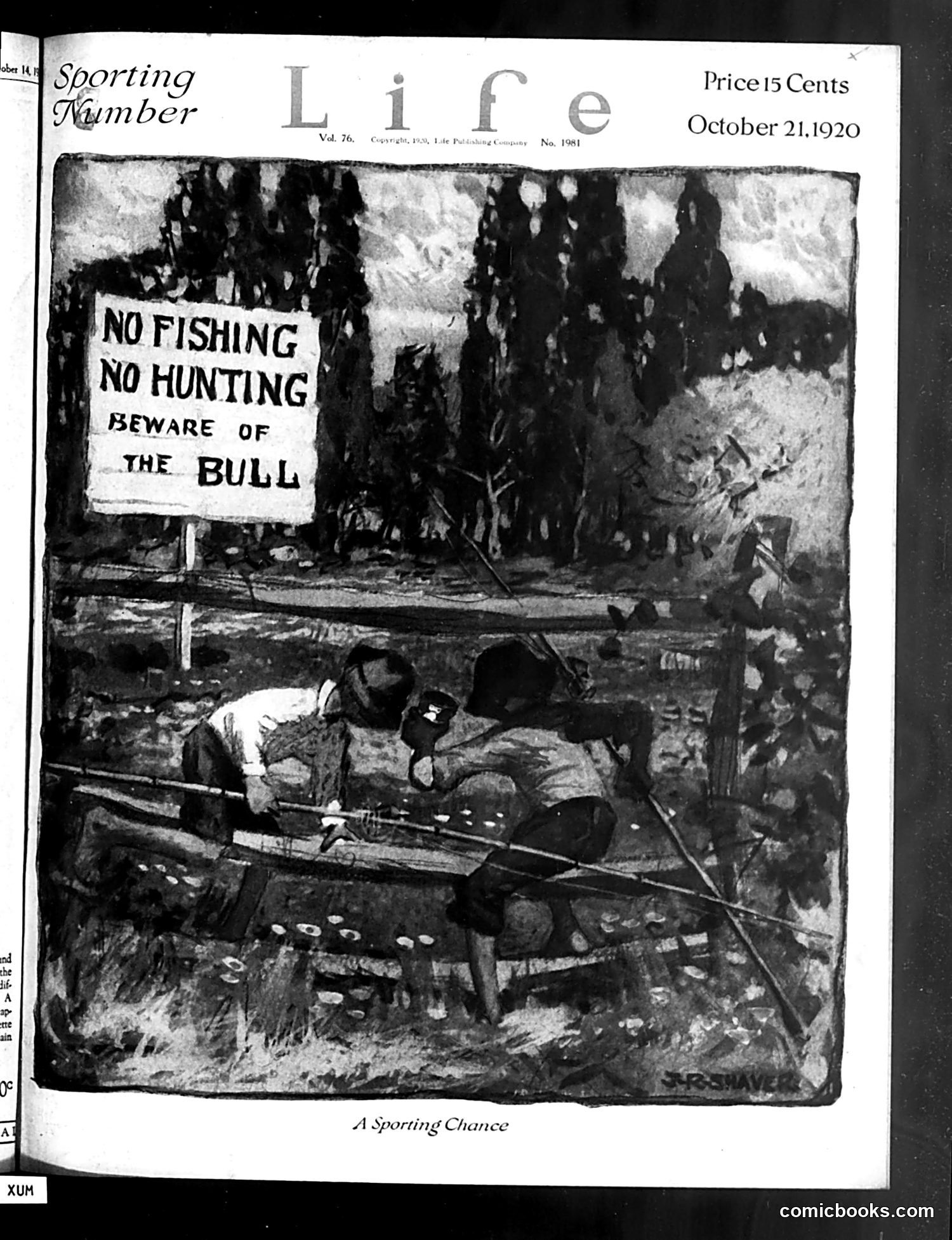
This cartoon depicts two hunters fishing beneath a sign reading "NO FISHING / NO HUNTING / BEWARE OF THE BULL." The humor hinges on the contradiction between the warning and the sportsmen's apparent willingness to ignore it—they're pursuing their hobby despite explicit prohibition. The title "A Sporting Chance" plays on the phrase's double meaning: it refers both to hunting/fishing as sports and to the risky gamble these men are taking by trespassing on private property where a bull poses a physical threat. This satirizes the conflict between working-class recreation (fishing and hunting) and property owners' attempts to restrict access to land. The "sporting chance" is that the hunters might escape before encountering the dangerous bull—a commentary on class tensions and rural land access circa 1920.
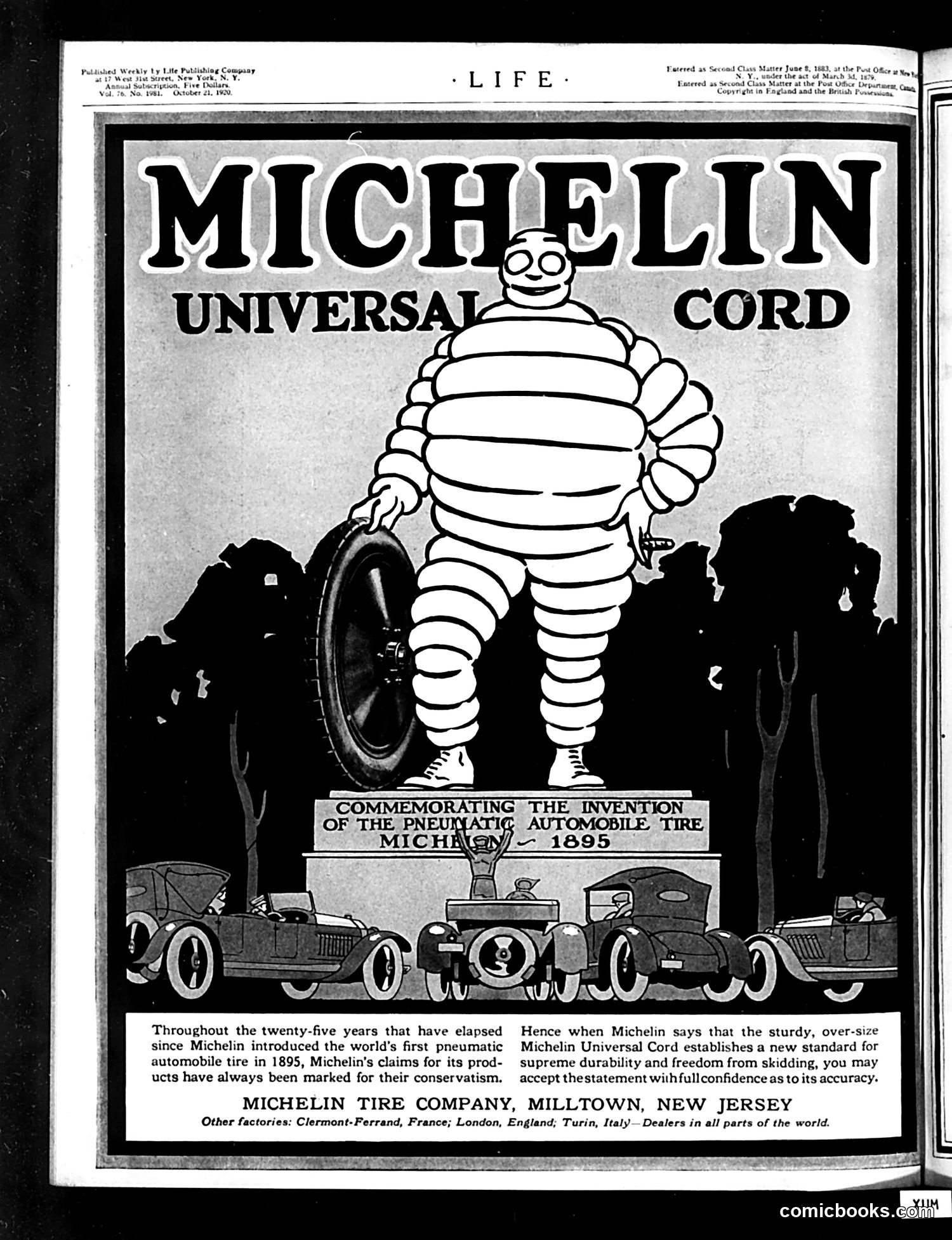
This is primarily **advertising copy, not political satire**. It commemorates Michelin's 1895 invention of the pneumatic automobile tire. The famous **Michelin Man** (a rotund character made of tire treads) is the brand mascot, shown here in his characteristic puffy, segmented form holding a tire. He towers over early automobiles below, emphasizing the tire's importance to motoring. The text claims Michelin tires offer "durability and freedom from skidding" after "twenty-five years" of proven performance. This is a straightforward product advertisement emphasizing reliability through longevity and innovation. The Michelin Man became iconic American advertising imagery, but this page represents commercial promotion rather than political commentary or satire.
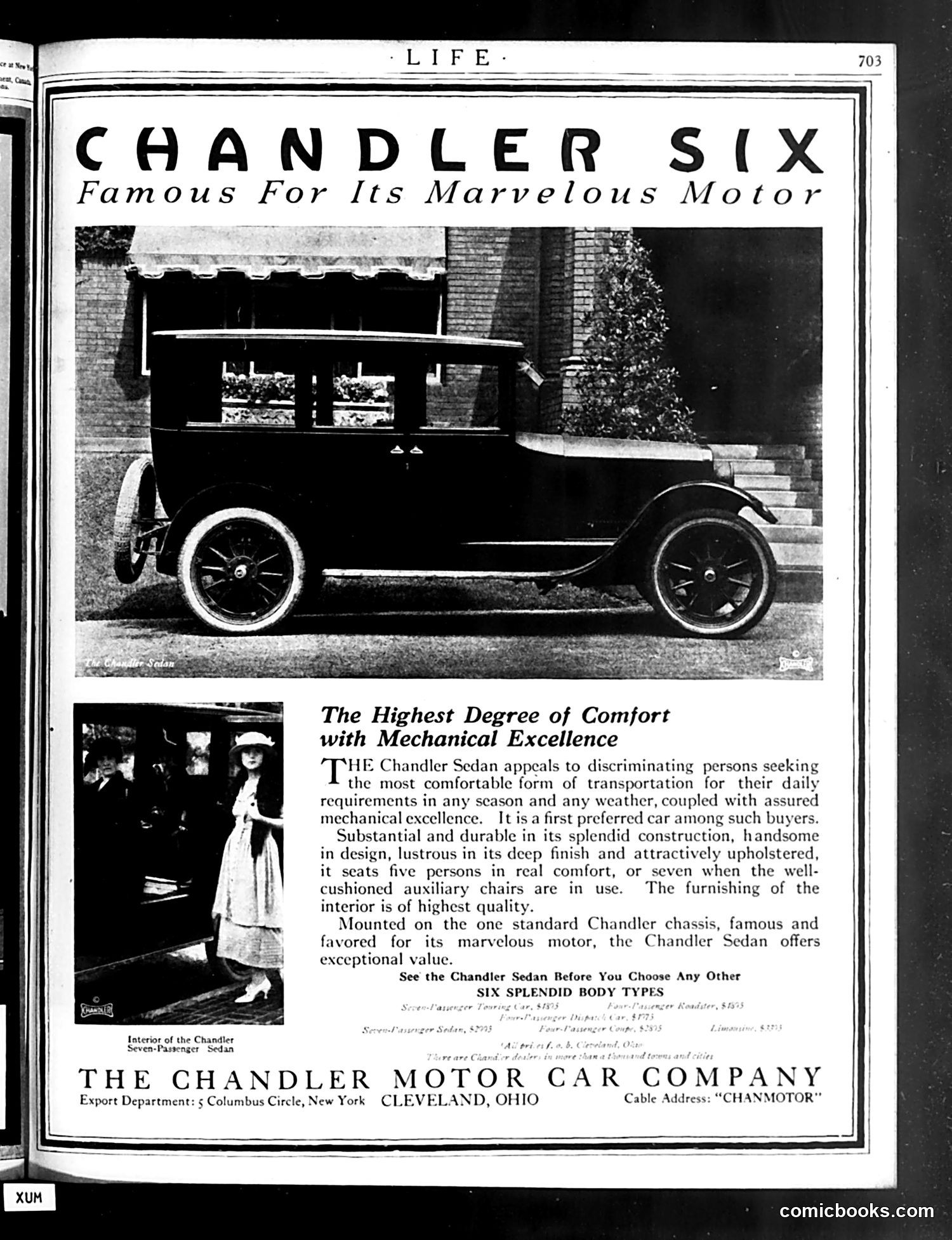
This is **not a political cartoon or satire page**—it's a straightforward automobile advertisement for the Chandler Six sedan, published in *Life* magazine (page 703). The page features: - A large photograph of a 1920s Chandler sedan automobile - A smaller interior photograph showing the car's passenger compartment - Marketing copy emphasizing the vehicle's comfort, durability, and "marvelous motor" - Company information for the Chandler Motor Car Company (Cleveland, Ohio) The advertisement targets affluent buyers seeking luxury vehicles, highlighting features like seating for five or seven passengers and "highest quality" interior furnishings. This represents typical early 20th-century automotive advertising, before *Life* magazine shifted toward predominantly satirical content in later decades.
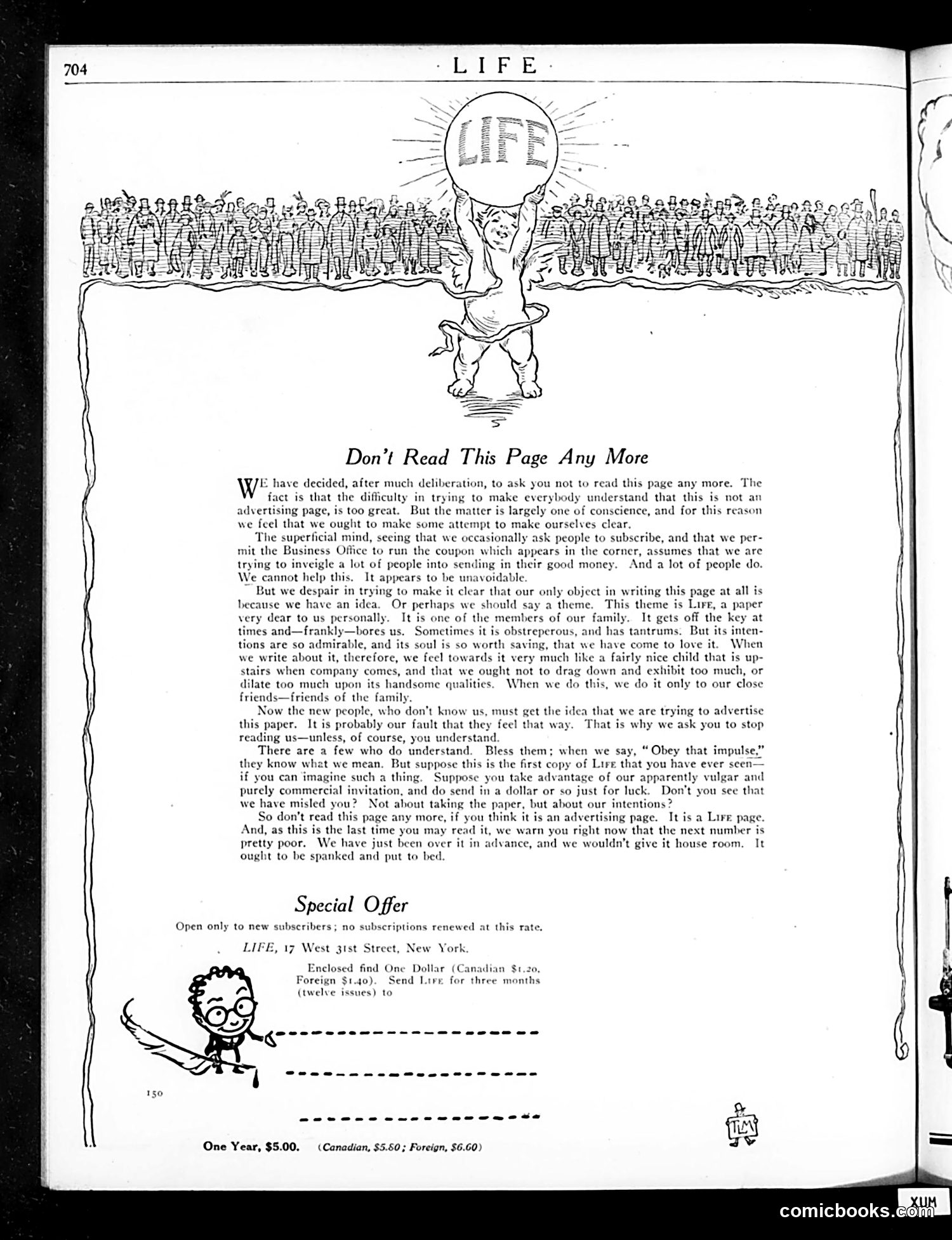
This page is primarily a **subscription appeal disguised as editorial content**. The headline "Don't Read This Page Any More" uses reverse psychology—the editors ask readers to stop reading to avoid seeing advertising, then confess the real purpose: soliciting subscriptions. The top illustration shows a figure holding up a "LIFE" globe to a crowd, likely representing the magazine's aspirational mission to reach and inform the public. The lower cartoon depicts a small figure pointing to subscription information, emphasizing the call-to-action. The text acknowledges readers' likely skepticism about the magazine's motives, essentially admitting that Life occasionally uses manipulative tactics to secure subscriptions while claiming their actual editorial mission is noble and worthwhile. It's a self-aware pitch attempting humor and honesty as persuasion tactics.
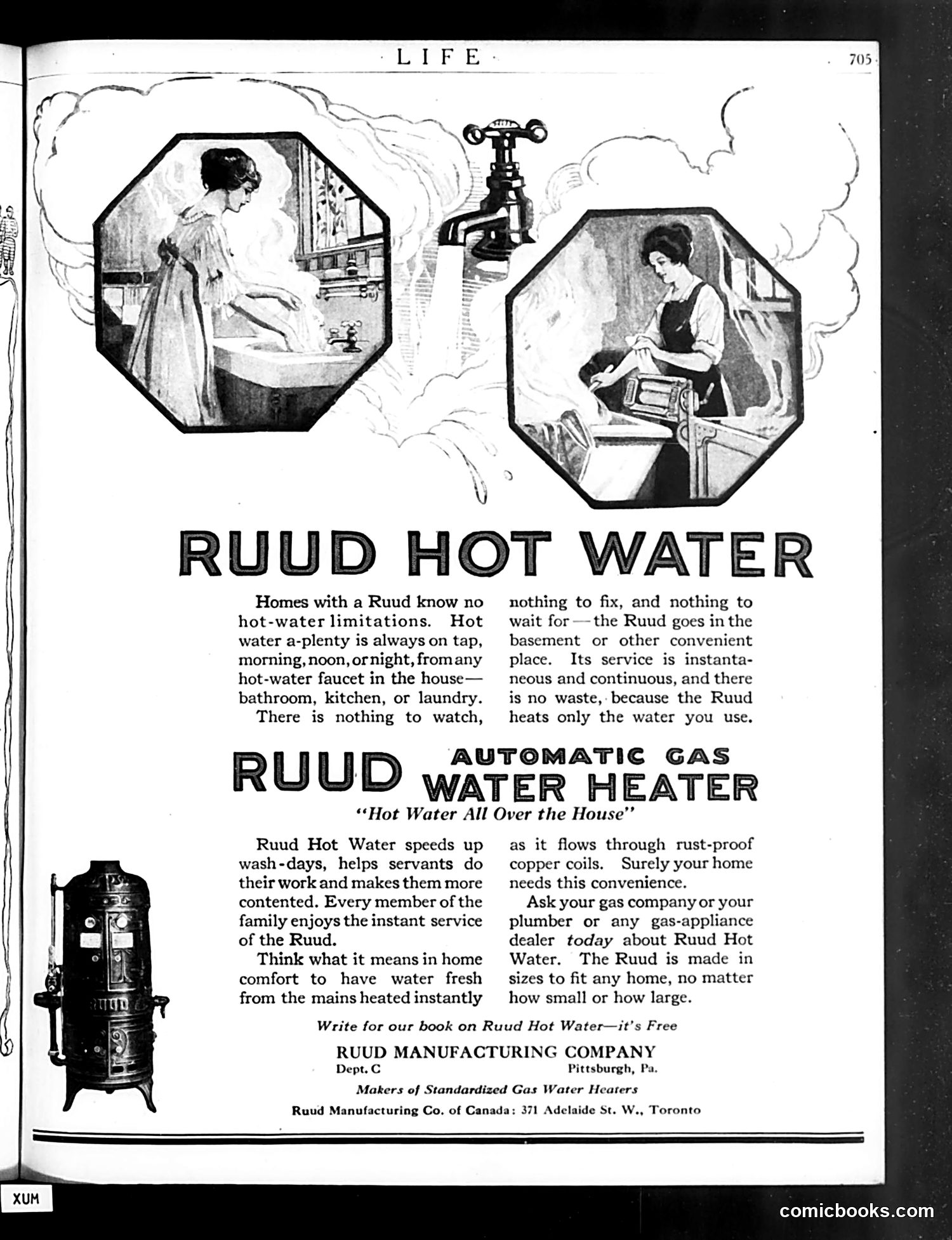
This page is **primarily an advertisement**, not political satire. It promotes the Ruud Automatic Gas Water Heater, a home appliance manufactured in Pittsburgh, Pennsylvania (with a Canadian distributor in Toronto). The two octagonal photographs show women using hot water—one at a bathroom sink, another doing laundry or kitchen work. These images illustrate the product's convenience: unlimited hot water "all over the house" without waiting or maintenance. The smaller illustration on the left depicts the actual heater unit itself. The ad's messaging emphasizes labor-saving benefits for households and servants, typical of early 20th-century appliance marketing targeting middle-class homeowners concerned with domestic efficiency and comfort. This is straightforward commercial content rather than editorial cartoon or satire.
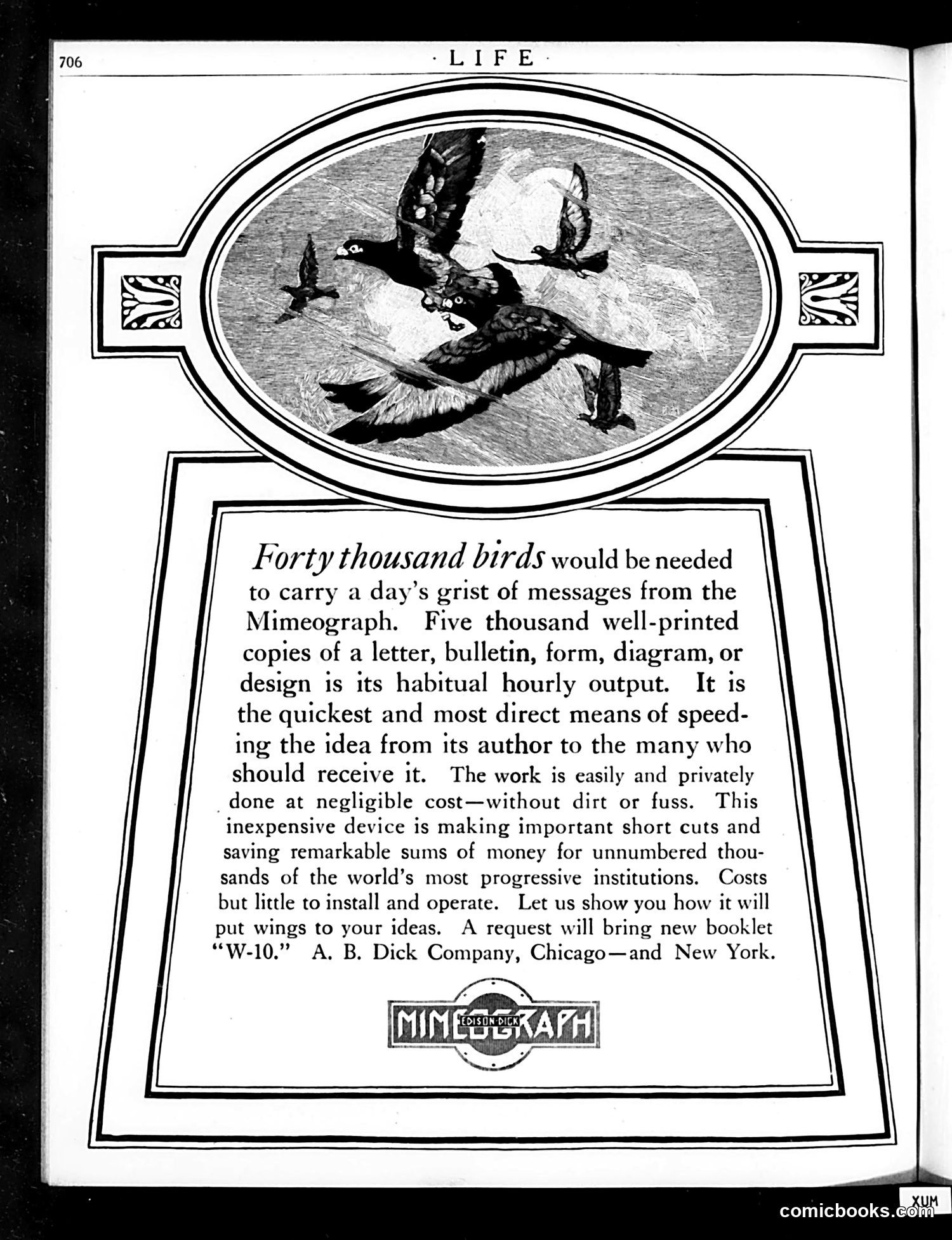
This page is primarily an **advertisement for the Mimeograph machine** by A.B. Dick Company, not political satire. The text promotes the device's efficiency: it can produce 5,000 copies hourly at negligible cost, making it ideal for distributing messages to large audiences. The illustration shows **birds in flight**, likely symbolizing speed and message-delivery—a visual metaphor playing on the phrase "put wings to your ideas" in the copy. The bird imagery suggests swift, effortless communication, which was the Mimeograph's selling point. This reflects early 20th-century American business culture, where new duplicating technology was celebrated as revolutionary for institutions seeking cost-effective mass communication. There is no political cartoon or satire present—this is straightforward product marketing.
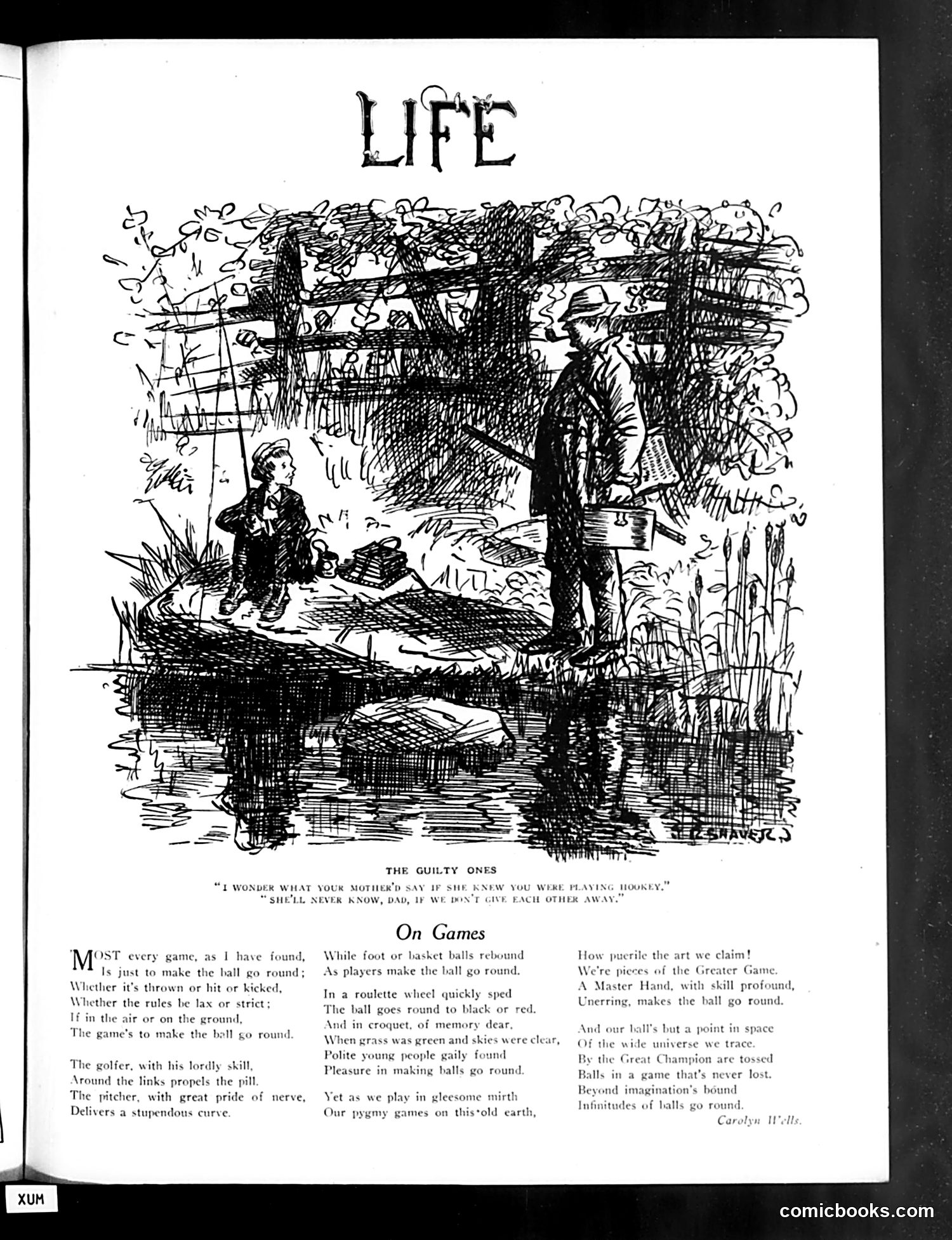
This page features an illustration titled "The Guilty Ones" depicting an adult and child by a stream, with dialogue about hockey. Below is a poem "On Games" by Carolyn Wells celebrating various sports. The cartoon's satire appears to address parental hypocrisy: the adult warns the child that the mother would disapprove of them playing hockey together, yet suggests they won't tell her. This captures turn-of-the-century anxieties about children's unsupervised activities and gender-appropriate play. The accompanying poem romanticizes games—golf, cricket, roulette, and ball sports—presenting them as noble pursuits that teach skill and character. The satire likely mocks this sentimental view by juxtaposing it with the cartoon's depiction of deception and rule-breaking in actual play.
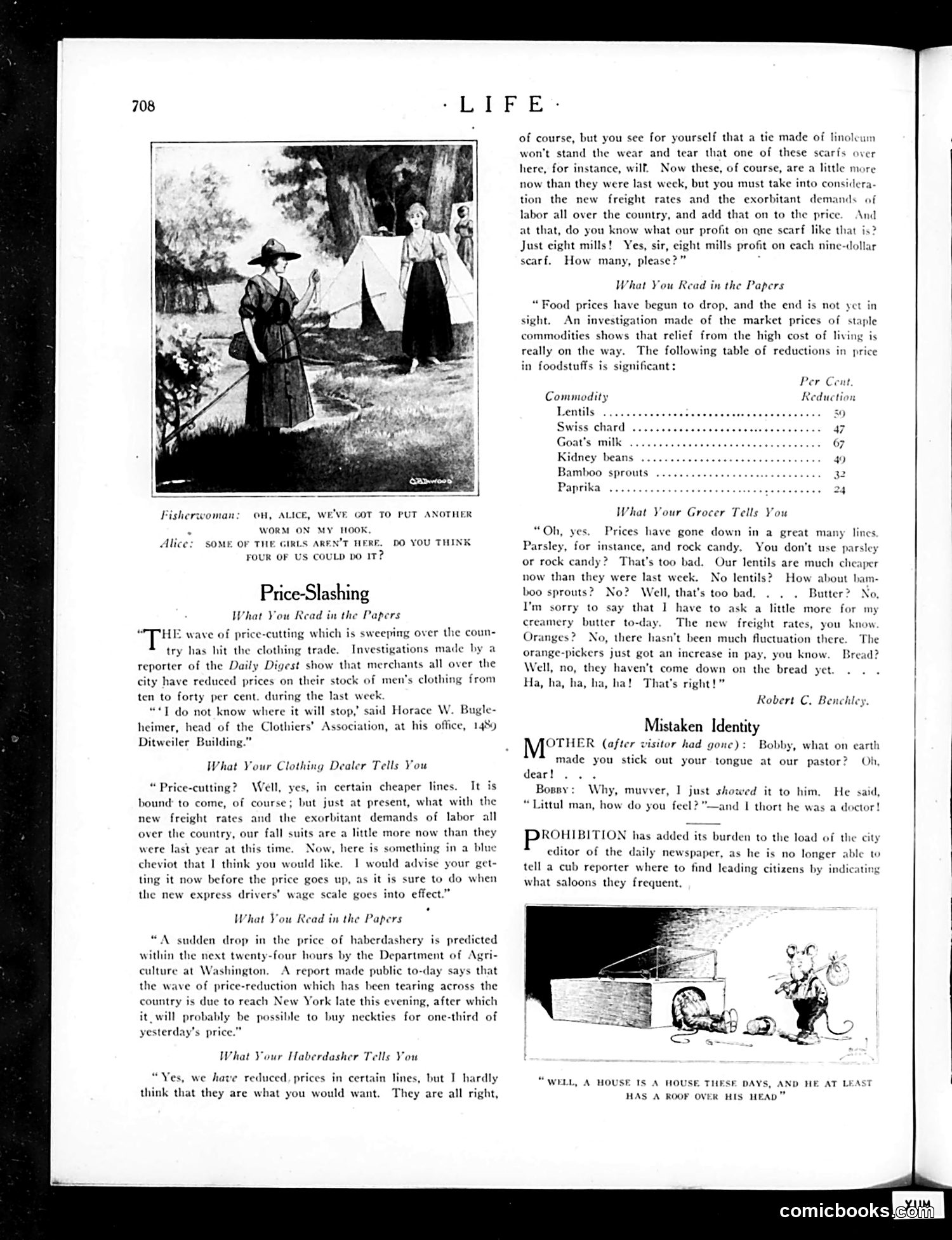
This page satirizes post-WWI economic conditions. The main photograph shows fisherwomen discussing whether four of them could catch fish—likely commentary on labor scarcity and wage demands. The text collects complaints from various trades (clothing, groceries, haberdashery) about price-cutting. Each merchant blames external pressures: new freight rates, labor costs, and market competition force them to reduce prices while claiming quality suffers. The smaller cartoon at bottom depicts Prohibition's unintended consequence: a man smuggling liquor ("a house is a house these days, and he at least has a roof over his head"), suggesting citizens evade the law by hiding contraband alcohol in their homes. The page satirizes how wartime inflation and Prohibition created economic distortions and widespread complaints across retail sectors.
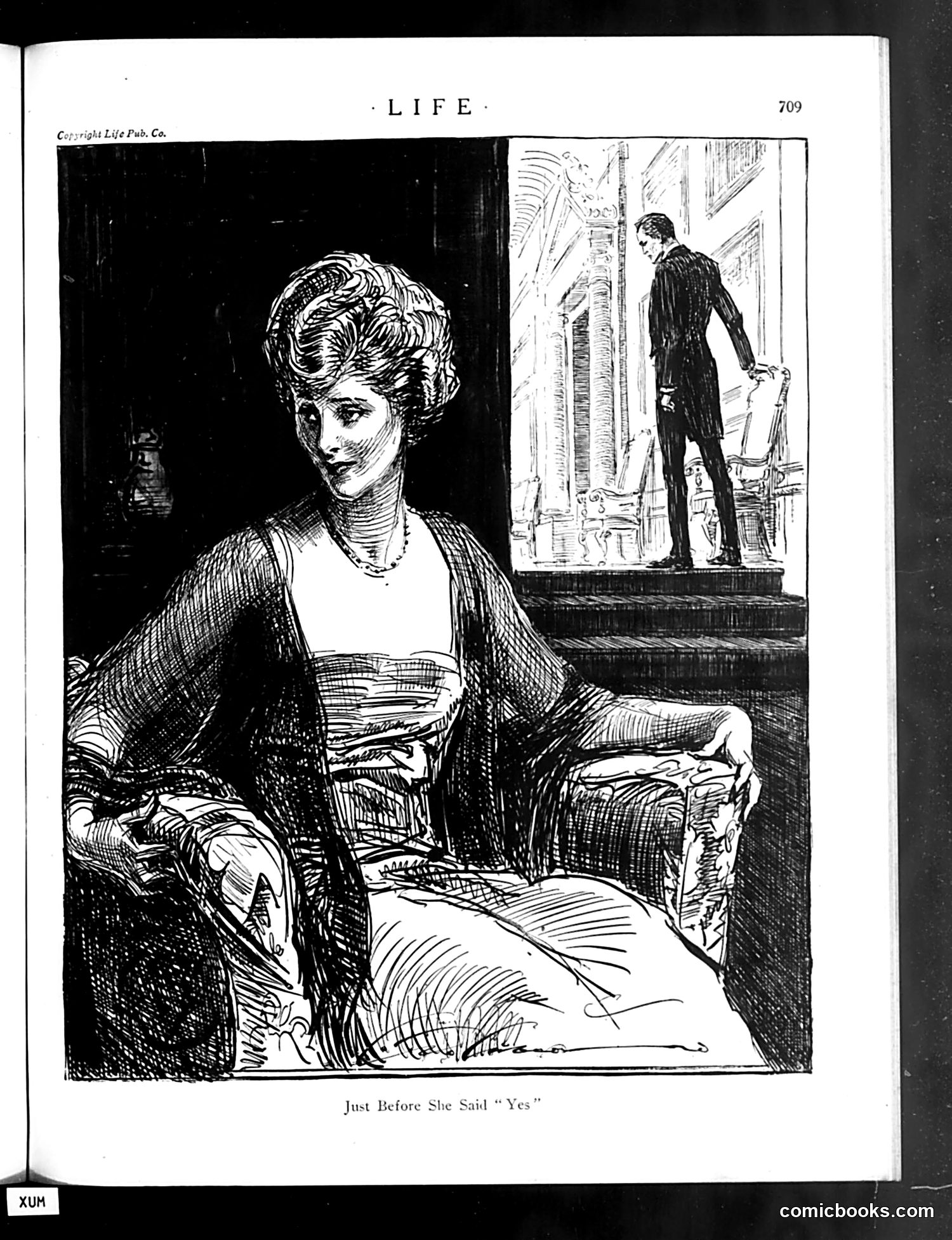
This illustration from *Life* magazine depicts a romantic scene with satirical intent. A well-dressed woman sits relaxed in an interior setting while a man stands at a window in the background, suggesting he's just left or is about to propose. The caption "Just Before She Said 'Yes'" is the satirical crux—it captures the moment of anticipation before acceptance. The humor likely mocks the predictability of romantic proposals and the assumed inevitability of a woman accepting marriage. The woman's composed, almost knowing expression suggests she's anticipated this moment. The style and subject matter reflect early 20th-century *Life* magazine's focus on social commentary about courtship, gender expectations, and matrimonial conventions among the upper classes, presented through elegant pen-and-ink illustration.
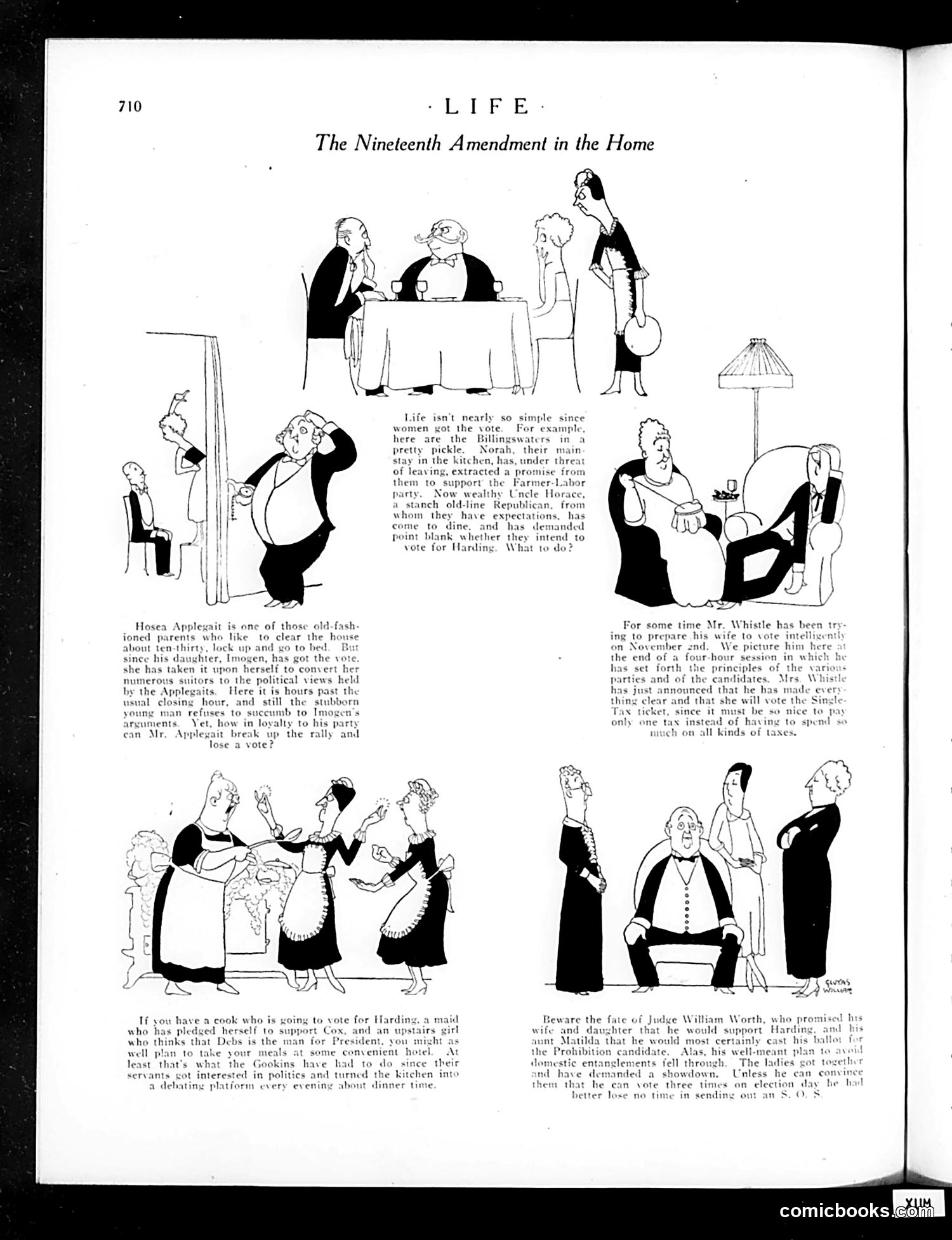
This satirical page mocks how women's newly-gained voting rights (19th Amendment, ratified 1920) disrupted household dynamics. The cartoons depict domestic scenes where wives now pursue political interests, creating conflict with husbands. Key scenarios shown: - **Hoses Applegate**: A stubborn father refuses to let his daughter vote, despite pressure from numerous sisters with different political views - **The Billingswaters**: A husband tries convincing his wife to vote for Harding; she's unmoved by his arguments - **Kitchen servants**: Depicted abandoning domestic duties to discuss politics - **Judge William Worth**: A cautionary tale of a man who promised his wife political support but now faces consequences The satire suggests women's political engagement threatened traditional gender roles and male household authority.
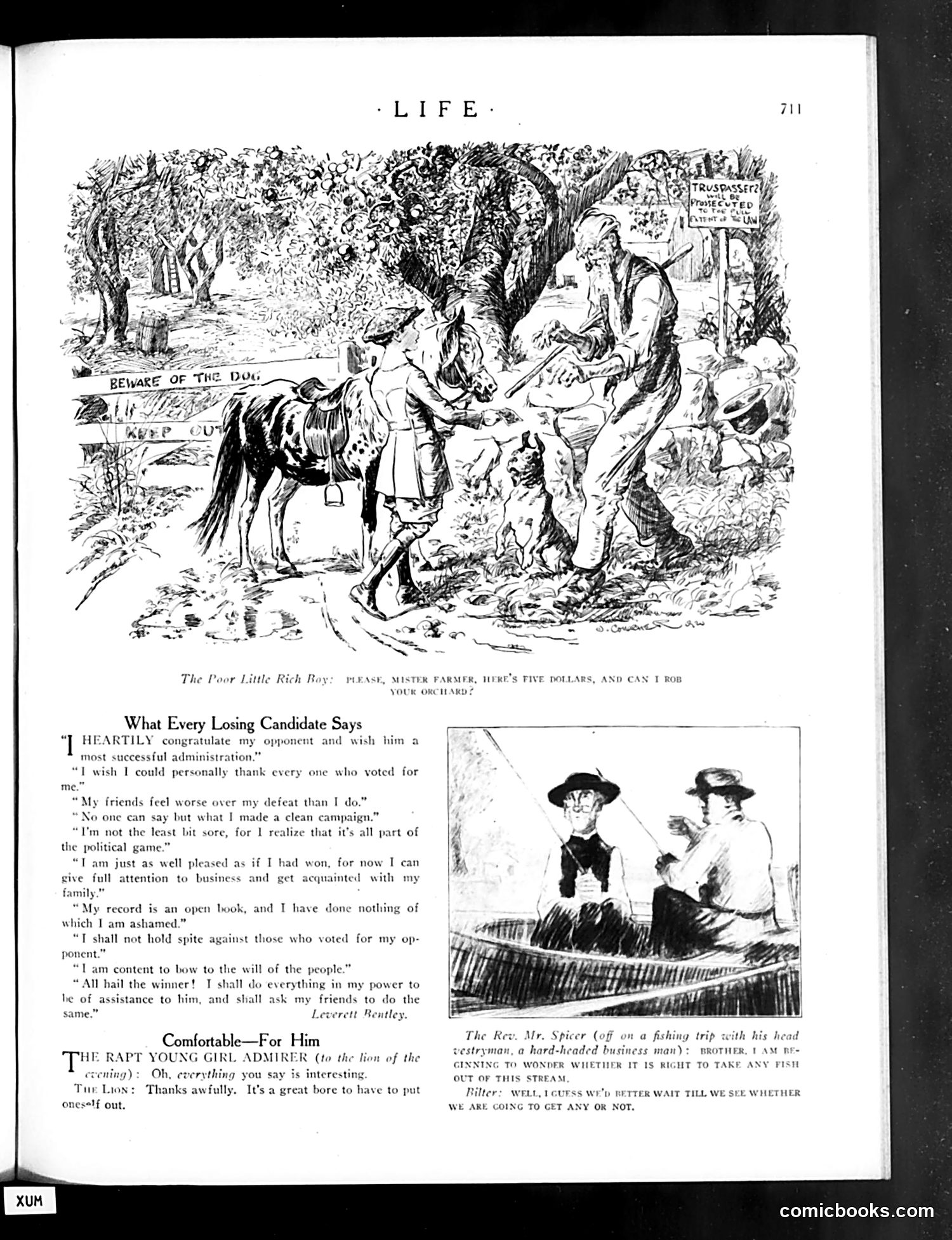
The top cartoon, titled "The Poor Little Rich Boy," depicts a well-dressed child offering money to a farmer, saying "Please, mister farmer, here's five dollars, and can I rob your orchard?" The satire mocks wealthy children's entitled behavior and assumption that money can purchase permission for any action, including mischief. Below, "What Every Losing Candidate Says" collects hypocritical statements from defeated politicians—congratulating opponents while claiming clean campaigns, yet refusing to "hold spite" against voters. The satire exposes standard post-election rhetoric as insincere. The remaining items are brief comic dialogues: "Comfortable—For Him" jokes about a boring fishing companion, while another sketch shows two businessmen discussing fishing prospects on a stream.
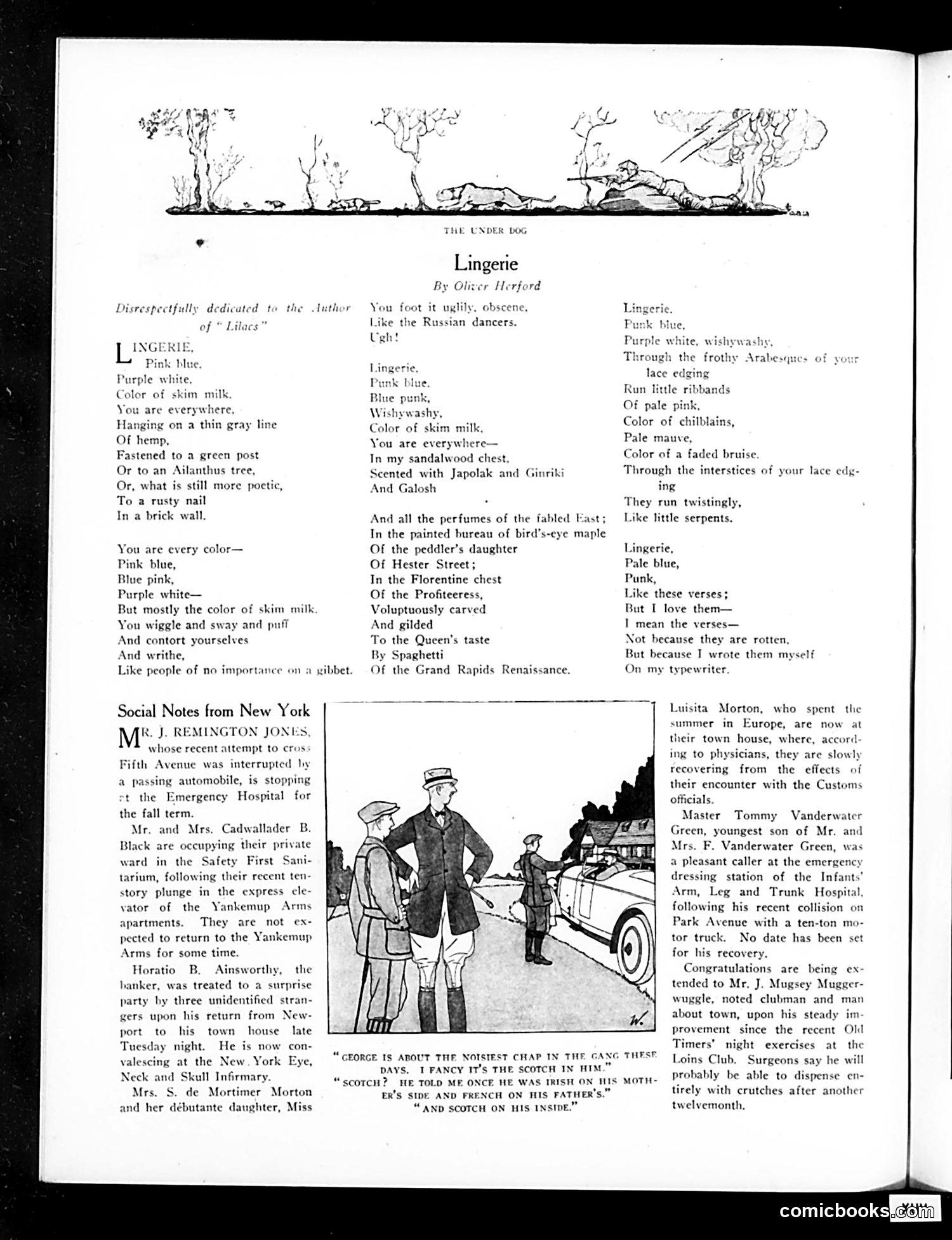
This page contains a poem titled "Lingerie" by Oliver Herford and a "Social Notes from New York" gossip column with an accompanying illustration. The cartoon depicts three men in formal attire on a street, with the caption discussing "George" being "the noisiest chap in the gang these days" and making jokes about his Irish and French heritage. The humor appears to target ethnic stereotyping common to the era—specifically Irish and French national characteristics. The gossip column reports on New York society figures, including updates on injuries and social events among Manhattan's elite. The content reflects the magazine's focus on satirizing high society through celebrity news and social commentary, typical of Life magazine's editorial approach during this period.
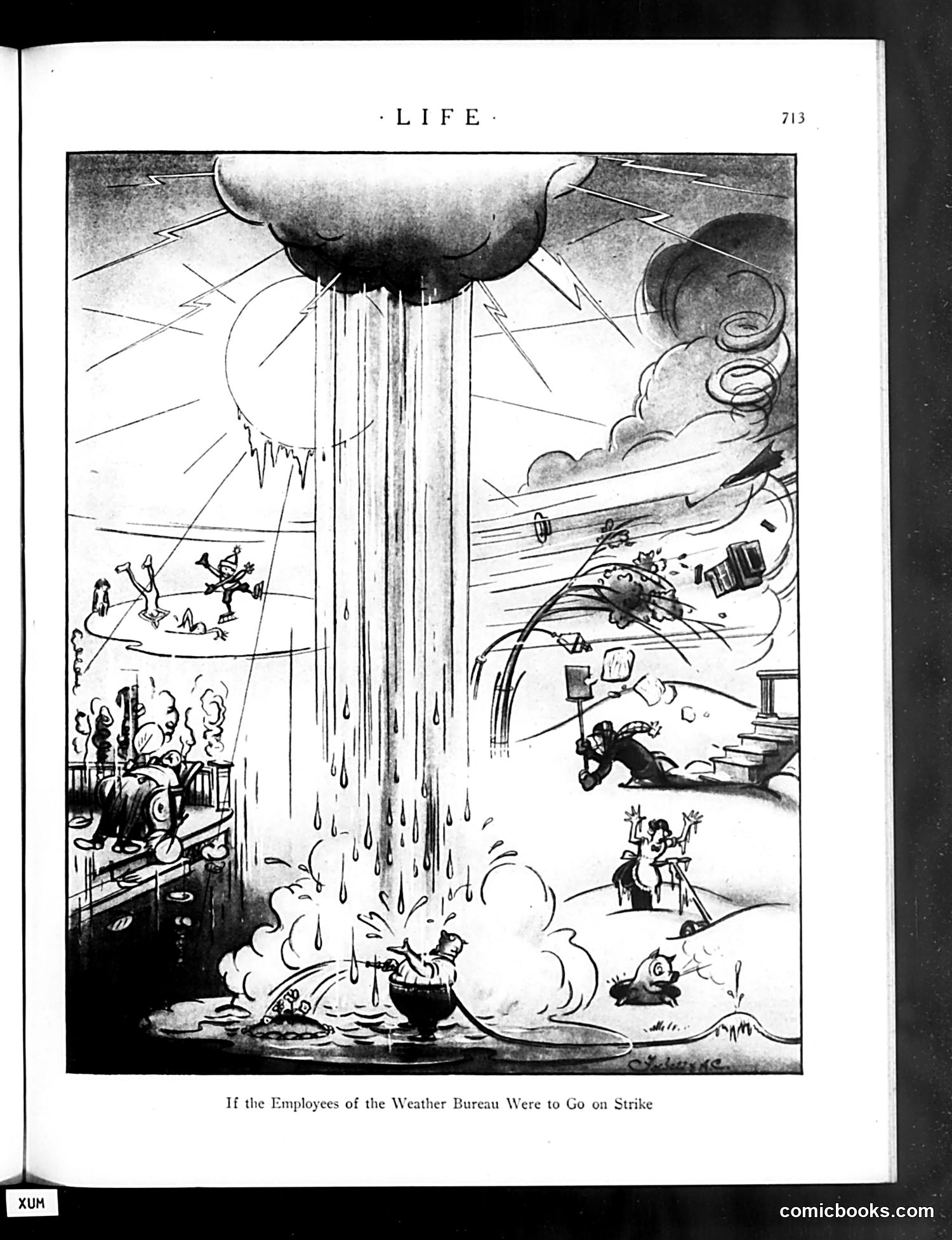
This cartoon satirizes the consequences of a hypothetical strike by U.S. Weather Bureau employees. The image depicts catastrophic chaos: torrential rain pours from a massive cloud-machine above, flooding the landscape below. People scramble in panic—some drowning, others fleeing—while infrastructure crumbles around them. The satire suggests that weather forecasting, though often taken for granted, is essential to public safety and economic function. Without Weather Bureau workers, the cartoon implies, society would face disaster as people couldn't prepare for dangerous conditions. This reflects early-20th-century concerns about labor strikes and their ripple effects on critical government services. The exaggerated devastation underscores how dependent modern civilization had become on institutional expertise.
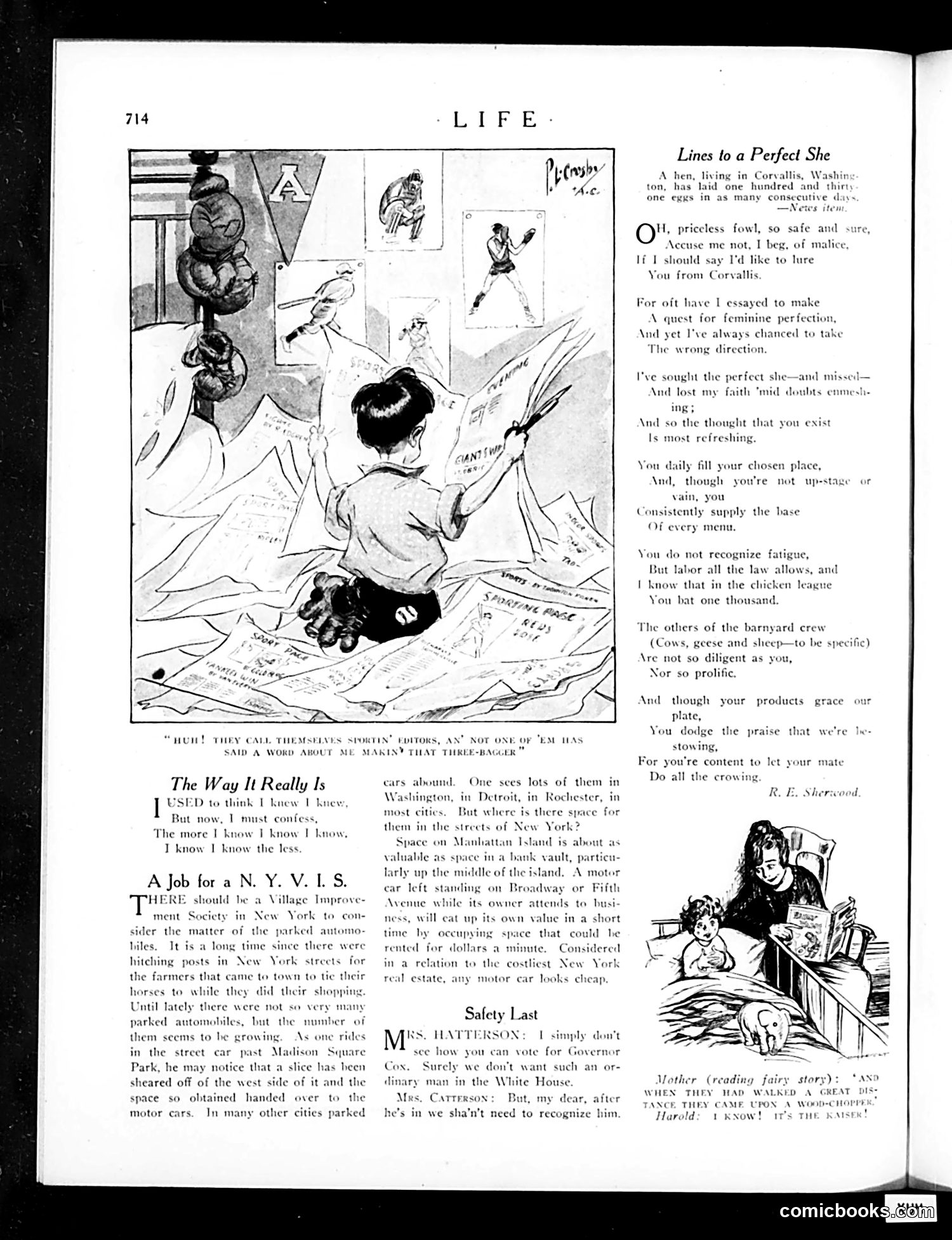
The main cartoon depicts a woman surrounded by sketches and notes, apparently designing or planning something. The caption reads: "HUH! THEY CALL THEMSELVES 'SORTIN' EDITORS, AN' NOT ONE OF 'EM HAS SAID A WORD ABOUT ME MAKIN' THAT THREE-BAGGER." This appears to satirize female ambition and workplace dynamics. The woman seems to be doing creative work (possibly editorial or design), while complaining that male colleagues ("sortin' editors") have ignored her athletic or professional accomplishment—the "three-bagger" (likely a baseball reference, meaning a triple hit). The satire likely critiques either women's frustration with workplace recognition or the absurdity of expecting acknowledgment for unrelated achievements. The baseball metaphor adds comedic incongruity to the office setting.
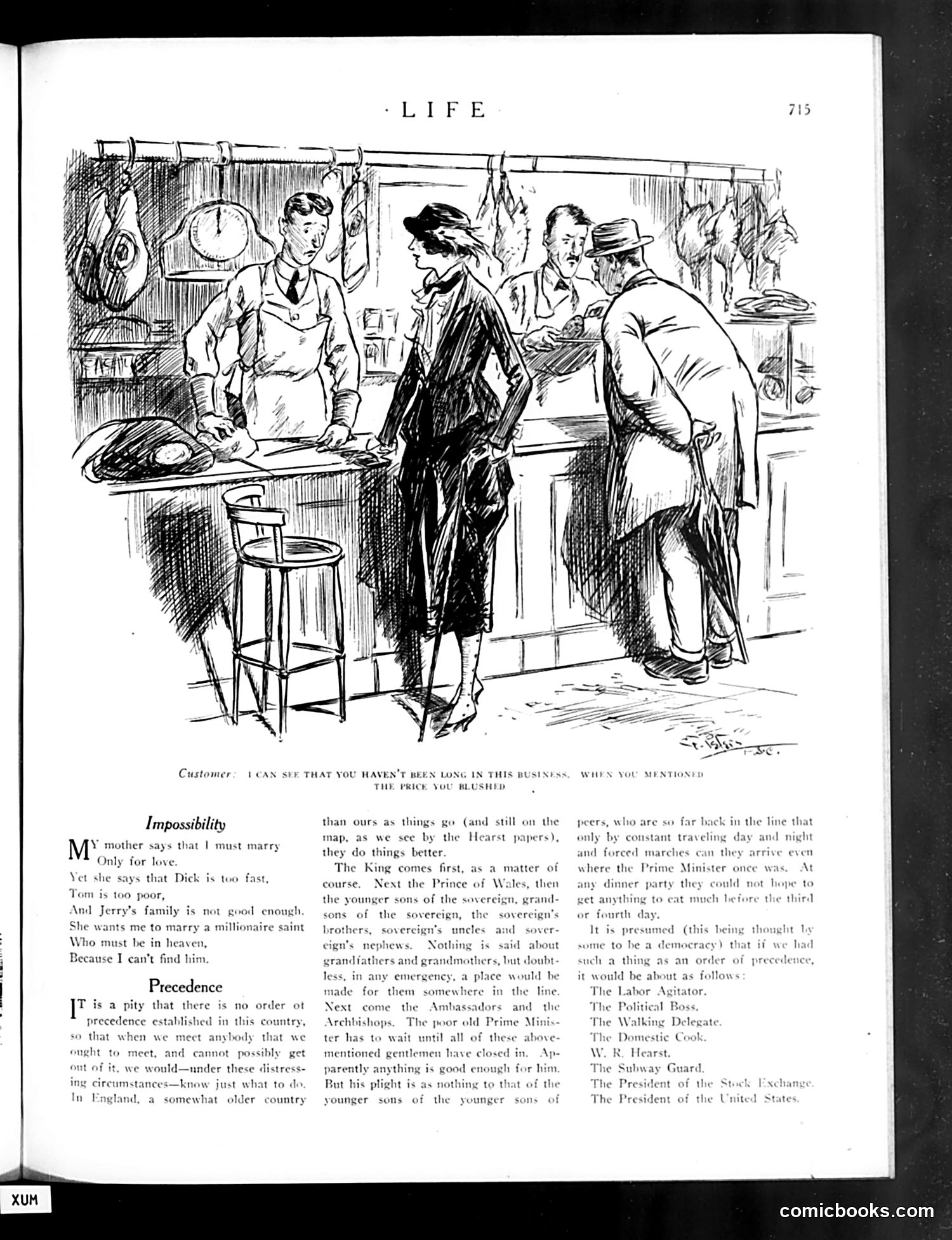
The cartoon depicts a butcher shop scene where a customer questions the butcher about his long absence, noting he's "blushed" at the prices—a visual pun on the butcher's red face and inflated meat costs. The two accompanying text pieces satirize British social hierarchy. "Impossibility" mocks the rigid class system through a mother's marriage requirements for her daughter—the suitor must be wealthy, well-born, and from an acceptable family, yet the mother rejects every candidate as inadequate. "Precedence" critiques the absurd protocol governing who meets whom in English society, where strict rank determines social interaction. Both pieces humorously expose how Britain's class obsession creates ridiculous, contradictory standards that prevent normal social functioning.
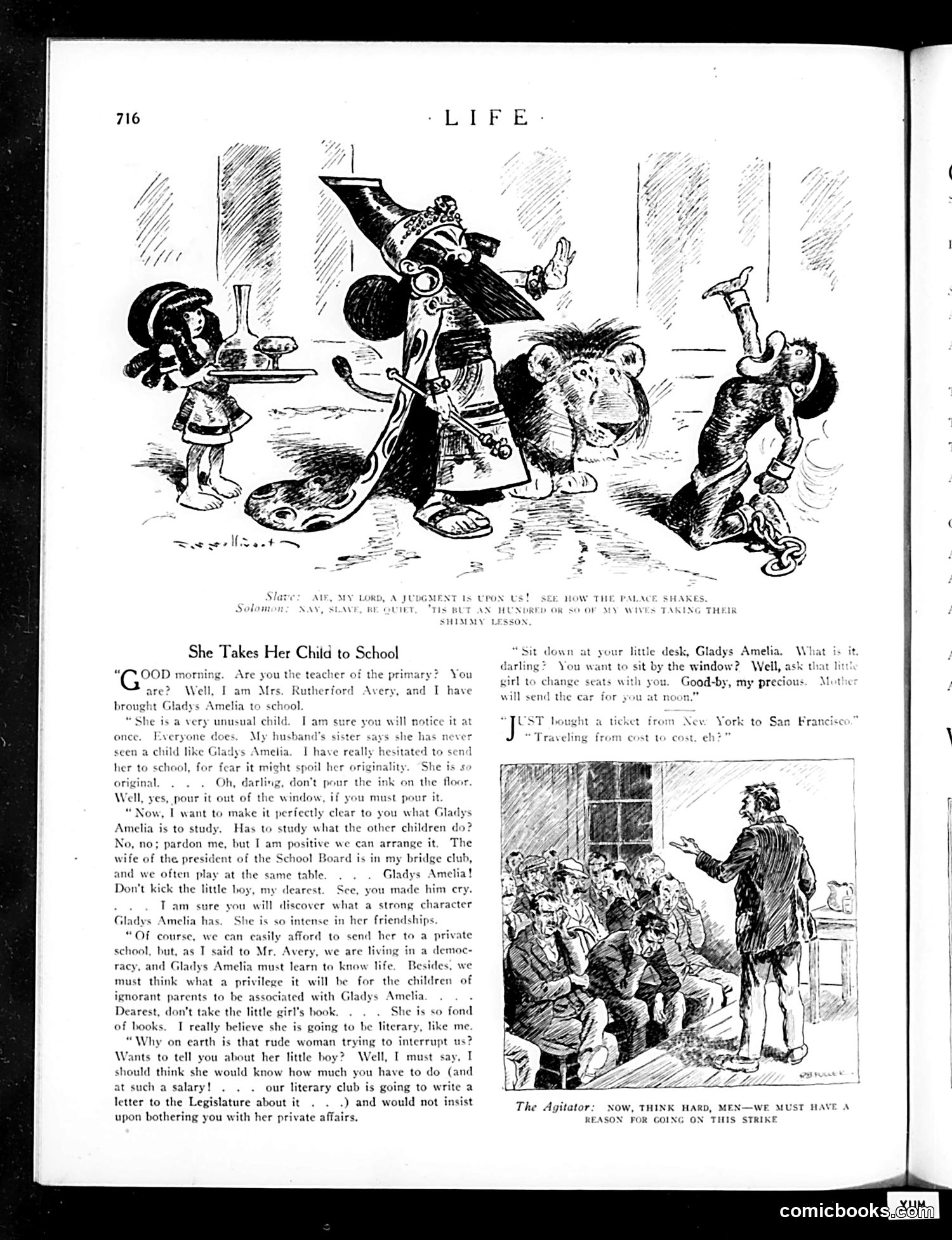
This page contains two distinct pieces. The upper section is a fairy-tale illustration showing a wizard or magician figure with child characters—likely a visual joke about children's literature, though the specific reference is unclear from context alone. The lower section, titled "She Takes Her Child to School," presents a satirical dialogue between a mother and a schoolteacher about sending a child named Gladys Amelia to primary school. The humor targets upper-class parental anxieties: the mother worries the school will damage her daughter's "originality," while making references to the family's wealth (private schools, a president of the school board). The satire mocks pretentious parents who regard public education suspiciously while simultaneously demanding their children receive special treatment. The right illustration captioned "The Agitator" appears to reference labor strikes, though context is limited.
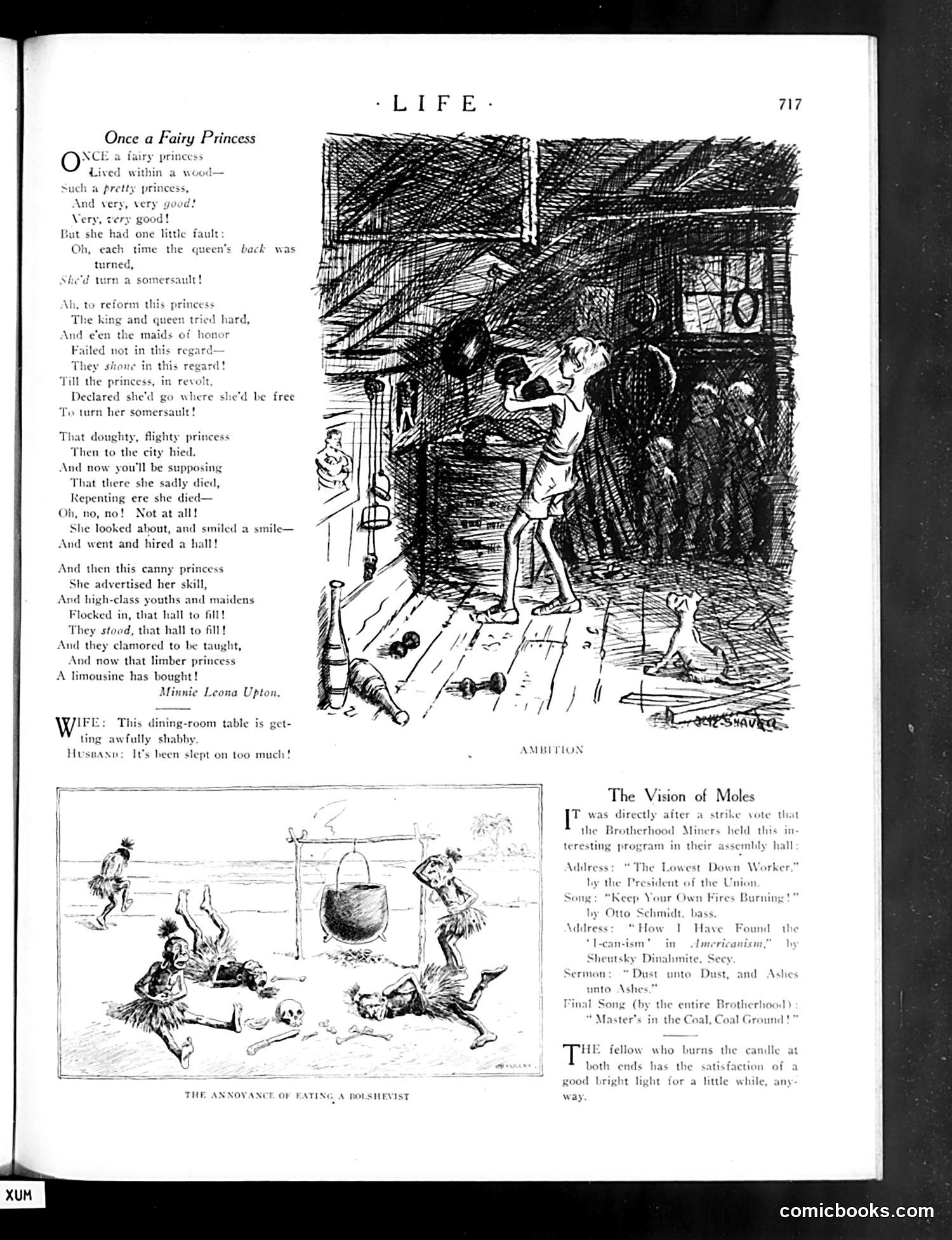
This page contains satirical content mocking early 20th-century social movements and labor activism. **"Once a Fairy Princess"** (poem with illustration): A whimsical critique of female rebellion and commercialization. A princess who breaks rules by doing somersaults escapes to the city, advertises her "skill," attracts paying audiences, and becomes wealthy with a limousine. The satire targets women gaining independence through entertainment and commerce—treating her rebellion as trivial yet mockingly celebrating her capitalist success. **"The Vision of Moles"** (illustration): Depicts figures labeled as Bolshevists in chaotic, undignified poses. The accompanying text references a Brotherhood Miners union meeting with speeches about workers and coal mining. The cartoon sarcastically mocks radical labor organizers and socialist ideology, portraying them as absurd and destructive—the "moles" image suggesting they burrow destructively underground. This reflects anti-communist/anti-labor sentiment common in 1920s American satirical magazines. The magazine's conservative stance opposes both female economic independence and labor radicalism.
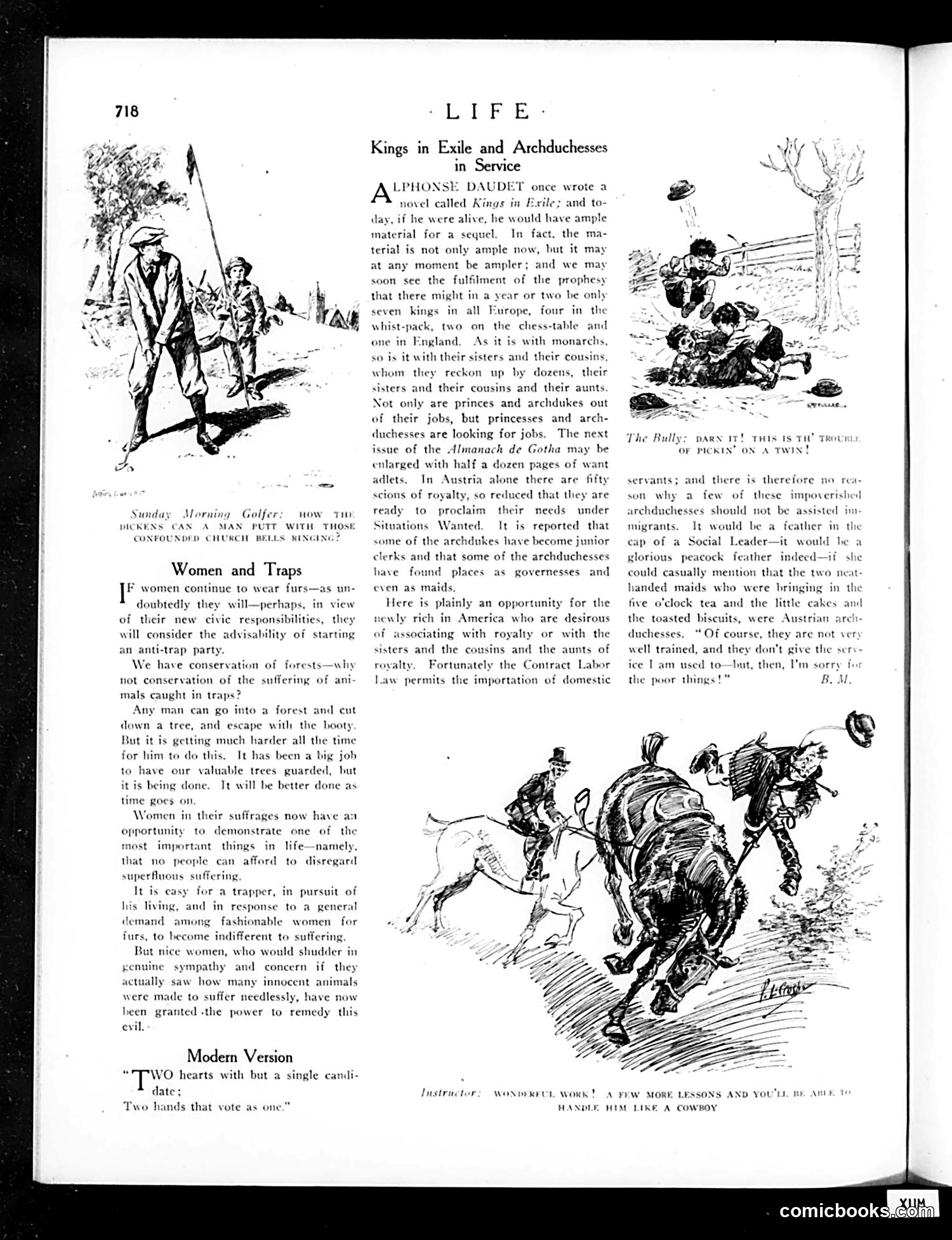
This page contains three distinct satirical pieces: **"Sunday Morning Golfer"**: A brief joke about a man unable to golf due to church bells—likely mocking either noisy urbanization or religious observance interrupting leisure. **"Women and Traps"**: An essay-cartoon arguing that newly enfranchised women (having just gained voting rights) should use their political power to ban animal traps used in the fur industry. The piece shames wealthy women who wear fur while remaining ignorant of animal suffering, suggesting they now have the power—and responsibility—to stop it. **"Kings in Exile and Archduchesses in Service"**: A satirical piece referencing post-WWI European upheaval, where deposed royalty faced unemployment. It jokes that wealthy Americans could hire impoverished European aristocrats as domestic servants—a humorous commentary on both the collapse of European monarchy and American nouveau-riche social climbing. The page reflects post-suffrage America (women's voting rights, 1920), post-WWI instability in Europe, and early 20th-century class anxieties.
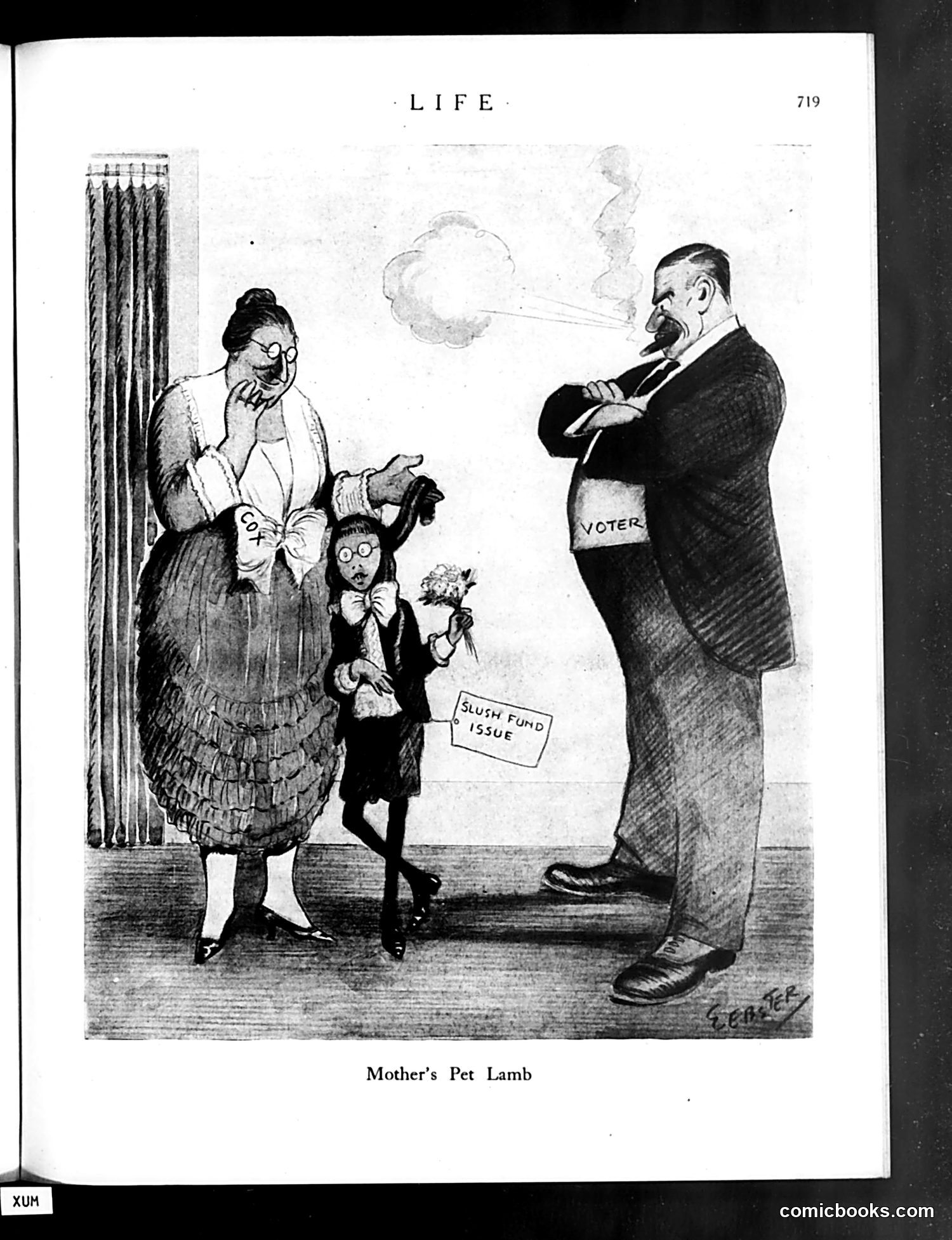
This political cartoon depicts a man labeled "VOTER" confronting a woman and small child about a document labeled "SLUSH FUND ISSUE." The satire compares the child to a "pet lamb"—suggesting the child represents a political constituency or issue being coddled and protected by its "mother" (likely a politician or political party). The cartoon appears to criticize how politicians use certain issues or groups as favored pets rather than addressing them seriously. The voter's skeptical expression and body language suggest disapproval of this patronizing approach. The "slush fund" reference indicates the cartoon concerns misuse of public money, possibly suggesting that political favorites receive special treatment or funding through questionable means.
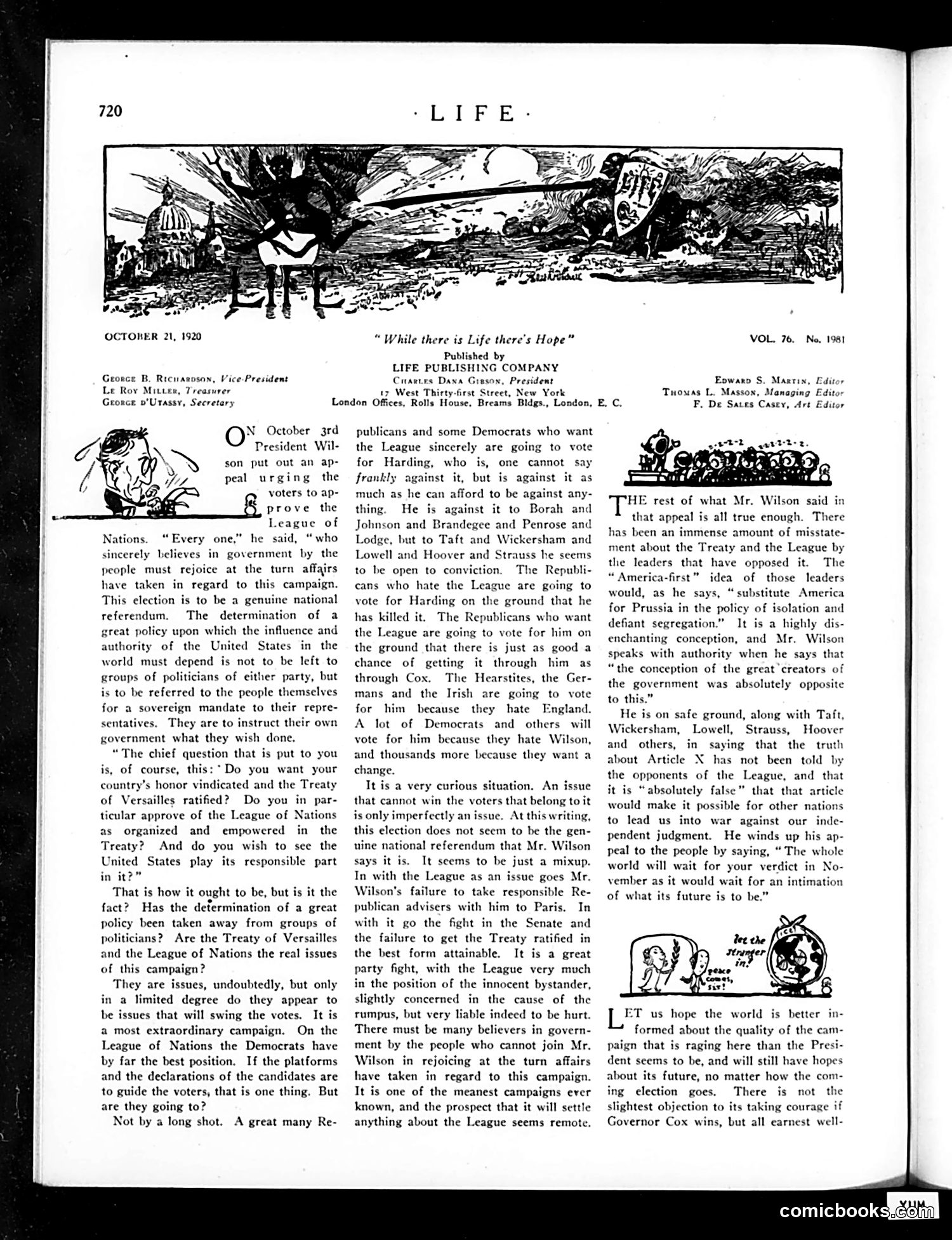
This editorial discusses the 1920 presidential election between Democrat incumbent President Wilson and Republican challenger Warren Harding, specifically focusing on the League of Nations as a campaign issue. **The Cartoon**: The left illustration depicts a hunched, worried figure—likely representing the League of Nations itself or Wilson's League policy—appearing distressed or uncertain. **The Argument**: Life's editors criticize Wilson's claim that the election is a "genuine national referendum" on the League. They argue voters will actually vote for Harding for contradictory reasons: Republicans wanting the League will vote for him thinking it can still pass; Republicans opposing it will vote believing he's killed it. Additionally, voters will support Harding out of hatred for Wilson, England, or desire for change—not based on the League issue itself. **The Satire**: Life satirizes how the 1920 election will be decided by shifting personal animosities and partisan tribal loyalty rather than genuine policy debate, making the League's actual fate uncertain and dependent on political chaos.
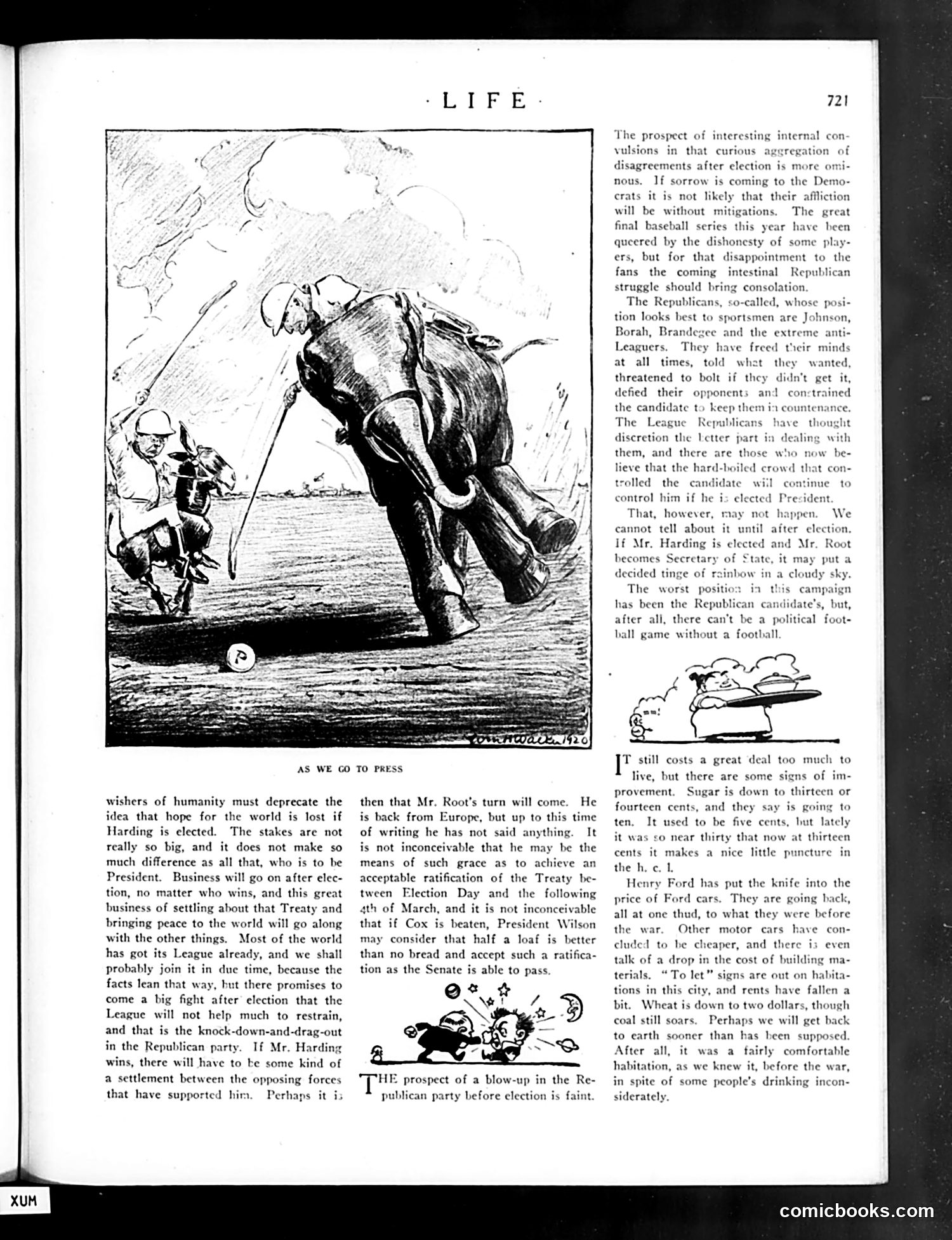
This page addresses the 1920 U.S. presidential election, likely between Republican Warren Harding and Democrat James Cox. **The main cartoon** shows an elephant (Republican Party symbol) kicking a football, with a small figure (possibly representing the League of Nations or internal party dissent) being launched into the air. The text explains the satire: the article warns of inevitable "knock-down-and-drag-out" conflict *within* the Republican Party after Harding's likely election, particularly between moderates (Johnson, Borah, Brandegee—League supporters) and hardliners who opposed the League of Nations treaty. **Key references:** - Elihu Root: elder statesman potentially becoming Secretary of State - Cox vs. Harding presidential race - League of Nations treaty ratification disputes - Internal Republican Party factions fighting over the treaty **The joke:** You can't play political football without internal combat. The satire suggests Republicans unified only to win the election; real conflict emerges afterward. The secondary text addresses economic issues (sugar, Ford prices, housing costs) affecting ordinary Americans.
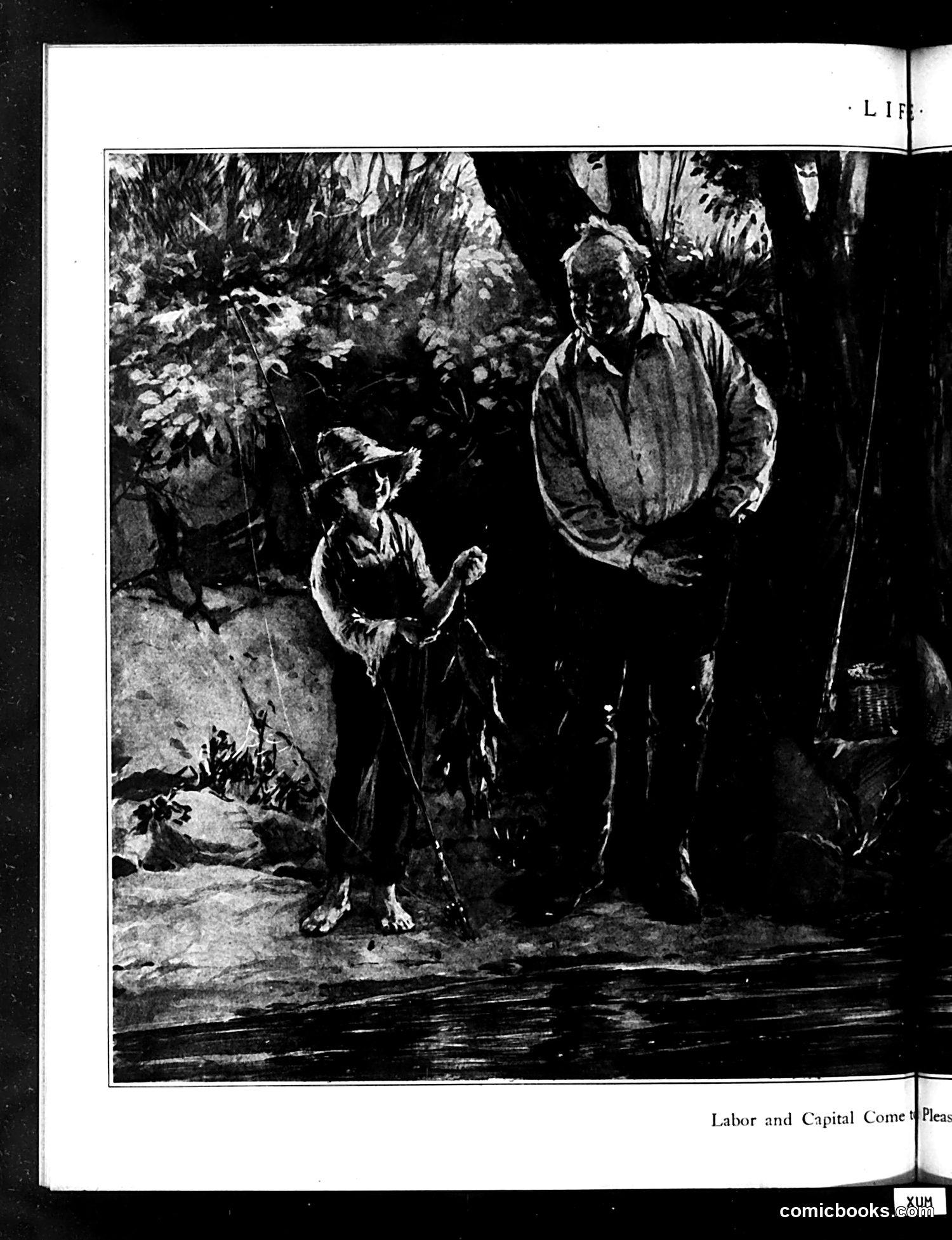
This page appears to be from Life magazine's satirical section. The visible caption reads "Labor and Capital Come t[o] Pleas[e]" (likely "Come Together" or similar, with text cut off). The black and white illustration depicts two figures by a riverbank in a wooded setting: a smaller figure wearing a hat (likely representing "Labor," a worker) and a larger, rotund figure (likely representing "Capital," or wealthy business interests). The composition and their relative sizes suggest a commentary on the power imbalance between working people and wealthy industrialists—a common satirical theme during the Progressive Era. The specific joke or message remains unclear without the complete caption, but the imagery appears critical of labor-capital relations, positioning them as unequal parties attempting to reach agreement.
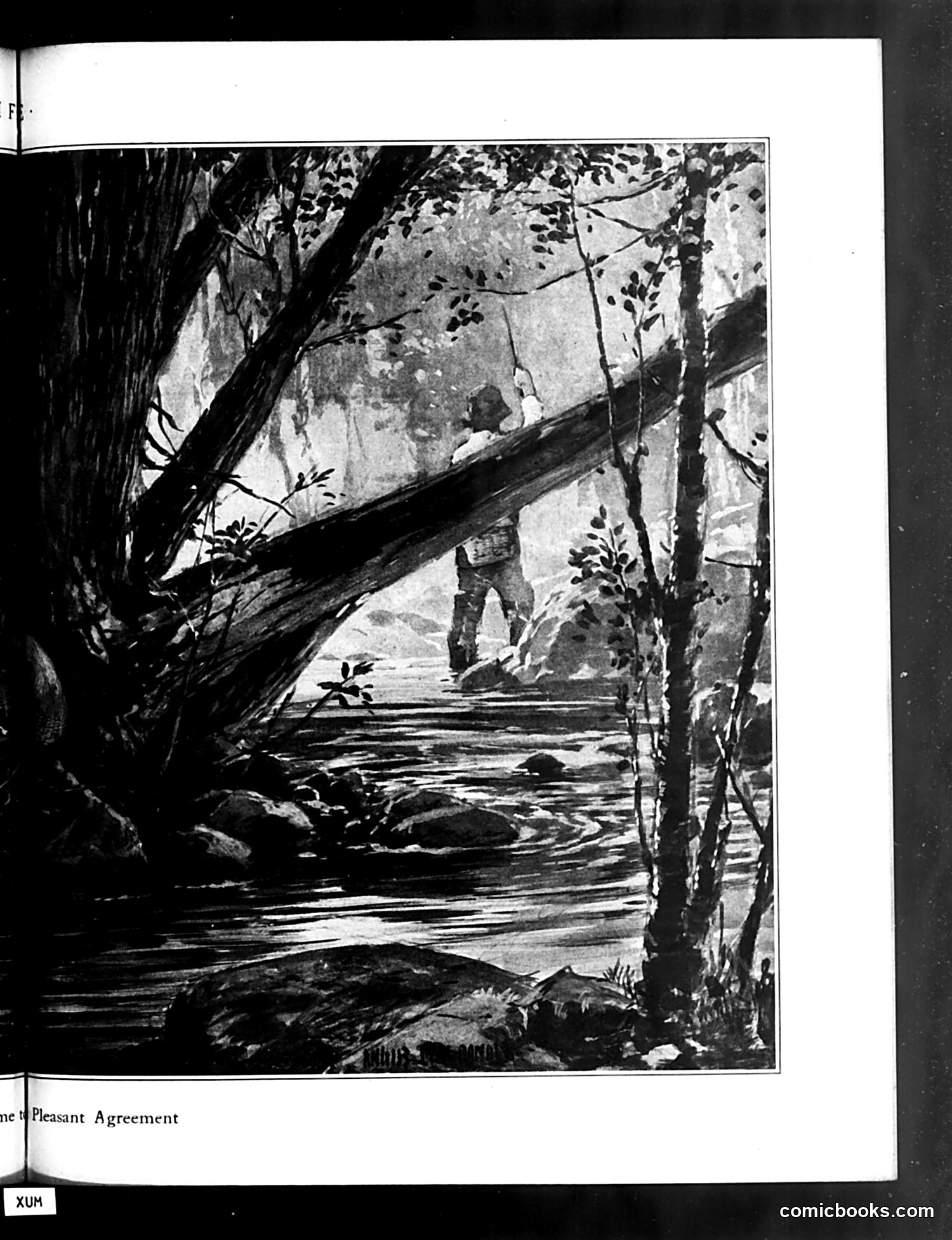
This appears to be an illustration from Life magazine showing a woodland stream scene. The caption reads "Pleasant Agreement," though the full context is unclear from this excerpt alone. The image depicts a naturalistic landscape with a stream, overhanging trees, and vegetation. A figure appears on a log or fallen tree above the water, while another figure stands in or near the stream below. The composition suggests a moment of encounter or agreement between two parties in a secluded natural setting. Without additional text or context from the magazine, I cannot definitively identify the specific political or social satire intended. The caption "Pleasant Agreement" is ambiguous—it could reference a political deal, social arrangement, or other contemporary matter, but I cannot specify what without risking inaccuracy.
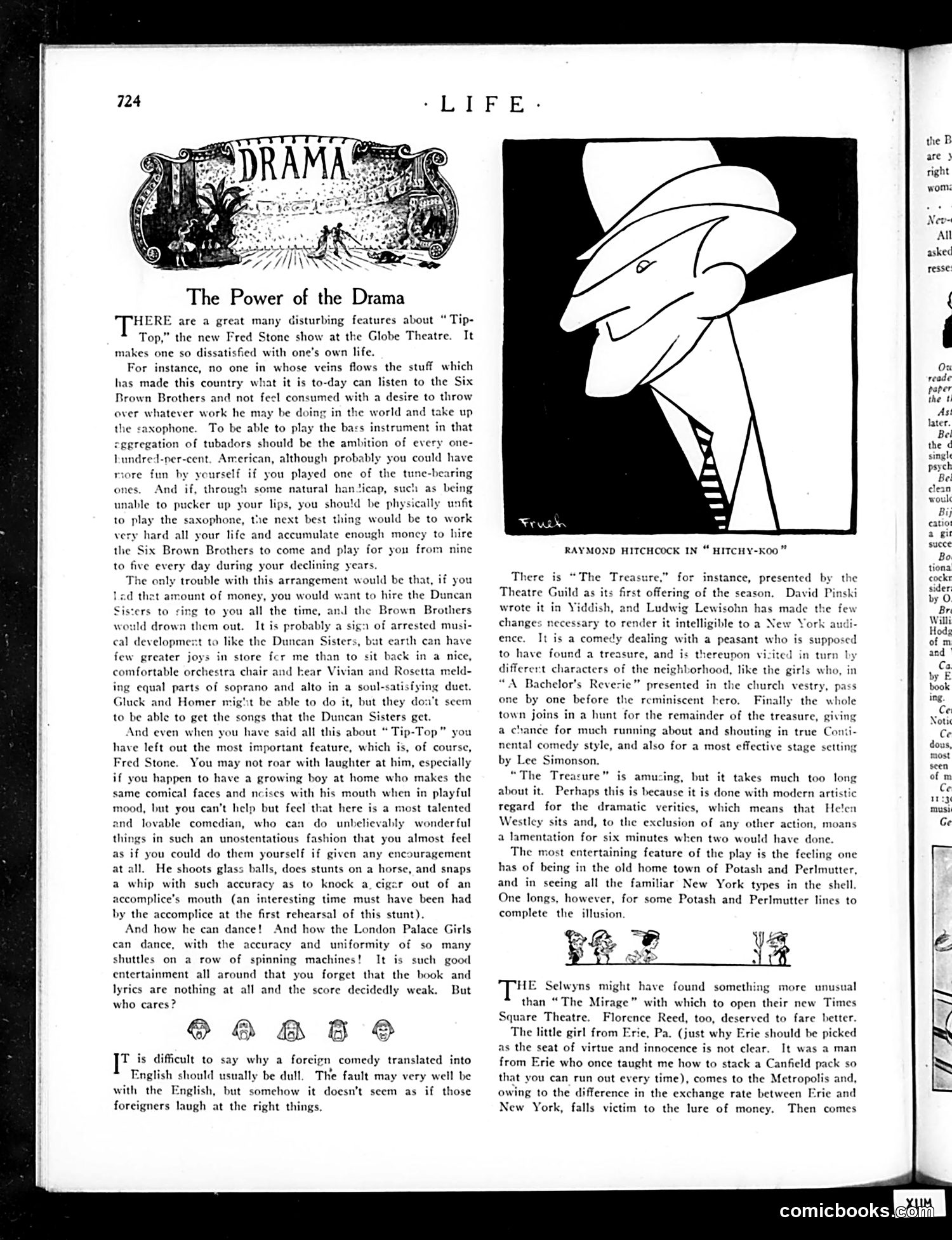
This page reviews Broadway theatrical productions, primarily Fred Stone's "Tip-Top" at the Globe Theatre. The accompanying caricature depicts **Raymond Hitchcock in "Hitchy-Koo,"** another contemporary stage show. The article's satire mocks how powerfully theater influences audiences' life choices. The author humorously argues that watching the Six Brown Brothers play saxophone makes one want to abandon real work to become a musician. Similarly, hearing the Duncan Sisters sing creates an irresistible desire to hire them for personal entertainment—an economically absurd fantasy. The piece celebrates Fred Stone as a genuinely talented comedian-performer whose physical comedy (shooting glass balls, horse stunts, whip-cracking) transcends weak book and lyrics, while praising the precision dancing of the "London Palace Girls." The page concludes discussing "The Treasure," a translated Yiddish play by David Pinski, suggesting foreign comedies often fail in English translation because "foreigners laugh at the right things"—a satirical jab at cultural differences in humor appreciation.
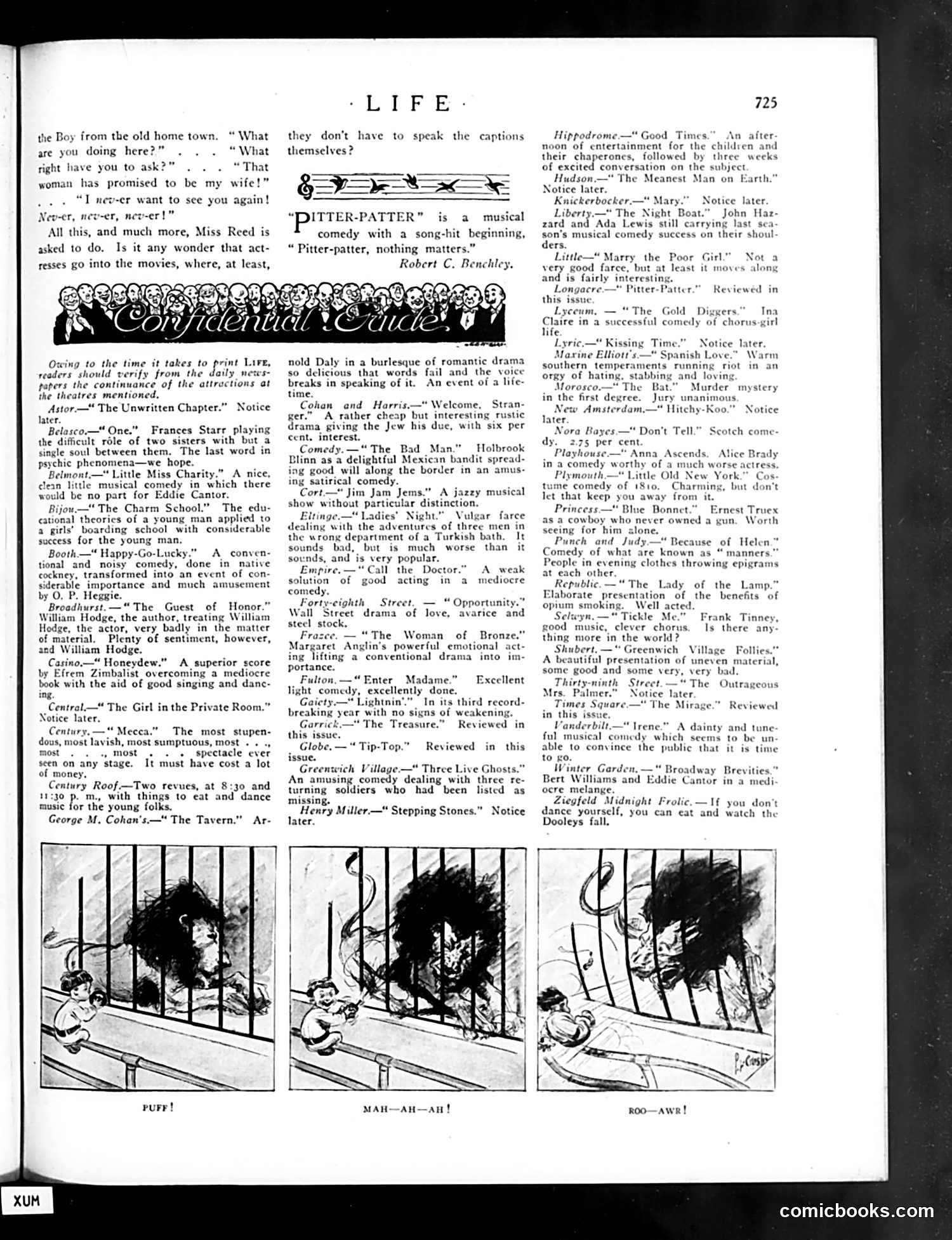
This is a theatrical review section from *Life* magazine (a satirical publication, not a news magazine). The page critiques Broadway shows currently running. **The Main Cartoon (bottom):** Three sequential panels show a child at a window with a lion behind bars. In each panel, the child makes different sounds ("PUFF!", "MAH-AH-AH!", "BOO-AW!") and the lion reacts with increasing agitation. This is wordless visual humor about provoking a dangerous animal—simple slapstick comedy about the consequences of taunting. **The Text's Point:** The opening section mocks stage actresses who must deliver melodramatic lines ("What are you doing here?" / "That woman has promised to be my wife!") while constrained by silent-film captions. *Life* sarcastically suggests actresses prefer working in movies where they don't have to speak such overwrought dialogue aloud. **The Reviews:** *Life* then catalogs Broadway productions with brief, witty assessments—praising some (Arnold Daly's burlesque), mocking others (calling a farce "sounds bad, but is much worse than it sounds"). The page reflects early 1920s theater culture and the emerging film industry's competition with live theater.
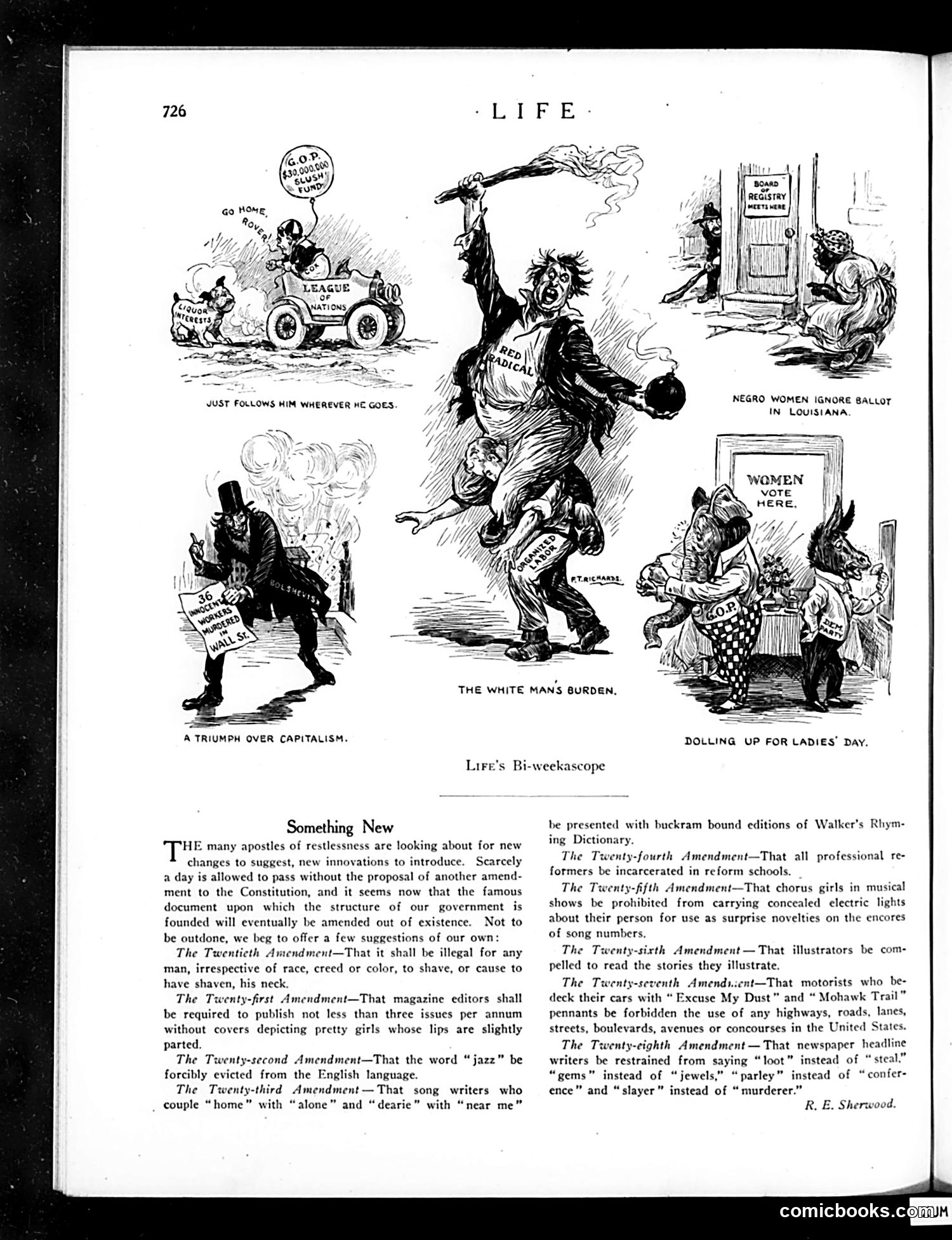
This page satirizes contemporary social issues through "Life's Bi-weekascope" cartoons: **"The White Man's Burden"** references Kipling's imperialist poem, here mocking progressive reformers as chaotic agitators disrupting society with constant constitutional amendments. **"Negro Women Ignore Ballot in Louisiana"** depicts Black women dismissing voting rights, sarcastically commenting on Southern resistance to Black suffrage. **"A Triumph Over Capitalism"** shows a wealthy man fleeing labor activists—satirizing either socialist movements or capitalist anxieties. **"Dolling Up for Ladies' Day"** mocks women's suffrage supporters. The accompanying text humorously proposes absurd constitutional amendments (banning certain hairstyles, words like "jazz," sentimental songs) to satirize what the magazine views as excessive amendment-mongering and social meddling. The cartoons reflect Life's skepticism toward progressive reform movements of the era, using crude racial imagery typical of the period.
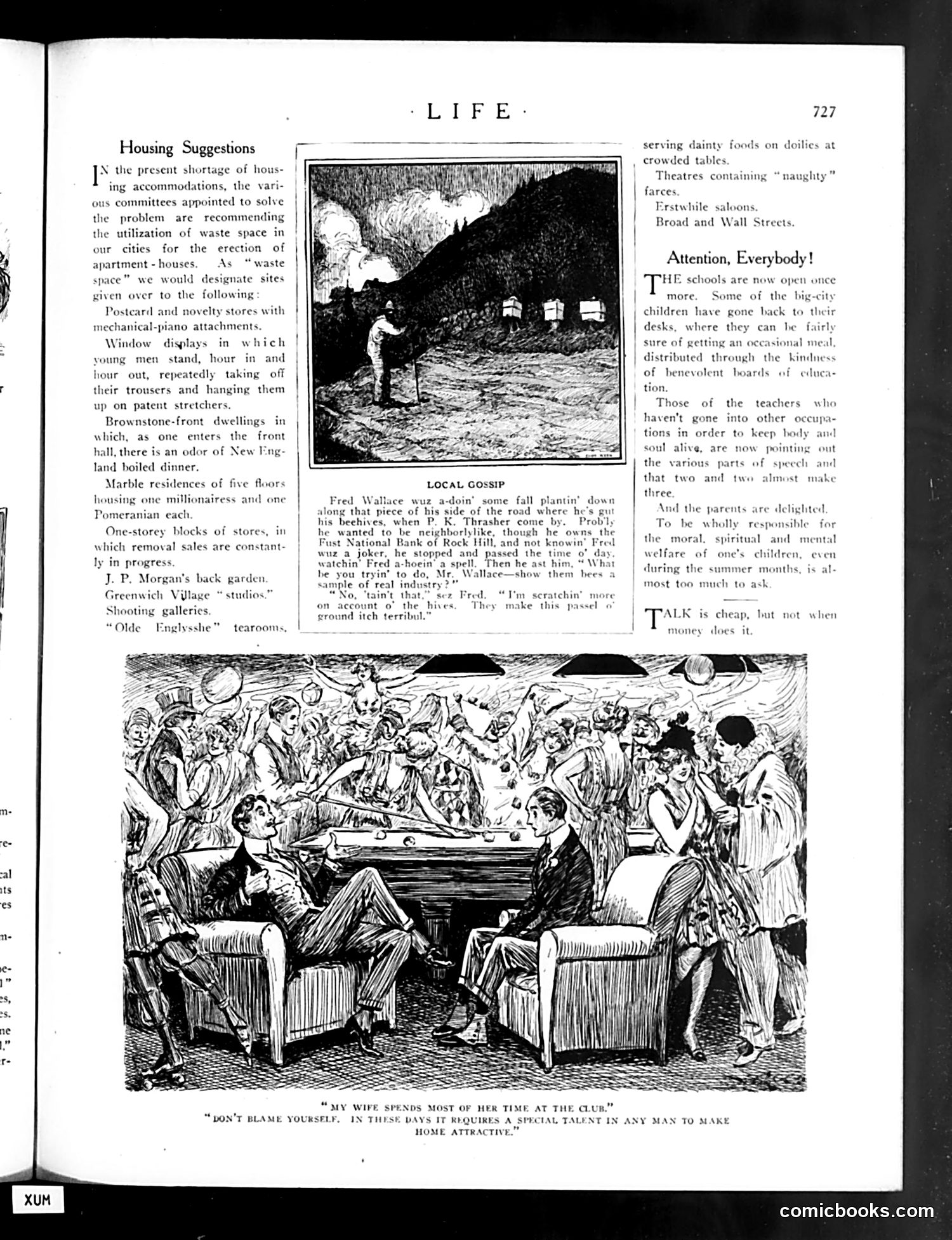
This page contains **two distinct satirical pieces**: ## Top Section: "Housing Suggestions" A humorous response to post-WWI housing shortage. The text proposes converting "waste spaces" in cities into apartments, then ridicules the suggestion by listing absurd "waste spaces": novelty stores, window displays of men repeatedly removing/hanging trousers, brownstone tenements, millionaires' marble homes with single dogs, and closing-sale storefronts. The satire mocks both the housing crisis and the impracticality of proposed solutions. ## Bottom Section: Two Cartoons **"Local Gossip"**: A rural anecdote where banker P.K. Thrasher observes farmer Fred Wallace planting near his beehives. Fred jokes he's "scratching" the ground to prevent bees from ground itch—obvious nonsense that fools the earnest banker. **Main Cartoon**: Depicts a husband complaining his wife spends all her time at "the club" while he sits surrounded by raucous socialites. The caption sardonically notes making home attractive requires "special talent" when wives neglect domestic life for social clubs—social criticism of 1920s leisure culture and changing gender roles.
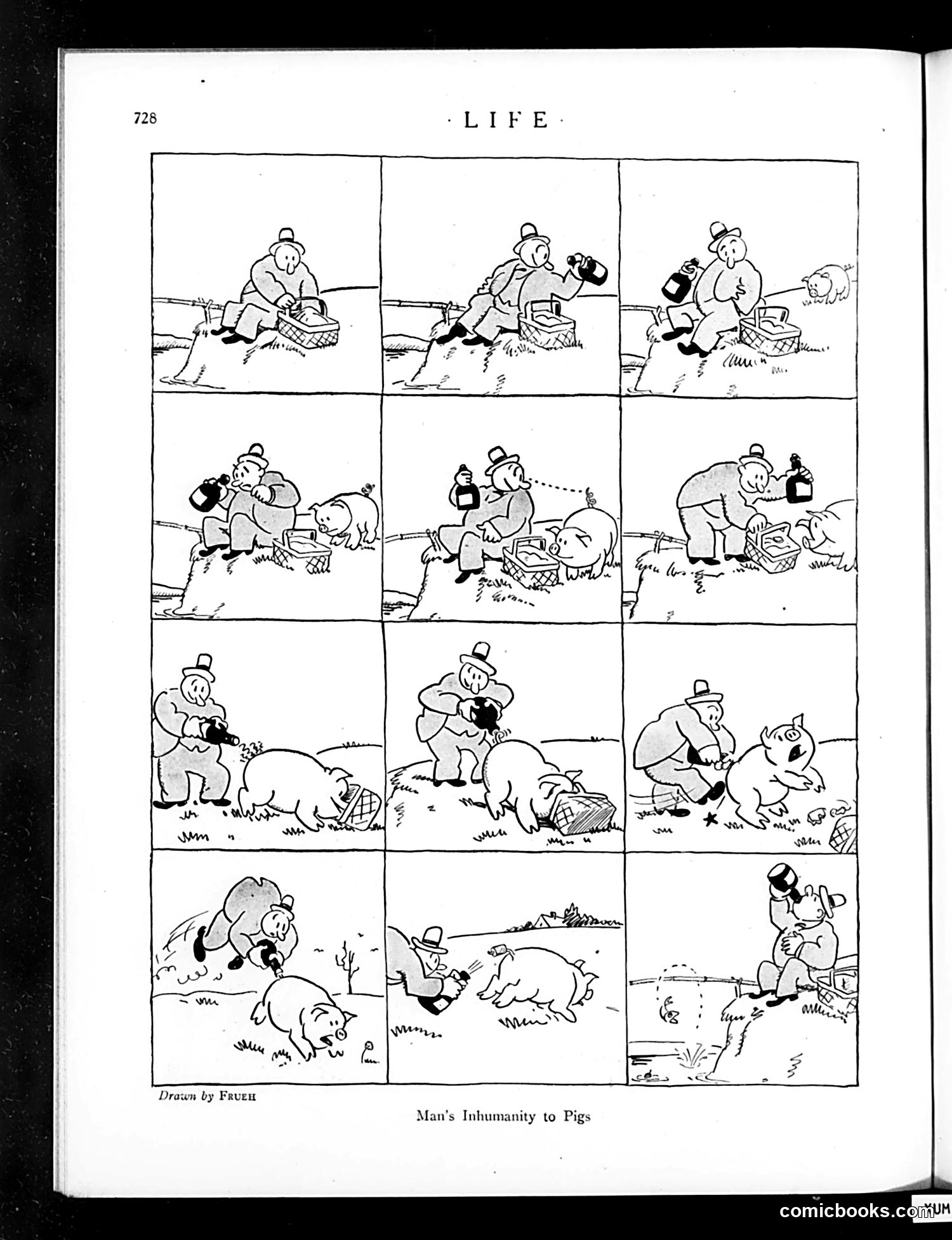
This is a twelve-panel satirical comic strip by cartoonist Frueh documenting cruel treatment of pigs. The narrative progresses from a farmer watering pigs, to feeding them, to increasingly harsh handling. The panels show the pigs being struck, dragged, and roughly managed by the farmer character (wearing a hat). The title is a play on the famous Robert Burns line "Man's inhumanity to man," but applies it to animal cruelty instead. The satire critiques farmers' brutal treatment of livestock, likely reflecting early 20th-century concerns about agricultural practices and animal welfare. By elevating pig mistreatment to the level of human moral failures, Frueh makes a pointed social commentary about ethical responsibility toward animals.
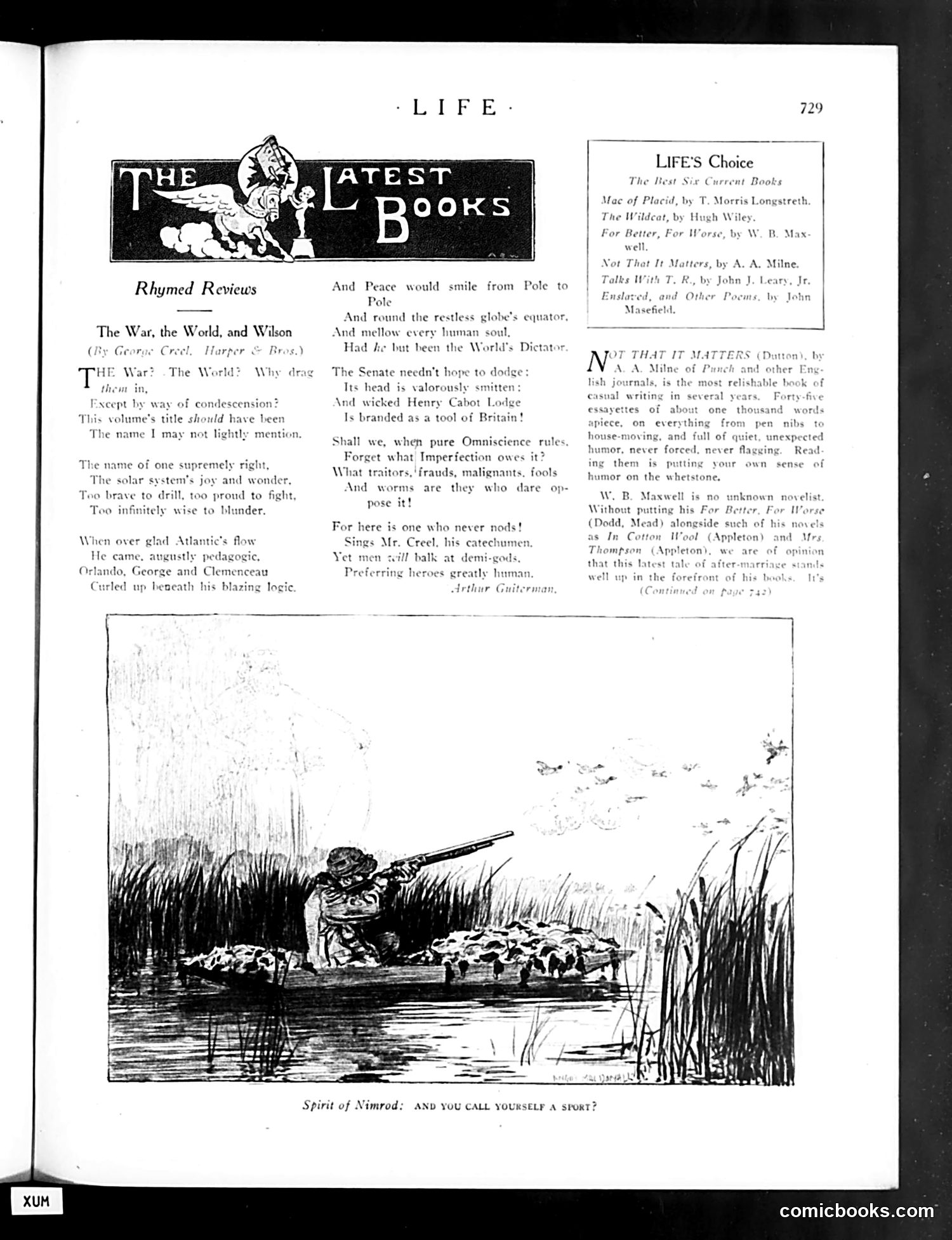
This page contains **book reviews in verse** rather than political cartoons. The main satirical content targets **President Woodrow Wilson** and his administration during WWI. The rhymed review mocks Wilson's idealistic rhetoric about ending war and bringing peace globally ("Had he but been the World's Dictator"). The satire suggests Wilson overestimates his own wisdom and importance, portraying him as self-righteous despite the messy realities of governance. References to "wicked Henry Cabot Lodge" (likely the Senator opposing Wilson's League of Nations) and "Mr. Creel" (George Creel, Wilson's propaganda chief) indicate this targets the administration's WWI policies and post-war diplomacy. The illustration below—captioned "Spirit of Nimrod: AND YOU CALL YOURSELF A SPORT?"—appears to show a hunter shooting waterfowl, likely satirizing poor sportsmanship or ethics, though its connection to the text above is unclear.
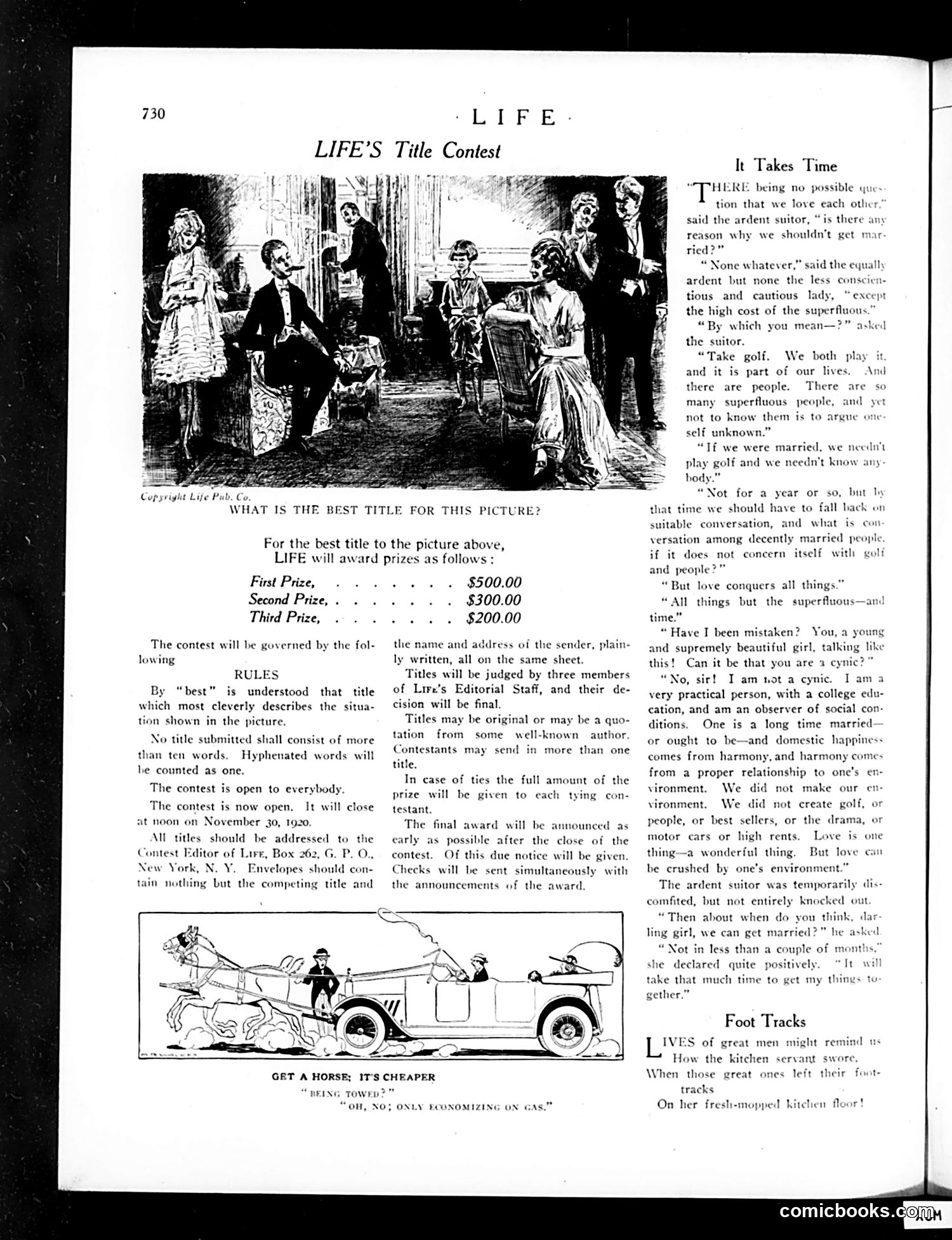
This page contains **two unrelated pieces**: a title-contest promotion and satirical fiction. ## Title Contest Life invites readers to caption the upper illustration—a domestic scene of well-dressed people in a parlor. The prizes ($500, $300, $200) indicate this was a popular reader-engagement strategy for magazines of the era. ## "It Takes Time" (Right Column) A satirical dialogue between an earnest suitor and a pragmatic young woman debating marriage. She argues that modern married couples need shared activities (golf) and conversation to maintain harmony. Her position—that love alone cannot sustain marriage without compatible environments and interests—reflects 1920s anxieties about companionate marriage versus romance. ## "Get a Horse; It's Cheaper" (Lower Cartoon) A visual joke about early automobiles: a car being towed is captioned with someone claiming they're "only economizing on gas." The humor satirizes the unexpected expense of car ownership versus traditional horses—a topical concern as automobiles became common but remained costly to operate. Both pieces reflect 1920s middle-class preoccupations: evolving courtship, marriage expectations, and technology's disruptive costs.
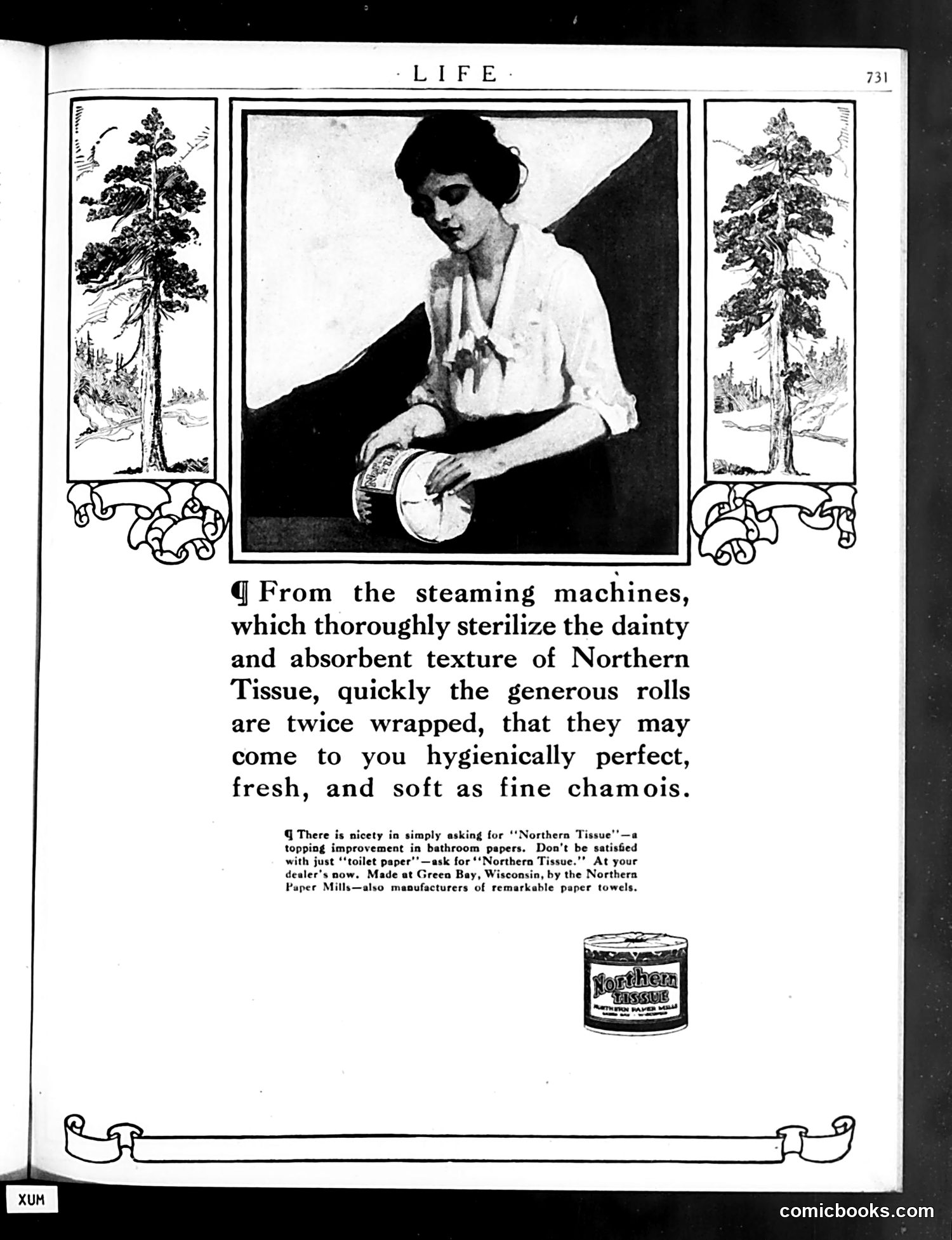
This is **advertising content**, not satire or political commentary. The page promotes Northern Tissue toilet paper through a product advertisement in *Life* magazine (page 731). The central image shows a woman examining a roll of tissue paper, emphasizing its quality and softness. The decorative pine tree illustrations flanking the photo reinforce the "natural" product messaging. The text emphasizes hygiene ("sterilized," "hygienically perfect") and luxury qualities ("soft as fine chamois"), positioning Northern Tissue as superior to generic "toilet paper." The ad instructs consumers to specifically request the brand by name at stores, suggesting a competitive market for bathroom tissue. This reflects early 20th-century advertising strategies that emphasized sanitation, brand differentiation, and consumer education—concepts that would have seemed novel to contemporary readers unfamiliar with branded household products.
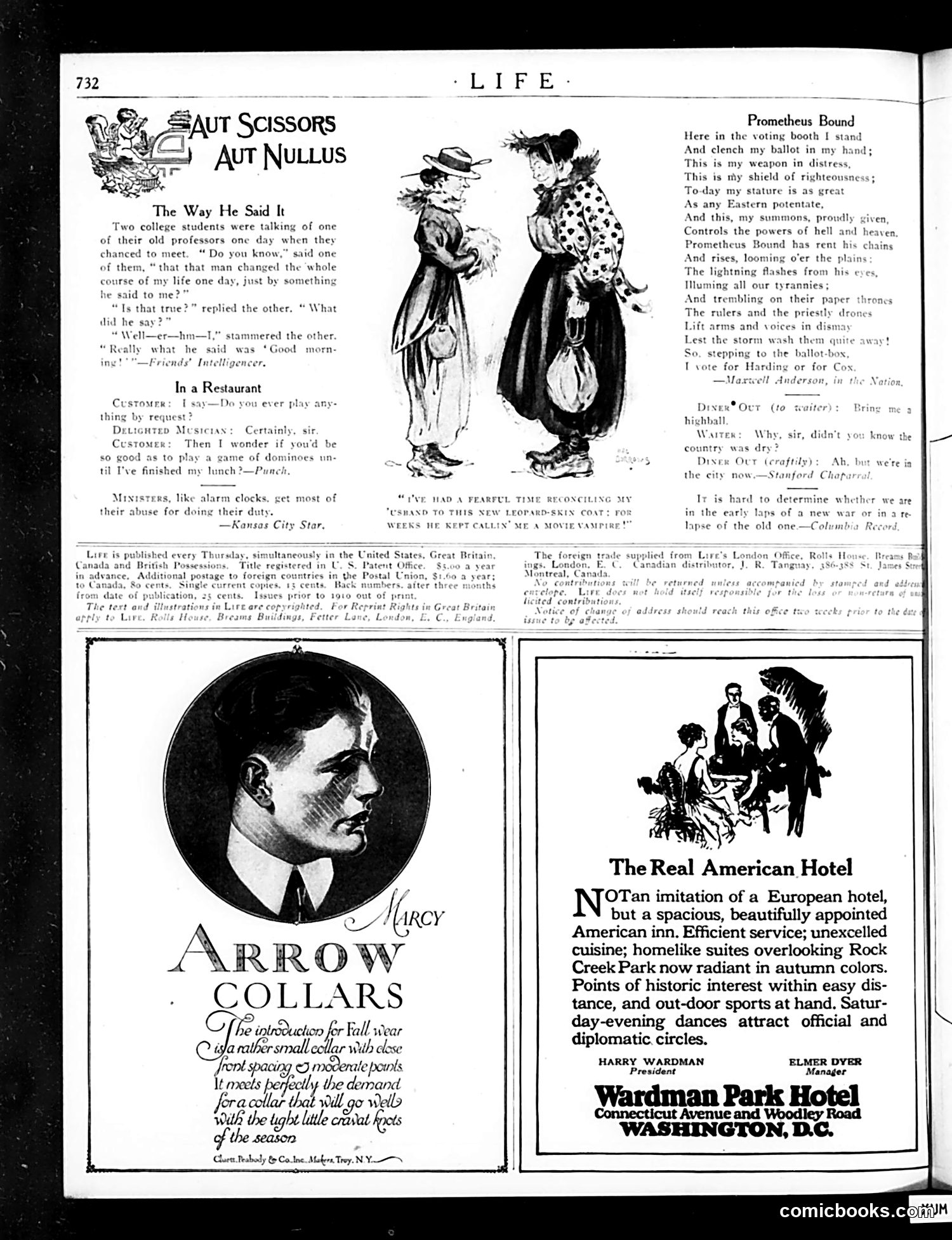
This page contains multiple satirical pieces typical of Life's format: **"Aut Scissors Aut Nullus" section:** Three brief humorous anecdotes mocking academic pomposity and social pretension. "The Way He Said It" jokes about a professor's influence; "In a Restaurant" satirizes musicians' complaints; "Ministers" compares clergy to alarm clocks for being criticized while performing their duty. **"Prometheus Bound" poem:** Appears to reference voting rights and democratic power, using classical mythology to elevate the voter's role. The reference to "Harding or Cox" (visible in text) dates this to the 1920 presidential election, suggesting the poem celebrates the ballot as a weapon against tyranny. **"Diver Out" dialogue:** A brief exchange about whether the country was "dry"—referencing Prohibition, which began in 1920. **Advertisements:** The page includes ads for Arrow Collars and the Wardman Park Hotel in Washington, D.C., typical of the magazine's commercial content. The overall tone mixes gentle social satire with patriotic sentiment about democratic participation.
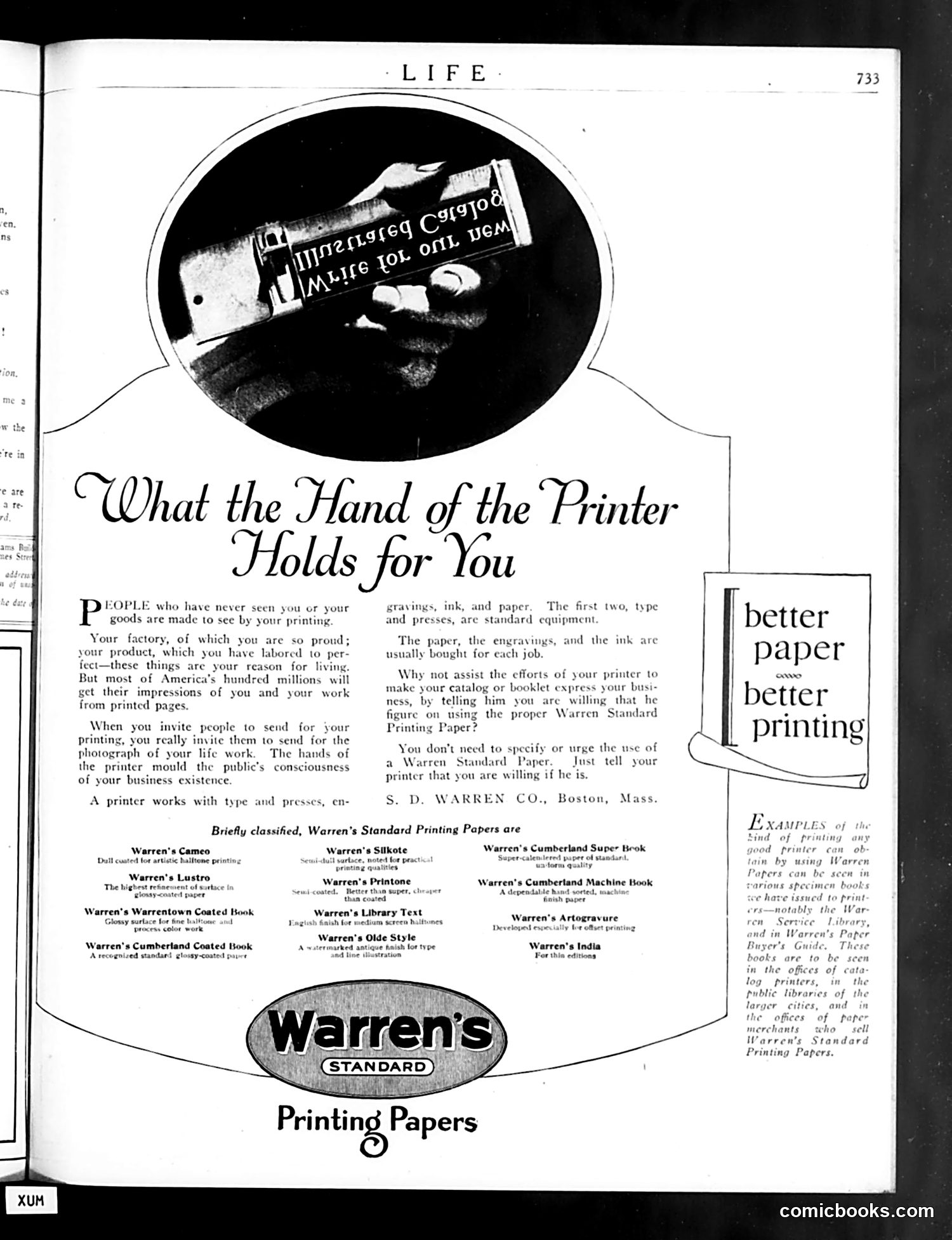
This is **not a political cartoon or satire**, but rather a **full-page advertisement** for Warren's Standard Printing Papers, disguised as editorial content in the style of *Life* magazine. The circular photograph at top shows a hand holding a printed product—visual evidence of the printer's craft. The headline "What the Hand of the Printer Holds for You" uses emotional, almost poetic language to argue that a business's reputation depends entirely on printed materials. The copy makes a rhetorical pitch: business owners should specify Warren paper to their printers because quality printing enhances their brand image. The list of paper types (Cameo, Silkote, Cumberland, etc.) suggests specialized products for different printing needs. For modern readers, this illustrates how early 20th-century advertising blurred the line between journalism and marketing—*Life* sold ad space that mimicked the magazine's own design and tone, making paid promotion appear as editorial endorsement. The appeal to vanity ("your reason for living") and consumer psychology ("mould the public's consciousness") reveals period advertising strategy.
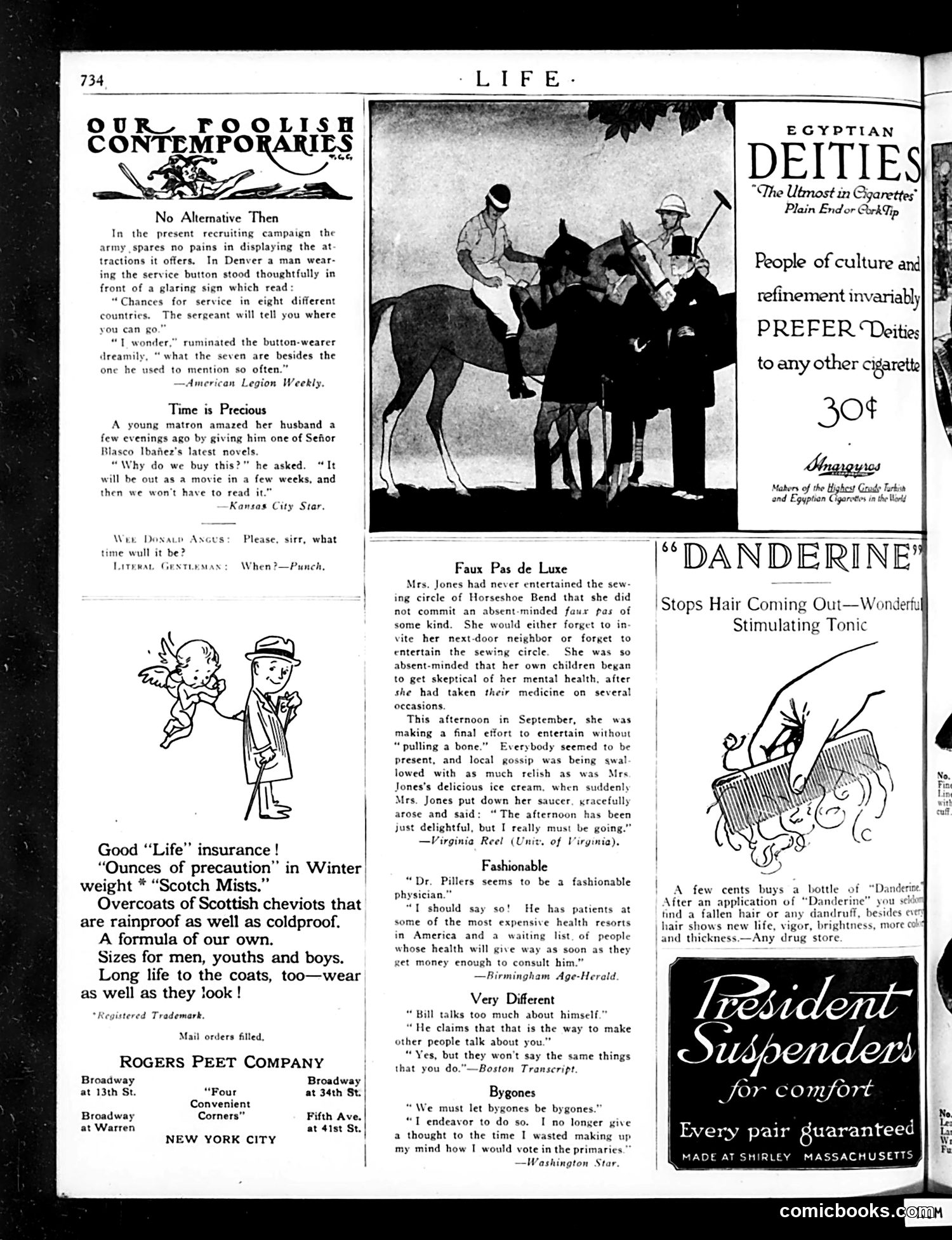
This page from *Life* magazine (likely 1920s) contains several brief satirical pieces and advertisements: **"No Alternative Then"** jokes about Army recruitment advertising "eight different countries" for service—a veiled reference to WWI, where soldiers were sent to various theaters. A veteran wonders what the "seven" other countries are besides the one (presumably France) traditionally mentioned. **"Time is Precious"** satirizes modern entertainment culture: a husband questions buying a novel since it will soon become a movie, making reading unnecessary. **"Faux Pas de Luxe"** tells of an absent-minded hostess (Mrs. Jones) who repeatedly forgets social obligations, highlighting period anxieties about women's mental competence. The remaining pieces ("Very Different," "Fashionable," "Bygones") are standard joke columns typical of *Life's* humor format. The advertisements—for Rogers Peet overcoats, Egyptian Deities cigarettes, Danderine hair tonic, and President Suspenders—reflect period consumer culture.
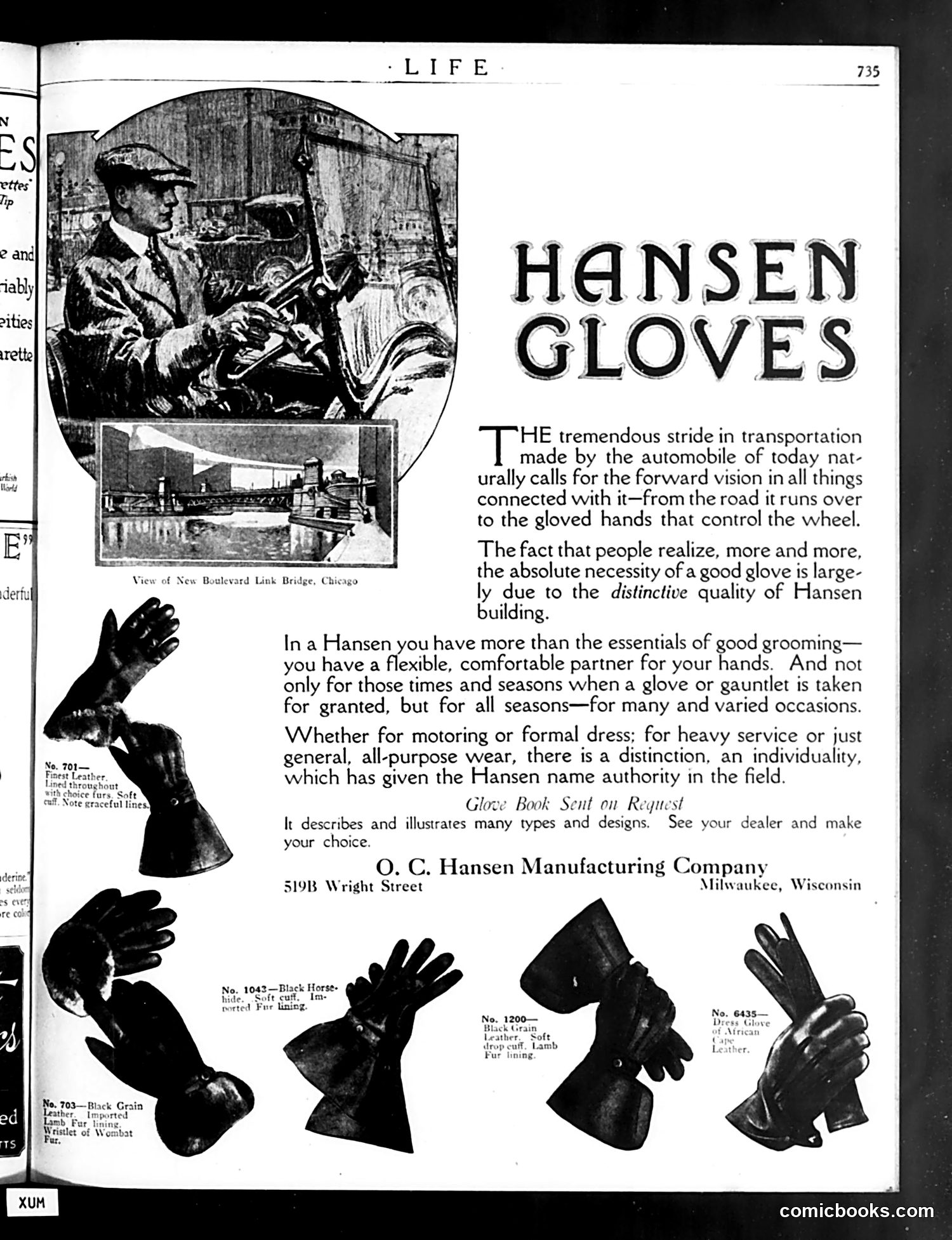
This is a **product advertisement**, not a political cartoon. The page promotes Hansen Gloves, manufactured in Milwaukee, Wisconsin. The content connects glove-wearing to the early automobile era—positioning quality gloves as essential safety equipment for drivers controlling steering wheels. The imagery shows various glove styles (formal wear, motoring gloves, work gloves) and includes a photograph of a man at an automobile's wheel. The appeal is to modernity and forward-thinking: just as automobiles represent progress in transportation, Hansen gloves represent progress in personal grooming and practical automotive safety. There is no satire or political commentary. This is straightforward commercial advertising from the early automotive age, emphasizing that quality gloves are necessary accessories for the modern motorist.
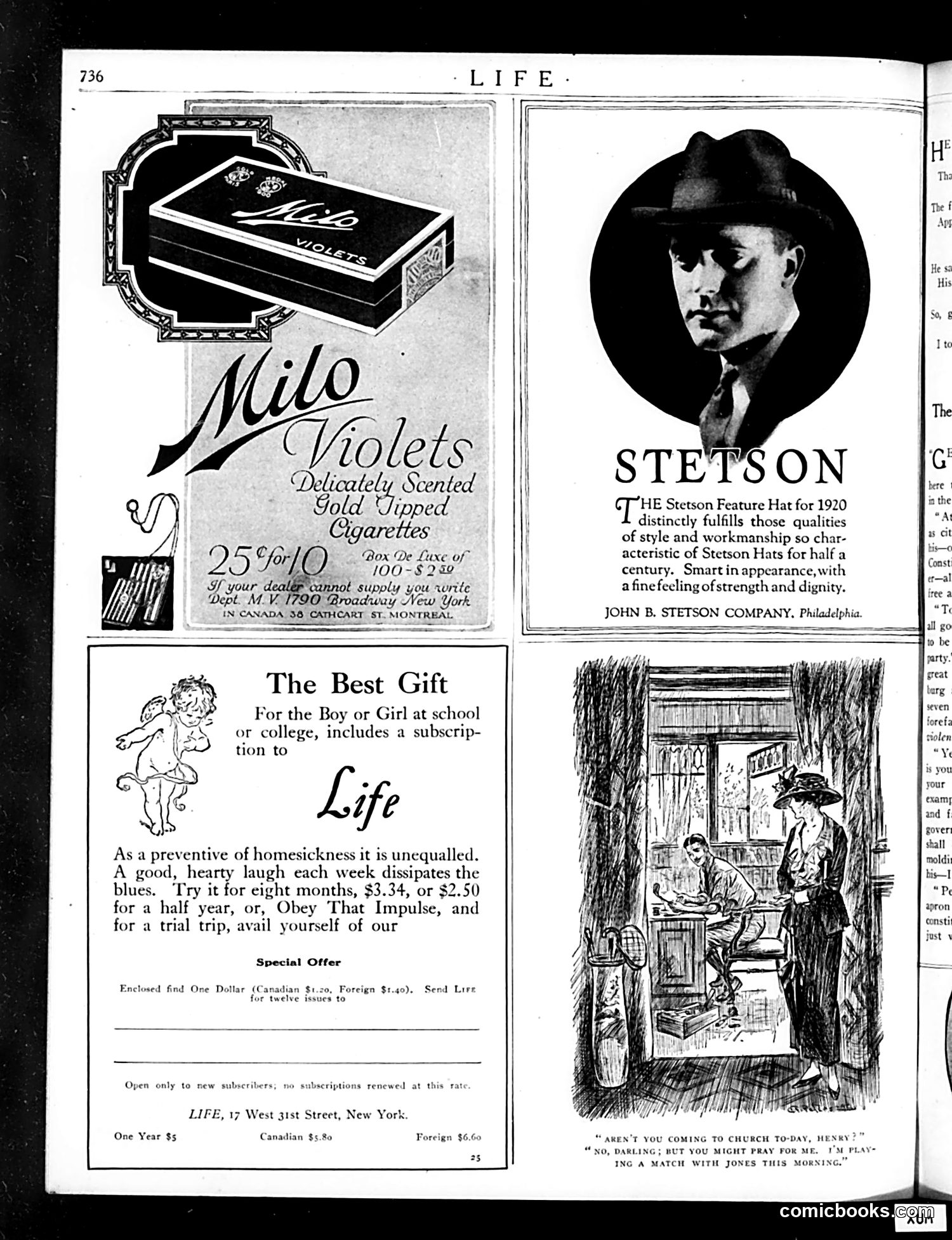
This page contains **four separate advertisements and one cartoon**, not political satire. **Advertisements:** Milo Violets cigarettes (25 for 10 cents), a Stetson hat for 1920, and a Life magazine subscription pitch emphasizing it prevents homesickness for students away at school. **The Cartoon (bottom right):** Shows a domestic scene where a wife asks her husband if he's attending church. He declines, saying he's playing a golf match with Jones instead, but offers to have her pray for him. **The Joke:** This is gentle social satire about **priorities and male leisure activities**—the husband values his golf game over religious observance, a common theme in early 20th-century humor about middle-class masculinity. The cartoon gently mocks how men justified prioritizing sports/recreation while their wives maintained religious duties. It reflects 1920s attitudes about gender roles and the growing popularity of golf as a status activity among men.
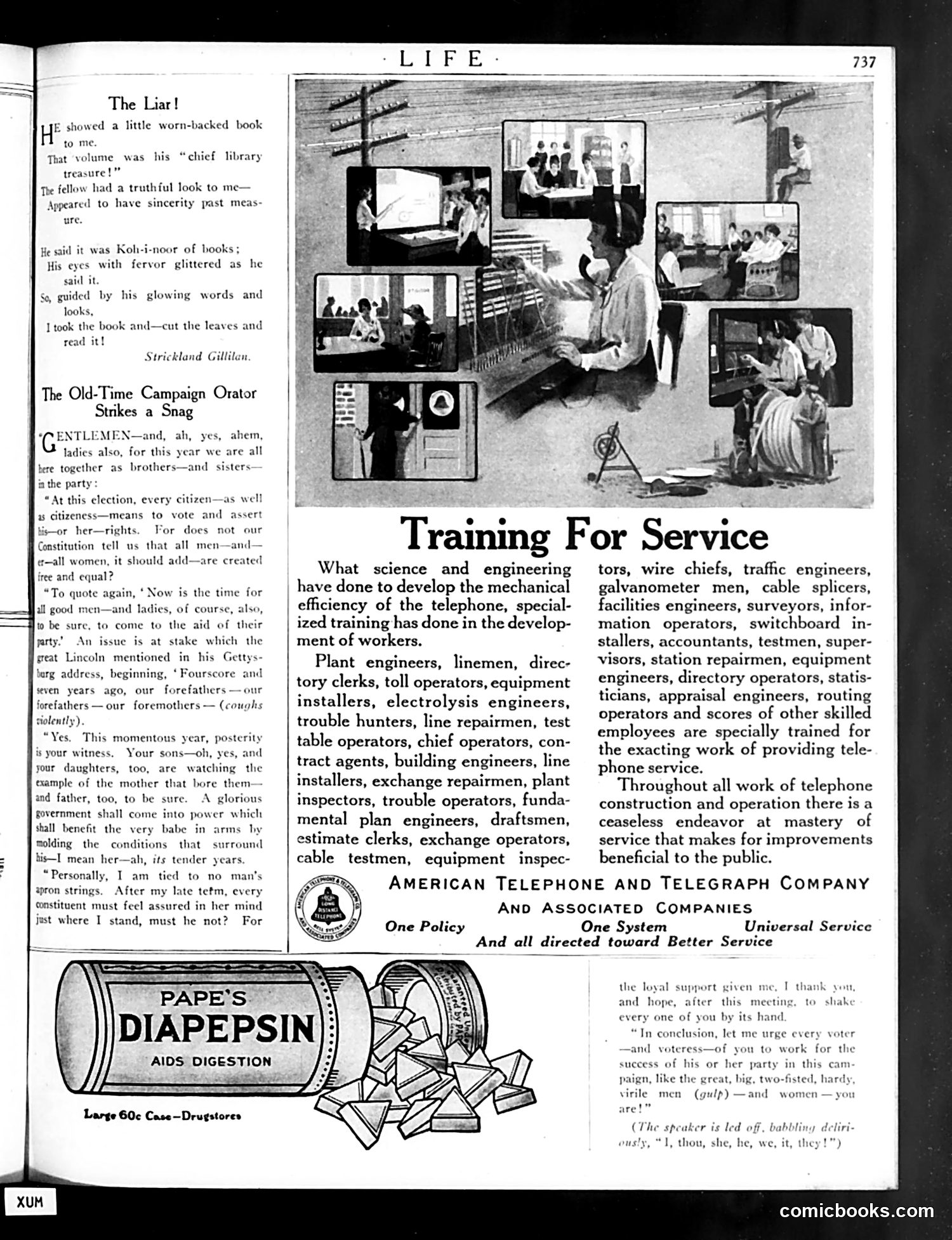
This page contains three distinct pieces: **"The Liar!"** (top left): A short satirical poem by Strickland Gillilan mocking someone who recommended a book as his "chief library treasure" with great enthusiasm, only for the narrator to discover upon reading it that the recommendation was false. The joke targets pretentious book recommendations. **"The Old-Time Campaign Orator Strikes a Snag"** (center): Satire of verbose political speechmaking. An old-fashioned campaign speaker delivers grandiose rhetoric about citizenship, rights, and the Constitution, repeatedly stumbling over gender-inclusive language ("men—and—ladies," "brothers—and sisters," "his—I mean her—ah, its tender years"). The humor mocks both the speaker's inability to modernize his rhetoric for women voters and his empty political bombast generally. **"Training For Service"** (right): AT&T company advertisement celebrating specialized worker training in telephone infrastructure—not satire, but earnest corporate promotion of workforce development. The page emphasizes period concerns about authenticity in communication and evolving social conventions around gender inclusivity in public discourse.
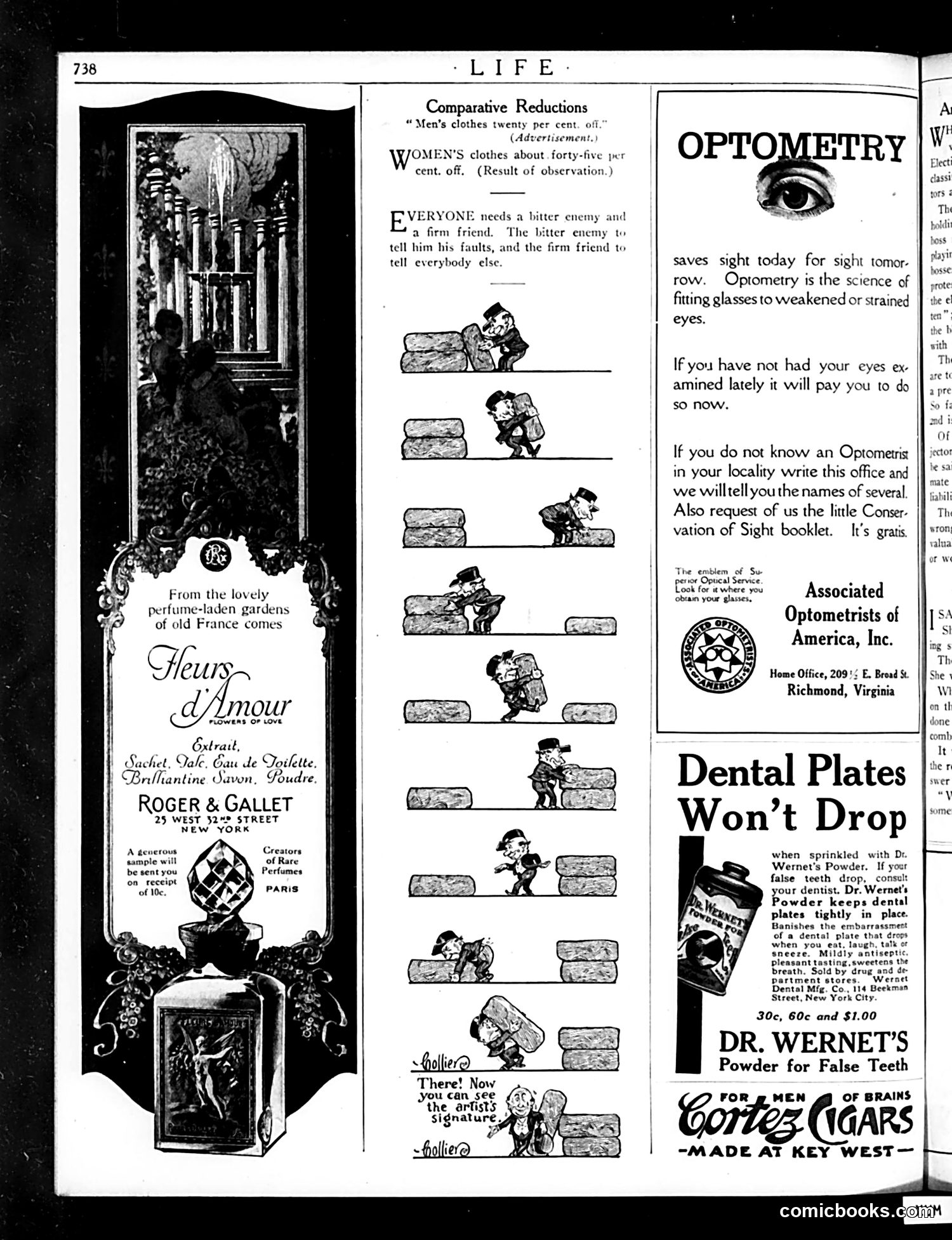
This page is primarily **advertising and commercial content**, not political satire. The main visual elements are ads for French perfume ("Fleurs d'Amour" by Roger & Gallet) and various products (optometry services, dental plates, cigars). The only satirical content is the small "Comparative Reductions" cartoon in the upper middle, which makes a social observation: men's clothes are advertised as 20% off, but women's clothes are actually 45% off. The accompanying text defines wit as "a bitter enemy and a firm friend"—the bitter enemy points out your faults privately; the firm friend tells everyone else publicly. This is gentle social humor, not political satire, joking about gendered shopping practices and how gossip spreads. The rest of the page consists of period advertisements for personal grooming and health products.
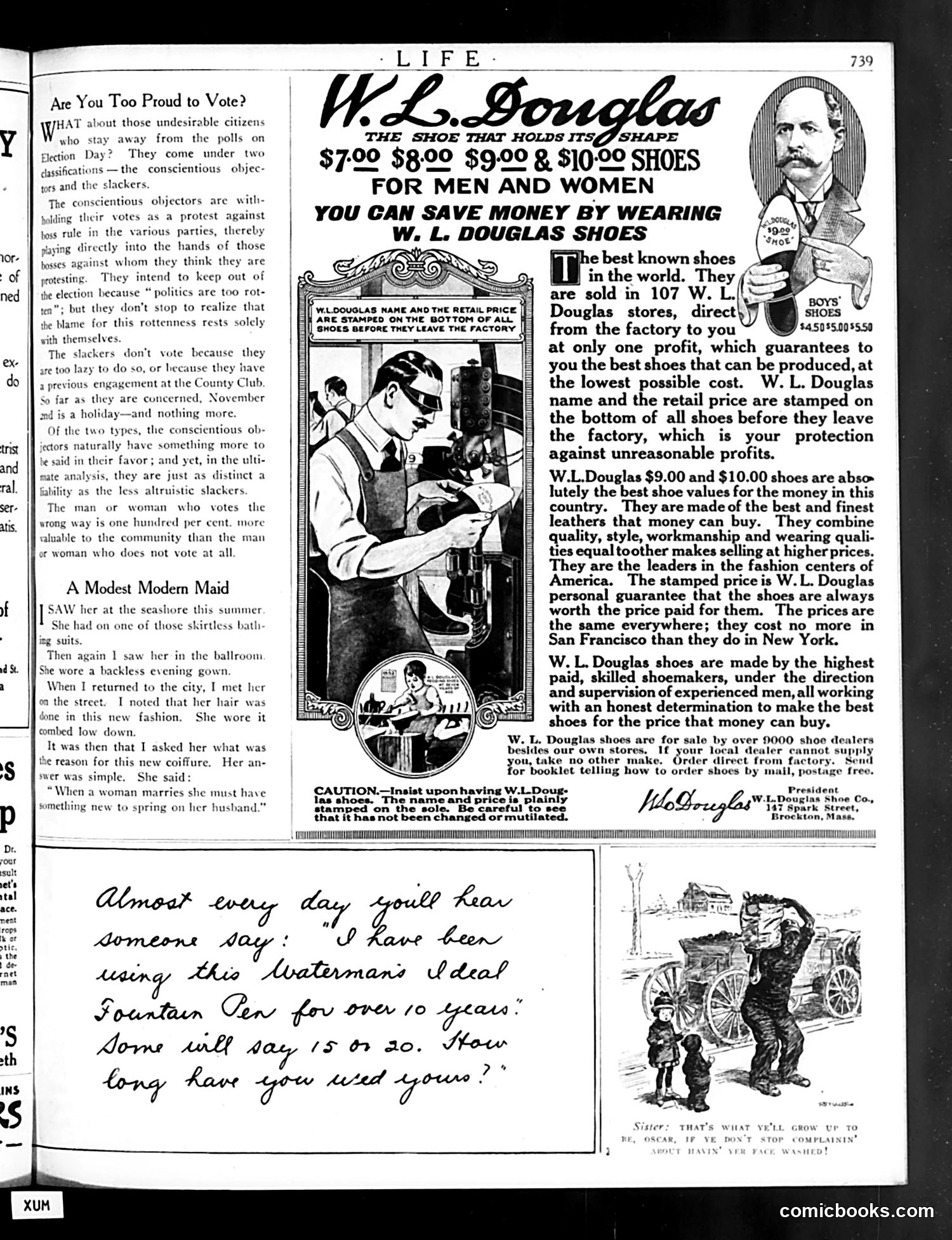
This Life magazine page critiques two types of non-voters in what appears to be an early 20th-century American election cycle. The article "Are You Too Proud to Vote?" distinguishes between "conscientious objectors" (idealistic protesters who boycott elections due to political corruption) and "slackers" (the lazily indifferent who simply neglect voting). The satire targets both groups as equally irresponsible: the objectors paradoxically enable the corruption they protest by abstaining, while slackers shirk civic duty entirely. The piece argues that even a "wrong" vote demonstrates more community value than non-participation. The surrounding content—including a humorous anecdote about a woman's changing fashion and a W.L. Douglas shoe advertisement—appears incidental to the main political message, which reflects Progressive Era concerns about voter apathy and civic engagement during a period of heightened debate about voting rights and political reform.
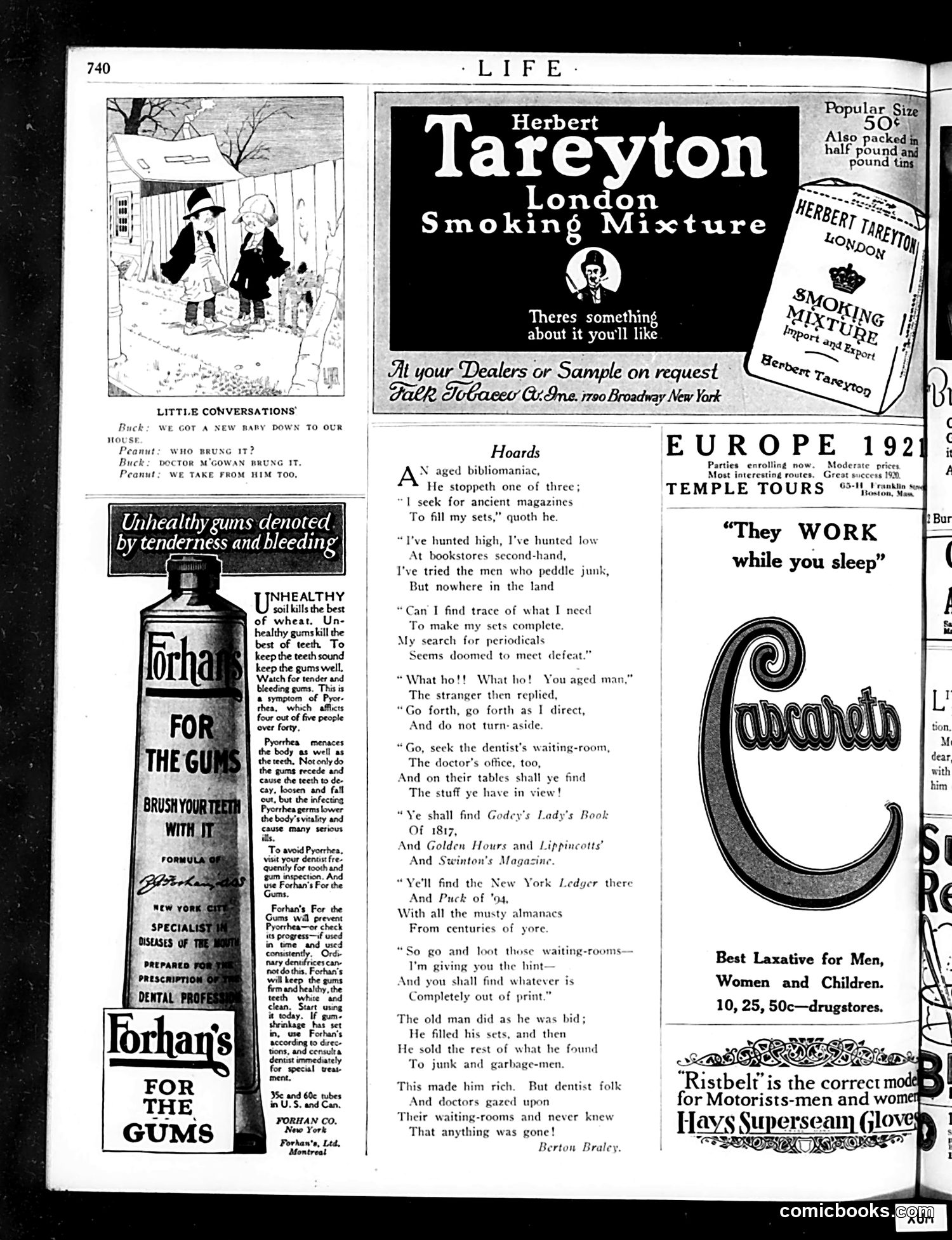
This page is primarily **advertisements and light satirical content** rather than political commentary. The cartoon "Little Conversations" shows children discussing a doctor delivering a baby—innocent humor about children's misunderstandings of adult situations. "Hoards" is a humorous poem by Berton Braley satirizing magazine hoarders. An elderly collector obsessively seeks rare old magazines to complete his collection. A mysterious stranger directs him to dental and doctor waiting rooms—where such outdated publications accumulate. The joke: the man raids these waiting rooms for old *Godey's Lady's Book*, *Puck*, and *Lippincott's*, then sells the haul to junk dealers. The irony is that professionals never notice the magazines vanishing. The remaining content is **commercial advertising**: Forhan's gum treatment (addressing pyorrhea/tooth decay concerns), Tareyton tobacco, Tabarroth laxative, and Hays gloves. This reflects early 1920s consumer culture and period anxieties about dental health.
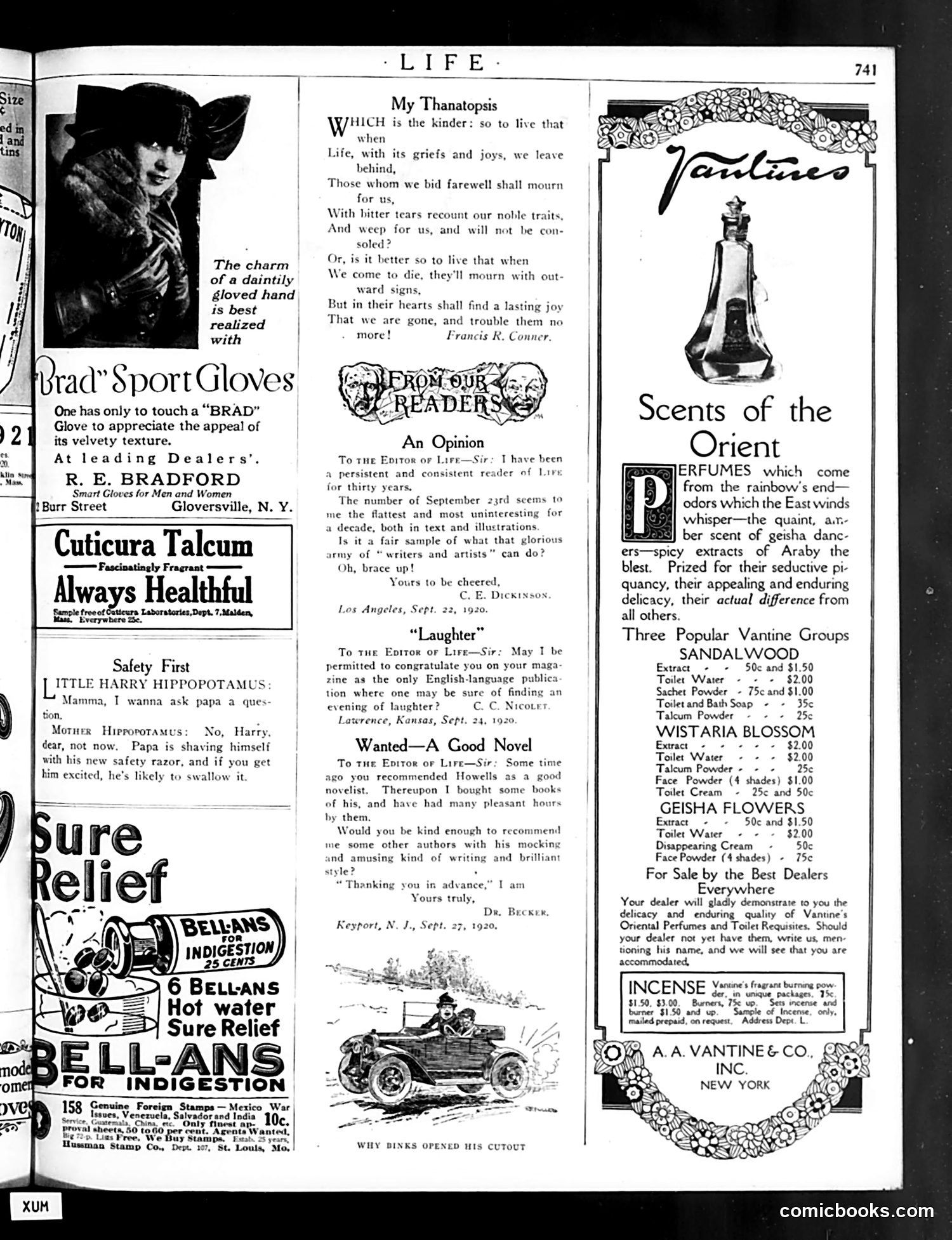
This page is primarily **advertising and readers' letters**, not political satire. The main cartoon shows a man in a car with his "cutout" (muffler valve) open—a reference to young men illegally removing car mufflers to create noise. The caption "WHY BINKS OPENED HIS CUTOUT" appears to be humorous commentary on this common 1920s practice. The "Safety First" joke depicts a child asking his father a question while the father shaves with a new safety razor, joking that excitement might cause him to swallow it—dark humor about accident risks. The readers' letters discuss *Life* magazine's quality, recommend authors like Howells, and praise it as a reliable source of humor during the 1920 period. The remaining content is product advertising for luxury items: Brad Sport Gloves, Cuticura Talcum, Bellans indigestion relief, and Vantine's Oriental perfumes and incense. This reflects the magazine's target audience of middle-to-upper-class readers.
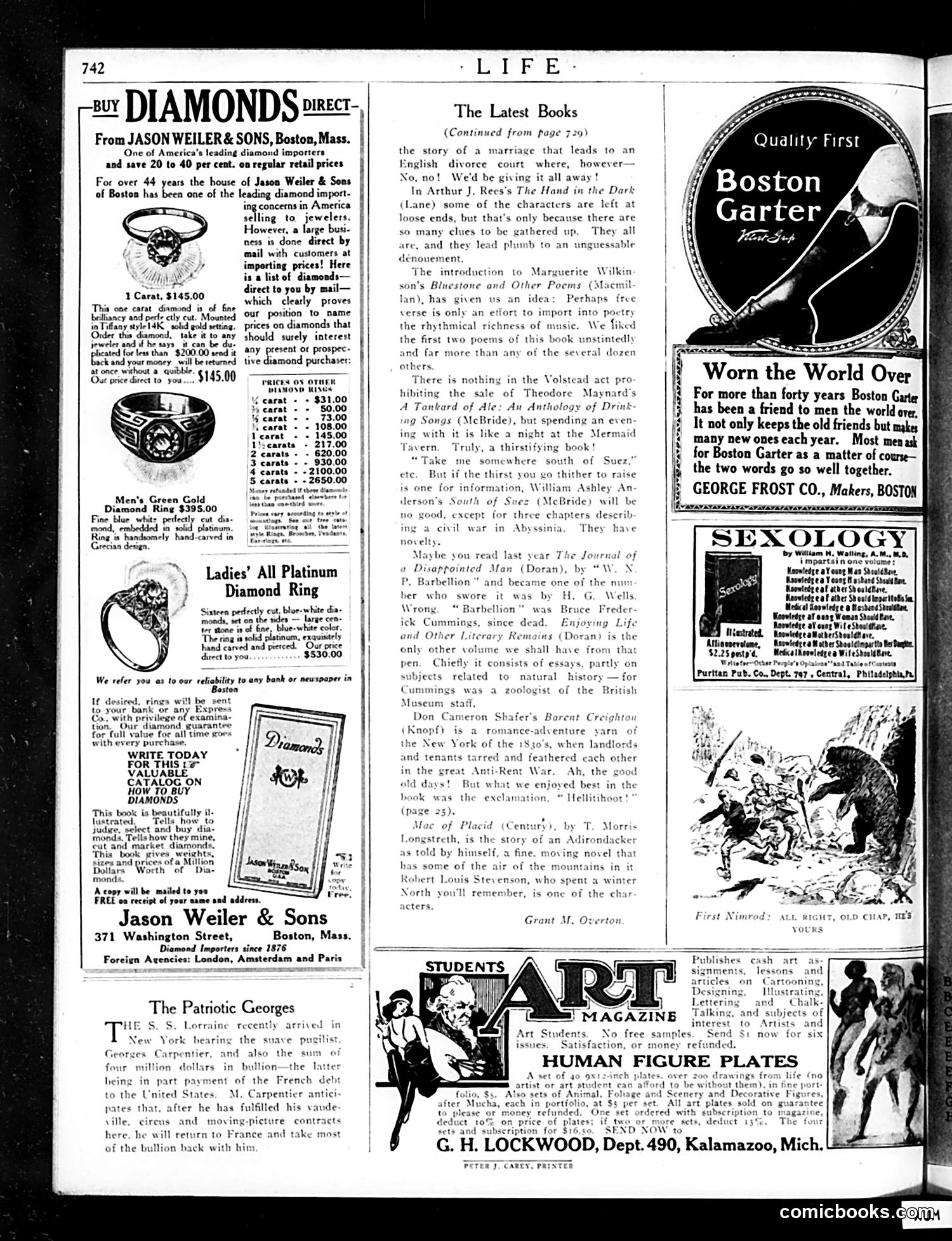
This page is primarily **commercial advertising**, not satirical content. It features diamond ring advertisements from Jason Weiler & Sons and Boston Garter (men's garters), along with a book review section. The only illustration with potential satirical intent is a small cartoon accompanying the "Students Art Magazine" advertisement at bottom right, showing what appears to be **figure-drawing instruction** — likely a humorous reference to life-drawing classes common in art education. The cartoon's exact meaning is unclear without clearer visibility. The "Patriotic Georges" text fragment mentions S. Lorraine Guitry arriving in New York with French bullion, referencing **post-WWI financial recovery** — a topical reference for the 1920s. Otherwise, this is a standard magazine page mixing literary reviews and consumer product advertising typical of Life's era. No clear political satire is evident.
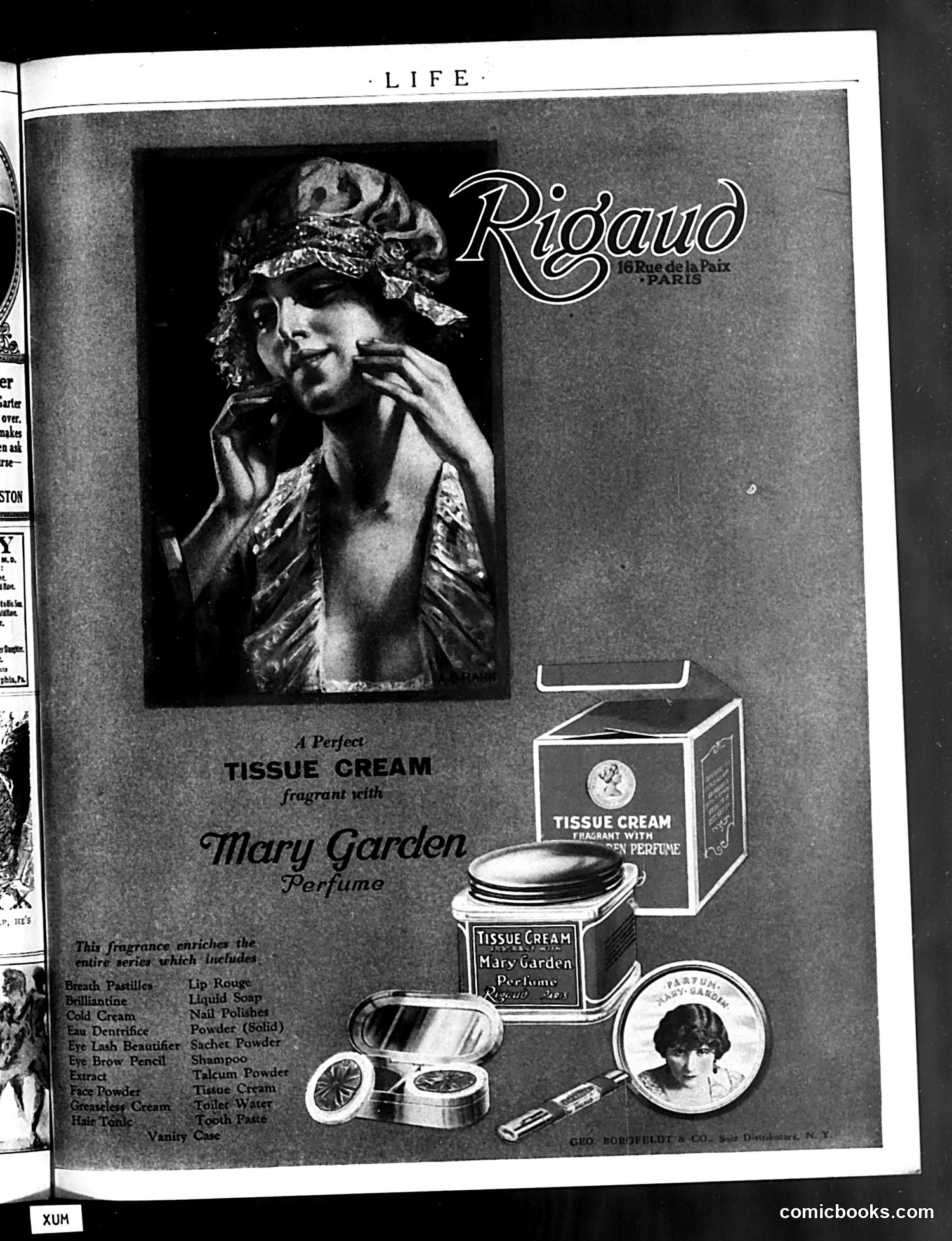
This is primarily a **cosmetics advertisement**, not political satire. It promotes Rigaud's "Tissue Cream" fragmented with Mary Garden Perfume, a Paris-based beauty brand. The page features a glamorous photograph of a woman in theatrical costume (headwrap, dramatic makeup) positioned above product displays. "Mary Garden" likely references the famous opera singer of that era, used as a celebrity endorsement. The ad lists an entire beauty product line (cold cream, nail polish, powder, eye makeup, etc.), suggesting comprehensive cosmetic offerings. The circular inset shows another woman's face as additional product imagery. This represents early 20th-century luxury cosmetics marketing—using theatrical/artistic imagery and celebrity association to appeal to affluent consumers. There is no evident political cartoon or satire on this page.
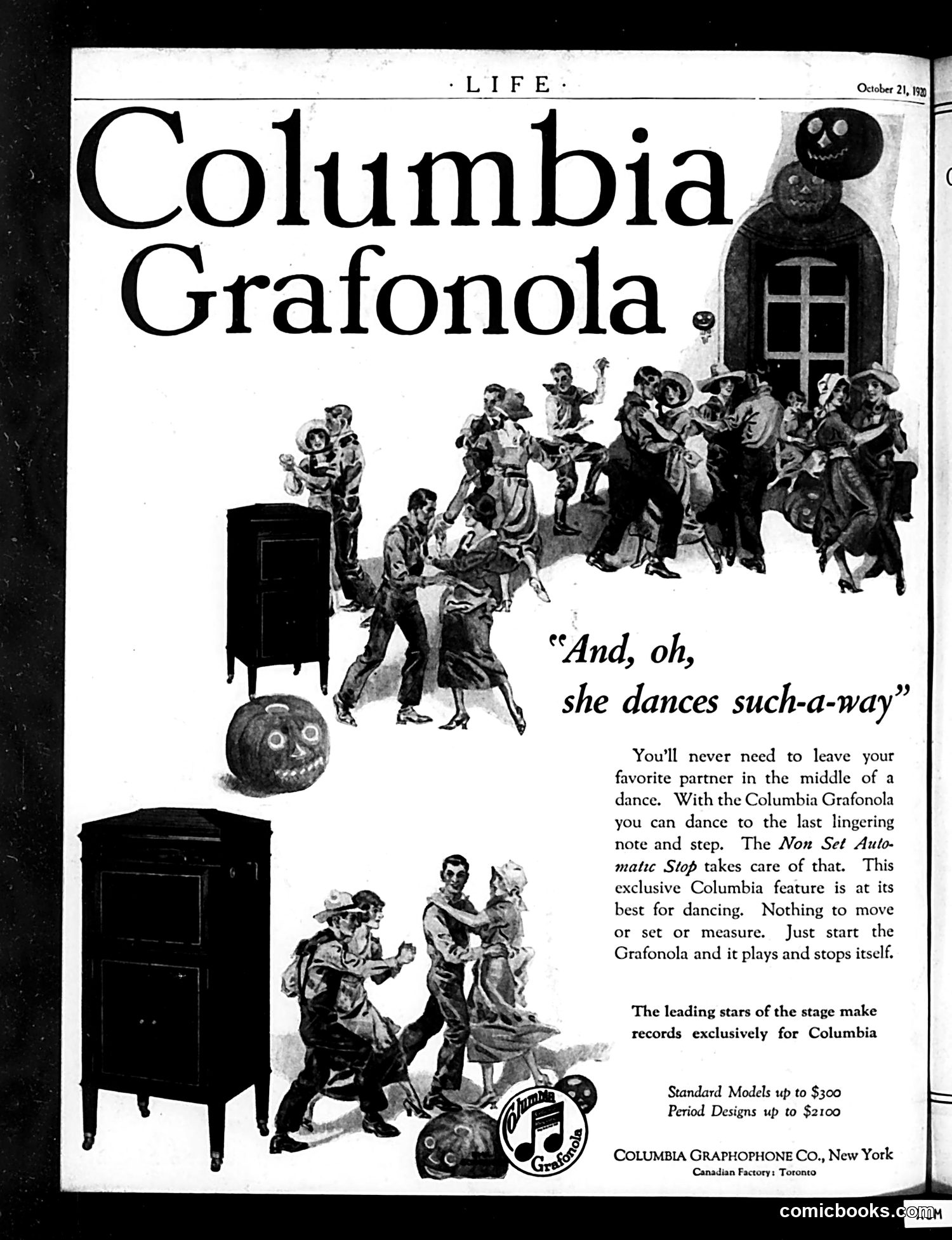
This is a **product advertisement**, not political satire. It promotes Columbia's Grafonola phonograph, emphasizing its "Non Set Automatic Stop" feature for dancing. The imagery shows couples dancing energetically to music from the machine—typical 1920s Jazz Age recreation. The grotesque jack-o'-lantern faces on the phonograph balls likely reference the publication date (October) and add whimsical Halloween theming rather than satirical commentary. The sales pitch targets dancers who want uninterrupted music: no need to manually stop the record or abandon your partner mid-dance. The advertisement mentions "leading stars of the stage" recording exclusively for Columbia, a common marketing strategy. Prices ($300–$2,100) indicate this was a luxury consumer product. This represents straightforward commercial advertising typical of *Life* magazine during the prosperous 1920s.