
Life, 1920-10-21 · page 24 of 44
Life — October 21, 1920 — page 24: what you’re looking at
What you’re looking at
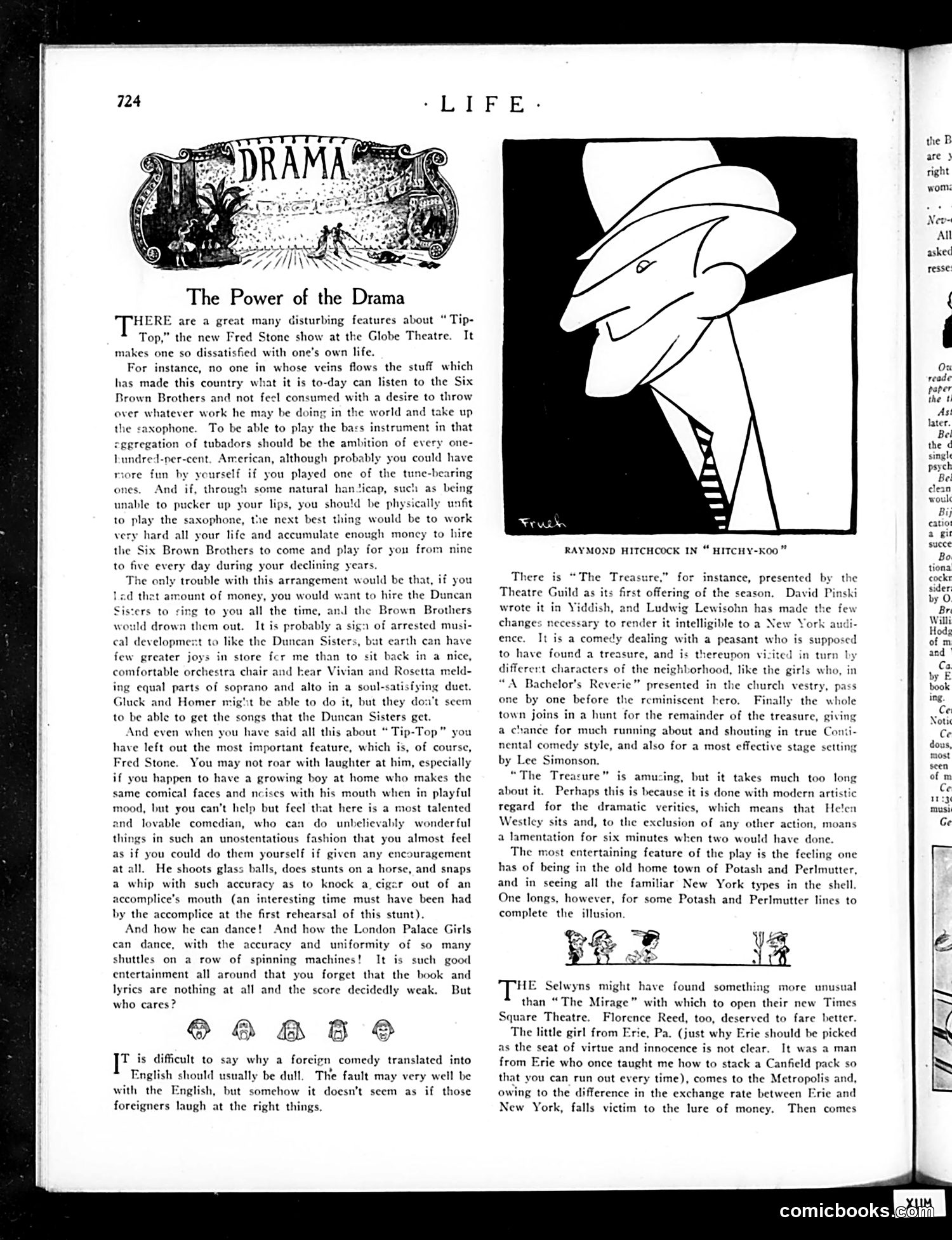
This page reviews Broadway theatrical productions, primarily Fred Stone's "Tip-Top" at the Globe Theatre. The accompanying caricature depicts **Raymond Hitchcock in "Hitchy-Koo,"** another contemporary stage show. The article's satire mocks how powerfully theater influences audiences' life choices. The author humorously argues that watching the Six Brown Brothers play saxophone makes one want to abandon real work to become a musician. Similarly, hearing the Duncan Sisters sing creates an irresistible desire to hire them for personal entertainment—an economically absurd fantasy. The piece celebrates Fred Stone as a genuinely talented comedian-performer whose physical comedy (shooting glass balls, horse stunts, whip-cracking) transcends weak book and lyrics, while praising the precision dancing of the "London Palace Girls." The page concludes discussing "The Treasure," a translated Yiddish play by David Pinski, suggesting foreign comedies often fail in English translation because "foreigners laugh at the right things"—a satirical jab at cultural differences in humor appreciation.
📄 Transcribed text from this page (OCR, searchable)
Machine-transcribed from the original scan — historical spelling and the odd misread are preserved.
The Power of the Drama are a great many disturbing features about “ Tip- the new Fred Stone show at the Globe Theatre. It makes one so dissatisfied with one’s own life. For instance, no one in whose veins flows the stuff which has made this country what it is to-day can listen to the Six Brown Brothers and not feel consumed with a desire to throw over whatever work he may be doing in the world and take up the saxophone. To be able to play the bass instrument in that egeregation of tubadors should be the ambition of every one- Lundred-per-cent, American, although probably you could have riore fun by yourself if you played one of the tune-bearing And if, through some natural hanJicap, such as being unable to pucker up your lips, you should be physically unfit to play the saxophone, the next best thing would be to work very hard all your life and accumulate enough moncy to hire the Six Brown Brothers to come and play for you from nine to five every day during your declining years, The only trouble with this arrangement would be that, if you dt amount of money, you would want to hire the Duncan Sisters to sing to you all the time, the Brown Brothers would drown them out. It is probably a sign of arrested musi- cal developm to like the Duncan Sisters, but earth can have few greater joys in store fer me than to sit back in a nice, comfortable orchestra chair and kear Vivian and Rosetta meld- ing equal parts of soprano and alto in a soul-satisfying duet. Gluck and Homer might be able to do it, but they don’t seem to be able to get the songs that the Duncan Sisters get. And even when you have said all this about “ Tip-Top” you have left out the most important feature, which is, of cours: Fred Sto: You may not roar with laughter at him, especially if you happen to have a growing boy at home who makes the same comical faces and ncises with his mouth when in playful mood, but you can’t help but feel that here is a most talented and ple comedian, who can do unbelievably wonderful things in such an unostentatious fashion that you almost feel as if you could do them yourself if given any encouragement at all. He shoots glass balls, does stunts on a horse, and snaps a whip with such accuracy as to knock a. cigzr out of an accomplice’s mouth (an interesting time must have been had by the accomplice at the first rehearsal of this stunt). And how he can dance! And how the London Palace Girls can dance, with the accuracy and uniformity of so many shuttles on a row of spinning machines! It is such good entertainment all around that you forget that the book and lyrics are nothing at all and the score decidedly weak. But who cares? T is difficult to say why a foreign comedy translated into English should usually be dull. The fault may very well be with the English, but somehow it doesn’t scem as if those foreigners laugh at the right things, is “1 easure,” for instance, presented by the Theatre Guild as its first offering of the season, David Pinski wrote it in Yj h, and Ludwig Lewisohn has made the f changes necessary to render it intelligible to a New York audi ence, It is a comedy dealing with a peasant who is supposed to have found a treasure, and is thereupon vizited in turn by different characters of the neighborhood, like the girls who, in “A Bachelor's Reverie” presented in the church vestry, one by one before the reminiscent kero, Finally the whole town joins in a hunt for the remainder of the treasure, giving a chance for much running about and shouting in true Conti- nental comedy style, and also for a most effective stage setting by Lee Simonson, "The Treasure” is amucing, but it takes much too long about it. Perhaps this is because it is done with modern artistic regard for the dramatic verities, which means that Helen Westley sits and, to the exclusion of any other action, moans a lamentation for six minutes when two would have done. The most entertaining feature of the play is the feeling one has of being in the old home town of Potash and Perlmutter, and in seeing all the familiar New York types in the shell. One longs, however, for some Potash and Perlmutter lines to complete the illusion. T! 2 Selwyns might have found something more unusual than “The Mirage” with which to open their new Times Square Theatre. Florence Reed, too, deserved to fare better. The little girl from Erie, Pa. (just why Erie should be picked as the seat of virtue and innocence is not clear. It was a man from Erie who once taught me how to stack a Canfield pack so that you can run out every time), comes to the Metropolis and, owing to the difference in the exchange rate between Erie and New York, falls victim to the lure of money. Then comes the B are } right wom: Nev- All asked resse catior a git succe Bo tiona cockr sider by 0. Bri Willi Hods 13 musi Ge > comicbooks Er ‘|