
Life, 1920-10-21 · page 21 of 44
Life — October 21, 1920 — page 21: what you’re looking at
What you’re looking at
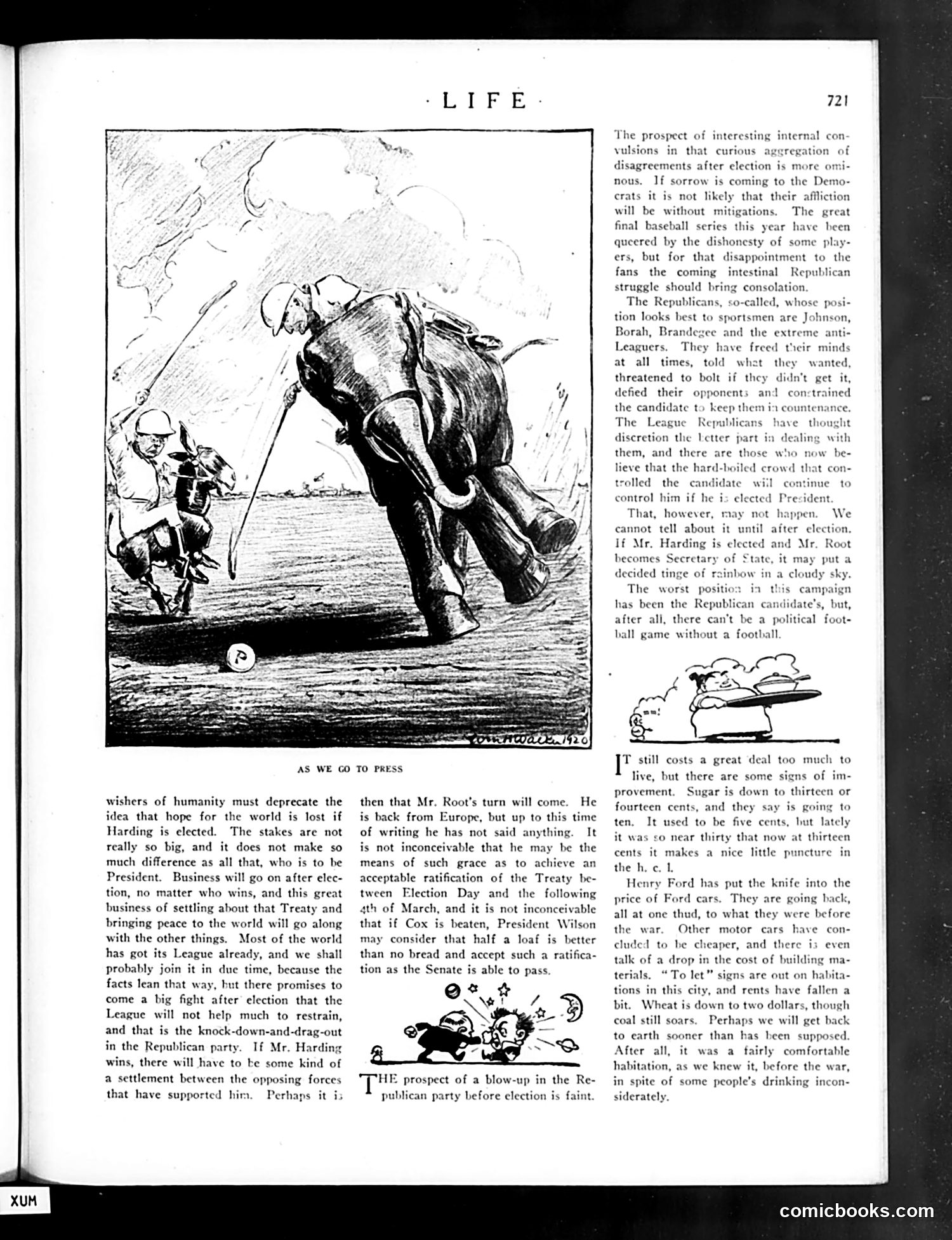
This page addresses the 1920 U.S. presidential election, likely between Republican Warren Harding and Democrat James Cox. **The main cartoon** shows an elephant (Republican Party symbol) kicking a football, with a small figure (possibly representing the League of Nations or internal party dissent) being launched into the air. The text explains the satire: the article warns of inevitable "knock-down-and-drag-out" conflict *within* the Republican Party after Harding's likely election, particularly between moderates (Johnson, Borah, Brandegee—League supporters) and hardliners who opposed the League of Nations treaty. **Key references:** - Elihu Root: elder statesman potentially becoming Secretary of State - Cox vs. Harding presidential race - League of Nations treaty ratification disputes - Internal Republican Party factions fighting over the treaty **The joke:** You can't play political football without internal combat. The satire suggests Republicans unified only to win the election; real conflict emerges afterward. The secondary text addresses economic issues (sugar, Ford prices, housing costs) affecting ordinary Americans.
📄 Transcribed text from this page (OCR, searchable)
Machine-transcribed from the original scan — historical spelling and the odd misread are preserved.
AS WE GO TO PRESS wishers of humanity must deprecate the idea that hope for the world is lost if Harding is elected. The stakes are not really so big, and it does not make so much difference as all that, who is to be President. Business will go on after elec- tion, no matter who wins, and this great business of settling about that Treaty and bringing peace to the world will go along with the other things. Most of the world has got its League already, and we shall probably join it in due time, because the facts lean that way, hut there promises to come a big fight after election that the League will not help much to restrain, and that is the knock-down-and-drag-out in the Republican party. If Mr. Harding wins, there will have to te some kind of a settlement between the opposing forces that have supported him. Perhaps it is then that Mr. Root's turn will come. He is back from Europe, but up to this time of writing he has not said anything. It is not inconceivable that he may be the means of such grace as to achieve an acceptable ratification of the Treaty be- tween Election Day and the following 4th of March, and it is not inconceivable that if Cox is beaten, President Wilson may consider that half a loaf is better than no bread and accept such a ratifica- tion as the Senate is able to pass. 2,4 Vege D > ~~ HE prospect of a blow-up in the Re- publican party before election is faint. g inte curious ‘egal The prospect of intere that disagreements after election is more ¢ vulsions in nous. If sorrow is coming to the De crats it is not likely that their affliction will be without miti; The great final baseball series this year have been tions, qucered by the dishonesty of some play- ers, but for that disappointment to the fans the coming intestinal struggle should bring consolation The Republi tion looks best to sportsmen a Republican ‘ans, so-called, whose posi- ¢ Johnson, Borah, Brandegee and the extreme Leaguers, They have freed their minds at all times, told threatened to bolt if they defied their opponents the candidate to keep The League Republicans discretion the Letter part aling them, and there are those who lieve that the hard-boiled crowd trolled the control him if he i whet they wanted, didn’t get it, and constrained in coun have th candidate wiil continue elected President We cannot tell about it until after election. If Mr. Harding is elected and Mr. Root becomes S of State, it may puta decided tinge of rainbow in a cloudy sky. The i campaign has been the Republican candidate's, but, after ali, there can't be a political foot- ame without a football. JR That, however, may not happen retar, worst position in t = T still costs a great deal too much to live, provement. Sugar is down to thirteen or fourteen cents, and they say is going to ten. It used to be five cents, but lately it was so near thirty that now at thirteen but there are some signs of im- cents it makes the h, ec. 1 Henry a nice little puncture in rd has put the knife into the price of Ford cars. They are going hack, all at one thud, to what they were | the war. Other cluded to be talk of a drop int terials. tions in this city, and rents have fallen a bit. Wheat is down to two dollars, though coal still soars. Perha fore motor cars have con- aper, and the even cost of building ma- “To let” signs are out on habit ps we will get back to earth sooner than has been supposed. After all, it was a_ fairly habita: in spite of some people's drinkin siderately. comfortable on, as we knew it, before the war, incon- comicbooks.com