
Life, 1920-10-21 · page 20 of 44
Life — October 21, 1920 — page 20: what you’re looking at
What you’re looking at
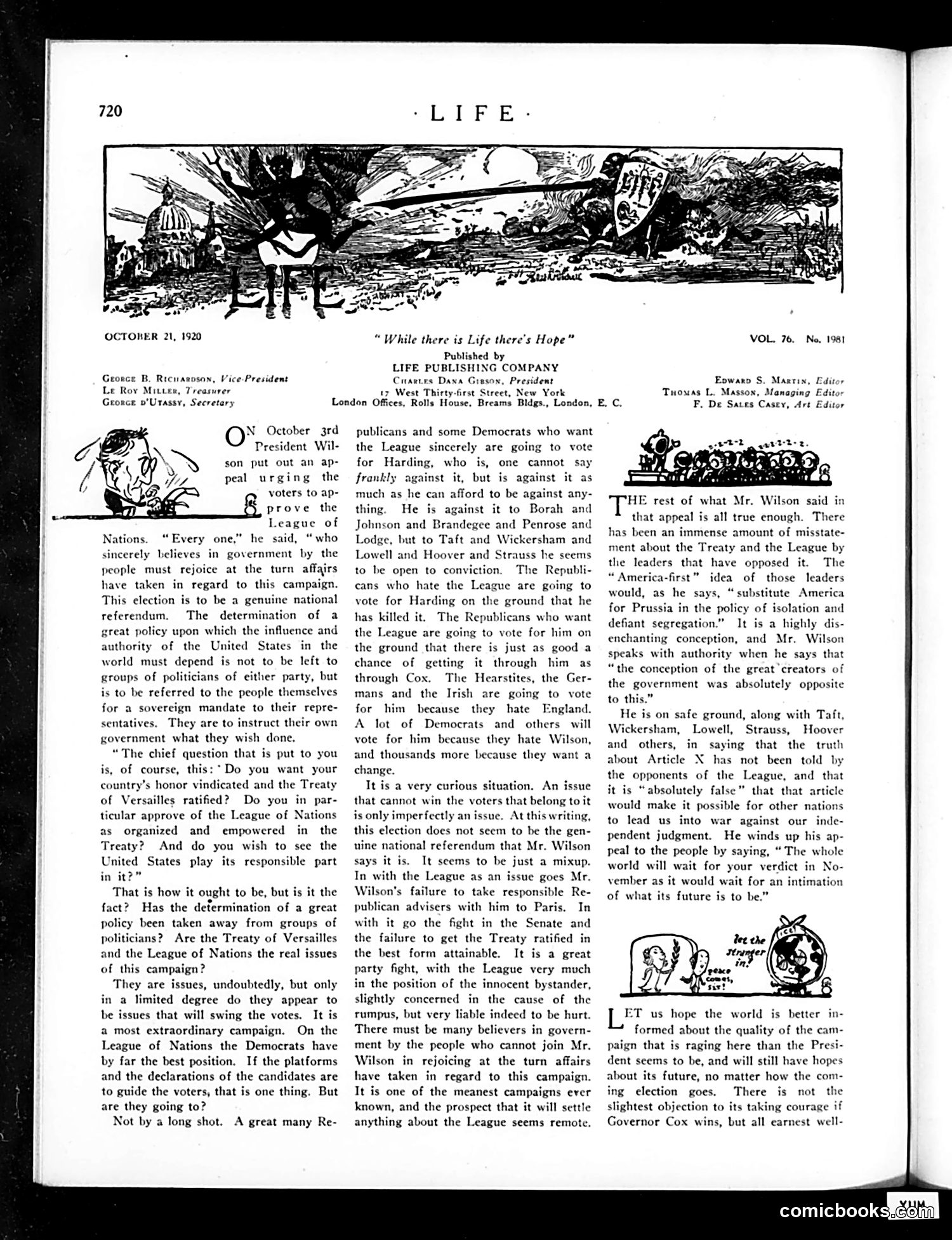
This editorial discusses the 1920 presidential election between Democrat incumbent President Wilson and Republican challenger Warren Harding, specifically focusing on the League of Nations as a campaign issue. **The Cartoon**: The left illustration depicts a hunched, worried figure—likely representing the League of Nations itself or Wilson's League policy—appearing distressed or uncertain. **The Argument**: Life's editors criticize Wilson's claim that the election is a "genuine national referendum" on the League. They argue voters will actually vote for Harding for contradictory reasons: Republicans wanting the League will vote for him thinking it can still pass; Republicans opposing it will vote believing he's killed it. Additionally, voters will support Harding out of hatred for Wilson, England, or desire for change—not based on the League issue itself. **The Satire**: Life satirizes how the 1920 election will be decided by shifting personal animosities and partisan tribal loyalty rather than genuine policy debate, making the League's actual fate uncertain and dependent on political chaos.
📄 Transcribed text from this page (OCR, searchable)
Machine-transcribed from the original scan — historical spelling and the odd misread are preserved.
OCTOHKER 21, 1920 Georce B. Ricuaenson, Vice-President Le Roy Mittrr, Treasurer Groncr b'Urassy, Secretary N October 3rd President Wil- son put out an ap- peal urging the voters to ap- prove the League of ery one,” he said, “who Nations. sincerely believes in government by the people must rejoice at the turn affairs have taken in regard to this campaign. This election is to be a genuine national referendum. The determination of a great policy upon which the influence and authority of the United States in the world must depend is not to be left to groups of politicians of either party, but is to be referred to the people themselves for a sovereign mandate to their repre- sentatives. They are to instruct their own government what they wish done, “The chief question that is put to you is, of course, this:*Do you want your country’s honor vindicated and the Treaty of Versailles ratified? Do you in par- ticular approve of the League of Nations as organized and empowered in the Treaty? And do you wish to sce the United States play its responsible part in it?” That is how it ought to be, but is it the fact? Has the determination of a great policy been taken away from groups of politicians? Are the Treaty of Versailles and the League of Nations the real issues of this campaign? They are issues, undoubtedly, but only in a limited degree do they appear to be issues that will swing the votes. It is a most extraordinary campaign. On the League of Nations the Democrats have by far the best position. If the platforms and the declarations of the candidates are to guide the voters, that is one thing. But are they going to? Not by a long shot. A great many Re- “While there is Life there's Hope” Published by LIFE PUBLISHING COMPANY Craetes Dana Grason, President ty West Thirty-first Street, New York London Offices, Rolls House, Breams Bldgs., London, E. C. publicans and some Democrats who want the League sincerely are going to vote for Harding, who is, one cannot say frankly against it, but is against it as much as he can afford to be against any- thing. He is against it to Borah and Johnson and Brandegee and Penrose and Lodge, but to Taft and Wickersham and Lowell and Hoover and Strauss he seems to be open to conviction. The Republi- cans who hate the League are going to vote for Harding on the ground that he has killed it. The Republicans who want the League are going to vote for him on the ground that there is just as good a chance of getting it through him as through Cox. The Hearstites, the Ger- mans and the Irish are going to vote for him because they hate England. A lot of Democrats and will vote for him because they hate Wilson, and thousands more because they want a change. It is a very curious situation. An issue that cannot win the voters that belong to it is only imperfectly an issue. At this writing, this election does not seem to be the gen- uine national referendum that Mr. Wilson says it is. It seems to be just a mixup. In with the League as an issue goes Mr. Wilson's failure to take responsible Re- publican advisers with him to Paris. In with it go the fight in the Senate and the failure to get the Treaty ratified in the best form attainable. It a great party fight, with the League very much in the position of the innocent bystander, slightly concerned in the cause of the rumpus, but very liable indeed to be hurt. There must be many believers in govern- ment by the people who cannot join Mr. Wilson in rejoicing at the turn affairs have taken in regard to this campaign. It is one of the meanest campaigns ever known, and the prospect that it will settle anything about the League seems remote. others VOL. 76. No, 1981 Eowaro S. Martin, Editor Tuowas L. Masson, Managing Editor F, De Sates Casey, Art Editor HE rest of what Mr. Wilson said that appeal is all true enough. There has been an immense amount of misstate- ment about the Treaty and the League by the leaders that have opposed it. The “America-first” idea of those leaders would, as he sa: “substitute America for Prussia in the policy of isolation and defiant segregation It is a highly dis- enchanting conception, and Mr. Wilson speaks with authority when he says that “the conception of the great’creators of the government was absolutely opposite to this. He is on safe ground, along with Taft, Wickersham, Lowell, Strauss, Hoover and others, in saying that the truth about Article X has not been told by the opponents of the League, and that it is “absolutely false” that that article would make it possible for other nations to lead us into war against our inde- pendent judgment. He winds up his ap- peal to the people by saying, “The whole world will wait for your verdict in No- vember as it would wait for an intimation of what its future is to be.” us hope the world is better in- formed about the quality of the cam- paign that is raging here than the Presi- dent seems to be, and will still have hopes about its future, no matter how the com- ing election goes. There is not the slightest objection to its taking courage if Governor Cox wins, but all earnest well- comicbookMeerl