
Life, 1920-10-21 · page 25 of 44
Life — October 21, 1920 — page 25: what you’re looking at
What you’re looking at
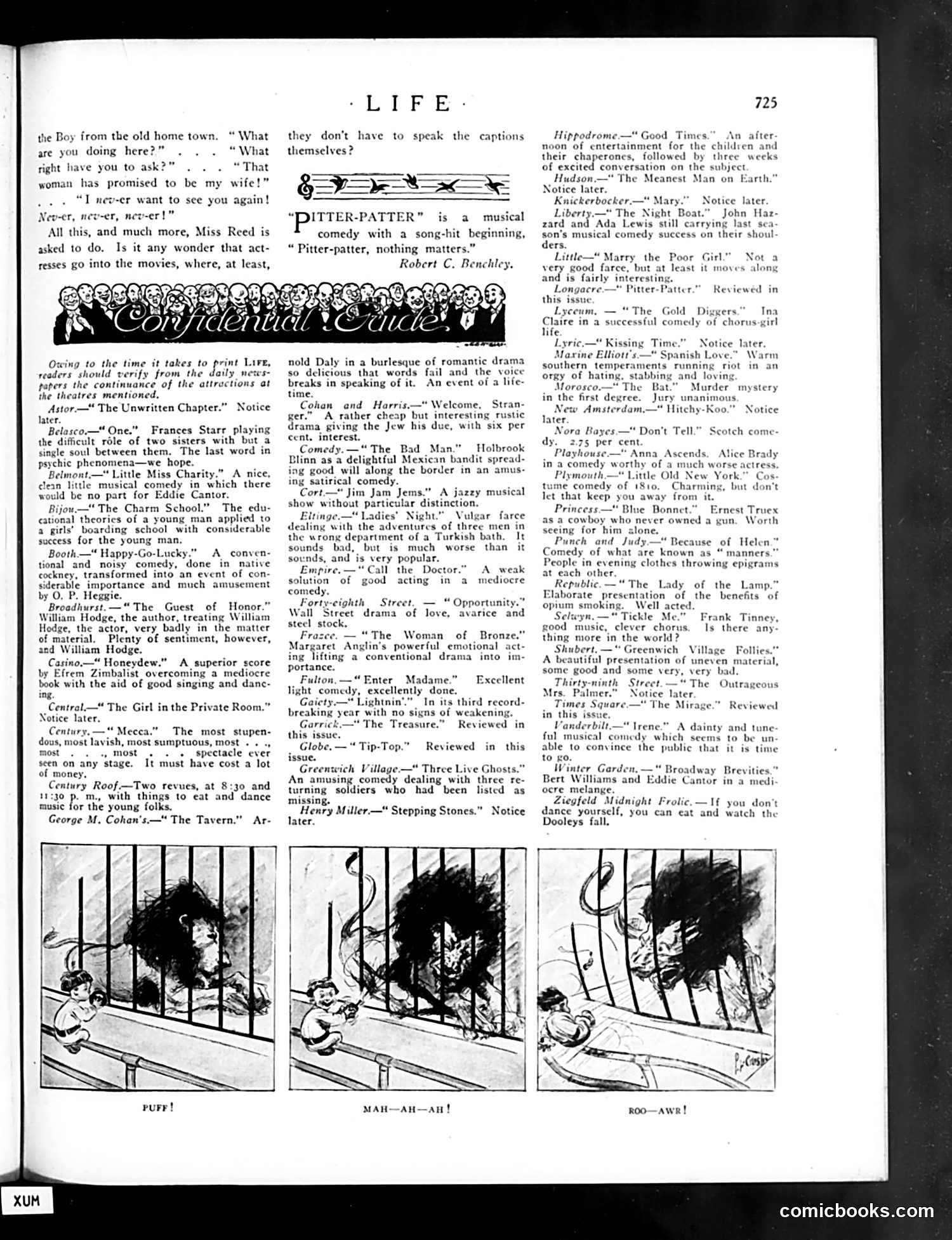
This is a theatrical review section from *Life* magazine (a satirical publication, not a news magazine). The page critiques Broadway shows currently running. **The Main Cartoon (bottom):** Three sequential panels show a child at a window with a lion behind bars. In each panel, the child makes different sounds ("PUFF!", "MAH-AH-AH!", "BOO-AW!") and the lion reacts with increasing agitation. This is wordless visual humor about provoking a dangerous animal—simple slapstick comedy about the consequences of taunting. **The Text's Point:** The opening section mocks stage actresses who must deliver melodramatic lines ("What are you doing here?" / "That woman has promised to be my wife!") while constrained by silent-film captions. *Life* sarcastically suggests actresses prefer working in movies where they don't have to speak such overwrought dialogue aloud. **The Reviews:** *Life* then catalogs Broadway productions with brief, witty assessments—praising some (Arnold Daly's burlesque), mocking others (calling a farce "sounds bad, but is much worse than it sounds"). The page reflects early 1920s theater culture and the emerging film industry's competition with live theater.
📄 Transcribed text from this page (OCR, searchable)
Machine-transcribed from the original scan — historical spelling and the odd misread are preserved.
“What “What “That the Boy from the old home town. are you doing here?” . right have you to ask?” woman has promised to be my wife! “T nev-er want to see you again! ver, nev-er, nev-er!” All this, and much more, Miss Reed is asked to do, Is it any wonder that act- resses go into the movies, where, at least, TOMEI GaTONNS LIFE they don’t have to speak the themselves ? captions ITTER-PATTER” is a musical comedy with a song-hit beginning, “ Pitter-patter, nothing matter: Robert C. Benchley. CRAG RE COC SCALE Owing to the time it takes to print Lire, readers should verify from the daily news- papers the continuance of the attractions at the theatres mentioned, Astor-—* The Unwritten Chapter.” later. Belasco—*“ One.” Frances Starr playing the difficult role of two sisters with but a single soul between them. The last word in psychic phenomena—we hope. Belmont,— Little Miss Charity.” A nice, clean little musical comedy in which there would be no part for Eddie Cantor. Bijou.— The Charm School.” The edu- cational theories of a young man applied to a girls’ boarding school with considerable success for the young man, Booth“ Happy-Go-Lucky.” A conven- tional and noisy comedy, done in native cockney, transformed into an event of con- erable importance and much amusement by O. P. Heggie. Broadhurst. —“ The Guest of Honor.” William Hodge, the author, treating William Hodge, the actor, very badly in the matter of material. Plenty of sentiment, however, and William Hodge. Casino.—“ Honeydew.” A superior score by Efrem Zimbalist overcoming a mediocre book with the aid of good singing and danc- ing. Central—* The Girl in the Private Room.” Notice later. Century. —" Mecca.” The most stupen- dous, most lavish, most sumptuous, most . . ., st. . 4, most . . « spectacle ever seen on any stage. It must have cost a lot of mone: Century Roof-—Two revues, at 8:30 and 11:30 i m., with things to eat and dance music for the young folks. George M. Cohan's.—“ The Tavern.” Notice Ar- nold Daly in a burlesque of romantic drama so delicious that words fail and the voice breaks in speaking of it. An event of a life- time, Cohan and Harris Welcome, Stran- ger.” A rather cheap but interesting rustic drama giving the Jew his due, with six per cent, interest. Comedy.—“ The Bad Man.” Holbrook Blinn as a delightful Mexican bandit spread. z good will along the border in an al ing satirical comedy. Cort—" Jim Jam Jems.” A jazzy musical show without particular distinction. tinge. —" Ladies’ Vulgar farce dealing with the adventures of three men in the wrong department of a Turkish bath. It sounds bad, but is much worse than it sounds, and is very popular. Empire. —“ Call the Doctor.” A weak solution of good acting in a mediocre comedy. Forty-cighth Street Wall Street drama of love, steel. stoc! — “ Opportunity, avarice and * The ‘ ns powerful emotional ing lifting a conventional drama into im- portance. Fulton. — light comedy, excellently done. Gaicty.—" Lightnin’.” In its third record- breaking year with no signs of weakening. The Treasure.” Reviewed in Woman of Bronze.” Enter Madame.” — Excellent Garrick, — this issue. Globe, —“ Tip-T issue. Greenwich Village. Three Live Ghosts.” An amusing comedy dealing with three re- turning soldiers who had been listed as missing. Henry Miller — later. Reviewed in this “ Stepping Stones.” Notice 725 Hippodro od Times.” An after noon of entertainment for the childre nd their chaperones, followed by three of excited conversation on the subject Hudson.—" The Meanest Man on Earth.” Notice later. Knickerbocker.—" Mary.” Notice later. Liberty.—" The Night Boat.” John Haz- zard and Ada Lewis still carrying last sea- son's musical comedy success on their shoul ders. Little—“ Marry the Poor very good farce, bi 1 and is fairly interestin Longacre.—" Pitter- this issue Lyceum. — “The Gold Diggers.” Ina Claire in a successful comedy of chorus-girl life. Lyric.—" Kissing T Maxine Elliott's. weeks Not a Girl” ast it moves ter.” Reviewed in Notice later. Spanish Love Warm southern temperaments running riot in an orgy of hating, stabbing and loving Morosco.—" The Bat.” Murder in the first degree. Jury unani New Amsterdam.—" Hitchy-K later Nora Bayes —" Don't dy, 2.75 per cent Playhouse —" Anna Ascends, A! Brady in a comedy worthy of a much worse actress. Plymouth.—" Little Old New York.” C tume comedy of 1810. Charming, but don't let that keep you away from it. Princess—" Blue Bonnet.” Ernest Truex as a cowboy who never owned a gun. Worth seeing for him alone. Punch and Judy— Because of Comedy of what are known as “m, People in evening clothes throwing at each other. Republic. —"“ The Lady of Elaborate presentation of the opium smoking. Well acted. Selwyn, —" Tickle Me.” good music, clever chorus. thing more in the world? Shubert. —“ Greenwich Village Follies.” A beautiful presentation of uneven material, some good and some very, very bad. Thirty-ninth Street. —" The Mrs. Palmer.” Notice later Times Square-—" The Mira in this ise. Vanderbilt.—" Irene.” ful musical comedy able to convince to go. ystery ous. Notice Tell.” Scotch come- Helen.” ners.” rams the L benefits of Frank Tinney, Is there any Outrageous Reviewed A dainty and tune. which seems to be un the public that it is time ry Garden, — Broadway Brevities.” Bert Willi, y Brevitie: ms and Eddie Cantor in a medi Ziegfeld Midnight Frolic. —1€ you don’t dance yourself, you can eat and watch the Dooleys fall. MAH—AH—auH! comicbooks.com