
A complete issue · 40 pages · 1920
Life — September 30, 1920
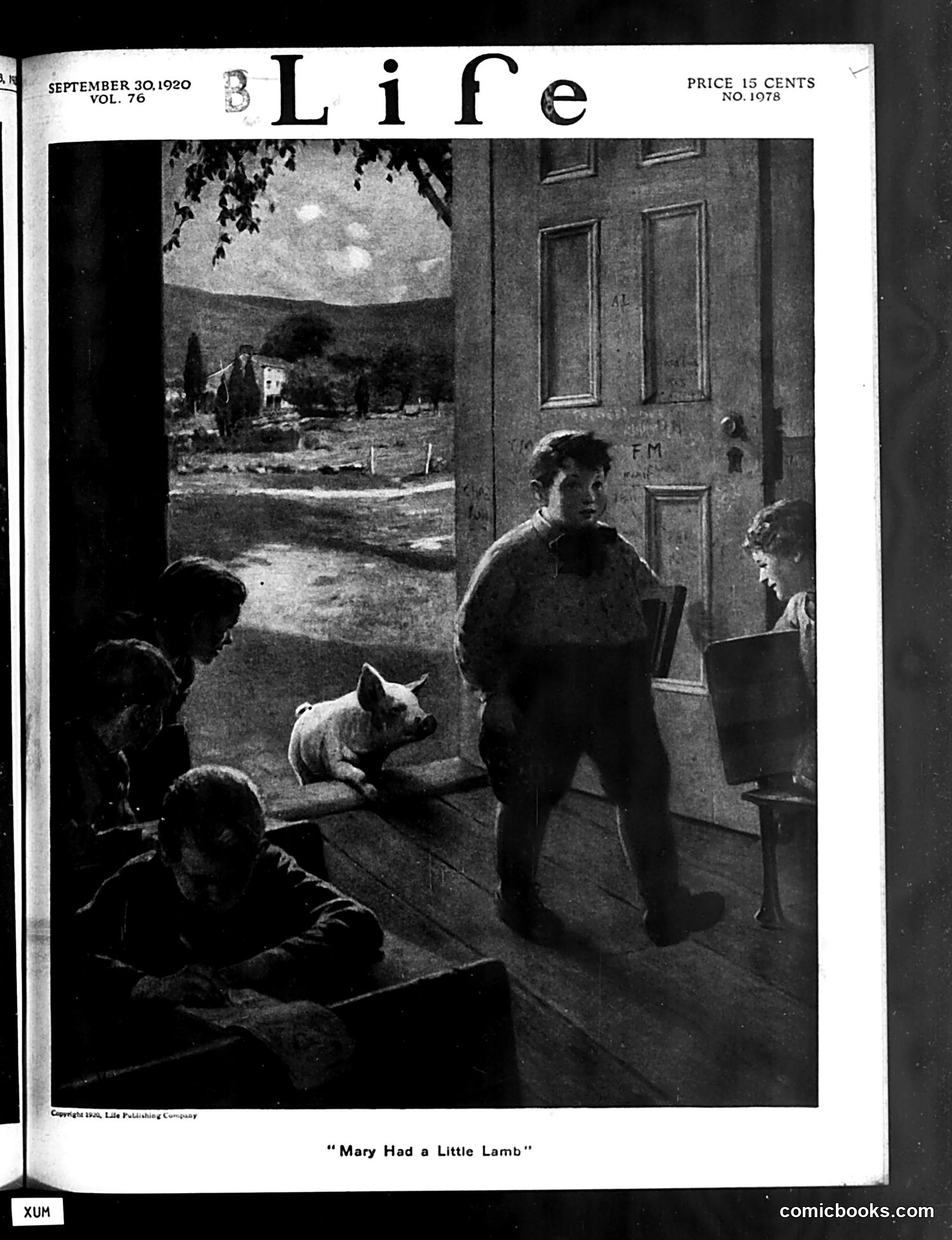
This is the cover of *Life* magazine from September 30, 1920 (Vol. 76, No. 1078). The image is titled "Mary Had a Little Lamb," referencing the nursery rhyme. The photograph depicts what appears to be a domestic scene: children and adults gathered around a lamb indoors, near a doorway, with a rural landscape visible through the opening. The scene recreates the famous nursery rhyme literally—a lamb present in a home setting where it wouldn't typically be found. Without additional context from the magazine's contents, the specific satirical point remains unclear. It may comment on rural life, children's education, or contemporary social practices circa 1920, but the image alone doesn't reveal the intended political or social critique the editors intended. The humor appears to derive from the literal visualization of an absurd, whimsical scenario.
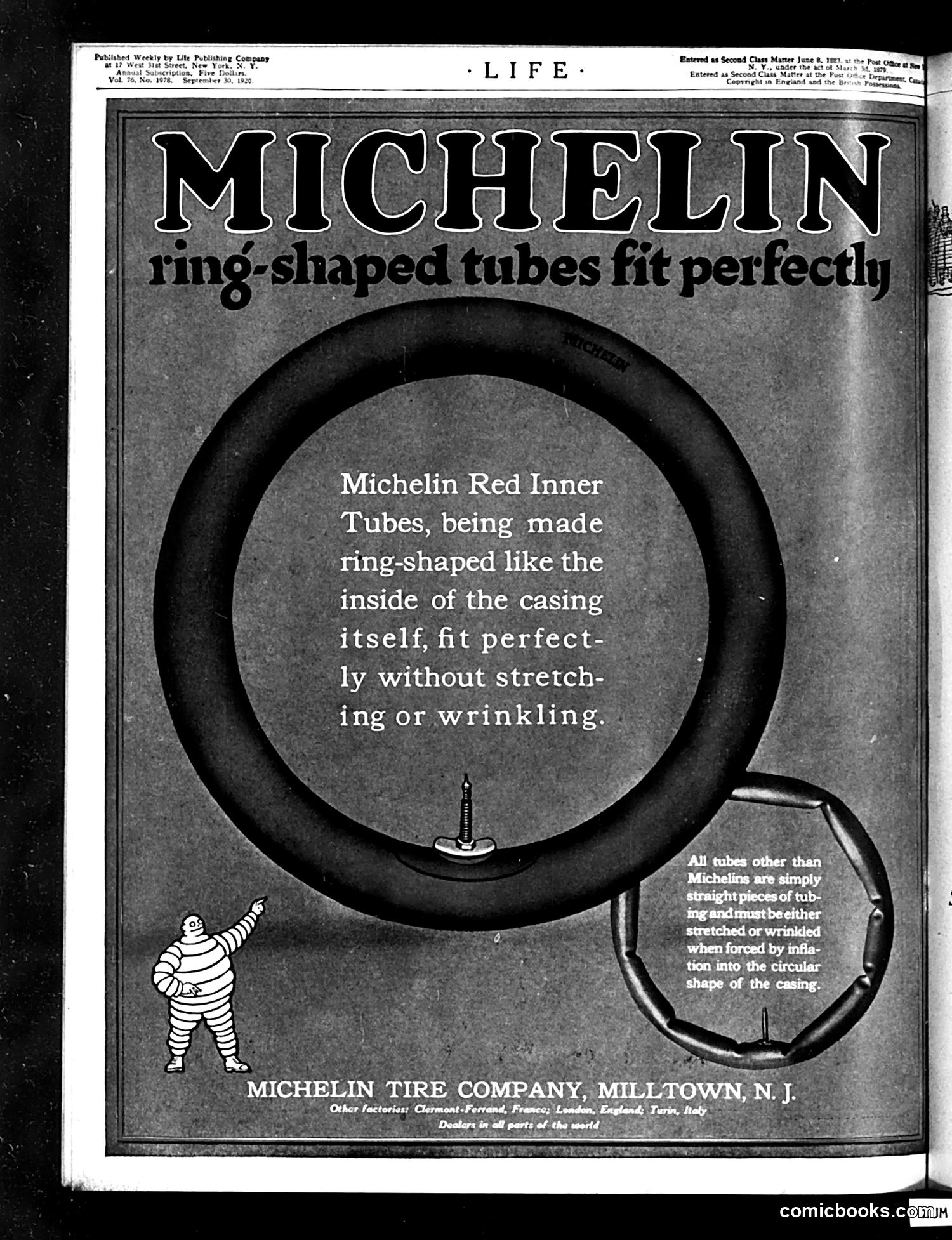
This is a **Michelin Tire Company advertisement**, not a political cartoon or satirical content. The page shows a large tire inner tube with the Michelin mascot (the "Michelin Man" or "Bibendum") pointing to it. The ad's central claim is that Michelin's ring-shaped inner tubes fit perfectly into tire casings without stretching or wrinkling, unlike competitors' straight tubes. This was presented as a technical innovation—the tubes' pre-formed circular shape supposedly matched the tire's interior geometry precisely. The small diagram on the right compares Michelin's shaped tube to straight tubes from other manufacturers that must be deformed during installation. This is essentially a product advertisement highlighting what Michelin marketed as a manufacturing advantage in early 20th-century tire technology.
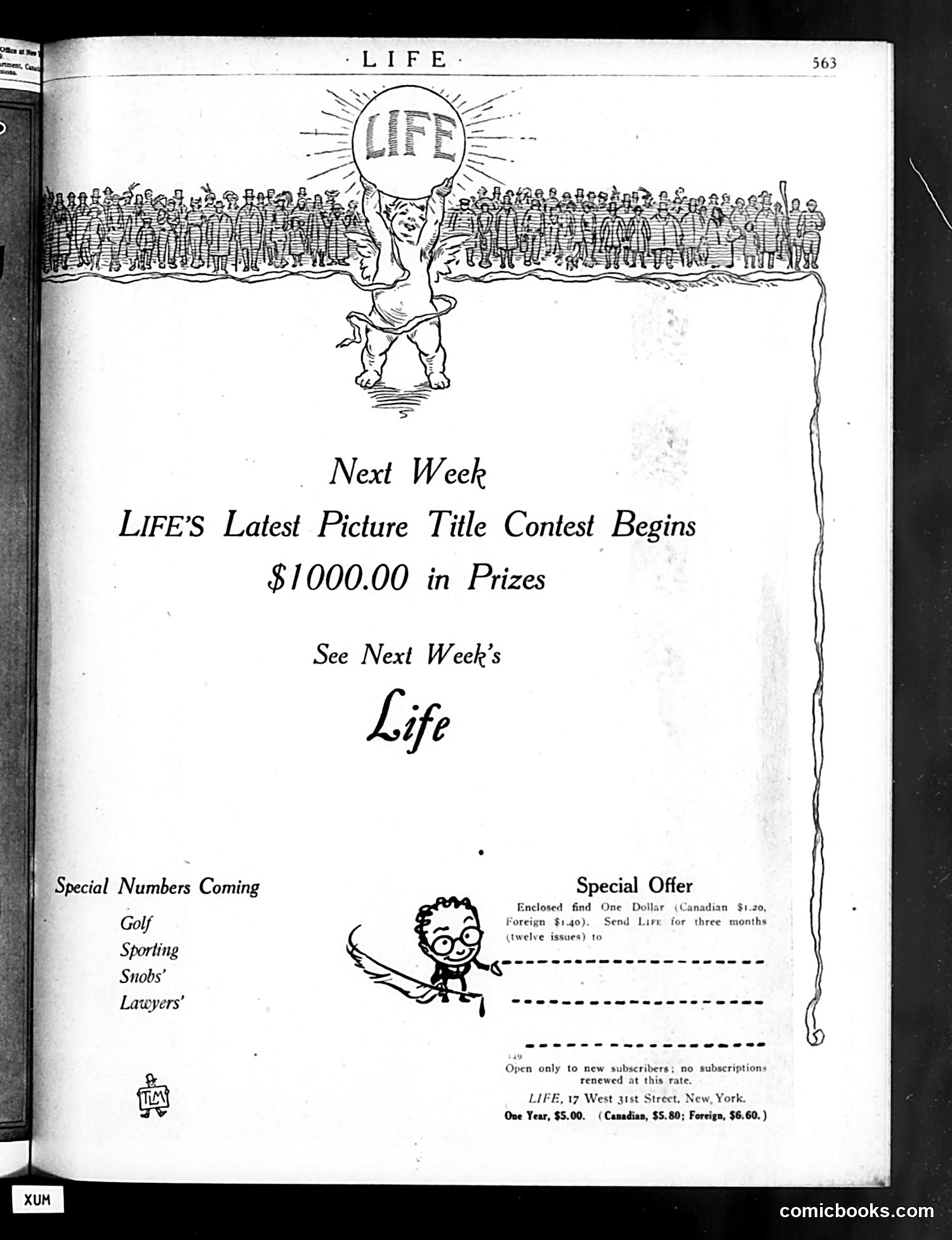
This page is primarily **advertising and promotional content** rather than political satire or comics. The main illustration shows a figure holding a large balloon labeled "LIFE" above a crowd, promoting the magazine's upcoming "Picture Title Contest" offering $1000 in prizes. Below that are announcements for upcoming special issues (Golf, Sporting, Snobs', Lawyers'), and a subscription offer featuring a simple cartoon character. The text advertises Life's address in New York and subscription rates. There is **no apparent political satire or social commentary** on this page. It functions as a back-page advertisement encouraging readers to subscribe and participate in the magazine's contests and special editions.
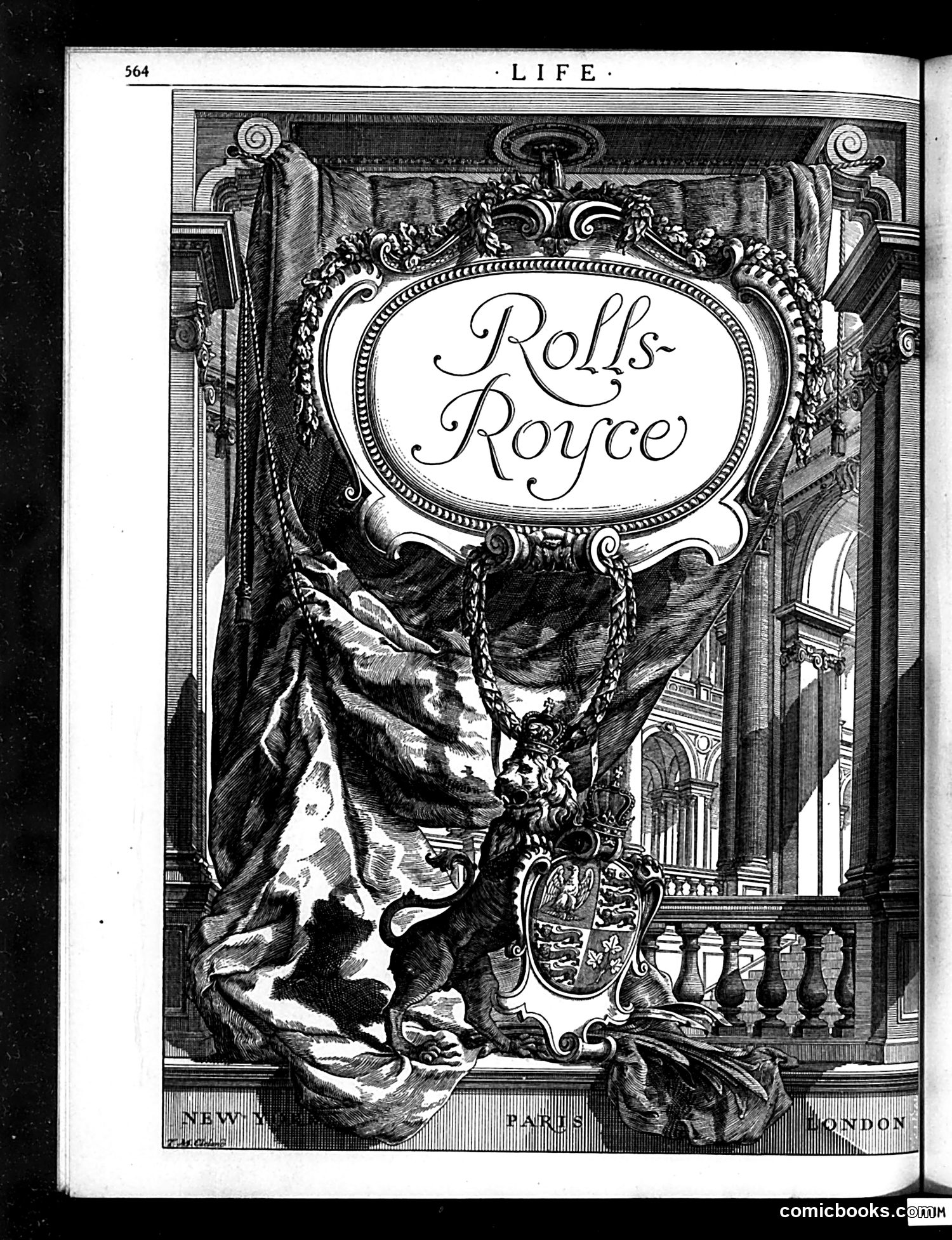
This page is primarily a **luxury automobile advertisement** for Rolls-Royce, not political satire. The ornate engraving depicts an elaborate Baroque-style frame with draped fabrics, cherubs, and heraldic crests, emphasizing the car's prestigious status and exclusivity. The decorative treatment—with its architectural grandeur, royal symbolism, and opulent ornamentation—conveys wealth and sophistication rather than commentary. The text indicates distribution in New York, Paris, and London, emphasizing the brand's international prestige. This represents how Life magazine's pages mixed satirical editorial content with high-end advertisements targeting affluent readers. The Rolls-Royce ad demonstrates the magazine's dual nature as both social critic and luxury lifestyle publication.
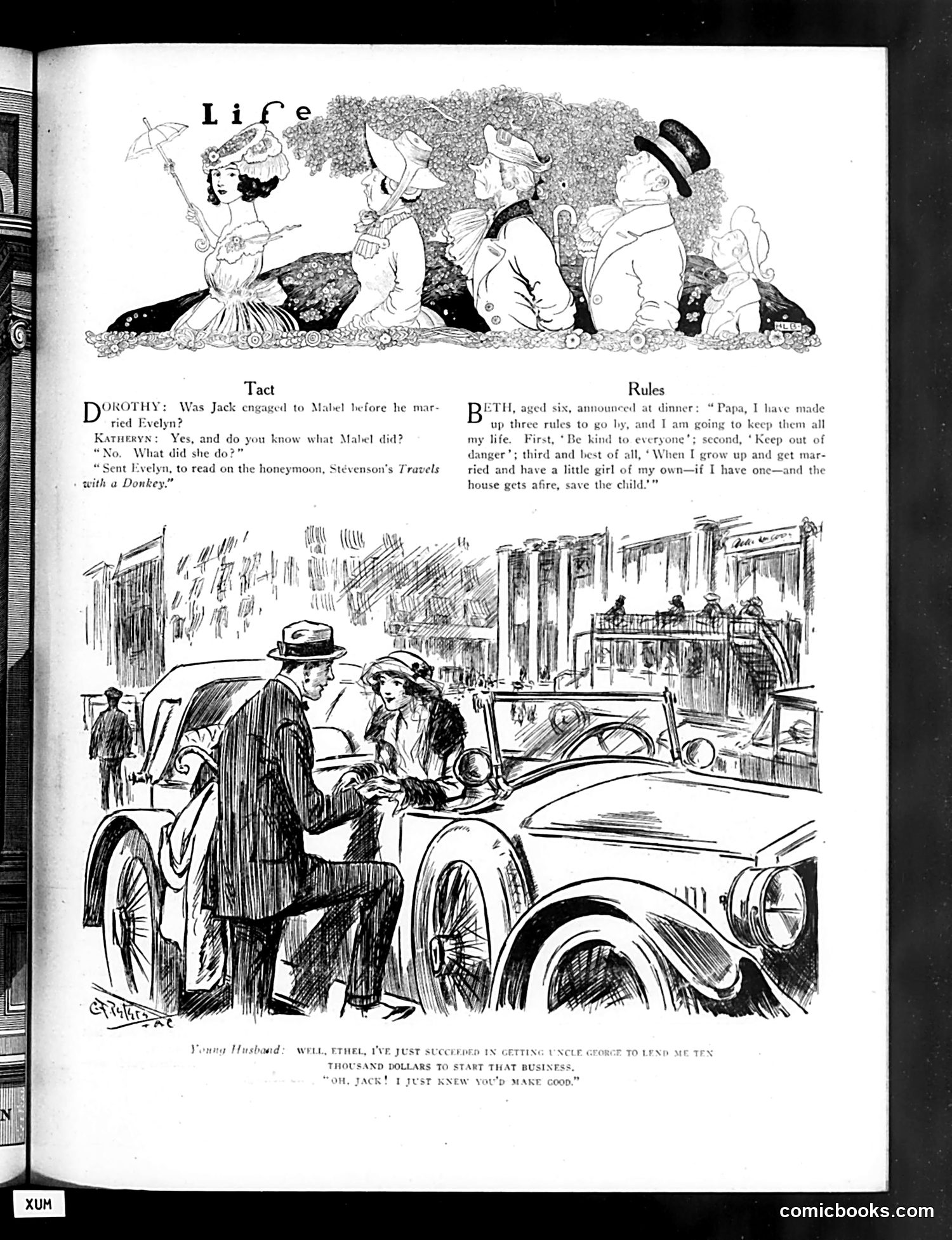
This page from *Life* magazine contains two distinct sections: **Top section ("Tact" and "Rules"):** A humorous dialogue between Dorothy and Katherine about Jack's engagement to Mabel, followed by Beth's announcement of three life rules at dinner—being kind, staying out of danger, and protecting children if her house catches fire. The illustration shows whimsical figures in period dress. **Bottom cartoon ("Young Husband"):** A sketch depicting a young man in a car speaking to an older gentleman, discussing securing a ten-thousand-dollar loan from "Uncle George" to start a business, with the younger man expressing confidence in success. The humor satirizes upper-class social conventions and youthful optimism about business ventures, likely reflecting early 20th-century attitudes toward financial independence and family assistance. The specific context and date remain unclear without additional publication information.
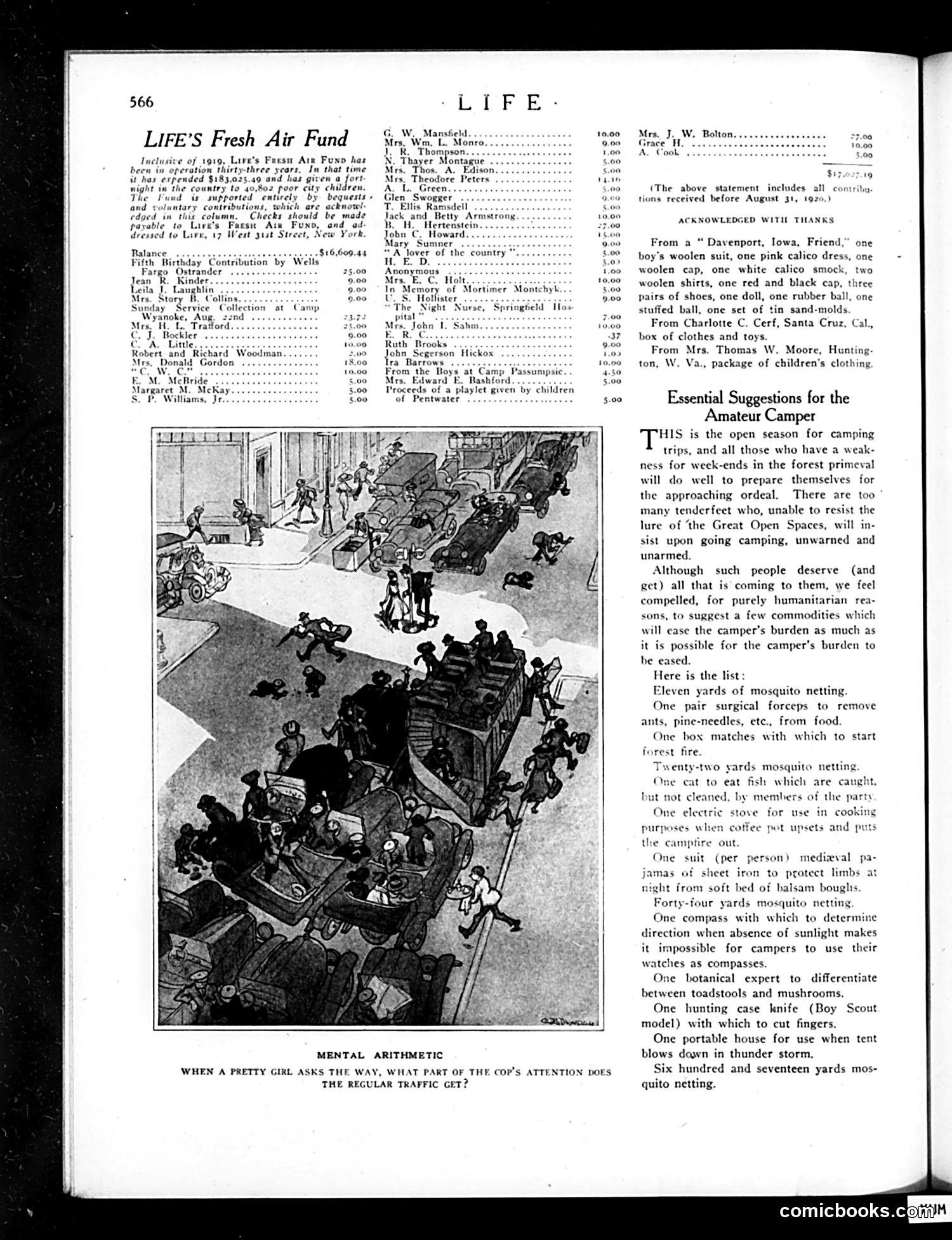
This page contains two distinct sections: **Left side:** A humorous illustration captioned "Mental Arithmetic" depicting a crowded urban traffic scene with many cars and pedestrians. The joke asks: "When a pretty girl asks the way, what part of the cop's attention does the regular traffic get?" The cartoon satirizes male police officers' distraction by attractive women, suggesting they neglect their traffic duties. This reflects early 20th-century gender dynamics and workplace humor common in Life magazine. **Right side:** Practical advice article titled "Essential Suggestions for the Amateur Camper," recommending camping supplies and equipment for outdoor trips. This is genuinely helpful editorial content, not satire. The page also includes "Life's Fresh Air Fund" donor listings and donation records—a charitable initiative the magazine supported.
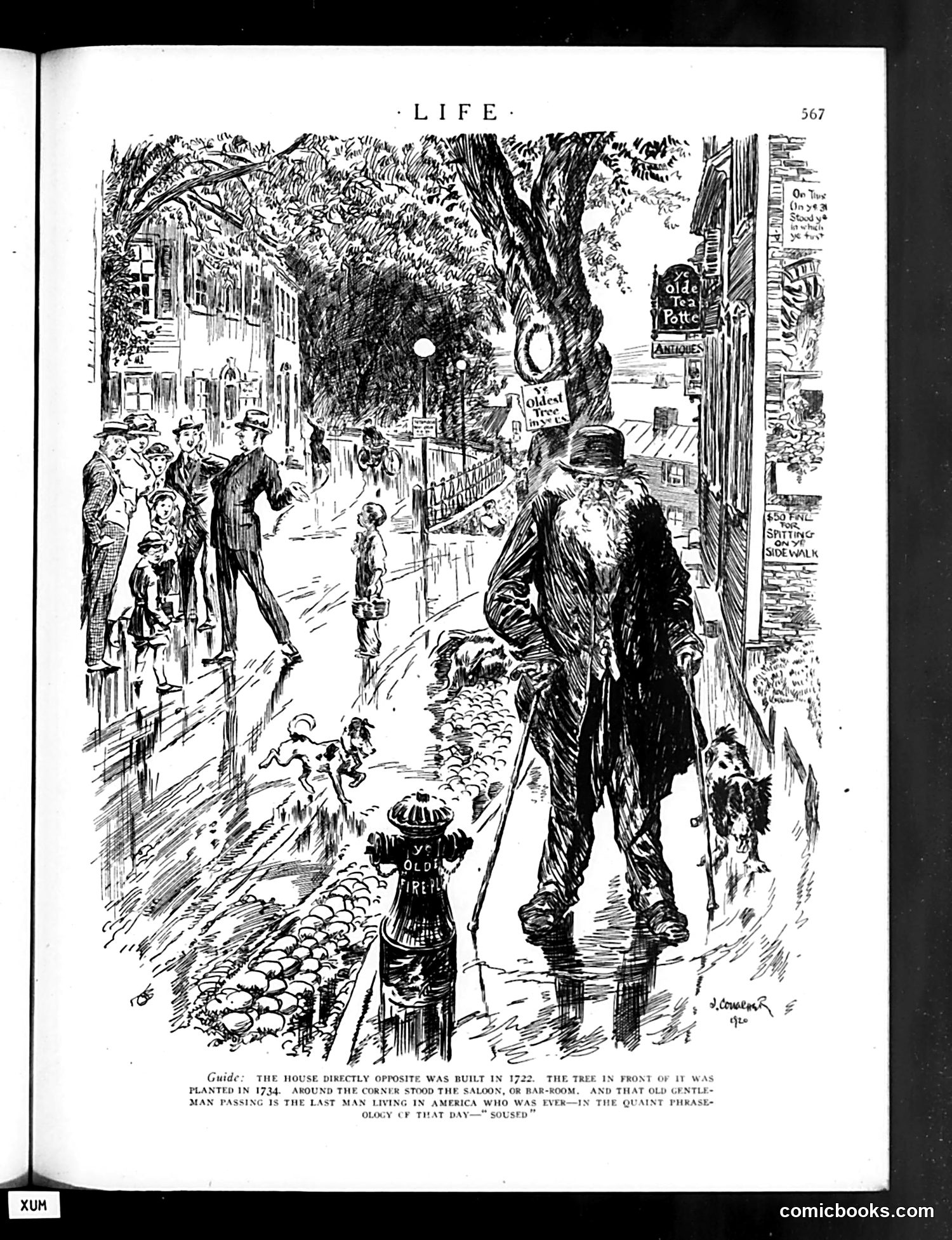
This is a single illustration from *Life* magazine (page 567) depicting a street scene in what appears to be colonial America. The caption indicates the house "directly opposite was built in 1722" and references a tree planted in 1734. The guide notes this is "the last man living in America who was ever—in the quaint phraseology of that day—'soused.'" The cartoon satirizes an elderly gentleman, likely meant to represent someone from the colonial era, as a relic of the past. The anachronistic figure and the emphasis on archaic language ("soused," meaning drunk) create gentle humor through juxtaposition: a man whose behaviors and vocabulary belong to centuries past, now walking through a modern street where children and other contemporaries pass by. The satire mocks outdated customs and generational disconnect.
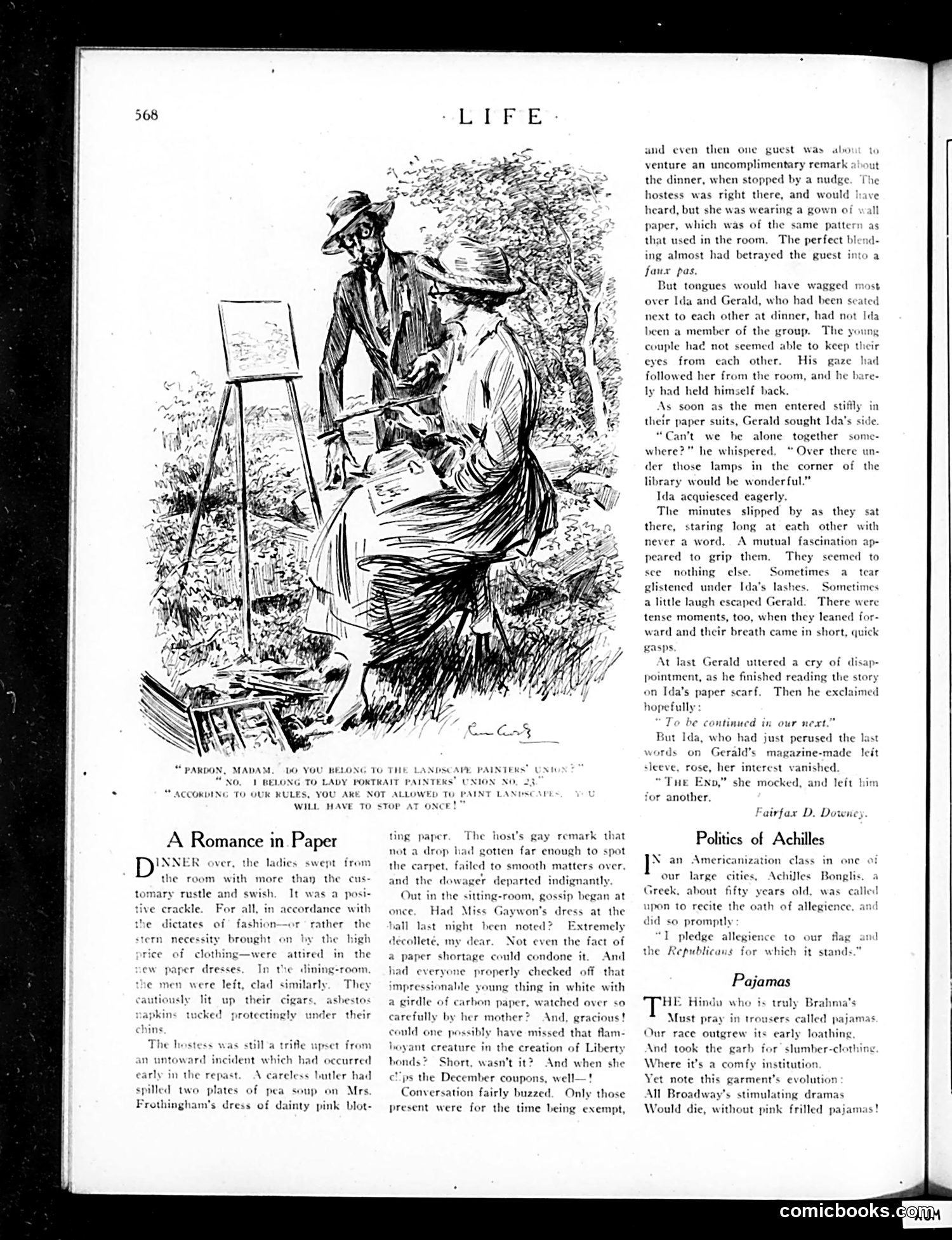
This illustration depicts a man and woman in an outdoor setting, with the man showing the woman sketches on an easel. The caption reads: "PARDON, MADAM, DO YOU BELONG TO THE LANDSCAPE PAINTERS' UNION?... NO, I BELIEVE YOU ARE AN INDEPENDENT... WELL, ACCORDING TO OUR RULES, YOU ARE NOT ALLOWED TO PAINT LANDSCAPES. YOU WILL HAVE TO STOP AT ONCE!" The cartoon satirizes restrictive labor union rules that arbitrarily exclude non-members from creative work. The humor lies in applying rigid union bureaucracy to an innocent romantic scene—a couple painting outdoors. It critiques how unions, despite intending worker protection, could prevent willing individuals from engaging in their craft, suggesting overzealous gatekeeping that stifles rather than protects labor.
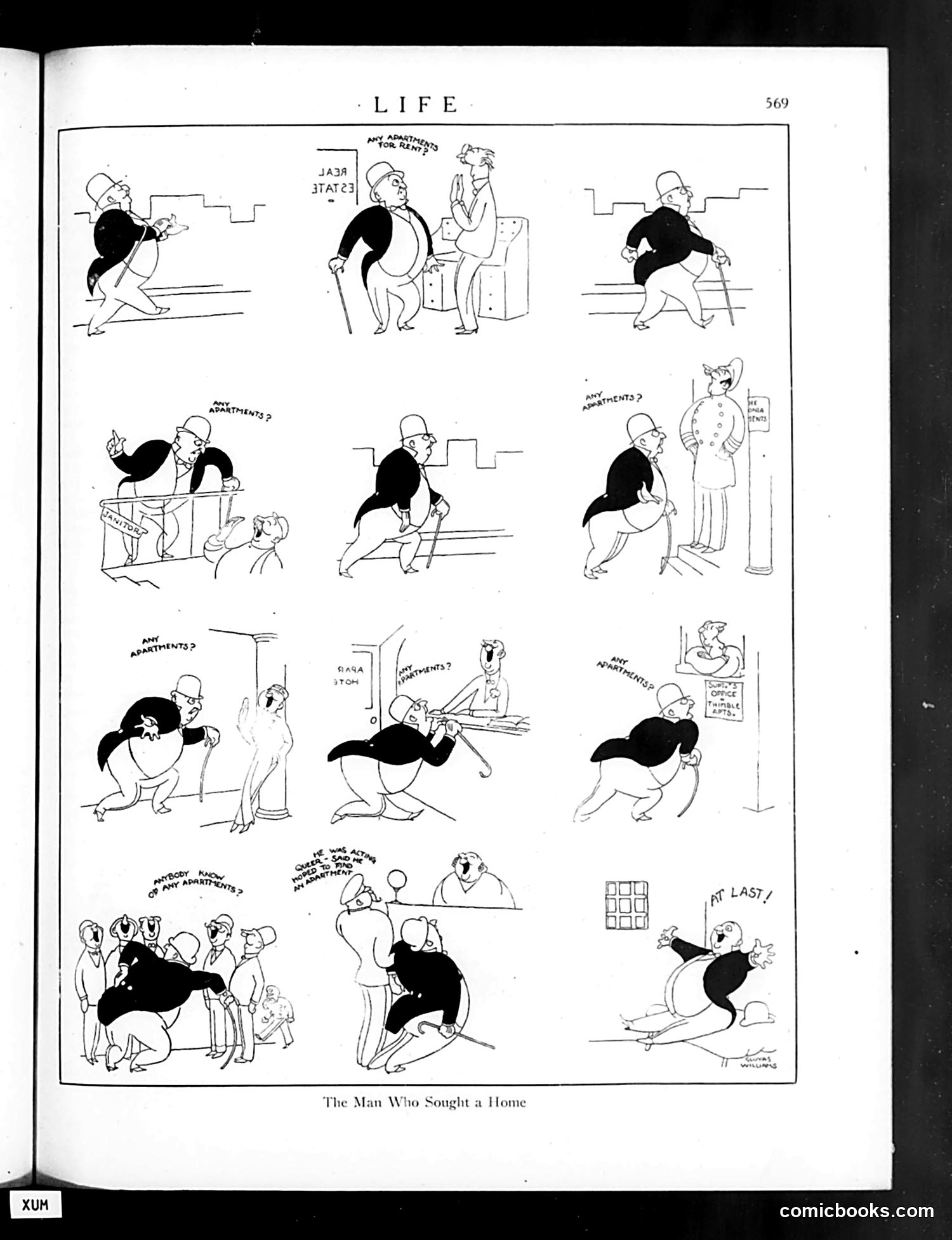
This comic strip satirizes the difficulty of finding affordable housing in early 20th-century America. A rotund, well-dressed man repeatedly encounters obstacles while apartment hunting: landlords asking "Any Apartments?" reject him, a woman refuses to rent to him, he's confronted with exorbitant prices, and he attempts increasingly desperate measures (climbing through windows, negotiating with multiple parties). The sequence culminates in him apparently giving up and sliding down what appears to be a pole marked "AT LAST!" The satire targets the housing shortage and predatory rental practices of the era, where landlords held power over desperate tenants. The man's persistence and ultimate resignation humorously illustrate the futility many faced in securing adequate housing during a period of urban overcrowding and speculation.
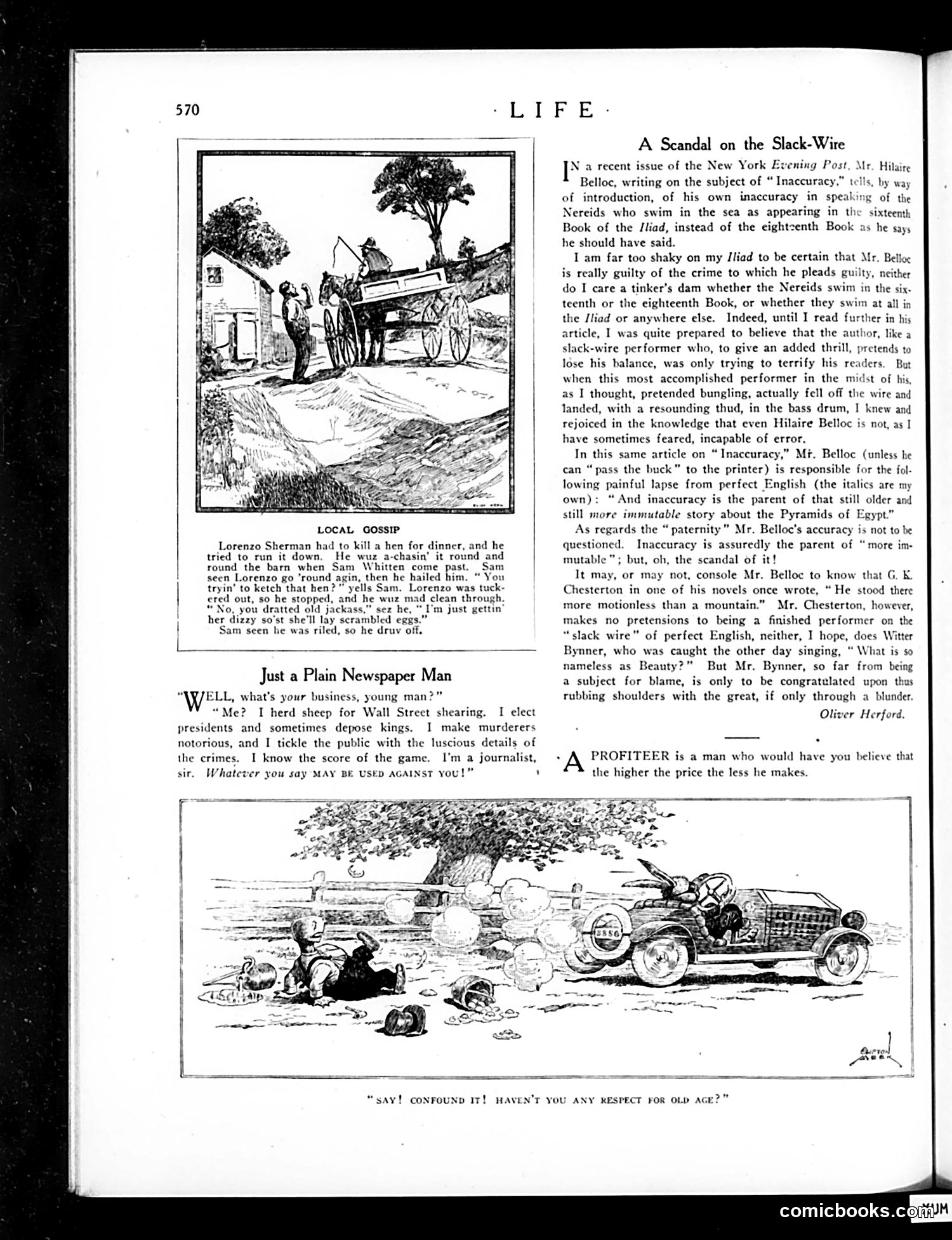
This page contains three distinct pieces: 1. **"A Scandal on the Slack-Wire"**: A letter criticizing writer Hilaire Belloc for an inaccuracy in his *Evening Post* article—he incorrectly stated the Nereids appear in the sixteenth Book of the *Iliad* rather than the eighteenth. The author humorously compares Belloc's error to a slack-wire performer falling, while noting even Belloc's errors are "immutable." 2. **"Just a Plain Newspaper Man"**: A brief first-person quote from a journalist defending his profession's intrusive methods—making murderers notorious and exposing crime details—framed as necessary work. 3. **Bottom cartoon**: An illustration showing a wrecked vintage automobile with debris scattered around, captioned "SAY! COMPOUND IT! HAVEN'T YOU ANY RESPECT FOR OLD AGE?" This satirizes reckless driving endangering elderly people.
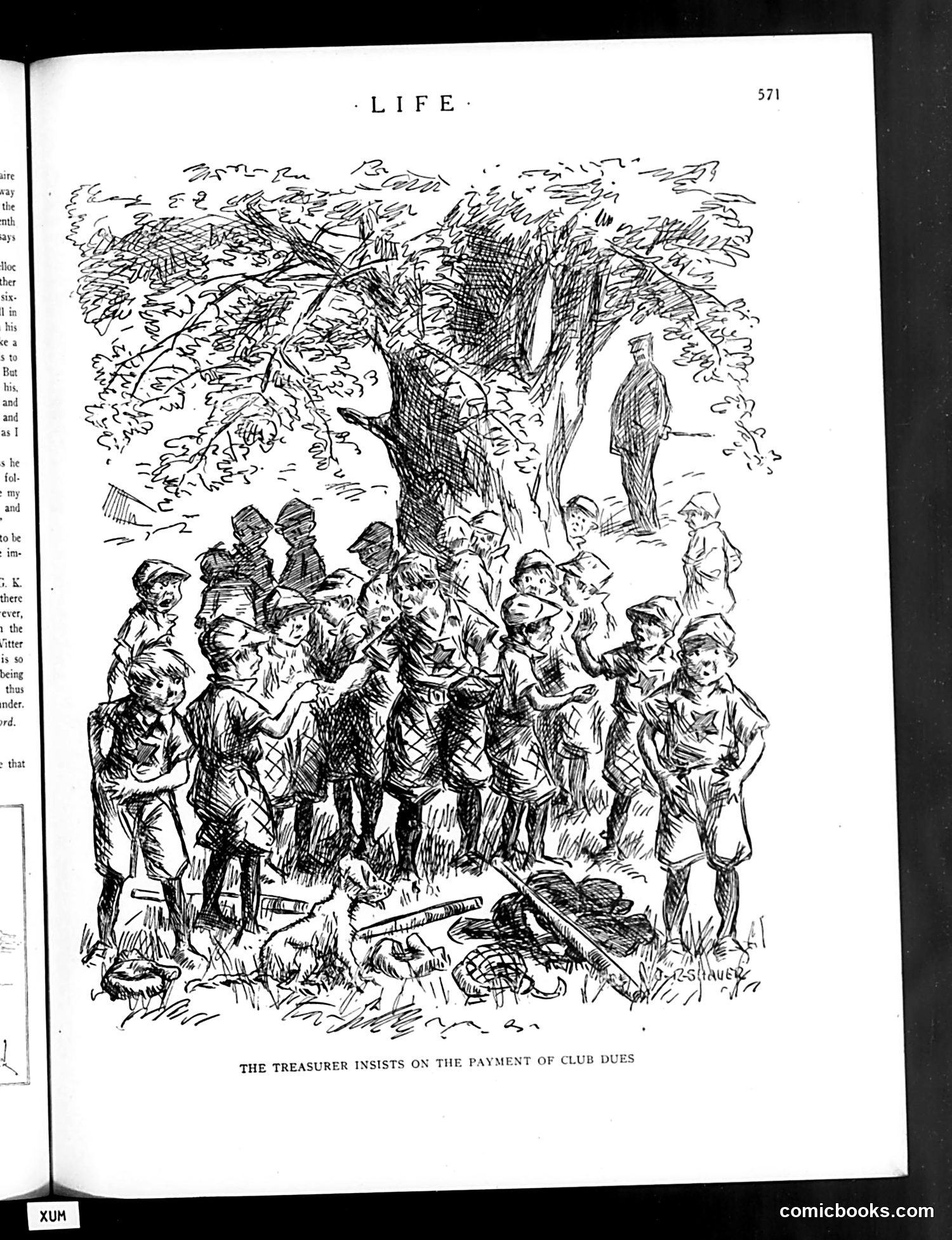
This cartoon depicts a group of boys gathered beneath a large tree, with what appears to be a stern figure (the "treasurer") standing apart, demanding payment. On the ground lie scattered belongings or confiscated items—possibly taken as collateral for unpaid club dues. The satire lampoons childhood club dynamics and the minor tyrannies of young organizers. The "treasurer" character represents the bureaucratic enforcement of rules within informal boy groups, treating membership fees with deadpan seriousness. The scattered items suggest harsh consequences for delinquent members—a humorous commentary on how children mimic adult institutions' administrative rigidity, turning playtime organizations into mini-hierarchies complete with financial enforcement mechanisms.
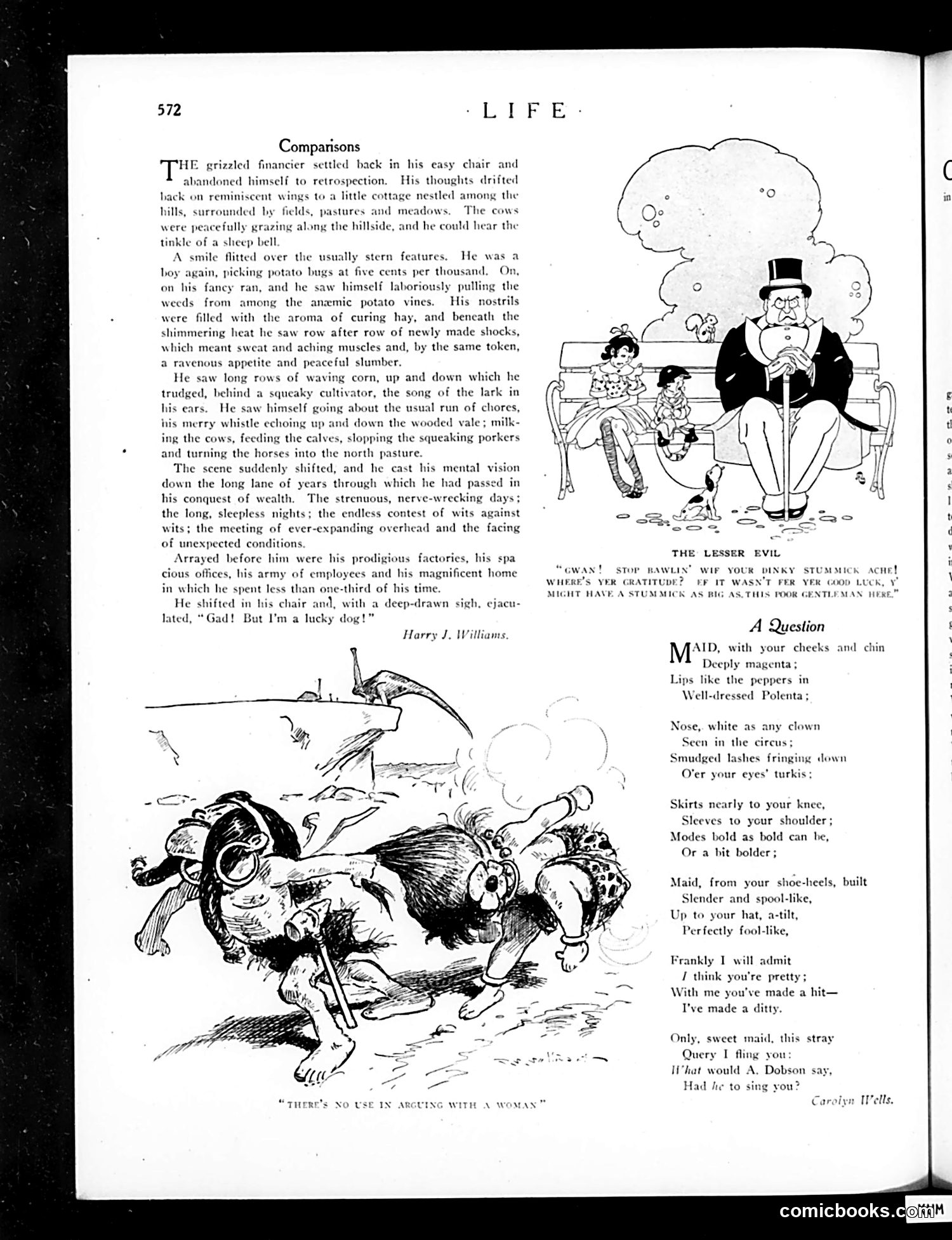
This page contains two distinct cartoons satirizing gender relations in early 20th-century America. **"The Lesser Evil"** (top right) depicts a rotund gentleman with two children, lecturing about the virtues of fatherhood versus marriage troubles. The caption suggests men preferred dealing with misbehaving children to dealing with difficult wives—a common domestic complaint of the era. **"There's No Use in Arguing With a Woman"** (bottom) shows chaotic figures in violent disagreement, the caption mocking the futility of logical debate with women. Both cartoons reflect period attitudes portraying women as unreasonable or problematic. The separate poem "A Question" sarcastically describes an idealized "maid" as foolish yet pretty—reinforcing stereotypes of feminine superficiality that contemporary satire frequently deployed.
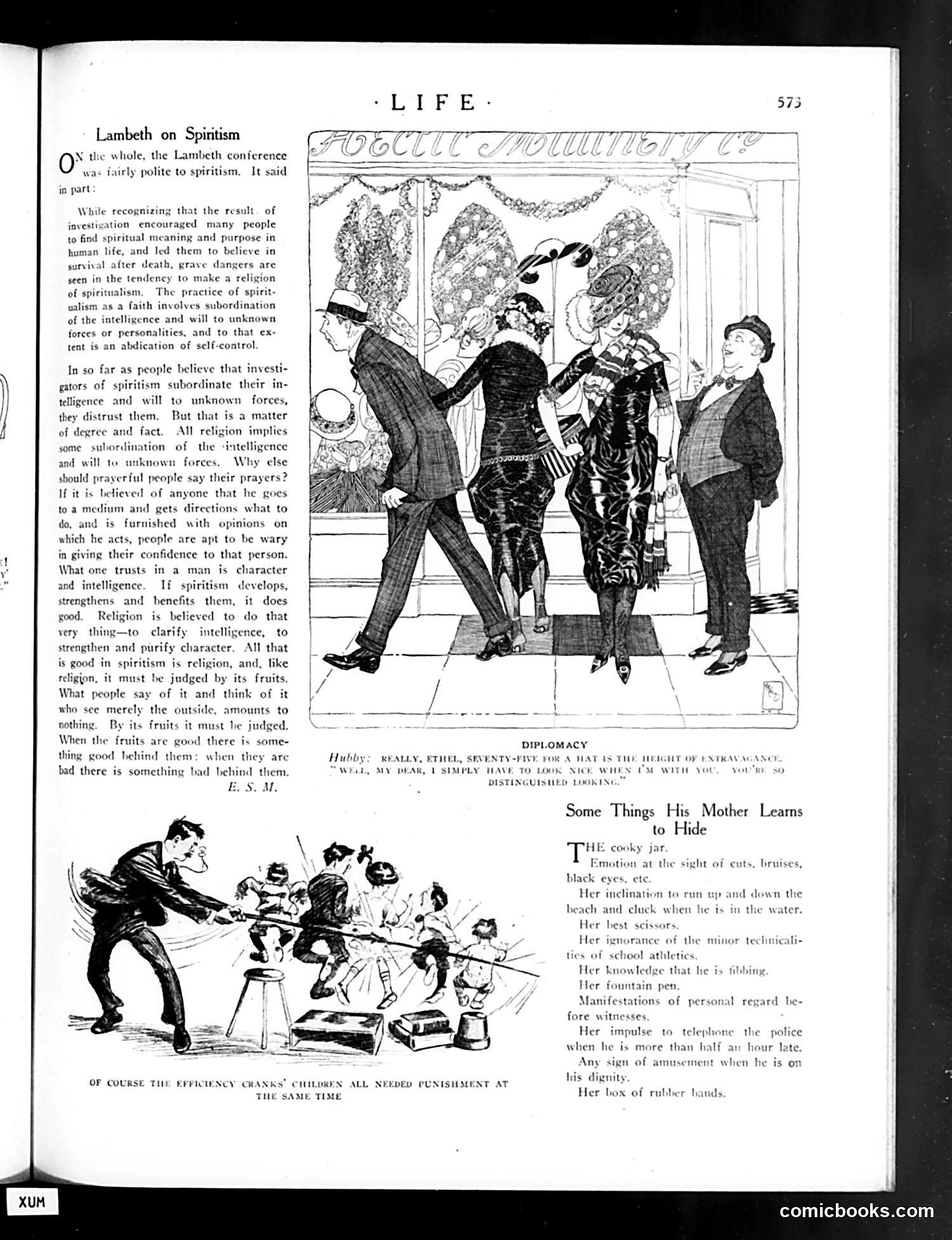
**Top Cartoon - "Diplomacy":** This illustration satirizes awkward social situations at formal gatherings. A tall, thin man in evening dress appears to be making an exaggerated, uncomfortable gesture while interacting with a woman in an elaborate black dress and another gentleman. The caption reads: "Hubby: Really, Ethel, seventy-five for a hat is the height of extravagance. Well, my dear, I simply have to look nice when I'm with you. You're so distinguished looking." The satire mocks both marital arguments about women's spending and the ironic dynamics of social pretense—the husband criticizes his wife's hat expense while complimenting her appearance and suggesting his own need to look good by association. **Bottom Section - "Some Things His Mother Learns to Hide":** A list-format cartoon showing a mother frantically managing multiple misbehaving children, satirizing the gap between children's chaotic reality and the dignified image mothers must maintain publicly.
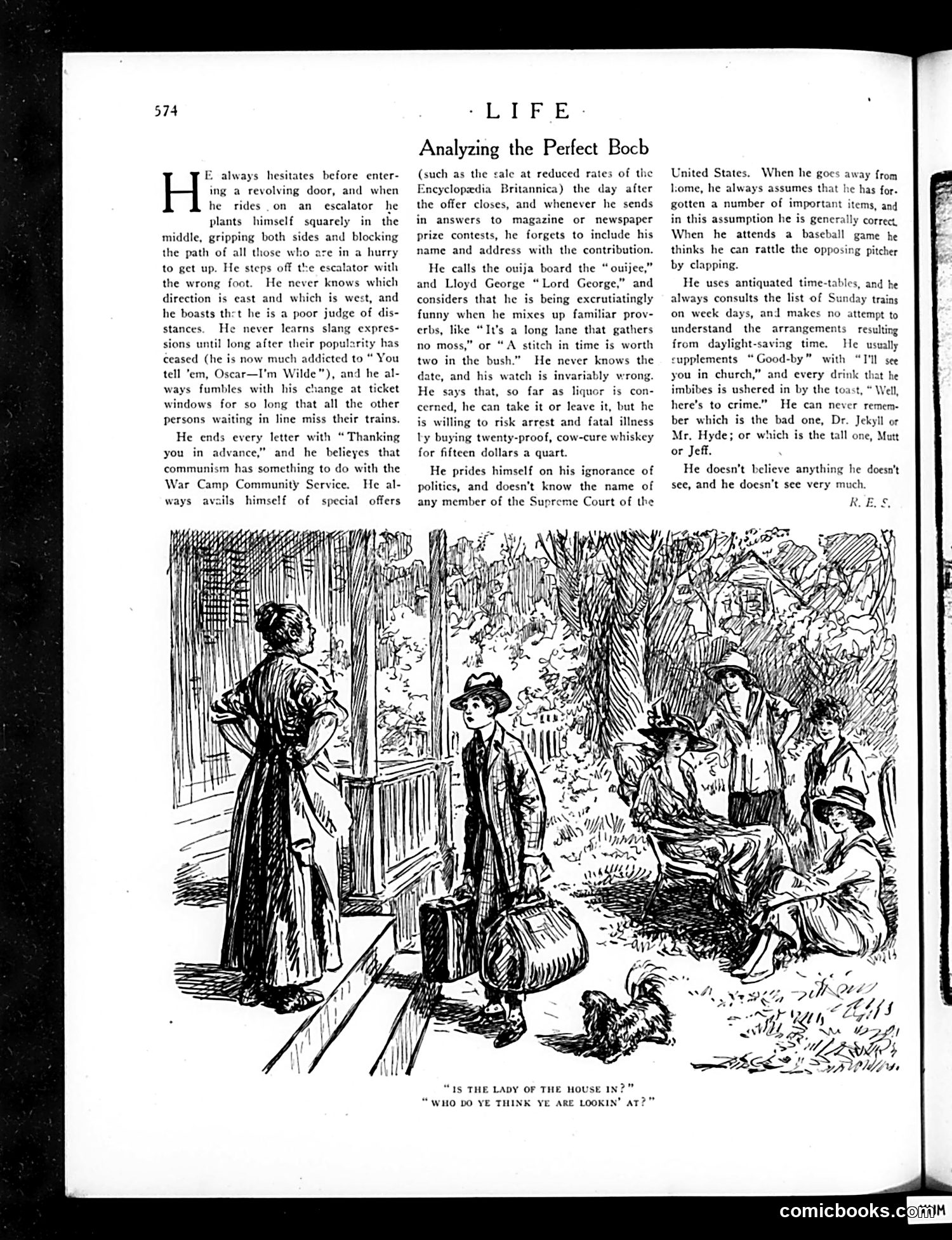
This page satirizes a man characterized by social incompetence and obliviousness. "Bob" exemplifies someone who: - Constantly makes social blunders (entering revolving doors incorrectly, misjudging distances) - Remains ignorant of current events and politics, unable to name Supreme Court justices - Participates in contests and magazine contests while forgetting to include his name - Misquotes common sayings and proverbs - Avoids War Camp Community Service work through excuse-making - Frequents bars, misses trains through tardiness, and generally operates through sheer luck The accompanying illustration depicts an awkward scene—likely showing Bob's characteristic social ineptitude among gathered figures. The satire targets a particular archetype of American male incompetence and willful ignorance, presented as entertainment for Life's readers.
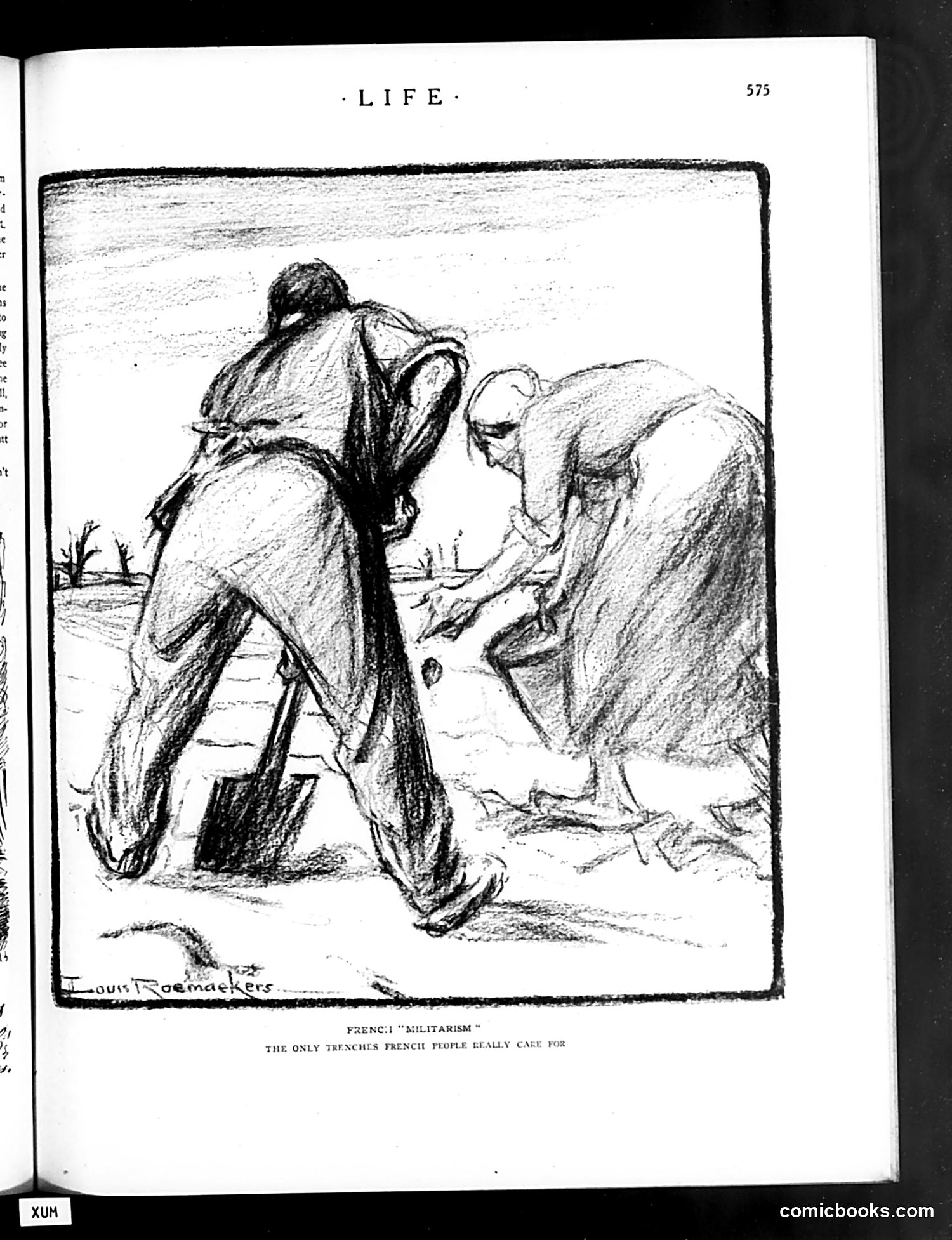
This cartoon by Louis Raemackers depicts "French 'Militarism'" and shows two figures in a trench setting—likely representing French military personnel or soldiers. The caption states: "The only trenches French people early cage for," suggesting satirical commentary on French military priorities or the prevalence of trench warfare in France. Given the historical context of Life magazine's satirical work, this appears to criticize French military culture or wartime decisions, possibly implying that the French military establishment is overly focused on trench-based warfare. The sketch shows soldiers in what appears to be a WWI-era trench environment, making sardonic commentary on French military strategy or the nation's approach to modern warfare through its trenches.
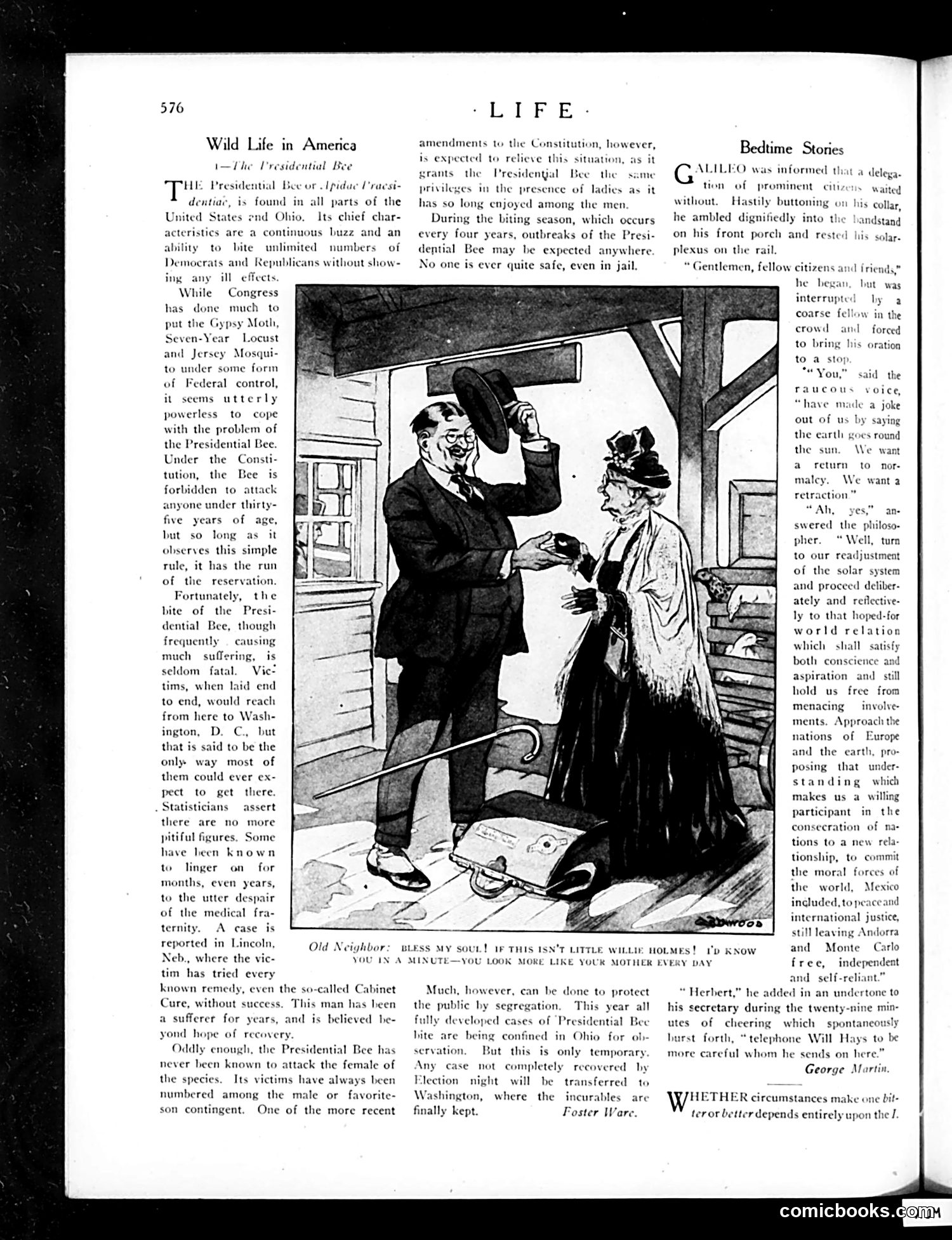
**The Main Cartoon** ("Old Neighbor") depicts a well-dressed man confronting an elderly woman at her doorstep. He's holding his hat and appears agitated, while she looks shocked. The caption reads: "BLESS MY SOUL! IF THIS ISN'T LITTLE WILLIE HOLMES! I'D KNOW YOU IN A MINUTE—YOU LOOK MORE LIKE YOUR MOTHER EVERY DAY." This is a classic insult disguised as a compliment—suggesting the man has become unattractive or effeminate by resembling his mother. The joke trades on period attitudes about masculine appearance and the sting of being compared unfavorably to one's mother. **Left Column Text** discusses the "Presidential Bee" (Presidential Bee infestation) affecting American politics, drawing a parallel between uncontrollable insect pests and political disruption.
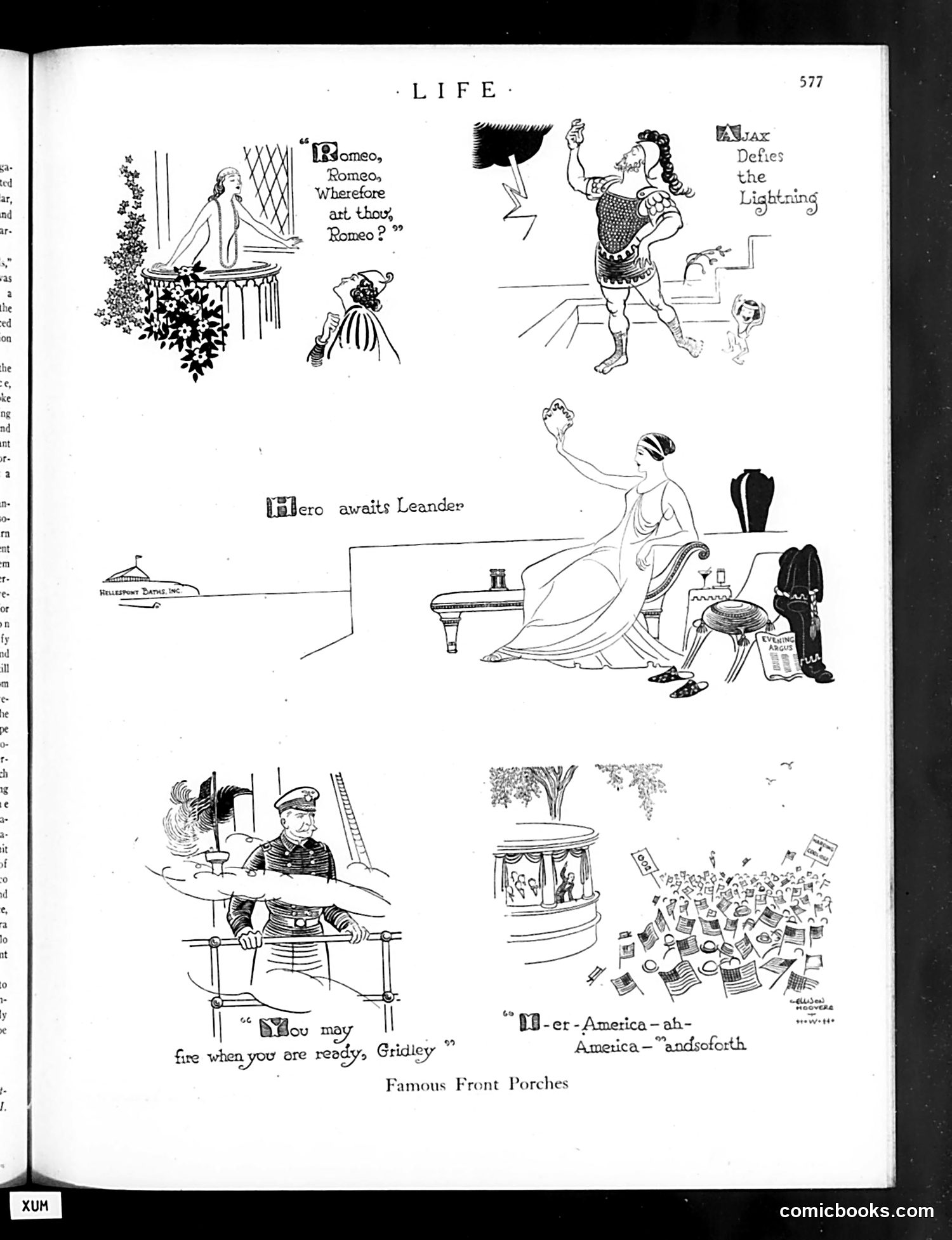
This page contains several satirical vignettes labeled "Famous Front Porches." The top illustration depicts Romeo and Juliet, referencing Shakespeare's famous balcony scene. Below, "Hero awaits Leander" shows classical mythology. The bottom panels mock American domestic life: one shows a military officer with a woman (captioned "You may fire when you are ready, Gridley"), referencing a famous naval command; another depicts "D-er-America-ah-America-andsoforth," apparently satirizing overwrought patriotic speechmaking or theatrical performance. The cartoons collectively mock romanticized or grandiose moments repackaged as ordinary American front-porch scenes—juxtaposing literary/historical drama with mundane domesticity. The humor relies on readers recognizing the classical and historical references being domesticated and trivialized.
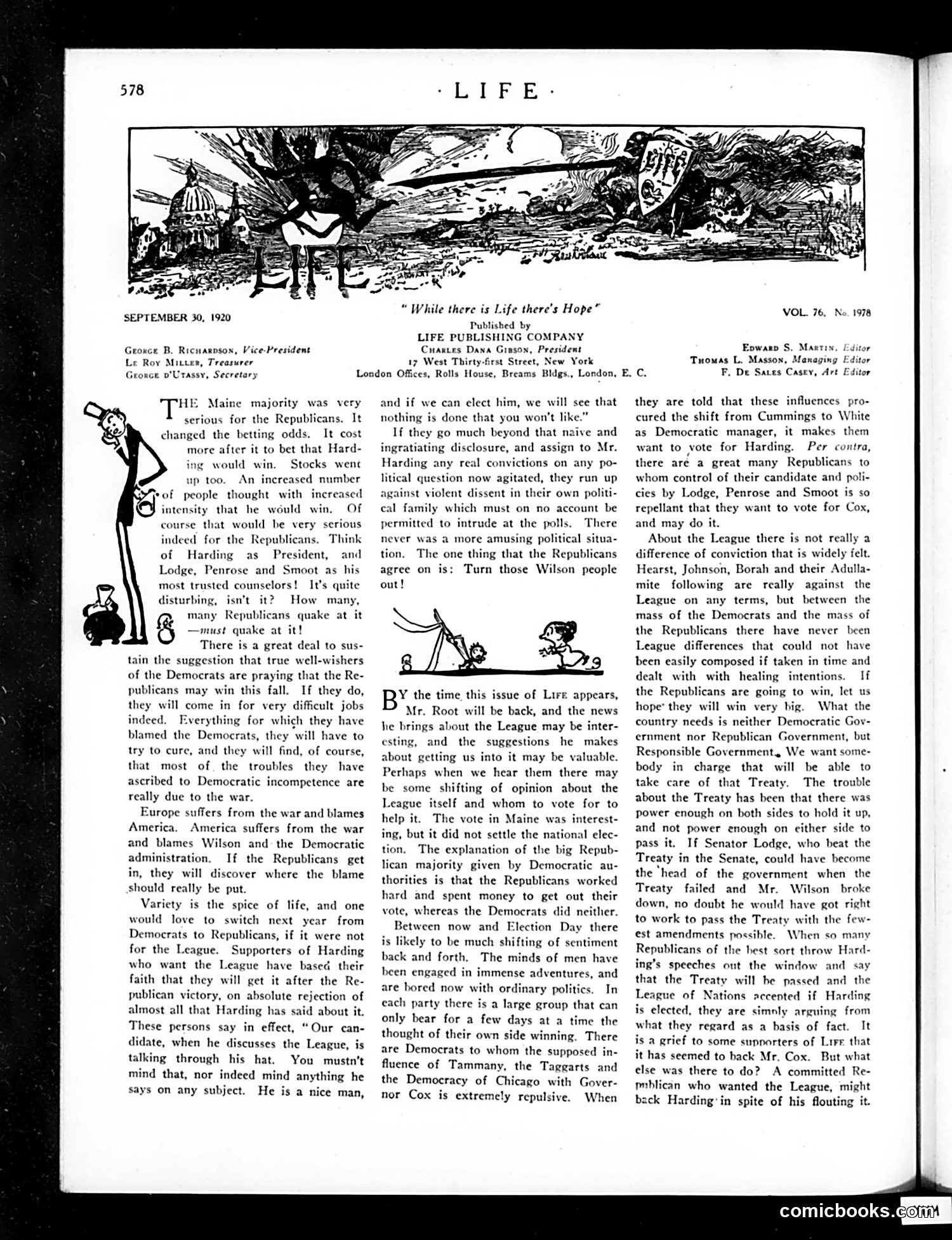
This editorial discusses the 1920 U.S. presidential election between Republican Warren G. Harding and Democrat James Cox, following Maine's recent Republican victory in early voting. **The Cartoons** (left margin): Simple illustrations of figures appearing anxious or distressed—likely representing Republicans nervous about their own candidate or Democrats worried about electoral prospects. **Key Political References:** - **Harding vs. Cox**: The Republican and Democratic presidential candidates - **The League of Nations**: The contentious issue dividing Republicans; some Harding supporters hope he'll join it despite his public skepticism - **Lodge, Penrose, Smoot**: Republican senators whom the writer sarcastically suggests would advise President Harding—apparently seen as undesirable by some Republicans - **Tammany Hall, Taggarts, Cox**: Democratic political machines the author notes repel some Democrats **The Satire's Point**: The writer humorously argues that Republicans are internally conflicted about their own candidate, while Democrats face defections over their party's urban machine politics. Both parties are united mainly by "Turn those Wilson people out!"—negative motivation rather than positive vision.
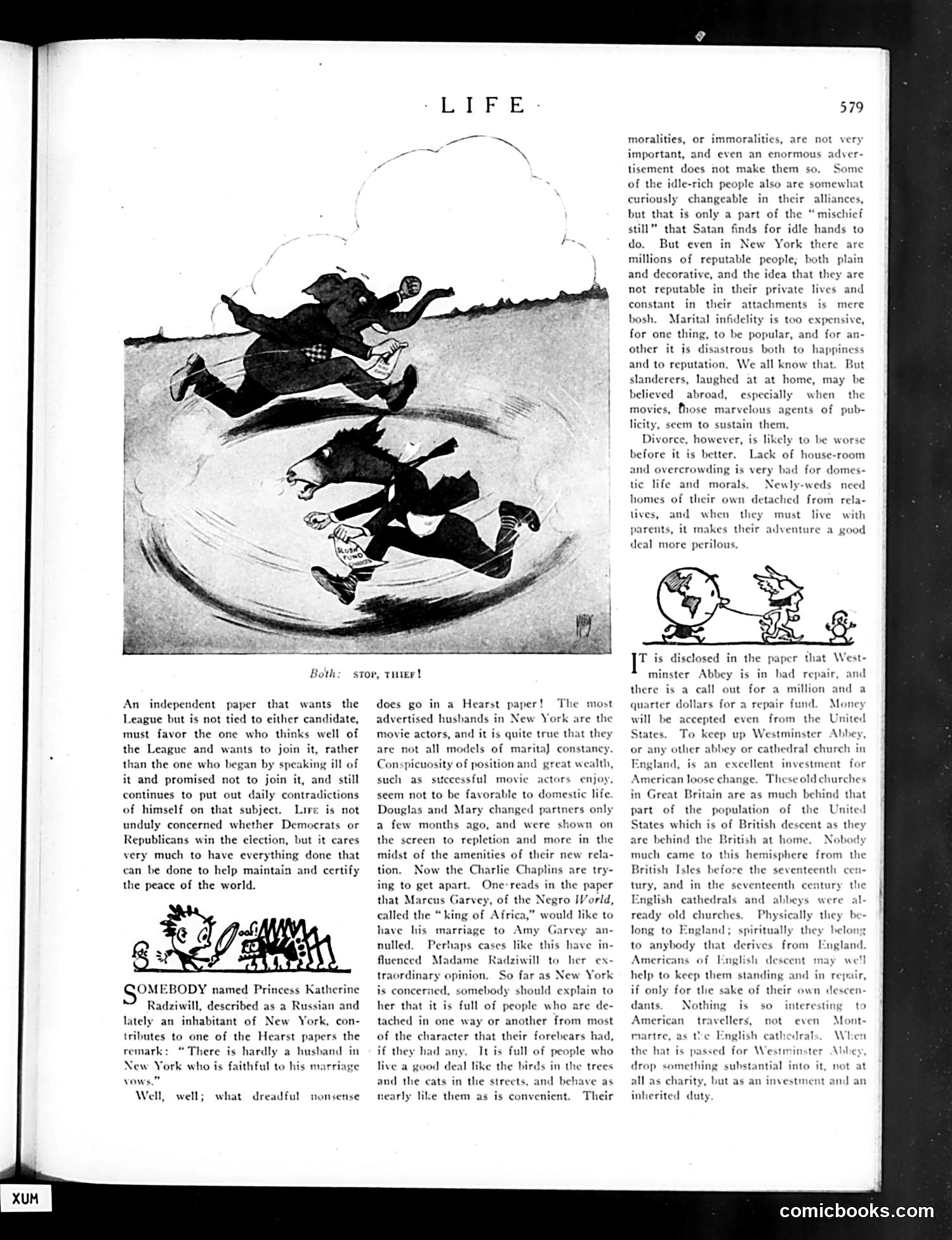
This page contains two distinct pieces of social commentary typical of Life's satirical approach. **The Main Cartoon** ("Both: stop, thief!") depicts two figures tumbling in a whirlwind, illustrating the article's discussion of marital infidelity and divorce among New York's wealthy. The cartoon satirizes how scandals—particularly involving movie actors—are sensationalized and perpetuated by newspapers and cinema. **The Text** addresses two separate topics: 1. **Movie stars and morality**: The piece argues that while the wealthy are portrayed as immoral in tabloids, actual infidelity is economically unfeasible for most people. It names real figures—Douglas Fairbanks and Mary Pickford (who recently divorced), and Charlie Chaplin—as examples of celebrity marital drama. 2. **Westminster Abbey repairs**: A brief note discusses fundraising for the Abbey's restoration, arguing that Americans of English descent should contribute to maintaining these historical monuments. The page's tone is characteristic of Life: cynical about celebrity gossip while defending ordinary Americans' morality.
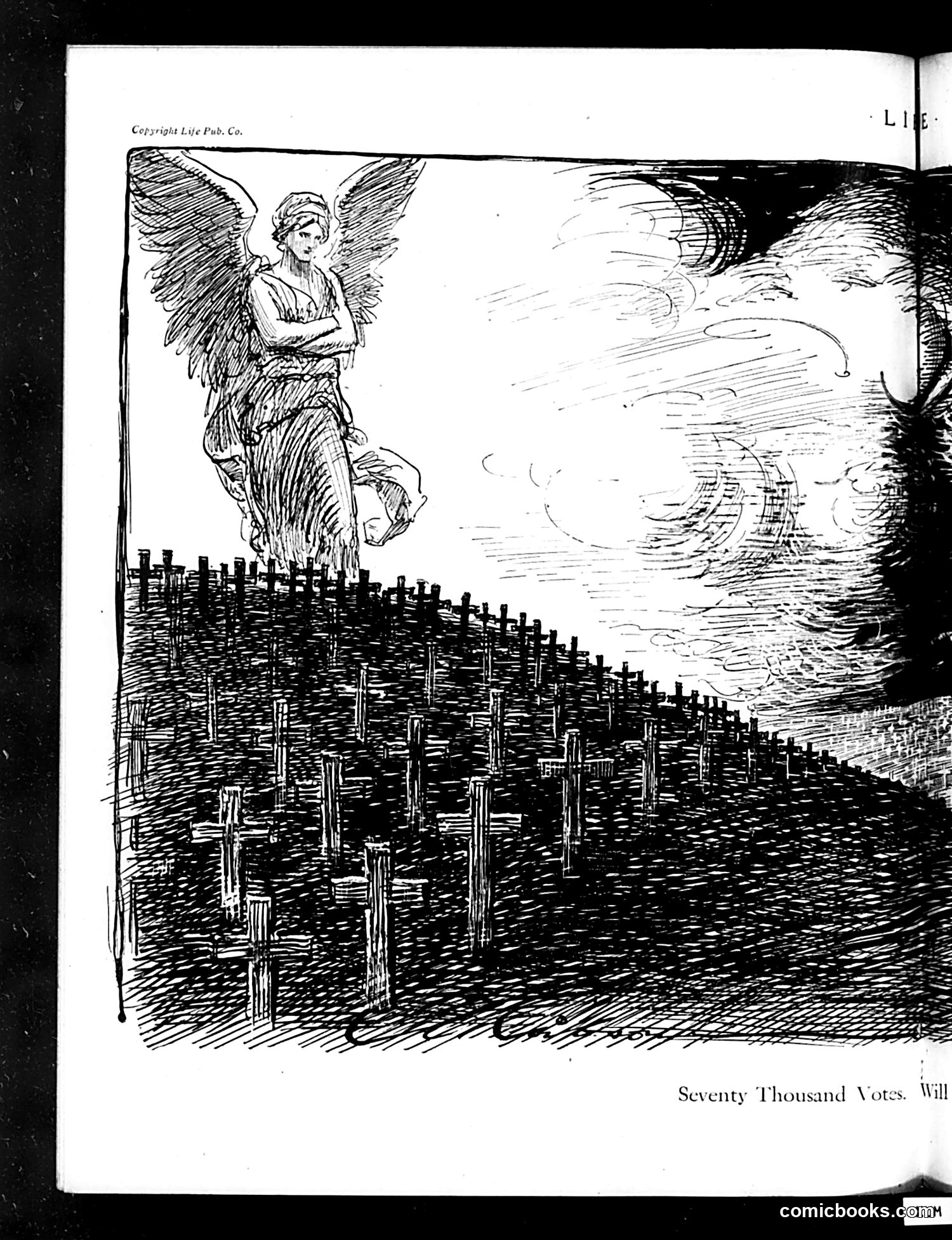
This appears to be an early 20th-century Life magazine editorial cartoon addressing voting or electoral politics. The image depicts an angel or allegorical figure standing above a vast military cemetery—rows of white crosses stretching across a battlefield. The caption references "Seventy Thousand Votes." The satire likely critiques the human cost of war or conflict being reduced to mere political calculations. The angel figure suggests divine judgment or moral oversight, contrasting sharply with the mechanistic counting of votes below. The "seventy thousand" likely represents casualties or losses being coldly quantified for political gain. Without more specific historical context, the exact political reference remains unclear, though the imagery powerfully condemns treating warfare's tragic toll as electoral currency.
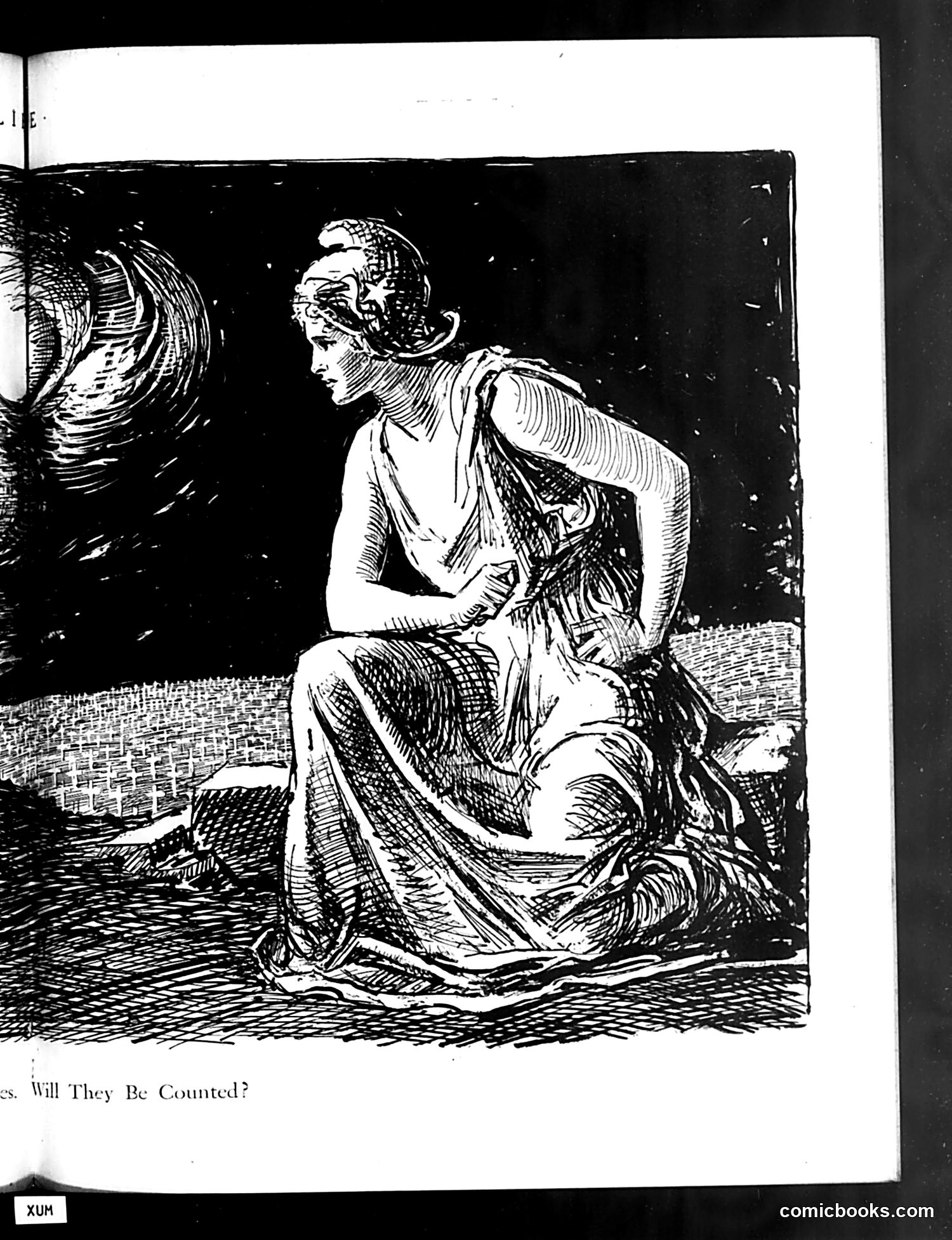
This political cartoon depicts a woman in classical or allegorical dress, seated and appearing contemplative or concerned. The caption "Will They Be Counted?" suggests the work addresses women's suffrage and voting rights—specifically, whether women will be included in official census counts or recognized as full citizens with voting power. The classical styling of the female figure suggests she represents "Woman" or "Womanhood" as an abstract principle. The questioning tone of the caption implies uncertainty about women's political recognition and enfranchisement during this era of American debate over women's suffrage (likely early 20th century, given Life magazine's publication period). The satire critiques society's ambivalence toward women's full civic participation and rights.
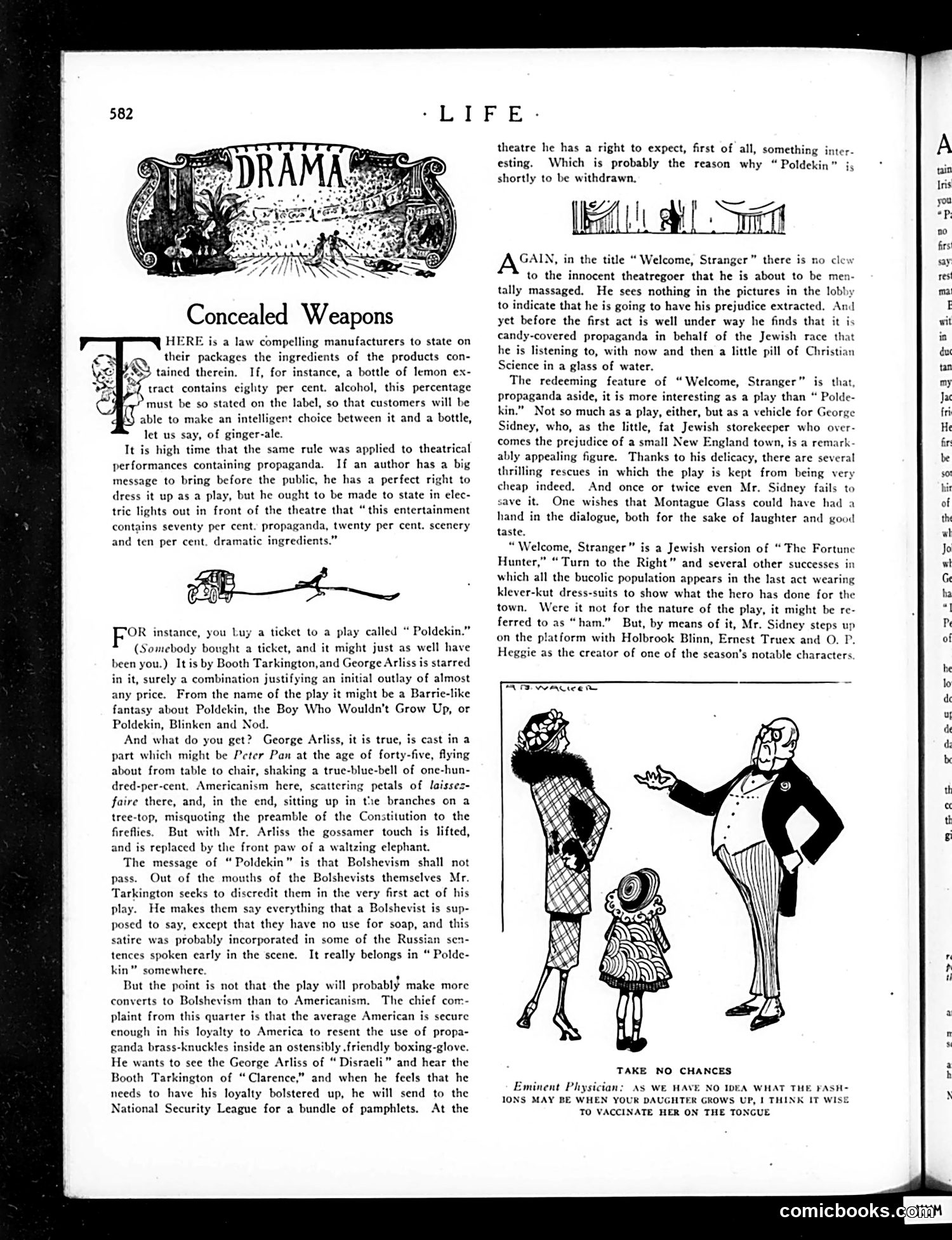
This article attacks plays that disguise political messaging as entertainment. The author argues that just as consumer products must list ingredients, theatrical performances containing propaganda should display warnings. The main target is **"Poldekin,"** a play by Booth Tarkington starring actor George Arliss. The satire criticizes the play for wrapping anti-Bolshevik propaganda in entertainment—using a whimsical fantasy premise to deliver political messaging against communism. The author argues that while Americans are secure enough in their loyalty to not need such "brass-knuckles" tactics, audiences resent being manipulated into political positions under the guise of drama. A secondary example, **"Welcome, Stranger,"** similarly uses entertainment to promote Jewish interests and Christian Science doctrine—described as "candy-covered propaganda." The cartoon (bottom right, captioned "Take No Chances") appears to mock the deceptive nature of such theatrical manipulation, though details are unclear from the image alone. The satire's core point: entertainment should entertain first; politics should be transparent, not hidden.
This page reviews Broadway plays from approximately 1919-1920. The main theater criticism discusses "Little Old New York," a play set in 1810 featuring historical figures like Cornelius Vanderbilt and John Jacob Astor as young friends. The reviewer praises actress Genevieve Tobin's performance as Patricia O'Day, a female character disguised as a boy. The critic notes this cross-dressing role could have been disastrous—particularly objectionable being "an Irish colleen dressed up as a boy," reflecting period prejudices against Irish stereotypes in theater. However, Tobin's talent overcomes these theatrical conventions and makes the production charming. The page also mentions Thomas Dixon's play "A Man of the People" about Lincoln, noting the incongruity of Dixon—known for pro-segregation views—writing about the "Great Emancipator." The remaining text lists other theatrical productions with brief notices.
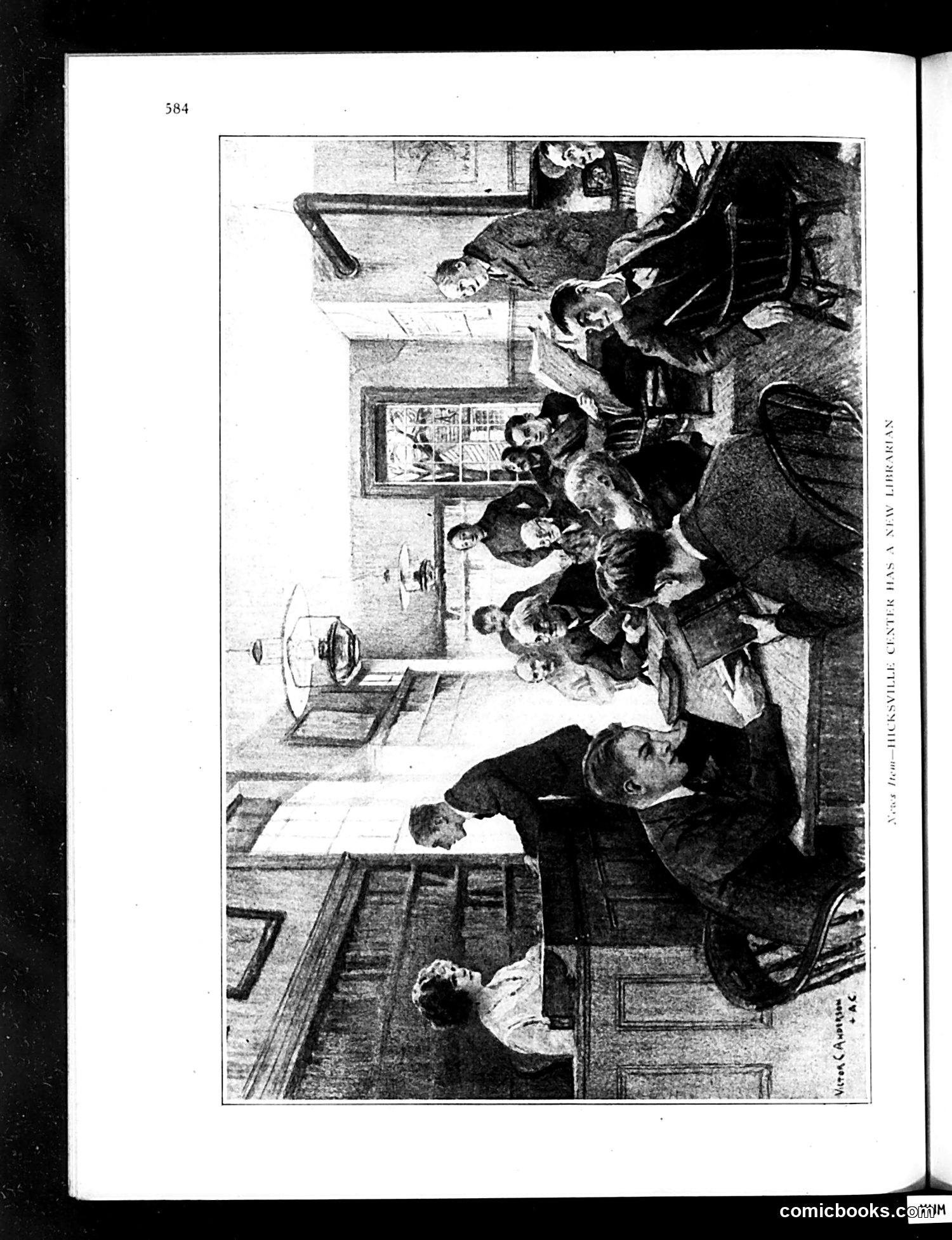
I can see this is a black and white photograph or illustration rotated 90 degrees, showing what appears to be an interior scene with multiple figures in formal dress gathered indoors. However, the OCR text is heavily corrupted and illegible, making it impossible to identify the specific cartoon, figures, or satirical point being made. Without reliable text to cross-reference with the image, I cannot accurately identify who these figures represent, what historical or political context is being referenced, or what the intended satire means. The image quality and rotation further complicate analysis. To properly explain this content to a modern reader, I would need either clearer OCR text or additional publication information (date, title, author).
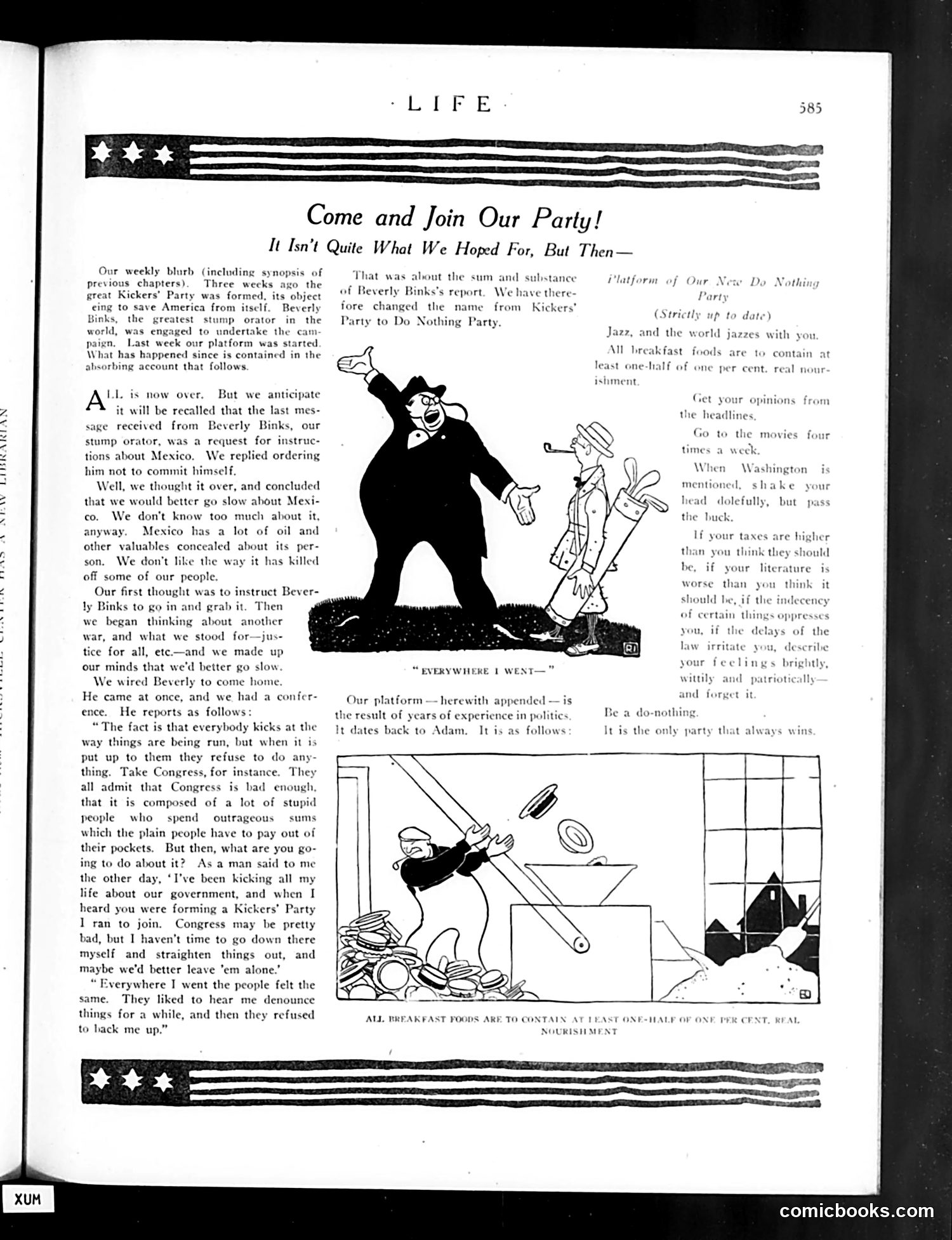
This Life magazine page satirizes American political apathy and the futility of reform movements. The "Kickers' Party" was formed to "save America from itself," but their stump orator Beverly Binks discovers that while citizens complain constantly about government problems—Congress, taxes, laws, morality—they refuse to actually *do* anything about them. The cartoon shows a man kicking money out of his pocket, illustrating the disconnect between complaint and action. The resulting platform is darkly humorous: the "Do Nothing Party" explicitly endorses inaction, advising people to vent their frustrations "brightly, wittily and patriotically—and forget it." The satire targets both passive voters who grumble without engaging civically and the politicians who profit from public discontent without delivering change. The phrase "It is the only party that always wins" suggests cynically that doing nothing—maintaining the status quo—is politically the safest course.
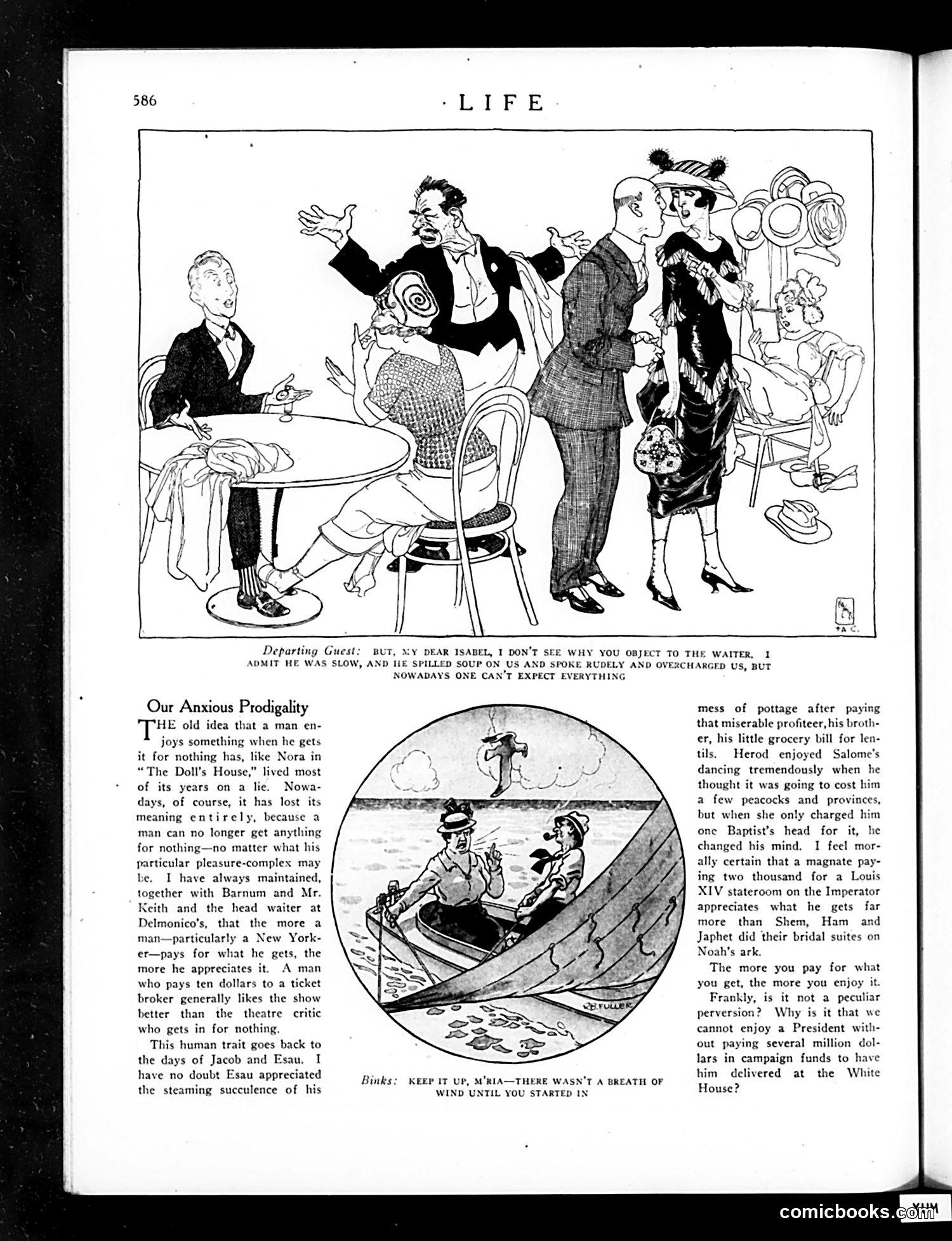
The top cartoon satirizes restaurant service standards. A departing guest defends a clearly incompetent waiter to his companion "Isabel"—the man was slow, spilled soup, spoke rudely, and overcharged them. The guest's rationalization: "nowadays one can't expect everything." This mocks how people rationalize poor service, suggesting lowered expectations have become normalized. The article "Our Anxious Prodigality" argues that people value things more when they pay for them. Using biblical references (Jacob and Esau, Herod and Salome), it suggests paying inflates perceived value. The final barb critiques presidential politics: Americans spend millions on campaign funds to "deliver" a President to the White House, yet wouldn't enjoy one obtained free—a satirical commentary on the cost of politics and questionable value received. The bottom cartoon's caption references wind and someone "starting in," though the full context remains unclear from the visible image.
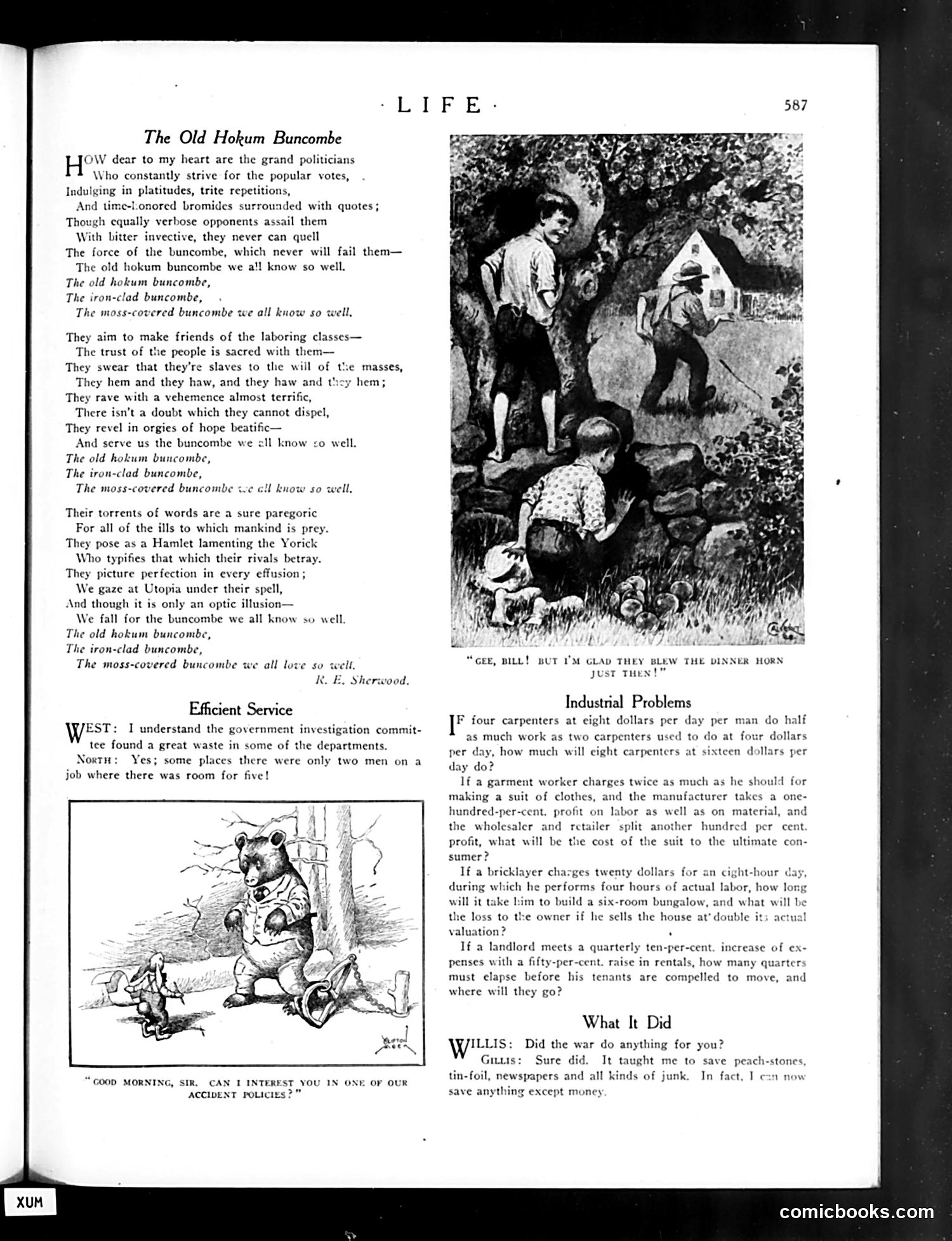
This page satirizes **American politicians and political rhetoric** through a song-poem by K.E. Sherwood. The satire targets politicians who win votes through empty promises and worn-out rhetoric ("buncombe"—meaning nonsense or deceptive talk). The poem mocks politicians who claim to champion working people while delivering only flowery speeches, theatrical emotion ("pose as a Hamlet"), and false visions of utopia. The repeated refrain emphasizes how voters knowingly accept this "buncombe" anyway. The accompanying cartoons reinforce the theme: one shows a bear (likely Uncle Sam or government) representing bureaucratic inefficiency, another depicts insurance salesmanship. The "Industrial Problems" section uses math word problems to expose economic exploitation—workers and manufacturers inflating costs at each level. The final "What It Did" joke suggests the war (likely WWI) taught people only to save junk, not money—implying widespread economic hardship despite wartime sacrifice. Overall, the page critiques political dishonesty and economic inequality in early 20th-century America.
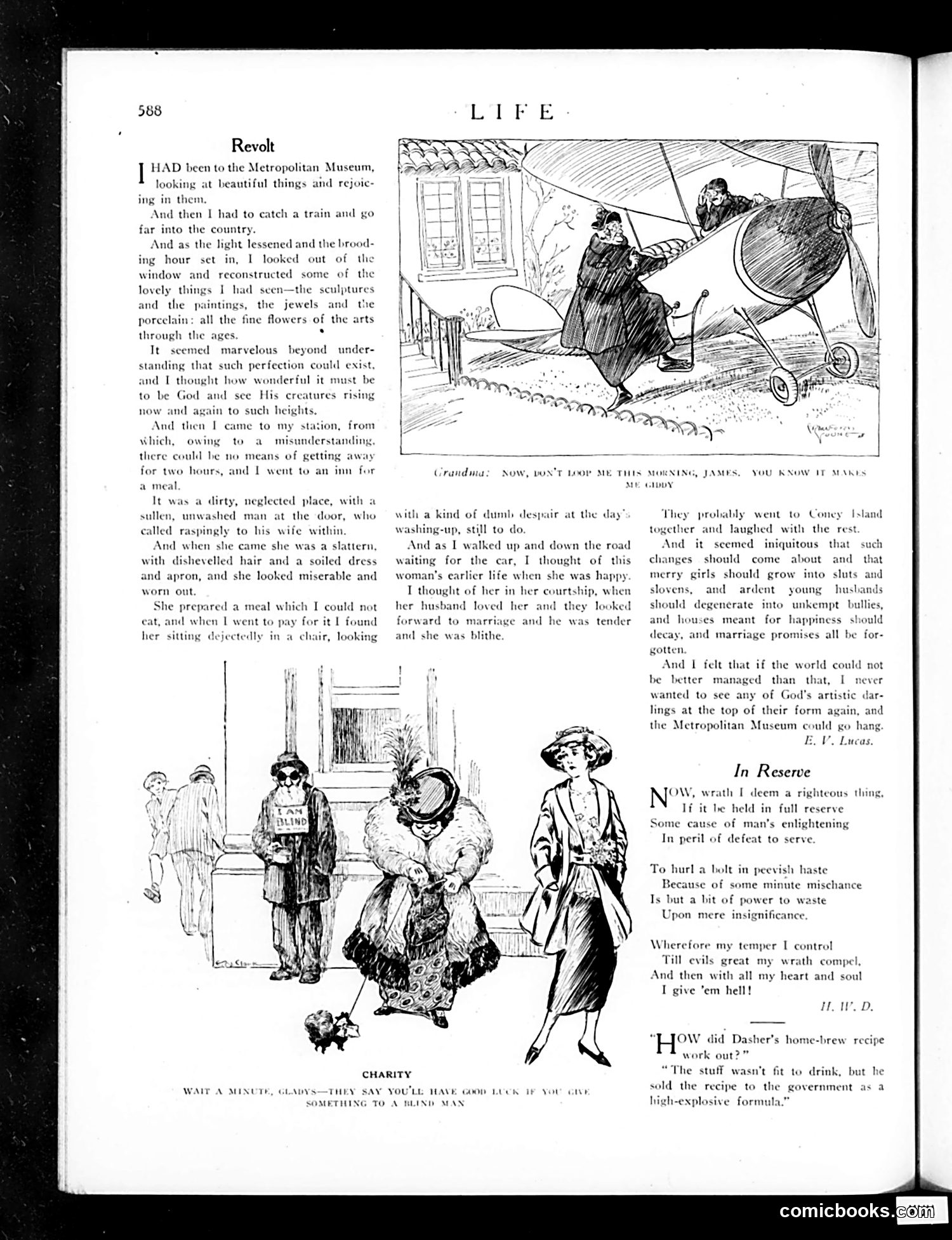
This page contains two distinct pieces satirizing social inequality: **"Revolt"** (main narrative with illustrations): The author contrasts visiting the Metropolitan Museum—appreciating humanity's artistic achievements—with a depressing train-station inn encounter. He meets a slovenly innkeeper couple, and reflects that the cheerful young woman this wife once was has deteriorated into an exhausted drudge. The satire critiques how marriage and poverty transform people, suggesting society is "better managed" if we ignore God's beautiful creations altogether rather than witness their degradation. It's social commentary on class, marriage, and wasted human potential. **"Charity"** (street scene cartoon): Shows well-dressed people approaching a beggar, with the caption suggesting superstitious charity ("good luck if you give something to a blind man"). The satire mocks superficial, self-interested charity—helping the poor not from genuine compassion but from superstition or desire for personal benefit. Both pieces critique indifference to human suffering and question whether civilization's "progress" means anything when ordinary people live in misery.
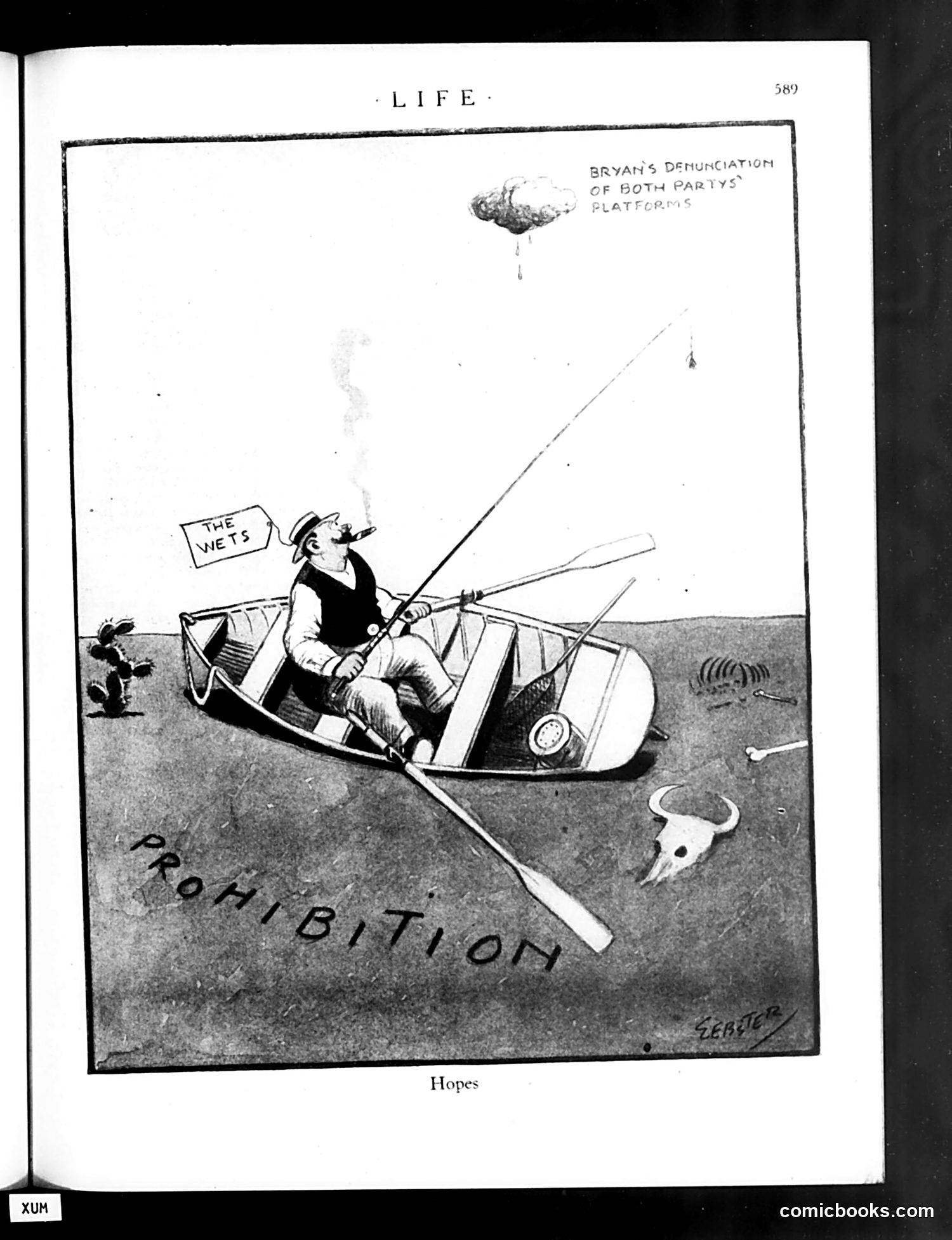
This satirical cartoon depicts a man labeled "The Wets" fishing in "Prohibition" waters. The caption references Bryan's denunciation of both political parties' platforms, likely referring to William Jennings Bryan and debates over alcohol prohibition policy. The cartoon's joke: a fisherman representing "wet" interests (those opposing Prohibition) is attempting to catch something in the prohibition landscape—suggesting futile or contradictory political maneuvering. The various creatures in the water and the surreal setting emphasize the absurdity of the political positions. The title "Hopes" suggests ironic commentary on political aspirations during this divisive era when Prohibition was a major partisan issue. Bryan's public criticism of both parties' stances on the matter appears to be the cartoon's topical reference.
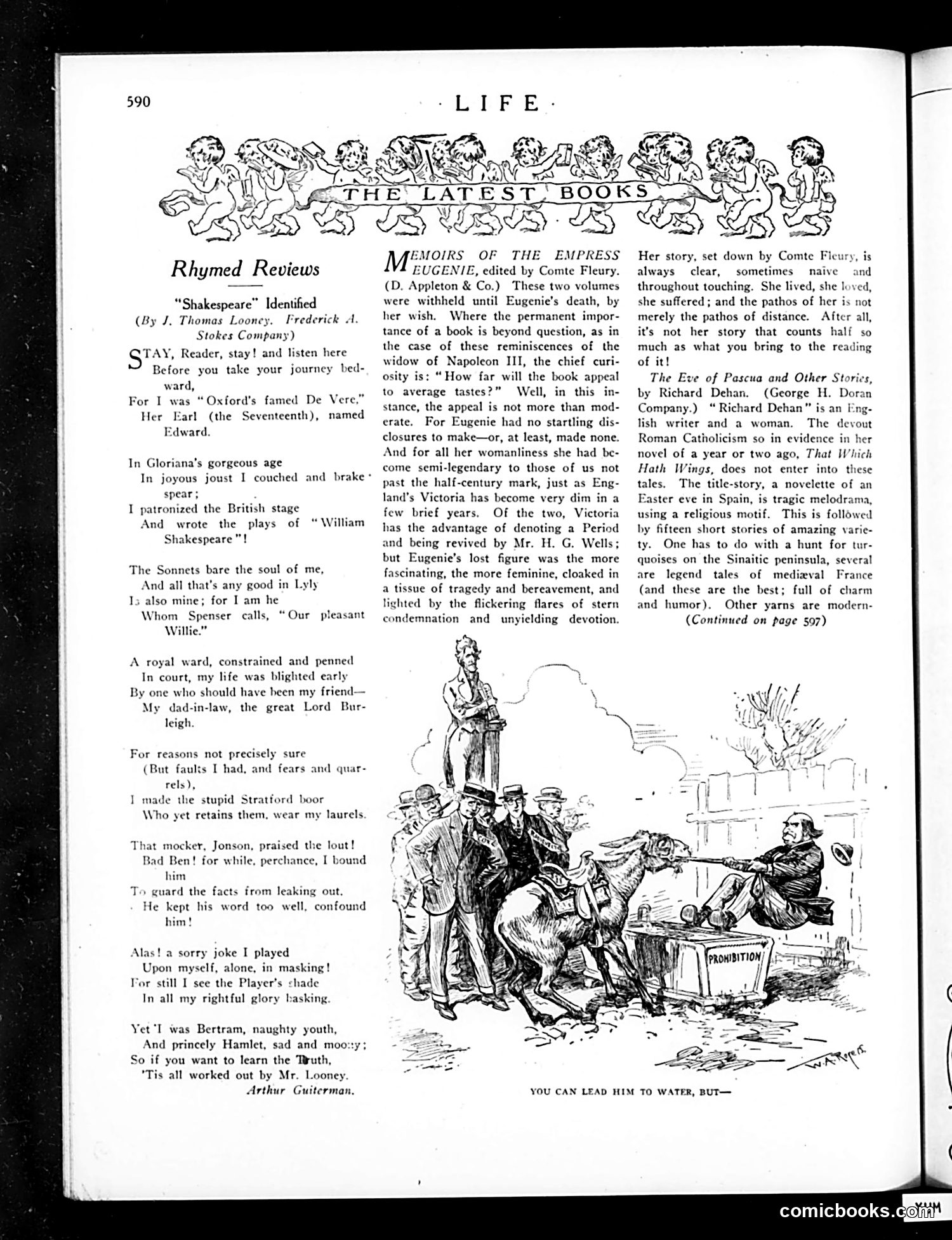
This page satirizes the "Shakespeare Authorship Question"—specifically J. Thomas Looney's 1920 theory that Edward de Vere, 17th Earl of Oxford, actually wrote Shakespeare's plays, not the "Stratford boor" William Shakespeare. The poem, attributed to Arthur Guiterman, mocks this theory by having "Oxford" confess he secretly authored all Shakespeare's work but let an illiterate actor take credit. The satire is sharp: Oxford complains he made "the stupid Stratford boor" famous while remaining anonymous, even fooling Ben Jonson into praising the impostor. The cartoon below (captioned "YOU CAN LEAD HIM TO WATER, BUT—") shows a donkey labeled "Prohibition" being led to water by men in formal dress—likely mocking Prohibition enforcement efforts as futile, suggesting you can't force compliance on an unwilling subject. The page primarily reviews recent books about Napoleon's widow Eugenie and stories by "Richard Dehan."
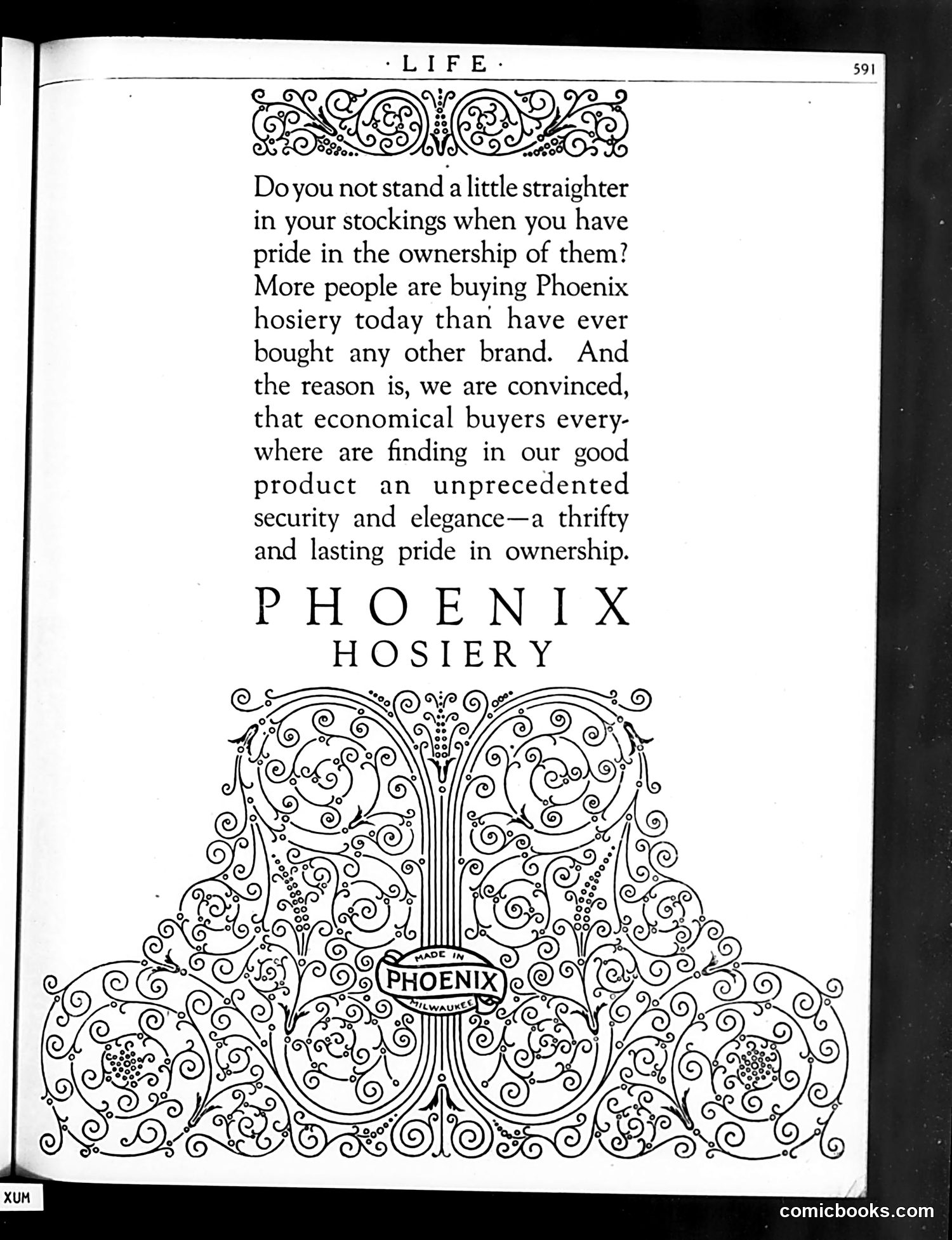
This is a full-page advertisement for Phoenix Hosiery, not political satire. The text appeals to consumer pride by suggesting that wearing quality stockings improves one's posture and self-esteem—literally making you "stand a little straighter." The ad claims Phoenix is outselling all competitors because economical buyers appreciate the combination of affordability ("thrifty") and elegance. The ornate decorative border and the stylized stocking imagery reinforce a message of quality and refinement. The pitch targets early-20th-century consumers' desire for both value and respectability. By marketing hosiery as conferring "pride in ownership," the advertisement transforms a mundane commodity into something psychologically rewarding—a marketing technique still used today.
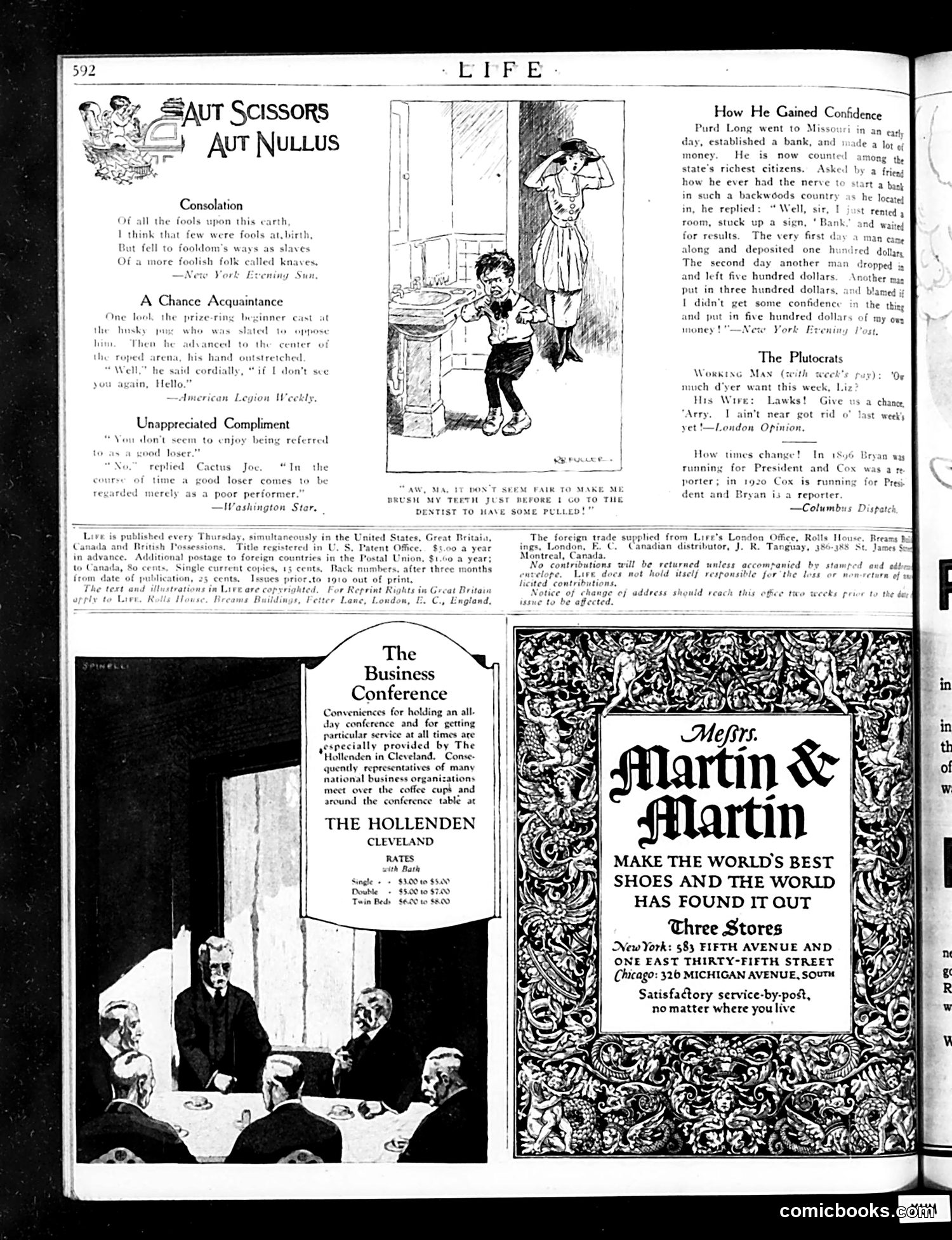
This page mixes humor columns with advertisements. The main cartoon shows a man at a dentist being told to brush his teeth before visits—a joke about poor hygiene habits. The text snippets are brief satirical pieces: "Consolation" mocks foolish people; "A Chance Acquaintance" plays on boxing slang; "Unappreciated Compliment" suggests a man prioritizes teeth-brushing over impressing his date. "How He Gained Confidence" tells of a backwoods banker who built trust by depositing others' money—a commentary on financial confidence schemes or banking practices of the era. "The Plutocrats" contrasts a working man asking his wife for weekly wages against her dismissing his needs—social satire about class and domestic economics. The advertisements promote The Hollenden Hotel (Cleveland business conferences) and Marvin & Marvin shoes (three store locations). The page reflects 1920s American life: workplace hierarchies, banking, consumer goods, and gender dynamics in domestic finances.
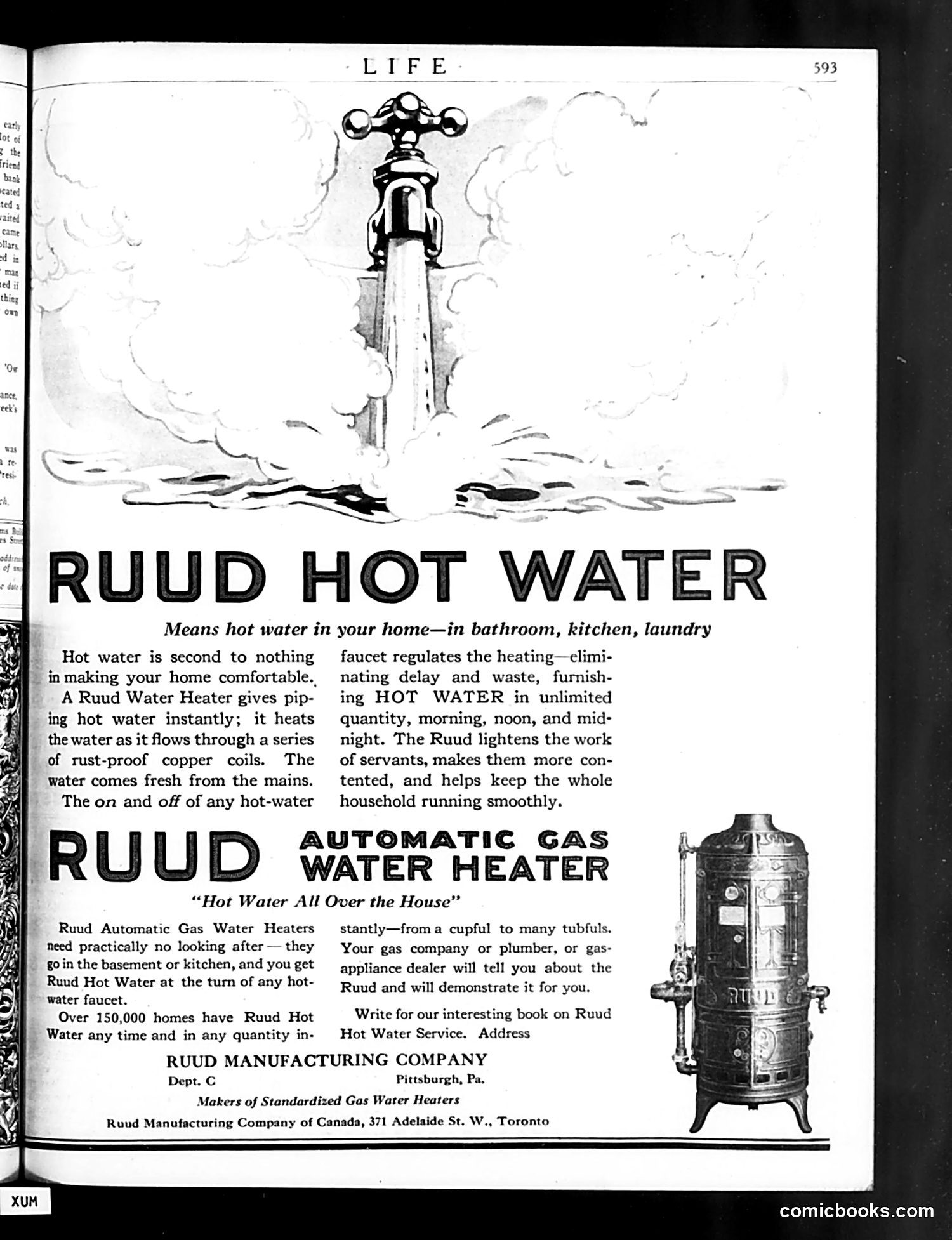
This page is **not a cartoon or satirical content** — it's a straightforward **product advertisement** for Ruud automatic gas water heaters, appearing in *Life* magazine (page 593). The ad promotes convenient hot water for domestic use across bathrooms, kitchens, and laundries. Key selling points include: instant heating via copper coils, no constant maintenance, and unlimited hot water supply "morning, noon, and mid-night." Notably, the copy emphasizes how the heater "lightens the work of servants, makes them more contented" — reflecting early 20th-century household dynamics where servants' labor was a concern for affluent homeowners. This detail reveals the target market: wealthy families with domestic staff. The illustration shows the tall cylindrical heater unit; a smaller diagram depicts it installed vertically. The ad lists Pittsburgh headquarters and a Toronto branch, indicating North American distribution. This is simply period advertising, not satire.
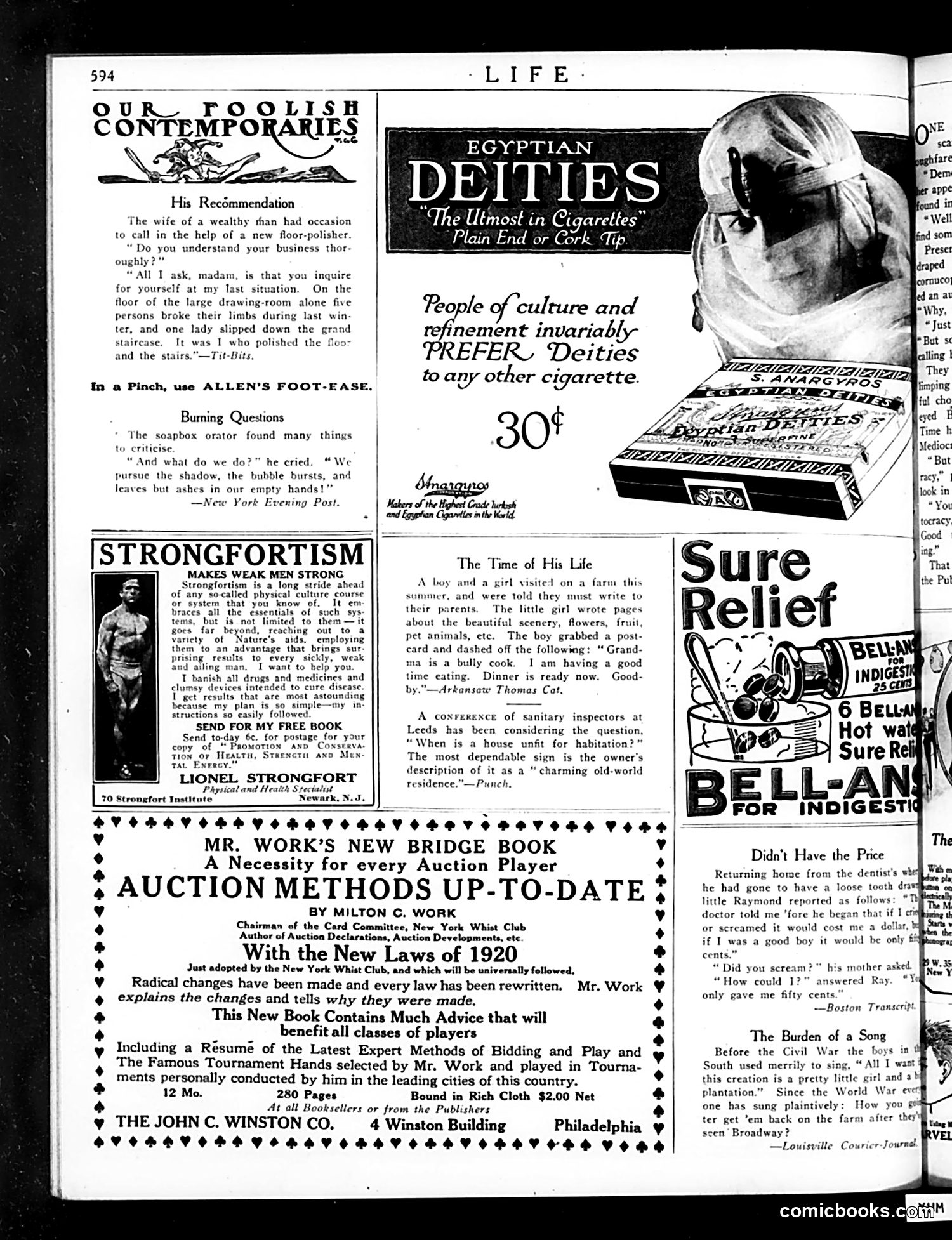
This page contains **primarily advertisements and brief humorous anecdotes** rather than political cartoons. The main satirical content appears in the "Our Foolish Contemporaries" section—short joke items mocking contemporary behavior. One anecdote ridicules a floor-polisher who boasts that five people broke their limbs in his employer's home, presenting dangerous incompetence as a credential. Another mocks a farm boy's postcard to his parents, reducing his experience to eating rather than appreciating nature—satirizing rural simplicity versus refined sensibility. The **Egyptian Deities cigarette ad** plays on cultural pretension, suggesting that people of "culture and refinement" prefer this brand, likely ironic commentary on marketing that appeals to snobbery. The page also features advertisements for physical culture courses (Strongfortism), bridge instruction books, and digestive remedies—typical early-1920s publications. No specific political figures or events are referenced; the satire targets general human foibles and consumer culture rather than particular contemporary politics.
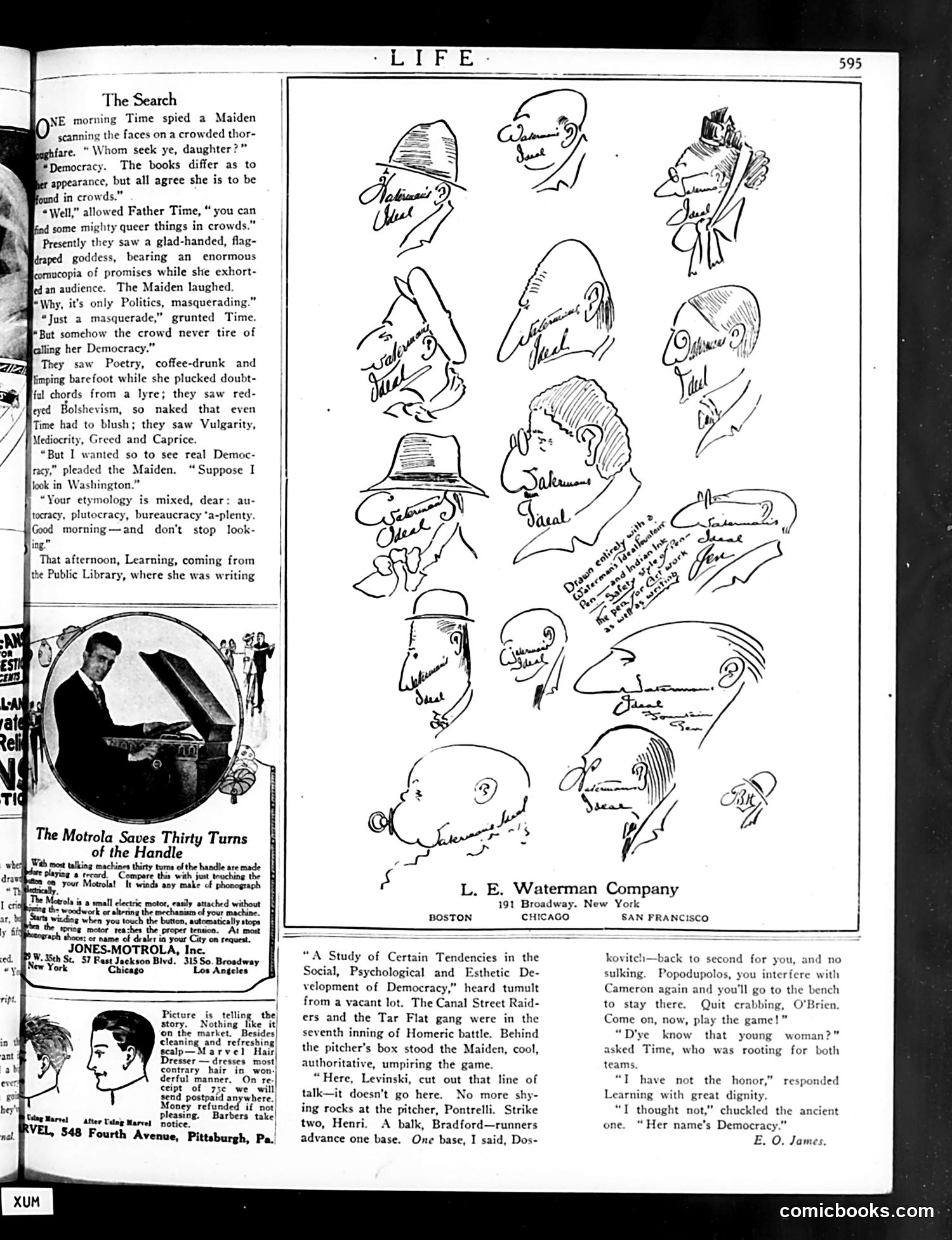
This allegorical cartoon satirizes the difficulty of finding genuine "Democracy" in American society. Father Time and the Maiden (representing Democracy) search through a crowded city, encountering fraudulent substitutes: "Politics" disguised as a glad-handed goddess, "Poetry," "Bolshevism," and "Vulgarity." When the Maiden asks to see "real Democracy," Father Time suggests looking in Washington—then sarcastically corrects himself, listing instead "autocracy, plutocracy, bureaucracy." The punchline arrives when they discover the true embodiment of Democracy: an umpire managing a street baseball game between immigrant children (Levinski, Pontrelli, Henri, etc.), enforcing fair rules impartially and maintaining order. The satire suggests that authentic democracy functions not in politics or high society, but in ordinary people fairly applying rules without favoritism—even in humble street games. The immigrant names emphasize that American democracy belongs to working-class newcomers, not the political establishment.
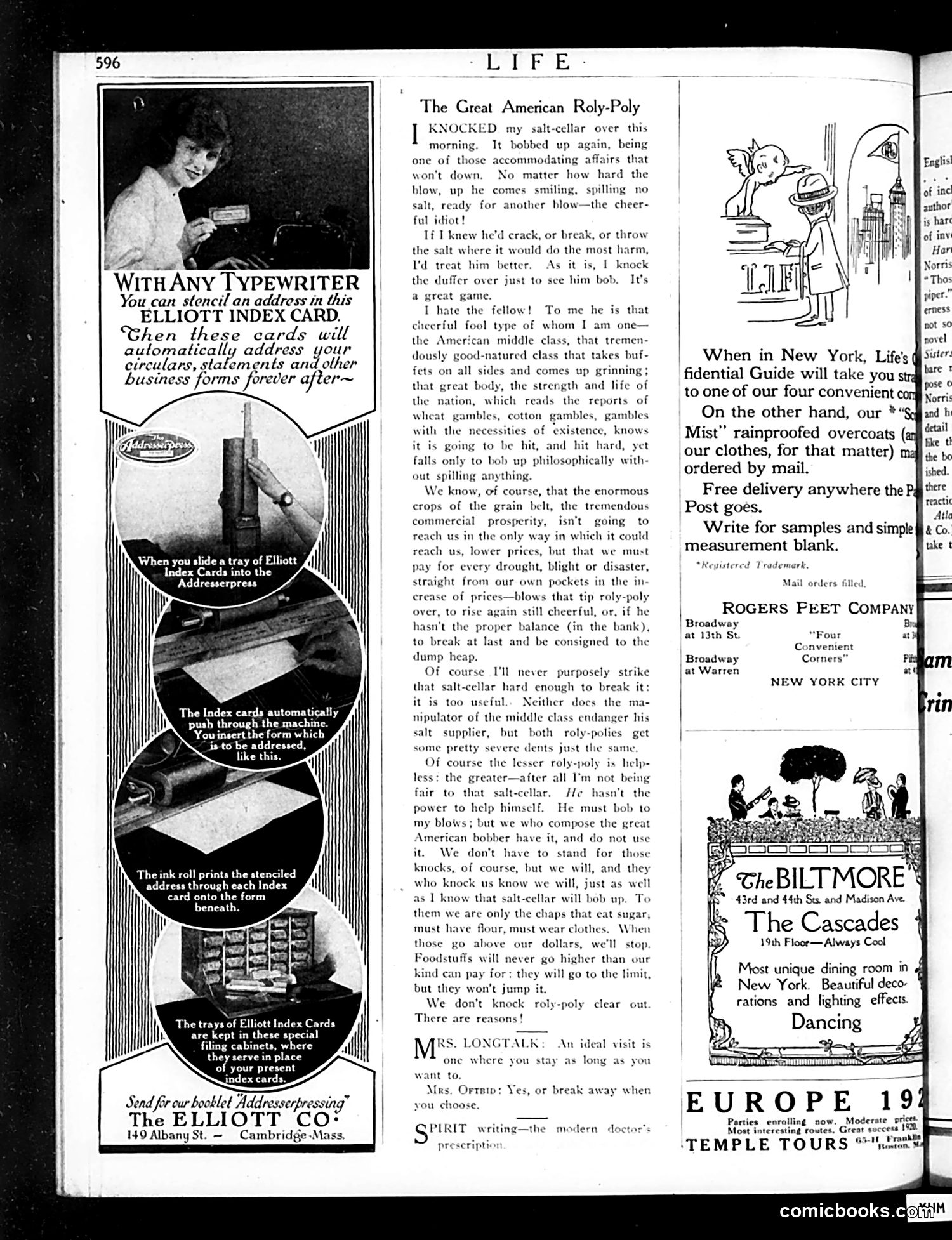
This page contains a satirical essay called "The Great American Roly-Poly," which uses a wobbling salt shaker as an extended metaphor for the American middle class. The author deliberately knocks over a salt shaker to watch it bob back up, comparing this to how ordinary Americans absorb economic hardship without resistance. The "roly-poly" is the cheerful, resilient working person who suffers from price manipulation, crop gambling, and wealth extraction yet never demands better—just keeps "bobbing up" smiling. The satire's point: the American middle class has the power to resist economic exploitation but chooses not to. They accept inflated prices, unfair practices, and financial instability as inevitable, never striking back hard enough to actually create change. The author critiques this passive acceptance of mistreatment by the powerful, comparing the exploited masses to an inanimate toy designed to absorb blows. This reflects early 20th-century *Life* magazine's tradition of social commentary on capitalism and class relations.
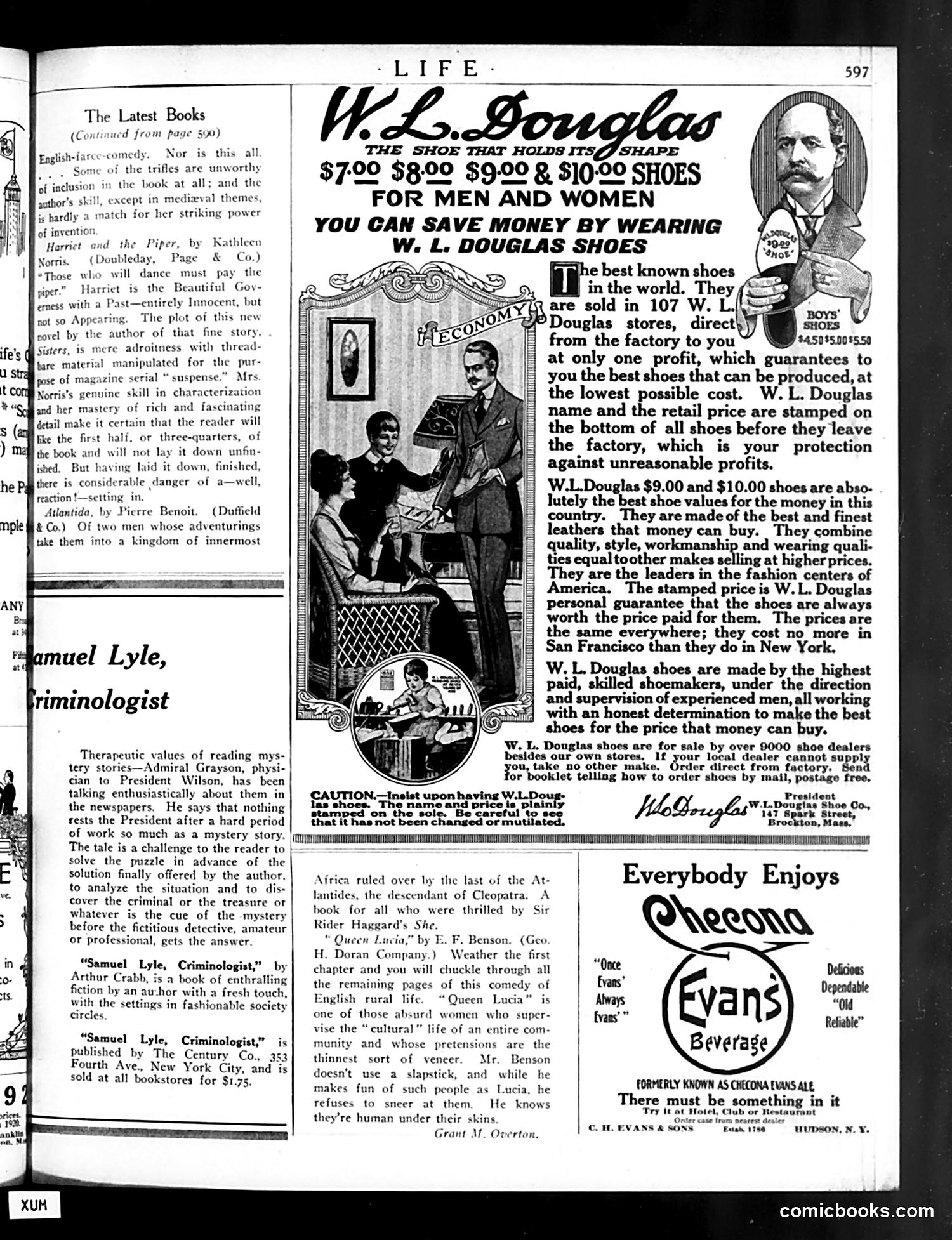
This page is primarily **advertising**, not political satire. The dominant content is a W.L. Douglas shoe advertisement featuring the company founder's portrait and an illustration of a shoe salesman with customers. The ad's rhetorical strategy is notable: Douglas emphasizes that shoes are "stamped on the bottom" with the retail price as "your protection against unreasonable profits"—a pitch designed to appeal to early-20th-century consumer consciousness about price-fixing and manufacturer markups. The claim that prices are "the same everywhere" underscores this anti-monopoly messaging. The page also includes book reviews, including one for "Samuel Lyle, Criminologist," described as an entertaining mystery novel. The **Chicona Evans Beverage advertisement** at bottom right is incidental—a soft drink ad noting it was "formerly known as Chicona Evans Ale." There is **no political cartoon** on this page; the illustrations are commercial advertisements, not satire.
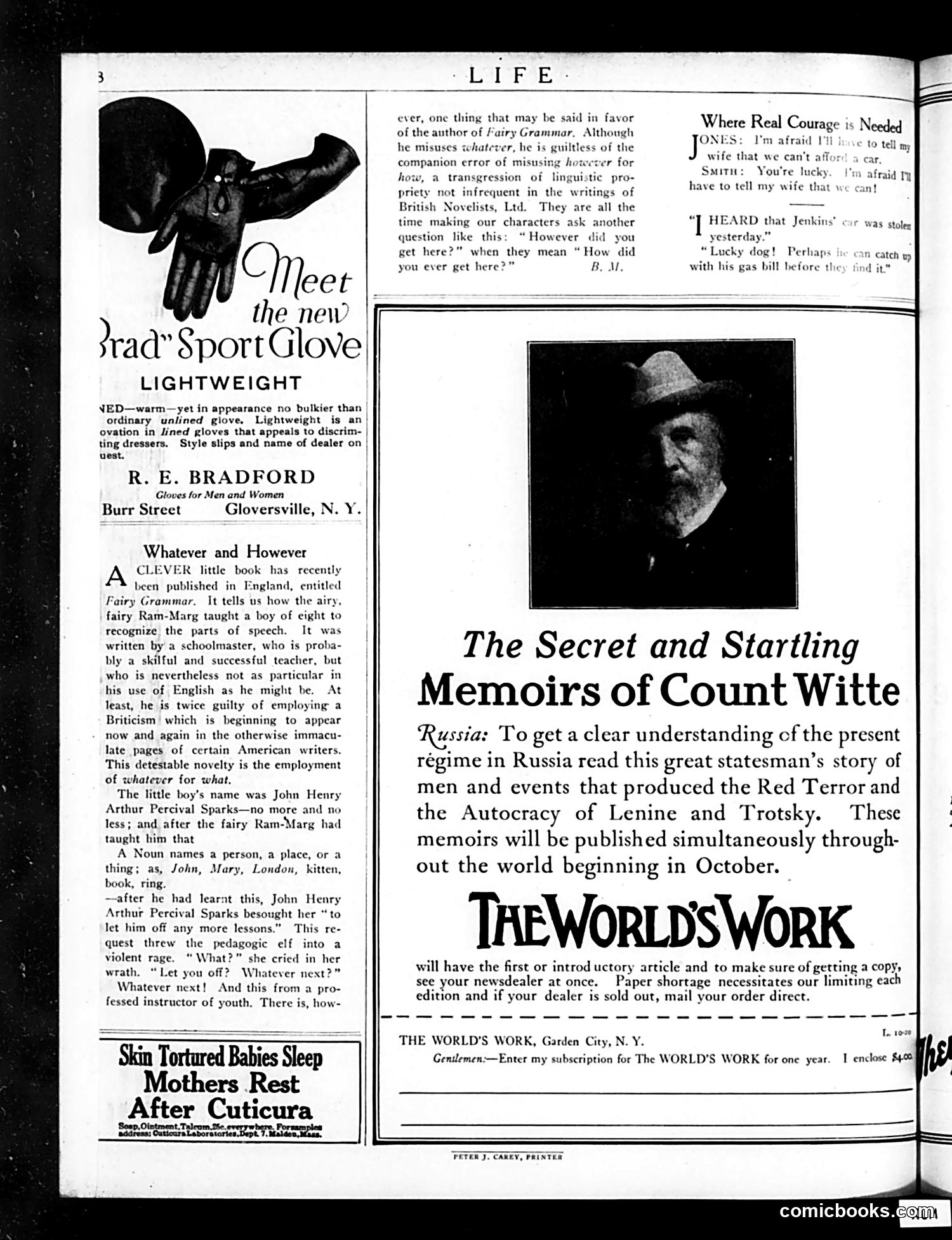
This page contains **primarily advertising and editorial content** rather than political cartoons. The main satirical element is a short article titled "Whatever and However," which mocks a British grammar book called *Fairy Grammar*. The piece ridicules both the book's author (a schoolmaster) and the broader problem of "Briticism" creeping into American writing. The satire targets the misuse of "whatever" and "however" in place of "what" and "how"—presented as an embarrassing linguistic error spreading from British novelists into American publications. The humor relies on depicting a fictional "fairy Ram-Marg" character punishing a student for questioning these grammar rules, suggesting the absurdity of defending such errors. The page also includes unrelated advertisements (Brad Sport Glove, Cuticura) and promotion for *The World's Work* magazine, advertising Count Witte's memoirs about Russian politics and the Bolshevik Revolution—timely content for the early 1920s.
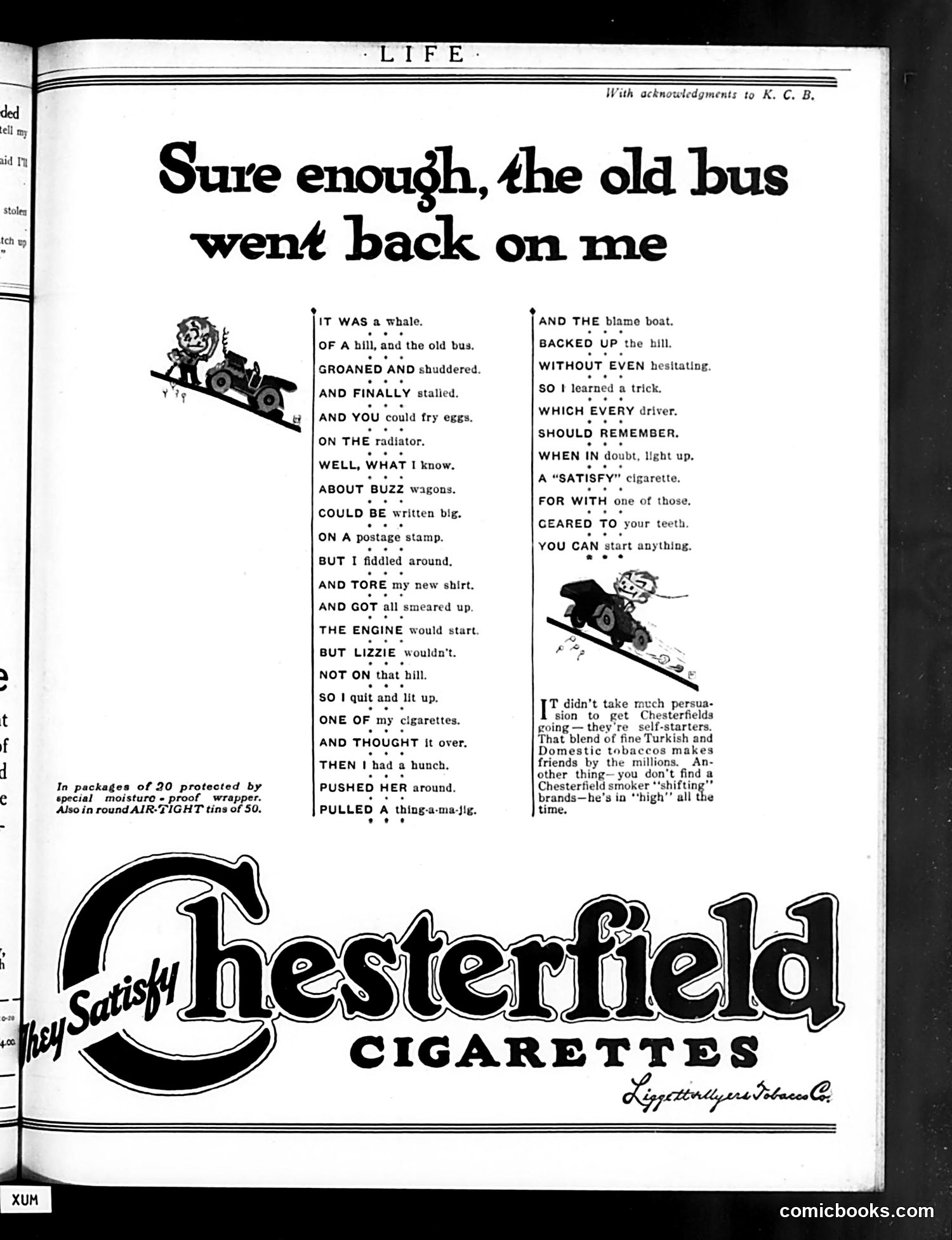
This is a **cigarette advertisement** disguised as humorous narrative content, a common advertising strategy in early 20th-century magazines. The story describes a man whose old car ("Lizzie," slang for Model T Ford) breaks down on a hill. Frustrated after trying mechanical fixes, he lights a Chesterfield cigarette, has a moment of clarity, tries a different approach, and the car starts. The "joke" is the punchline: smoking a cigarette somehow gave him the mental clarity to solve his problem. The ad then explicitly states the sales message—that Chesterfield smokers are confident, reliable, and "self-starters." **For modern readers:** This reflects an era when tobacco advertising could make absurd health/performance claims without restriction. The "mechanical breakdown solved by smoking" premise seems bizarre today, but the ad exploits common anxieties about automobiles (then new, unreliable technology) by suggesting cigarettes provide calm confidence in crisis. The illustrations show the protagonist struggling with the broken vehicle, then smoking triumphantly.
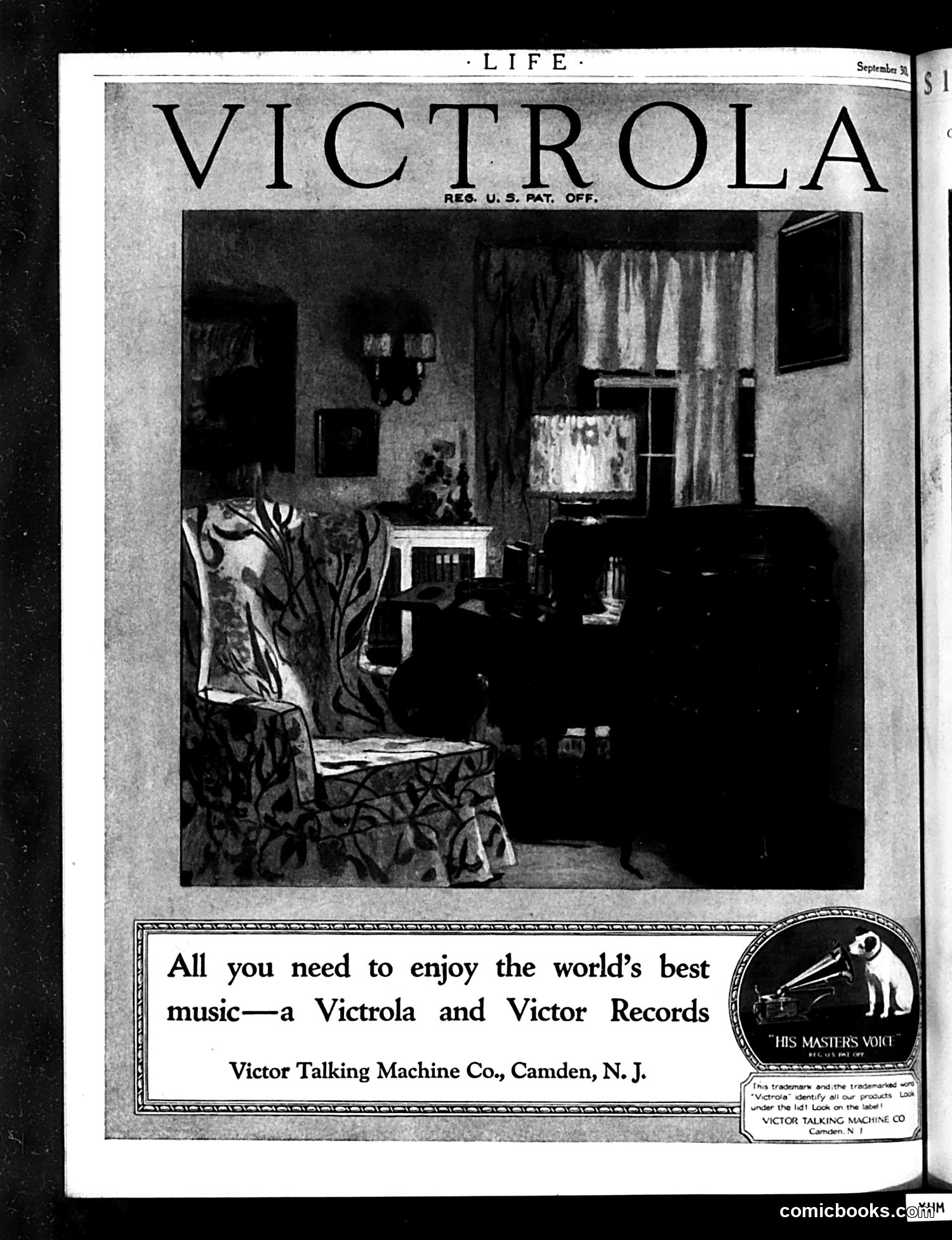
This is a **Victrola advertisement**, not a political cartoon. It shows an early 20th-century living room with a woman seated at a phonograph (the Victrola), positioned as a tasteful centerpiece of home entertainment. The ad's message is straightforward: owning a Victrola phonograph and Victor Records provides access to "the world's best music." The "His Master's Voice" dog logo (visible in the circular emblem) was Victor's trademark. For modern readers, this represents pre-radio domestic entertainment—when recorded music required mechanical playback devices. The elegant room staging suggests purchasing a Victrola conveyed sophistication and cultural refinement to middle-class consumers. This is essentially brand marketing positioning the product as essential to a cultured home.