
Life, 1920-09-30 · page 23 of 40
Life — September 30, 1920 — page 23: what you’re looking at
What you’re looking at
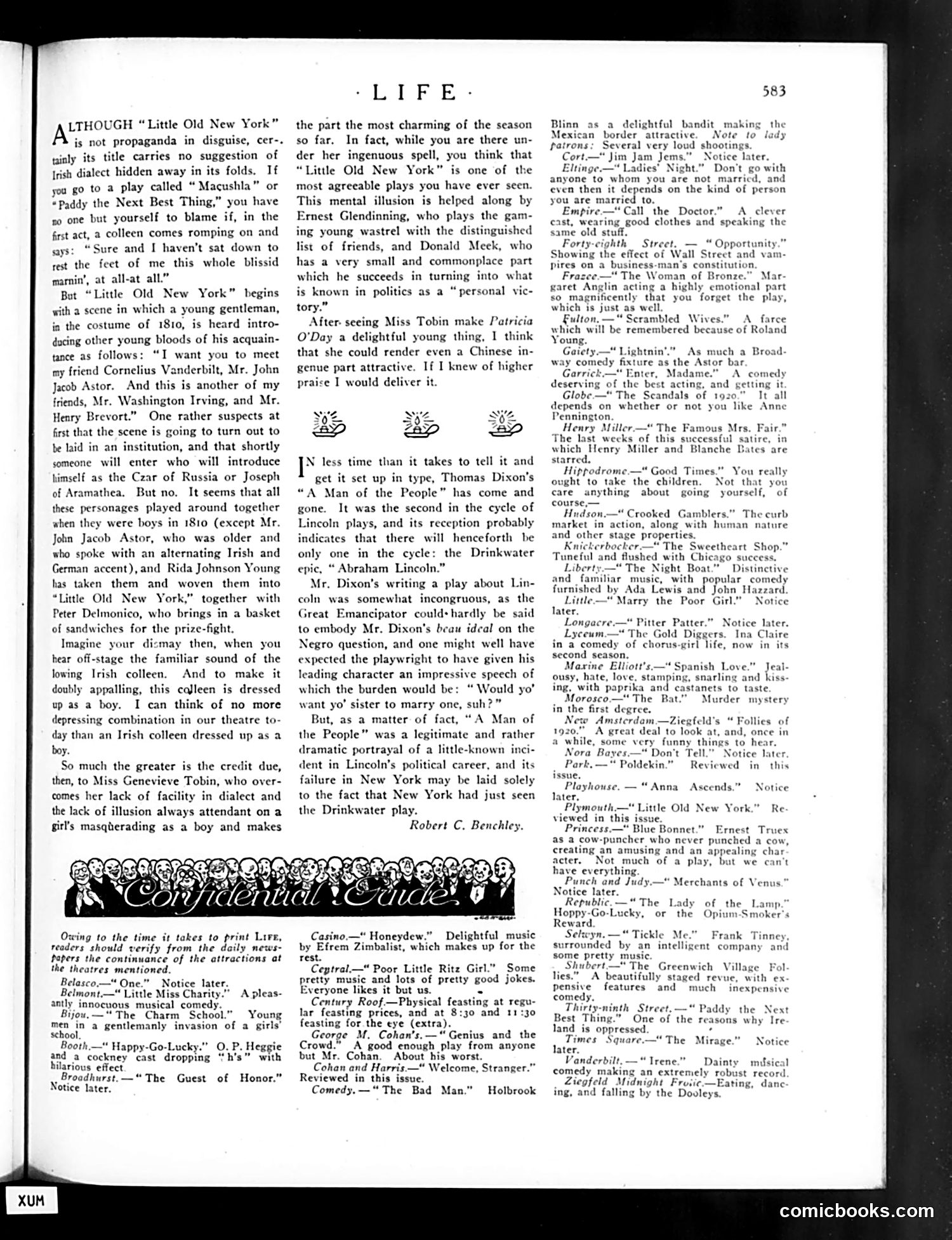
This page reviews Broadway plays from approximately 1919-1920. The main theater criticism discusses "Little Old New York," a play set in 1810 featuring historical figures like Cornelius Vanderbilt and John Jacob Astor as young friends. The reviewer praises actress Genevieve Tobin's performance as Patricia O'Day, a female character disguised as a boy. The critic notes this cross-dressing role could have been disastrous—particularly objectionable being "an Irish colleen dressed up as a boy," reflecting period prejudices against Irish stereotypes in theater. However, Tobin's talent overcomes these theatrical conventions and makes the production charming. The page also mentions Thomas Dixon's play "A Man of the People" about Lincoln, noting the incongruity of Dixon—known for pro-segregation views—writing about the "Great Emancipator." The remaining text lists other theatrical productions with brief notices.
📄 Transcribed text from this page (OCR, searchable)
Machine-transcribed from the original scan — historical spelling and the odd misread are preserved.
LTHOUGH “Little Old New York” is not propaganda in disguise, cer-. tainly its title carries no suggestion of Irish dialect hidden away in its folds. If you go to a play called “ Macushla” or «Paddy the Next Best Thing,” you have to one but yourself to blame if, in the first act, a colleen comes romping on and ays: “Sure and I haven't sat down to rest the feet of me this whole blissid marnin’, at all-at all.” But “Little Old New York” begins with a scene in which a young gentleman, in the costume of 1810, is heard intro- docing other young bloods of his acquain- tance as follows: “I want you to meet ny friend Cornelius Vanderbilt, Mr. John Jacob Astor. And this is another of my friends, Mr. Washington Irving, and Mr. Henry Brevort One rather suspects at first that the scene is going to turn out to be laid in an institution, and that shortly someone will enter who will introduce himself as the Czar of Russia or Joseph of Aramathea. But no. It seems that all these personages played around together when they were boys in 1810 (except Mr. John Jacob Astor, who was older and who spoke with an alternating Irish and German accent), and Rida Johnson Young has taken them and woven them into “Little Old New York,” together with Peter Delmonico, who brings in a basket of sandwiches for the prize-fight. Imagine your dismay then, when you hear off-stage the familiar sound of the lowing Irish colleen. And to make it doubly appalling, this colleen is dressed up as a boy. I can think of no more depressing combination in our theatre to- day than an Irish colleen dressed up as a boy. So much the greater is the credit due, then, to Miss Genevieve Tobin, who over- comes her lack of facility in dialect and the lack of illusion always attendant on a girl's masqherading as a boy and makes RN AY 19 to the time it takes to print Lire, readers should verify from the daily news- fapers the continuance of the attractions at the theatres mentioned. Belasco.—“ One.” Notice later. Belmont.— Little Miss Charity.” antly innocuous musical comedy. Bijou, —“ The Charm School.” Young men ina gentlemanly invasion of a girls’ school O.P. Heggie Apleas- Booth.—* Happy-Go-Luck: and a cockney cast dropping “h’s” with hilarious effect. Broadhurst. —“ The ; of Honor.” Notice later. Guest ES GEO TSS ST ONLGL * LIFE the part the most charming of the season so far. In fact, while you are there un- der her ingenuous spell, you think that “Little Old New York” is one of the most agreeable plays you have ever seen. This mental illusion is helped along by est Glendinning, who plays the gam- ing young wastrel with the distinguished list of friends, and Donald Meek, who has a very small and commonplace part which he succeeds in turning into what is known in politics as a “personal vic- tory.” After: seeing Miss Tobin make Patricia O'Day a delightful young thing, I think that she could render even a Chinese in- genue part attractive. If I knew of higher praise I would deliver it. iS 9 N less time than it takes to tell it and get it set up in type, Thomas Dixon's “A Man of the People” has come and gone. It was the second in the cycle of Lincoln plays, and its reception probably indicates that there will henceforth be only one in the cycle: the Drinkwater epic, “ Abraham Lincoln.” Mr. Dixon’s writing a play about Lin- coln was somewhat incongruous, as the Great Emancipator could+ hardly be said to embody Mr. Dixon's beau ideal on the Negro question, and one might well have expected the playwright to have given his leading character an impressive speech of which the burden would be: “ Would yo’ want yo’ sister to marry one, suh?” But, as a matter of fact, “A Man of the People” was a legitimate and rather dramatic portrayal of a little-known inci- dent in Lincoln's political career, and its failure in New York may be laid solely to the fact that New York had just seen the Drinkwater play. Robert C. Benchley. zap Ae CNL Casino,—" Honeydew Delightful, music by Efrem Zimbalist, which makes up for the rest. Ceytral.— Poor Little Ritz Girl.” Some pretty music and lots of pretty good jokes. Everyone likes it but us. Century Roof—Physical feasting at regu- lar feasting prices, and at 8:30 and tr: 130 feasting for the eye (extra). George M. Cohan’s.—“ Genius and the Crowd.” A good enough play from anyone but Mr. Cohan. About his worst. Cohan and Harris.—" Welcome, Stranger.” Reviewed in this issue. Comedy.—“ The Bad Man.” Holbrook 583 Blinn as a delightful bandit ing the Mexican border attractive. Note to lady patrons: Several very loud shootings Cort-—" Jia Jam Jems” Notice later. Eltinge.—" Ladies’ Night.” Don't go with anyone to whom you are not marricd, and even then it depends on the kind of person you are married to. Empire—" Call the Doctor.” A. clever cast, wearing good clothes and speaking the same old stuff. Forty-cighth Street. — “ Opportunity.” Showing the effect of Wall Street and vam- Pires on a business-man’s constitution —The Woman of Bronze.” Mar- glin acting a highly emotional part nificently that you forget the play, which is just as well Fulton, —“ Scrambled Wive farce which will be remembered because of Roluad puch a Broad- stor bar A ‘comedy ting it Tr all depends on whether or not you like Anne Pennington Henry Miller-—" The Famous Mrs, Fair.” The last weeks of this successful satire, in which Henry Miller and Blanehe Dates ‘are starred. Hippodrome—* Good Times.” You really ought to take the children. Not that yo care anything about going yourself, of course,— Hudson.—" Crooked Gamblers.” market in action, along with hu and other stage properties. Knickerbocker —" The Sweetheart Shop.” Tuneful and flushed with Chicago succe Liberty.—" The Night Boat.” Distinctive and familiar music, with popular comedy furnished by Ada Lewis and John Hazzard Little—" Marry the Poor Girl.” Notice later, Longacre. — Pitter Patter.” Notice later. Lyceum.— The Gold Diggers. Ina Claire in a comedy of chorus-girl life, now in its second season, Maxine Elliott's. panish Love.” J ousy, hate, love, stamping, snarling and kiss- ing, with paprika and castanets to taste Morosco— The Bat.” Murder in the first degree. New Amsterdam.—Ziegfeld’s “Follies of A great deal to look at, and, once in some very funny things to hear. —"Don't Tell.” Notice later Poldekin.” Reviewed in this The curb nan nature mystery a while, Playhouse. later, Plymouth—" Little Old New York.” Re viewed in this issue. Princess.—" Blue Bonnet.” Ernest Truex as a cow-puncher who never punched a cow, creating an amusing and an appealing char acter. Not much of a play, but we can't have everything Punch and Judy. Notice later. Republic. —“ The Lady of the Hoppy-Go-Lucky, or the Reward. Seloyn. —“ Tickle Me.” surrounded by an intell tty music. t—"The Greenwich Village Fol A beautifully staged revue, with ex- features and = much inexpensive —“Anna Ascends.” Notice Merchants of Venus.” Lamp.” Opium-Smoker's Frank Tinney pensive comedy. Thirty-ninth Street,—“ Paddy the Next One of the reasons why Ire land is oppressed. Times Square-—" The Mirage.” later. Vanderbilt. —“ Irene.” Dainty musical comedy making an extremely robust record _ Ziegfeld Midnight Froiie-—Eating, danc ing, and falling by the Dooleys. Notice comicbooks.com